Over recent decades the interest in positive youth development has increase substantially and some researchers have shifted their focus towards asset based (instead of pathogenic) models of health focusing on positive outcomes. New perspectives and concepts in psychology, such as positive psychology and resilience, have contributed greatly to this shift. In addition further development in the conceptualization of mental health away from traditional mental illness orientations are helpful in progressing the positive health field. Constructs, such as subjective well-being, life satisfaction and quality of life provide examples of how these developments have manifest themselves in research (Masten, Reference Masten, Glantz and Johnson1999; Moore, Lippman, & Brown, Reference Moore, Lippman and Brown2004; Morgan et al., Reference Morgan, Vera, Gonzales, Conner, Vacek and Coyle2011; Park, Reference Park2004).
Subjective well-being and its predictors
Subjective well-being arises from a person perception that their life is desirable, pleasant, and good. Three important characteristics of well-being emerge in this context: it is subjective; includes positive measures; typically include a global assessment of all aspects of a person’s life (Diener, Reference Diener2009). Several authors argue that it plays an important role in adolescent positive development (Matos, Simões, Batista-Foguet, & Cottaux, Reference Matos, Simões, Batista-Foguet and Cottaux2010; Park, Reference Park2004; Simões, Matos, & Batista-Foguet, Reference Simões, Matos, Batista-Foguet and Simons-Morton2014). The predictors of subjective well-being fall into four categories: demographics, personality/dispositional characteristics, acquisition of skills, and environmental variables. In each category it is possible to identify both positive and negative predictors of well-being. One such indicator is life events. The impact of negative life events has obvious links with mental health problems (Edward, Reference Edward2005; Hjemdal, Aune, Reinfjell, Stiles, & Friborg, Reference Hjemdal, Aune, Reinfjell, Stiles and Friborg2007; Oatley & Bolton, Reference Oatley and Bolton1985; Sandberg, Rutter, Pickles, McGuinness, & Angold, Reference Sandberg, Rutter, Pickles, McGuinness and Angold2001). However, research has also shown significant and consistent, although modest associations with well-being (Diener, Reference Diener2009). In this field it is important to emphasize the cumulative nature of risk, or in this case stressful events, and its consequences on well-being and mental health. The fact that the number of risk factors is a key feature for the understanding of maladjustment problems was raised by Rutter who found that the combination of four risk factors quadruplicates the likelihood of maladjustment, comparatively with the combination of three risk factors (Rutter, Reference Rutter, Kent and Rolf1979). This hypothesis, known has cumulative risk, emphasize to a large extent the quantitative aspects of risk as the crucial question comparatively to the qualitative aspects of risk (Daeater-Deckard, Dodge, Bates, & Pettit, Reference Daeater-Deckard, Dodge, Bates and Pettit1998; Forehand, Biggar, & Kotchick, Reference Forehand, Biggar and Kotchick1998; Simões, Matos, Tomé, & Ferreira, Reference Simões, Matos, Tomé and Ferreira2008).
Moderators of the impact of negative life events on well-being
An early review conducted by Johnson (Reference Johnson1986) found that life stress in children and adolescents was significantly related to anxiety, depression, low levels of self-esteem, delinquent behavior and poor school performance. Although, when other variables, (e.g. social support, behavioral style), were assessed, the results indicated that stressful events are related to adjustment problems in some cases, but not in others. Johnson (Reference Johnson1986) therefore reinforced the need to ensure that potential moderator variables are included in research to better understand the pathways to outcomes of interest. This approach has been taken in resilience research which embraces the need to understand how to minimize risk and increase protective factors. Resilience can be defined as an interactive phenomenon or process reflecting relatively good outcomes despite serious experiences of stress or trauma (Luthar, Reference Luthar2003). According to Benard (2004, p. 14), “personal resilience strengths are individual characteristics, also called internal assets or personal competencies, associated with healthy development and life success”. The internal assets analyzed in these framework are: cooperation and communication, empathy, problem solving, self-efficacy, self-awareness and goals and aspirations (Hanson & Kim, Reference Hanson and Kim2007). Cooperation and communication competences are associated with flexibility in relationships, work team skills and assertiveness in the expression of emotions, feelings, ideas and needs (Austin & Kilbert, Reference Austin and Kilbert2000). These skills promote interpersonal connection and relationship building (Benard, Reference Benard2004) that are important protective factors for well-being. Moreover, Pennebacker (1997, cit. in Tardy & Dindia, Reference Tardy, Dindia and Hargie2006) have demonstrated that talk or write about traumatic life events has a positive impact in subjective well-being. Empathy, the ability to understand other feelings and perspectives, is viewed as an important aspect in the area of interpersonal functioning (Fitness & Curtis, Reference Fitness and Curtis2005) and well-being (Wei, Liao, Ku, & Shaffer, Reference Wei, Liao, Ku and Shaffer2011). Wei and collaborators refer that a possible mechanism for these relations can be the fact that when people are empathetic to others, they feel the gratefulness of others, they may feel that are they doing something good for others and more connected to others, and this way experience positive feelings. Several authors also associate empathy to resilience (Benard, Reference Benard2004; Grotberg, Reference Grotberg1997; Kumpfer, 1999; Parker, Cowen, Work, & Wyman, Reference Parker, Cowen, Work and Wyman1990). As Benard (Reference Benard2004) mention “empathy not only helps facilitate relationships development, it also form the basis of morality, forgiveness, and compassion and caring for others” (p.15). Problem solving entails the ability to plan, critical think, reflect and evaluate different solutions before taking a decision or go for an action (Austin & Kilbert, Reference Austin and Kilbert2000). Several studies show that these abilities are present in resilient children and adolescents (Munist et al., Reference Munist, Santos, Kotliarenco, Ojeda, Infante and Grotberg1998). Problem solving skills seem to have a fundamental role in risk and resources evaluation, in the search for healthy environments or relations, as well as in the development of realist plans that are key aspects for adaptation and resilience (Werner & Smith, Reference Werner and Smith2001). Self-efficacy reflects the judgment of an individual’s ability to accomplish a certain level of performance (Bandura, Reference Bandura1999). According to Bandura, efficacy beliefs are important foundations of human action. These beliefs affect adjustment not only through their direct impact on outcomes, but also because they influence other outcomes determinants. Like problem solving skills, “efficacy beliefs also play a key role in shaping the courses lives take by influencing the types of activities and environments people choose to get into” (Bandura, Reference Bandura1999). As so, self-efficacy play also an important role on adaptation to negative life events (Boehmer, Reference Boehmer2007) and in resilience processes (Rutter, Reference Rutter1987; Taggart, Taylor, & McCrum-Gardner, Reference Taggart, Taylor and McCrum-Gardner2010). Self-awareness refers to the capacity to become the object of one’s own attention (Morin, Reference Morin2006). Greater levels of self-awareness were found to be associated to lower levels of depressive symptoms (Tandon & Solomon, Reference Tandon and Solomon2009) and to well-being (Yalcin, Karahan, Ozcelik, & Igde, Reference Yalcin, Karahan, Ozcelik and Igde2008). Finally, goals and aspirations and other future oriented strengths are associated to positive outcomes in health and school context in adolescence (Benard, Reference Benard2004). Future goals help to delay immediate gratification (Munist et al., Reference Munist, Santos, Kotliarenco, Ojeda, Infante and Grotberg1998) and the pursuing of attaining self-concordant goals are associated to a better global mood and well-being (Sheldon & Kasser, Reference Sheldon and Kasser2001). Having goals and aspirations is a determinant aspect in active construction of our own lives, that means be an agent (Bandura, Reference Bandura1999; Stein & Newcomb, Reference Stein and Newcomb1999). As Bandura (2001, p. 2) points “the core features of agency enable people to play a part in their self-development, adaptation and self-renewal with changing times.
The vulnerability of adolescents with special needs
Different life stages may predispose our ability to maintain levels of well-being. However adolescents appear to be particularly vulnerable to risks that can compromise their well-being. Many authors have highlighted (Jessor, Reference Jessor and Jessor1998; Matos & Sampaio, Reference Matos and Sampaio2009; Park, Reference Park2004; Simões, Reference Simões2007; Topolski et al., Reference Topolski, Patrick, Edwards, Huebner, Connell and Mount2001) that adolescents are at risk of peer pressure, substance use problems, violence, academic failure, and mental disorders. Some adolescents, like adolescents with special educational needs, can be especially vulnerable to these risks and consequences (Matos & Equipa do Projecto Aventura Social, 2003; Simões, Matos, Tomé, et al., Reference Simões, Matos, Ferreira, Tomé and Diniz2009; Taggart et al., Reference Taggart, Taylor and McCrum-Gardner2010). As a consequence, besides normative risks, experiences and turning points, these individuals experience also disability-related risks and experiences (Katims, Zapata, & Yin, Reference Katims, Zapata and Yin1996; King et al., Reference King, Cathers, Brown, Specht, Willoughby, Polgar and Havens2003) that increases the likelihood of negative outcomes. Simões, Matos, Ferreira et al. (Reference Simões, Matos, Ferreira, Tomé and Diniz2009), in a study of adolescents with special educational needs, highlight that they more frequently suffer negative life events, compared to their mainstream peers, such as, more frequent victims of bullying (9.8% adolescents with special educational needs; 4.3% adolescents without special educational needs) or being rejected by classmates (12.1% adolescents with special educational needs; 4.7% adolescents without special educational needs). They also are more likely to perceive their school performance to be lower than average (26.2% adolescents with special educational needs; 19.7% adolescents without special educational needs), feel more pressed to do homework (15.6% adolescents with special educational needs; 10.9% adolescents without special educational needs), feel more frequently unhappy (20.7% adolescents with special educational needs; 13.2% adolescents without special educational needs), lonelier (10.6% adolescents with special educational needs; 6.6% adolescents without special educational needs) and sadder (12.7% adolescents with special educational needs; 8.3% adolescents without special educational needs; Simões, Matos, Ferreira, & Tomé, Reference Simões, Matos, Ferreira and Tomé2010; Simões, Matos, Tomé et al., Reference Simões, Matos, Ferreira, Tomé and Diniz2009). More recently Taggart et al. (Reference Taggart, Taylor and McCrum-Gardner2010) found that adolescents with behavioral/emotional problems were more likely to experience a variety of negative life events comparatively to their peers without these kind of health issues (e.g. have been in contact with the police, have been bullied, have experienced community/sectarian issues, have had parents involved in a court appearance, had both parents unemployed, experienced issues of parental mental health and/or substance abuse). Furthermore, Mitchell and Hauser-Cram (Reference Mitchell and Hauser-Cram2009) refer that adverse negative life events in family context predicts externalizing and internalizing problems in young children with developmental delays. McBride and Siegel (Reference McBride and Siegel1997) suggest that learning disabilities can also be a risk factor in adolescent suicide. According to these authors, some issues associated to learning disabilities, namely poor problem solving and social skills, can lead these adolescents to experience many negative life events and impair then to cope successfully with these events. To overcome all the challenges and risks that adolescence poses and maintain good levels of well-being, adolescents with special needs have to be resilient and possess internal assets that help them to cope with life events (Simões, Matos, Ferreira et al., Reference Simões, Matos, Ferreira, Tomé and Diniz2009; Taggart et al., Reference Taggart, Taylor and McCrum-Gardner2010).
This study intend to investigate the “relative resilience” of adolescents who already have special needs, that poses to them several challenges, when confronted to further negative life events, that is, their capacity to withstand with resilience when confronted with significant levels of adversity. More specifically, this study aims to contribute to a further understanding of how protective factors can promote the well-being of adolescents with special needs by: a) verifying the most common negative life events experienced by this group; b) analyzing the relationship between negative life events and well-being; c) analyzing the relationship between negative life events and internal assets (cooperation and communication, empathy, problem solving, self-efficacy, self-awareness and goals and aspirations); d) assessing whether internal assets can act as moderators between negative life events and global well-being.
Method
Sample
Sample consists of 472 pupils, adolescents with special needs, 58.7% boys and 41.3% girls, aged 10 to 18 years old (M = 14.09; SD = 1.84). Pupils were from 77 public schools, 50.3% and were attending 6th grade, 35.5%, 8th grade and 14.2%, 10th grade. About half of the sample referred that had an health problem that inhibits them to do things that their peers do (48.7%). From these, 8.3% refer a chronic disease, 9.2% a physical disability, 6.3% a visual disability, 5.4% a hearing disability, 10.0% a language or speech disability, 25.1% learning disabilities, and 10.1% other disabilities (not mentioned). Most pupils had Portuguese nationality (95.7%) and have working parents, either father (76.2%), or mother (60.5%).
The survey
The questionnaire used in this study was the “Risk and resilience in adolescence survey” (Simões, Matos, Tomé, et al., Reference Simões, Matos, Ferreira, Tomé and Diniz2009). This questionnaire includes, besides socio-demographic questions, a set on HBSC/WHO questions regarding life styles (Currie, Smith, Boyce, & Smith, Reference Currie, Smith, Boyce and Smith2001; Matos et al., Reference Matos, Simões, Tomé, Gaspar, Camacho and Diniz2006), and a set of questions related with Resilience, Life events and Global well-being (Simões, Matos, Tomé, et al., Reference Simões, Matos, Ferreira, Tomé and Diniz2009).
For the purpose of this study, the following instruments were used:
Life Events Checklist ( Johnson, 1986 )
Forty-one life events list and four open questions (e.g. moving to a new home, death of close friend, failing a grade). For each event, adolescents indicate: (a) if they have experienced the event in past year; (b) whether they viewed as a good or a bad event; (c) the effect or impact in ones’ life (1- None; 4-A lot).
Resilience – California Healthy Kids Program Office ( CHKS, 2000 )
Eighteen items referring to six Internal assets (3 items per assets; 1-Never; 5-Always): cooperation and communication (e.g. “I enjoy working together with other students my age”); empathy (e.g. “I try to understand what other people feel and think”); problem solving (e.g. “I know where to go for help with a problem”); self-efficacy (e.g. “There are many things I do well”); self-awareness (e.g. “I understand why I do what I do”); goals and aspirations (e.g. “I have goals and plans for the future”).
Global Well-being (Kidscreen 10- Gaspar & Matos, 2008 )
Ten items (1-Never; 5-Always) referring to well-being in main life areas (e.g. “Feel good and in shape”; “Have enough time for your own”; “Perform well on school”).
Procedures
Sample was collected within the HBSC/WHO Portuguese health survey (Matos, et al., Reference Matos, Simões, Tomé, Gaspar, Camacho and Diniz2006; Simões, Matos, Tomé, et al., Reference Simões, Matos, Ferreira, Tomé and Diniz2009). From a national official list of schools from the whole country, 143 public schools were selected at random. Detailed sampling and data collection procedures were presented elsewhere (Currie et al., Reference Currie, Smith, Boyce and Smith2001; Matos et al., Reference Matos, Simões, Tomé, Gaspar, Camacho and Diniz2006). During the HBSC data collection procedure, a letter was sent to all the selected schools asking for a special collaboration in order to extend this survey to adolescents with special needs. Those would answer to a special questionnaire, after answering an adapted and reduced version of the HBSC survey, concerning health related behaviors. Response rate for schools was 54%.
Analysis
PAWS Statistics 18 was used in data analysis. Reliability analyses were conducted with the items of each Internal Assets subscale and Well-Being scale. After the reliability analysis, the items of each scale/subscales were summed to obtain the six internal assets subscales and the global well-being scale. The Negative Life Events Scale was obtained by selecting the negative events that had been experienced in past year from the life events checklist. Each event, selected as bad event, was multiplied by its impact or effect. After this operation all these scores were summed to obtain the Negative Life Events Scale.
Analysis of variance was chosen to analyze the impact of Negative Life Events on Global Well-being and impact of Negative Life Events on Internal Assets (One-way between-groups analysis of variance) and the moderation effect of internal assets (Two-way between-groups analysis of variance). To run these analyses it was assured that the main assumptions of analysis of variance were met (dependent variable measured at continuous level; random sampling as mentioned in the previous section; independence of observations, i.e. national large sample, stratified by regions, of the Portuguese adolescents with SEN in mainstream). The homogeneity of variances was also tested. When the Levene’s test for homogeneity of variances was significant, Robust test (Brown-Forsythe test) was used, in one-way ANOVA, and a more stringent significance level for main effects and interaction effects (i.e. .01) was set in the two-way ANOVA analysis. The assumption of normal distribution of dependent variable for each combination of the groups of the independent variables wasn’t verified for all the groups, nevertheless it is also known that ANOVA is quite “robust or tolerant” to violations of normality (Pallant, Reference Pallant2007).
To run the moderation analysis (Two-way ANOVA), the six Internal Assets subscales were categorized in three categories. The scores of each Internal Assets subscales were divided into three equal groups (low, medium and high scores) through visual binning in SPSS (2 cutpoints, equal percentiles based in scanned cases). The Negative Life Events Scale was also categorized into three groups. The criterion for the categorization was theoretical, namely the cumulative risk effect mentioned above. The first group was composed by the subjects that refer no negative events in the past year (score 0); the second group include the subjects that refer few negative life events with significant impact their life’s Footnote 1 (score 1 to 12); the third group included the subjects that refer several negative life events in past year (score above 12).
The missing data for the scales included in the analysis ranged from 11% (for problem solving scale) to 16% (for self-awareness).
Results
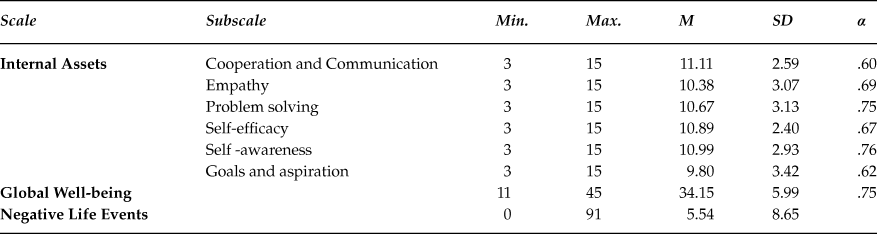
Cronbach Alpha for each of the six sub-scales of the Internal Assets ranged from .60 (cooperation and communication sub-scale), to .76 (self-awareness sub-scale). The Global Well-being scale (Kidscreen 10) had a Cronbach Alpha of .75 (after elimination of the item “your parents treat you fairly”), and was therefore from then on including 9 items. Psychometric properties of these scales (including Confirmatory Factorial Analysis of Global Well-being scale) were deeply reported elsewhere (Matos, Gaspar, & Simões, Reference Matos, Gaspar and Simões2012; Simões, Matos, Tomé, et al., Reference Simões, Matos, Ferreira, Tomé and Diniz2009). For the internal assets subscales, a confirmatory factorial analysis was performed in order to confirm its structure (first order model). The analysis showed good fit indices (CFI & NNFI >.95; RMSEA & SRMR <.05) with all factors loadings above .55. Table 1 presents descriptive statistics for the Internal Assets subscales, Global Well-being and Negative Life Events scales.
Mean values, Standard Deviations, Maximum and Minimum values and Cronbach Alpha of Internal Assets Subscales, Global Well-being and Negative Life Events Scales

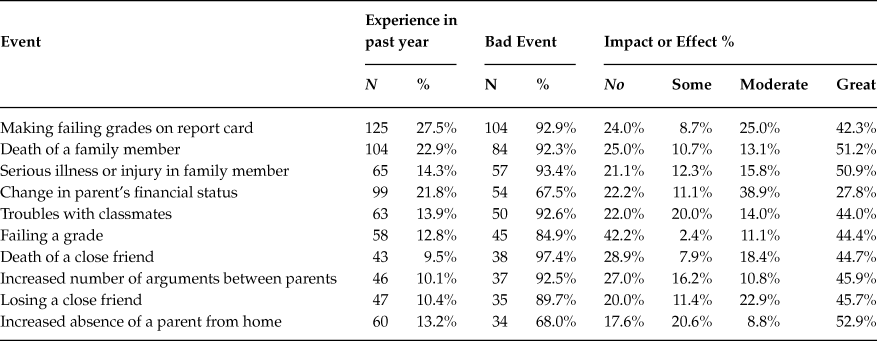
Negative life events referred by adolescents with special needs
Table 2 present the ten most referred negative life events. In these groups of events there are family related events, school related events and friends related events. As it is possible to see these events are qualified by the majority of the adolescents as bad events. Nevertheless, about one third of the adolescents hadn’t qualified the “Change in parent’s financial status” and “increased absence of a parent from home” as negative. The life event most referred by the adolescents with special needs was “making failing grades on report card”, reported by 27.5% of the adolescents and by 92.9% of these as a negative event. This event was followed by “death of a family member” that occur in 22.9% of the cases and “serious illness or injury in family member, in 14.3% of the cases. The percentage of adolescents that referred a great impact of these events on their lives is above 40%. An exception is made in “change in parent’s financial status” that only about one quarter (27.8%) had mentioned as having a great effect. On the opposite side, the percentage of adolescents that referred that these events had no effect in their lives was below 30%. Again, an exception was made in the case of “failing a grade” that was referred by 42.2% as having no effect in their lives.
Frequencies and percentages of negative life events and its impact

Relationship between Negative Life Events (NLE) and Global Well-being (GWB)
A one-way between-groups analysis of variance was conducted to explore the impact of Negative Life Events (NLE) on levels of Global Well-being (GWB), as measured by the Global Well-being scale. As mentioned before, subjects were divided into three groups according to the number of NLE that had occurred in the last year. The robust test of equality of means was used since the test of homogeneity of variances was significant. The Brown-Forsythe test indicated a statistically significant difference at the p < .05 for the three NLE groups: F(2, 407) = 4.70, p = .03. Despite reaching statistical significance, the effect size, calculated using eta squared, was .02. Post-hoc comparisons using the Dunnett T3 test indicated that mean scores for the group with no NLE (M = 34.07; SD = 5.80) and the group with few NLE (M = 34.72; SD = 5.57) were significantly different from group with several NLE (M = 31.90; SD = 7.59). The group with no NLE did not differ significantly from the group with few NLE.
Relationship between Negative Life Events (NLE) and Internal Assets
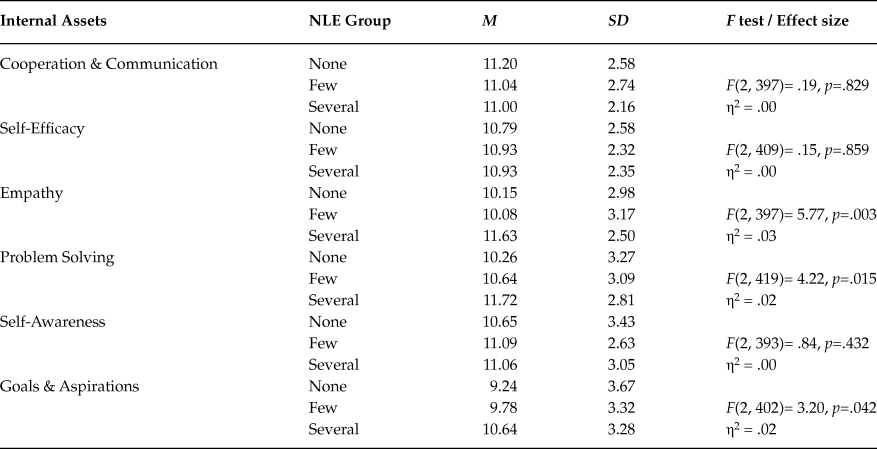
To analyze the impact of NLE on Internal Assets (Cooperation and Communication, Self-Awareness, Goals and Aspirations, Empathy, Problem Solving and Self-Efficacy) a one-way between-groups analysis of variance was conducted. The robust test of equality of means was used for self-awareness since the test of homogeneity of variances was significant. Table 3 presents descriptive data, F test and effect sizes for the six internal assets. As it is possible to see, there are significant differences in empathy, problem solving and goals and aspirations levels in the different negative life events groups, being the adolescents with negative life events the ones who present higher levels of these assets. Post-hoc comparisons using Tukey HSD test indicated that empathy mean score for the group with several NLE were significantly higher comparatively with the groups with few and without NLE, while for problem solving and goals and aspirations mean scores, the differences were only between the group with several NLE and the group without NLE (significantly higher for the group with several NLE comparatively with the group without NLE). The group with few NLE doesn’t differ from the other two groups for problem solving and goals and aspiration mean scores. Despite reaching statistical significance, the effect size, calculated using eta squared, was very small.
Mean values, Standard Deviations, F test and effect sizes for the six internal assets within each Negative Life Event group

Internal Assets moderating the relationship between Negative life events (NLE) and Global Well-being (GWB)
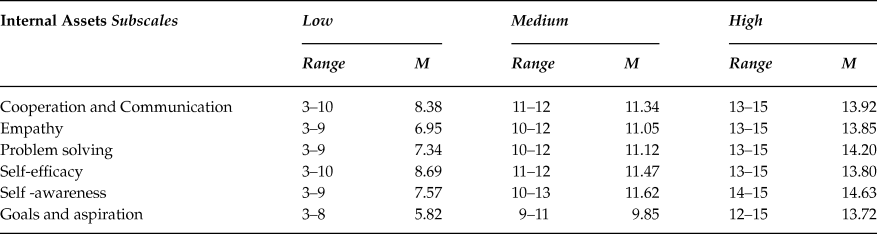
Despite the small effect size obtained in the previous analysis, a set of two-way between-groups analysis of variance were conducted to explore the moderate effect of each of the six Internal Assets (Cooperation and Communication, Self-Awareness, Goals and Aspirations, Empathy, Problem Solving and Self-Efficacy) on the relation between NLE and GWB. As mentioned above, each Internal Asset subject was divided into three groups according to their scores (low, medium, high) (see Table 4 for ranges and means of each group).
Internal assets subscales: Ranges and means (M) for the low, medium and high groups

In the first analysis it was intended to explore the moderating effect of Communication and Cooperation in the relationship between NLE and GWB. There was a statistically significant main effect for Cooperation and Communication, F(2, 364) = 12.11, p < .001. The effect size for Cooperation and Communication was medium (partial eta square = .06). Post-hoc comparisons using Tukey HSD test indicated that the mean score for the group with low levels of Cooperation and Communication skills (M = 32.37; SD = 5.84) was significantly different from the medium (M = 34.68; SD = 5.29) and high levels Cooperation and Communication skills groups (M = 35.91; SD = 6.19). The group with medium and high levels of Cooperation and Communication skills did not differ significantly from each other. The main effect for NLE was also significant, F(2, 364) = 6.69, p = .001; however the effect size for NLE was small (partial eta square = .04). Post-hoc comparisons indicated that the mean score for the group with several negative life events (M = 31.26; SD = 7.53) was significantly different from the group with few (M = 34.80; SD = 5.47) and the group without NLE (M = 34.51; SD = 5.81). The groups with few and without NLE did not differ significantly from each other. The interaction effect between Cooperation and Communication and NLE was not statistically significant, F(4, 364) = 1.58, p = .180.
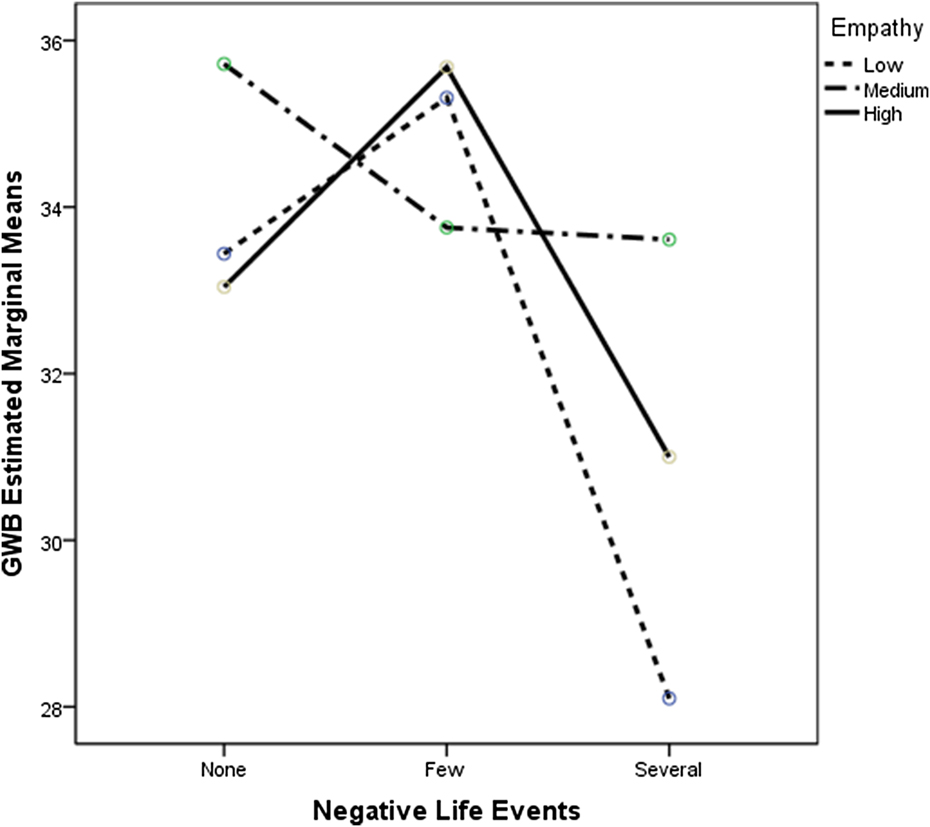
In the second analysis it was intended to explore the moderating effect of Empathy in the relationship between NLE and GWB. The main effect of Empathy, F(2, 367) = 2.60, p = .076, did not reach statistical significance. The main effect for NLE was significant, F(2, 367) = 8.63, p < .001. The effect size for NLE was small (partial eta square = .05). Post-hoc comparisons indicated that the mean score for the group with several NLE (M = 31.37; SD = 7.49) was significantly different from the group with few (M = 34.85; SD = 5.46) and the group without NLE groups (M = 34.14; SD = 5.79). The group with few and without NLE did not differ significantly from each other. The interaction effect between Empathy and NLE was statistically significant, F(4, 367) = 3.58, p = .007. The effect size for this interaction, calculated using eta squared, was .04. Additional analyses to explore this relation were conducted. The sample was split into three groups, corresponding each group to a different level of the Empathy variable, and separated one-way ANOVAs were conducted. In the low levels of Empathy group there was a statistically significant difference at the p < .001 for the three NLE groups: F(2, 139) = 9.65, p < .001. The effect size, calculated using eta squared, was .12. Post-hoc comparisons using the Tukey HSD test indicated that mean score for several NLE group (M = 28.10; SD = 5.82) was significantly different from the few (M = 35.31; SD = 5.21) and the no NLE groups (M = 33.44; SD = 4.73). The group with few NLE did not differ significantly from the group without NLE. In the medium levels of Empathy group the effect of NLE was not significant F(2, 129) = 1.77, p =.174. In the high levels of Empathy group there was a statistically significant difference at the p < .05 for the three NLE groups: F(2, 96) = 3.61, p = .031. The effect size, calculated using eta squared, was .07. Post-hoc comparisons using the Tukey HSD test indicated that the mean score for several NLE group (M = 31.00; SD = 8.36) was significantly different from the few NLE groups (M = 35.68; SD = 6.10). The group without NLE (M = 33.04; SD = 7.54) did not differ significantly from few and several NLE group. Figure 1 illustrates the moderation effect of Empathy in the relation between NLE and GWB.
Analysis of the relationship between Negative life events, Global well-being and Empathy.

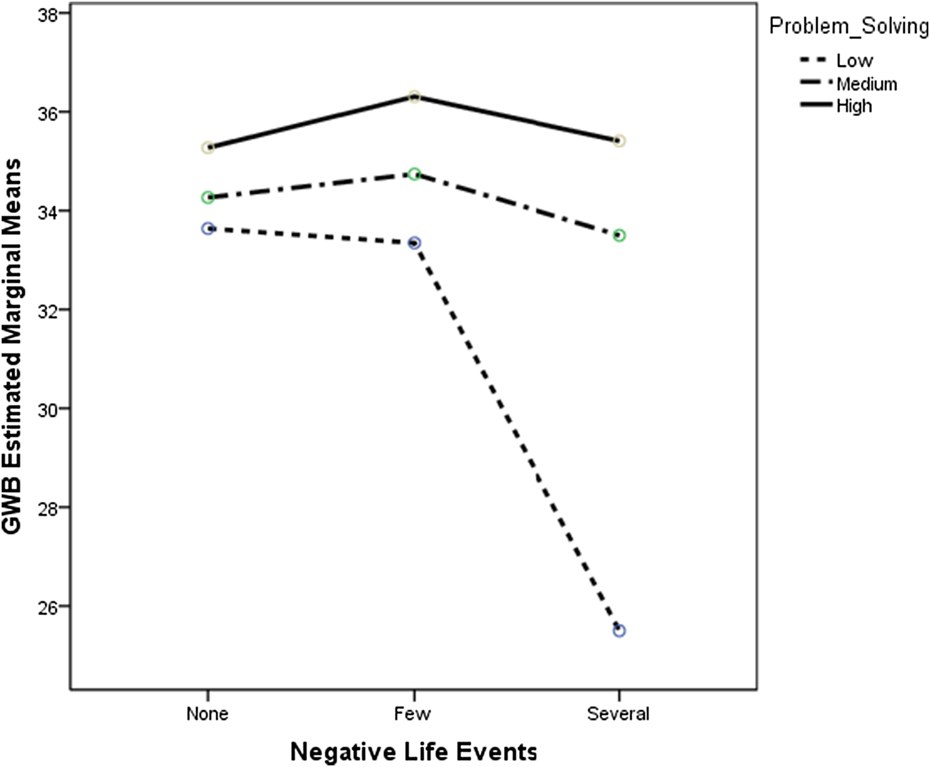
The third analysis was conducted to explore the moderating effect of Problem Solving in the relationship between NLE and GWB. There was a statistically significant main effect for Problem Solving, F(2, 383) = 17.37, p <.001. The effect size for Problem Solving was medium (partial eta square = .09). Post-hoc comparisons using Tukey HSD test indicated that the mean scores for the group with low levels of Problem Solving (M = 32.71; SD = 6.18) was significantly different from the groups with medium levels Problem Solving (M = 34.48; SD = 5.46) and high level Problem Solving (M = 35.85; SD = 5.72). The group with medium levels of Problem Solving group did not differ significantly from the high levels of Problem Solving group. The main effect for NLE was also significant, F(2, 383) = 6.41, p = .002. The effect size for NLE was small (partial eta square = .03). Post-hoc comparisons indicated that the mean score for the group with several NLE (M = 32.04; SD = 7.66) was significantly different from the group with few NLE groups (M = 34.70; SD = 5.57). The group without NLE (M = 34.24; SD = 5.70) did not differ significantly from the few and several NLE. The interaction effect between Problem Solving and NLE was statistically significant, F(4, 383) = 3.79, p = .005. The effect size for this interaction was .04. Additional analyses to explore this relation were conducted. The sample was split into three groups corresponding each group to a different level of the Problem Solving variable and separated one-way ANOVAs were conducted. In the low levels of Problem Solving group there was a statistically significant difference at the p < .001 for the three NLE groups: F(2, 146) = 12.21, p < .001. The effect size, calculated using eta squared, was .15. Post-hoc comparisons using the Tukey HSD test indicated that mean scores for several NLE group (M = 25.50; SD = 7.82) was significantly different from the few (M = 33.35; SD = 5.77) and the no NLE groups (M = 33.64; SD = 5.15). The few NLE group did not differ significantly from the group without NLE. In the medium levels of Problem Solving group the effect of NLE was not significant F(2, 118) = .30, p = .742 as well as in the high levels of Problem Solving F(2, 116) = .43, p = .654. Figure 2 illustrates the moderation effect of Problem Solving in the relation between NLE and GWB.
Analysis of the relationship between Negative life events, Global well-being and Problem Solving.

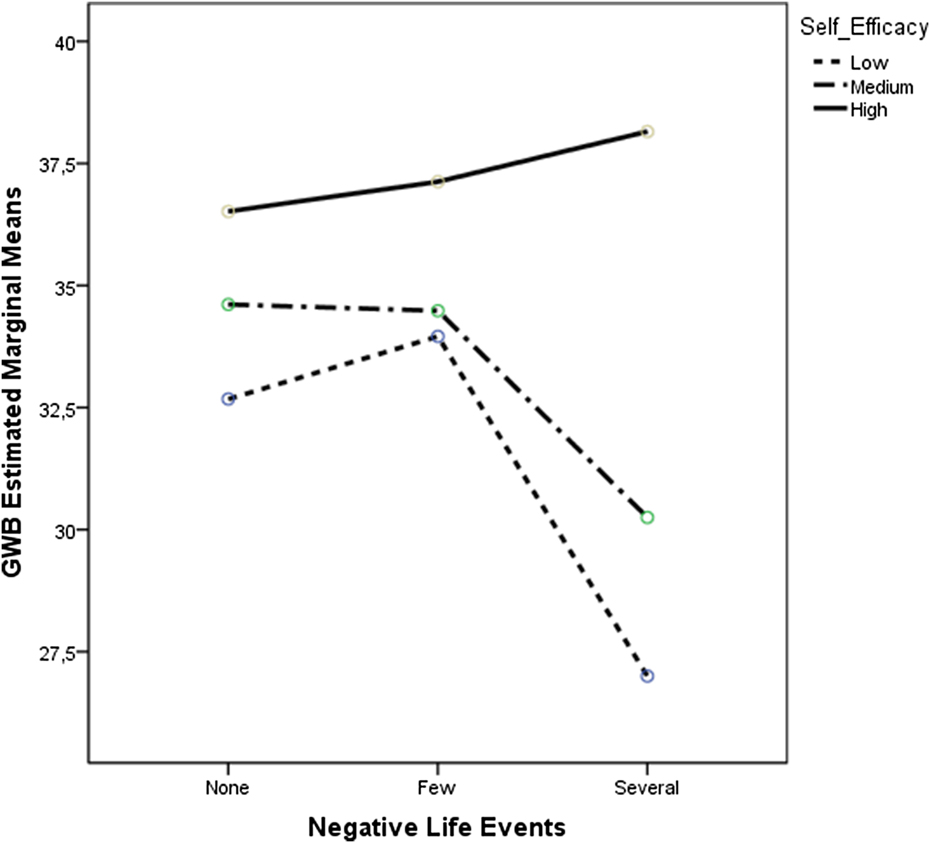
The fourth analysis was conducted to explore the moderating effect of Self-Efficacy in the relationship between NLE and GWB. There was a statistically significant main effect for Self-Efficacy, F(2, 377) = 24.33, p < .001. The effect size for Self-Efficacy was medium (partial eta square = .12). Post-hoc comparisons using Tukey HSD test indicated that the mean score for the group with high levels of Self-Efficacy (M = 37.07; SD = 5.42) was significantly different from the low levels Self-Efficacy group (M = 32.91; SD = 5.60) and medium level Self-Efficacy group (M = 33.83; SD = 6.12). The group with medium levels of Self-Efficacy group did not differ significantly from the group with low levels of Self-Efficacy. The main effect for NLE was also significant, F(2, 377) = 7.05, p = .001). The effect size for NLE was small (partial eta square = .04). Post-hoc comparisons indicated that the mean score for the group with several NLE (M = 31.37; SD = 7.49) was significantly different from the group with few (M = 34.95; SD = 5.47) and the group without NLE groups (M = 34.36; SD = 5.80). The groups with few and without NLE did not differ significantly from each other. The interaction effect between Self-Efficacy and NLE was statistically significant, F(4, 377) = 3.39, p = .010. The effect size for this interaction was .04. Additional analyses to explore this relation were conducted. The sample was split into three groups, corresponding each group to a different level of the Self-Efficacy variable and separated one-way ANOVAs were conducted. In the low levels of Self-Efficacy group there was a statistically significant difference at the p < .001 for the three NLE groups: F(2, 155) = 11.41, p < .001. The effect size, calculated using eta squared, was .13. Post-hoc comparisons using the Tukey HSD test indicated that mean score for several NLE group (M = 27.00; SD = 5.60) was significantly different the few (M = 33.96; SD = 5.04) and the no NLE groups (M = 32.67; SD = 5.29). The few NLE group did not differ significantly from the group without NLE. In the medium levels of Self-Efficacy group the effect of NLE was also significant F(2, 120) = 4.33, p = .015. The effect size was .07. Post-hoc comparisons using the Tukey HSD test indicated that mean score for several NLE group (M = 33.83; SD = 6.12) was significantly different the few (M = 34.48; SD = 5.83) and the no NLE groups (M = 34.61; SD = 5.59). The few NLE group did not differ significantly from no NLE group. In the high levels of Self-Efficacy group the effect of NLE was not significant, F(2, 99) = .42, p = .658. Figure 3 illustrates the moderation effect of Self-Efficacy in the relation between NLE and GWB.
Analysis of the relationship between Negative life events, Global well-being and Self-efficacy.

The fifth analysis intended to explore the moderating effect of Self-Awareness in the relationship between NLE and GWB. There was a statistically significant main effect for Self-Awareness, F(2, 366) = 12.55, p < .001. The effect size for Self-Awareness was medium (partial eta square = .07). Post-hoc comparisons using Tukey HSD test indicated that the mean score for the group with low levels of Self-Awareness (M = 32.23; SD = 5.54) was significantly different from the medium (M = 34.60; SD = 5.59) and high levels Self-Awareness groups (M = 36.29; SD = .6.53). The group with medium and high levels of Self-Awareness did not differ significantly from each other. The main effect for NLE was also significant, F(2, 366) = 8.91, p < .001. The effect size for NLE was small (partial eta square = .05). Post-hoc comparisons indicated that the mean score for the group with several NLE (M = 31.26; SD = 7.53) was significantly different from the group with few (M = 34.83; SD = 5.62) and the group with no NLE groups (M = 34.30; SD = 5.59). The group with few and no NLE did not differ significantly from each other. The interaction effect between Self-Awareness and NLE was not statistically significant, F(4, 366) = .66, p = .620.
In the sixth analysis it was intended to explore the moderating effect of Goals and Aspirations in the relationship between NLE and GWB. There was a statistically significant main effect for Goals and Aspirations, F(2, 371) = 5.53, p = .004. The effect size for Goals and Aspirations was small (partial eta square = .03). Post-hoc comparisons using Tukey HSD test indicated that the mean score for the group with low levels of Goals and Aspirations (M = 33.48; SD = 6.01) was significantly different from the high levels Goals and Aspirations group (M = 35.30; SD = 5.83). The group with medium levels of Goals and Aspirations (M = 33.84; SD = 5.89) did not differ significantly from the low and the high levels of Goals and Aspirations groups. The main effect for NLE was also significant, F(2, 371) = 9.46, p <. 001. The effect size for NLE was small (partial eta square = .05). Post-hoc comparisons indicated that the mean score for the group with several NLE (M = 30.65; SD = .88) was significantly different from the group with few (M = 34.83; SD = .41) and the group without NLE groups (M = 34.44; SD = .54). The group with few and no NLE did not differ significantly from each other. The interaction effect between Goals and Aspirations and NLE was not statistically significant, F(4, 371) = .72, p = .576.
Discussion
Results showed that adolescents with special needs face different negative life events in their lives, but simultaneously had a set of internal assets that are protective factors regarding their well-being. Nevertheless, it is important to point that not all adolescents have protective or resilience factors to help them to deal with significant levels of adversity, but the ones who possess these factors generally have better results. In addition, another important remark is that neither all adolescents are confronted with significant levels of adversity, nor all the internal assets under study present a moderate effect over the impact of negative life events on well-being.
The negative life events most referred by the adolescents were events related to the main life contexts: family, school or peers. Some events like “change in parent’s financial status” and “increased absence of a parent from home” weren’t qualified as negative by about one third of the adolescents, probably because they were associated to positive outcomes. Some of the most referred events, namely “making failing grades on report card”, “failing a grade” and “troubles with classmates”, were related to school context. Other studies conducted with special needs adolescents point out also for the presence of negative events in this context (Matos et al., Reference Matos, Simões, Tomé, Gaspar, Camacho and Diniz2006; Simões, Matos, Ferreira et al., Reference Simões, Matos, Ferreira, Tomé and Diniz2009; Simões, Matos, Tomé et al., Reference Simões, Matos, Ferreira, Tomé and Diniz2009). Although the majority of these events, were referred by the adolescents as having a great effect or impact in their lives, it seems important to point out that failing a grade was referred has having no impact for almost half of the adolescents. In this scope it is relevant to highlight that the way life events are perceived and categorized, influence the experience of adversity. The perception of an event as negative or stressful leads to negative emotions and feelings like anxiety, fear, sadness, lack of hope, guilty or anger. Some recent studies show that emotional regulation have an important role in this process, acting as a protective or risk factor for resilience in the initial stages to event exposure. Cognitive emotion regulation abilities, namely selective attention control and cognitive reappraisal of stressful events, when used in an adaptive way can prevent negative outcomes like depression (Troy & Mauss, Reference Troy, Mauss, Southwick, Litz, Charney and Friedman2011). For instance, these authors refer that selective attention control over irrelevant negative stimuli for wellbeing can lead to negative outcomes, being the reverse when these stimuli are relevant to well-being. Also cognitive reappraisal can have a protective role in stressful life contexts, specifically when this strategy is used to change the intensity of negative emotions triggered by the confrontation with stress.
Negative Life Events had a negative and significant impact on Global Well-being, even it is a small impact, which is consistent with Diener’s (Reference Diener2009) claims. A close analysis showed that there is a certain level of multiple negative life events to which adolescents seem more vulnerable. This fact is also consistent with the literature, that suggests that the cumulative effect of multiple negative life events is one major threat to well-being and positive adjustment in adolescence (Daeater-Deckard et al., Reference Daeater-Deckard, Dodge, Bates and Pettit1998; Forehand et al., Reference Forehand, Biggar and Kotchick1998; Rutter, Reference Rutter, Kent and Rolf1979; Werner & Smith, Reference Werner and Smith2001).
Negative Life Events had also a significant impact on Internal Assets. The analysis conducted in this scope showed that the levels of empathy were significantly higher in the groups that had been exposed to several negative life events in the last year comparatively to the ones that hadn’t been exposed to this kind of events or only to few negative events. Moreover, the levels of problem solving and goals and aspirations were significantly higher in adolescents that had to face some level of adversity (few or several negative life events) comparatively to the ones that haven’t been confronted with negative life events. These results are in line with the thriving hypothesis (Carver, Reference Carver1998) that points to the positive effects that can result from the confrontation with adversity, namely knowledge and competences acquisition.
The moderator effect of internal assets on the impact of negative life events in well-being was found only in three of the six assets under analysis. Regarding “cooperation and communication”, “self-awareness” and “goals and aspirations” it was only found a single significant main effect on well-being, which means that the adolescents that referred higher levels of these assets have higher levels of well-being independently of the number of negative life events. Nevertheless, these effects were small regarding “cooperation and communication” and “goals and aspirations”. Regarding “self-awareness” it was found a medium effect on well-being. These results are consistent with the literature that refers these assets as important features in well-being (Austin & Kilbert, Reference Austin and Kilbert2000; Benard, Reference Benard2004; Sheldon & Kasser, Reference Sheldon and Kasser2001; Yalcin et al., Reference Yalcin, Karahan, Ozcelik and Igde2008).
Considering “Problem Solving” and “Self-Efficacy” it was also found a significant effect on well-being, in this case a medium effect. These effects show that high or medium levels of problem solving and high levels of self-efficacy seem to have a protective effect on well-being, which is consistent with other studies (Austin & Kilbert, Reference Austin and Kilbert2000; Bandura, Reference Bandura1999; Benard, Reference Benard1995; Boehmer, Reference Boehmer2007; Munist et al., Reference Munist, Santos, Kotliarenco, Ojeda, Infante and Grotberg1998; Werner & Smith, Reference Werner and Smith2001). Nevertheless, besides the main effects, it was also found a significant interaction, although with a small effect, between these assets and the negative life events. An in-depth analysis of the interaction between problem solving and negative life events, showed a large effect of negative life events on well-being in the group with low levels of problem solving skills. This means that in the presence of several negative life events, adolescents with low problem skills decrease significantly their levels of well-being, while regarding adolescents with medium or high levels of problem solving skills, the number of negative life events has no significant impact in well-being levels, which means that medium or high levels of problem solving have a protective-stabilizing effect on well-being (Luthar, Cicchetti, & Becker, Reference Luthar, Cicchetti and Becker2000).
Regarding “self-efficacy” it was also found a large effect of negative life events on well-being in the low levels of self-efficacy group, in the same way as it had happen with problem solving. Once more, in the presence of several negative life events, adolescents with low self-efficacy levels decrease significantly their levels of well-being. Nevertheless, this same profile is verified also for medium levels of self-efficacy, which points out that high levels of self-efficacy are required to cope with significant adversity, while medium levels of problem solving skills seem enough to deal with success considering similar levels of adversity. Only high levels of self-efficacy had revealed a protective-stabilizing effect on well-being (Luthar et al., Reference Luthar, Cicchetti and Becker2000).
The effect of empathy on well-being wasn’t statistically significant. Nevertheless, the interaction between empathy and negative life events was significant, although small. The detailed analyses showed that, in the groups with high levels and low levels of empathy, there was a medium effect of negative events which was expressed by a significant decrease in the well-being levels, in the presence of several negative life events. For adolescents with medium levels of empathy the number of negative life events has no significant impact in the well-being levels. It seems that “too much” empathy or “not enough” empathy, both have not the desired protective effect on well-being, as had happened with medium levels of empathy. As such, “medium” seems the “right amount” of empathy in order to cope with different levels of adversity. These results are indeed a bit unexpected and deserves surely further research, since there are several authors that point out the importance of empathy on well-being (Wei et al., Reference Wei, Liao, Ku and Shaffer2011) and in the resilience processes (Benard, Reference Benard2004; Grotberg, Reference Grotberg1997; Kumpfer, Reference Kumpfer, Glantz and Johnson1999; Parker et al., Reference Parker, Cowen, Work and Wyman1990).
It seems still important to mention an interesting feature highlighted in this study that is the fact that while negative life events (few or several) are associated to high levels of problem solving and that these skills act as resilience factors (i.e. can maintain the levels of well-being even in the presence of significant difficulties), for empathy it was found also that high levels of negative life events are associated to high levels of empathy, but these high levels aren’t in turn protective of well-being. So, even though the thriving hypothesis, that points to some positive effects of adversity, namely gain of competences as mention before, can be applied in this case, it seems that in some cases these gains aren’t always a plus for well-being.
This study highlighted the impact of negative life events in well-being and to the importance of internal assets. Both these results are important issues regarding psychotherapeutical interventions targeting young people either planning more universal interventions, or more selective interventions. Even in the presence of especially heavy negative life events, the promotion of internal assets seems always a good starting point.
Considering the negative impact of stressful events in adolescents with special needs (McBride & Siegel, Reference McBride and Siegel1997; Mitchell & Hauser-Cram, Reference Mitchell and Hauser-Cram2009) and the lack of important assets in this group, it is extremely important to include these assets, in school-based intervention programs, as a way to help adolescents with special needs to face daily challenges and stressful life events.
It is still important to mention that these findings should be interpreted within the limitations of the study, which include its cross-sectional design, the potential error or bias from self-report and the heterogeneity of the population of adolescents with special needs. Also the lack of analysis by gender, age, and type of special need can be mentioned as a limitation of the study.
The cumulative effect of life events is a threat to Well-being in Adolescents with Special Needs. In this context, Internal Assets are important protective factors for Well-being. This is the case of Cooperation and Communication, Self-Awareness and Goals and Aspirations that appear as protective factors since higher levels of these assets are associated to higher levels of Well-being independently of the level of Negative Life Events. Problem Solving and Self-Efficacy are moderators of the relation between Negative Life Events and Well-being: Medium and high levels of Problem Solving appear as a resilience factor, while only high levels of Self-Efficacy seems effective to cope successfully with high levels of adversity. Empathy appears also as moderator of impact of Negative Life Events on Well-being but only in medium levels; High levels of Empathy hadn’t reveal as a protective factor for Well-being. Taking in account these results, the promotion of internal assets is a promising feature in pychotherapeutical interventions, aiming at you people autonomy and well-being, especially regarding young people facing multiple adversity.
Thanks to the Aventura Social Project Team, for their fieldwork, collecting data. Thanks to the national funding agency a Fundação para a Ciência e Tecnologia / Ministério da Ciência e do Ensino Superior – Projecto (RIPD/PSI/63669/2005).