Extremely low birth weight (ELBW; <1000 g) births provide an experiment in nature that can illustrate how exposure to extreme adversity in pre- and early postnatal life may shape brain–behavior relations. Infants born at ELBW are the tiniest and most vulnerable babies. Research has shown that these individuals are at increased risk for a wide range of neurosensory impairments, behavioral and emotional problems, decrements in intellectual performance, and poorer general health than are normal birth weight (NBW; birth weight ≥ 2500 g) infants (Levy-Shiff et al., Reference Levy-Shiff, Einat, Har-Even, Mogilner, Mogilner and Lerman1994; Rickards, Kelly, Doyle, & Callanan, Reference Rickards, Kelly, Doyle and Callanan2001; Saigal et al., Reference Saigal, Feeny, Rosenbaum, Furlong, Burrows and Stoskopf1996; Saigal, Hoult, Streiner, Stoskopf, & Rosenbaum, Reference Saigal, Hoult, Streiner, Stoskopf and Rosenbaum2000; Saigal, Rosenbaum, Szatmari, & Campbell, Reference Saigal, Rosenbaum, Szatmari and Campbell1991; Saigal, Szatmari, Rosenbaum, Campbell, & King, Reference Saigal, Szatmari, Rosenbaum, Campbell and King1990).
During early adulthood, individuals who were born at ELBW have also been found to show personality characteristics that are associated with socioemotional problems (Schmidt, Miskovic, Boyle, & Saigal, Reference Schmidt, Miskovic, Boyle and Saigal2008, Reference Schmidt, Miskovic, Boyle and Saigal2010). For example, they tend to be more cautious, shy, risk averse, and less extraverted than NBW controls (Schmidt et al., Reference Schmidt, Miskovic, Boyle and Saigal2008; Waxman, Van Lieshout, Saigal, Boyle, & Schmidt, Reference Waxman, Van Lieshout, Saigal, Boyle and Schmidt2013). Using the Eysenck Personality Questionnaire—Revised Short Form (EPQ-RS; Eysenck, Eysenck, & Barrett, Reference Eysenck, Eysenck and Barrett1985), Allin et al. (Reference Allin, Rooney, Cuddy, Wyatt, Walshe and Rifkin2006) showed that 18- to 19-year-olds born very preterm (<33 weeks gestation) scored lower on the extraversion scale and higher on the neuroticism scale compared to a term-born control group. These individuals also had higher lie scale scores, a scale that measures dissimulation and the tendency for respondents to adjust their responses so that they are more socially acceptable (Allin et al., Reference Allin, Rooney, Cuddy, Wyatt, Walshe and Rifkin2006).
An additional factor that can place individuals born at ELBW at an even greater risk is related to intrauterine growth restriction and size for gestational age (GA). Recent evidence suggests that being born at a birth weight that is small for gestational age (SGA; <10th percentile of birth weight for gestational age) versus appropriate for gestational age (AGA) may elevate the risk for psychopathology among those born at very low birth weight (VLBW; <1500 g) as well as ELBW. For example, the Helsinki Study of Very Low-Birth-Weight Adults reported that among adults aged 18–27 years who were born at VLBW, only those born SGA were at elevated risk for emotional instability and depression compared with those born at VLBW and AGA (Raikkonen et al., Reference Raikkonen, Pesonen, Heinonen, Kajantie, Hovi and Jarvenpaa2008; Strang-Karlsson et al., Reference Strang-Karlsson, Räikkönen, Pesonen, Kajantie, Paavonen and Lahti2008). Furthermore, ELBW individuals who were born SGA appear to be at greater risk for internalizing problems than are those who were born AGA (Boyle et al., Reference Boyle, Miskovic, Van Lieshout, Duncan, Schmidt and Hoult2011). Thus, GA is a factor that may modify the risk of developing psychopathology in those born at ELBW. According to a cumulative risk model, individuals born at both ELBW and SGA are placed at the greatest risk for negative developmental outcomes, including psychopathology.
Although internalizing problems seem to be present at elevated rates among adolescents and adults born at ELBW and VLBW (Aarnoudse-Moens, Weisglas-Kuperus, van Goudoever, & Oosterlaan, Reference Aarnoudse-Moens, Weisglas-Kuperus, van Goudoever and Oosterlaan2009), some studies have reported increased rates of externalizing problems as well, including attention-deficit/hyperactivity disorder (ADHD; Bhutta, Cleves, Casey, Cradock, & Anand, Reference Bhutta, Cleves, Casey, Cradock and Anand2002; Foulder-Hughes & Cooke, Reference Foulder-Hughes and Cooke2003; Johnson & Marlow, Reference Johnson and Marlow2011; Strang-Karlsson et al., Reference Strang-Karlsson, Räikkönen, Pesonen, Kajantie, Paavonen and Lahti2008; Szatmari, Saigal, Rosenbaum, & Campbell, Reference Szatmari, Saigal, Rosenbaum and Campbell1993; Szatmari, Saigal, Rosenbaum, Campbell, & King, Reference Szatmari, Saigal, Rosenbaum, Campbell and King1990; Taylor, Klein, Minich, & Hack, Reference Taylor, Klein, Minich and Hack2000). Furthermore, SGA status and lower birth weight have been linked with higher levels of ADHD symptoms (Heinonen et al., Reference Heinonen, Raikkonen, Pesonen, Andersson, Kajantie and Eriksson2010). Moreover, SGA girls were more likely to have attentional problems than were AGA participants (O'Keeffe, O'Callaghan, Williams, Najman, & Bor, Reference O'Keeffe, O'Callaghan, Williams, Najman and Bor2003).
Research has shown that children born preterm are likely to have an abnormally protracted development of frontal subcortical cerebral regions and frequently display white matter abnormalities that are associated with difficulties in executive function (Edgin et al., Reference Edgin, Inder, Anderson, Hood, Clark and Woodward2008). In addition, regional cortical volumes have been found to be significantly smaller in infants (Peterson et al., Reference Peterson, Anderson, Ehrenkranz, Staib, Tageldin and Colson2003) as well as 8-year-old children (Peterson et al., Reference Peterson, Vohr, Staib, Cannistraci, Dolberg and Schneider2000) who were born preterm compared with those born at term. These morphological abnormalities were, in turn, associated with poorer cognitive outcomes among the preterm groups (Peterson et al., Reference Peterson, Vohr, Staib, Cannistraci, Dolberg and Schneider2000, Reference Peterson, Anderson, Ehrenkranz, Staib, Tageldin and Colson2003). With respect to GA, studies suggest that term-SGA children have a reduced total brain volume (Martinussen et al., Reference Martinussen, Fischl, Larsson, Skranes, Kulseng and Vangberg2005), and preterm-SGA infants have a significant reduction in absolute cortical gray matter volume and in overall brain tissue volumes (Tolsa et al., Reference Tolsa, Zimine, Warfield, Freschi, Sancho Rossignol and Lazeyras2004). Thus, impairments in the underlying cognitive mechanisms that are associated with these structural brain differences could have important implications for later developmental outcomes.
Relatively few studies have examined developmental trajectories that result in outcomes related to psychopathology among SGA, very preterm, VLBW, and/or ELBW survivors. Thus, our knowledge of their specific psychiatric risks is incomplete. Specifically, it is unclear why some ELBW survivors develop internalizing problems while others develop externalizing problems. In order to elucidate this multifinality in developmental outcomes (Cicchetti & Rogosch, Reference Cicchetti and Rogosch1996), the aim of the present study was to examine possible mechanisms that might account for these differences. In this study, we use a differential susceptibility theoretical framework (Belsky & Pleuss, Reference Belsky and Pleuss2009; Ellis, Boyce, Belsky, Bakermans-Kranenburg, & van IJzendoorn, Reference Ellis, Boyce, Belsky, Bakermans-Kranenburg and van IJzendoorn2011) to understand individual differences in levels of risk related to psychopathology. According to this model, biological risk factors at the level of an individual do not always predict the same outcomes. Certain contexts or underlying mechanisms may lead these biological factors to either negative or positive developmental outcomes.
One such mechanism that has been found to be related to both internalizing and externalizing behaviors, as well as to functional and anatomical brain development, is executive function (EF; Zelazo, Carlson, & Kesek, Reference Zelazo, Carlson, Kesek, Nelson and Luciana2008), also referred to as fluid intelligence (Blair, Reference Blair2006). Fluid intelligence refers to cognitive processing not necessarily associated with any specific content domain, and as involving the active or effortful maintenance of information in working memory for purposes of planning and performing goal-directed behavior (Kane & Engle, Reference Kane and Engle2002). Because domain general indicators of cognitive abilities involve functions such as information maintenance, attention shifting, and resistance to interference, measures of fluid intelligence have demonstrated significant associations with performance on measures of general intelligence (Embretson, Reference Embretson1995; Engle, Tuholski, Laughlin, & Conway, Reference Engle, Tuholski, Laughlin and Conway1999). However, there is also evidence for a dissociation between fluid intelligence and general intelligence (see Blair, Reference Blair2006, for a review), namely, fluid intelligence seems to be a specific subset of more global cognitive abilities (Séguin & Zelazo, Reference Séguin, Zelazo, Tremblay, Hartup and Archer2005).
Previous research has shown links between poor fluid intelligence/EF and both externalizing and internalizing problems. For example, it has been proposed that atypical EF development is related to physical aggression (Séguin & Zelazo, Reference Séguin, Zelazo, Tremblay, Hartup and Archer2005). Moreover, individual differences in children's effortful control abilities, assessed using behavioral and parent-rating measures, were negatively associated with child externalizing problems reported by parents and preschool teachers (Olson, Sameroff, Kerr, Lopez, & Wellman, Reference Olson, Sameroff, Kerr, Lopez and Wellman2005). EF also has been found to moderate the link between exuberant temperament and propensity for risk taking (Lahat et al., Reference Lahat, Degnan, White, McDermott, Henderson and Lejuez2012). Finally, poor fluid intelligence/EF, measured with Raven's Progressive Matrices, has been linked to behavior problems, including tobacco smoking (Conwell et al., Reference Conwell, O'Callaghan, Andersen, Bor, Najman and Williams2003), as well as physical violence and drug use (Huepe et al., Reference Huepe, Roca, Salas, Canales-Johnson, Rivera-Rei and Zamorano2011).
With respect to internalizing problems, certain EFs, such as enhanced response monitoring and inhibitory control, have been found to be associated with increased anxiety (McDermott et al., Reference McDermott, Perez-Edgar, Henderson, Chronis-Tuscano, Pine and Fox2009; Weinberg, Olvet, & Hajcak, Reference Weinberg, Olvet and Hajcak2010; White, McDermott, Degnan, Henderson, & Fox, Reference White, McDermott, Degnan, Henderson and Fox2011), whereas other EFs, such as increased attention shifting, have been found to be associated with reduced anxiety problems (White et al., Reference White, McDermott, Degnan, Henderson and Fox2011).
During childhood, ELBW survivors show reduced cognitive and intellectual abilities as compared to those born at NBW (e.g., Saigal et al., Reference Saigal, Szatmari, Rosenbaum, Campbell and King1990, Reference Saigal, Rosenbaum, Szatmari and Campbell1991, Reference Saigal, Hoult, Streiner, Stoskopf and Rosenbaum2000). Other studies have found that preterm children and adolescents also have poorer EF abilities than those born at term (Anderson & Doyle, Reference Anderson and Doyle2004; Baron, Kerns, Muller, Ahronovich, & Litman, Reference Baron, Kerns, Muller, Ahronovich and Litman2012; Böhm, Smedler, & Forssberg, Reference Böhm, Smedler and Forssberg2007; Luu, Ment, Allan, Schneider, & Vohr, Reference Luu, Ment, Allan, Schneider and Vohr2011). For example, adolescents born preterm, compared with term controls, showed deficits in EF abilities, including verbal fluency, inhibition, cognitive flexibility, planning/organization, and working memory, as well as poorer verbal and visuospatial memory (Luu et al., Reference Luu, Ment, Allan, Schneider and Vohr2011). In a different study (Böhm et al., Reference Böhm, Smedler and Forssberg2007), NBW controls surpassed VLBW children on EF, even after controlling for IQ. In a study comparing 8- to 9-year-old ELBW survivors to their NBW peers (Anderson & Doyle, Reference Anderson and Doyle2004), cognitive and behavioral measures of EF were reduced in the ELBW group. This cognitive assessment revealed global impairment rather than deficits in specific executive domains. Furthermore, ELBW 3-year-olds performed worse than term-born controls on simple and complex working memory and inhibition tasks, and had the highest percentage of incomplete performance on a continuous performance test (Baron et al., Reference Baron, Kerns, Muller, Ahronovich and Litman2012).
Reduced cognitive performance and poorer school achievement have also been found among individuals who were born SGA compared to those born AGA (Paz et al., Reference Paz, Gale, Laor, Danon, Stevenson and Seidman1995). In addition, adolescents who were SGA were more likely to experience learning difficulties than those who were AGA (O'Keeffe et al., Reference O'Keeffe, O'Callaghan, Williams, Najman and Bor2003). Furthermore, among VLBW adults, those who were born SGA scored higher on executive dysfunction and emotional instability than did those who were born AGA (Strang-Karlsson et al., Reference Strang-Karlsson, Räikkönen, Pesonen, Kajantie, Paavonen and Lahti2008). These authors concluded that rather than VLBW per se, intrauterine growth retardation, as indexed by SGA, confers risk for cognitive and emotional problems associated with ADHD.
To date, cognitive abilities and personality characteristics related to psychopathology have been examined in separate studies in those born at ELBW. To the best of our knowledge, the developmental pathways and links among these variables have not been examined in the same study in low birth weight samples. Given associations among birth weight, fluid intelligence, and externalizing and internalizing problems, it is likely that fluid intelligence plays a role in the links between birth weight and psychopathology. Therefore, we examined the combined effect of ELBW and fluid intelligence on personality components related to psychopathology in a sample of individuals born at ELBW. Specifically, we examined differences among ELBW survivors who were born SGA (ELBW/SGA) versus ELBW survivors who were born AGA (ELBW/AGA) to see whether differences in birth weight for GA among ELBW individuals accounts for additional risk for psychopathology.
In the present study, a cohort of ELBW survivors was followed up at age 8 and again at 22–26 years of age. During the 8-year visit, participants completed Raven's Coloured Progressive Matrices (RCPM), a measure of fluid intelligence (Blair, Reference Blair2006) and the Wechsler Intelligence Scale for Children (WISC-R), a measure of general intelligence. As young adults, a subset of nonimpaired survivors (i.e., those free of major neurosensory impairments including cerebral palsy, intellectual disability, microcephaly, blindness, and/or deafness) completed the EPQ-RS in order to assess the personality characteristics of neuroticism, extraversion, and psychoticism. In addition to these EPQ-RS scales, as in previous research, we also computed a theoretically and empirically derived measure of externalizing behaviors (using the psychoticism and lie scale reversed; see Santesso, Segalowitz, & Schmidt, Reference Santesso, Segalowitz and Schmidt2005; Schmidt et al., Reference Schmidt, Miskovic, Boyle and Saigal2008; Waxman et al., Reference Waxman, Van Lieshout, Saigal, Boyle and Schmidt2013). This composite measure is known to reflect externalizing behaviors, including undersocialized behavior, aggression, rule breaking, risk taking, and disregard for societal norms. Given previous research on EF and psychopathology, we expected that low fluid intelligence would play a role in the link between GA group among ELBW survivors (ELBW/GA group) and personality characteristics related to externalizing problems, whereas high fluid intelligence would play a role in the link between ELBW/GA group and internalizing problems.
Method
Participants and cohort overview
The study followed up a cohort of 397 predominantly Caucasian infants who were born at ELBW (501–1000 g) between 1977 and 1982 to residents of a geographically defined region in central-west Ontario, Canada. Infants were weighed at birth, and GA was estimated from maternal report of the first day of the last menstrual period. Infants with birth weights < 10th percentile for GA were classified as SGA and the remainder as AGA using Canadian norms (Kramer et al., Reference Kramer, Platt, Wen, Joseph, Allen and Abrahamowicz2001). Follow-up assessments were conducted when participants were 8 and 22–26 years old. Of the original 397 infants, 179 (45%) survived to hospital discharge from the neonatal intensive care unit. There were 13 late deaths and 166 survived to young adulthood (ages 22–26).
During the young adult visit, we followed up a homogeneous group of participants, excluding individuals with significant neurosensory impairments (cerebral palsy, blindness, deafness, mental retardation, and microcephaly; N = 46), major psychiatric problems (N = 2), and those who were not right-handed (determined by using the Edinburgh handedness scale; N = 25). These exclusions were made because participants were part of a larger electroencephalographic study designed to assess cortical asymmetry (Schmidt et al., Reference Schmidt, Miskovic, Boyle and Saigal2010). Of the 93 adult survivors eligible to participate, 7 were lost to follow-up, and 16 either refused or were unable to be recalled to the laboratory. A total of 70 of the 93 eligible adult ELBW survivors participated in the young adult assessment. Of these 70, a total of 66 had complete data on the measures taken at the 8-year visit. Of these, 44 were classified as ELBW/AGA and 22 as ELBW/SGA.
Measures
RCPM
RCPM (Raven, Reference Raven1983) was administered when children were 8 years of age. This is a nonverbal measure of fluid intelligence/EF in which the participant is shown colored illustrations with one part missing. The participant is asked to identify and select the missing element that completes the pattern from six possible choices. This measure has been found to be reliable (α = 0.81–0.86) for children at this age (Carlson & Jensen, Reference Carlson and Jensen1981).
WISC-R
Ten subtests of the WISC-R (Wechsler, Reference Wechsler1974) were administered when children were 8 years of age. From these subtests, verbal and performance IQ scores were calculated. The full scale IQ score was derived from the two subscale scores and was used in the analysis.
EPQ-RS
The EPQ-RS (Eysenck et al., Reference Eysenck, Eysenck and Barrett1985) was administered when participants were 22–26 years of age. It is a 48-item questionnaire that is used to measure the personality dimensions of neuroticism, extraversion, and psychoticism. All of the items are answered either “yes” or “no,” and the scores are subsequently summed to derive a total for each of the subscales. Reliability on the various scales ranges from 0.62 to 0.88 for males and 0.51 to 0.84 for females (Eysenck et al., Reference Eysenck, Eysenck and Barrett1985). While the neuroticism dimension is associated with a predisposition to anxiety and internalizing problems, the psychoticism dimension taps a predisposition to externalizing and antisocial problems (Allin et al., Reference Allin, Rooney, Cuddy, Wyatt, Walshe and Rifkin2006). The EPQ-RS also includes a lie scale, which is a measure of social desirability and conformity. The lie scale was reverse scored, standardized, and combined with the psychoticism scale to create an externalizing behaviors composite score (Santesso et al., Reference Santesso, Segalowitz and Schmidt2005; Schmidt et al., Reference Schmidt, Miskovic, Boyle and Saigal2008; Waxman et al., Reference Waxman, Van Lieshout, Saigal, Boyle and Schmidt2013).
Results
Descriptive statistics
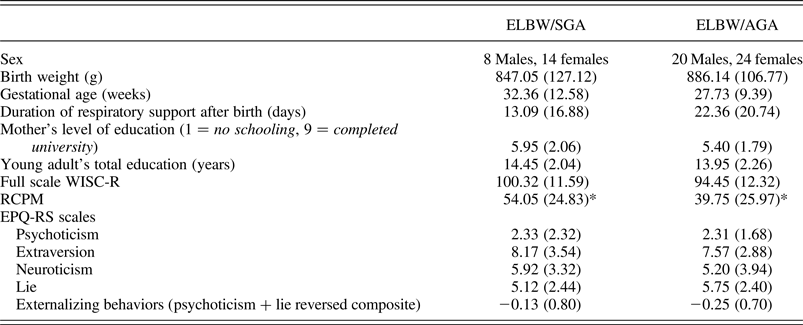
In order to examine associations between ELBW/GA group and the main variables in the study, a series of t tests comparing ELBW/SGA and ELBW/AGA participants were carried out on variables collected at birth (birth weight, GA, and duration of respiratory support), variables reflecting demographics and socioeconomic status (gender, socioeconomic status, mother's level of education, and young adult's total years of education), as well as the main variables of interest (fluid intelligence, general intelligence, and personality characteristics). Descriptive statistics are presented in Table 1.
Mean (SD) for variables of interest by gestational age group

Note: ELBW, Extremely low birth weight; SGA, small for gestational age; AGA, appropriate for gestational age; WISC-R, Wechsler Intelligence Scale for Children—Revised; RCPM, Raven's Coloured Progressive Matrices; EPQ-RS, Eysenck Personality Questionnaire—Revised Short Form.
*p < .05.
No significant differences were found between the ELBW/AGA and ELBW/SGA groups on gender, birth weight, GA, mother's level of education, and young adult's highest level of education (all ps > .10). In addition, no significant differences were found between ELBW/AGA and ELBW/SGA in the number of days of respiratory support (p = .07). The findings indicate that ELBW/SGA participants had significantly higher scores on RCPM than did ELBW/AGA participants, t (64) = 2.14, p < .05. Furthermore, ELBW/SGA participants showed a trend for higher full scale WISC-R scores than did ELBW/AGA participants, t (64) = 1.86, p = .07. No significant differences were found between ELBW/SGA and ELBW/AGA participants on any of the EPQ-RS scales.
However, we found sex differences on several scales of the EPQ-RS: males (psychoticism M = 3.06, SD = 1.73; externalizing behaviors composite M = 0.05, SD = 0.63; extraversion M = 8.68, SD = 2.77) had higher scores than did females (psychoticism M = 1.77, SD = 1.85; externalizing behaviors composite M = –0.41, SD = 0.75; extraversion M = 7.11, SD = 3.19) on psychoticism, t (64) = 2.88, p < .01, externalizing behaviors composite, t (64) = 2.60, p < .01, and extraversion t (64) = 2.08, p < .05; whereas females (M = 6.50, SD = 3.56) had higher scores than did males (M = 4.00, SD = 3.53) on the neuroticism scale, t (64) = –2.82, p < .01. Therefore, sex was entered as a covariate in the regression model.
In addition, full scale WISC-R was entered as a covariate in order to examine the unique role of fluid intelligence, above and beyond that of general intelligence in the association between ELBW/GA group and externalizing behaviors.
Effects of ELBW/GA and fluid intelligence on personality characteristics
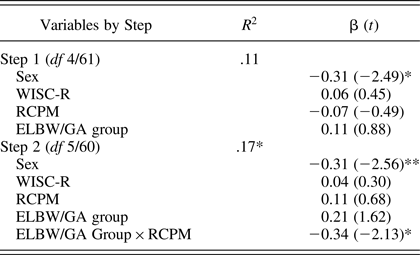
In order to examine the moderating role of fluid intelligence in the association between ELBW/GA and personality characteristics related to psychopathology, separate hierarchical multiple regression analyses were carried out on the various scales of the EPQ-RS (i.e., neuroticism, extraversion, psychoticism, and externalizing behaviors composite). To reduce multicollinearity and aid in interpretation, mean centered predictors were used. Next, the interaction terms were computed as the product between ELBW/GA group and the mean-centered measure of fluid intelligence. The first step of the regression analyses included the main effects of sex, full scale WISC-R, ELBW/GA group, and RCPM score. To test for the moderating effect of fluid intelligence on the link between ELBW/GA group and personality characteristics, the interaction product term between ELBW/GA group and RCPM score was entered in the second step. Although all of the regression models and the terms contained in them were examined for significance, the moderation hypothesis was tested by examining whether the second step significantly increased the variance explained by the model. Interactions were probed and plotted according to guidelines by Aiken and West (Reference Aiken and West1991). High and low levels of fluid intelligence were defined as ±1 SD. Follow-up statistical tests from these probes are reported below.
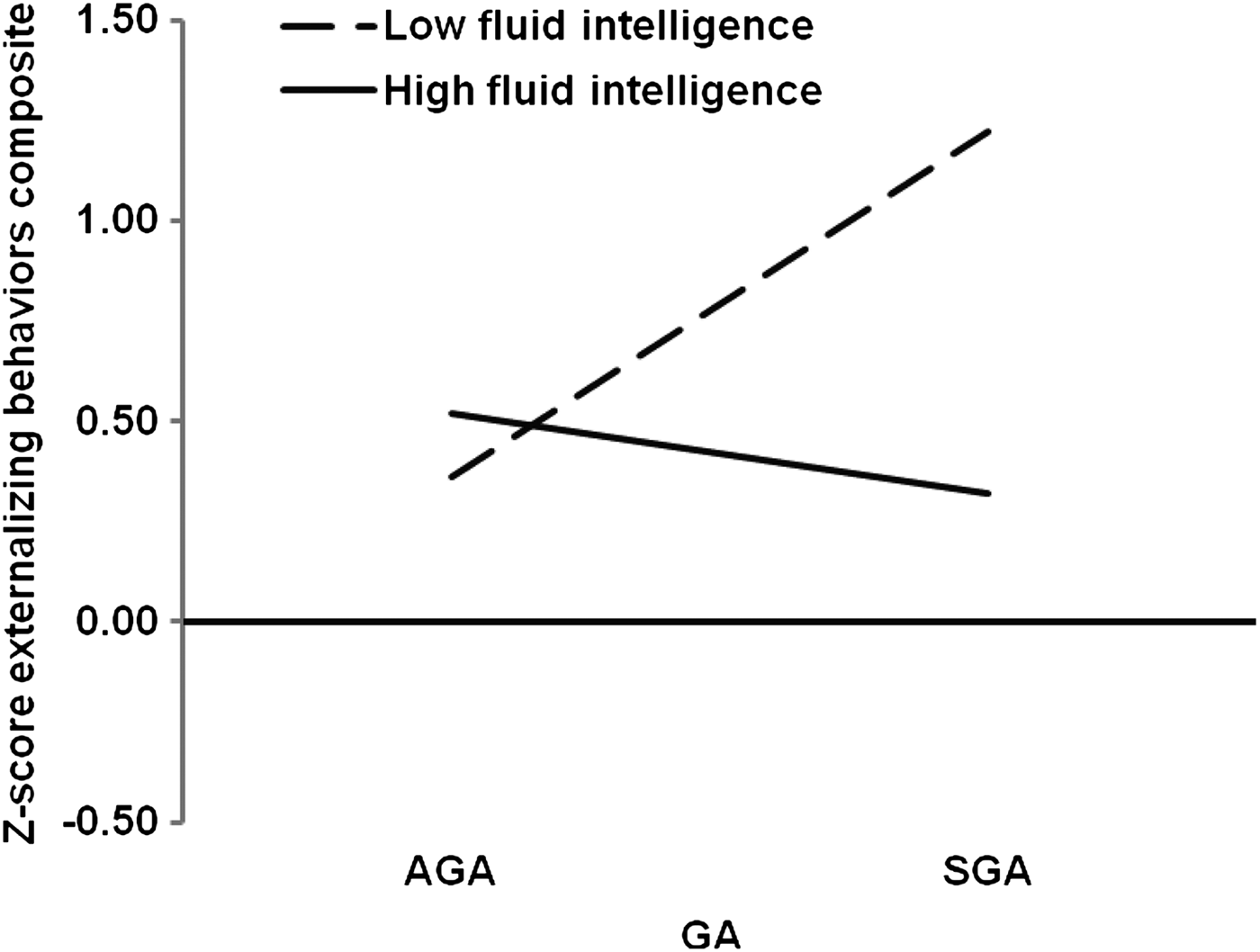
Of the EPQ-RS scales, significant findings were obtained for the regression using the externalizing behaviors composite only. The results indicated a significant interaction between ELBW/GA group and fluid intelligence in predicting the externalizing behaviors composite. This interaction significantly improved the fit of the model, ΔR 2 = .06, F (1, 60) = 4.55, p < .05. The full model with the interaction term was significant, F (5, 60) = 2.52, p < .05, and predicted 17% of the variance in the externalizing behaviors composite score (Table 2 and Figure 1). To decompose this interaction, follow-up regressions were conducted. The findings indicate that within participants who had low fluid intelligence, ELBW/GA group was positively related to externalizing behaviors, β = 0.48, t (60) = 2.26, p < .05, such that participants who were at greatest risk at birth (i.e., ELBW/SGA), scored highest on the externalizing behaviors composite. However, no such relation emerged in participants with high fluid intelligence, β = –0.06, t (60) = –0.38, p = .70. In addition, among ELBW/SGA participants, fluid intelligence was negatively related to externalizing behaviors, β = –0.45, t (60) = –1.97, p < .05, but no such relation was found for ELBW/AGA participants, β = 0.11, t (60) = 0.68, p = .50.
Joint effect of gestational age and fluid intelligence at age 8 on externalizing behaviors in young adulthood among nonimpaired extremely low birth weight (ELBW) survivors. GA, gestational age; AGA, appropriate for gestational age; SGA, small for gestational age.
Hierarchical multiple regression analysis predicting externalizing behaviors
Note: WISC-R, Wechsler Intelligence Scale for Children—Revised; RCPM, Raven's Coloured Progressive Matrices; ELBW, extremely low birth weight; GA, gestational age.
*p < .05. **p < .01.
Discussion
In the present study, we followed a cohort of nonimpaired ELBW survivors prospectively at age 8 and again during young adulthood (ages 22–26). During the 8-year visit, participants completed measures of fluid and general intelligence. Approximately 15 years later, a subset of ELBW survivors was assessed for personality characteristics related to psychopathology. As expected, our findings suggest that the relation between birth weight for GA among ELBWs and psychopathology was moderated by fluid intelligence. In particular, ELBW/SGA participants with poor fluid intelligence were at the greatest risk for externalizing behaviors. In addition, when probing the interaction from the other direction, we found that among ELBW/SGA participants, there was a negative relation between fluid intelligence and externalizing behaviors. These findings suggest that ELBW/SGA individuals who also had poor fluid intelligence during childhood were at increased risk for externalizing psychopathology.
It is important to note that this interaction was statistically significant even when general intelligence was included in the model as a covariate. This result suggests that fluid intelligence plays a role in the relation between ELBW and externalizing problems above and beyond the role of general intelligence. This finding is important given the presence of substantial correlations between fluid intelligence and measures of general intelligence (e.g., Embretson, Reference Embretson1995; Engle et al., Reference Engle, Tuholski, Laughlin and Conway1999), and suggests that fluid intelligence/EF, specifically contributes to externalizing problems among ELBW survivors.
These findings are in line with prior work showing an association between EF and later externalizing problems, above and beyond the contribution of general intelligence. For example, in a longitudinal study (Nigg, Quamma, Greenberg, & Kusche, Reference Nigg, Quamma, Greenberg and Kusche1999) examining the influence of early neuropsychological performance (verbal fluency, inhibitory control, and visual spatial ability) on later childhood behavioral problems, inhibitory control, a subtype of EF, was found to contribute to externalizing problems. Externalizing behavior problems are thought to be related to a failure of regulatory control processes (Barkley, Reference Barkley1997). This relation may be associated with perturbations in activation in the anterior cingulate cortex.
The interaction between ELBW and fluid intelligence was found only for the externalizing behaviors composite (i.e., psychoticism + lie reversed), but not the other scales (i.e., neuroticism and extraversion). Although some research suggests an elevated risk for externalizing-related outcomes in VLBW individuals, particularly ADHD (Bhutta et al., Reference Bhutta, Cleves, Casey, Cradock and Anand2002; Johnson & Marlow, Reference Johnson and Marlow2011; Strang-Karlsson et al., Reference Strang-Karlsson, Räikkönen, Pesonen, Kajantie, Paavonen and Lahti2008), research on ELBW individuals has shown that these survivors suffer mostly from internalizing problems as young adults (e.g., Boyle et al., Reference Boyle, Miskovic, Van Lieshout, Duncan, Schmidt and Hoult2011) and have personality characteristics linked to internalizing problems (e.g., Schmidt et al., Reference Schmidt, Miskovic, Boyle and Saigal2008; Waxman et al., Reference Waxman, Van Lieshout, Saigal, Boyle and Schmidt2013). Thus, while most ELBW survivors may not be at risk for externalizing problems, those with low fluid intelligence may be, and a failure to consider this, as well as other cognitive variables in the literature, may explain the mixed findings seen with respect to externalizing outcomes. Our findings also underscore the importance of identifying moderators that explain maladaptive outcomes. Finally, our results point to the multifinality of developmental outcomes in this population (Cicchetti & Rogosch, Reference Cicchetti and Rogosch1996).
Why might poor fluid intelligence in childhood put ELBW/SGA individuals at increased risk for externalizing behaviors but not ELBW/AGA individuals? This increased risk may be related to structural brain differences in those born SGA rather than AGA. For example, it has been shown that term-SGA children have a reduced total brain volume (Martinussen et al., Reference Martinussen, Fischl, Larsson, Skranes, Kulseng and Vangberg2005), and preterm-SGA infants have a significant reduction in absolute cortical gray matter volume and in overall brain tissue volumes (Tolsa et al., Reference Tolsa, Zimine, Warfield, Freschi, Sancho Rossignol and Lazeyras2004). Further, a smaller total brain volume has been shown to be associated with externalizing problems, such as ADHD (Krain & Castellanos, Reference Krain and Castellanos2006). Such structural brain differences have been associated with EF in preterm children (Edgin et al., Reference Edgin, Inder, Anderson, Hood, Clark and Woodward2008). Thus, differences in the structural development of the brain may place ELBW/SGA individuals at greater risk than their AGA counterparts.
Another interesting finding that emerged was that ELBW/SGA participants had higher fluid intelligence than did ELBW/AGA participants. This finding seems inconsistent with prior work showing that SGA infants have a reduction in cortical gray matter volume (Tolsa et al., Reference Tolsa, Zimine, Warfield, Freschi, Sancho Rossignol and Lazeyras2004). However, Tolsa et al. examined a nonselected group of VLBW participants, whereas the present study utilized a select group of nonimpaired ELBW participants. One possible explanation for the higher fluid intelligence among ELBW/SGA participants may be related to the GA of the participants. Although not significant, GA was higher among ELBW/SGA infants than ELBW/AGA infants, and younger ELBW/SGA participants did not survive. Although this finding may explain the fluid intelligence differences, it is important to note that when GA was included as a covariate in the hierarchical regression, our main findings remained significant. Furthermore, parenting is associated with improvement of cognitive skills among at-risk populations (e.g., Burchinal, Roberts, Zeisel, Hennon, & Hooper, Reference Burchinal, Roberts, Zeisel, Hennon and Hooper2006; Burchinal, Roberts, Zeisel, & Rowley, Reference Burchinal, Roberts, Zeisel and Rowley2008), and it is possible that ELBW/SGA participants may have received parenting that is more protective than did ELBW/AGA participants. Thus, these participants may have received more support that is related to enhancement of cognitive skills. Future research should examine the mediating and/or moderating factors during the first 8 years of life that would account for the higher fluid intelligence found among ELBW/SGA survivors.
Of note is the nonsignificant finding that ELBW/SGA survivors were somewhat older in GA than were ELBW/AGA survivors. This finding is line with literature on late preterm children who are at greater risk for medical problems, developmental outcomes, and mortality compared to full-term children (e.g., Engle, Tomashek, & Wallman, Reference Engle, Tomashek and Wallman2007; van Baar, Vermaas, Knots, de Kleine, & Soons, Reference van Baar, Vermaas, Knots, de Kleine and Soons2009). For example, late preterm children were found to have more school problems, a slightly lower IQ, as well as attention and behavioral problems when compared with term-born children (van Baar et al., Reference van Baar, Vermaas, Knots, de Kleine and Soons2009).
In addition, although fluid intelligence and EF involve the same underlying processes (Blair, Reference Blair2006), there is some debate about equating these two constructs (Birney, Bowman, & Pallier, Reference Birney, Bowman and Pallier2006; Burgess, Braver, & Gray, Reference Burgess, Braver and Gray2006; Garlick & Sejnowski, Reference Garlick and Sejnowski2006; Heitz et al., Reference Heitz, Redick, Hambrick, Kane, Conway and Engle2006). For example, some argue that working memory and fluid cognition are highly related but separable, and suggest that the mechanism behind the relation is controlled attention, an ability that is dependent on normal functioning of the prefrontal cortex (Heitz et al., Reference Heitz, Redick, Hambrick, Kane, Conway and Engle2006).
Finally, several limitations of the present study should be noted. First, the longitudinal nature and selection of nonimpaired right-handed participants resulted in a relatively small sample size. In addition, the use of only nonimpaired participants limits the generalizability of the present findings but also highlights the subtle impairments that might be in place even among nonimpaired survivors. Second, participants were from a geographically limited area in a country with universally available healthcare.
In this study, we examined long-term psychopathology outcomes in the oldest known longitudinally followed cohort of ELBW survivors in the world. The findings indicated that individuals, who were born ELBW/SGA and had poor fluid intelligence at age 8, are at increased risk for externalizing behaviors as young adults. These findings provide evidence for a cumulative risk model and point to the importance of examining possible moderating mechanisms that contribute to developmental outcomes and risk for behavioral problems. Future research should further examine neurocognitive mechanisms that play a role in the relation between ELBW/GA and clinical psychopathology.