There is a tendency among historians of Ireland to pay lip service to the significance of religion. Religious differences are recognized as an essential component of political identity—the Catholic majority supported demands for various forms of Irish independence from Great Britain, while the Protestant minority wanted to maintain the United Kingdom of Great Britain and Ireland (1801). Yet, religious motives and rhetoric are invariably reduced to such material factors. This article argues that historians need to pay attention to self-confessed religious convictions and how these relate in complex ways to nonreligious factors. It does so by examining Protestant minorities in the northern Irish province of Ulster at the turn of the twentieth century who can be described as evangelical. These grew significantly in the decades after the Ulster revival of 1859 and, along with the Methodist Church in Ireland, challenged the dominant position of the two largest Protestant churches, the Presbyterian Church in Ireland and the Anglican Church of Ireland. These evangelical others are also important because the scholarship surveyed in this article shows that their members in the late twentieth century were more likely to have fundamentalist tendencies than those who belonged to the three main churches. The existing scholarship on fundamentalism in Northern Ireland focuses on Ian Paisley (1926–2014), who was a life-long adversary of Irish republican separatism, founder of the Democratic Unionist Party (1971), and later First Minister of Northern Ireland from 2007 to 2008. Paisley was also a self-identified fundamentalist with strong links to the United States who railed against Roman Catholicism, ecumenism, and alleged theological liberalism within the larger Protestant churches.Footnote 2 Yet, the focus on Paisley too often draws attention away from the potential origins of fundamentalism in Ulster in the early twentieth century. In the 1920s, W. P. Nicholson—Ulster's Billy Sunday—was the figurehead of an outbreak of religious revival among Protestants, and, around the same time as the Scopes “monkey trial” in Dayton, Tennessee, a professor of the Presbyterian Church in Ireland was unsuccessfully tried for heresy on accusations of being a “modernist.”Footnote 3 George Marsden's classic study defined fundamentalism as an American phenomenon, yet, with Paisley and developments in the 1920s seemingly in mind, he noted that, “Ulster appears to be an exception—one that would offer another illustration of the relationship of fundamentalism to relatively unique cultural experiences.”Footnote 4 To what extent was that true? Was there a constituency of potential fundamentalists in the north of Ireland in the early twentieth century? If there was, did the social and political circumstances of the region and period produce a distinctive Ulster variety of fundamentalism?
The period was a defining one in Irish and British politics. The Liberal government of the United Kingdom was reliant on the support of Irish nationalist MPs at Westminster and, in return, had promised to introduce a form of devolved government for Ireland popularly known as Home Rule. Protestants were opposed to this measure, especially in the northern province of Ulster, which, in 1911, contained, by far, the highest proportion of Protestants of all types in Ireland—64% of the Church of Ireland, 96% of Presbyterians, 78% of Methodists, and 79% of “All other Denominations.”Footnote 5 Such was the significance of Ulster, that political unionism became a provincial phenomenon. The “Ulster Crisis” dominated United Kingdom politics from 1911 until the outbreak of the Great War in September 1914 and led to the partition of Ireland and the formation of the state of Northern Ireland in 1921.Footnote 6 A highpoint of opposition to Home Rule was the signing of Ulster's Solemn League and Covenant on “Ulster Day,” September 28, 1912. This Presbyterian-inspired document underlined the significance of religious opposition to the prospect of “Rome Rule” in an Irish state that would be, it was claimed, dominated by the Catholic majority who were subservient to the Vatican. Furthermore, it illustrated the importance of evangelicalism in forging intra-Protestant unity.Footnote 7 It did so by asserting the positive values that united Protestants—the authority of the Bible, personal conversion, missionary and social activism, and high-toned morality—and their combined opposition against the theological errors of Catholicism. Evangelicals could be found in virtually all the Protestant churches; this article focuses upon a self-selecting cohort of evangelical others who chose not to express their evangelical convictions within the three largest Protestant denominations.
Against this dramatic political backdrop, this article considers whether strong evangelical religion produced strong unionist politics and whether we can discern among evangelical others the potential origins of Protestant fundamentalism in Northern Ireland after 1921. It opens with a discussion of the existing secondary literature on evangelicalism in Ulster, its definition, origin, and development in the aftermath of the 1859 revival. It introduces the scholarship on the emergence of fundamentalism in the United States in the early twentieth century and the growing body of work on the sociology of evangelicalism and fundamentalism in late twentieth-century Northern Ireland. By doing so, a number of characteristics are noted that are then interrogated in the following two sections. The data displayed in these sections were collected from the 1911 census of Ireland and the list of signatories of the 1912 Ulster Covenant. The census returns have been digitized and placed online by the National Archives of Ireland, and the Public Record Office of Northern Ireland has done the same for the Covenant.Footnote 8 Both repositories provide digital images of the original documents within a searchable index. On the basis of a database of 36,136 entries compiled from these sources, this article explores the social, economic, and political character of evangelical others in the province in 1911 and 1912. Section 2 provides an overview of the constituency using the 1911 census to examine their geographical distribution, occupational spread, and literacy levels. The final section assesses the extent to which this self-selecting evangelical constituency defined their identity in terms of politics. It examines their attitude to the signing of the Ulster Covenant in 1912 and considers whether religious principle can simply be submerged into ethnic politics.
I. Protestant Minorities, Evangelicalism, and Fundamentalism
It is a truism among historians of Ireland that religious differences played an essential role in defining how Irish people saw their relationship with Great Britain; Catholics were nationalists and Protestants were unionists.Footnote 9 In general terms, this focus on the two communities is entirely appropriate, yet it often implies that religious motives can be explained simply by reference to, for instance, political power, cultural identity, or class interest. Furthermore, there is still an inclination to describe both Catholicism and Protestantism as monoliths. This is particularly noticeable in the case of Protestantism, the lion's share of which can be found in the northern province of Ulster. A number of reasons can be cited to explain this inclination, including the need of news outlets to tell a simple and coherent story, the methodology and assumptions of social and political scientists, and the logic of unionist politics. The requirement to display unity during the Troubles after 1968 and to prioritize small differences with the nationalist “other” meant that there was a reticence to discuss the variety and differences of opinion within Protestantism.Footnote 10 In recent years, scholars have challenged the assumption that religion in Northern Ireland simply serves as a boundary marker.Footnote 11 By doing so, they have recognized the need to disaggregate Protestantism, especially evangelicalism, and to give due consideration to religious faith and denominational identity. Geographers, sociologists, and political scientists have subjected to detailed and illuminating study the “Protestant mosaic” and how members of smaller Protestant groups tend to be more religiously committed than adherents of mainstream churches.Footnote 12 An important feature of the identity of these groups is the experience of being a double minority—a Protestant minority in Catholic Ireland and minorities in comparison to the numerically dominant Church of Ireland, Presbyterian Church in Ireland, and Methodist Church.Footnote 13
Minorities have always played a central role in the history of Ulster Protestantism and in the development of evangelicalism from the early eighteenth century.Footnote 14 Against the backdrop of the religious wars of the sixteenth and seventeenth centuries that had left Protestantism bruised, evangelicalism was a movement of religious renewal that began among displaced Protestant refugees from Counter-Reformation Europe.Footnote 15 French Huguenots, German Palatines, and Moravians from Bohemia brought to Britain, Ireland, and the North American colonies new ways of doing religion. In particular, the “good news” of the “new birth”—personal conversion—was spread in Ireland by Moravian preachers such as John Cennick, who gathered together small groups of brethren, and by John Wesley and other itinerant preachers who organized a more numerically impressive Methodist presence. Yet, before 1770, this new form of Protestantism was largely ignored by members of the Church of Ireland and the powerful Presbyterian community in Ulster and resented by Protestant minorities who owed their origin to the Cromwellian regime of the 1650s. For instance, Methodist preachers were criticized by the Baptists of Cork for “empire building, money grabbing, family splitting, heiress hunting, and ‘sheep stealing.’”Footnote 16 The flexibility of Methodist itinerancy contrasted with the commitment of Independents and Baptists to congregational order and autonomy. Generally speaking, though Methodist numbers remained small, the movement “introduced a new competitiveness into Irish religion.”Footnote 17 In addition, the concern with promoting individual conversion came to dominate the religious life of Protestants in Ulster, not least because it reawakened the religious zeal of Presbyterians, who comprised the majority of Protestants in the province.Footnote 18
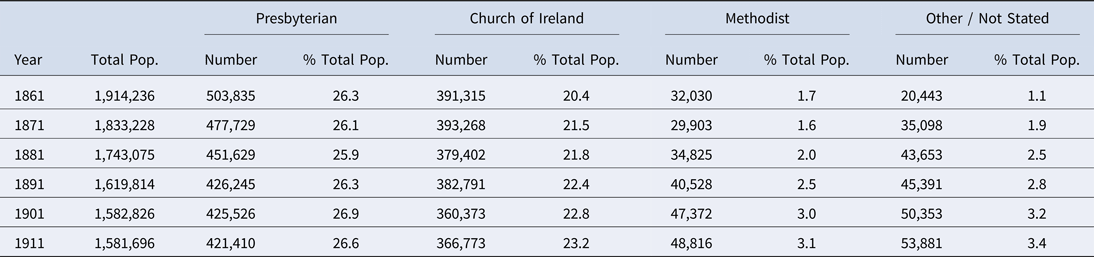
The revivalist fervor of evangelicals is significant because it disrupts self-serving narratives of Protestant homogeneity and religious propriety. This can be illustrated through nineteenth-century census records. Unlike British censuses of the same period, a religious question was included in the Irish version, and individuals were permitted “the most entire freedom of description as concerns their definition of belief.”Footnote 19 This is particularly important because two years prior to the 1861 census Protestant Ulster experienced a remarkable outbreak of evangelical religious enthusiasm.Footnote 20 The 1859 revival reportedly led to the conversion of tens of thousands of individuals and to debate over the use of male and female lay preachers, the physical manifestations that accompanied some of the conversions, and the type of popular theology that was preached. Moreover, fears were expressed about the fragmentation of Protestantism. In subsequent decades, larger denominations lost members to smaller groups who demanded a more visible commitment from their members through believers’ baptism, advocated a more intense personal religiosity or theological commitment, displayed a greater openness to lay involvement in church life, or rejected denominational labels altogether. There developed a vibrant and variegated evangelical subculture of smaller churches and groups who vied with each other for additional recruits and to assert their fidelity to biblical principle. Table 1 demonstrates that though the proportion of the population of Ulster who self-described as Presbyterian and Church of Ireland remained stable or even increased, their overall numbers declined as the provincial population fell by around 330,000. By contrast, both Methodists and “Others” increased in absolute numbers and as a proportion of the population.
Non-Catholic Population of Ulster, 1861–1911.1

Source: Census of Ireland, 1911: Area, Houses, and Population; Also the Ages, Civil or Conjugal Condition, Occupations, Birthplaces, Religion, and Education of the People; Province of Ulster; Summary Tables (Dublin: His Majesty's Stationery Office, 1912), 38.
1 Please note, the percentage figures have been rounded to the nearest decimal place.
Nicola Morris has provided a telling analysis of this post-revival period. Methodists in Ireland bucked the trend of population decline after the Famine and experienced steady growth between 1845 and the Great War. This occurred mostly, though not exclusively, in urban areas and in Ulster. Yet, even the growth of Methodism in Ireland as a whole was outstripped by the growth of the “Other,” which grew by 218% between 1861 and 1911, from 31,252 to 68,301. Morris claims that the growth of smaller denominations “appears to demonstrate an increasing dissatisfaction with the established denominations within Ireland,” and that Methodist growth in Ulster illustrates a “trend towards evangelicalism.”Footnote 21 Furthermore, table 1 shows that, between 1861 and 1911, there was a 163.57% increase in the “Other” at the expense of Presbyterians and the Church of Ireland, while the total provincial population declined by 17.37%. Significantly, Morris concludes that marriage patterns, family size, and emigration cannot explain this growth and suggests that it was caused by the attractive qualities of evangelicalism, especially its emphasis on fellowship.Footnote 22
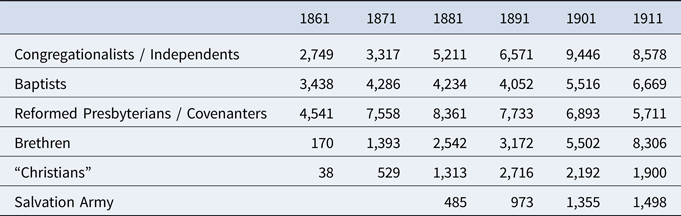
The present study is based upon a database of those recorded as “other” in the 1911 census. The database includes a total of 36,136 individuals, and the most numerous evangelical groups to which they belonged are listed in table 2. In addition to the exclusion of the three largest Protestant churches, the sample excludes three other specific categories: non-Christian groups (including Spiritualists) and the tiny number of those who refused to give their religion; those who can be assigned to other categories such as members of Scottish Presbyterian churches (for example, Church of Scotland, United Free Church, Free Church) and the Anglican communion (for example, Church of England, Scottish Episcopalians); and so-called unorthodox bodies, such as those self-described as Unitarians (Presbyterian Nonsubscribers), Christadelphians, Adventists, Christian Scientists, and Swedenborgians. It is worth noting that the number of distinct self-described groups in the “Other” category for Ulster (including the very small number of those who gave no answer or were unknown) rose dramatically from 65 in 1861 to 214 in 1911. A reflection of the significance of evangelicalism was that the census included references to those who had not yet experienced personal conversion. For example, the 1891 census returns for Ulster recorded 26 “Unconverted (children of “Christians”)” and 7 “Unsaved (Children of “Christians”)”; the 1901 listed 18 “Unconverted,” 14 “Not old enough to make any profession of faith,” 10 “Undecided,” and 9 “Without knowledge”.
Selected Evangelical Others in Ulster, 1861–1911.

Sources: The figures given in columns are taken from the relevant volume of the census for each year: Census of Ireland for the Year 1861, part 4, Reports and Tables Relating to Religious Professions, Education, and Occupations, vol. 4, Religions and Occupations (Dublin: Her Majesty's Stationery Office, 1863), 482–483; Census of Ireland, 1871, part 1, Area, Houses, and Population: Also the Ages, Civil Condition, Occupations, Birthplaces, Religion, and Education of the People, vol. 3, Province of Ulster (Dublin: Her Majesty's Stationery Office, 1875), 1044; Census of Ireland, 1881, part 1, Area, Houses, and Population: Also the Ages, Civil or Conjugal Condition, Occupations, Birthplaces, Religion, and Education of the People, vol. 3, Province of Ulster (Dublin: Her Majesty's Stationery Office, 1882), 994; Census of Ireland, 1891, part 1, Area, Houses, and Population: Also the Ages, Civil or Conjugal Condition, Occupations, Birthplaces, Religion, and Education of the People, vol. 3, Province of Ulster; Summary Tables and Indexes (Dublin: Her Majesty's Stationery Office, 1892), 994; Census of Ireland, 1901, part 1, Area, Houses, and Population: Also the Ages, Civil or Conjugal Condition, Occupations, Birthplaces, Religion, and Education of the People, vol. 3, Province of Ulster. Summary Tables (Dublin: His Majesty's Stationery Office, 1902), 31; and Census of Ireland, 1911: Province of Ulster (Dublin: His Majesty's Stationery Office, 1912), 37.
The first three groups listed in table 2 traced their origins to the religious and political turmoil of the mid-seventeenth century. The Reformed Presbyterians—also known as Covenanters—declared their adherence to the perpetual obligation of the Scottish National Covenant of 1638 and the Solemn League and Covenant of 1643.Footnote 23 It was believed that these documents involved a solemn compact with God to bring about the reformation of Britain and Ireland along Presbyterian lines through the extirpation of Catholicism, Protestant prelacy, and heresy in its various forms. Because the Williamite revolution of 1688/9 ignored the terms of these covenants by confirming bishop-led Protestant episcopal churches in England and Ireland, the tiny rump of Presbyterians who maintained commitment to the terms of the covenants found themselves in opposition to the Hanoverian state. This bred a distinctive form of political radicalism and led many Covenanters in Ulster to take up arms against the state in 1798. Rather than rebellion acting as a brake on further growth, the Reformed Presbyterian presence grew steadily in early and mid-Victorian Ulster. The denomination shared in the upsurge of evangelical sentiment by developing missionary agencies and joining with other Protestants in religious networks and crusades, though they, like a number of evangelicals within the Presbyterian Church of Ireland, opposed the unrestrained revivalism displayed in 1859.Footnote 24 In principle, they continued to reject the constitution of the United Kingdom, though some, in opposition to the direction of their clergy, tacitly acknowledged the legitimacy of the state by voting in elections.Footnote 25
The other two groups associated with the upheavals of the mid seventeenth century were Baptists and Independents / Congregationalists.Footnote 26 Both agreed with Presbyterians that Christ alone was the head of the Church, but they also believed that individual congregations were self-determining and self-governing. Many opposed the imposition of human-made creeds, though, in the nineteenth century, congregations and representative bodies produced statements of faith that demonstrated their orthodox and conservative views.Footnote 27 Baptists adhered to congregational principles but rejected infant baptism. They practiced believers’ baptism that restricted membership to those who had been baptized on profession of their personal faith. By the late eighteenth century, both groups were insular and numerically insignificant—there were around 500 Baptists in the whole of Ireland in 1800. Their fortunes were transformed by the expansion of evangelicalism from the 1790s, particularly the work of the Scottish evangelists, Robert and James Haldane, and both received significant support from coreligionists in Britain through the Irish Evangelical Society (1814) and the Baptist Irish Society (1814). In 1800, most congregations were found outside Ulster; over the next century, that pattern was reversed. For instance, there were no Baptist churches in Ulster in 1800; by 1848, 22 out of a total of 45 were in the province.Footnote 28
This growth was accompanied by the increasing self-assertion of the Irish churches. Perceived English interference led to the formation in 1829 of the Congregational Union of Ireland, which continued to exist throughout this period, except between 1848 and 1860. The acquiescence of many English and Scottish nonconformists in the Liberal Party's support for Irish Home Rule after 1885 further exacerbated these tensions, as both Irish Congregationalists and Baptists were opposed to what they interpreted as the breakup of the United Kingdom.Footnote 29 For Irish Baptists, this was compounded by the growing acceptance of moderate theological views among English Baptists, a process which came to a head during the “Downgrade Controversy” of 1887–1888. Their concern about the religious and political laxity of their British coreligionists informed their decision to establish the Baptist Union of Ireland in 1895.Footnote 30
This self-assertion was in itself a product of the boost given to both churches by the 1859 revival, though the gains were sometimes short-lived, new congregations often lacked stability, and there was considerable movement between the denominations. The accession of new members to Congregational churches was modest and the individualism promoted by the revival led to problems in local meetings, including losses to the Baptists.Footnote 31 In subsequent years, thirteen Congregational churches were closed; in the case of Armagh and Newry, the buildings were transferred to the Salvation Army.Footnote 32 Similarly, Baptists in 1859 experienced a sharp growth in numbers, yet this was also accompanied by false starts and setbacks in the decades between 1861 and 1891. In Coleraine, for example, the significant gains of the revival were eaten away owing to emigration and “back-sliding,” including one member who had “gone back to Presbyterianism.” In the sixty years to 1902, the congregation had no less than twelve pastors.Footnote 33 In the aftermath of the 1859 revival, there was significant Presbyterian opposition to believers’ baptism as a form of proselytism and Baptist growth was also held back by “the disorganizing influence of the Plymouth Brethren.”Footnote 34
Yet, despite the setbacks, both groups grew. The census figures (table 2) show an almost fourfold increase in the number of Congregationalists from 2,749 in 1861 to 9,446 in 1901. Baptist growth was less spectacular before the 1880s, but, between 1891 and 1911, their numbers increased from 4,052 to 6,669. H. D. Gribbon noted that church membership—as opposed to adherence—in Ireland doubled between 1865 and 1891 and ten new Baptist churches were formed in Ulster. Membership grew among blue collar workers in urban areas, but Baptists also widened their social base to include mill owners in Coleraine, Carrickfergus, and Belfast, including R. G. Glendenning, the Liberal Member of Parliament for North Antrim.Footnote 35
With their origins in the early nineteenth century, the Brethren are perhaps the most obvious example of the growth of evangelical sentiment in the aftermath of the 1859 revival.Footnote 36 Described by D. W. Bebbington as “radical, intense, quixotic,” they became a significant “ginger group in the evangelical world,” despite their relatively small numbers.Footnote 37 The Brethren label is used to describe a variety of groups whose origins can be traced to individuals disillusioned with the state churches of England and Ireland in the 1820s, most notably John Nelson Darby. In response to the sustained attack on Anglican privilege from Catholic democracy in Ireland and an increasingly religiously neutral British state, Darby developed an apocalyptic vision of the ruin of the institutional church and the necessity of divine intervention to renew the world before the final judgement.Footnote 38 Many of his followers sought to restore the piety and practice of the New Testament by adopting weekly communion and by stripping local fellowships of bureaucracy and clergy. They were committed to the inspiration and infallibility of the Bible and developed an apocalyptic view of history and the end of the world known as dispensational premillennialism. They were suspicious of modern scholarship and systematic theology, but their ardent biblicism and system of eschatology meant that they adopted an alternative intellectualism rather than the anti-intellectualism that is often used to caricature evangelicals. They self-consciously stood separate from the world and voting was discouraged.Footnote 39 They avoided denominational labels and, as a consequence, the Brethren category in our dataset combines a number of different self-descriptors, including “Brethren,” “Christian Brethren,” “Plymouth Brethren,” “Exclusive Brethren,” “Open Brethren,” and “Darbyites.” It is also probable that those who described themselves simply as “Christians” were part of this amorphous group, and references to “Gospel Halls” usually indicate Brethren assemblies.Footnote 40 Though the origins of the movement can be found among the Church of Ireland elite, the Brethren throughout the United Kingdom broadened their social base after 1859 and became associated with the skilled working class.Footnote 41
The fragmentation of Protestantism and the invigoration of the laity presented challenges to the mainstream churches. Though the prime promoters of the 1859 revival, Presbyterians were worried about the growth of these smaller groups and the proliferation of untrained lay evangelists.Footnote 42 Yet, they too were deeply influenced by evangelicalism and engaged in a variety of endeavors aimed at the spiritual and social renewal of society. In particular, Presbyterian ministers supported late Victorian revivalism. Rather than the sudden outbreak of religious enthusiasm experienced in 1859, revivals reflected middle-class values and were prepared along the lines of a business.Footnote 43 For instance, a feature was the use of professional revivalist preachers, the greatest of whom was Dwight L. Moody, who was enthusiastically supported by the clerical elite of the Presbyterian Church during his successful campaigns in urban Ulster in 1874, 1883, and 1892.Footnote 44
In addition to revivalism, there was a renewed emphasis on personal holiness in the late Victorian period, a factor that contributed to the popularity of Methodism.Footnote 45 This quest for the higher spiritual life became associated with the Keswick Convention held annually in the English Lake District from 1875 and the Portstewart Keswick Convention in County Antrim from 1914.Footnote 46 The refrain of personal holiness was repeated by the Faith Mission, founded in Scotland in 1886 in the wake of another Moody crusade, which quickly established itself as a small yet influential presence in Ulster after 1894.Footnote 47 Another expression was the Salvation Army, formed as the East London Christian Mission in 1865 by William and Catherine Booth and reorganized along militaristic lines in 1878. The first Salvation Army corps in Belfast was set up in May 1880, and, within eight years, twenty-eight were operating in Ulster. Though the Army was committed to non-sectarian evangelism, it was concentrated in protestant areas of northeast Ulster and Dublin and saw Roman Catholics as especially in need of conversion.Footnote 48
It is evident that evangelicalism permeated Ulster Protestantism and affected those within and without the mainstream denominations. It was inherently interdenominational, and the emphasis on personal conversion and religious activism brought like-minded individuals together from across the Protestant spectrum. Significantly, during the heresy trial that rocked the Presbyterian Church in Ireland in 1927, those church members who tabled charges against the alleged modernism of Professor J. E. Davey received substantial support from evangelicals in general, including Brethren, Baptists, and nondenominational evangelists.Footnote 49 As Marsden notes, it was from the broader evangelical and revivalist movement that fundamentalism emerged in the United States during the first decades of the twentieth century.Footnote 50 Fundamentalism as a distinct movement in America came to prominence in the 1920s in opposition to theological “modernists” in the mainstream Protestant churches. Fundamentalists believed in the verbal inspiration and inerrancy of the Bible, held a deeply pessimistic eschatology that led to otherworldliness and introversion, and may be defined by their strong opposition to modernism and a desire to remain pure by separating from error.
Marsden's focus on the ideas of the movement has been accepted by historians, though the study of fundamentalism in the United States has been enhanced by new perspectives. Recent scholarship has examined the broader social and cultural context in more detail and charted the relationship between these strong evangelicals and factors such as social class and gender.Footnote 51 As a consequence, fundamentalism is now seen as a product of modernity and not simply as a reaction against it. In social and economic terms, the stereotype of uneducated, rural hillbillies has been overturned by the realization that fundamentalism was an urban phenomenon in northern cities and was attractive to upwardly mobile Protestants. Kathryn Lofton has questioned the binary between “modernists” and “fundamentalists” because reality was more complex and many of the fundamentalists “were, in so many ways, tied to the bureaucratic tendencies, mercantile industries, and scholastic techniques of the modern era.”Footnote 52 Margaret Bendroth has observed that fundamentalism was particularly associated with industrial cities in the north where white Protestants from the upper working class and lower middle class saw their status decline in response to the immigration of large numbers of Jews and Roman Catholics from Europe.Footnote 53
Charting the growth of smaller Protestant denominations after the 1859 revival and comparing this with the sophisticated study of American fundamentalism offers an opportunity to add to the scant historical literature on fundamentalism in Ulster. The focus has been on Ian Paisley and how evangelicalism and fundamentalism continue to count in contemporary Northern Ireland because religion matters to ethnic and political identity.Footnote 54 In a study of Belfast Protestants conducted in the 1980s, it was found that, in comparison to the three main Protestant churches, members of minor denominations such as Brethren, Baptists, and Reformed Presbyterians were much more likely to have fundamentalist attitudes and to support Paisley's political party.Footnote 55 Yet Steve Bruce has cautioned against the simplistic conflation of religious and political values made by many social and political scientists. He noted that there was no direct correlation between “evangelicalism and ultra-unionism because . . . a number of different political agendas can be derived from evangelical theology, and the political views of even those evangelicals minded to be conservative unionists are influenced by other considerations such as denominational loyalty.”Footnote 56
It is apparent that the labels “Protestant,” “evangelical,” and “fundamentalist” need to be disaggregated. Protestant minorities had been significant for the early history of evangelicalism, and the 1859 revival led to both revitalization and fragmentation. It created a lively evangelical subculture of various denominations whose members actively decided to join rather than simply being brought up in their parents’ denomination. In the United States, these groups were often associated with the urban skilled-working class and from this constituency emerged a proto-fundamentalist subculture that was to have such a significant impact in the 1920s and beyond. To what extent do Ulster's evangelical others conform to this social and economic profile? Were they as likely to be urban dwellers and members of the skilled working class? Can the strong, self-selecting religious views of evangelical others be explained by the fraught politics of the “Ulster crisis”? Is there a clear relationship between strong evangelical religion and strong Unionist politics?
II. The Social and Economic Profile of Evangelical Others
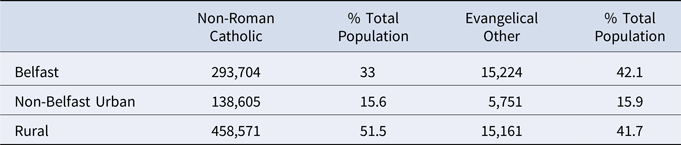
The complete dataset (n = 36,136) represents 2.3% of the total Ulster population and 4.1% of its non-Catholic population. 15,224 entries to the dataset were resident in Belfast on census night, 3.9% of the population of Ireland's fastest growing and only industrial city. Evangelical others were therefore a much larger proportion of Belfast's population than of Ulster as a whole. Yet, this was not a strictly urban-rural divide. The census enumerators produced a list of all urban areas with a population of 1,500 or greater, and, by combining these, it is possible to calculate an urban population for the province as a whole. Further, the total Catholic population of each area can be subtracted to give an approximate “Protestant” population. The aggregate figures show that the evangelical other population is roughly 10% more likely to live in an urban area and roughly 10% less likely to live in a rural area than the non-Catholic population as a whole. However, a closer look at the distribution (table 3) shows that the proportion of the population living in urban areas other than Belfast (15.9%) is extremely close to the proportion of the overall non-Catholic population living in those areas (15.6%), while the proportion of evangelical others living in Belfast (42.1%) is considerably larger than for the overall non-Catholic population (33%) or for the entire provincial population (24.5%). Therefore, while a majority of evangelical others (58%) were resident in urban areas, membership of the evangelical other category is more strongly correlated with living in industrial Belfast than with urban living more generally.
Belfast, Other Urban and Rural Populations.

Source: The figures in columns 2, 3, and 5 are derived from Census of Ireland, 1911: Province of Ulster, 58.
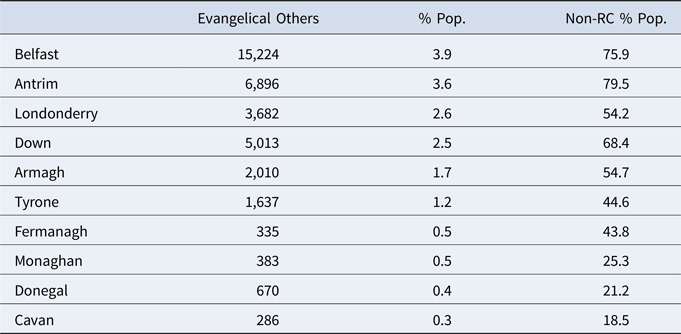
In summary, outside Belfast, the incidence of evangelical others increases with the non-Catholic population (see table 4). In five of Ulster's nine counties, a majority of the population was Catholic. These five counties (Cavan, Donegal, Monaghan, Fermanagh, Tyrone) were also the five counties with the lowest incidence of evangelical others. Of these counties, Cavan, with the largest Catholic majority, had the lowest proportion of evangelical others; Tyrone, with the smallest majority, had the highest proportion of evangelical others. The other majority-Catholic counties fit this pattern, with the proportion of evangelical others decreasing in direct proportion to the increasing size of the Catholic majority. In the counties with a Protestant majority, however, the pattern is slightly different, and the relationship between the size of the Protestant majority and the rate of evangelical others is less clear. Londonderry, the county with the smallest Protestant majority, had the third highest rate of evangelical otherness.
Evangelical Others and Non-Catholic Populations as a Percentage of Total Population.

Source: The figures in columns 3 and 4 are derived from Census of Ireland, 1911: Province of Ulster, 37.
Counties are a useful administrative unit though there is a degree of arbitrariness about their boundaries that can obscure more specific considerations of space. In particular, there is a noticeable clustering of evangelical others in specific urban areas. One result is a “Bible belt” (see map) that stretches between Coleraine, on the eastern edge of County Londonderry, to Belfast, at the southern end of County Antrim, with its buckle in the area around Ballymena, the epicentre of the 1859 revival. Indeed, examining individual electoral divisions shows that even the rural areas surrounding Ballymena had remarkably high populations of evangelical others, defying the general trend, including 9.6% of the population of Ahoghill. In addition to the noticeably high rates of nonmainstream Protestantism, towns across this Bible belt, most notably Larne, Ballymena, Ballyclare, and Ballymoney, were home to a wide array of denominations. Carrickfergus, the town with the highest proportion of evangelical others (14.4%), had a plethora of Independents and Congregationalists and a smaller number of Baptists.
Principal Towns in Ulster.

Rural areas in the Bible belt also had relatively high populations of evangelical others but were often dominated by single denominations. Those in Belfast's northern hinterland, at the southern edge of the belt, were predominantly Congregational, while there was a large Brethren population in the rural hinterland of Ballymena. This clustering is less noticeable in areas outside of the Bible belt, yet which are still located in the heavily Protestant areas of Antrim and Down. Lisburn, for instance, had a lower-than-average rate of nonmainstream Protestantism (1.5%), as did urban areas in northern County Down, such as Newtownards, Comber, and Bangor. Only Holywood had a rate at or above the average (4.1%), due to the presence of several rather large Brethren families. Another cluster is, however, discernible along the transition between County Down, with a large Protestant majority, and County Armagh, where the Catholic and Protestant populations were much closer to parity. Outside of the “Bible belt,” clusters of evangelical others tended to occur in urban areas, most noticeably in Banbridge, Cookstown, Keady, Lurgan, and Tandragee. Except for Cookstown, the only Protestant majority town in Tyrone, all of these are in either Armagh or Down, and, of these, only Keady is more than a handful of miles from the border between the two counties.
Disaggregating the province's urban population reveals that it was Belfast, rather than urban areas more generally, that contained an outsized proportion of evangelical others. Examining the remaining population more closely demonstrates another geographical trend: a Bible belt spanning the heavily Protestant county of Antrim in which even rural areas contained a high proportion of evangelical others.
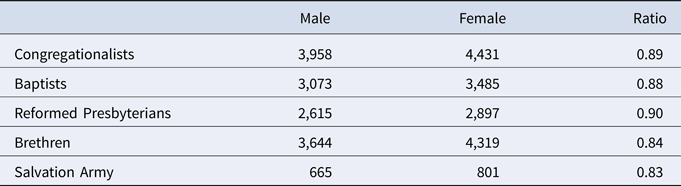
Margaret Bendroth has argued that “by the early twentieth century, fundamentalism was beginning to define itself in opposition to feminist trends elsewhere in evangelical Protestantism.”Footnote 57 Women had played a crucial role in the evangelical movements of the late nineteenth century, especially in missionary and temperance societies. Yet, the feminization of religion and the apparent threat that this posed to doctrinal issues such as biblical inerrancy and dispensationalism was a contentious topic within the early fundamentalist movement. The revivalist movement, with its pietistic emphasis on personal holiness, was particularly keen to attract men using a masculine message of a courageous life of faith.Footnote 58 In Ulster, women continued to make up a majority of nonmainstream churchgoers. While the province had a slightly larger female than male population, the gender ratios within denominations are nevertheless notable. Women made up 51% of both the general population and the non-Catholic population. However, women accounted for 53% of evangelical others, with a ratio of 0.89 males to every female. As table 5 illustrates, of the larger nonmainstream denominations, only Reformed Presbyterians had a larger ratio (0.9), with Baptists and Congregationalists slightly less (0.88 and 0.89 respectively), and Brethren groupings and the Salvation Army having the smallest ratios (0.84 and 0.83 respectively).
Gender Breakdown, Selected Denominations.

It appears that the more institutional, traditional denominations attracted more even numbers of men to women, while pietistic movements attracted a larger ratio of women to men. Further evidence to support this can be found by examining the mainstream denominations, where each, apart from Methodism (0.88), has a similar ratio, in the range 0.94–0.97.Footnote 59 As noted in the previous section, Methodism was the only mainline Christian denomination to grow in both absolute numbers and as a proportion of the population in the late nineteenth and early twentieth centuries. Morris argues that Methodism and smaller denominations grew in comparison to the mainstream churches because their brand of evangelicalism was more engaging and capable of fostering closer fellowship.Footnote 60
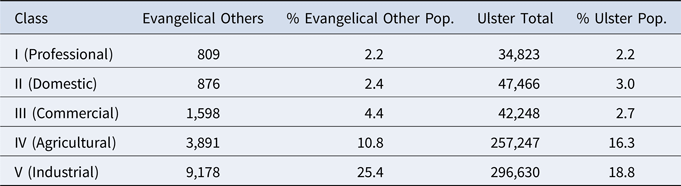
In terms of social class, the census enumerators provided a five-class breakdown of those in employment, based on professional, domestic, agricultural, commercial, and industrial occupations.Footnote 61 These are then broken down into orders and suborders of increasing granularity, with an order representing a broad field, such as government work, and a suborder representing a smaller field within that order, such as the military. From these classes it is possible to make comparisons with the evangelical other dataset. However, some caveats must be acknowledged. This system of classification is arranged according to employment and the type of work undertaken. Those who were engaged in domestic duties in their own home, the retired (except for military pensioners), and those of private means, such as pensions and annuities are excluded from the five classes. The focus on the type of work undertaken can sometimes be confusing. For instance, since librarians and booksellers worked with printed materials, they are counted as industrial workers. Many farmers had additional occupations, while many tradespeople such as carpenters and plumbers might have worked in housebuilding (Class V, suborder 11.1) or shipbuilding (Class V, suborder 13.1). Similarly, many office workers such as clerks and accountants might have been employed by the central government (Class I, suborder 1.1), the local government (Class I, suborder 1.2), or the private sector (Class III, suborder 5.1). Messengers and telegraph operators may have been in government service (Class I, suborder 1.1) or commercial work (Class III, suborder 5.5), and medical missionaries could be listed either under medicine (Class I, suborder 3.3) or mission (Class I, suborder 3.1). Further, the suborders do not always have sufficient detail to identify the class of the workers. For instance, merchants and traders in textiles and minerals are classified in the same suborder as those involved in their production or extraction. Enlisted soldiers and staff officers are in the same suborder (2.1), as are postmen, prison officers, and peers of the realm (1.1); all are in the first, “professional” order.
Nevertheless, it is possible, with these caveats in mind, to calculate a rough idea of the class profile of evangelical others using this system and compare it to the Ulster population as a whole, as these figures are given in the printed report of the census.Footnote 62 Figures for classes I and II are fairly similar to those for the general population. Evangelical others were considerably more likely to be involved in commerce (1.7 times more likely) and industry (1.4 times more likely), but only two-thirds as likely to be involved in agriculture as the population as a whole. This is partially a result of geography; since evangelical others were concentrated in urban areas, it is to be expected that fewer jobs in agriculture and more jobs in business and industry would be available. Examination of the orders and suborders is also helpful. For instance, evangelical others were slightly less likely to be involved in government work (0.5%), especially defence (0.04%), and slightly more likely to be involved in the professions (1.7%) than the general population (0.6%, 0.3%, and 1.3%). As table 6 illustrates, evangelical others were slightly less likely to be employed domestically and considerably more likely to be involved in commerce. Indeed, the proportion involved in finance was more than twice as large for evangelical others (3%) as for the population as a whole (1.3%). The relative lack of agricultural workers is striking: 10.7% compared to 16% for the entire population. So too was the overrepresentation of housebuilders, general tradespeople, shipbuilders, textile workers, makers of clothes and tools, and those involved in the printing industry; these occupations are discussed in more detail below.
Class Breakdown of Evangelical Others and Entire Population.

Source: The figures in columns 4 and 5 are derived from Census of Ireland, 1911: Province of Ulster, 11.
Classification into suborders is somewhat less helpful since the presence of so many makes it relatively difficult to discern patterns. Nevertheless, there are a few instances where examining suborders can clarify employment patterns. For instance, the breakdown into local and national government shows that while the proportion employed by the national government was consistent between evangelical others (0.4%) and the general population (0.3%), evangelical others were underrepresented in local government (0.1% compared to 0.3%). This was mostly a result of only 11 of the province's 2,957 police officers being included in the dataset; as a matter of policy, the Royal Irish Constabulary did not station officers in the counties of their birth, in which they had familial connections, or in which they had last resided.Footnote 63 Since the dataset used religious identity as one of its main criteria, it is unsurprising that ministers of religion and related jobs are overrepresented (0.6% compared to 0.3%). The remainder of the professions are fairly close in proportion to the population as a whole, although engineers were three times more common among evangelical others. In the domestic class, it becomes clear that domestic servants were somewhat less common (1.9%), but other domestic services (0.5%) were close to the proportion of the general population (2.6% and 0.4%), in part because of a large number of laundry workers (63), another reminder that urban workers comprise a disproportionately large number of entries. There is some useful granularity in the commercial class, where the nonmanual suborders such as merchants, agents, bankers (2.7%), and those working in insurance (0.3%), were overrepresented (compared to 1.2% and 0.1%). This was driven by a large cohort of salespeople and office workers (942) and also by the involvement of many Salvationists (105, or 14% of the total membership) in the insurance trade, largely a result of the Salvation Army operating its own life assurance company.Footnote 64 In agriculture, meanwhile, the pattern is one of underrepresentation, and those evangelical others engaged in agriculture tended to work on family farms.
In industry, the proportion of workers involved in the printing trade was particularly large (0.12% compared to 0.02%); however, since the overall numbers are fairly low (42 and 292), some statistical variance is to be expected. Two remarkable groups do emerge, however. First, there were large cohorts of tradesmen working in housebuilding and shipbuilding. As highlighted above, there is a chance that some could have been working in either industry, and, therefore, the individual suborder figures might differ. However, by combining the two into a composite “trades” category, it becomes obvious that, no matter how they are divided, they represented a larger than expected portion of the dataset. At 3%, this is double the rate of 1.5% for the general population. Those working with textiles and clothing present another large cohort. There is some variance between the numbers of those working with cotton and flax and those working with unspecified or mixed materials than would be expected from the general population. However, as with the trades, combining these to give a composite “textiles” category shows that it represents, at 6.4% of the dataset, a noticeably larger proportion than for the population at large (5.5%).
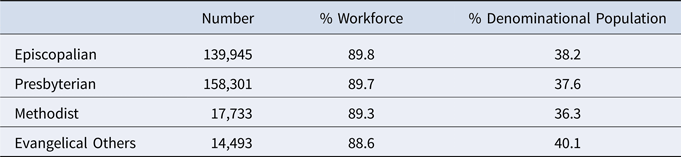
Taking this approach of composite categories further, by combining all of classes II (domestic), IV (agricultural), and V (industrial), as well as order 3.6 (conveyance), since this includes large numbers of railway workers, seamen, messengers, and porters, it is possible to construct a cohort that can be understood reasonably as working class. As tables 7 and 8 show, the proportion of the evangelical other workforce that could be considered working class is broadly similar to other denominational groups. However, slightly more of the overall evangelical other population is likely to be employed in a working-class job than the population of other Protestant denominations. This reflects the more urban character of evangelical others compared to the general population. Methodism was even more heavily concentrated in urban areas, and specifically Belfast. Indeed, Morris's study shows that, in 1911, 38% of all declared Methodist affiliates in Ireland were found in Belfast.Footnote 65 However, although Methodism had a similarly low proportion of agricultural workers and a high proportion of industrial workers, the rate of industrial workers among evangelical others is higher still. This is primarily a result of the large number of females, who were more likely than those of other denominations to be employed, and particularly to be employed in industry. As with industry, the creation of a composite category in commerce demonstrates an area of comparative overrepresentation within business, broadly defined. Combined, the main mercantile suborders represent 3% of the evangelical other total, more than double the rate for the population as a whole (1.3%). Indeed, despite the dataset containing only 2.3% of the province's population, it contains 5.4% of its business class.
Members of the Working Class, Selected Denominations.

Source: The figures in rows 2, 3, and 4 are derived from Census of Ireland, 1911: Province of Ulster, 11–35.
Members of the Workforce in Working-Class Occupations, Selected Denominations.

Source: The figures in rows 2, 3, and 4 are derived from Census of Ireland, 1911: Province of Ulster, 11–35.
Finally, it should be noted that the high proportion of evangelical others in industrial jobs does not indicate a lack of literacy; indeed, this was a highly literate group. The census enumerators calculated the rate of illiteracy from the proportion of the population aged 9 and above who self-reported as being unable to read and write. At 8.7%, this is fairly low, but it does mask significant denominational differences—Roman Catholics 14.7%, Protestant Episcopalian 6.1%, Presbyterian 2.8%, Methodist 1.9%, and Other 1.8%. The figure for evangelical others, 0.37%, is particularly striking.Footnote 66 Illiteracy was common among agricultural workers, and the relative lack of these among Ulster's evangelical others might go some way toward explaining the low levels of illiteracy. It might also be supposed that Belfast's factories would have provided employment for illiterate workers; indeed, some scholars suggest that the rate among general and factory laborers might be as high as 7%.Footnote 67 However, only three Belfast laborers from the dataset were illiterate, and the rate of illiteracy for Belfast's evangelical others is just 0.4%, compared to 3.6% in the general population. The emphasis placed by evangelical Protestants upon the Bible as the final authority on theological matters, as a reference text, and as a basic textbook for literacy skills, goes some way toward explaining this comparatively literate nature.Footnote 68 Indeed, the two main denominations that were significantly evangelical in outlook, Presbyterianism and Methodism, also have notably low rates of illiteracy. Further, the fracturing of evangelical denominations was frequently the result of disputes on matters of ecclesiology and doctrine. This required the ability to understand, articulate, and endorse what were sophisticated, and often obscure, points of theology, statements of faith, and denominational constitutions. Therefore, it is no surprise that the Reformed Presbyterians and the Brethren had the lowest illiteracy rates, at 0.2% each. By contrast, the Salvation Army, which based its separation from other denominations on outward displays such as uniforms and marching, and matters of piety such as temperance, as much as on its Arminian theology, had a still low but comparatively high rate of 0.7%.
The profile that emerges of Ulster's evangelical others defies traditional stereotypes of fundamentalists. In a province that was predominantly rural and with an economy heavily based on agriculture (though not in comparison with the rest of Ireland), this was, rather than a backward, rural, agrarian community, a disproportionately urban group, extremely literate and overrepresented in skilled trades, commerce, and industry.
III. Strong Religion and Strong Politics?
Ulster's Solemn League and Covenant was a highpoint of resistance to Home Rule. The short document summarized the grounds of opposition—material loss, threats to civil and religious liberty, denial of citizenship, jeopardizing imperial unity—and pledged signatories “in solemn Covenant, throughout this our time of threatened calamity, to stand by one another in defending, for ourselves and our children, our cherished position of equal citizenship in the United Kingdom, and in using all means which may be found necessary to defeat the present conspiracy to set up a Home Rule Parliament in Ireland.”Footnote 69 It was signed on Ulster Day, September 28, 1912, by 218,206 men aged 16 and over who represented 77% of the eligible population; a similarly worded Declaration was signed by 228,999 women, 72% of the qualified female population.Footnote 70 Of the 36,136 entries recorded on the database of evangelical others, there were 11,726 males who were 14 or older on the census date of April 2, 1911. Assuming a standard distribution of birthdays, half of those aged 14 would have reached 16 years and would thus be eligible to sign the Covenant by Ulster Day, and so all of those aged 14 or older were searched. Indeed, many of those who had not reached 16 years appear to have signed; two individuals from Belfast, Samuel Baird of Spencer Street and Nathaniel Barr of Dunvegan Street, were both recorded as 13 on the census, and thus, even if they turned 14 the following day, they could have been no older than 15 years and 5 months on Ulster Day. Nevertheless, both signed the Covenant. In sixty cases, insufficient information was given in the census returns to search the Covenant. These were usually residents of institutions, such as asylums, workhouses, and barracks, who were identified only by initials. However, these represent only 0.5% of the eligible total, and so are unlikely to impact the overall results. In a small number of cases, two entries with the same name and address were eligible to sign the Covenant, but only one signature was recorded. Often, it was possible to compare the signatures with the signatures for household heads on the census returns and thus determine which family member signed. However, in fifteen instances, it was not possible to positively identify the signee. These cases have been included in the aggregate figures but excluded from those which consider specific items of demographic data.
Adding together the total number of signings which have been positively identified, alongside those where the probability of signing is extremely high, gives a total of 4,536, or 38.7%. This is roughly half the rate that David Fitzpatrick has identified for the Protestant male population as a whole (77%). However, just as it is likely that some evangelical others did sign the Covenant but were impossible to track, it is almost certain that the overall rate of signing is slightly lower than Fitzpatrick suggests. Fitzpatrick notes that, “in the course of many individual searches,” he never found “an unmistakeably duplicated signature.”Footnote 71 However, during the process of comparing the dataset with Covenant signatures, several identical signatures were observed. For example, Robert Lilly of Foyle Street, Belfast, signed twice, while, not to be outdone, Thomas and Alexander Foreman, both of Knockbracken, signed three times each. There are also instances where several signatures purporting to represent different individuals are written in the same hand.Footnote 72 Nevertheless, even if both figures are taken to be broadly accurate, given the constraints of technology and the actions of some signatories, the signing rate among evangelical others is still so much lower than for the Protestant population as a whole that it demands explanation.
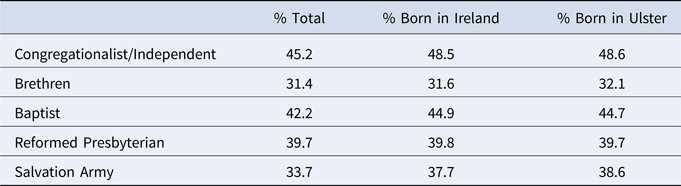
One obvious answer lies in geography. Although any males of sufficient age were eligible to sign the Covenant on the basis of their residence in Ulster, it might be supposed that those born outside the province were less militant. This is important, since only 89.7% of evangelical others were born in Ulster, compared to 93.8% of the entire population. Analysis of selected denominations make this relationship clearer (table 9). Congregationalists and Independents, Baptists, and Reformed Presbyterians were more likely than the evangelical other average to have signed, while Brethren and Salvationists were less likely. However, some of these denominations, particularly the Salvation Army, contain many members born outside Ulster. Birthplace analysis shows that the foreign-born population slightly lowers the signing rate for the population. If the scope is restricted to those born only in Ireland or Ulster, Congregationalists and, especially, the Salvation Army, were noticeably more likely to sign. The difference between Ireland and Ulster-only populations is not significant, which suggests that the large number of British-born Congregationalists and Salvationists affects the total for these groups. Conversely, the Reformed Presbyterians, with very few members born outside Ireland, are almost entirely unaffected. For evangelical others as a whole, if those not born in Ireland are excluded, the rate of signing is 40.2%, while for Ulster only it is 40.4%, and so the same pattern seems to hold.
Covenant Signing Rates among Eligible Males by Birthplace, Selected Denominations.

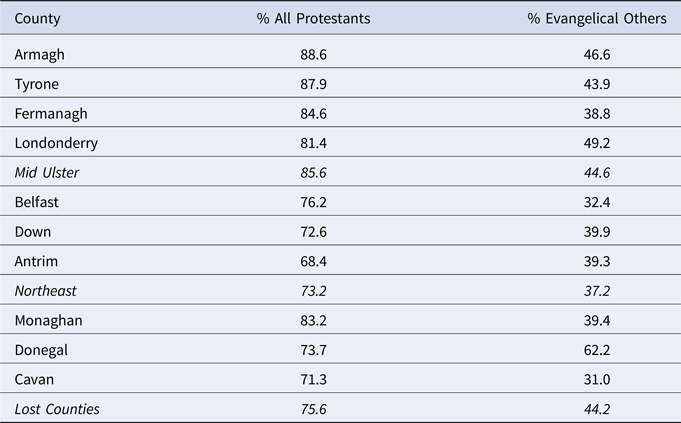
Fitzpatrick calculated the rate at which the Covenant was signed in each county. His analysis also included three regional groupings—the Northeast, Mid Ulster, and the so-called “lost counties.” The Northeast comprised heavily Protestant Antrim, Belfast, and Down; mid-Ulster comprised the geographically central and religiously mixed counties of Armagh, Fermanagh, Londonderry, and Tyrone; the “lost counties” comprised Cavan, Donegal, and Monaghan, which all had Catholic majorities, and which did not form part of Northern Ireland after the partition of the island in 1921. Comparison with Fitzpatrick's findings show that the pattern is fairly similar between the overall Protestant population and evangelical others (table 10). The only notable exception is in Donegal, which had an extremely high rate of signing. This was driven almost entirely by the county's large population of Reformed Presbyterians, who signed at the rate of 71.3%, close to the rate for the county as a whole, and not far off the overall Protestant rate for the entire province. If Reformed Presbyterians were excluded, the signing rate for Donegal would instead be much closer to the trend, at 44.1%. Otherwise, although there are a few variations, such as the rate being slightly lower in Belfast and slightly higher in Armagh, the broad trend between evangelical others and the overall Protestant population follows the same pattern.
Covenant Signing Rates, All Protestants and Evangelical Others, by County.

Source: The figures for “All Protestants” are from David Fitzpatrick, Descendancy: Irish Protestant Histories since 1795 (Cambridge: Cambridge University Press, 2014), 243.
It is also possible to compare these rates with the overall non-Catholic population in each county to determine whether what might crudely be considered the “Protestantness” of a county affects the rate at which evangelical others in that county signed the Covenant. The result is that counties with either large majorities or small minorities of Protestants tend to have lower rates of signing, although Donegal, for the reason given above, is a noticeable outlier. Those counties closer to denominational parity, however, tend to have higher rates of signing. Rather than being positively or negatively correlated with the non-Catholic population of a county, the strongest correlation can in fact be found in the “contested” counties. It seems likely that in the north east, Protestants comprised such a comfortable majority that the prospect of Home Rule seemed less immediately threatening. By contrast, Mid Ulster was a place of transition between Protestant and Catholic minorities, and so the threat of “Rome Rule” would have seemed much more pressing.
While geography goes some way toward explaining the lower rate of signing, the major difference between evangelical others and the wider Protestant population is their membership in particular denominations. As table 9 illustrates, there were significant differences in the rate of signing across the various denominational groups. Considering only those born in Ulster, almost half of all eligible Congregationalists and Independents signed. Baptists were more likely to sign than the average for evangelical others as a whole. However, less than a third of eligible Brethren signed, and both Reformed Presbyterians and Salvationists were slightly less likely than average to sign. In one sense, it might be surprising that so many, rather than so few, Brethren and Reformed Presbyterians signed. Section 1 noted that Brethren groupings were generally apolitical and did not vote as a matter of conscience. Calls to oppose the government, especially through the implied threat of violence, were unlikely to gain much support from a group that refused in many cases to bear arms and often believed that Christians should not be concerned with temporal government. The Reformed Presbyterians, meanwhile, were universally opposed to Home Rule, since it would almost inevitably increase the political power of Catholicism.Footnote 73 Nevertheless, signing the Ulster Covenant was unthinkable to many members of a denomination still commonly known as Covenanters, and who considered the seventeenth-century covenants a perpetual obligation. Indeed, the high number of Reformed Presbyterians who signed the Covenant in Donegal may reflect the fact that the congregation in Milford had only recently joined the denomination and may have been less committed to Covenanter principles.Footnote 74
The tension between opposition to Home Rule and willingness to sign the Covenant is perhaps most clearly evident in the case of ministers of religion. From the dataset, 135 entries who described their occupations as some synonym for minister of religion—whether preacher, pastor, evangelist, minister, or Salvation Army officer—were eligible to sign the Covenant, yet only 21 did so. The London Daily Mail canvassed Ulster's Protestant clergy for their views on Home Rule and published responses by 298 ministers on Ulster Day. The majority of responses were from the mainline denominations (145 Anglicans, 118 Presbyterians, and 15 Methodists), and so only 20 of the province's evangelical other ministers replied.Footnote 75 Morris has demonstrated how, even among the mainline denominations, overwhelming clerical opposition to Home Rule did not result in an equivalent enthusiasm for signing the Covenant. One of the main reasons was because doing so had the potential to embroil signatories in organized civil disobedience, perhaps even armed rebellion, to a legitimate government, though the outbreak of the First World War in September 1914 meant that potential was never tested.Footnote 76
A closer look at the Daily Mail respondents clearly demonstrates that this was also the case for evangelical others and to an even greater degree. Letters from nine members of the Baptist Union of Ireland were printed by the Daily Mail, unanimous in their opposition to Home Rule. Yet, only six Baptist ministers signed the Covenant, and only three of those who responded to the Daily Mail: William James Thomson of Clough, County Antrim, Burt Sharp of Donaghmore, County Tyrone, and Isaac Bell of Belfast.Footnote 77 The Reverend Alexander Jardine noted that he had “never taken an active part in politics or been connected with the Orange Institution” but believed that Home Rule would be disastrous. Nevertheless, his claim to trust in prayer as a solution appears to have been quite serious, as he was not among the signatories to the Covenant. Eight responses from members of the Reformed Presbyterian Synod were published by the Daily Mail; as might be expected, all of these were staunchly opposed to “Rome Rule,” yet none signed the Covenant.Footnote 78 Once more, there was a clear division between the clergy and the laity, and it is significant that the Reformed Presbyterian Church did not explicitly forbid its members to sign the Covenant.Footnote 79
IV. Conclusion
The necessity of disaggregating conservative forms of Protestantism is obvious; so too is the need to question widely held assumptions about their character and outlook. The evangelical others of Ulster described in this article fit the social profile of similar groups in the United States who can be labelled fundamentalist. The evidence challenges the stereotype of this shared constituency as anti-intellectual, rural, uncouth, and opposed to modernity. This group was disproportionately urban, exceptionally literate, and overrepresented in skilled trades, commerce, and industry. Their strong, self-selecting religious conservatism was an expression of an alternative intellectualism that was sophisticated and coherent and not simply a rejection of modern thought. Altogether, they comprised a conservative evangelical subculture out of which a self-conscious fundamentalism may have emerged later in the century. However, that did not happen in the interwar period. The campaign against modernism within the Presbyterian Church neither produced a numerically large secession from within its ranks nor a significant self-described fundamentalist constituency.Footnote 80
In addition, the strong relationship between fundamentalism and conservative unionist politics seems to have been a product of the growing political turmoil of the 1960s. Though evangelical others were more likely to support Paisley, the religious culture of this group in the earlier period cannot be reduced to militant opposition to “Rome Rule.” As Bruce observed, there is no simple relationship between evangelicalism and ultraunionist politics because evangelical religion lends itself to a variety of political agendas. Evangelical others were twice as likely not to express their opposition to Home Rule by signing the Ulster Covenant, though most supported the Union between Ireland and Great Britain. This lack of political militancy during one of the moments that defined modern political unionism is striking. It emphasises the significance of temporal context and further challenges the simple conflation of conservative religion and conservative politics. In this case, a commitment to personal conversion, pietistic holiness, and denominational convictions trumped political posturing. Evangelical others, it seems, could be too heavenly minded to be of any earthly use.