Introduction
Over the past 30 years, there has been substantial research on the intricate relationship between economic development and fertility decline. While there is some disagreement among social scientists on the influence of family planning programmes and other factors on fertility decisions, there appears to be widespread consensus that improvements in education have played an important role (Cochrane, Reference Cochrane1979; Caldwell, Reference Caldwell1982; Cleland & Rodriguez, Reference Cleland and Rodriguez1988; Jejeebhoh, Reference Jejeebhoy1995; Jeffrey & Basu, Reference Jeffery and Basu1996; Bledsoe et al., Reference Bledsoe, Casterline, Johnson-Kuhn and Haaga1999).
The theoretical literature on the determinants of fertility-related behaviour points to three pathways that can potentially explain the relationship between education and fertility decline. First, women's and men's own educational experiences affect childbearing behaviour by increasing the opportunity cost of childrearing, by increasing women's empowerment and facilitating the spread of Western family values (Caldwell, Reference Caldwell1980; Axinn & Barber, Reference Axinn and Barber2001). Second, as the availability of education opportunities increases, having children enrolled in schools influences subsequent fertility decisions of parents by reducing children's potential to work inside and outside the home (Caldwell, Reference Caldwell1980), by parents learning new information about the costs and benefits of childrearing (Bulatao & Lee, Reference Bulatao and Lee1983; Easterlin & Crimmins, Reference Easterlin and Crimmins1985) and by emphasizing the value of children as future producers rather than as present producers (Caldwell, Reference Caldwell1980). If parents have full information about the costs of childbearing and make future fertility and schooling decisions simultaneously (simultaneous models) or if they have their first child, learn costs of childbearing and then adjust their decision to whether to have more children (sequential models), then the overall effect of mass schooling is to reduce the desired number of children (Axinn & Barber, Reference Axinn and Barber2001). A third possible pathway posited by Caldwell (Reference Caldwell1980) as part of his mass-schooling hypothesis is that, independent of the household's exposure to formal education, expansion in the availability of schools in the community speeds up cultural change and propagates Western middle-class values, including the view that parents are obligated to send their children to school, which in turn influences fertility-related behaviour.
While there is a large body of empirical evidence that suggests that parents' own level of education is associated with lower levels of fertility, after controlling for other factors, there is relatively little evidence of the effects of the overall school environment and availability of schools in the community. This paper explores the influence of primary and secondary gross enrolment ratios during women's childhoods on fertility in rural Nepal, a country which, given its rapid fertility decline in recent years, provides an interesting opportunity to investigate the role of education in childbearing.
Among twenty-nine developing countries that have available multiple rounds of nationally representative population-based data from the Demographic and Health Survey (DHS), the pace of the fertility decline in Nepal in recent years has been more rapid than in any of the other Asian, African and Latin American countries analysed (Bongaarts, Reference Bongaarts2008). From 1996 to 2006, the total fertility rate (TFR) dropped from 4.6 to 3.1 births per woman, a decline of 33% (Ministry of Health and Population et al., 2007). In rural areas, the TFR dropped from 4.8 to 3.3 births per woman, a decline of 31%, and among women without any formal education the TFR dropped from 5.1 to 3.9 births per woman, a decline of 24% (Ministry of Health and Population et al., 2007).
During the same period, Nepal made impressive gains in primary school enrolment. For example, between 1995–96 and 2003–04, the percentage of children 6–10 years of age enrolled in school increased from 62% to 79%, an increase of 27%. Enrolment also increased substantially among older children and young adolescents. For example, among children 11–15 years of age, the percentage enrolled in school increased from 64% to 75%, an increase of 17% (World Bank, 2006).
Remarkably, these changes occurred at a time when Nepal was experiencing a Maoist insurgency, which damaged private and public infrastructure and may have compromised social and health services in rural areas, including schools and family planning services (Government of Nepal, 2006). While Axinn & Barber (Reference Axinn and Barber2001) found that mass schooling had already begun to contribute to fertility decline by 1996, we find evidence that its effects continued to be crucial during the subsequent decade, independent of whether women themselves had any schooling.
The study is based on data collected from rural women through the 2003–04 Nepal Living Standards Survey (NLLS), from the National Population Census of Nepal and from the Statistical Yearbook of Nepal, the latter two published by the Nepalese Government. The NLLS data are cross-sectional and consist of household-level data gathered through a nationally representative and comprehensive household survey that contained questions on fertility and its individual- and household-level determinants. The Census and Statistical Yearbook data are used to measure the childhood schooling environment of sample women, one of the hypothesized determinants of fertility behaviour.
Literature review
Education is considered one of the main determinants of reproductive behaviour (Shreffler & Dodoo, Reference Shreffer and Dodoo2009). Because of the intricate and multidimensional relationship between these two variables, the theoretical and empirical literature linking education and fertility is vast. Although an exhaustive review is not part of the present scope, the focus of this paper leads to the emphasis of two lines of contributions to the literature. The first relates to the parents, especially the woman's own level of schooling, and the second relates to socioeconomic changes in the community caused and reinforced by mass schooling.
Regarding the effects of women's own level of schooling, the empirical evidence of its importance is strong at both the individual level (comparing the education levels of women within the same country) and the country level (comparing the average educational level of women across different countries) (Shreffler & Dodoo, Reference Shreffer and Dodoo2009). Women's education can influence fertility behaviour in a numbers of ways. First, new knowledge gained at school makes women more likely to limit their fertility through birth control methods (Axinn & Barber, Reference Axinn and Barber2001). Second, exposure to schooling spreads Western family values that emphasize small families and give women more status and autonomy to make decisions (Caldwell, Reference Caldwell1980, Reference Caldwell1982; Caldwell et al., Reference Caldwell, Reddy and Caldwell1985; Axinn & Barber, Reference Axinn and Barber2001; Conley et al., Reference Conley, McCord and Sachs2007). Economists argue that education increases the economic value of women's time and, as a result, the opportunity cost of childbearing (Becker, Reference Becker and Becker1960; Coleman, Reference Coleman1990; Diamond et al., Reference Diamond, Newby, Varle, Bledsoe, Casterline, Johnson-Kuhn and Haaga1999; see Boca & Sauer, Reference Boca and Sauer2009, for a recent theoretical contribution). Nevertheless, Lavy & Zablotsky (Reference Lavy and Zablotsky2011) found that education reduced fertility, even in the case of Muslim women in Israel when there was not a meaningful increase in women's participation in the labour market. The authors speculate that the increase in female education must have impacted Arab women's fertility through other channels, such as knowledge and ability to process information about fertility and contraception options and spousal education through assortative mating. Thus, as argued by Schellekens (Reference Schellekens2009), education may affect fertility not only through all these channels but also by changing the women's overall socioeconomic status. Conley et al. (Reference Conley, McCord and Sachs2007), Shreffler & Dodoo (Reference Shreffer and Dodoo2009) and McCrary & Royer (Reference McCrary and Royer2011) present an exhaustive description of the empirical literature that finds a negative relationship between mothers' education and parity. However, it is not always the case that more educated mothers have lower parity. As Schellekens (Reference Schellekens2009) points out in his literature review, (1) greater family income of more-educated individuals makes a larger family more affordable (Freedman et al., Reference Freedman, Baumert and Bolte1959); (2) education may lower childrearing costs since more-educated mothers are more efficient in childrearing (Michael, Reference Michael1973); (3) educated women are more likely to find jobs with flexible work hours (Kravdal, Reference Kravdal2001); and (4) although higher levels of education may be associated with greater foregone earnings, they tend to be associated with fewer lost hours and years over the lifetime (Calhoun & Espenshade, Reference Calhoun and Espenshade1988). Some empirical research finds that education did not lead to decreased fertility. In developed countries, this includes studies in Norway (Monstad et al., Reference Monstad, Propper and Salvanes2008), Norway and the United States (Kravdal, Reference Kravdal1992), Sweden and Britain (Hoem, Reference Hoem1993; Ní Bhrolcháin, Reference Ní Bhrolcháin and Ní Bhrolcháin1993) and the United States (McCrary & Royer, Reference McCrary and Royer2011). In developing countries, as pointed out by Axinn & Barber (Reference Axinn and Barber2001), some studies have found that initial increases in women's education may be associated with increased fertility, such as among young women in the rural community of the Buddhist Tamang, in the Nepalese Himalayas, when fertility limitation and education were just beginning to spread (Axinn, Reference Axinn1993; see also Cochrane, Reference Cochrane1979; Singh & Casterline, Reference Singh, Casterline, Cleland and Hobcraft1985).
Concerning community-level effects, it is well known that modernization affects how parents make fertility choices. Caldwell's (Reference Caldwell1980) pioneering work elucidates the mechanisms through which mass education interacts with socioeconomic variables and, thus, with fertility. In critiquing the literature on education and fertility, Caldwell argued that researchers had neglected the impact of children's schooling on reproductive decision-making and had concentrated instead on the impact of parent's own education on subsequent fertility (Sathar et al., Reference Sathar, Lloyd, Mete and Haque2000). According to Caldwell, children's schooling reduces the child's potential to work inside and outside the home as it subtracts hours from the day as a result of school attendance and homework. It also increases the costs of childbearing as a result of school fees and the costs associated with the purchase of uniforms and other types of clothing, books, stationery, supplies and other items necessary to attend school. In brief, the child becomes a future rather than a present producer, and society expects the family to protect its investment in the child for future returns (Caldwell, Reference Caldwell1980). This insight is consistent with classical microeconomic theory of fertility where parents choose to limit the quantity (number) of children in order to increase the quality of children through education and other human capital investments (Becker, Reference Becker and Becker1960).
Put another way, education speeds up and reinforces cultural changes, propagating the values of the Western middle class in developing countries (Caldwell, Reference Caldwell1980; Axinn & Barber, Reference Axinn and Barber2001; Fernández & Fogli, Reference Fernández and Fogli2009); and the more the community is influenced by these values, the larger the decline in fertility. It is argued here that the improved availability of educational opportunities at the community level, via the above-mentioned cultural and economic changes, has the potential to contribute to the decline in fertility, not only among educated women, but also among uneducated women living in rural areas.
Although it has been 30 years since Caldwell first proposed his mass-schooling hypotheses, there are only a handful of studies that have explored the empirical linkages between schooling opportunities at the community level and fertility behaviour. For example, Casterline (Reference Casterline1985) found that current contraceptive use was affected positively by the village primary school enrolment ratio for girls but negatively by the primary school enrolment ratio for boys in rural areas of Egypt. Using longitudinal data from Indonesia, Gertler & Molyneaux (Reference Gertler and Molyneaux1994) found that the number of junior high schools per 1000 population was positively and significantly related to the use of modern contraceptive methods and negatively and significantly related to fertility, but that the number of primary schools per 1000 population was negatively and significantly related to the use of modern contraceptive methods and positively and significantly related to fertility. Guilkey & Jane (Reference Guilkey and Jayne1997) found that the number of schooling opportunities in the community had a positive and statistically significant effect on contraceptive use, after controlling for other factors in Zimbabwe. Lloyd et al. (Reference Lloyd, Kaufman and Hewett2000) found a strong empirical link between the achievement of mass schooling and the onset of the fertility transition in sub-Saharan Africa.
However, researchers who have more recently conducted empirical research on this issue recognize that estimating the effects of mass education on fertility presents major challenges. To start, these two variables may be endogenous. When testing the Caldwell hypothesis for Pakistan, Sathar et al. (Reference Sathar, Lloyd, Mete and Haque2000) argue that the availability of schools and fertility decisions are often made simultaneously since schools are often constructed through parents' petitions. In their analysis, the authors chose to include only districts whose schooling rates were not entirely explained by the levels of income in an attempt to capture variations of school supply (instead of demand) conditions. Conley et al. (Reference Conley, McCord and Sachs2007) used malaria transmission as an instrument since it is presumably exogenous to fertility. Lee (Reference Lee2008) proposed an instrumental variable approach that exploits the sex of the first baby which, in a society where there is a strong preference for sons (South Korea), should be a good predictor of parents having another child.
On the other hand, since endogeneity can, at least in principle, be attenuated by the use of an instrumental variable approach, the main challenge seems to be how to address the timing of events. Axinn & Yabiku's (Reference Axinn and Yabiku2001) theoretical and empirical contribution shows that not only current but also past individual and community characteristics affect a mother's childbearing decisions. In addition, the effects of past and present contexts shape fertility in independent ways. For instance, Axinn & Barber (Reference Axinn and Barber2001) found that a mother's childhood access to school, independently if she attended school or not, affects her fertility behaviour. This finding was independent of other past and current variables, such as whether her husband attended school or whether she lived near a school in adulthood. Edmeades (Reference Edmeades2008) argued that, while research on current contextual factors affecting fertility is well established, not enough attention has been devoted to the effects of past contextual factors and behaviour. Failing to account for them introduces the possibility of omitted variable bias in fertility models. Using data from Thailand, he found that contraceptive behaviour is particularly responsive to current community context, with past context primarily exerting an indirect effect on behaviour through shaping current contextual influences. Given the richness of the present study's data, it is possible to control for past contextual factors in the estimations.
The dynamics over time of fertility processes themselves must also be taken into account. In virtually every demographic transition, urban fertility declines first. However, in the post-transition period, marital fertility in rural areas is often only slightly higher than in urban regions (Kulu et al., Reference Kulu, Vikat and Andersson2007). In Nepal, the urban fertility rate is already at replacement levels, while the rural rate seems to be dropping fast (Karki & Krishna, Reference Karki and Krishna2008). Since TFR reflects changes made in the past, it is not expected to completely reflect those rapid and recent changes. In addition, in line with Axinn & Yabiku's (Reference Axinn and Yabiku2001) argument on the importance of past experiences, while young women's future plans on fertility depend on future contingencies, they may change their minds as they update their information on current income and previous parity experiences, for instance (Kulu et al., Reference Kulu, Vikat and Andersson2007; Hayford, Reference Hayford2009). This study proceeds as Adsera (Reference Adsera2005), Philipov et al. (Reference Philipov, Spéder and Billari2006), White et al. (Reference White, Muhidin, Andrzejewski, Tagoe, Knight and Reed2008) and Schellekens (Reference Schellekens2009) and includes parity as a time-varying covariate; parity for a woman increases by one if she had a birth in the prior year. This methodology also allows the capture of a possible shift in childbearing profile associated with the demographic transition: mothers may be delaying childbearing (Gustafsson, Reference Gustafsson2001; White et al., Reference White, Muhidin, Andrzejewski, Tagoe, Knight and Reed2008).
Methods
The primary source of data for the analysis is the 2003–04 Nepal Living Standards Survey (NLSS), a nationally representative multi-purpose household survey conducted by Nepal's Central Bureau of Statistics with assistance from the World Bank. Designed to assess living standards of the Nepalese population, the questionnaire includes questions regarding consumption, income, assets, housing, education, health, fertility, migration and employment, among other topics. The survey follows the Living Standards Measurement Survey (LSMS) methodology developed by the World Bank and applied in more than 50 developing countries. The LSMS data have been used extensively in previous studies to investigate the determinants of fertility and contraceptive use in developing countries (Bhushan & Oliver, Reference Bhushan, Oliver, Grosh and Glewwe2000). The 2001 Population Census of Nepal provided the basis for the survey's sampling frame. Further details on the sampling strategy and questionnaire can be found in World Bank (2006).
To test Caldwell's mass-schooling hypothesis, it is important to measure characteristics of the schooling environment when each woman was a child. Possible measures of the schooling environment include the net enrolment ratio, the gross enrolment ratio and the attendance rate. As is the case in many developing countries, there is limited availability of these data because schooling data have not been systematically collected in Nepal until recently. The NLSS administered community questionnaires to collect information on the presence of schools and the number of years these schools have been open, but using these data would be problematic since the NLSS was not designed to be representative at the district level. Two other possible sources of data are the National Population Census of Nepal and the Statistical Yearbook of Nepal, both published by the Government of Nepal. Neither of these sources contains systematic schooling information in every publication. However, the census conducted in 1971 included the total number of students in each district attending primary and secondary school that year (Government of Nepal, 1971), and the Statistical Yearbook of 2007 (Government of Nepal, 2007) contains the total number of students in each district attending primary school from 1994 to 2003 and the total number of students in each district attending secondary school from 1997 to 2003.
Each of the sources of schooling data, the Census and the Statistical Yearbook, presents advantages and limitations. The census has the advantage of providing information as far back as 1971. However, unfortunately, the 1981 census data do not include the number of current students (Government of Nepal, 1981). Data are available on the educational attainment of individuals, but this information is available only at the regional level, not the district level. The 1991 census data, on the other hand, do not include the number of students of all ages (Government of Nepal, 1991). Thus, the census data are clearly not comparable across years. The Statistical Yearbook, on the other hand, was more recently published, may be more reliable, but only presents information for more recent years.
Based on these data issues, two approaches are adopted. In the first, census data and mathematical interpolations are used to estimate the number of students attending primary and secondary schools in each of the years that these variables are missing, as described below. However, considering these data substantial limitations, one must be cautious about the results. Thus, in the second approach, the more concrete Statistical Yearbook data are used and the age of the mothers included in the estimations limited to 30 years or younger. As will be discussed later in this article, both procedures yield qualitatively similar results, providing robustness to the analysis.
Since population estimates are needed for public policy and managerial purposes and are made available on a regular but infrequent basis, such as censuses, which are conducted every 10 years, a wide variety of estimation techniques have been developed (Bryan, Reference Bryan, Siegel and Swanson2004). Intercensal estimates, which relate to estimates for a year in between two censuses, as in this paper's case, can be obtained either by mathematical interpolative techniques or by methods that require additional, sometimes called ‘symptomatic’, data (Bryan, Reference Bryan, Siegel and Swanson2004). One example of the latter is the Component Method, which uses data on birth, death and migration to estimate the population in between censuses. However, these kinds of data are often unavailable for geographical subdivisions, especially in undeveloped countries and for specific groups, such as the number of students. Besides, although evaluation studies show that mathematical methods are not very reliable for making post-censal population projections for geographical subdivisions, they are much more reliable when used to prepare intercensal estimates (Bryan, Reference Bryan, Siegel and Swanson2004). Thus, in this analysis, mathematical interpolation is used to impute school enrolment data for missing years.
Numerous mathematical interpolation methods are available, ranging from very simplistic to extremely complex ones. However, many of the most complex interpolative functions will generate estimates that are nearly identical to simple ones, minimizing the debate about which method to use (Bryan, Reference Bryan, Siegel and Swanson2004). Thus, the total number of students (of any age) enrolled in primary school in 1971 (from the Census) and in 1994 (from the Statistical Yearbook) is used to construct a district-level, annual series of estimates of the number of primary school students between these two dates using geometric interpolation. Specifically, the growth rate of primary students is computed using the formula:
 $$r=[(number of primary students in 1994)/(number of primary students in 1971)]^{(1/23)}-1$$
, and, subsequently, the number of primary students in each year was estimated by:
 $$(number of primary students in year t)=(number of primary students in 1971) (1+r)^{(t-1971)}, t=1972, 1973, \ldots , 1993$$
.
The same procedure is used to estimate the number of secondary students between 1971 and 1997. In addition, the censuses of 1971 and 2001 contain information on the age distribution of the population for each district and, also using geometric interpolation, a district-level annual series of population is constructed. Thus, the primary and secondary gross enrolment ratios could be estimated by dividing the number of individuals who are estimated to have been enrolled in school by the number of children who were of the corresponding school enrolment age.
This method presents significant limitations. First, since multiple sources are used, the Census and Statistical Yearbook data should be comparable. Second, as in any mathematical interpolation, some assumptions must be made as to the trend of the population change (Bryan, Reference Bryan, Siegel and Swanson2004). Specifically, it is assumed that the population groups are growing exponentially at a constant rate during the study period, which, in this case, includes more than two decades. On the other hand, despite these limitations, this uses the scarce data available in the best possible way. Moreover, it should be pointed out that the main goal was not to precisely estimate the number of students in each year of the study period but to construct a proxy for the school environment across districts during those years. Thus, we are interested in the variability of these variables, not in their exact levels.
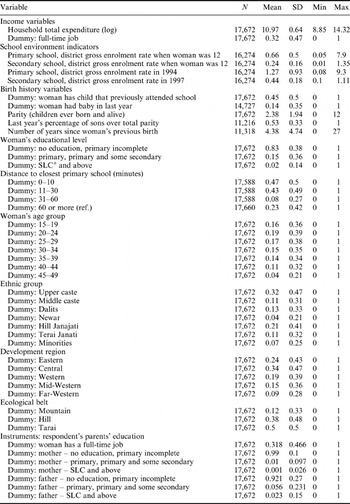
Given these data limitations, in the second approach the 1994 primary gross enrolment ratio and the 1997 secondary gross enrolment ratio, computed directly from the Statistical Yearbook, are used as proxies for school environment during the women's childhoods and, as mentioned above, the analysis limited to women 30 years and younger. The survey data from the NLSS contain information on 2946 rural ever-married women of reproductive age (from 15 to 45 years). The analysis is restricted to ever-married women because never-married women were not asked about their fertility history. However, as described next, the data are used to reconstruct the women's yearly birth histories from 5 years before the interview to the interview date, a total of 6 years. Thus, the total number of observations is 17,672 (current observations plus five lags; however, there were four observations in which the data on the number of living children seemed to contradict the data on children's educational level, leaving 17,672 observations). The list of variables and descriptive statistics are presented in Table 1.
Descriptive statistics of study sample, Nepal 2003–04
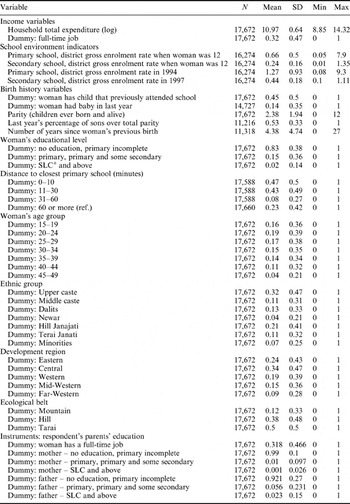
a SLC, school leaving certificate.
The goal of the analysis is to estimate the determinants of fertility. Specifically, Schellekens' (Reference Schellekens2009) methodology is followed, which entails reconstructing the women's birth history for 5 years. This is possible since the NLSS data contain retrospective data on each woman's fertility history, including the date of birth of each child. The paper's main dependent variable, yit, is binary and equal to one in year t if woman i gave birth between years t−1 and t. This variable is constructed for t=0 (interview date), −1, −2, −3 and −4 (4 years before the interview). For instance, this variable is equal to one in year t=−4 if the women had a baby between the years t=−5 and t=−4. One advantage of using Schellekens' (Reference Schellekens2009) method is that it is possible to run parity-specific regressions. For instance, it is possible to estimate, at time t, the probability of a woman who had a certain number of children alive in year t−1 giving birth to another child between the years t−1 and t. This is especially relevant since, as discussed in the next section, the results show that education has a larger effect among women of higher parities.
Given that the main dependent variable is discrete, the logit model of probability is used throughout. Specifically, denoting the probability that woman i gives birth between the years t−1 and t by:
 $$\pi_{it}=Prob(y_{it}=1|{\bi x}_{it})=F({\bi x}^\prime_{it}{\bi \beta})$$
, where xit is the vector of control variables, β is the vector of parameters to be estimated and F(.) is the cumulative logistic distribution. It is convenient to re-write this equation in terms of the log-odds that yit=1:
 $$log [\pi_{it}/(1-\pi_{it})]=F^{-1}(\pi_{it})=\beta_0+x^prime_{it}\beta_1$$
, where β 0 is a constant term and β1 is the vector of all parameter but that of the constant. This general specification is modified to accommodate different assumptions regarding the possible inclusion of random effects and the variance–covariance structure of the data.
Independent variables that potentially change over time are also included in the model. For instance, the woman's and child's level of educational attainment and ages were obtained by backdating information from the year of the survey. It was possible to determine past education with a considerate degree of certainly since the data contain information regarding the mothers' and the children's past and current school enrolment, even if the children do not currently live at home.
Because the study's main interest is to assess the effects of education on fertility, the proxies for the schooling environment at the time the woman was a child, as described earlier, are among the independent variables of interest. When including these variables in the regression, it is important to point out that migration within rural areas is common in Nepal. In fact, the results from the NLSS suggest that more than 70% of women in rural Nepal had ever migrated across districts. To address this issue, women are linked to their schooling environment when they were children through the use of information collected on past migration. Specifically, if the woman had migrated to her current district after she was 10 years old, the information from the district of her previous residence was used.
The woman's level of education is also controlled for and, following Axinn & Barber (Reference Axinn and Barber2001), a dummy variable measuring whether the woman has any child that has ever attended school is included. In line with Caldwell's mass-schooling hypothesis, a mother may have less incentive to have children when she has learned the costs associated with education. The data also present information on the current availability of schools. Specifically, dummy variables corresponding to the distance between the respondent's home and the closest primary school are included.
Other determinants of parity have been studied in the literature and, to investigate the effects of mass education, it is important to control for them in the estimations to avoid omitted variable bias. The first one is the socioeconomic status of the woman. One approach is to include proxies for expenditure and employment. Information on household expenditure (monetary and non-monetary) and on the respondent's job market participation is available in the present data, but only their current levels. Thus, the previous values of these variables must be proxied by their current ones. Facing a similar challenge, Schellekens (Reference Schellekens2009) only included women's educational level. However, since this study's main research question is about the effect of education on fertility net of all other effects, this approach would not be appropriate. Since the longer the time period the more problematic this procedure, the robustness of the results is tested by including only three lags.
The interdependencies between fertility and women's labour force participation and between fertility and income are well documented (Becker, Reference Becker and Becker1960, Reference Becker1965; Mincer, Reference Mincer1962; Willis, Reference Willis1973; Soares & Falcao, Reference Soares and Falcao2008; Matysiak, Reference Matysiak2009; Fang et al., Reference Fang, Eggleston, Rizzo and Zeckhauser2010). Thus Terza's et al. (Reference Terza, Basu and Rathouz2008) methodology was used to control for the endogeneity. While the traditional approach would be to use instrumental equations, Terza et al. (Reference Terza, Basu and Rathouz2008) showed that extending the techniques derived for linear models to non-linear ones, which are estimated in this analysis since the main dependent variable is discrete, produces inconsistent estimates. He proposed a simple and consistent alternative.
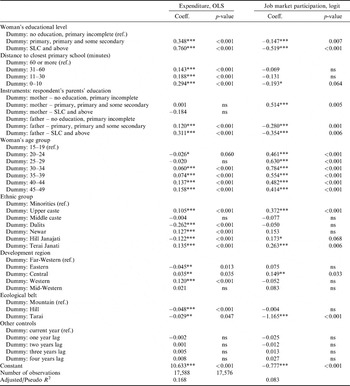
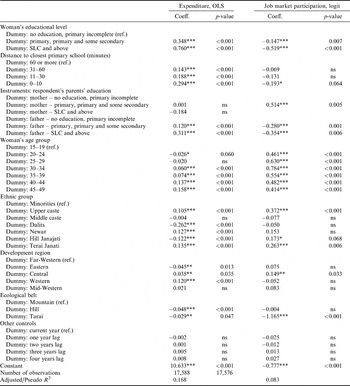
The first step is to estimate the reduced form of the equations of expenditure and job market participation. For identification purposes, the educational level of the parents of the respondent woman is included in both equations. While the expenditure equation is estimated by OLS, the job market participation is estimated using the logit model of probability. The Huber/White variance–covariance estimator is used in both regressions to control for the possibility of non-standard errors. The results are presented in the Appendix. Second, the estimates are used to predict the residuals in both models. Finally, the predicted residuals are included in the estimation of the main model of interest. The level of significance of the residuals' coefficients constitutes a test of the endogeneity of expenditure and job market participation.
The time series component of the data is likely to be temporally dependent. Thus, the number of years between the previous birth and t−1 is included as an independent variable for the cases where parity at t−1 is larger than zero. In addition, since fertility has fallen rapidly in Nepal, dummies for each time period are included. The existence of son preference, which is likely to be an important factor in Nepal, is also accounted for by controlling for the sex composition of previous children. Dummies for age groups, ethnicity, economic regions and ecologic zones are included to capture the effects of age and other unobserved factors.
Since women generally contribute more than one year to the analysis, it is important to investigate the possibility of unobserved heterogeneity between women before the results are interpreted. This possibility is examined by modifying equation (1) to:
 $$F^{-1}(\pi_{it}=\beta_0+x^\prime_{it}\beta_1+u_i$$
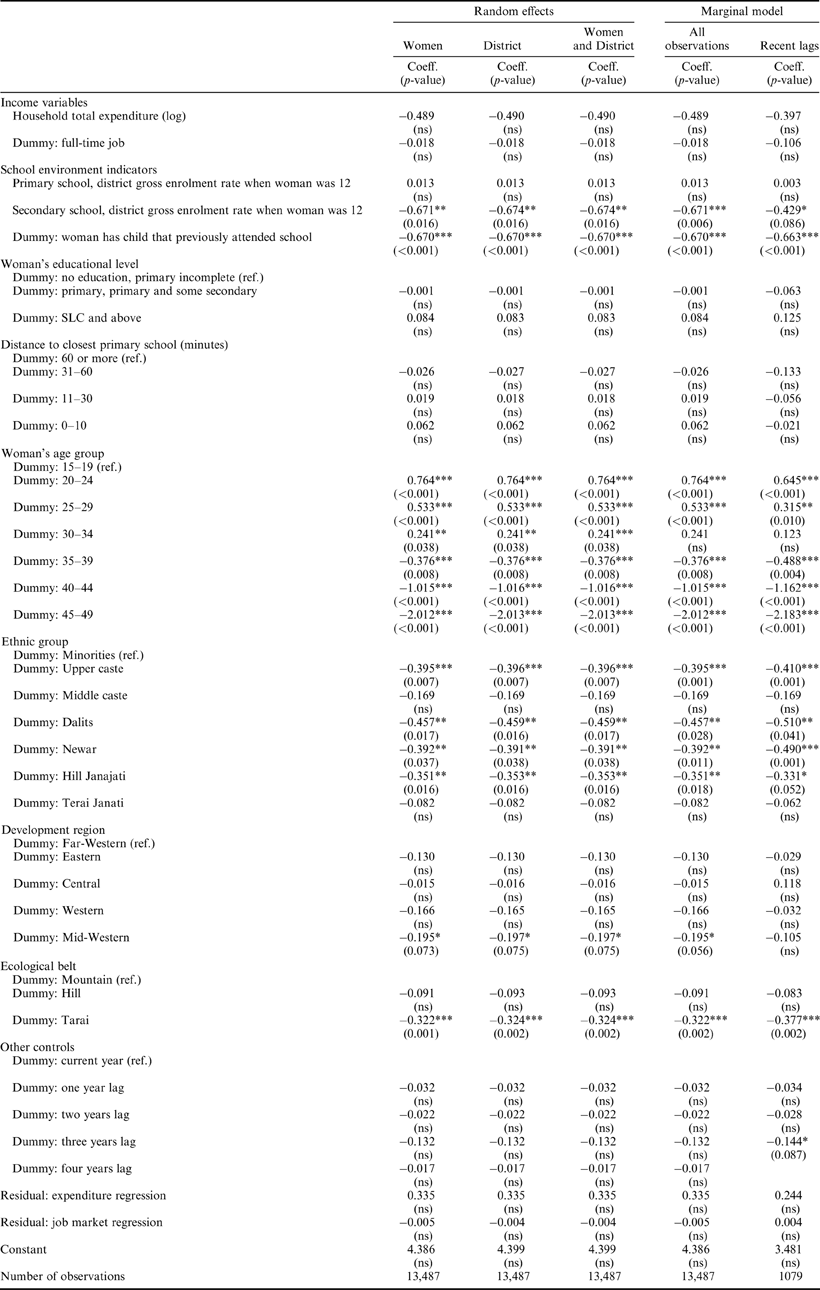
, where the intercept β 0 is shared by all women while the random intercept ui is specific to women i and follow a normal distribution with mean zero and variance σ2u. The results are reported in Table 2, column 1. The estimated rho (intra-class correlation coefficient) is 1.22×10⁻⁶ and the p-value of the likelihood test that rho is different from zero is 0.488. Thus, there is no evidence of unobserved heterogeneity between women that is not already accounted for by the covariates.
Logit model estimates of the probability of giving birth, Nepal 2003–04
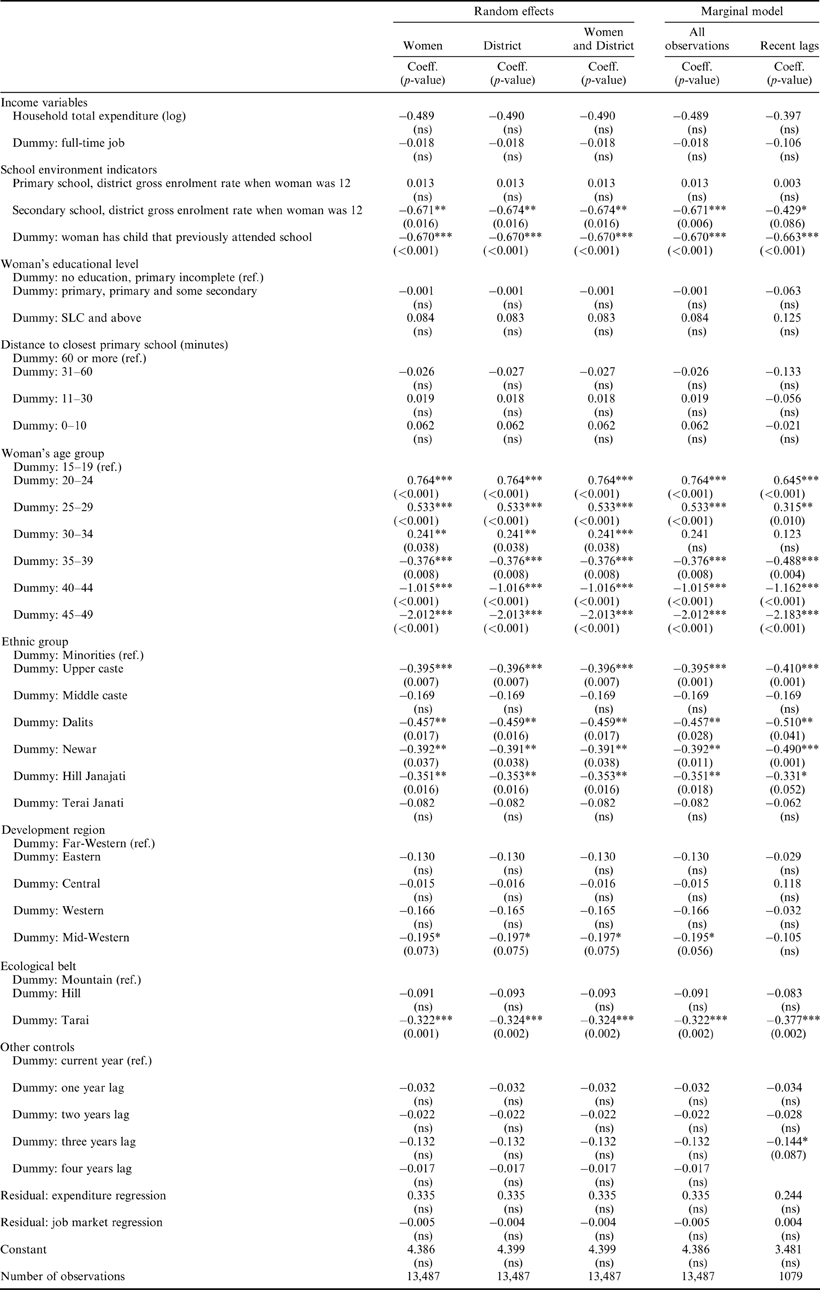
***p<0.01; **p<0.05; *p<0.1.
A model is also estimated including a random intercept for each district (Table 2, column 2). The model being estimated is:
 $$F^{-1}(\pi _{ijt})=\gamma_0+{\bf x}^\prime_{it}{\bf \beta}_1+w_j$$
, where the intercept γ 0 is shared by all districts and the random effect wj∼N(0, σ 2w) is specific to district j. In this case, the estimated rho is 0.0004 and the p-value of the likelihood test that rho is different from zero is 0.434. Thus, there is also no evidence of unobserved heterogeneity between communities. For completeness, a hybrid model containing both of the above-mentioned random intercepts is estimated, one for each women, one for each community, independently normally distributed and following the same distribution assumptions as before. The results, presented in column 3 of Table 2, also show no evidence of unobserved effects. The p-value of the likelihood test comparing the random effect model versus the logistic regression is 0.9864. Although this test is considered conservative (McLachlan & Basford, Reference McLachlan and Basford1988; Stram & Lee, Reference Stram and Lee1994), it is reported as a reference since the qualitative results do not change.
However, the random effects model assumes that the random components and the independent variables are uncorrelated. If this assumption is not satisfied, the estimations described above are invalid and there may be unobserved effects unaccounted for. Another possibility is to use the marginal model (also known as population-averaged panel-data model), which addresses the correlation structure explicitly. Specifically, a marginal model consists of two components: (i) a generalized linear model specifying the relationship between the response probability and the predictors; and (ii) a specification of the structure of the correlations between pairs of individuals in the same clusters, in this paper's case, districts and women (Steele, Reference Steele2009). The approach used by Miglioretti & Heagerty (Reference Miglioretti and Heagerty2007) is followed to estimate the marginal models by GEE and obtain confidence intervals that are still valid, even if there are multiple levels of clustering. Specifically, since cluster levels are nested (each women is in only one community), Miglioretti & Heagerty (Reference Miglioretti and Heagerty2007) show that the analysis requires only clustering on the top-level cluster and the use of the Huber/White variance estimation method (contact authors for details).
Results
This section presents the marginal model estimation results. Note that, although the tables include the dummies for age groups, ethnicity, economic regions and ecologic zones, these are not discussed in order to save space. This section focuses on the effects of parity- and education-related variables, among others, on fertility, which constitute the main scope of this paper.
The results of the determinants of fertility among sample rural women are presented in Table 2, column 4. When all women – regardless of parity – are included in the estimations and controlling for all the covariates in the model, neither expenditure nor the dummy indicating whether the woman has a full-time job are significant determinants of fertility. There is also no evidence that these variables are endogenous given the insignificance of their respective residuals' coefficients. As described above, this study is interested in the effects of education through three separate pathways: (1) the effect of women's childhood schooling environment; (2) the effect of women's own level of education; and (3) the effect of having an older child enrolled in school. Regarding the first type of effect, the estimation results suggest that the district-level primary school gross enrolment ratio during the woman's childhood is not associated with fertility. On the other hand, the district-level secondary school gross enrolment ratio is found to be negatively and significantly associated with fertility, as hypothesized. The effect of women's own level of education, as measured by two dummy indicators of whether the woman has attended primary and secondary schools, is not found to be statistically significant.
Also found to be significant is the effect of having an older child that previously attended school, which is the variable that indicates whether the woman is aware of the costs associated with education. It is important to mention that current availability of schools, also included in the model, may result in endogeneity if families migrate in search of better schools for their children. If this is the case, parity is influencing the school environment, the reverse of Caldwell's hypothesis. However, the results show that current school availability is not found to be associated with fertility. One possible explanation for this finding is that 97.73% of women in the sample (adjusting for sample weights) reported living less than an hour away from a school and 90.31% less than half an hour away. Robustness checks (available upon request) also show that the main results do not change with the exclusion of current availability. Thus, availability of primary schools at the time of the NLSS does not seem to have been a constraint.
Since the lagged values of the variables expenditure and job market participation are proxied by their current values, the robustness of this potentially problematic approach is tested by re-estimating the model with only three lags. The results, presented in column 5 of Table 2, are qualitatively similar. Note, however, that the coefficient of the secondary school gross enrolment ratio is less significant (at the 10% significance level rather than at the 5 or 1% significance level). Although the data do not allow the further investigation of this issue, one possible explanation is that this result comes from a model based on fewer observations. It is also possible that, in the last 3 years of the data, the fertility rate had already declined and, thus, the effects of the educational variables were less clearly statistically distinguishable. In any case, the overall tendency of a fertility reduction caused by this variable is still present.
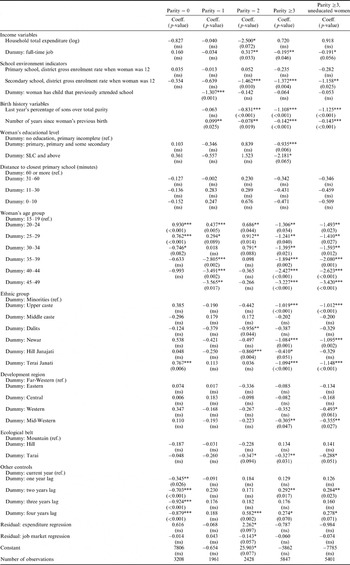
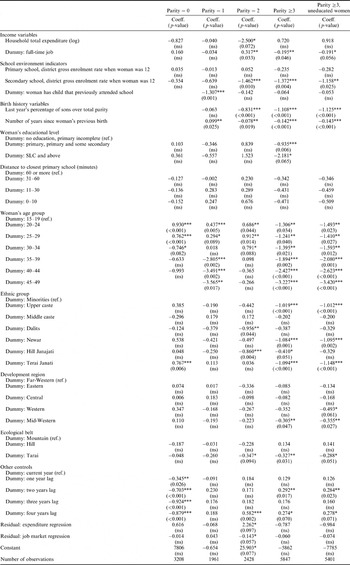
Table 3 presents the parity-specific regressions results (columns 1–4). The sample is divided into four groups: women with no living children at t−1, with one living child, with two living children, and with three or more living children at t−1. For the latter case of parity larger or equal to three, the model is also estimated based on non-educated women (column 5). As argued by Axinn & Barber (Reference Axinn and Barber2001), even when parents in Nepal did not attend school, if a school is nearby, it is likely that at least some of the neighbours' children attended school. This is likely to encourage children's schooling because ‘… network members with whom individuals interact regularly influence attitudes and behaviour,’ (p. 486).
Logit model estimates of the probability of giving birth, parity-specific results, Nepal 2003–04
***p<0.01; **p<0.05; *p<0.1.
When parity equals zero (first column), maximum likelihood estimates based on the marginal model did not converge. Logit estimates presented, computed using Huber/White variance–covariance estimator.
When the previous parity is larger or equal to 3, women with full-time jobs are less likely to have had given birth that year and there is no evidence that this variable is endogenous, as can be seen by the sign and significance of the dummy indicating job market status and the coefficient of this variable's residual. Surprising, when the previous parity equals 2, the effect is significant but of opposite sign and there is evidence of endogeneity. The coefficient of income, on the other hand, indicates that wealthier mothers were less likely to give birth, as expected, and the coefficient of this variable's residual provides no evidence of endogeneity.
The results suggest that the district-level secondary school gross enrolment ratio during the women's childhood is negatively and significantly associated with fertility among women with two or more children, and among uneducated women with three children, but not among women with one child or no children. As is the case with the models reported in Table 2, the district-level primary school gross enrolment ratio is found to be statistically insignificant in each of the parity-specific estimations.
Women's own level of education and the presence of an older child who has attended school are not found to be significant in the parity-specific estimations, with two exceptions. In the model based on sample women with three children, both dummy indicators of women's own level of education are found to significant, and in the model based on women with one child, having an older child who has attended school is found to be significant.
The previous year's percentage of sons over total parity presents a highly significant coefficient over total parity in all cases where the number of children is larger or equal to 2. The number of years since the woman's previous birth is always significant: positive when previous parity equals 1, and negative otherwise.
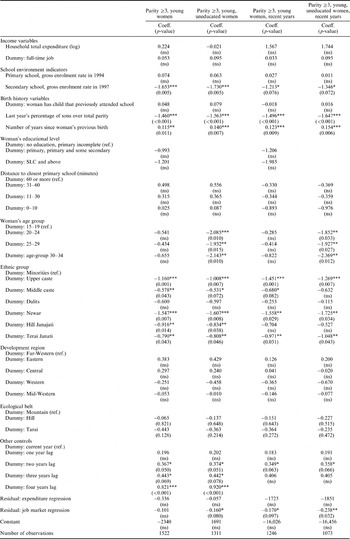
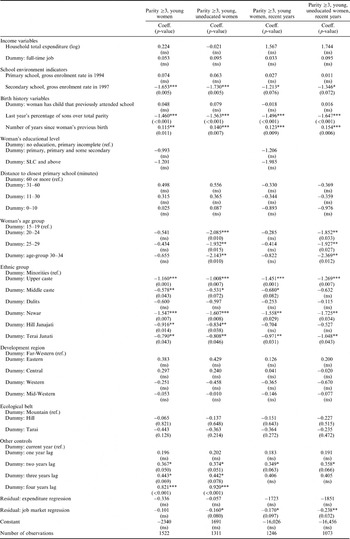
Table 4 presents the results for women 30 years old or younger and using the gross enrolment ratios obtained from the Statistical Yearbook. In column 1, all young women are included in the estimation and, in column 2, only young and uneducated women. This exercise is repeated in columns 3 and 4, respectively, but including only lags up to 3 years. The purpose is to control for the fact that the expenditure and job market participation measures are only based on the year of the interview and this procedure is more problematic when a higher number of lags is considered.
Logit model estimates of the probability of giving birth, women 15–30 years of age, Nepal 2003–04
***p<0.01; **p<0.05; *p<0.1.
The results in Table 4 are very similar to the results based on sample women of all ages. District-level secondary school gross enrolment ratios, but not primary school gross enrolment ratios, are found to be negatively and significantly associated with fertility behaviour. Note, however, that the coefficients of secondary school gross enrolment ratios are less significant than the ones presented in the previous tables. Similar to the case where only more recent lags were included (Table 2, last column), possible explanations are that these results were estimated using fewer and more recent observations since only information regarding young women was included.
In addition, women's own level of education, and having an older child who had attended school are not found to be statistically associated with fertility. The last year's percentage of sons over total parity presents a negative and significant effect in all specifications. Finally, different from the case where all women are included in the estimations, the number of years since previous birth is positive for all parities when only young women are included in the model.
Discussion and Conclusions
From 1996 to 2006, Nepal experienced a substantial drop in fertility, mainly among uneducated women living in rural areas, and an increase in the enrolment of children in schools. These changes are particularly interesting considering the well established relationship in the literature between education and fertility. While previous literature on the determinants of fertility decline in low-income contexts suggests that women's education plays an important role, the influence of children's education and the availability of schools on fertility decline, as posited by Caldwell (Reference Caldwell1980) in his mass-schooling hypothesis, have not received much attention by previous researchers. According to Caldwell, mass education can affect fertility through channels in addition to that of educating girls who later become women. For instance, education reduces children's potential to work inside and outside the home and turns them into future investments rather than present producers. That, along with propagating Western middle-class values, increasing childbearing costs and raising the status of women in society, among other pathways, can have a potentially important impact on fertility. This paper investigates the importance of these pathways in order to more fully understand the relationship between education and fertility.
In this study, the linkages between education and fertility in rural Nepal are investigated based on a population-based household survey that includes detailed retrospective birth histories and household- and individual-level determinants of fertility, complemented by census and administrative data that are used to construct measures of primary and secondary school enrolment ratios at the time the woman was a child. To account for unobserved heterogeneity between women and between communities, women- and district-level random effects are included in the estimations. Although likelihood tests show no evidence of clustering, this result may be spurious if the unobserved effects are correlated with the other independent variables. Therefore, marginal models are estimated that are robust to the possibility of clustering between women and between communities. In addition, Terza's et al. (Reference Terza, Basu and Rathouz2008) methodology is followed to control for the potential endogeneity of income per capita and job market participation (Bollen et al., Reference Bollen, Guilkey and Mroz1995).
The results suggest that district-level gross enrolment ratios for secondary education during the woman's childhood significantly reduce the probability of a woman having a child in a given year. The presented evidence suggests that the effects of this variable, which represents the school environment during the women's childhood, are more robust in rural Nepal than those of other variables often considered in the literature, such as household expenditure, women's job market status and current proximity to primary schools. When parity-specific regressions are estimated, secondary gross enrolment ratios' coefficients are mainly significant when the parity is two or more. Thus, the main effect of mass education via community-level effects is to reduce the total number of children. This effect persists when the model is estimated only for uneducated women at parity three or more, which provides further evidence that the effects of the women's childhood school environment are independent of those of the women's own level of education. The results also persist when the models are restricted to young women, and to more recent lags. However, there is no evidence that district-level gross enrolment ratios for secondary education delay childbearing, as indicated by the insignificance of the coefficient in the model that is restricted to women who have no children (parity=0).
District-level gross enrolment ratios for primary education during the woman's childhood, on the other hand, did not have the expected effect on fertility. This apparent incongruence was also found in studies by Benefo & Schultz (Reference Benefo and Schultz1996) in Cote d'Ivoire and Ghana and by Gertler & Molyneaux (Reference Gertler and Molyneaux1994) in Indonesia. Possible explanations are the extensive availability of primary education in rural Nepal, a country whose gross primary enrolment was 114% in 2002 (World Bank, 2010), and the poor quality of the primary school system (Benefo & Schultz, Reference Benefo and Schultz1996). In addition, primary schools may have been utilized by women as free day-care facilities, encouraging them to have more children. The vast number of primary schools may also be the reason why the dummies indicating the distance to the closest primary school have insignificant coefficients.
Also consistent with Caldwell's mass-schooling hypothesis is the finding that having a child previously in school has a significant and negative effect on subsequent fertility for some model estimations. As suggested by Caldwell (Reference Caldwell1980), having a child enrolled in school may affect how parents perceive the costs of having additional children and children's potential for work, which can influence the demand for additional children.
On the other hand, women's own level of education is only negative and significant among women at parity three or more, and when all women were included in the estimations (Table 3). It may be the case that this result is not significant when only young women were included (Table 4) due to a not large enough sample size. Also, the insignificance of this variable for smaller parities indicates that, although women's own educational level may have an effect on the total number of children, it has no effect on delaying childbearing in the rural Nepal context.
This is at odds with a large body of literature that suggests women's educational attainment is among the most important deterrents of fertility. On the other hand, the results are in line with those of Axinn & Barber (Reference Axinn and Barber2001), who found that women in Nepal who did not attend school are more likely to use permanent contraceptive methods. Axinn & Barber (Reference Axinn and Barber2001) also discussed previous studies that found that women's formal education has a negative influence on fertility limitation in countries at the beginning of the fertility transition (Cochrane Reference Cochrane1979; Singh & Casterline, Reference Singh, Casterline, Cleland and Hobcraft1985; Axinn Reference Axinn1993), while Schellekens (Reference Schellekens2009) cited similar findings regarding countries where the transition is at a more advanced stage, such as the United States, Norway (Kravdal, Reference Kravdal1992), Sweden and Britain (Hoem, Reference Hoem1993; Ní Bhrolcháin, Reference Ní Bhrolcháin and Ní Bhrolcháin1993). A possible explanation is that education may lower childrearing costs because educated mothers are more efficient in childrearing, and that may be counter-balancing the effects of education on the women's opportunity costs (Schellekens, Reference Schellekens2009). Thus, there is no clear consensus in the empirical literature regarding the sign of the effect of women's own education on fertility. While this study finds clear evidence that community-level changes in educational opportunities reduce fertility, the net impact of women's own educational attainment levels appears to be ambiguous, perhaps due to both the positive and negative effects of education described above.
Overall, these results based on data from rural Nepal support Caldwell's (Reference Caldwell1980) mass-schooling hypothesis. Mass education has had a deep impact on fertility in rural Nepal, including among uneducated women. This result has important policy implications. In particular, the results suggest that government-supported mass-schooling strategies influence fertility-related behaviour, not only through the education of girls who later become women of reproductive age, but also through other channels, including through enrolment of a previous child in school and through social externalities affecting society at large. Moreover, the results provide evidence that policies that promote the availability of secondary schooling, in addition to primary schooling, can influence fertility.
Acknowledgments
A previous version of this paper was prepared as a background paper for the World Bank's Nepal poverty assessment. The authors wish to thank an anonymous reviewer for providing thoughtful and constructive comments on a previous version of the manuscript.
Appendix
First-stage instrumental variable regressions: household expenditure and job market participation