


1. Introduction
Many interpretations concerning the rise of mass primary schooling highlight the role of democracy. They claim that as countries move to democratic regimes, the spread of voting rights and a more equal distribution of political power would have given people the opportunity to voice their demands for education (Mariscal and Sokoloff, Reference Mariscal, Sokoloff and Haber2000; Lindert, Reference Lindert2004; Go and Lindert, Reference Go and Lindert2010; Engerman et al, Reference Engerman, Mariscal, Sokoloff, Eltis, Lewis and Sokoloff2009). By contrast, other authors suggest that primary education expansion results from top-down reforms associated with nation-building efforts (Ramirez and Boli, Reference Ramirez and Boli1987; Melton, Reference Melton1988; Green, Reference Green1990). In Europe, the French Ferry laws of the 1880s and the 19th-century German leadership in primary education would be prime examples of this phenomenon. In line with this argument, Paglayan (Reference Paglayan2020) recently documents that schooling was promoted by non-democratic regimes seeking to foster industrialization, increase military strength, forge national identity, and encourage political loyalty. Therefore, in many countries, “a majority of the population already had access to primary schooling before democratising” (p. 17).
This paper provides novel evidence in support of the argument that democracy plays a key role in expanding public education. We focus on the semi-democratic system of Restoration Spain and explore whether widespread political clientelism and the government’s ability to largely ignore the demands of the electorate affected government spending on primary education.
There are several reasons why the Spanish case is interesting to study from this premise. First, like other European countries, Spain launched a top-down education reform shortly after the turn of the 20th century. During the Cuban War of Independence in 1898, the country suffered a resounding defeat at the hands of the United States. As a result of this Desastre del 98, the desire for reform and the need to put an end to Spain’s decline increased, and a new political and intellectual movement, Regenerationism (Regeneracionismo), emerged. Many blamed the defeat on ignorance. Santiago Alba, Minister of Education in 1912 and 1918, said in 1901 that it was not the US soldiers but “the Yankee school, rational, human, [and] flourishing (…) that defeated the Spanish school, primitive, routine, [and] poor” (cited in Villares and Moreno Luzón, Reference Villares and Moreno Luzón2009, p. 328). The military defeat paved the way for education reform. Until then, primary education had been the responsibility of the municipalities. The Moyano Law of 1857 created a common regulatory framework for the whole country, but funding was local. In 1900, the government created the Ministry of Education and, in 1902, took over payment of primary school teachers’ salaries and the purchase of school supplies. Primary education was thus centralized, mainly following the example of the French Ferry Laws of the 1880s. The Spanish results, however, were much poorer. In 1920, two decades after the reforms, 39% of the population was still illiterate.
Secondly, the Spanish education reforms were implemented under a semi-democratic regime, but under the rule of a duopoly instead of a single party. During the Bourbon Restoration, Spain was officially a democracy. However, electoral fraud, corruption, and widespread political patronage enabled the political elite to ignore bottom-up demands. The system was dominated by two main parties, the Conservatives and the Liberals (dynastic parties), which had agreed to alternate in power by means of rigged elections. Before each election, the two ruling parties planned a provisional electoral result in which the incoming party always obtained a majority in Parliament. This national agreement, or encasillado, was then implemented by local elites in their districts through widespread client-patron relationships, or by means of massive vote buying and outright intimidation.
Local elites, in fact, played a crucial role in this system. They acted as intermediaries between the public resources offered by national members of parliament (MPs) to buy electoral support and local communities or individuals. This gave local elites a great deal of power, and national MPs often had to negotiate with them to ensure that the prearranged electoral results were successfully implemented (Moreno-Luzón, Reference Moreno-Luzón2007). In fact, some national MPs decided to reinforce their clientelist ties with local elites to guarantee that they were elected (or re-elected). They were the so-called candidatos propios or “propios”: candidates who were repeatedly elected in the same electoral district outside of the alternation system agreed upon by the Liberal and Conservative parties.
Despite its corrupt nature, this system allowed for some political stability but weakened over time. The First World War was a powerful political shock. After it, elections became increasingly competitive (especially in urban areas, where voter control was more difficult than in rural areas). A combination of military discontent and increased social mobilization, supported by political parties outside the alternation system, led to the most serious political crisis the Restoration system had faced since 1874. From then on, it became increasingly complex for the dynastic parties to control election results and ensure the appointment of their candidates, who gradually lost ground in favour of those from emerging parties.
In this political setting, we can analyze the impact of two aspects related to the influence of political factors on primary education spending. On one hand, given the non-democratic nature of the Restoration regime, one would expect the government to make political use of resource allocation in order to reinforce regime stability (Curto et al, Reference Curto, Herranz and Solé2012; Robinson and Torvik, Reference Robinson and Torvik2009). Thus, we explore whether the government invested more in schooling in loyal constituencies to the detriment of “rebel” districts that voted for third-party candidates outside the encasillado. At the same time, given that the government could largely ignore bottom-up demands, voter turnout would not exert the expected positive effect on schooling expenses, typical of fully democratic contexts (Lindert, Reference Lindert2004). On the other hand, primary education investment appears to be less suited for patron-client relationships than other public expenses like public works, which can offer the promise of employment and contracts to specific individuals in exchange for votes (Keefer, Reference Keefer2007). In line with this, we examine whether constituencies with a strong presence of propios MPs received less primary education outlays.
Finally, as previously noted, the government gradually lost its ability to control the outcome of elections, which became increasingly competitive due to gradual urbanization, the rise of organized social movements (such as the labour movement), and the political impact of the First World War. Then, we also analyze whether the above-described effects changed over time by comparing their impact at the beginning and the end of the period.
In the empirical approach, we exploit the variation across provinces and political and public spending data over time. We partly build on Curto et al (Reference Curto, Herranz and Solé2012), who analyzed road investment allocations in 1880–1914 Spain by using a dataset on MPS and electoral outcomes. We completed the historical data and included central government expenditure on primary education at the provincial level. Our period of analysis runs from 1902 (when the education reform came into effect) to 1922 (just before Primo de Rivera’s coup d’état in 1923, which marked the end of the Bourbon Restoration).
Our results show that the national government lowered primary education investment in provinces with a high share of elected candidates from non-dynastic parties. It seems the government punished “rebellious” provinces that ignored the encasillado agreements and voted for minority parties. However, this adverse effect tended to vanish after the First World War, when the government was no longer immune to demands from below and had to compete for the votes of minority parties (now on the rise). Similarly, it seems that the positive effect of voter turnout was more evident by the end of our period. When the government’s ability to control election results was reduced, it would become more responsive to bottom-up demands. Also, as expected, the share of propios MPs had a negative impact on primary education expenditure. And again, this negative effect declined after the First World War. Our interpretation is that purely clientelistic practices were no longer sufficient to secure the re-election of propios, so they had to resort to more competitive methods to gain electoral support.
Our findings contribute to existing debates on the role of democracy in the early expansion of primary education. The empirical evidence is often based on non-democratic regimes with rapid educational expansion (such as Prussia) or on cross-country analyses, where differences within democracies and non-democracies tend to be overlooked.Footnote 1 Alternatively, our paper focuses on a semi-democratic regime with poor educational outcomes. This allowed us to analyze in more detail whether democratic shortcomings significantly impacted primary education spending. Our paper is indeed the first to examine the influence of political dynamics on public primary education spending during the Spanish Restoration. Previous studies focusing on Spain have typically analyzed the effect of economic or institutional factors, such as land inequality and access to common land (Beltrán Tapia and Martínez- Galarraga, Reference Beltrán Tapia and Martínez- Galarraga2018; Beltran Tapia, Reference Beltran Tapia2013) or have been more descriptive in nature (Beltrán-Tapia et al, Reference Beltrán-Tapia, Díez-Minguela, Martínez-Galarraga and Tirado-Fabregat2019; Núñez, Reference Núñez1992; Pérez Moreda, Reference Pérez Moreda1997). More generally, our findings may also have implications for debates about the causes of slow economic growth during the Restoration period (O’rourke and Williamson, Reference O’rourke and Williamson1997; Prados de la Escosura and Rosés, Reference Prados de la Escosura and Rosés2010). If democratic shortcomings did reduce public spending on primary education, this could be one of the mechanisms through which democracy affected economic growth.
The paper is organized as follows: The next section summarizes the background literature. Section 3 describes the political setting and educational system of the early 20th century in Spain. Section 4 presents the data and methodological approach, while Section 5 outlines the results of the econometric analysis. Finally, Section 6 concludes.
2. The rise of primary schooling and democracy: potential explanations
There is currently no consensus on the relationship between democracy and education. Several studies have emphasized the importance of democracy and the extension of voting rights to generate broad demand for schooling expansion (Mariscal and Sokoloff, Reference Mariscal, Sokoloff and Haber2000; Lindert, Reference Lindert2004; Engerman et al, Reference Engerman, Mariscal, Sokoloff, Eltis, Lewis and Sokoloff2009; Gallego, Reference Gallego2010; Go and Lindert, Reference Go and Lindert2010). However, other accounts on the rise of modern education have focused on the role of top-down reforms implemented by political elites for nation-building purposes (Ramirez and Boli, Reference Ramirez and Boli1987; Melton, Reference Melton1988; Green, Reference Green1990; Aghion et al, Reference Aghion, Jaravel, Persson and Rouzet2019; Paglayan, Reference Paglayan2020).
To explain the apparent discord between scholars who associate schooling spread with either top-down reforms or democracy, Lindert (Reference Lindert2004) stated that the discussion needs to go hand in hand with reassessing the role of local political power. In non-democratic Prussia, for example, schooling decentralization granted political voice to rapidly urbanizing regions with a high demand for education. This made it possible to quickly expand primary education (in these areas) and overcome the opposition of Junker-dominated areas. In the USA, decentralization also allowed regions with high demand for education to rapidly expand schooling in the 19th century (Goldin and Katz, Reference Goldin and Katz2008; Go and Lindert, Reference Go and Lindert2010).
The attitude of powerful local lobbies towards mass schooling is also the subject of widespread discussion. Recent empirical analyses have suggested that political elites, particularly landed elites, boosted the expansion of education in Sweden and Austria in the 19th century (Andersson and Berger, Reference Andersson and Berger2019; Cvrcek and Zajicek, Reference Cvrcek and Zajicek2019). Other studies, however, are less optimistic about the effect of strong local elites. Chaudhary et al (Reference Chaudhary, Musacchio, Nafziger and Yan2012) showed that in the early 20th century, the lack of a broad political voice in developing countries, particularly Brazil, Russia, India and China, led local elites to capture political institutions and delay the expansion of primary education. For example, Cinnirella and Hornung (Reference Cinnirella and Hornung2016) and Beltrán Tapia and Martínez- Galarraga (Reference Beltrán Tapia and Martínez- Galarraga2018) considered that land inequality negatively affected the demand for education. Galor et al (Reference Galor, Moav and Vollrath2009) and Goñi (Reference Goñi2023) also found a negative correlation between land inequality and schooling. They highlighted the role of supply-side factors, namely the opposition of landed elites to education reforms.
The relationship between democracy and the provision of public goods (like public education) has also been analyzed under the lens of political motivations. Studies related to the field of “distributive politics” assume that, in democratic regimes, politicians tend to allocate resources seeking electoral and partisan benefits, allowing for their political survival (Golden and Min, Reference Golden and Min2013). Keefer and Khemani (Reference Keefer and Khemani2005) and Keefer (Reference Keefer2007) showed that governments that rely on clientelist practices tend to overprovide targeted goods (such as public works projects and public jobs) to narrow groups of voters and to underprovide non-targeted goods (such as universal healthcare and education). This is because patrons have weak incentives to provide general public goods to benefit clients and non-clients alike.
Keefer and Khemani (Reference Keefer and Khemani2005) also accounted for the importance of electoral party competition for the provision of public goods. The incumbent party can win elections with exceedingly modest promises without credible opposition parties. Competition, by contrast, may lead to the higher provision of public goods and a reduction in political patronage if the competing political parties can make credible promises to broad segments of the population in search of electoral support. The authors supported their claims with evidence from contemporary India. However, there is also historical evidence that points in the same direction. Eli and Salisbury (Reference Eli and Salisbury2016), for example, found that the expansion of pensions for Confederate veterans and widows in the southern United States during the 1920s occurred in counties where Democratic candidates were threatened by alternative parties in elections.
Robinson and Torvik (Reference Robinson and Torvik2009) expanded this general framework to semi-democratic contexts where standard democratic strategies to gather political support, such as public good provision and redistribution to potential voters, are combined with coercion and violence. In these political contexts, voters who are non-loyal to the government attract more public resources and generate more public good provision only when the government is unable or unwilling to implement coercive methods successfully. Otherwise, non-legal voters receive fewer public revenues. In this regard, Curto et al (Reference Curto, Herranz and Solé2012) found that in Restoration Spain, the government used road investment allocations to punish provinces that elected candidates outside the alternation system. However, during the last few years of the 19th century, when political and social mobilization increased, this strategy was abandoned and “swing” (or rebel) provinces were favored for political stability.
Our contribution to this debate is to study how the absence of reliable democratic governance mechanisms conditioned the spread of schooling under the centralized system implemented by the Restoration regime in Spain at the turn of the 20th century. This semi-democratic regime obstructed political opposition, favored clientelist ties and made voter turnout ineffective. In fact, these could be relevant factors to explain why under similar conditions in terms of regional education disparities or poor fiscal capacity, in France and above all, Italy it was centralization, together with existing voting rights, that ultimately gave rise to schooling expansion (Lindert, Reference Lindert2004; Cappelli, Reference Cappelli2016a; Reference Cappelli2016b; Cappelli and Vasta, Reference Cappelli and Vasta2020).
To our knowledge, few economic history studies have analyzed the disruptive influence of politics on the expansion of education. In Azar (Reference Azar2022), the effect of political tactics on school provision is documented for Uruguay during the first half of the 20th century. Another case—albeit not entirely analogous- is the study conducted by Cinnirella and Schueler (Reference Cinnirella and Schueler2018), who found that the increase in primary education spending in Imperial Germany boosted the vote share of pro-nationalist parties.
3. Historical background
3.1. Political context
In 1874, a parliamentary monarchy under the Bourbon dynasty was established in Spain and led to the so-called Restoration period (1874–1923). In the preceding decades, particularly since the start of Isabella II’s reign in 1833, military coups, or pronunciamientos, had been common. Since massive electoral fraud prevented any political alternation in government, political leaders in the opposition often relied on the military to organize plots to overthrow the government (Sabaté et al, Reference Sabaté, Espuelas and Herranz-Loncán2022).
During the Restoration period, the two dynastic parties (the Conservatives and Liberals) agreed to alternate in power by means of fraudulent elections, the so-called “peaceful turn” (or turno pacífico). The role of the Crown was to give the system support and stability. Anti-liberal sectors of the Catholic right and groups of leftist republicans and revolutionaries were excluded from the alternation system. This design created some political stability, but it came at the price of widespread corruption and limited political competition. It worked as follows. Before each election, the incoming and incumbent parties came together to plan the preliminary distribution of the chamber seats, which always gave the former the victory. This national agreement, or encasillado, had to be implemented by the local elites on Election Day.
Several mechanisms were used to enforce the encasillado. Massive vote buying was common practice and increased substantially after the introduction of universal male suffrage in 1890. Fraudulent activities, such as manipulation of the electoral census, and outright intimidation, which was particularly effective in areas where the labor market was close to monopsony, were also frequent. However, the main source of political control arose from widespread political patronage. Local bosses, or caciques, were crucial to this end. They acted as intermediaries between national MPs and their local communities by providing their clients with access to public resources. Given the nature of the Restoration system, national leaders often had to negotiate with local elites to implement the prearranged electoral results. In turn, these close ties with national leaders increased the political influence of local bosses.
The political power of the caciques laid more in their control over administrative mechanisms than in their privileged economic position, although the two factors were often linked (Comín, Reference Comín1988; Moreno-Luzón, Reference Moreno-Luzón2007). Their social profile varied from region to region. Landowners, for example, were predominant in the south and west (Andalusia, Extremadura, and parts of Castile). Mid-sized farmers were common in Valencia, in the east. Professionals, particularly lawyers, who had good knowledge of the administrative system, played a leading role in regions such as Catalonia and Galicia. Finally, merchants and ship-owners were very active in Valencia, Seville, and Cadiz, and industrialists were predominant in Catalonia (Moreno-Luzón, Reference Moreno-Luzón2007).
From the beginning of the Restoration period, the local elites in some electoral districts established long-term relationships with their corresponding MPs to ensure that the later were elected or re-elected without respecting the electoral turn. These MPs were known as propios, as they were said to “own” an electoral district and were continually elected independently of their party affiliation (Moreno-Luzón, Reference Moreno-Luzón2007). This behavior was initially more common where propios proved to be particularly effective in obtaining resources for the local elites’ clientele. This increased their chances of being re-elected and boosted the influence of local elites in national politics.
This governing scheme operated rather successfully until the end of the 19th century. However, social unrest at the turn of the 20th century expedited the demand for political change (for example, male universal suffrage was approved in 1890). Some years later, in 1907, a Conservative government implemented another electoral reform. Voting was declared compulsory, with sanctions devised for civil servants who did not vote, although this was rarely enforced. To prevent fraud and manipulation, mayors were removed from polling stations, the Supreme Court was made responsible for checking the electoral results and independent electoral boards were created.
The reform also established that no elections would take place in districts with only one candidate, who would automatically win the election. This peculiar electoral rule, included as Article 29, initially conceived to stimulate political participation, had the opposite effect and led to the election of more than a quarter of the total number of MPs between 1910 and 1923. In any case, the 1907 reform did not introduce greater proportionality, which would have benefited emerging parties, and electoral districts remained very small, which benefited the local bosses and led to the persistence of clientelist practices.
In addition to these subtle changes, a number of historical events fueled the emergence of deep-rooted political and social conflicts. The Restoration system weakened over time due to both external factors (namely, the emergence of new parties, especially in urban areas) and internal factors (the gradual strengthening of the local elites).
According to Comín (Reference Comín1988), the abovementioned national identity crisis provoked by the Desastre del 98 represented a major turning point in the Restoration period. The Tragic Week of 1909, which plunged Barcelona into violent anticlerical riots, and the discrepancies over Spain’s neutrality during the First World War, which led to additional ruptures between pro-Allies and pro-German factions, were also key events. In 1917, in the midst of the armed conflict, growing military discontent over poor pay conditions caused a government crisis, that eventually led to the worst crisis faced by the Restoration regime since its creation (Villares and Moreno Luzón, Reference Villares and Moreno Luzón2009). Faced with the weakness of the government, the parties opposed to the turn system, such as the Catalan nationalists and the leftist republicans, promoted deep political reforms to democratize the country’s political life. In addition, since 1917 there was a sharp increase in social and labor conflict, favored in part by the triumph of the Russian revolution that peaked in 1920.
The initial response to the shock caused by the First World War was the formation of national governments including both liberals and conservatives. One of these national governments decided to call clean elections for the first time in the Restoration regime in 1918, without encasillado or government fraud. However, successive governments found it increasingly difficult to obtain a parliamentary majority thereafter. Dynastic parties were divided into different factions, political clientelism and Propios MPs remained strong and opposition parties were not powerful enough to build an alternative. As a result, early elections were called in 1918, 1919, and 1920 to renew the parliament and try to achieve political stability (elections were, usually held every 2 years). In the 1919 elections, the party that entered the government to organize the elections was not able to win them, something that had not happened since the 1840s. Instead, in the 1923 elections, it seems that the encasillado was restored, but it was not enough to stop the military coup of September of that same year (Villares and Moreno Luzón, Reference Villares and Moreno Luzón2009).
In any case, the shock associated to the First World War seems to have accelerated a trend that had started long before. After the introduction of universal male suffrage in 1890, the average voter turnout across provinces ranged from 68% to 74% and the use of electoral campaigns and ideological arguments to persuade and mobilize the electorate became more common, in a context of increasingly competitive elections (Moreno-Luzón, Reference Moreno-Luzón2007).
In this setting, minority parties, like the republicans, the Catalan nationalists and the socialists (who won parliamentary representation for the first time in 1910) gained more influence, thus encouraging “the arrival of the masses in the political arena” (Moreno-Luzón, Reference Moreno-Luzón2007, p. 431).Footnote 2 Specially after the First World War, the traditional methods that were predominant in rural areas coexisted alongside more competitive elections in industrial cities, although fraud and political patronage remained widespread until the collapse of the Restoration regime in 1923. The crisis of the dynastic parties also pushed a growing number of MPs to look for the protection of local powers “…in order not to be swept away by the instability of the government” (Moreno-Luzón, Reference Moreno-Luzón2007, p. 435). This led to an increase in the share of propios in Parliament.
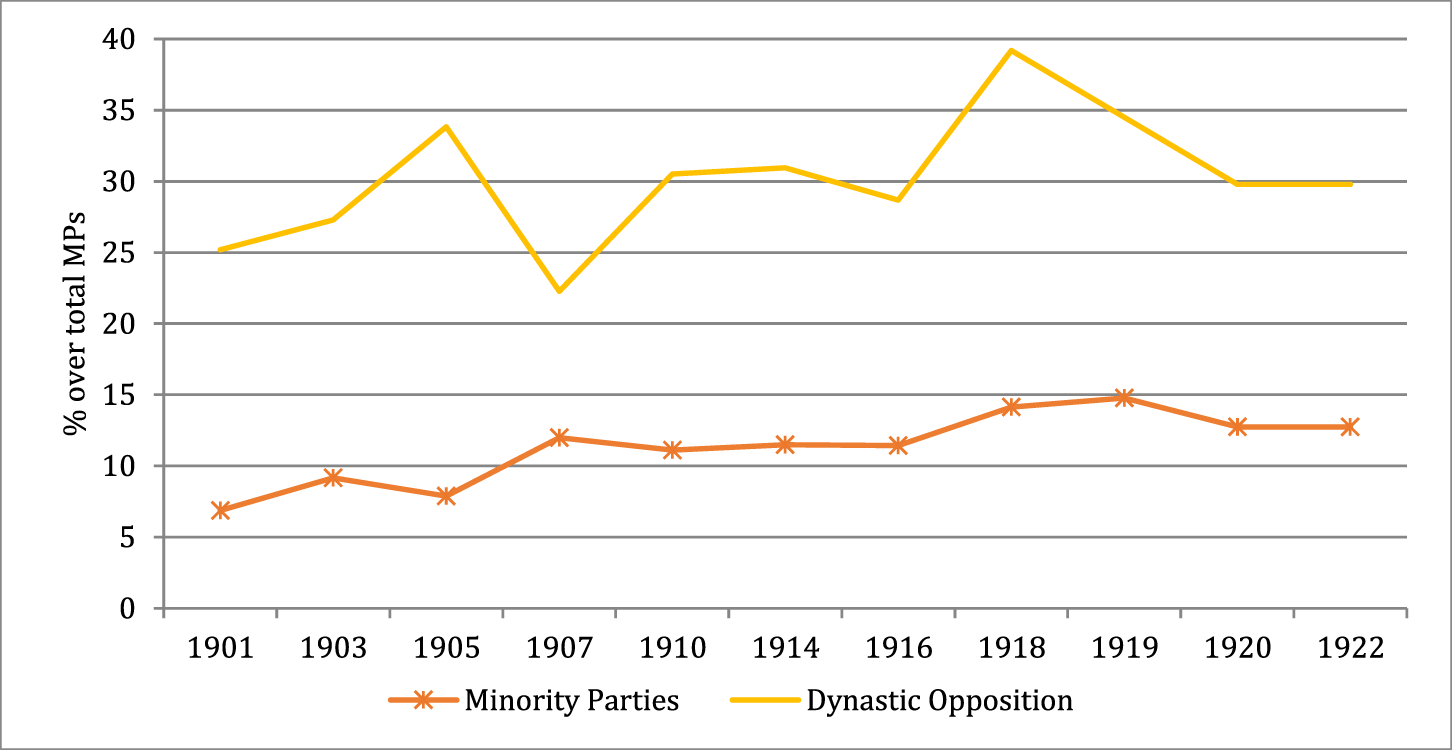
Figure 1 shows that, on average, the share of MPs of dynastic parties remaining in the opposition and those of minority parties increased after 1907, and then after 1916. This general picture reflects the growing difficulties associated with reaching a consensus on the distribution of MPs following the encasillado. By the end of the period, approximately 40% of total MPs belonged to the dynastic opposition or to minority parties.
Share of minority and dynastic opposition parliamentary seats.

With the crisis of the dynastic parties, a growing number of MPs looked for the protection of local powers “…in order not to be swept away by the instability of the government” (Moreno-Luzón, Reference Moreno-Luzón2007, p. 435). This led to an increase in the share of propios in Parliament (who averaged 50% in 1922). They were distributed throughout the territory, for their presence associated with different types of local bosses, was common in most provinces during the period (see Map A-1 in the Appendix). In relation to political voice, voter turnout averaged 70% of the electorate but it followed different patterns both across provinces and over time (Figure A.1 in the Appendix). As discussed in the paper, it was not its level but its effect what would have changed over the period.
3.2. The education system
Spain’s first national education law, the so-called Moyano Law, was passed in 1857. It was inspired largely by the French Guizot Law of 1833. Education was divided into primary, secondary and university levels. A clear distinction between public schools (funded with public resources) and private schools (funded by private individuals or institutions) was established. Schooling was declared compulsory for children between the ages of 6 and 9 and was free of charge for poor families. To benefit from free schooling, a certificate issued by the local authorities was required. The definition of “poor,” however, seems to have been quite broad, as schooling was free for more than half of children by 1860.
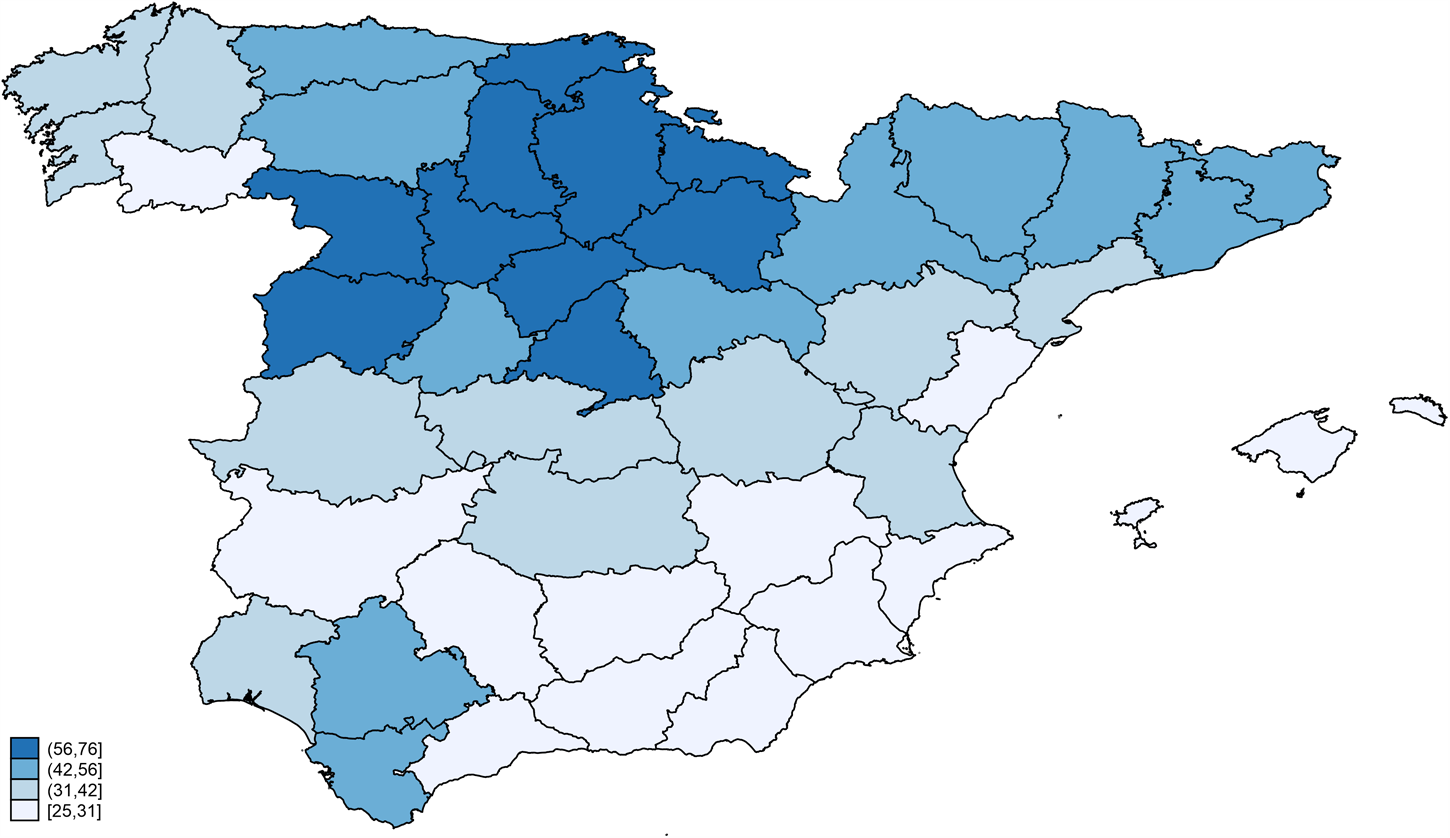
The new legislation required local governments to set up a minimum number of schools, depending on population size (Núñez, Reference Núñez1991, Reference Núñez1992).Footnote 3 Primary enrollment rates increased gradually from 1860 but progress was rather slow: percentages were 36% in 1860, 47% in 1878 and even in 1900, they were below 45% and a far cry from European standards (Núñez, Reference Núñez1992, p. 294). Moreover, this rather modest increase occurred mainly in areas that already had relatively high literacy rates, such that preexisting regional disparities in literacy rates actually increased under the Moyano Law (Beltrán-Tapia et al, Reference Beltrán-Tapia, Díez-Minguela, Martínez-Galarraga and Tirado-Fabregat2019). A snapshot of literacy rates across Spanish provinces in 1900 (Map 1) shows a clear divide between the northern half of the country, which had above-average literacy rates (with the exception of Galicia in the northwestern corner), and the Mediterranean coast, especially the southern provinces, which presented lower rates.
Literacy rates in Spanish provinces (1900)

The Moyano Law established nationwide regulations, but funding remained a local responsibility. As a result, schooling expansion was concentrated in areas where local governments were able (or willing) to raise enough taxes to fund primary education. In this regard, Beltran Tapia (Reference Beltran Tapia2013) showed that the persistence of common land, which contributed to both municipal and household income, led to higher levels of education spending. It is also likely that the average size of the local population conditioned school provision because of the way the law was designed. Since the Moyano Law required that at least one school be created in the smallest municipalities, school provision increased in areas where small municipalities were predominant, such as north-central Spain (Pérez Moreda, Reference Pérez Moreda1997). Local demand for schooling should also have been shaped by the economic activities typical of each region. Thus, one would expect that traditional agricultural areas were less interested in developing mass schooling than industrialized, urban, and commercial regions (Núñez, Reference Núñez1992; Pérez Moreda, Reference Pérez Moreda1997).
As mentioned in the introduction, the Desastre del 98 paved the way for education reform. The military defeat by the United States and the loss of the last colonies (Cuba and the Philippines) in 1898 was a trauma for the Spanish political and cultural elites. It brought into question the liberal model of the 19th century and led to a kind of “crisis of conscience” about the future of the nation. As Pan-Montojo (Reference Pan-Montojo1998) has said, “the defeat was experienced in terms of the failure of the Spanish national project. […] The Restoration regime’s institutional arrangement experienced no ‘before’ and ‘after’ 98” (p. 16). However, Regenerationism did give rise to many debates about the measures to be taken to revitalize Spanish political, cultural, and economic life. In fact, the measures proposed could be very different. For example, criticism of political clientelism or caciquismo was common, but while for some the natural solution was more democracy, for others, such as Joaquín Costa (politician and intellectual considered one of the greatest exponents of Regenerationism), reforms could only be carried out by an “iron surgeon.” Regenerationism was a heterogeneous movement.Footnote 4
It was in this context that education was seen by many as the key to political and economic regeneration. As expressed by writer Emilia Pardo Bazán, “Our problem is a problem of education and culture” (citation taken from Costa, Reference Costa1982). This was a widespread opinion among both the general public and the policymakers of the Restoration regime. Until then, schooling debates had focused mainly on ideological issues related to academic freedom and secularization (Villares and Moreno Luzón, Reference Villares and Moreno Luzón2009; Otero Carvajal, Reference Otero Carvajal, Otero Carvajal and de Miguel Salanova2018). After the Desastre, the liberals embraced the program reform devised by the Institución Libre de Enseñanza (ILE). The ILE was an influential institution established in 1876 under the leadership of Francisco Giner de los Ríos, “one of the most significant pedagogues of contemporary Spain” (Colmenar et al, Reference Colmenar, Rabazas and Ramos2015, p. 39). Convinced that education was crucial to Spain’s social and cultural reform, the ILE advocated for urgent reforms to change the organization, methods, and curricula of the Spanish school system “with an eye to (..) the most modern European pedagogy” (Colmenar et al, Reference Colmenar, Rabazas and Ramos2015, p. 91).Footnote 5 Some factions of the Conservative Party also committed to similar reforms, such that, rather than being a fight between the Liberal and Conservative parties, the battle over schooling turned into a dispute between reform supporters from both ideologies and Catholics groups (Moreno Luzón, Reference Moreno Luzón and Álvarez Lázaro2001).
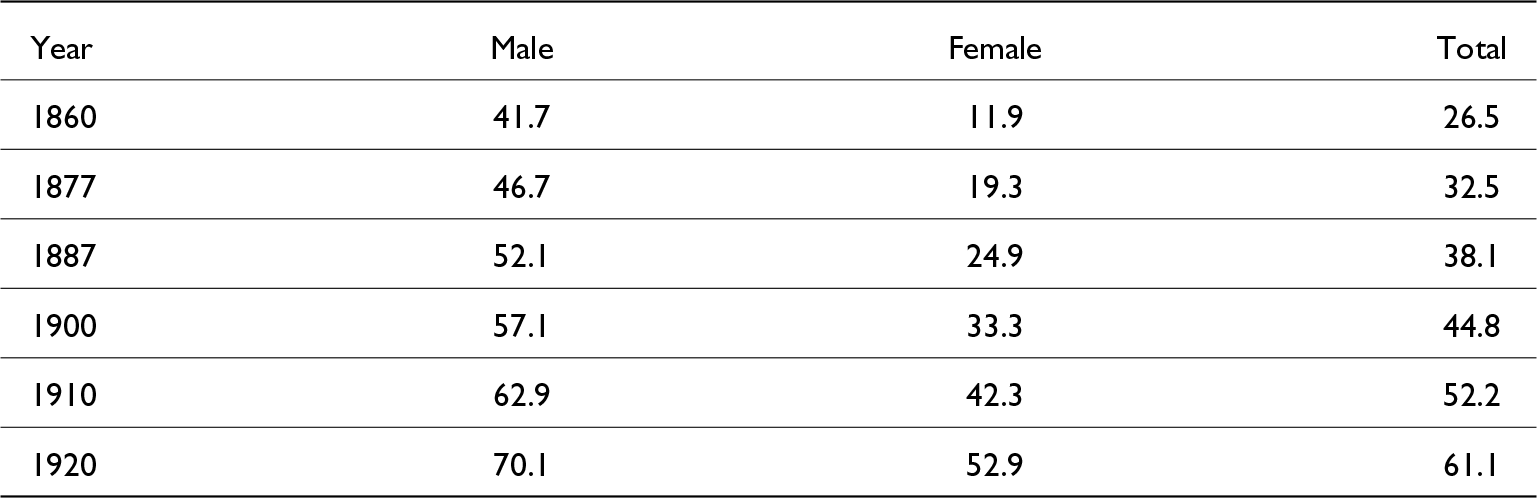
At the turn of the century, the government created the Ministry of Education (Ministerio de Instrucción Pública y Bellas Artes). One year later, in 1901, the upper age for compulsory schooling was extended from 9 to 12 years. In 1902, the national government took over the payment of primary school teachers’ salaries and the purchase of school supplies, in line with the example set by the French Ferry laws. The construction and maintenance of schools, however, remained the responsibility of local governments. After the reform, average primary education spending per capita increased by almost 70% (from 1.72 constant pesetas in 1902 to 2.91 in 1922). This change is very suggestive as public sector was the main schooling supplier across provinces. Consider that, according to the Spanish statistic yearbooks, the number of public schools between 1908 and 1915 represented, on average, 80% of the whole provision and in less than a third of provinces the share of private schools reached more than 25% of the total offer. However, literacy rates increased gradually and coexisted with huge gender gaps (Table 1). In 1920, the Spanish literacy rate among the adult population was 61.1%, while in countries such as the UK, the Netherlands, Germany and Sweden it had already exceeded 80% by 1870 (Crafts, Reference Crafts1997).
Literacy rates in Spain, 1860–1920 (%)

Source: Beltrán-Tapia et al (Reference Beltrán-Tapia, Díez-Minguela, Martínez-Galarraga and Tirado-Fabregat2019)
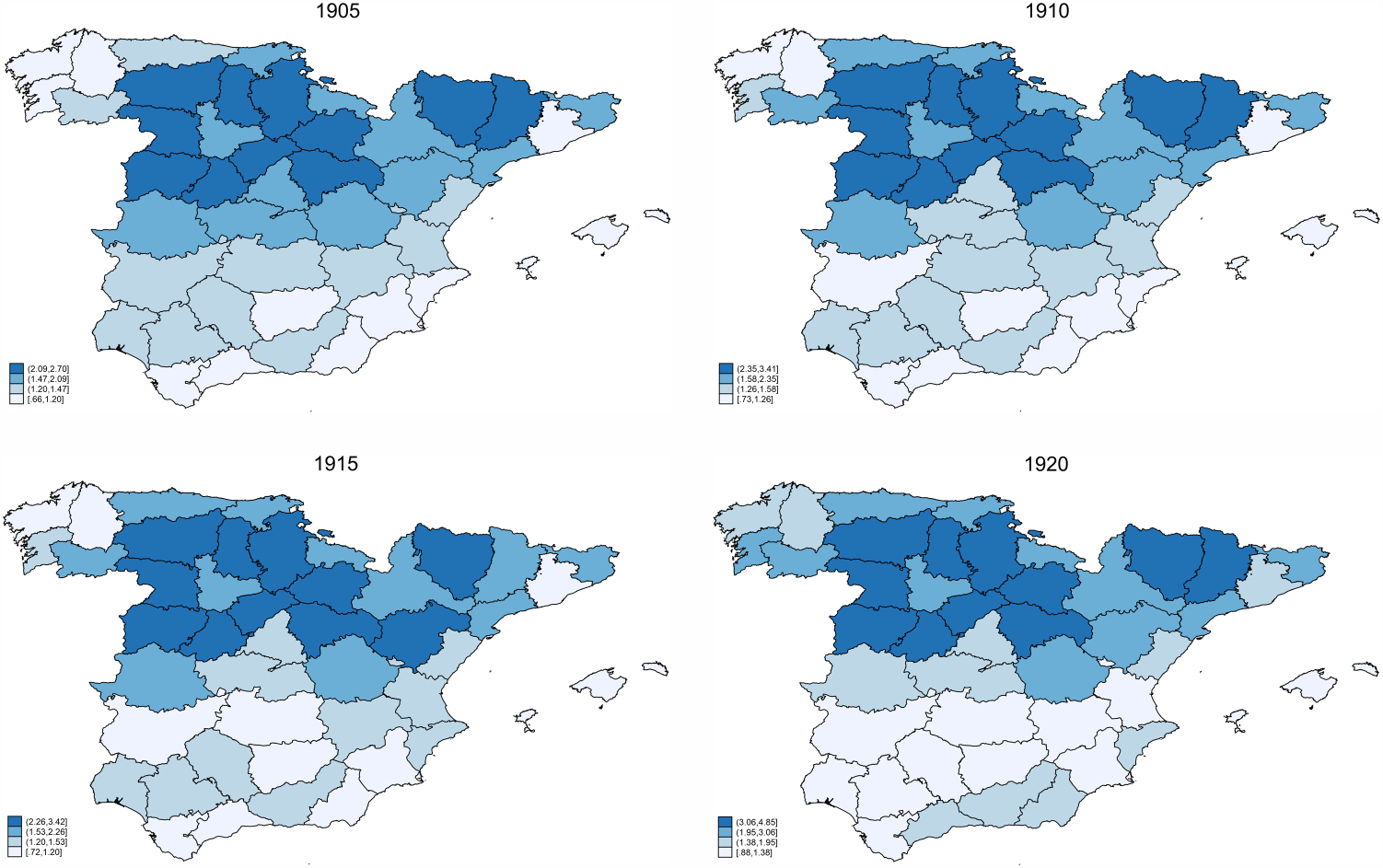
Regional disparities also persisted. In 1920, there was still a clear divide between the northern provinces with high literacy rates and the southern provinces and Mediterranean coast, with low literacy rates (Núñez, Reference Núñez1991). Accordingly, during the period central government expenditure on primary education across provinces also shows regional differences (Map 2 and Figure A.2, in the Appendix). The northern half of the country (except for Galicia) showed higher levels of government expenditures than the Mediterranean coast and southern regions. As a result, the centralization process initiated in 1902 did not lead to regional convergence in terms of public outlays.
Central government expenditure per capita on primary education in Spain (1905–1920)

The persistence of regional disparities was, probably, shaped both by structural characteristics of regions (such as religion, culture, and other institutional features) and factors related to the size and dynamics of their society and economy (GDP, literacy, child population, sectorial composition of employment). The objective of this paper is to analyze whether political factors associated to the lack of democratic quality also conditioned the allocation of government spending on primary education across provinces.
4. Empirical approach
4.1. Baseline model, main variables, and their sources
To explore the influence of the Spanish semidemocratic regime on the allocation of primary schooling spending, we exploit changes over time and across provinces in the electoral representation of opposition parties, political clientelism, and voter turnout.
The basic model to be estimated is as follows:
 \begin{equation}{Y_{it}} = c + \beta {P_{it}} + \gamma {X_{it}} + {\alpha _i} + {\lambda _t} + {\mu _{it}}\end{equation}
where  ${Y_{it}}$ stands for the central government’s spending on primary education in province (i) and year (t);
 ${P_{it}}$ includes our political variables;
 ${X_{it}}$ stands for a set of control variables;
 $\beta $ is the vector of estimated coefficients;
 $c$ is an intercept,
 ${\alpha _i}$ are province fixed effects;
 ${\lambda_t}$ are time fixed effects and
 ${\mu _{it}}$ is an error term.
Data on the provincial distribution of central government spending on primary education were obtained from the Spanish general state budgets (Presupuestos Generales del Estado and Cuentas Generales del Estado), which comprise the outlays by province on both personnel and material (personnel accounted for 89% of the total).Footnote 6 From 1917 onwards, however, the general state budgets only offer aggregated figures for Spain as a whole. In this case, the information was obtained from Spain’s statistical yearbooks, which also include information on central government outlays on primary education disaggregated at the province level. Where there was a discrepancy between the total amount reported in the Spanish general state budgets and the statistical yearbooks, we retained the total figure reported in the budgets and the same distribution across provinces reported in the statistical yearbooks. From 1914 onwards, we have data on government settled expenditures. Before that date, only budgeted expenditure is available. Data for 1921 were missing and were therefore interpolated. The Basque Country and Navarre were excluded from the analysis, as their education expenditure was financed and executed directly at the provincial level.
Our new database, therefore, consists of a total of 45 provinces. The time period starts in 1902, when the central government took over primary schooling expenditure and ends in 1922, before the Restoration broke up (21 years in total). The amounts are expressed in constant pesetas per capita at 1914 prices. The information about provincial population was taken from Rosés et al (Reference Rosés, Martinez-Galarraga and Tirado2010) and interpolated to fill in the gaps.
As for the political factors ( ${P_{it}}$), we have included the political representation of opposition parties. This gives us an indication of the government’s ability to implement the prearranged electoral results. Specifically, we classify all MPs according to their membership to one of the two dynastic parties (Liberals or Conservatives) or to any of the minority parties (e.g., left-wing republicans, right-wing traditionalists, Catalan nationalists and socialists). We then calculate the share of MPs belonging to minority parties and to the dynastic opposition (e.g., the share of Liberals or Conservatives remaining in the opposition) in each province.Footnote 7 This means that, in the regressions, we use the share of government MPs as the reference category and both the effect of the share of minority and dynastic opposition legislators on education spending should be read in relation to the impact of government MPs.
During the period, there were 10 elections and government terms were of varying duration. The Liberals held government in 1901–1902, 1905–1906, 1910–1913, and 1916–1917. They were the dynastic opposition party and the Conservatives were the ruling party in 1903–1904, 1907–1909, 1914–1915, and 1919–1922. However, during 1917 and 1918, the incumbent governments were forced to resign and national governments comprising liberals and conservatives became common. In these cases, we considered the share of dynastic opposition MPs to be equal to zero during the number of days in which national governments existed.
The expected sign of these two variables (share of minority seats and share of dynastic opposition seats) is negative. Restoration Spain was a semidemocratic regime. The lack of effective political competition allowed the government to ignore voters’ demands in swing constituencies and focus on core voters (at least in the election years when the ruling duopoly was able to successfully implement the alternation system). Thus, we expect increased representation of opposition parties (especially minority parties) to be detrimental to education spending at the provincial level.
Data on the affiliation of MPs for the period 1902–1914 were obtained from Curto et al (Reference Curto, Herranz and Solé2012). Information for subsequent years was taken from Varela Ortega (Reference Varela Ortega2001), who compiled the name, district and party of all MPs. The missing information was filled in from the website of the Spanish Historical Archive of the Congress of Deputies, which also provides the name and district of all elected MPs.Footnote 8
Another relevant variable is the share of propios at the province level. As indicated in section 3, political clientelism was widespread during the Spanish Restoration, so that this political variable allows us capturing the effect of the particularly strong clientelistic networks. As in Curto et al (Reference Curto, Herranz and Solé2012), we defined propios as MPS who: (i) had been elected in the past in the same district, (ii) belonged to one of the dynastic parties and (iii) had sat with the opposition for at least one term (that is, they did not conform to the alternation system). Our calculations consider the continuity of these MPs from 1901 onwards. As before, the data came from Varela Ortega (Reference Varela Ortega2001) and the website of the Historical Archive of the Congress of Deputies. The expected sign of the variable propios is negative. As representatives of the political clientelism, they would not have any incentive to struggle for more spending on education that would benefit both clients and non-clients.
Voter turnout was also included in the estimates to measure the effect of the population’s willingness to use its political voice on education spending. It was computed as the ratio between the total number of votes and the potential electorate at the province level, based on the number of people on the electoral register. As already mentioned, from 1910 onwards, voting was not required in districts where only one candidate was running for election, in accordance with Article 29. Therefore, our voter turnout computations only consider districts in which elections were actually held. We included as an additional variable the share of MPs who entered Parliament through Article 29 in each province. The information was obtained from Martínez Cuadrado (Reference Martínez Cuadrado1969). Where there were information gaps or minor incongruities, the information was checked and completed with the Spanish statistical yearbooks, which also provide information disaggregated at the province level on electoral results from 1916 onwards, and the website of the Historical Archive of the Congress of Deputies. Regretfully, these data are available from 1907 onwards only. Information for 1914 and 1915 is also missing. The expected sign of voter turnout is positive. However, the semi-democratic nature of the Spanish Restoration may have played a role in reducing this potential positive effect.
Our estimates also account for the relative seniority of MPs. This variable indicates the difference between the maximum seniority in the legislative term and that of each MP, measured as the number of legislative terms for which he had been elected.Footnote 9 Since seniority could be the result of a leadership position in the corresponding party and could also lead to better access to information and state officials, we would initially expect more senior MPs to be in a better position to obtain public funding for their provinces. However, it is also true that in a context of widespread political patronage, they may have had little incentive to use their presumably increased capacity to attract resources to improve schooling provision, which, as mentioned above, would benefit both clients and non-clients.
As a general rule, we assume that expenditure decisions in a given year were influenced by the composition of parliament in the current legislature. In other words, we assume that the allocation or primary education spending was shaped by the interest of politicians who used their control over government resources to reinforce their position. Therefore, all through the period, the data on education spending in one given year are merged with data on political variables emerged in the nearest previous election. Consequently, the value of the political variables is the same within each legislative term. In years in which elections were held and, therefore, effective education expenditures were decided by two different legislatures (1914, 1916, and 1919), we weight our political variables from the length (in days) of each parliamentary composition. Before 1914, we only have data for budgeted expenditures (instead of effective expenditures). In this case, we use the composition of parliament in the years in which the public budgets were passed.
4.2. Model extensions and control variables
In addition to the basic model in equation 1, we also included some extensions in the analysis to capture whether the effect of political variables changed as the Restoration regime weakened. As noted in Section 2, in semi-democratic political contexts, the government is able to ignore (and/or punish) non-loyal voters. However, when the government is unable (for whatever reason) to control the outcome of elections, it will stop punishing this part of the electorate. And these voters may even begin to attract more public resources (Robinson and Torvik, Reference Robinson and Torvik2009). In fact, according to Curto et al (Reference Curto, Herranz and Solé2012) in the case of road construction, as the regime weakened and opposition parties increasingly gained ground, the government had an incentive to replace the punishment strategy with one of attraction. To capture this potential change in government attitude, we estimated the potential non-linear relationship between education expenditure and increasing political opposition by including both the share of minority party MPs and the share of dynastic opposition MPs squared in Equation 1.
As previously mentioned, Spanish historiography has explained that the Restoration regime weakened over time, and that World War I was a major political shock. To test whether the influence of political variables on education spending changed over time, we interacted our political variables with time-dummies as follows:
 \begin{equation}{Y_{it}} = c + \,\beta {P_{it}} \times time\,dummies + \gamma {X_{it}} + {\alpha _i} + {\lambda _t} + {\mu _{it}}\end{equation}
where each  $time\,dummy$ represents one of the years we cover in the present analysis. We expect the negative effect of minority voting and propios to be less pronounced at the end of the period (when elections became somewhat more competitive). For the same reason, we also expect the effect of voter turnout to be more salient during those years.
Finally, we recognize that government’s strategy towards minority opposition parties might be the combination of the historical context and of an urban-rural effect. This would reflect the diversity in the competitive nature of elections and in the interest in schooling diffusion in urban and rural settings. As a result, we examine whether the estimates from Equation 2 change when we divide the provinces into urban and rural.
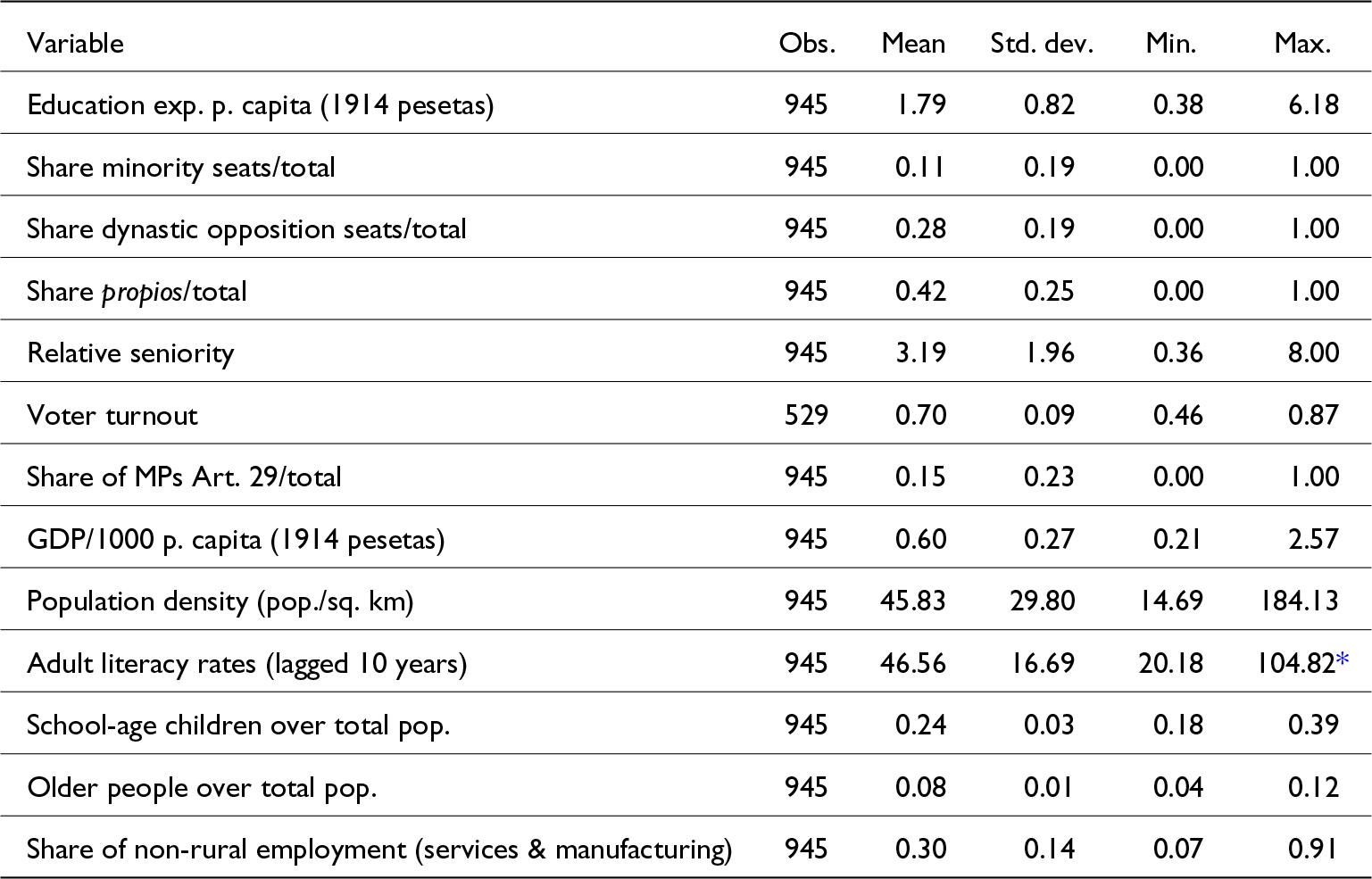
The estimations also include a series of controls aiming to address any possible omitted variable bias. We control for the share of school-age children between 5 and 15 years old over the total population and the population density (i.e., population per square km) at the province level. We also include the share of older people (above 60 years old) over the total. These variables take account of the different competing interests for public funding according to the age structure and the distribution of the population throughout the territory. The information on total population, and its composition by age bracket, at the local level was retrieved from the national census (1900, 1910 and 1920) and interpolated to fill in time gaps. Data on province area were obtained from Díez-Minguela et al (Reference Díez-Minguela, Martinez-Galarraga and Tirado Fabregat2016).
Adult literacy rates (lagged 10 years) were also included to control for parents’ level of education resulting either from the previous diffusion of private or public schooling at the province level. GDP per capita was used to measure the economic development of each province. We expected richer, more educated regions to have higher education demands. GDP per capita was taken from Rosés et al (Reference Rosés, Martinez-Galarraga and Tirado2010) and literacy data from Núñez (Reference Núñez1992). Finally, we use the share of the labor force employed in non-rural activities (i.e., manufacturing and services) to identify the rural or urban nature of the provinces in the sample. The idea is that skilled labor was not a prime requirement in agricultural societies but became increasingly relevant as urbanization and non-rural activities grew (Lindert, Reference Lindert2004). This variable was taken from Rosés et al (Reference Rosés, Martinez-Galarraga and Tirado2010). We categorize provinces as predominantly urban (rural) if their share of non-rural employment was above (under) the panel mean (30%).
In addition to control variables, we also included province fixed effects to capture any unobserved time-invariant characteristic of the province such as geography, local culture (e.g., Church influence on education provision, private schooling diffusion). In the same line, year fixed effects reduce potential concerns of omitted variables related to unobserved external changes over time that affect all provinces, such as national budget constraints or extensions that are decided centrally. The potential non-independence of errors within provinces are tackled by clustering standard errors at the province level. Since in observational studies the possibility that some relevant variable is still excluded cannot be completely ruled out, in the robustness test section we test for model misspecification by means of a placebo test. Table 2 summarizes the descriptive statistics for the panel.
Descriptive statistics

* Notes: Adult literacy rates are calculated by using the population over 10 years old as a proxy for the adult population. Values above 100 suggest that some children under 10 were literate. See Núñez (Reference Núñez1992), p. 94.
5. Results
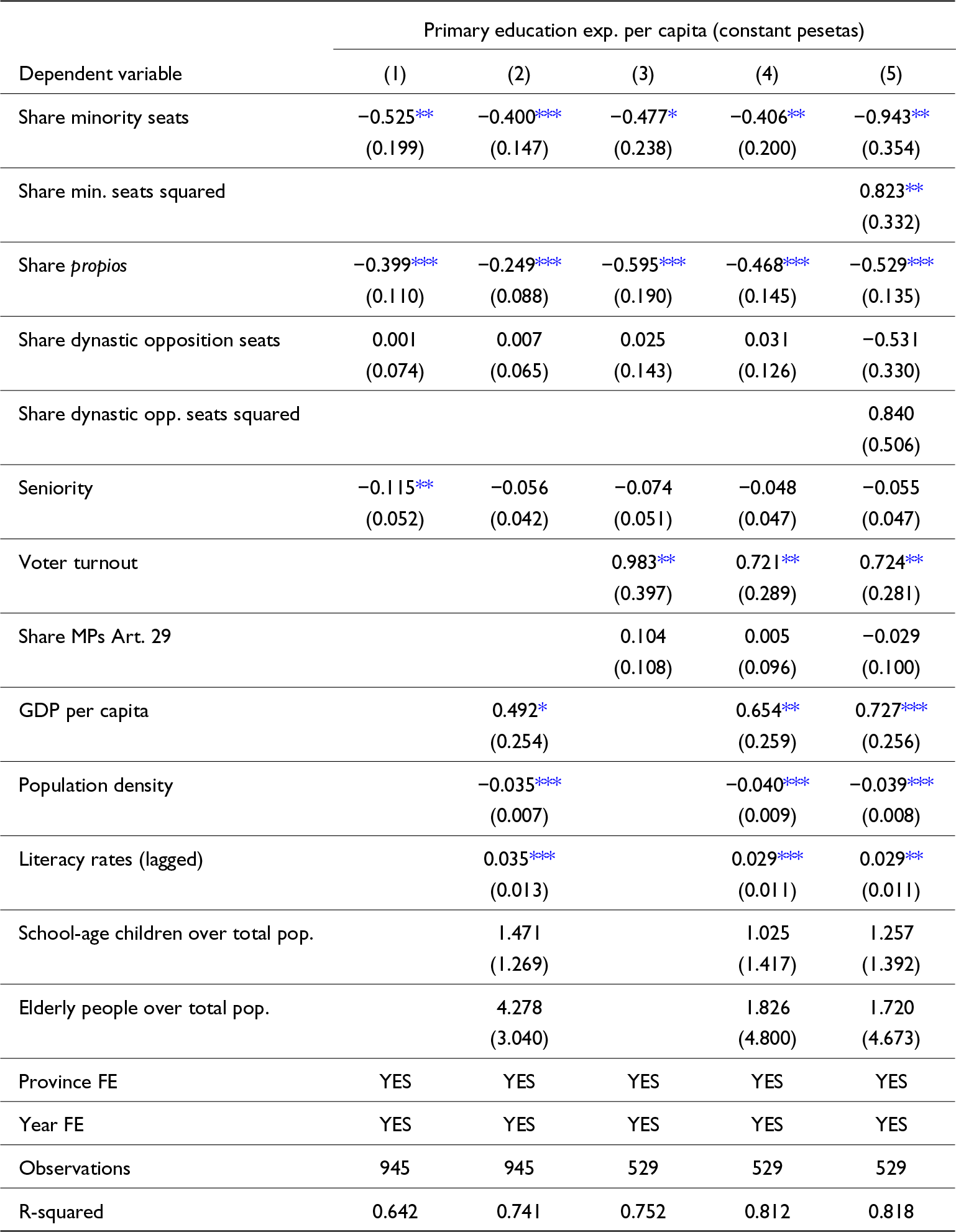
Table 3 summarizes the results of the baseline specification. Columns 1 and 2 indicate the estimates of a first set of political variables, excluding voter turnout, for which the number of observations was much smaller. Column 2 includes our set of control variables to avoid potential concerns about omitted variables. In both cases, the share of minority party seats, in relation to government representatives, shows a negative and significant effect on primary education spending. This suggests that, the government was able to ignore and even punish disloyal provinces by spending less on education and concentrating spending on the most loyal provinces. This is, indeed, consistent with the expected behavior of a semi-democratic regime such as the Spanish Restoration. As stated by Curto et al (Reference Curto, Herranz and Solé2012) in their study on road investments before 1914, it is very likely that the government implemented this punishment strategy to give opposition constituencies an incentive to join the alternation system.
Political determinants of primary public education expenditure

Note: The lack of data on voter turnout reduces the number of observations in Columns 3, 4, and 5.
*** All regressions include a constant. Clustered robust standard errors in parentheses. *** P < 0.01, ** P < 0.05, *P < 0.1
The share of propios is also negative and statistically significant. That is, primary education outlays were lower in provinces with a higher share of MPs who had closer ties to local bosses and were able to be re-elected outside the alternation system. This suggests that propios had little incentive to pressure for primary education spending. Interestingly, Curto et al (Reference Curto, Herranz and Solé2012) found that propios had a strong positive effect on road investment. Our interpretation is that investment in public roads could be easily used to benefit specific voters (clients). In contrast, investment in education was more likely to benefit both clients and non-clients, and was therefore less suitable for clientelistic purposes.
The seniority of legislators shows a negative impact, but it is no longer significant once the control variables are included. Similarly, the share of dynastic opposition seats did not exert any statistically significant influence. Regarding the other covariates, the results show that education expenditures were higher in richer and more literate provinces. There was also a negative relationship between education expenditure and population density, which seems to confirm the claim of Pérez Moreda (Reference Pérez Moreda1997). According to this author, schooling provision was higher in areas where small municipalities predominated because of the design of the Moyano Law, which required that at least one school be created in municipalities with fewer than 500 inhabitants. The other demographic controls were not statistically significant.
Column 3 includes voter turnout and the share of MPs elected through Article 29. The latter did not affect primary education spending, while voter turnout showed a positive and statistically significant effect. Therefore, it seems that political participation, which is likely to be capturing demands from below, had a positive impact on education spending. The share of minority MPs and propios held their influence. The results remained unchanged in column 4 when the controls were included. In terms of magnitudes, the impact of political variables in column 4 implies that a rise of one standard deviation in the share of minority MPs and propios would produce a 9% and 14% decrease in the standard deviation of schooling expenditure, respectively. The positive effect of voter turnout did not countervail this negative impact, as it implied a 7% increase in the standard deviation of the dependent variable.
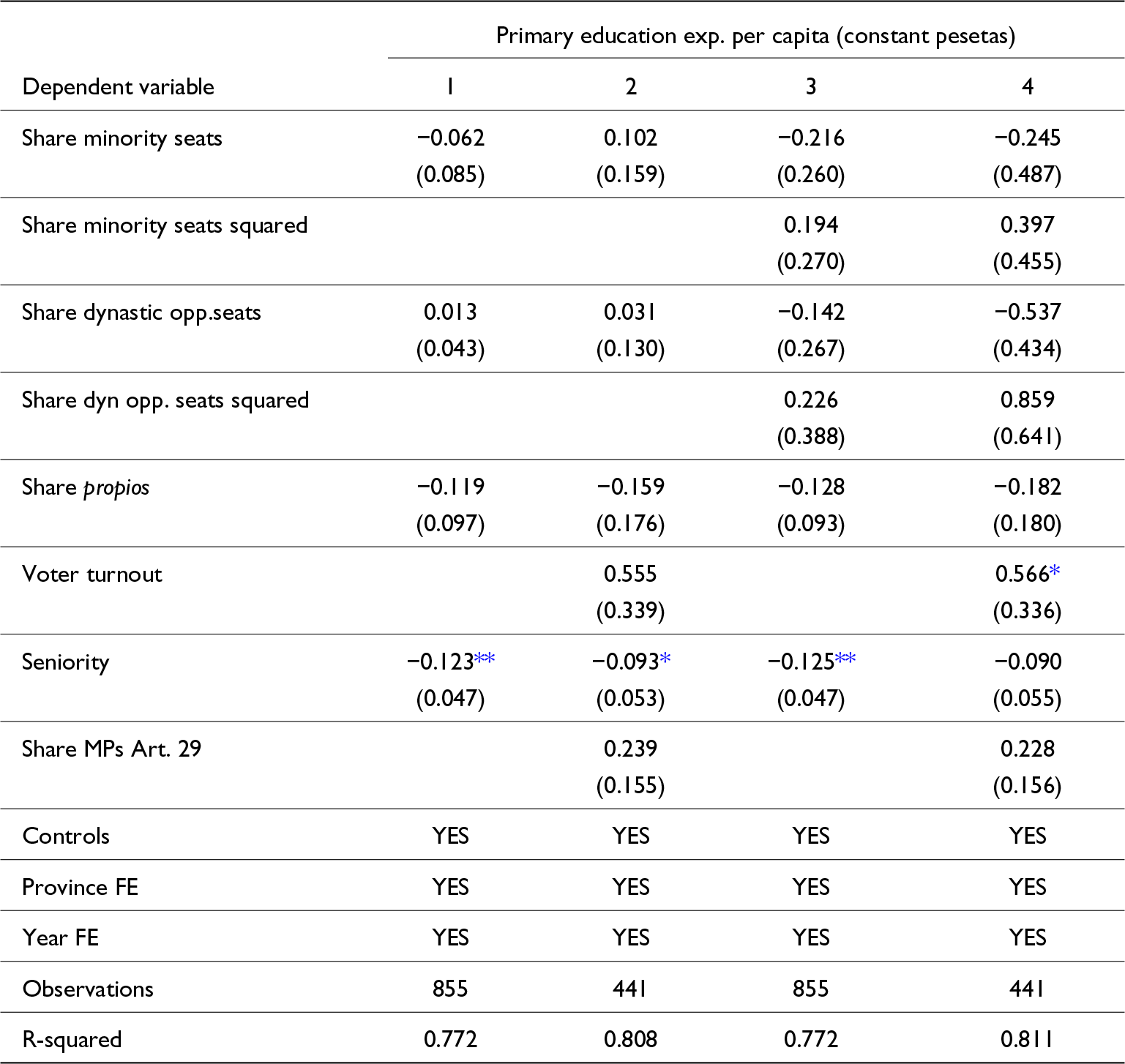
Finally, in Column 5, we tested whether a rise in the opposition made the government change its allocation of education expenditure strategy for the sake of political stability. The estimates show that the square term of minority seats is positive and statistically significant. This suggests that as the opposition grew, the government effectively replaced its strategy of punishment with a strategy of attraction. However, this change in government attitude is only observed for very high shares of minority MPs. The net global impact of minorities becomes positive only for provinces with a share of minority MPs above 57%. The estimates for the rest of the political variables (and also the controls) remained the same after including the share of minority seats squared.
5.1. Delving into political effects
As discussed in Section 3, the First World War was a major political shock. Government instability increased considerably, and elections became increasingly competitive, particularly in industrial cities, where traditional methods of voter control were more challenging to implement (Moreno-Luzón, Reference Moreno-Luzón2007). Therefore, our period seems to comprise a time shock associated with World War and a rural-urban divide that could interact with the baseline effects of the political variables under analysis. In this section, we explore the role of these two situations in our results.
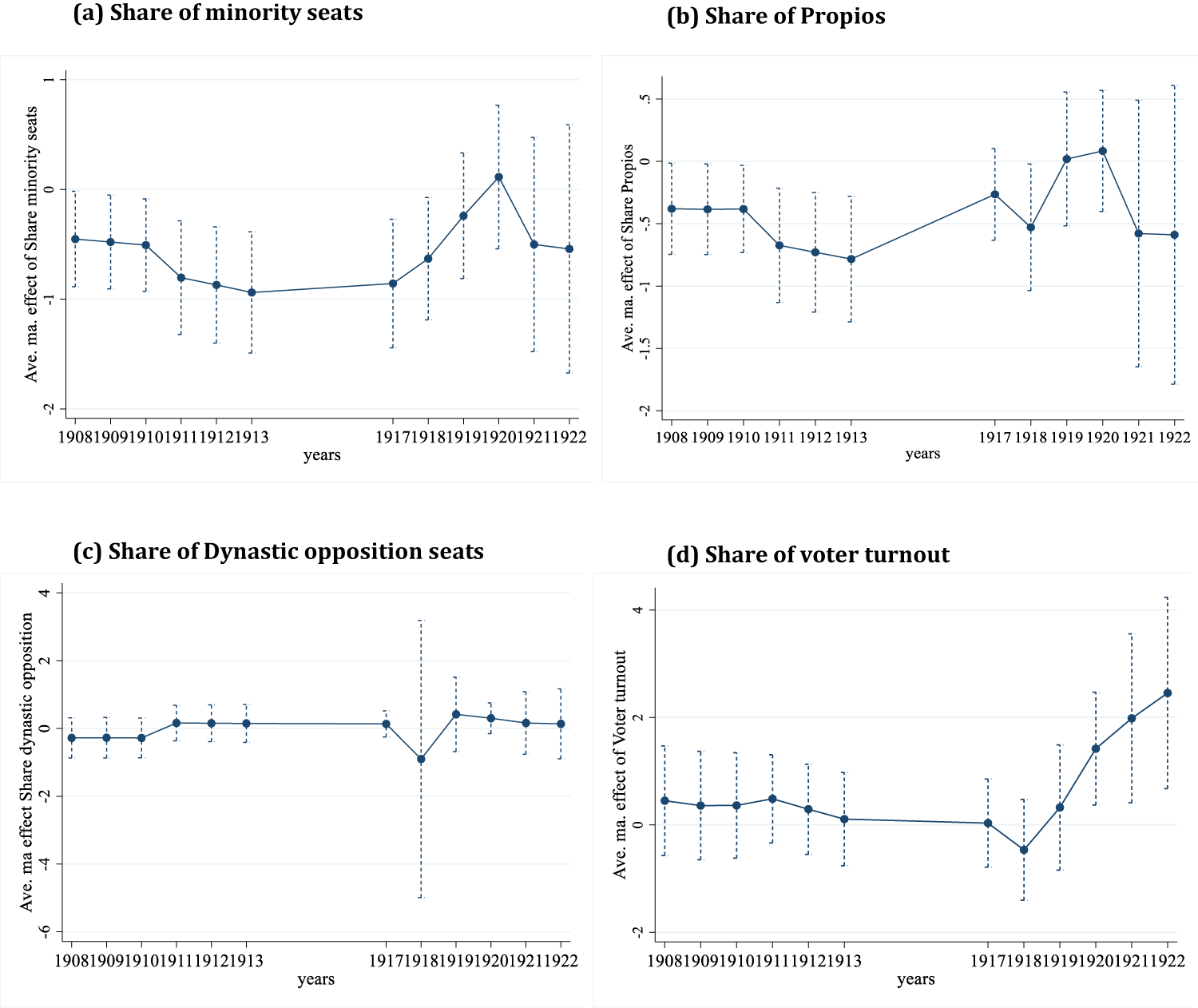
First, we tested whether the impact of our political variables changed over time. Figure 2 reports the marginal effect on public education spending of each political variable interacted with year-dummies, following regressions in Equation (2). They aim to capture the timing of the political effects. Table A.1 in the Appendix contains the regression estimates.
Average marginal effects of political variables on public primary education expenditures by year. (a) Share of minority seats, (b) share of propios, (c) share of dynastic opposition seats, and (d) share of voter turnout.

The figures seem to confirm the results in Table 3 until around 1917, but introduce some interesting nuances. The shares of minorities and propios had a negative effect on education spending before the First World War. Still, in the last years of the period, their negative effects were no longer significant (Figures 2a-b). This suggests that the government’s strategy of punishing constituencies that voted for minority parties gradually vanished after the First World War, as the regime found it increasingly difficult to control election results. Similarly, as electoral outcomes became more difficult to control and the purely clientelistic practices were no longer sufficient to guarantee re-election, it appears that propios stopped curbing investment in education to retain electoral support. Finally, it is noteworthy that the effect of voter turnout became positive and statistically significant precisely after the First World War (Figure 2d), confirming that Spanish Restoration politicians had been largely immune to bottom-up demands prior to that time.
It is worth noting that this change in the government’s tactics in relation to education spending is different in timing from what Curto et al (Reference Curto, Herranz and Solé2012) found for public roads expenditures. They detected that investment in public roads started favouring provinces outside the alternation system after the introduction of universal male suffrage in 1890. In our results, the change in government tactics was much later (after the First World War) and did not imply to benefit minority parties but to cease harming them. We interpret that this is because, unlike investment in public roads, education may foster civic engagement and political and social participation. From the perspective of the Restoration political elite, this probably turned education into a more threatening and less attractive tool to reward opposition. That is why the change came later in time, when the regime was even weaker.
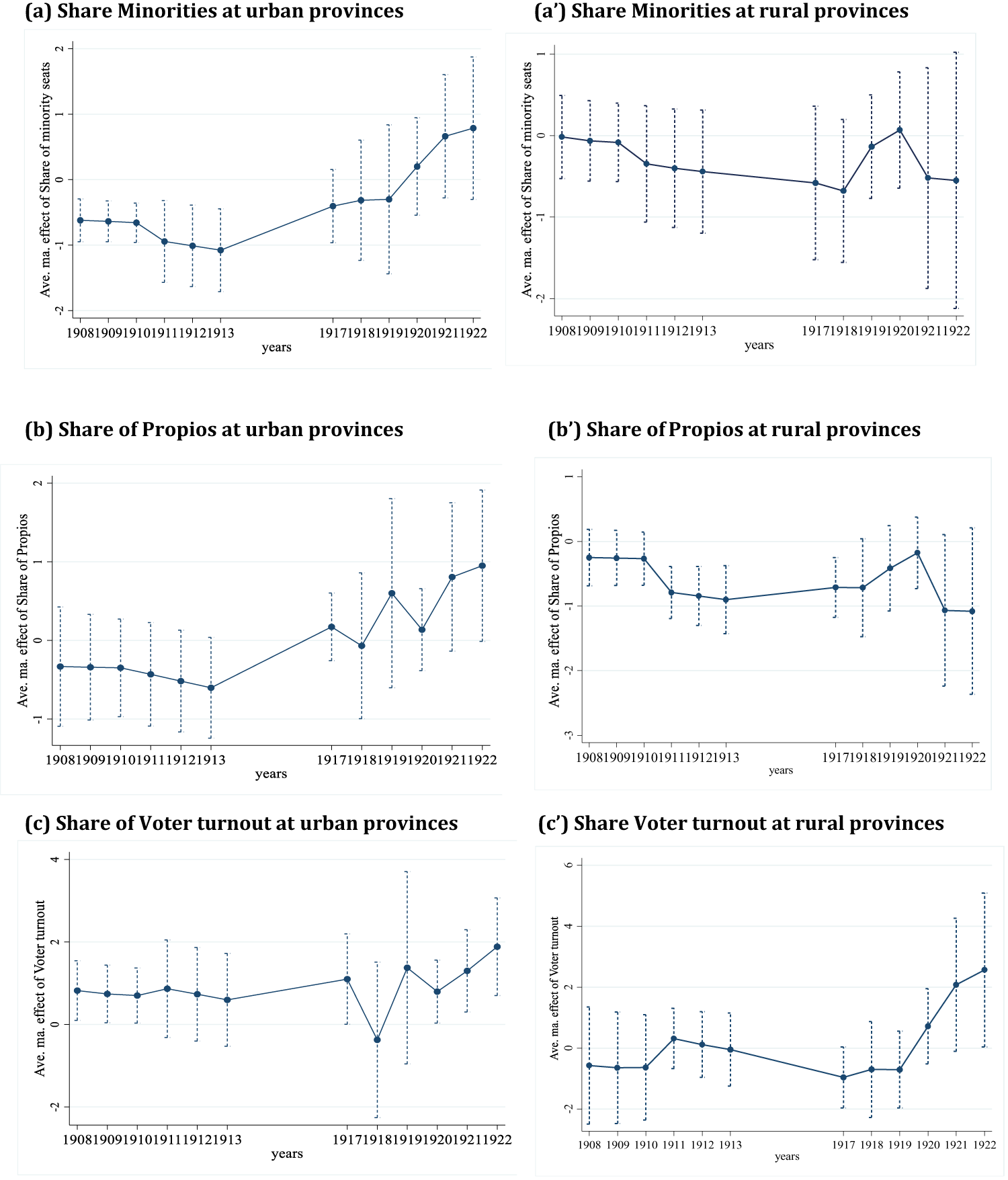
In addition to the varying effects of political factors over time, the Spanish historiography has emphasized that political dynamics differed between urbanized and industrialized areas and rural districts. Figure 3 shows the results of running separate regressions of Equation (2) for provinces regarded as “urban” or “rural” (see Table A.2a and A.2b in the Appendix for regression estimates).
Average marginal effects of political variables by year for urban and rural provinces. (a) Share minorities at urban provinces, (b) share of propios at urban provinces, and (c) share of voter turnout at urban provinces.

The figures show heterogeneous effects. In urban provinces, the effect of minority parties was negative and statistically significant until 1917 (consistent with Figure 2). However, the same variable rendered no significant effects in more rural provinces. Therefore, the government’s punishment strategy affected more industrial contexts, identified with independent and rebellious constituencies. Conversely, in rural areas, where the demand for education was probably lower and traditional political methods remained more effective, a given share of minority party MPs seemed to have been less threatening to the government’s interests. The increasing representation of minority parties did not translate into lower education spending. These differences tended to disappear after 1917, as the boost in social and political instability forced a change in the government’s attitude towards opposition.
As for the share of propios, its effect on urban provinces turned positive after 1917–1918 but remained non-statistically significant (Figure 3b). In the case of rural provinces, the pattern seems to be similar to that of Figure 2b: coefficients are always negative, although they are only significant in 1911–1917. This suggests that the negative influence of propios was more frequent in rural areas. The finding is consistent with propios’ disregard for the provision of non-targeted goods (e.g. universal primary education) and also with the fact that local bosses in rural areas were probably uninterested in mass schooling spread (especially where big farms predominated).
Voter turnout tended to be positive and statistically significant both at the beginning and at the end of the period in urban provinces. As before, the size of the coefficient is larger for the last years of our time period. Remarkably, political voice started contributing to higher schooling expenditures in more rural contexts by the end of the period. These patterns support the notion that it was in urbanized areas where the government first lost its power to manipulate electoral results. The situation tended to become more general after the First World War. We do not discuss the results on dynastic opposition seats because they rendered no significant effects across different types of provinces.
In summary, the urban–rural divide expresses the lack of democratic quality with different emphases. Urban regions were more likely to experience the government’s negative attitudes towards minority parties, while voter turnout seemed to be more effective in voicing population demands for education spending. Conversely, in more rural communities, the patronage ties of propios MPS to local elites, traditionally opposed to the spread of mass schooling, made them exert a more evident negative influence on education expenditures.
5.2. Robustness checks
In our baseline estimates (Table 3), we introduced several control variables to capture the effect of potentially omitted variables, as well as time and province fixed-effects to control for unobserved time and province heterogeneity. However, we cannot completely rule out the possibility that some relevant variable is still excluded. This could affect the reliability of our estimates. We performed a placebo test to check that our interest variables were not just capturing the effect of potentially omitted variables. We follow Equation 1, but in this case, the political variables refer to a legislature before the one in which education spending occurred. If our results are correct (and the parliament composition affected investment in education across provinces), the composition of parliament in a previous legislature should not have any effect on the current education spending. For example, the share of propios (or the share of minority parties) in 1915 should not have had any impact on education spending in 1917, as in 1916, there were elections, and the composition of parliament changed.
It is worth noting that our placebo variables are not purely random. They are likely to be related to unobserved province characteristics, which should help detect specification errors in the original model. If our placebo variables were statistically significant, it would indicate that our original results were probably affected by unobserved factors.
The results of the placebo test are shown in Table 4. The coefficients associated with the share of minority party seats or the share of propios are generally smaller in size and not significant across specifications (columns 1 to 4). In some cases, the variable sign is even the opposite of the baseline estimates (e.g. the share of minority seats in column 2). This suggests that these variables were not just capturing the effect of unobserved factors, which increases our confidence in the results shown in Table 3. Regarding voter turnout, the coefficients associated with our placebo variable also seem smaller in size, but are significant in column 4. This suggests that this variable could be, at least partially, capturing the effect of unobserved factors both correlated with voter turnout and education spending (as seems to be implied in Figures 2 and 3, which show that these factors could be related to changing conditions in terms of urbanization and time).
Placebo tests

Note: All regressions include a constant and controls for GDP per capita, population density, literacy rates (lagged), school-age children and older people over the total population, provincial, and time-fixed effects. Clustered robust standard errors in parentheses.
*** P < 0.01, ** P < 0.05, * P < 0.1
Additional robustness checks presented in the Appendix (part B) further show that the main results are robust to changes in the estimation method, the sample, and the use of alternative dependent variables.
6. Conclusions
Shortly after the turn of the century, nation-building reformers in Spain attempted to stimulate schooling expansion to improve, or at least dignify, Spain’s position in the international arena. Education was centralized in 1902, and the government took over the payment of primary school teachers’ salaries and the purchase of school supplies. Nation-building motivations undoubtedly explain the timing of the reform, as it was primarily motivated by the resounding military defeat by the USA and the loss of the last colonies in Cuba and the Philippines. In this paper, we discuss whether the political dynamics of Restoration Spain affected the evolution of government spending on primary education across Spanish provinces and, therefore, the evolution of reform implementation.
According to our results, when the Restoration system was stable enough, the government reduced education investment in electoral districts voting for minority parties. Similarly, the share of propios also had a negative effect on education outlays. We argue that propios were not interested in promoting primary education because it could not be easily targeted to specific voters and therefore, it did not serve to reinforce patron–client relationships.
However, the negative effect of both minority party voting and the share of propios vanished over time. We argue that as elections became more competitive, the government could no longer easily manipulate the election results. As a result, the ruling dynastic parties stopped punishing the “rebellious” provinces and began competing for their votes. In the case of propios, in the new context purely clientelistic practices did not seem sufficient to ensure the re-election. We consider that this might have led propios to be more sensitive to public education spending so to compete for the electoral support of the general population, not just their clients. Finally, voter turnout shows a positive and statistically significant effect only in the 1920s, which is consistent with the idea that (except in the final years of the Restoration regime) the government was able to largely ignore bottom-up demands. Therefore, our analysis of the Spanish case provides evidence to support the role of political voice and democracy to explain the evolution of education spending, as Lindert (Reference Lindert2004) previously showed for other cases. This, in turn, helps explain the modest impact of the 1902 reforms, despite initial good intentions.
Supplementary material
The supplementary material for this article can be found at https://doi.org/10.1017/S0212610925100542.
Acknowledgements
We thank for helpful comments to the participants of the “VII Jornadas Uruguayas de Historia Económica,” the workshop on “The rise of education in historical perspective” (online sessions), the Economic History Seminar at Universitat Rovira i Virgili and the session on “State capacity formation and economic growth in peripheral countries” in the XIXth World Economic History Congress. We are also thankful to Alfonso Herranz, Marc Badia, Xabier García-Fuente, Peter Lindert, Oriol Sabaté, and Raimon Soler for relevant insights. Marc Rivas and Alejandro Cichevski provided valuable assistance with the dataset. We are grateful to Marta Curto who shared her database with us.
Funding
Funding from the project PGC2018-095821-B-I00 (MINECO/FEDER, EU) is acknowledged.