Implications
Grape proanthocyanidins (GPCs) are polyphenol compounds derived from grape seeds known to be excellent immunomodulators in broiler chicks. In this study, we investigated the possibility of use and safe dosage of GPCs as feed additives and demonstrate that dosages of 7.5 and 15 mg/kg improve growth performance, jejunum morphology and antioxidant indices. Feeding GPCs as a supplement at 30 mg/kg leads to adverse effects on broiler blood biochemistry. Our results show that GPCs (fed at 13 to 17 mg/kg) have clear potential as feed additives, and that a low responsive dosage may have potential to improve the economic returns of the broiler industry.
Introduction
GPCs are a family of naturally occurring polyphenols derived from grape seeds (Shi et al., Reference Shi, Yu, Pohorly and Kakuda2003). A number of physiological and biomedical functions of GPCs are known including inhibition of terephthalic acid-induced tumor promotion in CD-1 mouse epidermis (Bomser et al., Reference Bomser, Singletary, Wallig and Smith1999), cardioprotection against doxorubicin-induced cardiotoxicity (Demirkaya et al., Reference Demirkaya, Avci, Kesik, Karslioglu, Oztas, Kismet, Gokcay, Durak and Koseoglu2009), attenuation of the development of aortic atherosclerosis from cholesterol-fed diet (Yamakoshi et al., Reference Yamakoshi, Kataoka, Koga and Ariga1999), and regulation of immune response in tumor-bearing mice (Tong et al., Reference Tong, Song, Sun, Sun and Du2011) and UV-irradiated mice (Vaid et al., Reference Vaid, Singh, Prasad, Elmets, Xu and Katiyar2013). GPCs can also inhibit stress from oxidants (Wang et al., Reference Wang, Suo, Gu, Zhang, Fang and Wang2008), increase antioxidant capacity in diet and excreta (Brenes et al., Reference Brenes, Viveros, Goñi, Centeno, Saura-Calixto and Arija2010), and ameliorate cadmium-induced renal injury and oxidative stress because of their capacity as powerful antioxidants (Nazima et al., Reference Nazima, Manoharan and Miltonprabu2015). Furthermore, storability enhancement of yogurts and salad dressing was also observed by grape pomace rich in GPCs (Tseng and Zhao, Reference Tseng and Zhao2013). As a result, GPCs have also been used extensively in the medical (e.g. the drug licensed as Endotelon in Romania), cosmetic (Martino et al., Reference Martino, Nowak and Pasapane1993) and food (e.g. the vitamin supplement licensed as Pycnogenol in the United States and France) industries.
Indeed, because of the versatile known functions of GPCs, the potential application of waste products rich in these polyphenols has generated interest in the recent years in the poultry industry. For example, grape pomace has been reported to enhance resistance to coccidiosis and necrotic enteritis (McDougald et al., Reference McDougald, Hofacre, Mathis, Fuller and Hargrove2008), and to improve the quality of intestinal microflora and gut morphology in poultry (Viveros et al., Reference Viveros, Chamorro, Pizarro, Arija, Centeno and Brenes2011). Grape seed extract (GSE) is also known to have the ability to increase antioxidant activity in chicken (Brenes et al., Reference Brenes, Viveros, Goñi, Centeno, Saura-Calixto and Arija2010), whereas GPCs enhance resistance to coccidiosis infection in broilers (Wang et al., Reference Wang, Suo, Gu, Zhang, Fang and Wang2008). Proanthocyanidins extracted from other plants have also aroused interest because of their uses in animal nutrition. Park et al. (Reference Park, Cha, Kang, So, Go, Mun, Ryu and Jang2011), for example, reported that a proanthocyanidin-rich extract from Pinus radiata bark modulates immunity in chickens, whereas Zhang et al. (Reference Zhang, Jiang, Mantovani, Valdez Lumbreras, Comi, Alborali, Savoini, Dell’Orto and Bontempo2014) have shown that a prepared plant polyphenol mixture increases the antioxidant ability of plasma in piglets.
Because the potential applications of GPCs in animal husbandry are still emerging, there is limited information available concerning the physiological responses of broiler chickens when these compounds are used as dietary supplements. Indeed, recent increases in the price of corn have forced the use of more abundant wheat as a substitute energy feed in China. It remains unclear, however, whether GPCs can be used as feed additives in a wheat–soybean meal diet for commercial poultry production. It was reported that the efficiency of phytogenic additives was affected by type of diet (corn or wheat) in chickens (Pirgozliev et al., Reference Pirgozliev, Beccaccia, Rose and Bravo2015). Thus, it is interesting to explore the efficacy of GPCs on wheat-based diet in broiler chicken.
GPCs belong to the condensed tannin family of compounds, known to have adverse effects on the digestibility of proteins and carbohydrates when ingested in relatively high levels (Ortiz et al., Reference Ortiz, Centeno and Treviño1993; Nyachotti et al., Reference Nyachotti, Atkinson and Leeson1997). However, feeding an appropriate amount of GPCs may beneficially modulate intestinal microflora and gut morphology (Viveros et al., Reference Viveros, Chamorro, Pizarro, Arija, Centeno and Brenes2011). In our previous work, we have shown that feeding GPCs at an appropriate level as a dietary supplement improves broiler chicken growth performance and immunity (Yang et al., Reference Yang, Wang, Wu, Yue, Qi and Zhang2014). On the basis of these previous results, we hypothesize that GPCs improve growth performance by modulating chick gut function and antioxidant status. Therefore, to test our hypothesis and to confirm the results of our previous work, we conducted a further trial to investigate the potential benefits of GPCs to broiler chicks. GPCs of known polymerization and high purity were used in this study as both degree of polymerization and proanthocyanidin purity are known to affect GPC function (Murga et al., Reference Murga, Ruiz, Beltrán and Cabezas2000). We measured growth performance, carcass characteristics, intestinal morphology, plasma antioxidant capacity and biochemical parameters. Our dose responsive trials may contribute to accurate estimates for optimal GPC supplement level in the diet of broiler chicks and as a result will serve as a basis for future work.
Material and methods
Experimental design and diets
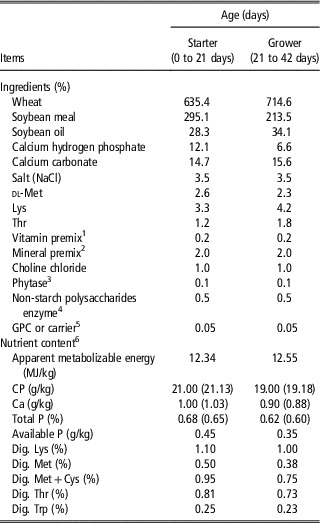
All experimental protocols were approved by the Animal Care and Use Committee of the Feed Research Institute, Chinese Academy of Agricultural Sciences. A total of 280 newly hatched male broiler chicks (Cobb 500) were randomly allotted into four treatments, each comprising seven replicates with 10 birds per replicate. Chicks were fed a wheat–soybean meal basal diet supplemented with or without (control group), 7.5, 15 or 30 mg of GPCs/kg (mg/kg), respectively. The GPCs used here were purchased from Tianjin Jianfeng Natural Products R&D Co. Ltd (Tianjin, China), at a concentration of 98.14%, determined by optimized normal-phase HPLC-MS fluorescence detection (Gu et al., Reference Gu, Kelm, Hammerstone, Beecher, Cunningham, Vannozzi and Prior2002). Composition of GPCs was 12.00% monomers, 65.23% oligomers (degree of polymerization between 2% and 5%) and 22.77% polymers, confirmed using the method of Gu et al. (Reference Gu, Kelm, Hammerstone, Beecher, Holden, Haytowitz and Prior2003). The experiment lasted for 42 days, with two wheat–soybean basal diets formulated for use as feed during the ‘starter’ (days 0 to 21) and ‘grower’ (days 21 to 42) phases of the broiler lifecycle (Table 1). Diets were formulated to meet both the requirements of the National Research Council (1994) and the Feeding Standard of Chickens in China (NY/T 33-2004).
Composition and nutrient content of experimental diets

GPC=grape proanthocyanidins; dig.=digestible.
1 Vitamin premix contained the following per kilogram of diet: vitamin A, 1100 IU; vitamin D3, 240 IU; vitamin E, 6 IU; menadione sodium bisulfite, 0.6 mg; vitamin B12, 0.004 g; biotin, 0.45 mg; folic acid, 0.2 mg; nicotinic acid, 50 mg; d-pantothenic acid, 5 mg; pyridoxine hydrochloride, 1.2 mg; riboflavin, 2.2 mg; thiamine mononitrate, 1.6 mg.
2 Mineral (inorganic source) premix contained the following per kilogram of diet: Fe, 80 g; Cu, 8 mg; Mn, 60 mg; Zn, 40 mg; I, 0.4 mg; Se, 0.2 mg.
3 Granular 6-phytase (Beijing Challenge Group, Beijing, China).
4 Rovabio® Excel AP (INNOV’IA, La Rochelle, France) containing xylanase and β-glucanase.
5 The diet of treatments contained GPC 0, 7.5, 15.0 or 30 mg/kg and carrier (zeolite powder) 50, 42.5, 35 or 20 mg/kg, respectively.
6 The nutrient contents listed in parentheses were analyzed values, others were calculated values.
Throughout the experiment, broilers had free access to feed and water, although the former was withdrawn overnight to allow gut clearance before sampling. Light and ventilation conditions were checked daily over the 42-day experimental period, and birds were raised in wire floor cages (each 110×100×55 cm3) in a four-level battery environmentally controlled room with continuous incandescent white light. Room temperature was maintained at 33°C for the 1st week of the experimental period, and was then gradually decreased by 3°C each week until room temperature was attained after 4 weeks. At all times, the management of birds was in accordance with guidelines for raising Cobb broilers.
Growth performance and carcass attributes
BWs and feed intake were recorded during the ‘starter’ (days 0 to 21) and ‘grower’ phases (days 21 to 42). Average daily feed intake (ADFI), average daily gain (ADG) and feed conversion ratio (FCR, feed : gain (g : g)) were calculated, and dead birds were removed, weighed and recorded twice daily. ADG, ADFI and FCR were corrected for dead birds.
On days 21 and 42, after a 12-h fasting period, two birds of average BW were selected from each experimental replicate for blood and jejunum sampling, and carcass measurements. Blood was drawn from wing veins and centrifuged (3000×g for 10 min) at 4°C, whereas plasma samples were stored at −20°C for biochemical analyses. After blood sampling, birds were stunned using an electrical stunner (40 V: AC current, 400 Hz for 5 s), immediately exsanguinated and defeathered to determine their carcass weight. Eviscerated weight was then recorded after removal of the head, feet, abdominal fat and giblets. Breast muscles (including the pectoralis major and pectoralis minor), leg muscles (including the thigh and drumstick muscles) and abdominal fat (including the leaf fat surrounding the cloaca and the abdominal fat surrounding the gizzard) were then weighed and the eviscerated yield percentages were calculated as the ratio between carcass weight and BW after fasting. Weight percentages of breast muscle and leg muscle were calculated as percentage of eviscerated weight, whereas abdominal fat was calculated as percentage of live weight after fasting.
Plasma biochemical indices
For plasma biochemical indices assay, the plasma within the replicate was pooled and analyzed in duplicate.
Total superoxide dismutase (T-SOD) activity in plasma samples was assayed based on the ability of T-SOD to inhibit the reduction of nitroblue tetrazolium by superoxide. One unit of T-SOD was defined as the amount of sample resulting in a 50% inhibition of nitroblue tetrazolium reduction. Results were expressed as units per milliliter of plasma, and enzyme activity was measured using a standard kit (Cat. No. A001–1 SOD) purchased from the Nanjing Jiancheng Bioengineering Institute (Nanjing, China).
Concentrations of malondialdehyde (MDA) in plasma were also determined by mixing a 100-µl aliquot of plasma with a thiobarbituric acid reagent in an incubator. After centrifuging samples, the optical density of the clear pink supernatant was read at 532 nm with MDA bis (dimethyl acetal) used as the standard. This assay was also conducted using a standard kit (Cat. No. A003–1, MDA) purchased from the Nanjing Jiancheng Bioengineering Institute.
Levels of total protein, albumin, uric acid (UA) and creatinine (CRE), as well as alkaline phosphatase (ALP), alanine aminotransferase (ALT) and aspartate aminotransferase (AST) activity levels in plasma were determined using an automatic biochemical analyzer (model 7020; Hitachi, Tokyo, Japan).
Jejunum morphology
The middle segment of the jejunum (i.e. the medial portion posterior to the bile ducts and anterior to Meckel’s diverticulum) was collected from the two sampled birds (see above) to check morphology. Methods for examining the length of the villus and the depth of the crypt in the jejunum followed the study by Gao et al. (Reference Gao, Zhang, Wu, Yu, Yoon, Moore, Gao, Yan and Qi2009); the ratio between villus length and crypt depth (V : C ratio) was also calculated and the average value from the two birds was used as the replicate.
Statistics
All data were subjected to one-way ANOVA using the SPSS software package (SPSS 16.0 for Windows; SPSS Inc., Chicago, IL, USA). The model included the treatment effect, and the cage represented the experimental unit for growth performance, whereas the mean value of two birds from each cage was the experimental unit for others parameters. Significant differences between treatments were determined by Duncan’s multiple range tests. Linear and quadratic contrasts for GPC effects were also computed with a P-value of <0.05 considered significant (unless otherwise stated). Polynomial regression was performed with dietary GPC level as a dependent variable when quadratic relationships existed.
Results
Growth performance
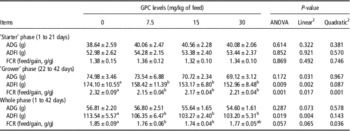
Growth performance data are presented in Table 2. Results show that supplementing the broiler diet with GPCs numerically improved both ADG and ADFI, and reduced FCR, during the ‘starter’ phase (days 0 to 21), when compared with the control group, these differences are not significant (P>0.05).
Effect of dietary grape proanthocyanidins (GPCs) on broiler chick growth performanceFootnote 1

ADG=average daily gain; ADFI=average daily feed intake; FCR=feed conversion ratio.
a,bMeans within a row with no common superscript letters differ significantly (n=7; P<0.05).
1 Data are the mean of seven replicates with 10 birds each.
2 Orthogonal polynomial contrasts.
In contrast, during the ‘grower’ phase (days 22 to 42), adding dietary GPCs linearly decreased (P=0.002) ADFI and ADG (P=0.031) (as GPCs increased). Chicks with GPCs added to their diets had significantly lower FCR compared with those in the control group (P=0.001); results show that this improvement to feed efficiency was both linear (P=0.017) and quadratic (P=0.001).
Throughout the whole raising period (days 0 to 42), adding GPCs to diet significantly lowered both ADFI (linear, P=0.019) and FCR (linear, P=0.065; quadratic, P=0.036) with increasing GPC levels. Results show that chicks fed with 7.5 to 15 mg/kg of GPCs exhibited better feed efficiencies due to lower ADFI when compared with the control group.
Carcass composition
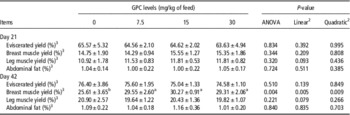
Carcass composition data are presented in Table 3. Results show that no significant differences in carcass composition were seen between different treatments up to 21 days, although leg muscle yields in birds fed with GPCs were 5% to 9% higher than in the control group (P>0.05).
Effect of dietary grape proanthocyanidins (GPCs) on broiler chick carcass compositionFootnote 1

a,bMeans within a row with no common superscript letters differ significantly (P<0.05).
1 Data are mean of seven replicates (two birds from each replicate).
2 Orthogonal polynomial contrasts.
3 Percentage of BW.
Results show that by 42 days, dietary supplement with GPCs had significantly improved breast muscle yields by 14.4% to 18.2% compared with the control group (linear, P=0.005; quadratic, P=0.009). Indeed, chicks fed with 15 mg/kg of GPCs exhibited the highest breast muscle yield of all groups, although no differences were seen in any other carcass quality indices (P>0.05).
Jejunum morphology
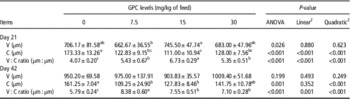
Jejunum morphology data are presented in Table 4. Results show that by day 21, supplementing diet with GPCs had no effect on villus length (P>0.05), but did reduce crypt depth and improve V : C ratio significantly when compared with the control group (linear and quadratic, P<0.001). The most marked change in jejunum morphology was seen in the group fed a diet supplemented with 15 mg/kg of GPCs.
Effect of dietary grape proanthocyanidins (GPCs) on broiler chick jejunum morphologyFootnote 1

V=villus length; C=crypt depth.
a,b,cMeans within a row with no common superscript letters differ significantly (P<0.05).
1 Data are mean of seven replicates (two birds from each replicate).
2 Orthogonal polynomial contrasts were used to determine the effect of dietary GPC levels.
By day 42, addition of GPCs in 7.5 and 30 mg/kg dosages numerically elevated villus length (P>0.05), whereas chicks fed GPC-supplemented diets exhibited quadratically reduced crypt depth (P<0.001) as GPCs increased. Supplementing diets with GPCs also significantly elevated V : C ratio (linear and quadratic, P<0.01); chicks fed with a 7.5 mg/kg GPC supplement had the lowest crypt depths and highest jejunum V : C ratio seen across treatments.
Plasma antioxidants
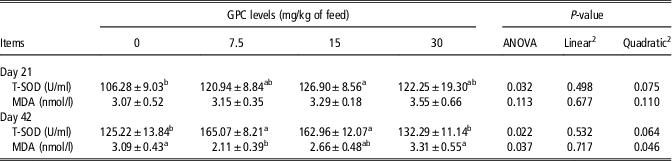
Plasma antioxidant parameters for broilers fed different GPC dosages are presented in Table 5. Results show that by day 21, T-SOD activity in the group fed with 15 mg/kg of GPCs was significantly elevated compared with the control group (P<0.05). By day 42, a quadratic trend in plasma T-SOD activity (P=0.064) and a quadratic response in MDA content (P=0.046) was observed as the level of dietary GPCs increased. Broiler chicks fed 7.5 and 15 mg/kg supplement of GPCs showed a significant improvement in T-SOD activity compared with the control group (P<0.05), whereas plasma MDA content in the group fed GPCs at 7.5 mg/kg was significantly reduced compared with the control group (P<0.05). Finally, the group supplemented with GPCs at 30 mg/kg showed no significant difference in plasma antioxidant status by day 21 or 42 when compared with the control group.
Effect of dietary grape proanthocyanidins (GPCs) on broiler chick plasma antioxidant indicesFootnote 1

T-SOD=total superoxide dismutase; MDA=malondialdehyde.
a,bMeans within a row with no common superscript letters differ significantly (P<0.05).
1 Data are mean of seven replicates (two birds from each replicate).
2 Orthogonal polynomial contrasts.
Plasma biochemical indices
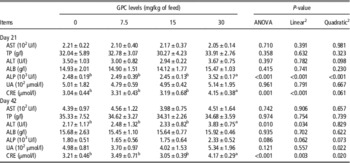
Data on the plasma biochemical indices of broiler chicks are presented in Table 6. Results show that by day 21, a dietary supplement of 30 mg/kg of GPCs significantly increased ALP activity and CRE concentration (P<0.05). By day 42, a GPC feed supplement of 30 mg/kg markedly elevated ALT activity (i.e. 76.49%, P<0.01), as well as CRE concentration (i.e. 29.90%, linear, P=0.003; quadratic, P=0.020), compared with the control group.
Effect of dietary grape proanthocyanidins (GPCs) on the plasma biochemistry of broiler chicksFootnote 1

AST=aspartate aminotransferase; TP=total protein; ALT=alanine aminotransferase; ALB=albumin; ALP=alkaline phosphatase; UA=uric acid; CRE=creatinine.
a,bMeans within a row with no common superscript letters differ significantly (P<0.05).
1 Data are mean of seven replicates (two birds from each replicate).
2 Orthogonal polynomial contrasts.
Prediction of optimal grape proanthocyanidin level
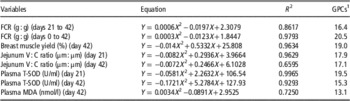
Prediction of optimal GPC level based on growth, gut and antioxidant data is presented in Table 7. Results show that by day 21, broiler showed highest jejunum V : C ratio and plasma T-SOD activity when the diet had a supplement of GPCs at 17.9 and 19.5 mg/kg. By day 42, the best antioxidant, gut morphology and breast muscle yield would be achieved when the diet had between 13.1 and 19.0 mg/kg GPCs. For the grower phase and the whole experimental phase, the best feed efficiency was observed when GPCs fed at a level of 16.4 or 20.5 mg/kg.
Prediction of optimal grape proanthocyanidins (GPCs) (mg/kg) based on growth, gut morphology or plasma antioxidant capacity

FCR=feed conversion ratio; V=villus length; C=crypt depth; T-SOD=total superoxide dismutase; MDA=malondialdehyde.
1 GPC levels calculated from the vertex of the corresponding curve.
Discussion
This study shows that adding GPCs to the diet of broiler chicks has no significant impact on their growth during the ‘starter’ phase. However, during the ‘grower’ phase and over the whole growth period, supplementing diets with GPCs decreases both ADFI and FCR. Indeed, feeding GPC supplements at 7.5 and 15 mg/kg resulted in an overall improvement in efficiency.
This improved growth performance in the ‘grower’ phase as well as over the whole growth period (but not in the ‘starter’ phase) observed in current study is consistent with the idea that the addition of GPCs has a time-dependent cumulative effect, as suggested in our previous work (Yang et al., Reference Yang, Wang, Wu, Yue, Qi and Zhang2014). Different from the current result, GPCs at a level of 30 mg/kg also markedly elevated feed efficiency in our previous study. However, other studies addressing the application of grape by-products as feed for broiler chicks did not observe growth-promoting effects (McDougald et al., Reference McDougald, Hofacre, Mathis, Fuller and Hargrove2008; Brenes et al., Reference Brenes, Viveros, Goñi, Centeno, Saura-Calixto and Arija2010; Zhang et al., Reference Zhang, Xu, Yue, Wu, Pan, Wei and Wang2012), so these could be attributed here to the difference in housing, stress and performance level, as well as the combination of GPCs and an alternative diet. Note that in previous studies, corn-type diets have usually been used, whereas in our work the basal diet was wheat-type diet. Thus, improved growth performance could be associated with the plasma glucose balance created by the combination of GPCs and wheat (Hanhineva et al., Reference Hanhineva, Törrönen, Bondia-pons, Pekkinen, Kolehmainen, Mykkänen and Poutanen2010). Both Holt et al. (Reference Holt, Jong, Faramus, Lang and Brand Miller2003) and Andersen et al. (Reference Andersen, Koehler and Somoza2008) have noted that glucose content in serum tends to be stable when food is ingested that combines grape extracts with grinded wheat, and the growth improvement seen in broilers fed a wheat-type diet containing 60 g/kg of grape pomace concentrate (Viveros et al., Reference Viveros, Chamorro, Pizarro, Arija, Centeno and Brenes2011) would appear to support this conclusion. Furthermore, the lower added fat in wheat diet than in corn diet and the presence of non-starch polysaccharides (NSP) enzyme might contribute to the diverse efficacy of GPCs between corn and wheat-type diet. Nevertheless, further investigations are needed to test these hypotheses.
Because the jejunum is the main region for nutrient absorption in the broiler intestine (Leeson and Summers, Reference Leeson and Summers2001), its morphology can be used as a proxy measure for efficiency (Varel et al., Reference Varel, Robinson and Pond1987). Digestion and absorption of nutrients are accomplished by the action of a heterogeneous monolayer of columnar epithelial cells along the villus–crypt axis in small intestine; we know that heavier chickens tend to have longer villus, shallower crypts and larger V : C ratios compared with their lighter counterparts (Boka et al., Reference Boka, Mahdavi, Samie and Jahanian2014). In this experiment, GPC supplements of 7.5 and 15 mg/kg positively modulated jejunal morphology, perhaps associated with antioxidant and/or antibacterial properties (Al-Habib et al., Reference Al-Habib, Al-Saleh, Safer and Afzal2010; Oliveira et al., Reference Oliveira, Salvador, Smânia, Smânia, Maraschin and Ferreira2013). It is known that proanthocyanidins can protect the intestinal mucosa from oxidative stress (Bagchi et al., Reference Bagchi, Swaroop, Preussc and Bagchi1999), and can also selectively inhibit the growth of intestinal pathogenic bacteria (Puupponen-Pimiä et al., Reference Puupponen-Pimiä, Nohynek, Hartmann-Schmidlin, Kähkönen, Heinonen, Määttä-Riihinen and Oksman-Caldentey2005). The reduction in jejunum crypt depth observed in this study is in agreement with earlier results (Viveros et al., Reference Viveros, Chamorro, Pizarro, Arija, Centeno and Brenes2011) on the use of grape products as broiler supplements. In contrast, however, other studies have shown that supplementing diet with green tea polyphenols increases jejunum villus length in broilers (Hassanpour et al., Reference Hassanpour, Zamani Moghaddam, Yazdani and Bashi2010), and can enable villus to recover to a normal state in the small bowels of fasting rats (Asfar et al., Reference Asfar, Abdeen, Dashti, Khoursheed, Al-Sayer, Mathew and Al-Bader2003). This variation in effect might thus be because of a difference in the structure–function relationship in proanthocyanidins.
Modulation of the antioxidant capacity of the body has also been suggested as an action attributable to polyphenols derived from grapes (Koga et al., Reference Koga, Moro, Nakamori, Yamakoshi, Hosoyama, Kataoka and Ariga1999; Shi et al., Reference Shi, Yu, Pohorly and Kakuda2003; Demirkaya et al., Reference Demirkaya, Avci, Kesik, Karslioglu, Oztas, Kismet, Gokcay, Durak and Koseoglu2009; Bagchi et al., Reference Bagchi, Balmoori, Bagchi, Ray, Kuszynski and Stohs2014). Indeed, our data show that an appropriate level (i.e. <15 mg/kg) of dietary GPCs can improve the antioxidant capacity of broiler plasma, as evidenced by higher activity of T-SOD and a lower content of MDA. Our results in this area are thus in agreement with earlier observations on the inhibition of lipid peroxidation in broilers (Wang et al., Reference Wang, Suo, Gu, Zhang, Fang and Wang2008). Nevertheless, broilers fed with 30 mg/kg of GPCs showed no significant difference in their antioxidant status when compared with birds that were not fed GPCs, an effect that might be due to the actions of polyphenols as either pro-oxidants or antioxidants depending on dose, duration of administration and systemic antioxidant machinery status (Chedea et al., Reference Chedea, Braicu and Socaciu2010; Ignea et al., Reference Ignea, Dorobanţu, Mintoff, Branza-Nichita, Ladomery, Kefalas and Chedea2013). For instance, in chick cardiomyocyte, low concentrations of GPC attenuated oxidative injury; in cells pretreated with GPC (10, 50 or 100 μg/ml), the cell death decreased dose-dependently from 60.6% in H2O2-exposed cells to 39.1%, 27.5% and 25.0%, respectively (Shao et al., Reference Shao, Becker, Vanden Hoek, Schumacker, Li, Zhao, Wojcik, Anderson, Qin, Dey and Yuan2003a), whereas higher concentrations of GPCs (100 or 500 μg/ml) became pro-oxidant, resulting in an increase in reactive oxygen species (ROS) generation and lactate dehydrogenase release and caused cell death (Shao et al., Reference Shao, Vanden Hoek, Xie, Wojcik, Chan, Li, Hamann, Qin, Schumacker, Becker and Yuan2003b). Ignea et al. (Reference Ignea, Dorobanţu, Mintoff, Branza-Nichita, Ladomery, Kefalas and Chedea2013) demonstrated that the role of physiologically relevant levels (5 and 50 μM gallic acid equivalents) of GSE in yeast cell and yeast cell recovery assay varied from antioxidant to pro-oxidant depending on the cellular antioxidant deficiency; in cells deficient of catalase activity or glutathione level, GSE augmented cell growth, whereas GSE operated as pro-oxidant agents in cells lacking SOD activity. In the present study, the increased T-SOD activity was accompanied by unchanged MDA level in 15 mg/kg GPCs at day 21, and at day 42 the highest T-SOD levels exhibited a large difference in MDA (Ns) between 7.5 and 15 mg/kg GPC group. The diverse response of T-SOD activity at different age and the irrelevance of T-SOD activity on MDA level may be due to the subtle balance between antioxidant and pro-oxidant role of GPCs. In grower phase, the supplement of 15 mg/kg GPCs might lean to pro-oxidant side and evoke the rise of MDA by day 42, which warrant further investigation. The characteristically high metabolic rates of modern high-yield broiler chicks are often associated with elevated production of ROS and free radicals (Avanzo et al., Reference Avanzo, Mendonca, Pugine and Cesar2001). Our results reveal that an appropriate level of dietary GPCs has the potential to protect broiler chicks against damage from ROS and free radicals.
In the present study, dietary GPCs at a level of 7.5 and 15 mg/kg positively affected growth, carcass, gut and antioxidant status. Quadratic responses of GPCs were observed on these parameters. Based on polynomial regression, broiler chicks showed the highest breast muscle yield at 42 days when the diet was supplemented with 19 mg/kg GPCs. The biggest V : C ratio in jejunum at 42 days could be attained by addition of 17.1 mg/kg GPCs in the diet. The best plasma antioxidant capacity at 42 days would be generated at the level of 13.1 to 15.3 mg/kg GPCs. For the optimal feed efficiency in grower phase and the whole phase, a supplement of 16.4 or 20.5 mg/kg GPCs was required. Due to the reduced ADG in grower phase, dietary inclusion of high GPC level should be avoided. These results are in the optimum range for growing chicken recommended by Wang et al. (Reference Wang, Suo, Gu, Zhang, Fang and Wang2008). On the basis of growth performance, carcass composition, jejunum morphology, antioxidant status and blood biochemistry, the optimal GPC supplement level to be added to a wheat–soybean meal diet for broiler chicks is recommended to be 13.1 to 17.1 mg/kg.
Although the metabolic pathways of proanthocyanidins remain poorly understood, it is known that the liver and kidneys are involved in this process. The liver is the main organ for the conversion and metabolism of xenobiotics, whereas the kidneys excrete absorbed GPC (Luo et al., Reference Luo, Yao, Jia and He2006). Blood enzyme activity values (i.e. ALT, AST and ALP) are considered important diagnostics for liver function because these enzymes exist in hepatocytes at varying levels (Klein et al., Reference Klein, Lafferty, Pearson and Curtiss1964; Cheng et al., Reference Cheng, Shen, Pang and Cheng2001). The increased ALT activity indicated that 30 mg/kg GPC might affect the liver function, although an unchanged AST activity was observed. It is well known that ALT mostly lodges itself in cytoplasm of hepatocytes, whereas AST mainly distributes in mitochondria of liver cell and slightly in cytoplasm. When hepatocytes are mildly damaged and the permeability of hepatic membrane is pathologically increased but mitochondria are not obviously affected, large amount of ALT would release into the blood rapidly and AST might lack significant change (Daba and Abdel-Rahman, Reference Daba and Abdel-Rahman1998). The enhanced activity of ALP, contained in hepatocytes in high level, also supported this viewpoint to some extent (Lambert et al., Reference Lambert, Kennettb, Sangc, Reuhld, Jue and Yang2010). Therefore, the supplementation of 30 mg/kg GPC might induce slight dysfunction of liver. Thus, histopathological and ultrastructural observations are suggested to determine the exact influence of dietary high GPCs on liver of broiler in future study.
CRE, the final metabolite of creatine and phosphocreatine in the muscles and excreted by the kidneys, is usually used as a proxy for the filtration ability of the glomerulus (Wyss and Kaddurah-daouk, Reference Wyss and Kaddurah-daouk2000). Thus, an increase in CRE indicates that a GPC supplement of 30 mg/kg might have an adverse effect on kidney filtration, perhaps because of the increased metabolic burden placed on the kidney glomerulus by the GPC metabolite. Because we also know that proanthocyanidins are partly catabolized by intestinal microflora into low-molecular-weight phenolic acids and excreted by the kidneys (Déprez et al., Reference Déprez, Brezillon, Rabot, Philippe, Mila, Lapierre and Scalbert2000), higher concentrations of GPCs might also contribute to higher toxicity of the products of metabolism. Although the output of the kidneys is positively correlated with ingestion of GPCs, further work is needed in this area.
Finally, UA is often used as a general indicator of amino acid utilization and degree of protein breakdown (Donsbough et al., Reference Donsbough, Powell, Waguespack, Bidner and Southern2010). A quadratic trend in the reduction of the blood UA level compared with dietary GPC was observed in this experiment; chicks fed GPC supplements of 7.5 and 15 mg/kg had comparably reduced UA levels as they got older. Thus, this trend in the reduction of blood UA indicates that broilers fed with an appropriate GPCs dosage may have the potential to increase their levels of protein synthesis and retention, coincident with an improvement in growth performance and carcass quality.
Conclusion
This study shows that dietary supplements of 7.5 to 15 mg/kg of GPCs can improve growth performance, carcass attributes, jejunum morphology and the antioxidant status of broiler chicks. However, a high supplement dosage of GPCs at 30 mg/kg can adversely affect blood biochemical indices. Quadratic responses occur on growth, jejunum morphology and plasma antioxidant capacity. Regression showed that optimal GPC levels for best plasma antioxidant capacity at 42 days was 13.1 to 15.3 mg/kg, for best feed efficiency during grower phase was 16.4 mg/kg and for best jejunum morphology at 42 days was 17.1 mg/kg. Overall, GPCs (at a level of 13.1 to 17.1 mg/kg) have the potential to be a promising feed additive for broiler chicks.
Acknowledgments
The authors are grateful for the financial support provided by the National Natural Science Foundation of China (31272456, Beijing, China), the National Science & Technology Pillar Program (2011BAD26B04, Beijing, China) and the Chinese Agriculture Research System Poultry-Related Science and Technology Innovation Team of Peking (CARS-PSTP, Beijing, China).