Healthcare Associated Infection (HAIs) account for ~1.7 million infections and ˜99,000 deaths annually. Reference Haque, Sartelli and McKimm1 Clostridioides difficile infection (CDI) is the leading cause of hospital-acquired diarrhea and is associated with significant morbidity and mortality. A 2015 Centers for Disease Control and Prevention (CDC) study Reference Lessa, Mu, Bamberg and Beldavs2 found that CDI caused nearly half a million infections and ˜29,000 deaths in 2011, and a recent systematic review by Zhang et al Reference Zhang, Palazuelos-Munoz and Balsells3 estimates that the total annual CDI-attributable cost in the United States at $6.3 billion.
Institution of strict hand hygiene policies have been effective at reducing rates of HAIs, including CDI. In a large trial of a hospital-wide hand hygiene campaign, hand hygiene compliance increased from 48% to 66% (P < .001) and was associated with reduction in nosocomial infection rates from 16.9% to 9.9% (P < .04). Reference Pittet, Hugonnet and Harbarth4 Nonetheless, hospital-wide hand hygiene rates rarely exceed 60%. Reference Pittet, Simon and Hugonnet5
Since the work of Johnson et al Reference Johnson, Gerding and Olson6 in 1990, the use of vinyl gloves is recognized as a core method to interrupt Clostridioides difficile nosocomial transmission. Reference Johnson, Gerding and Olson6 Gloving compliance is easier to monitor than hand hygiene compliance and is not as dependent on technique and duration as hand hygiene is. Nonetheless, only a handful of small studies have evaluated the use of universal gloving as a method to reduce the incidence of HAI’s. In a recent meta-analysis of studies that implemented universal gloving, Chang et al Reference Chang, Kates and Ward7 showed a mixed impact on HAI depending on whether universal gloving was implemented alone or as part of intervention bundles.
Glove use is not recommended (with the exception of patients on contact precautions) for patient care activities with no potential for exposure to blood or body fluids or a contaminated environment. The CDC and WHO raise concerns that inappropriate glove use may result in missed opportunities for hand hygiene and represent a waste of resources while not contributing to reducing the spread of infection. 8,Reference Siegel, Rhinehart and Jackson9 These concerns stem from early work by Fuller et al Reference Fuller, Savage and Besser10 and Bearman et al, Reference Bearman, Marra and Sessler11 both of whom demonstrated decreased hand hygiene rates with glove use.
Based on the disparate findings of reduced incidence of HAI’s and reduced hand hygiene, the University of Rochester Medical Center embarked on a hospital-wide universal gloving protocol, the “Wash–Glove–Wash” initiative, as part of a multiple-year quality improvement study aiming at reducing HAI rates.
Methods
Study design
This study was a prospective cohort analysis involving all adult units at the University of Rochester Strong Memorial Hospital (URMC) with the exception of our obstetrics unit. On January 1, 2016, we instituted a universal gloving policy requiring use of gloves for all clinical encounters with emphasis on hand washing before and after patient care. Previously, gloving use was based on CDC recommendations.
Our hospital infection prevention division surveyed compliance with hand hygiene and gloving using a “secret shopper” methodology whereby monitors randomly rotated across all units throughout the study period. They collected data on CDI rates, catheter-associated urinary tract infection (CAUTI) rates, and central-line–associated bloodstream infection (CLABSI) rates for each hospital unit per NHSN definitions. Collectively, we refer to CDI, CLABSI, and CAUTI as HAIs.
Study population
All providers and adult inpatient units at Strong Memorial Hospital from January 1, 2015, to December 31, 2017, with the exception of the obstetrics unit, were included. Our data set included 770 unit-level observations each encompassing 1 month, which included 32,290 unique gloving and hand hygiene opportunities. No ex-ante power calculations were made to determine this sample size.
This study was reviewed by the URMC Institutional Review Board, was deemed to pose minimal risk, and was granted approval with waiver of consent and a Health Insurance Portability and Accountability Act (HIPAA) waiver.
Intervention and control groups
After January 1, 2016, all healthcare workers with patient contact were required to wash their hands and wear gloves for each instance of patient contact and to wash their hands after patient care as part of the Wash–Glove–Wash effort. Hand washing included use of soap and water or alcohol-based hand sanitizer. Education was provided via hospital-wide poster campaign emphasizing the importance of hand hygiene and gloving for patient care, unit-level competitions, and amplified compliance monitoring by infection prevention staff.
During the baseline control period (January 1–December 31, 2015), healthcare workers followed standard of care hand hygiene protocols as set out by the CDC.
Hospital leadership identified physician and nursing champions that developed and disseminated the Wash–Glove–Wash educational materials. This committee met monthly to discuss implementation and to ensure adequacy of information dissemination. The infection prevention team reviewed and followed CDC National Health Safety Network definitions for HAI’s, trained secret shoppers, and audited their measurements regularly.
Outcomes
The primary outcome measures were hand hygiene and gloving compliance at the unit-level collected monthly by surreptitious observation by “secret shoppers.” Unit selection for observation was determined by the infection prevention team in a systematic fashion assuring equal representation throughout the institution. Concurrent data on CDI, CAUTI, and CLABSI rates at the unit level were collected according to hospital protocol by the infection prevention service.
Statistical analysis
Multivariate regression and the existence of statistically significant relationships between variables was assessed using either an alpha value of 0.05, if the Bayesian equi-tailed 95% credible interval excluded zero, or equivalently if the “Bayesian P value” was <.05. We defined the latter as 2 min (P(θ > 0|D), P(θ < 0|D)), where P(θ|D) represents the posterior distribution of a parameters given the data. Reference Pereira and Stern12
Hospital-level data were analyzed with ordinary linear regression. Unit-level data were analyzed using Bayesian mixed-effect binomial regression with R version 3.6.2 software and R-package “brms” version 2.11 (R Foundation for Statistical Computing, Vienna, Austria). Reference Bürkner13 For the mixed-effects binomial regression, because we had multiple observations from each unit and we assumed each unit differed in its baseline risks for each HAI and baseline levels of hand hygiene and gloving, we incorporated a random effect, which modeled the baseline odds of the outcome in each unit. In the model of hand hygiene, the response variable was the log odds of hand hygiene (events per opportunities). For models of individual HAIs (CDI, CLABSI, and CAUTI), we used unit-level rates of each HAI (ie, events per patient day, line day, or catheter day) as response variables, and considered the effects of gloving, hand hygiene, the unit-level random effect, and in some cases, a nonparametric temporal trend.
Results
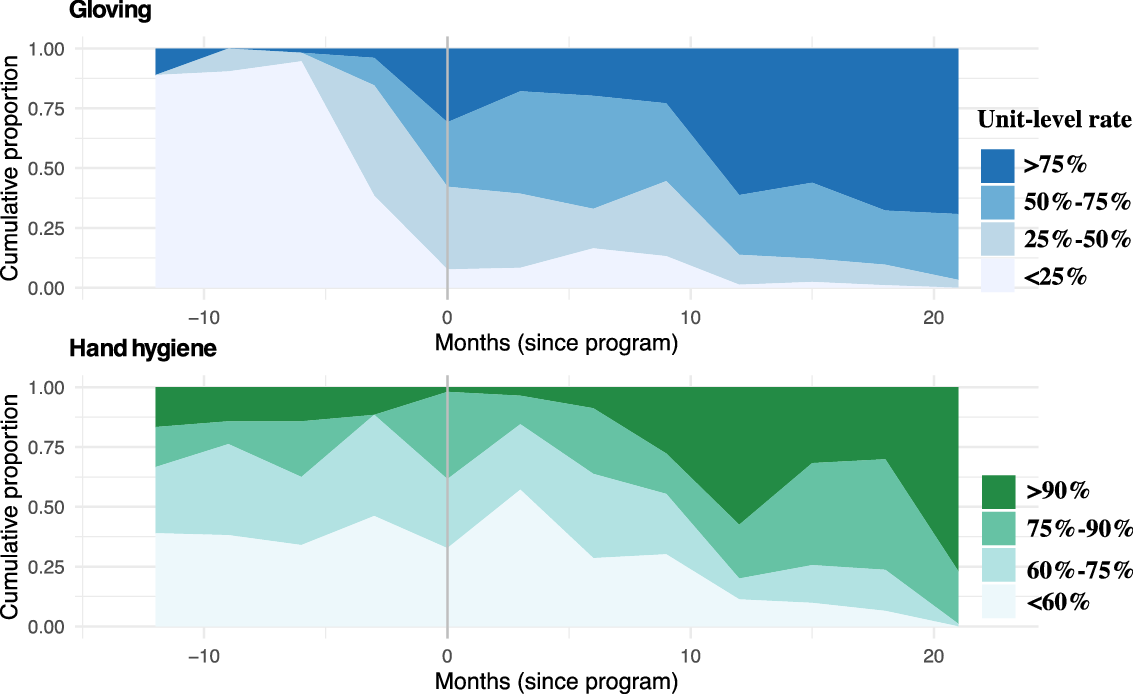
Hand hygiene compliance and gloving compliance increased steadily during the Wash–Glove–Wash initiative, reaching 88% for hand hygiene and 80% for gloving in 2017 compared to 2015 (Bayesian P < .0002 using logistic mixed models). Month 0 represents the program start date of January 1, 2016. This was a clear increase from baseline levels of hand hygiene compliance in 2015, which averaged 68%, as well as gloving compliance, which rarely occurred until late 2015. By the end of 2017, almost every unit had >90% hand hygiene compliance, compared to <25% of units in early 2015 (Fig. 1).
Temporal trends in unit level gloving and hand hygiene rates before and during the Wash–Glove–Wash initiative.

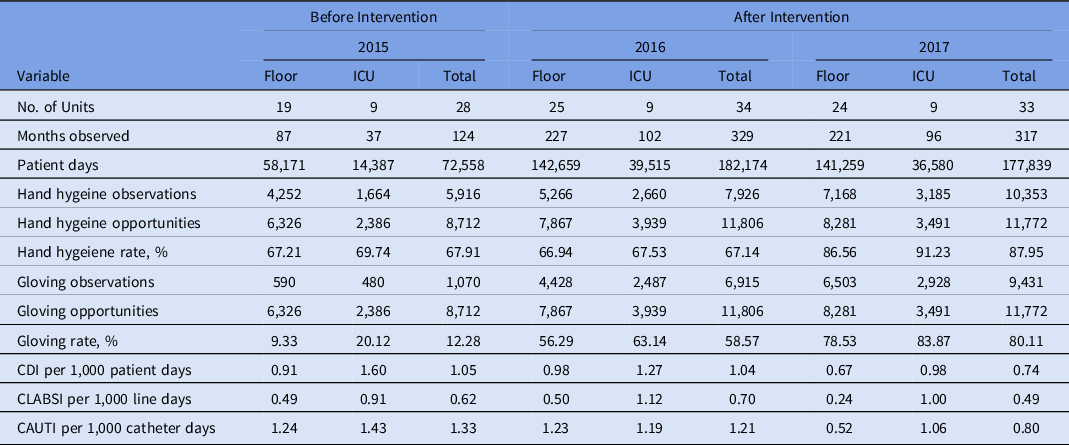
A significant reduction in the rate of Clostridioides difficile infection occurred, decreasing from 1.05 infections per 1,000 patient days in 2015 to 0.74 infections per 1,000 patients days in 2017 (95% credible interval (CrI) on change, 0.58 to −0.03; Bayesian P < .04) CAUTI rate also decreased from 1.33 cases per 1,000 line days to 0.8 cases per 1,000 line days (95% CrI, −1.36 to −0.01) from 2015 to 2017. CLABSI rates appeared to decrease, but not significantly so (Table 1). Hospital-wide rates of Clostridioides difficile infection decreased by 0.05 events per 1,000 per 10% point increase in gloving compliance (95% CI, −0.091 to −0.005; P < .04) as the latter increased over time. A similar association was noted between hospital-wide CDI rates and hospital-wide hand hygiene compliance (−.11 events per 1,000 per 10% point change in hand hygiene; 95% CrI, −0.21 to −0.01; P < .03).
Units, Months Observed, and Patients Days by Floor and ICU from 2015 through 2017 With Hand Hygiene and Gloving Observations, Opportunities, and Rates as Well as CDI per 1,000 Patients Days, CLABSI per 1,000 Line Days, and CAUTI per 1,000 Catheter Days

Note. CDI, Clostridioides difficile infection; CAUTI, catheter-associated urinary tract infection; CLABSI, central-line–associated bloodstream infection.
The availability of unit-level data allowed for modeling of the relationships among hand hygiene compliance rates, gloving rates, and the rates of individual HAIs. In each unit, months with greater rates of gloving were significantly associated with greater rates of hand hygiene. A 10% increase in gloving was associated with a 1.13-fold increase in the odds of hand hygiene (95% CrI, 1.12–1.14).
The 35 months of observation also permit an estimate of a “secular” effect of calendar date, which captures longer-term nonperiodic trends in hand hygiene and HAI at the hospital. After adjusting for secular temporal effects, the association between gloving and hand hygiene persisted, though the effect was somewhat attenuated to a 1.1-fold increase per 10% point increase in gloving (95% CrI, 1.08–1.18).
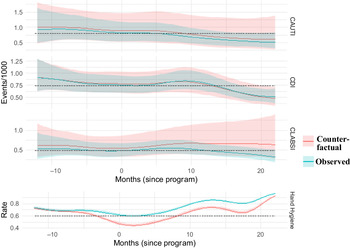
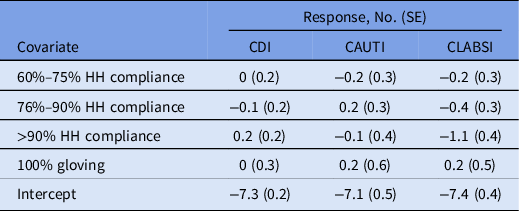
The interrelations between time and increases in gloving, increases in hand hygiene, and decreases in some HAI led us to ask whether gloving or hand hygiene could have associations on HAI after adjusting for temporal effects. Moreover, might hand hygiene exhibit a threshold effect, in which a critical proportion of proper hand hygiene is necessary to disrupt nosocomial transmission? We addressed this by estimating a joint model for the odds of a HAI in a unit, given the rates of hand hygiene, gloving, adjusting for temporal shifts in the hospital-wide prevalence of the HAI (Fig. 2). In this joint model, universal gloving does not have a substantial or significant association with any HAI, yet hand hygiene does have a significant and substantial association with some HAIs. When a unit exceeded 90% hand hygiene, the CLABSI odds decreased 3.3-fold compared to when a unit had <60% hand hygiene (Bayesian P < .002) (Table 2).
Time trends of CAUTI, CDI, CLABSI (events per 1,000 at risk), and hand hygiene (rate) before and after universal gloving. The “observed” trend reflects the average unit-level trend, while the “counterfactual estimate” is the trend that would have been expected under no gloving and <60% hand hygiene (top three panels) or no gloving (bottom panel).

Logistic Regression Coefficient Estimates for Models that Adjust for Arbitrary Time Trends and the Joint Effects of Hand Hygiene (HH) and Gloving

Note. SE, standard error; CDI, Clostridioides difficile infection; CAUTI, catheter-associated urinary tract infection; CLABSI, central-line–associated bloodstream infection.
aThe HH rates in a unit were categorized into 4 bins.
bThe first 3 rows show log odds ratios of CDI, CAUTI, and CLABSI, depending on hand hygiene intensity with <60% hand hygiene as the reference.
cThe fourth row contains the effect attributable to 100% gloving vs 0% gloving.
Secular effects, which could be attributed to other components of the Wash–Glove–Wash program as well as the impact of regional effort to combat CDI seem to explain most of the decrease in CDI. If we counterfactually assume that gloving and hygiene rates remained constant at their preprogram levels, a substantial decrease in both CDI and CAUTI would be estimated to be from 0 months to +24 months (Fig. 2), whereas CLABSI rates would not have decreased if it were not for changes in the hand hygiene and gloving levels.
Secular effects can also explain much of the change in hand hygiene. The average unit experienced a ˜30% point increase in hand hygiene per encounter at the end of 2017, compared to when the program was initiated. At many points in the counterfactual scenario, this increase would be attenuated by as much as 15%, which coincides with our estimate of 1.1-fold increased odds of hand hygiene per 10% increase in gloving noted above. However, even in the counterfactual setting, we would have expected to see a substantial increase in hand hygiene.
Finally, a cost and utilization analysis was performed from 2015 through 2017 and demonstrated an increase in annual glove utilization of 57,546 boxes at an increased cost of $404,401.22 as well as an increase in annual alcohol wash utilization of 2,164 cases at an increased cost of $63,839.22. These findings corroborate evidence that the Wash–Glove–Wash intervention was associated with an increase in both glove and alcohol-based hand wash utilization.
Discussion
Unit-level data on hand hygiene and gloving rates from 2015 to 2017 at our institution demonstrated that institution of a “universal gloving” protocol increased the odds of hand hygiene compliance 3-fold. Given the observational nature of this study, we cannot conclude a causal link, only that the 2 factors were associated. Our intervention involved a hospital-wide informational campaign stressing the importance of hand hygiene and gloving for patient care. We suspect that the component of the increase in hand hygiene observed, but not accounted for by gloving, was related to this educational campaign as demonstrated previously by Kurunu et al. Reference Kurunu, Kasahara and Mikasa14 However, the persistence of the association between gloving and hand hygiene in temporally adjusted models suggests that secular effects are not solely responsible. This finding is consistent with more recent work by Bearman et al, Reference Bearman, Rosato and Duane15 which demonstrated an increase in hand hygiene compliance with universal gloving with emolliate impregnated gloves compared to contact precautions alone. Unlike our study results, however, they failed to show any significant change in the rates of device-associated infection or CDI. Reference Kaufman, Blackman and Conaway16
The rates of various HAIs decreased during this period, with the strongest evidence of decrease for CDI. We were unable to demonstrate a direct unit-level association between increased gloving compliance and decreased individual HAI rates. This is not surprising with respect to CAUTI and CLABSI because standard protocol already requires gloving when manipulating these devices. With respect to CDI, one possible explanation for this observed lack of association is the reality that the unit where a patient acquires CDI is not always the unit where CDI is ultimately diagnosed. Notably, not until well in to the campaign (10 months) did CDI rates begin to decrease, and this finding coincides with when hospital units were consistently maintaining hand hygiene compliance >80%.
We identified a measurably important effect of hand hygiene on CLABSI rates, but this was not demonstrated with Clostridioides difficile or CAUTI rates. This impact on CLABSI is similar to findings reported by Kaufman et al Reference Kaufman, Blackman and Conaway16 in a single-center neonatal intensive care unit and by Yin et al Reference Yin, Schweizer and Herwaldt17 in a single-center pediatric center study with periods of mandatory gloving during RSV season. Even though the expectation in clinical care is that providers wear gloves when handling central lines or indwelling urinary catheters, the fact that improved hand hygiene still has an impact on CLABSI rates implies that this may not always be true.
Our study has several limitations. Primarily, this was a multiple-year, before-and-after, quasi-experimental, quality improvement study. We were unable to control for other interventions or confounders at the institution and unit-level across the hospital targeting HAI reduction, though the testing approach for CDI diagnosis did not change during the study period. Admission and overall prevalence of CDI did not vary significantly over the study period (Supplementary Graph 1 online). Efforts targeting antimicrobial stewardship pre-dated this effort but continued during the study period as did efforts to reduce unnecessary testing for CDI. This may explain, in part, our inability to demonstrate a direct relationship between increased gloving compliance and reduced HAI rates. Other limitations of our work include those commonly identified with any research utilizing clinical behavior monitoring through the use of secret shoppers, including variability between auditors and degree of auditor anonymity.
Our findings demonstrate that universal gloving supports an increase in hand hygiene compliance rates and may have an indirect impact on reducing HAIs. We report that a hospital-wide universal gloving protocol can increase hand hygiene compliance.
Supplementary material
To view supplementary material for this article, please visit https://doi.org/10.1017/ice.2020.1422
Acknowledgments
We would like to acknowledge the support and efforts of all the staff, faculty and administration at Strong Memorial Hospital and the University of Rochester Medical Center for making this work possible.
Financial support
No financial support was provided relevant to this article.
Conflicts of interest
All authors report no conflicts of interest relevant to this article.