Introduction
English is used by more than one and a half billion people as a first, second or foreign language for communication purposes (Strevens, Reference Strevens1992). In this context, the purpose of teaching English has shifted from mastery of the grammatical rules to the ability to use the target language for successful communication. Consequently, the communication aspect of teaching and learning English has become the key issue in the domain of second language acquisition (Yashima, Reference Yashima2002: 54). Therefore, the issue of whether the learners will communicate in English when they have the chance to do so and to what extent they are willing to communicate gain importance. These questions have led to the emergence of an important construct in the field of L2 instruction, i.e. willingness to communicate (hereafter, WTC), which is defined as a learner's ‘readiness to enter into discourse at a particular time with a specific person or persons, using a L2’ (MacIntyre et al., Reference MacIntyre, Dörnyei, Clément and Noels1998: 547). MacIntyre and his associates even proposed that WTC in L2 should be conceptualized as ‘the primary goal’ of language instruction (MacIntyre et al., Reference MacIntyre, Dörnyei, Clément and Noels1998: 545). This paper explores the important concept of WTC by looking into Pakistani students' WTC in Canada.
Literature review
The concept of WTC was introduced to the communication literature by McCroskey and Richmond (Reference McCroskey and Richmond1990). They treated WTC as a personality trait. MacIntyre at al. (Reference MacIntyre, Baker, Clément and Conrod2001) proposed WTC to be a trait-like predisposition. MacIntyre et al. (Reference MacIntyre, Dörnyei, Clément and Noels1998) adapted the concept of WTC for research in second language acquisition and applied linguistics. They argued that it is not necessary to limit WTC to a trait-like variable. Rather, they conceptualized WTC as a situational variable with enduring and transient influences. They developed a heuristic model, which is still predominant and significant in WTC research. They used a pyramid-shaped figure to illustrate the WTC model, which explains the probable causes of WTC in L2. This model demonstrates a complex relationship among variables affecting WTC in L2. Since its proposal in 1998, researchers have been testing the various aspects, such as anxiety, motivation, frequency of L2 use of the model. A number of factors have been identified as being directly or indirectly predictive of WTC, including perceived communication competence, communication apprehension, motivation, personality, attitude, content and context.
Yashima (Reference Yashima2002) developed and tested her own model in Japan. Her study applied MacIntyre et al.'s (Reference MacIntyre, Dörnyei, Clément and Noels1998) WTC model in the English as a Foreign Language (EFL) context. Another novel aspect of her study is that she assessed students' attitudes toward the international community. She found a relation between WTC and L2 self-confidence and international posture.
Kim (Reference Kim2004) replicated Yashima's (Reference Yashima2002) study in the Korean context and found that Korean university students' WTC was directly related to their confidence in English communication, and indirectly related to their attitudes and motivation through confidence in English communication. Unlike Yashima (Reference Yashima2002), Kim (Reference Kim2004) did not find a direct relationship between students' attitudes toward the international community and their willingness to communicate, but he found that WTC was more trait-like than situational.
Cameron (Reference Cameron2013) conducted a study in New Zealand on Iranian immigrants. Factors like perceived communication competence (PCC), personality, motivation, anxiety and learning context, including methods and approaches and roles of teachers, emerged as important aspects of their language learning experience, and as such led to their overall WTC. Moreover, change in learning context emerged as an important factor regarding WTC in New Zealand. Another study carried out in Canadian context found that Chinese students were somewhat willing to communicate in English (Zeng, Reference Zeng2010). Zeng (Reference Zeng2010) found that there was a significant relationship between WTC and students' perceived communication behavior.
Previous studies have investigated the trait or situational/contextual nature of WTC both in ESL and EFL contexts. In Asia, a lot of research on WTC has been done on Japanese (Yashima, Reference Yashima2002), Chinese (Xie, Reference Xie2011), Korean (Kim, Reference Kim2004), and Turkish (Cetinkaya, Reference Cetinkaya2005) students, but little has been done on Pakistani students in the EFL context. Only one study exploring Pakistani students' WTC in Pakistan has been conducted (Mari, Pathan & Shahriar, Reference Mari, Pathan and Shahriar2011). Mari et al. (Reference Mari, Pathan and Shahriar2011) found that the WTC of Pakistani students in Pakistan was neither high nor low. Furthermore, interviews suggested that most of the participants were nervous, anxious and hesitant while communicating in English. There also seems to be a gap in research that investigates the WTC of Pakistani students in an English-speaking country.
Present study
Given the importance of WTC in the field of second language acquisition (SLA), the present study explores Pakistani students' WTC in Canada. Students from Pakistan are worthy subjects to investigate in regard to their WTC when moving from an EFL (English as a Foreign Language) to an ESL (English as a Second Language) language learning environment. The following research questions have been developed to get an overall picture of Pakistani students' WTC in Canada.
-
• How willing are the Pakistani students to communicate in English in an English-speaking country?
-
• Is there any significant relationship between perceived communication competence, communication apprehension and willingness to communicate?
In order to adress the above research questions we conducted an online survey among Pakistani students in Canada.
Participants
Prior to collecting the data, Pakistani students were contacted by the first author using social media. Informed consent was obtained from the Pakistani students in Canada, for their voluntary and anonymous participation. The survey asked respondents to indicate their age, gender, level of study, how often they had communicated in English in and outside the classroom, how many native English-speaking friends they had and how long they had been in Canada. 196 Pakistani students in Canada participated in this study. The participants were 18 to 31 years old. They were using English as a second language in an English-speaking country rather than studying English as a foreign language and as a school subject, as they had done in Pakistan.
Instrumentation
Since the purpose of the current study was to gain an overall understanding of Pakistani students' WTC in English in an ESL context, an online survey was conducted. Data were collected from March 2014 to June 2014. The survey consisted of two parts. Part one asked about the background information of the Pakistani participants. The second part of the survey was designed to control for three variables, i.e. WTC in English, PCC and communication apprehension (CA). Reliability of all three scales was measured by calculating Cronbach's alpha.
Pakistani students' WTC in Canada was measured by using WTC scale adapted from McCroskey (Reference McCroskey1992). The scale used twelve items to measure WTC in terms of four communication contexts, i.e. dyad, large meeting, small group and public speaking, and three types of receivers, i.e. strangers, acquaintances and friends. The Pakistani respondents were asked to select a percentage (ranging from 0%−100%) representing their willingness to communicate in English different situational contexts, such as ‘talking in English in a small group of friends', or ‘talking in English with a friend while standing in line.' Reliability using Cronbach's alpha for WTC scale in this study was 0.78.
12 situational contexts were used to assess the extent to which the Pakistani respondents felt competent communicating in English (PCC). On this scale, the contexts and the receivers of the communication were the same as the ones used to measure WTC. The respondents self-evaluated their PCC by selecting a percentage ranging from 0% (fully incompetent)–100% (fully competent). Reliability using Cronbach's alpha for PCC scale in this study was 0.90.
The third variable in the current study, i.e. CA of Pakistani students, was also measured by 12 items adopted used to measure WTC and PCC .The Pakistani respondents self-assessed their communication anxiety in English by selecting a percentage between 0% (not at all)–100% (always). Reliability using Cronbach's alpha for CA scale in this study was 0.97.
Results
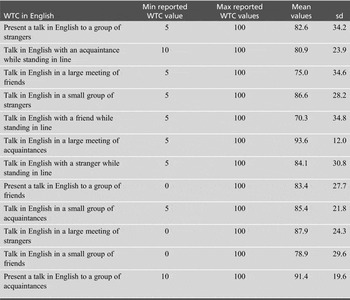
The SPSS (version 17.0.0) was used to generate descriptive statistics, the Pearson Correlation and reliability statistics. In terms of WTC in English, Pakistani respondents were highly willing to communicate (mean = 83.35). Respondents did not show great differences between talking with friends, with strangers, or with acquaintances. Respondents showed slight differences in the contexts of a dyad, a small group or in a large meeting. They were least willing to talk in English with friends in dyads (M = 70.33, N = 196) while they preferred talking in English with acquaintances in large meetings (M = 93.63, N = 196), as shown in Table 1.
WTC in 12 situational contexts

Regarding the question which asked with whom the Pakistani respondents in Canada would be more willing to communicate, respondents did not show great differences between willingness to talk with strangers and with acquaintances but they did show a slight difference regarding willingness to communicate in English with friends (see Table 2). They were more willing to communicate in English with acquaintances (M = 87.83, N = 196) and were less willing to communicate in English with friends (M = 76.91, N = 196).
WTC in terms of types of receiver

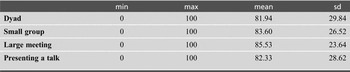
Regarding the question about the context, Table 3 shows the results regarding the respondents' WTC in four contexts, i.e. dyads, in a small group, in a large meeting, and a presentation in public. The Pakistani respondents were more willing to communicate in a large meeting and less willing when presenting a talk or talking in a small group, and were the least willing to communicate in a dyad (M = 81.94, N = 196).
WTC in terms of communication contexts

Table 4 shows statistical data for the Pakistani respondents' WTC, PCC and CA. As illustrated, the PCC of the Pakistani respondents is very high (M = 90.87) and their CA is low (M = 34.54).
Pakistani students' perceived communication competence and communication apprehension

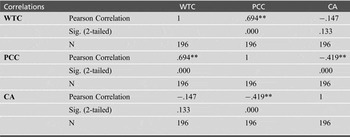
The results of correlation analysis between WTC, PCC and CA in the present study are somewhat different from those of previous studies. As can be seen in Table 5, there is a statistically significant correlation between WTC and PCC. Surprisingly, there is not a significant relationship between CA and WTC but CA is significantly found to be negatively correlated with PCC.
Pearson correlation between WTC, PCC and CA

**Correlation is significant at the 0.01 level (2-tailed).
Discussion
In this study, WTC in English is examined through looking at how and when Pakistani participants became involved in communicative encounters with English speakers in Canada. The findings indicate that Pakistani students were highly willing to communicate in English in Canada. Most of the students showed a strong desire to communicate in English wherever they had been provided with opportunities to do so. The total mean score of WTC in English from 196 Pakistani students was M = 83.35. Considering the colonial past of Pakistan, this finding is not astounding, as English is the official language and possesses a royal status in Pakistan. For Pakistani students, one reason, among others, to study in an English-speaking country is to get a native-like command over English language. For that reason, the universities in English-speaking countries are the first and foremost choice of all Pakistani students.
These results are not consistent with those of a recent study in Canada on Chinese students' WTC by Zeng (Reference Zeng2010). According to her, the Chinese students were somewhat willing to communicate (M = 53.06). This is perhaps because of the cultural and historical difference between China and Pakistan (although they are neighbors). Pakistan was a British colony until 1947. Hence, English is not alien to Pakistani students. On the other hand, China opened its doors to the world in the 1970s. Moreover, the Chinese cultural belief of ‘value less talk’ made Chinese students not initiate communication when they had the opportunity to do so.
However, the Pakistani students in the present study appeared to be highly willing to communicate in English in Canada. This shows that L2 learning context does affect individual's WTC and this supports Cameron's claim of the significance of the environmental factor ‘change in language learning context’ in WTC research (Cameron, Reference Cameron2013). Mari et al. (Reference Mari, Pathan and Shahriar2011) conducted a study in a relatively less developed area of Pakistan where English is not used for communicative purposes in daily life and found that the WTC of Pakistani students was neither low nor high (M = 53.20 out of 100). Furthermore, they wrote that ‘the poor and rural background of participants could be a strong factor which seems to prevent further generalization’ (Mari et al., Reference Mari, Pathan and Shahriar2011: 78). This contrast in the results in Pakistan and Canada points towards the effect of socio-economic status on an individual's WTC. Future studies are recommended to explore the relationship between learners' WTC and their socio- economic status.
MacIntyre et al. (Reference MacIntyre, Dörnyei, Clément and Noels1998) argued that the number of people present in the communication situation could affect a person's WTC. The present study does not confirm their argument because there was not a significant difference among Pakistani students' WTC in dyads (M = 81.94), small group (M = 83.60), large meeting (M = 85.53) and, in public speaking (M = 82.33).
As far as the type of the receiver is concerned, the majority of students were willing to communicate with acquaintances in English (M = 87.83), followed by strangers (M = 85.31) and, friends (M = 76.91). These results are opposite to those found in a study conducted on Pakistani students in Pakistan (Mari et al., Reference Mari, Pathan and Shahriar2011). This shows that in an English-speaking country, Pakistani students prefer to communicate with friends in their mother tongue than in their second language. These findings suggest that, in Canada, the unfamiliarity of the audience could encourage students to communicate in English more. The more distant the audiences were, the more willing the Pakistani students were to communicate in English in Canada. The native Canadian participant found friends, as an audience, to be attractive interlocutors (MacIntyre et al., Reference MacIntyre, Baker, Clément and Conrod2001). The same findings were obtained in Pakistan (Mari et al., Reference Mari, Pathan and Shahriar2011). Contrary to the above mentioned studies, in the present study the participants were least willing to communicate with friends in another country. This is because Pakistani students were more comfortable communicating with their friends in their mother tongue. One reason might be the fact that abroad most of their friends were their country-mates rather than native or other international students. These results are consistent with Zeng (Reference Zeng2010), who found Chinese participants were less willing to communicate with friends in Canada.
Table 3 shows a correlation matrix of the three variables in this study, i.e. WTC, PCC and CA. As expected, WTC correlated significantly with PCC. It was expected that WTC would correlate significantly with CA, but there was no significant relation. However, there was a significant negative correlation between PCC and CA, suggesting that lower L2 CA is associated with higher L2 PCC. These findings are similar to those found for Turkish (Cetinkaya, Reference Cetinkaya2005), Korean (Kim, Reference Kim2004), Japanese (Yashima, Reference Yashima2002; Yashima et al., Reference Yashima, Zenuk-Nishide and Shimizu2004), and Chinese (Zeng, Reference Zeng2010) students. This is in line with the existing belief that PCC is a strong predictor of WTC. However, there is one point of variation in the present study: the researchers did not find any correlation between WTC and CA.
Limitations and future research
This study has several limitations which will be briefly addressed. Firstly, since the data were collected from Pakistani students in Canada, it may not be appropriate to generalize the findings to all other international students in Canada. Secondly, the study was conducted in Canada so the findings cannot be generalized to other English-speaking countries such as Australia, the UK and New Zealand, etc. Lastly, this study only targeted the WTC of the students' speaking skills and did not investigate their WTC regarding listening, writing and reading skills.
Future research is also needed in order to extend our understanding of WTC regarding the Pakistani context in Canada. Therefore, qualitative or hybrid research instruments, including in-depth interviews or classroom observation, are recommended to be used to further enrich and supplement the targeted issue.
Conclusion
Pakistani students are highly willing to communicate in English in Canada. The finding about a correlation between WTC and PCC is consistent with recent studies in the field of WTC in English (Kim, Reference Kim2004; Yashima, Reference Yashima2002; Zeng, Reference Zeng2010). One point of variation in the present study is that there is no significant relationship between WTC and CA but there is a negatively significant relationship between PCC and CA. This study primarily highlights the significance of the environmental factor ‘change in language learning context’ for WTC research, as pointed out by Cameron (Reference Cameron2013). The results reveal that Pakistani students are more willing to communicate in English in Canada, as compared to other Asian students, such as Korean and Chinese students, who are somewhat willing to communicate in English. This is because in the past Pakistan was a British colony and English is the official language of Pakistan as well.
 SYEDA FARZANA BUKHARI is currently doing her PhD in Applied Linguistics from Northeast Normal University in Changchun, China. She received a scholarship from the government of Pakistan under the Cultural Exchange program for her doctoral degree. Her research interests include ELT, TESOL, second language acquisition, and English as a lingua franca. Email: syedafarzanabukhari@gmail.com
 Dr. Xiaoguang Cheng, professor of English at School of Foreign Languages of Northeast Normal University of China. Research interest includes second language acquisition, language teaching and pedagogy, pragmatics and philosophy of language. Published in RTE (Research in the Teaching of English), Pragmatics and Language Teaching, and in Chinese academic journals such as Foreign Languages Teaching and Research, Journal of Foreign Languages, Foreign Languages Teaching and Their Research, etc. Email: xiaoguangcheng@hotmail.com