Introduction
Globally, the ageing population is booming and is expected to triple in size by 2050; in New Zealand, this is a 26% increase in individuals aged 80 years or older (NZ Statistics, 2018). This global phenomenon has created fears about future labour market shortages (Armstrong-Stassen, Reference Armstrong-Stassen2008) and, accordingly, concerns around the need to retain and develop older workers (defined as those aged 55+ by the World Health Organization, 2015), since this cohort is central to sustaining workplaces of the future (Kooij, Jansen, Dikkers, & De Lange, Reference Kooij, Jansen, Dikkers and De Lange2008). While older workers offer opportunities for future workforce sustainability, they also face unique and unusual barriers, such as dealing with erroneous aged stereotypes, undermining and dismissive treatment (James, McKechnie, Swanberg, & Besen, Reference James, McKechnie, Swanberg and Besen2013; Harris, Krygsman, Waschenko, & Laliberte Rudman, Reference Harris, Krygsman, Waschenko and Laliberte Rudman2017; Ng & Feldman, Reference Ng and Feldman2012). Accordingly, the work and wellbeing outcomes that employees usually derive from their jobs take on a different inflection when it comes to older workers. Moreover, particular approaches to leadership can pose as a stressor for older workers, where reports of poor quality relationships and feelings of disrespect from leaders are in stark contrast to the necessities identified by these workers to remain active in the workforce (Collins, Hair, & Rocco, Reference Collins, Hair and Rocco2009; James et al., Reference James, McKechnie, Swanberg and Besen2013; Ng & Feldman, Reference Ng and Feldman2012; Thorsen, Jensen, & Bjørner, Reference Thorsen, Jensen and Bjørner2016).
To overcome such barriers, and to improve the workplace wellbeing of older workers, it is paramount to investigate the antecedents to wellbeing, by examining the internal psychological resources of such workers (i.e., mindfulness) and by ascertaining how this may also influence the leader–follower relationship (Sparks, Faragher, & Cooper, Reference Sparks, Faragher and Cooper2001). Ultimately, research has shown that retaining and developing (older) workers derives from two connected but differing functions: the individual's positive psychological resources (e.g., mindfulness) and the social context and environment in which they work (e.g., leader–follower relationships) (Brown & Ryan, Reference Brown and Ryan2003; Olafsen, Reference Olafsen2017). However, there has been minimal research on these connected processes, in terms of promoting older workers' wellbeing (Allen, Henderson Tyler, Mancini, & French, Reference Allen, Henderson Tyler, Mancini and French2017; Thorsen, Jensen, & Bjørner, Reference Thorsen, Jensen and Bjørner2016), and we seek to address this.
Research on mindfulness in the workplace suggests that it is a valuable personal psychological resource (Roche et al., Reference Roche, Good, Lyddy, Tuckey, Grazier, Leroy and Hülsheger2020). A mindful person has heightened awareness and attention to the present. They are not cognitively ‘distracted’ by future thinking, or ruminating over previous situations. Mindful workers have a mental clarity that facilitates self-regulation (Holzel, Lazar, Gard, Schuman-Olivier, Vago, & Ott, Reference Holzel, Lazar, Gard, Schuman-Olivier, Vago and Ott2011; Roche et al., Reference Roche, Good, Lyddy, Tuckey, Grazier, Leroy and Hülsheger2020), enabling them to disengage themselves from automatic or dysfunctional thoughts, habits and behaviours (Holzel et al., Reference Holzel, Lazar, Gard, Schuman-Olivier, Vago and Ott2011), which, in turn, facilitates their workplace wellbeing (Hafenbrack, Kinias, & Barsade, Reference Hafenbrack, Kinias and Barsade2014; Mesmer-Magnus, Tedone, & Viswesvaran, Reference Mesmer-Magnus, Tedone and Viswesvaran2017). Specifically, mindfulness has been offered as a valuable wellbeing resource for employees, including aiding employee engagement and satisfaction, and reducing turnover (as expanded below), but there is limited research demonstrating that mindfulness can be directly beneficial for older workers (c.f. Allen et al., Reference Allen, Henderson Tyler, Mancini and French2017).
The mechanisms that support the relationships between older workers' mindfulness, wellbeing and organisational leadership remain understudied (Reb, Chaturvedi, Narayanan, & Kudesia, Reference Reb, Chaturvedi, Narayanan and Kudesia2019; Roche et al., Reference Roche, Good, Lyddy, Tuckey, Grazier, Leroy and Hülsheger2020). Drawing from the limitations of studies in mindfulness, we go beyond a focus on the (individual) psychological processes related to internal cognition (such as quieting the mind, rumination and thought distraction), and instead foreground the role of mindfulness and its relationship with environmental (external) phenomena, within the work environment (Hafenbrack, Reference Hafenbrack2017; Hafenbrack, Kinias, & Barsade, Reference Hafenbrack, Kinias and Barsade2014; Roche et al., Reference Roche, Good, Lyddy, Tuckey, Grazier, Leroy and Hülsheger2020). The workplace is full of external stimuli and phenomena that shape the wellbeing of individuals, such as leadership support (Olafsen, Reference Olafsen2017), and the environment in which we work, including the leadership styles enacted in that environment, is increasingly the subject of research on mindfulness (see Hülsheger, Walkowiak, & Thommes, Reference Hülsheger, Walkowiak and Thommes2019). There is evidence to suggest that positive leadership support and the leader–follower relationship, which includes leader member exchange (LMX) and leader autonomy support (LAS) approaches, are external/environmental influences that contribute to worker wellness (Hülsheger, Walkowiak, & Thommes, Reference Hülsheger, Walkowiak and Thommes2019; Slemp et al., Reference Slemp, Kern, Patrick and Ryan2018).
As such, we seek to support the growing literature that highlights the importance of understanding the mechanisms of mindfulness at work at both the individual and environmental (leadership) level, and to explore the implications of this for older worker wellbeing. We pose two key questions:
What is the relationship between mindfulness and older workers' wellbeing (work engagement, job satisfaction and turnover intentions)?
When older workers are mindful, are both leader–follower relationship practices (LMX and LAS) equally beneficial to the wellbeing of older workers (work engagement, job satisfaction and turnover intentions)?
In addressing these questions, we make the following contributions:
Firstly, we outline the importance of mindfulness for older workers in terms of enhanced engagement, job satisfaction and turnover intentions. While the relationships between mindfulness and the importance of these outcomes exist in wider literature (see Roche et al., Reference Roche, Good, Lyddy, Tuckey, Grazier, Leroy and Hülsheger2020), very limited research has focused specifically on the connection between mindfulness and the wellbeing of older workers (c.f Allen et al., Reference Allen, Henderson Tyler, Mancini and French2017).
Secondly, we contribute to the literature on leadership, mindfulness and aged workers. While prior research has found the importance of mindfulness influencing employee perceptions of LMX (Reb et al., Reference Reb, Chaturvedi, Narayanan and Kudesia2019), we augment this research to include both LMX and LAS. As such, we provide a granulated analysis of (two) relational leadership theories – one that emphasis exchanges (LMX), and the other, autonomy (LAS). This provides insight into the awareness of mindful older workers with respect to different relational leadership theories.
Thirdly, we advance the mindfulness and employee decision-making literature with regards to the leadership of older workers by assessing the importance of LMX and LAS on wellbeing outcomes. Despite being in its infancy, research on mindful workers and decision-making (Galles, Lenz, Peterson, & Sampson, Reference Galles, Lenz, Peterson and Sampson2019; Pless, Sabatella, & Maak, Reference Pless, Sabatella and Maak2017; Small & Lew, Reference Small and Lew2021) suggests that mindful workers have a greater ability to engage in decision-making including leadership styles (Reb et al., Reference Reb, Chaturvedi, Narayanan and Kudesia2019) that are of most benefit to the individual (Galles et al., Reference Galles, Lenz, Peterson and Sampson2019; Reb et al., Reference Reb, Chaturvedi, Narayanan and Kudesia2019). We seek to determine whether exchanges (LMX) or autonomy (LAS) is more beneficial in harnessing the wellbeing of mindful older workers.
Finally, we provide and test an initial model of wellbeing for the older worker, one that integrates both personal internal processes (i.e., mindfulness) and external phenomena (i.e., leader–follower relationships), providing a framework that may stimulate further research into older workers' wellbeing.
In the next section, we seek to confirm the effect of mindfulness as a personal, psychological resource for older workers' wellbeing on their work engagement, job satisfaction and retention of roles. We provide clarity of specific terms and offer insights into the types of relationships that are important for improving mindful older workers' wellbeing. We distinguish between LMX and LAS as relational leadership constructs, and investigate how mindfulness, leadership and older workers' discernment of leadership styles affect their wellbeing.
Mindfulness and wellbeing
Mindfulness does not have a single definition. However, common across most definitions is that mindfulness is, firstly, a cognitive process (Brown, Ryan, & Creswell, Reference Brown, Ryan and Creswell2007). This includes enhanced awareness of, and attention to, internal and external stimuli, as well as possessing a non-reactive or non-judgemental evaluation/orientation towards inner or outer experiences or stimuli. Secondly, mindfulness has a temporal focus, focused on the present moment as opposed to the past or the future (Sutcliffe, Vogus, & Dane, Reference Sutcliffe, Vogus and Dane2016). The surge of research attesting to the beneficial properties of mindfulness and the importance of mindfulness as a personal psychological resource for employee workplace wellbeing (Atkins & Styles, Reference Atkins, Styles, Reb and Atkins2015; Dane & Brummel, Reference Dane and Brummel2014; Roche, Haar, & Luthans, Reference Roche, Haar and Luthans2014, Reference Roche, Good, Lyddy, Tuckey, Grazier, Leroy and Hülsheger2020) is convincing.
As outlined above, scant attention has been paid to the mechanisms for motivating, understanding and leading an ageing workforce. Yet this need is particularly important as this group of workers also face additional challenges because of their age. While some research suggests mindfulness buffers the effects of discrimination (e.g., Shallcross & Sprull, Reference Shallcross and Spruill2018), there has been surprisingly little research on the role mindfulness may play in promoting the wellbeing of older workers at work. This paper examines the direct effects of mindfulness on the workplace wellbeing of this unique follower group, particularly in relation to their work engagement, job satisfaction and intentions to remain in their workplace.
Mindfulness functions in a way that counters automatic cognitive processes and it facilitates more appropriate responses to situations. Therefore, while older workers may face negative effects, such as workplace stereotyping (Karpinska, Henkens, Schippers, & Wang, Reference Karpinska, Henkens, Schippers and Wang2015), mindfulness may help such workers to ‘re-orientate’ or to ‘re-direct’ their focus on satisfying aspects of their work (Shapiro, Carlson, Astin, & Freedman, Reference Shapiro, Carlson, Astin and Freedman2006).
As outlined above, we define wellbeing as older workers engagement, job satisfaction and decreased turnover intentions. Engagement and job satisfaction are positively related to employee workplace thriving (see Kleine, Rudolph, & Zacher, Reference Kleine, Rudolph and Zacher2019) while research on turnover intentions has urged for greater understanding, given turnover intentions centrality in addressing issues in the future work (see Rubenstein, Eberly, Lee, & Mitchell, Reference Rubenstein, Eberly, Lee and Mitchell2018) – of which older workers will also play a pivotal role (Bentley et al., Reference Bentley, Blackwood, Catley, O'Driscoll, Roche, Teo, Twiname, Antoniou, Burke and Cooper2017). Further, prior research has found that mindfulness is related to the enhancing of job satisfaction and engagement, and reducing turnover intentions (Andrews, Kacmar, & Kacmar, Reference Andrews, Kacmar and Kacmar2014; Dane & Brummel, Reference Dane and Brummel2014; Gunasekara & Zheng, Reference Gunasekara and Zheng2019). Given the mechanism of mindfulness for older workers, as outlined above, follow the same cognitive processes (see Allen et al., Reference Allen, Henderson Tyler, Mancini and French2017) and mindfulness has an established role in engagement, satisfaction and turnover, we expect that mindfulness will be related to these same wellbeing outcomes for older workers.
We firstly test the direct effects of mindfulness on the wellbeing of older workers/followers.
Hypothesis 1: Mindfulness will be positively related to (a) engagement and (b) job satisfaction.
Hypothesis 1c: Mindfulness will be negatively related to turnover intentions.
Mindfulness and leader–follower relationships
Research suggests that social stereotyping of older workers is especially prevalent amongst their younger managers (Sparks, Faragher, & Cooper, Reference Sparks, Faragher and Cooper2001), who therefore require education/training to remedy this viewpoint. This lack of understanding on how to lead older workers – who rate positive leadership relationships as very important – has fuelled concerns around the future of leading older workers, particularly for organisations (Karpinska, Henkens, & Schippers, Reference Karpinska, Henkens and Schippers2013; Thorsen, Jensen, & Bjørner, Reference Thorsen, Jensen and Bjørner2016). Unsupportive leaders, negative follower–management relationships, lack of recognition from management and poor trust in management are all themes that dominate older worker research (Thorsen, Jensen, & Bjørner, Reference Thorsen, Jensen and Bjørner2016). However, while older workers may struggle with issues of poor management, mindful older workers, via the cognitive mechanism outlined above, may be able to reduce automatic cognitive processes and actively focus on positive aspects of the existing leadership relationships in their workplace. We will now examine positive leadership, specifically through the lens of relational leadership, as this leadership style resonates with older worker leadership needs (Thorsen, Jensen, & Bjørner, Reference Thorsen, Jensen and Bjørner2016).
A relational leadership focus is built on the relationships between leaders and followers, as a micro level (c.f. organisational) stance. As such, we conceptualise positive leadership by using two relational leadership theories: LMX and LAS. Both these theories share similarities in that they focus on building positive relationships between leaders and followers. Both are concerned with the close proximity between leaders and followers, and how the interactions facilitate a positive relationship, environment and outcomes. However, they differ in their explanation of how this happens: LMX focuses on building relationships via positive (social) exchanges, while LAS focuses on harnessing perceptions of followers' psychological autonomy at work. We outline these similar but contrasting theories below.
Leader member exchange (LMX)
LMX describes the quality of the relationship between leaders and followers (Yukl, O'Donnell, & Taber, Reference Yukl, O'Donnell and Taber2009). The central tenet is that LMX quality, or the degree to which these exchanges are mutually beneficial, is defined by the exchanges of valued tangible, informational and socio-emotional resources (Graen & Uhl-Bien, Reference Graen and Uhl-Bien1995). High-quality LMX is characterised by mutual trust and respect, as well as a general expectation of some form of future return, even though this is not stipulated in advance. Thus, relationships develop via exchanges and include feelings like gratitude, trust, altruism and respect that are reciprocal. LMX has been found to be highly predictive of a range of individual-level outcomes as described further below.
Leader autonomy support (LAS)
Deci, Olafsen, and Ryan (Reference Deci, Olafsen and Ryan2017) suggest the workplace can enhance or restrict one's autonomy. A controlling environment enforces deadlines, limits rewards and over-emphasises the evaluation of workplace tasks, which can lead to decreased meaning and interest in activities (Gagne, Reference Gagne2003; Olafsen, Halvari, Forest, & Deci, Reference Olafsen, Halvari, Forest and Deci2015). Conversely, environments that actively acknowledge employee feelings and priorities, and which offer choice, serve to enhance worker autonomy (Slemp, Zhao, Hou, & Vallerand, Reference Slemp, Zhao, Hou and Vallerand2020). A recent meta-analysis found that leaders who develop an autonomy-enhancing relationship with their workers aid employee wellbeing (Slemp, Kerin, Patrick & Ryan, Reference Slemp, Kern, Patrick and Ryan2018). LAS is a form of leadership support that enhances psychological autonomy, and it is viewed as interdependence between leaders and followers. Ryan, La Guardia, Solky-Butzel, Chirkov, and Kim (Reference Ryan, La Guardia, Solky-Butzel, Chirkov and Kim2005) found that people are more inclined to depend upon those who support their autonomy. Indeed, Deci and Ryan (Reference Deci and Ryan2000) found that positive reliance on others fosters a sense of autonomy in those others and that people feel most connected to those who enthusiastically support their autonomy. LAS is an approach that promotes and provides choice, freedom, rationale and support for employees' decisions (Gagne & Bhave, Reference Gagne, Bhave, Chirkov, Ryan and Sheldon2011; Slemp et al., Reference Slemp, Kern, Patrick and Ryan2018), in a climate of relatedness (Deci & Ryan, Reference Deci and Ryan2000, Reference Deci and Ryan2008). LAS includes providing rationale for tasks, framing requests using non-controlling language, acknowledging employees' perspectives even if tasks are not intrinsically motivating, and it ultimately serves to bolster employee wellbeing through enhanced psychological autonomy (Slemp et al., Reference Slemp, Kern, Patrick and Ryan2018).
While older workers often view their workplace leaders as largely unsupportive, we suggest that mindful older workers may be able to actively orientate and acknowledge positive aspects of the leadership relationships surrounding them. As outlined above, mindfulness as a cognitive mechanism creates mental space, which, in turn, facilitates the employee's ability to ‘re-perceive’ both internal and external phenomena through a positive lens. As with our hypothesis on the mechanism of mindfulness towards wellbeing outcomes (i.e., internal phenomena), we expect mindfulness will also aid the process of awareness and re-orienting leadership perceptions (i.e., external phenomena).
In summary, previous research has confirmed that when employees are mindful, they also perceive leadership with clarity, including the benefits of interpersonal leadership relationships (Reb et al., Reference Reb, Chaturvedi, Narayanan and Kudesia2019). By viewing leadership mindfully, older workers may be more attuned to the respect and consideration enabled by high-quality relationships. Attentive and mindful employees, who are not automatic and habitual in their cognitions, have enhanced sensitivities towards the importance of ethical, authentic and task-related leadership (see Nübold et al., Reference Nübold, Van Quaquebeke and Hülsheger2019; Reb, Narayanan, & Chaturvedi, Reference Reb, Narayanan and Chaturvedi2012; Roche et al., Reference Roche, Good, Lyddy, Tuckey, Grazier, Leroy and Hülsheger2020). While Reb et al. (Reference Reb, Chaturvedi, Narayanan and Kudesia2019) found that perceptions of ethical and relational (LMX) leadership were more pronounced in mindful employees, we take a nuanced approach by using only the relational leadership theories of LMX and LAS. We suggest that perceptions of leadership from the same nomological framework (or family – i.e., positive relational leadership) will still be enhanced when employees are mindful. As such, our contribution to the mindfulness and relational leadership literature is granular in nature.
We suggest that, when employees are mindful, even similar perceptions of leadership stemming from the same framework of relational leadership can be further clarified. While relational leadership sees effective leadership as resulting from high-quality relationships between leaders and employees, we suggest mindful workers are able to view these with greater cognitive clarity and granularity. We propose that, for mindful older workers, mindfulness highlights the high-quality exchanges that take place between leaders and followers (i.e., LMX) and foregrounds the autonomy and supportive role leaders play (i.e., LAS).
This leads to our next direct hypothesis:
Hypothesis 2: Mindfulness is related to positive follower perceptions of (a) leader member exchanges and (b) leader autonomy support.
Mediating role of the leader-member relationship on mindful follower outcomes
While mindfulness may facilitate the positive awareness of, and attention to, leader–member relationships (i.e., LMX and LAS), it is unclear if these perceptions translate into positive outcomes with respect to the wellbeing of older workers. Mindful older workers may have a positive view of the leadership they experience in their workplace, but this may not necessarily increase their work engagement or satisfaction. Coupled with this, within the mindfulness literature, there is emerging and convincing evidence that suggests mindfulness enables greater discernment at the point of decision-making (Hafenbrack, Reference Hafenbrack2017; Holzel et al., Reference Holzel, Lazar, Gard, Schuman-Olivier, Vago and Ott2011). We were curious to determine if the relationship between mindfulness, LAS and older worker outcomes is the same as the relationship between mindfulness, LMX and older worker outcomes. In other words, do LMX and LAS (i.e., regardless of the relational leadership type) equally influence job satisfaction, engagement and turnover rates?
To answer this, we attempt to advance the mindfulness and employee decision-making literature by assessing the importance of each (LMX and LAS) on wellbeing outcomes. Mounting research finds that mindful employees, as they re-perceive events with greater clarity, engage in higher quality decision-making, including those relating to leadership styles (Reb et al., Reference Reb, Chaturvedi, Narayanan and Kudesia2019). Mindful employees are found to be more capable of orientating the decisions they make to optimise benefits for themselves . This has been with respect to research on ethical decision-making (Pless, Sabatella, & Maak, Reference Pless, Sabatella and Maak2017; Small & Lew, Reference Small and Lew2021), career decisions and financial decisions (Hafenbrack, Kinias, & Barsade, Reference Hafenbrack, Kinias and Barsade2014).
Building on the growing literature on mindfulness and decision-making, we suggest that mindful older workers may re-perceive positive relational leadership (i.e., LMX and LAS) and ‘decide’ which is more appropriate for their workplace wellbeing. That is, while mindful older workers may have clarity around the benefits of relational leadership, whether or not LMX and LAS generate equally important effects with respect to work outcomes (job satisfaction, engagement and turnover) is yet to be established, a question this paper seeks to address. Before outlining our next hypotheses, it is pertinent to discuss the literature that provides the basis for them.
Mediation hypothesis
Mindfulness, LAS and outcomes: Nübold et al. (Reference Nübold, Van Quaquebeke and Hülsheger2019) and Reb et al. (Reference Reb, Chaturvedi, Narayanan and Kudesia2019) have found that mindful employees have positive leadership perceptions and that these perceptions are related to positive employee outcomes. The enhanced sensitivities that attentive and mindful employees have towards leadership also extend towards the cognitive processing of outcomes (see Nübold et al., Reference Nübold, Van Quaquebeke and Hülsheger2019). Furthermore, a meta-analysis of 72 studies of work settings by Slemp et al. (Reference Slemp, Kern, Patrick and Ryan2018) found that LAS is positively related to job engagement and job satisfaction and is negatively related to turnover intentions. Other studies also indicate that LAS is negatively related to turnover intentions across different organisational types (Williams, Halvari, Niemiec, Sørebø, Olafsen, & Westbye, Reference Williams, Halvari, Niemiec, Sørebø, Olafsen and Westbye2014) and industries (Gillet, Gagné, Sauvagère, & Fouquereau, Reference Gillet, Gagné, Sauvagère and Fouquereau2013; Guntert, Reference Guntert2015) while a study by Slemp et al. (Reference Slemp, Lee and Mossman2021) concluded that LAS is positively related to work engagement. This leads us to extrapolate from these findings and to contend that LAS, by facilitating one's sense of autonomy (Van Solinge & Henkens, Reference Van Solinge and Henkens2014, will also be advantageous to the engagement, job satisfaction and retention of mindful older workers. As such we propose the following hypothesis:
Hypothesis 3: LAS mediates the relationship between mindfulness and outcomes ([a] engagement, [b] satisfaction and [c] reduced turnover) for older workers (see model one below).
Mindfulness, LMX and outcomes: LMX has also been found to be highly predictive of a range of individual-level outcomes including engagement, job satisfaction and performance (Masterson, Lewis, Goldman, & Taylor, Reference Masterson, Lewis, Goldman and Taylor2000). Indeed, the role of LMX in predicting employee wellbeing is well documented in the wider organisational behaviour and HR literature (Cropanzano & Mitchell, Reference Cropanzano and Mitchell2005). For example, Reb et al. (Reference Reb, Chaturvedi, Narayanan and Kudesia2019) found that LMX mediated the relationship between mindfulness and employee performance, which we also expect to be the case for older workers. As with LAS, prior research indicates that LMX has a clear relationship with mindfulness (Reb et al., Reference Reb, Chaturvedi, Narayanan and Kudesia2019) and that LMX is positively related to job satisfaction (Epitropaki & Martin, Reference Epitropaki and Martin2005) and job engagement (Breevaart, Bakker, Demerouti, & Van Den Heuvel, Reference Breevaart, Bakker, Demerouti and Van Den Heuvel2015; de Oliveira & da Silva, Reference de Oliveira and da Silva2015) while negatively related to turnover intentions (Gerstner & Day, Reference Gerstner and Day1997; Harris, Wheeler, & Kacmar, Reference Harris, Wheeler and Kacmar2009). This provides us with the basis for our next hypothesis:
Hypothesis 4: LMX mediates the relationship between mindfulness and work outcomes ([a] engagement, [b] satisfaction and [c] reduced turnover) for older workers (see model two below).
Method
Participants aged 55 or above were recruited via Diversity Works New Zealand (previously the Equal Employment Opportunities Trust). Contacts (HR managers, diversity managers and business owners) in Diversity Works member organisations distributed a link to our online survey to staff who were eligible. Participation was voluntary, anonymous and confidential and the study was approved by the University ethics board before data collection commenced.
Sample
In total, 1237 participants from 28 organisations across a wide range of industries in New Zealand participated in this study. Participants were 33.2% male and 66.8% female. The age range of our participants was between 55 and 79, with 47.9% in the 55–59 age group, 34.5% in the 60–64 age group, 14.5% in the 65–74 age group and 3.1% over 70 years old. Approximately 6% of respondents were senior managers, 20% were mid-level managers, 10% were first-line supervisors and approximately two-thirds of respondents (64%) were non-managerial employees.
Measure
All measures applied in this study have been widely adopted in previous research. The research questionnaire consisted of the following elements:
Control variables
For this study, the age, gender and job roles of our participants were included as control variables. According to Spector and Brannick (Reference Spector and Brannick2011), if variables are thought to be theoretically important, then they do need to be controlled or investigated. Previous research on older workers (e.g., Zacher, Burke, Cooper, & Antoniou, Reference Zacher, Burke, Cooper and Antoniou2017) suggests that age is related to staying longer in a complex role (Mujahid & Ozminkowski, Reference Mujahid, Ozminkowski, Antoniou, Burke and Cooper2017) and that the wellbeing of older workers rests on deriving a sense of achievement from, and engagement with, work (Robson, Hansson, Abalos, & Booth, Reference Robson, Hansson, Abalos and Booth2006). Zhan, Wang, and Shi (Reference Zhan, Wang and Shi2015) found that gender differences, shaped by role theory, mattered in continued work for older workers. Subsequent t-test evidence supported these various findings. That is, age is significantly correlated with job satisfaction (r = .16, p < .01), turnover intention (r = −.18, p < .01) and emotional engagement (r = .10, p < .01). Gender is significantly correlated with job satisfaction (r = .07, p < .05), LMX (r = −.08, p < .01), physical engagement (r = .16, p < .01), cognitive engagement (r = .17, p < .01) and emotional engagement (r = .09, p < .01). Job role is significantly correlated with job satisfaction (r = −.11, p < .01), LMX (r = −.13, p < .01), LAS (r = −.14, p < .01), physical engagement (r = .07, p < .05), cognitive engagement (r = −.07, p < .05) and emotional engagement (r = −.14, p < .01). Based on this, we include statistical controls in our model testing.
Mindfulness
Brown and Ryan's (Reference Brown and Ryan2003) single-factor Mindful Attention Awareness Scale with 15 items was used to measure mindfulness. Respondents were required to rate the frequency of the listed experiences happening in their daily life on a 6-point scale (where 1 is ‘almost always’ and 6 is ‘almost never’). A sample item is that ‘I could be experiencing some emotion and not be conscious of it until sometime later’. The Cronbach α for this instrument was .90.
Leadership autonomy support (LAS)
LAS was measured using a scale by Baard, Deci, and Ryan (Reference Baard, Deci and Ryan2004), ranging from 1 denoting ‘strongly disagree’ to 5 being ‘strongly agree’. Sample items include ‘My manager listens to how I would like to do things’ and ‘My manager made sure I understood the goals for my job and what I need to do’. The Cronbach α was .95.
Leader member exchange (LMX)
An eight-item instrument taken from Bernerth, Armenakis, Feild, Giles, and Walker (Reference Bernerth, Armenakis, Feild, Giles and Walker2007) was used to measure LMX. Respondents were asked to rate the social exchange between leaders and subordinates by using a 5-point Likert scale (where 1 is ‘strongly disagree’, and 5 is ‘strongly agree’). A sample item is ‘If I do something for my manager, he or she will eventually repay me’. The Cronbach α for this measurement was .96.
Job satisfaction
This was measured using the widely employed single-item scale by Warr, Cook, and Wall (Reference Warr, Cook and Wall1979). Participants were asked to indicate their general feeling about their job – ‘Now taking everything into consideration, how do you feel about your job as a whole?’ – by using a 7-point scale (where 1 is ‘extremely dissatisfied’ and 7 is ‘extremely satisfied’).
Turnover intention
A three-item scale by Meyer and Allen (Reference Meyer and Allen1991) was used to measure turnover intention. Respondents were required to indicate how often they thought about leaving their current organisations using a 5-point scale ranging from 1 = ‘never’ to 5 = ‘always’. A sample item is ‘I plan to look for a new job within the next 12 months’. The Cronbach α was .83.
Job engagement
The 18-item scale by Rich, Lepine, and Crawford (Reference Rich, Lepine and Crawford2010) was used and it contains three dimensions: physical engagement, emotional engagement and cognitive engagement, each of which was measured by six items. Respondents were required to indicate to what extent they agreed with the items on a 5-point Likert scale, ranging from 1 denoting ‘strongly disagree’ to 5 denoting ‘strongly agree’. Sample items include ‘I work with intensity on my job’ for physical engagement, ‘I am enthusiastic in my job’ for emotional engagement and ‘at work, my mind is focused on my job’ for cognitive engagement. The Cronbach αs for these three components were .91, .93 and .94 respectively.
Analysis and results
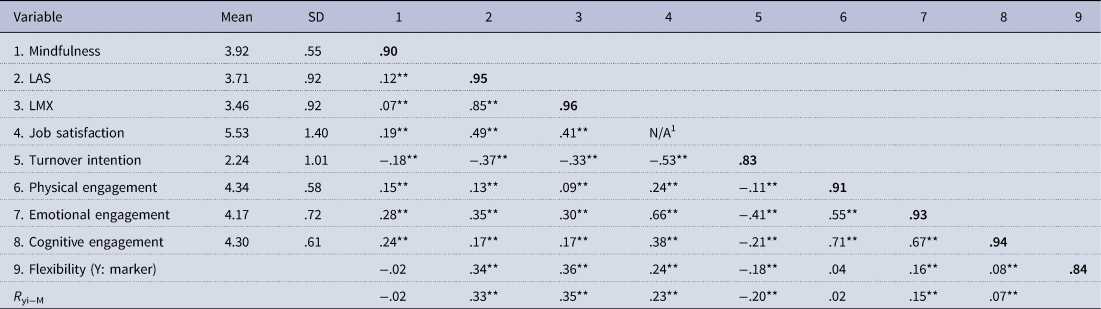
Table 1 presents the means, standard deviations, correlations and reliability coefficients of all continuous study variables.
Descriptive statistics and correlations for major variables (N = 1237) and marker variable technique to test common method variance

Note: **p < .01 (one-tailed). 1 = one-item measurement. Internal reliabilities are reported along the bold diagonal line; LAS, leader autonomy support; LMX, leader-member exchange; Flexibility, workplace flexibility, which is the marker variable for testing common method variance. R yi−M is the correlation between studied variables and maker variable after adjustment of common method variance.
Confirmatory factor analysis (CFA) and testing for common methods bias
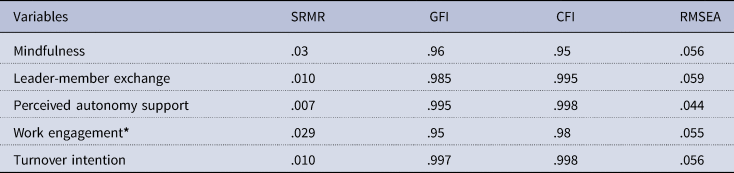
Before proceeding with hypothesis testing, a series of CFA was conducted using AMOS 24.0 to confirm the factor structures of the instruments for mindfulness, LAS, LMX, working engagement and turnover intention. Job satisfaction was not applicable for CFA, because job satisfaction is measured by only one item. Mindfulness, LAS, LMX and turnover intention were one-factor measures while work engagement was split into three factors: physical engagement, emotional engagement and cognitive engagement. All instruments, as listed in Table 2, achieved an acceptable level of fit suggested by Williams, Vandenberg, and Edwards (Reference Williams, Vandenberg and Edwards2009): the comparative fit index (CFI ⩾ .95), the root-mean-square error of approximation (RMSEA ⩽ .08) and the standardised root mean residual (SRMR ⩽ .10). Hence, eight distinct constructs were used in this research: mindfulness, LAS, LMX, turnover intention, physical engagement, emotional engagement and cognitive engagement.
Fit indices of measurements of mindfulness, leader-member exchange, perceived autonomy support, work engagement and turnover intention

Note: Work engagement is a three-factor construct. The three-factor construct of work engagement achieved an ideal model fit compared with one-factor work engagement
All the data were derived from a single source: a cross-sectional questionnaire-based survey, which raises potential concerns regarding common method variance (CMV) or common method bias (e.g., Fuller, Simmering, Atinc, Atinc, & Babin, Reference Fuller, Simmering, Atinc, Atinc and Babin2016). To address this, following Podsakoff, MacKenzie, Lee, and Podsakoff (Reference Podsakoff, MacKenzie, Lee and Podsakoff2003), we performed the most commonly used Harman's one-factor test to detect the levels of CMV. The results show that the first factor only accounted for 27.85% of the variance, which is lower than the 50% threshold (Podsakoff et al., Reference Podsakoff, MacKenzie, Lee and Podsakoff2003). Therefore, no dominant factor explains the majority of the variance. To provide further evidence, we employed the marker variable technique of Lindell and Whitney (Reference Lindell and Whitney2001). This method requires including a measure, which is not theoretically relevant to at least one measure in the survey, as a marker variable. The logic of this method is that if the correlations between the study variables and the marker variable are not significant in the test of zero-order correlation, they will not be statistically significant after the adjustment for CMV (Lindell & Whitney, Reference Lindell and Whitney2001). Otherwise, CMV will be problematic for further analysis. We chose flexible human resource practice (a five-item variable with an α coefficient of .84) as the marker variable, because it is identified a priori as being theoretically unlikely to correlate with individuals' mindfulness. From Table 1, the correlations between our studied variables and flexibility slightly changed after an adjustment for CMV, but the significance of them was consistent. Therefore, we conclude that CMV is unlikely to inflate the relationships found in this study.
Hypothesis testing
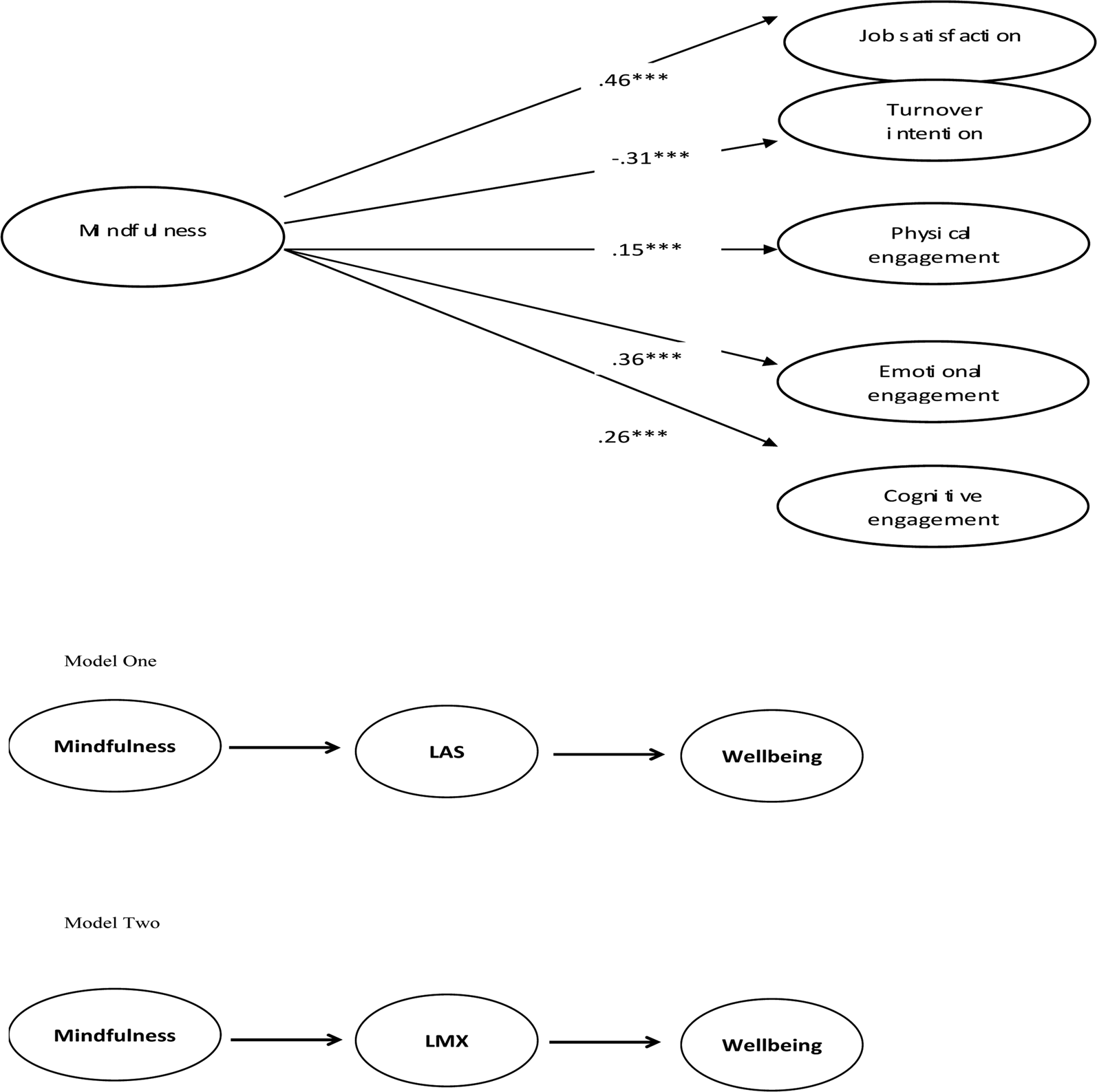
Structural equation modelling (SEM) was conducted to test Hypotheses 1–4 by using AMOS 24.0. Unstandardised regression coefficients were used in this research as recommended by Grace and Bollen (Reference Grace and Bollen2005). First, the direct relationships between mindfulness and outcome variables (job satisfaction, turnover intention and three dimensions of working engagement) were examined. This was supported, as can be seen in Figure 1, with acceptable goodness-of-fit indices: CFI = .998, TLI = 961, RMSEA = .074 and SRMR = .016. Results suggest that mindfulness was positively and significantly related to job satisfaction (β = .46, p < .001), physical engagement (β = .15, p < .001), emotional engagement (β = .36, p < .001) and cognitive engagement (β = .26, p < .001), and negatively associated with turnover intention (β = −.31, p < .001), supporting Hypothesis 1.
Direct relationships between mindfulness and outcome variables.

Subsequently, the mediation hypotheses were also tested by undertaking SEM. Following the recent appealing practice of mediation testing by Zhao, Lynch, and Chen (Reference Zhao, Lynch and Chen2010) and Zhu, Newman, Miao, and Hooke (Reference Zhu, Newman, Miao and Hooke2013), we conducted two sets of SEM: a full mediation model (in which direct effects from mindfulness to outcome variables were excluded), and a partial mediation model (in which direct effects from mindfulness to outcome variables were included). The goodness-of-fit indices for the full mediation model were CFI = .981, TLI = .901, RMSEA = .115 and SRMR = .048, while the indices for the partial mediation model were CFI = 1.00, TLI = .990, RMSEA = .031 and SRMR = .006. Accordingly, the partial mediation model was accepted as the better model, as it improved the overall model fit.
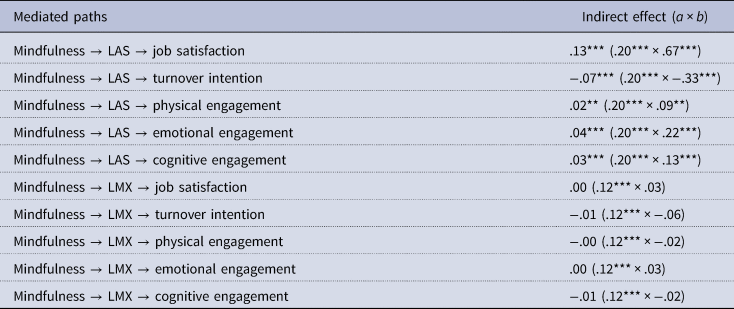
To determine the significance of indirect effects in the mediation hypotheses (Hypotheses 3–4), we followed the recommendations from Zhao, Lynch, and Chen (Reference Zhao, Lynch and Chen2010), and utilised the bootstrapping estimates provided by AMOS 24.0. The direct and indirect coefficients in the partial mediation model are presented in Table 3. The results show that LAS significantly mediated the relationships of mindfulness with job satisfaction (β = .13, p < .001), turnover intention (β = −.07, p < .001), physical engagement (β = .02, p < .01), emotional engagement (β = .04, p < .001) and cognitive engagement (β = .03, p < .001), supporting Hypothesis 3. Within those mediation paths, mindfulness was significantly associated with LAS (β = .20, p < .001), which supports our Hypothesis 2b, and LAS was significantly related to all the outcome variables (see Table 3). However, LMX did not significantly mediate the relationships between mindfulness and the following: job satisfaction (β = .00, p > .05), turnover intention (β = −.01, p > .05), physical engagement (β = −.00, p > .05), emotional engagement (β = .00, p > .05) and cognitive engagement (β = −.01, p > .05), leading us to reject Hypothesis 4. Within this set of mediation paths, mindfulness was significantly associated with LMX (β = .12, p < .001), supporting Hypothesis 2a, but LMX was not significantly related to any outcome variables (see Table 3), which could be responsible for those insignificant mediation relationships in Hypothesis 4.
Direct and indirect coefficients in the partial mediation model

Note. a = the unstandardised path coefficients of path from predictor to mediator; b = the unstandardised path coefficients of path from mediator to outcome; LAS, leader autonomy support; LMX, leader-member exchange. **p < .01, ***p < .001; control variables were age, gender and job position.
Discussion
To ensure workforce sustainability, calls for the retention and development of older workers have been made (Collins, Hair, & Rocco, Reference Collins, Hair and Rocco2009; James et al., Reference James, McKechnie, Swanberg and Besen2013; Ng & Feldman, Reference Ng and Feldman2012; Thorsen, Jensen, & Bjørner Reference Thorsen, Jensen and Bjørner2016).
However, despite the need for older workers, research consistently shows that for older workers, stress, negative stereotypes and leadership inability pose challenges to their retention and enjoyment of work (Collins, Hair, & Rocco, Reference Collins, Hair and Rocco2009; James et al., Reference James, McKechnie, Swanberg and Besen2013; Ng & Feldman, Reference Ng and Feldman2012). We sought to redress this by developing and testing a model for older worker wellbeing, which includes personal resources (i.e., mindfulness) and external/environmental (i.e., leadership) variables.
Mindfulness and engagement, satisfaction and turnover
We tested and found a positive relationship between mindfulness and older workers' wellbeing (engagement, satisfaction and intention to leave). While research to date has found these relationships in other demographics and populations (see Roche et al., Reference Roche, Good, Lyddy, Tuckey, Grazier, Leroy and Hülsheger2020) scant literature has investigated the importance of mindfulness on the wellbeing of older workers (c.f Allen et al., Reference Allen, Henderson Tyler, Mancini and French2017). As with workers in other demographics, we found that mindfulness is a personal psychological resource for older workers, one on which they draw as they navigate difficult organisational terrains.
Mindfulness and relational leadership (LMX and LAS)
Secondly, we found a positive relationship between mindful older workers and relational leadership. Older workers often cite leadership ineffectiveness and disrespect as major issues they face at work. However, as mindfulness facilitates a process of selectiveness and purposefulness, it enhances the alignment of one's environment and one's needs (Eisenbeiss & Van Knippenberg, Reference Eisenbeiss and Van Knippenberg2015; Glomb, Duffy, Bono, & Yang, Reference Glomb, Duffy, Bono and Yang2011; Hafenbrack, Reference Hafenbrack2017), including leadership perceptions (Reb et al., Reference Reb, Chaturvedi, Narayanan and Kudesia2019) and we found this for both LAS and LMX. As such, mindfulness is not only a key personal (psychological) resource for workers, it is central to the enhancement of positive organisational and social processes in the work environment, including leadership (Hülsheger, Walkowiak, & Thommes, Reference Hülsheger, Walkowiak and Thommes2019; Sutcliffe, Vogus, & Dane, Reference Sutcliffe, Vogus and Dane2016)
Mindfulness, relational leadership (LMX vs. LAS) and outcomes
As previously noted, there has been scant research on how different positive leadership behaviours, as perceived by mindful followers in leader–follower relationships, affect the workplace wellbeing of older workers. Overall, we find that more mindful older workers tend to enjoy greater wellbeing, orientate towards positive leadership and are more discerning of the style of positive relational leadership that is most beneficial for their engagement, satisfaction and intention to stay in the organisation.
One of the key findings of this paper is that while LAS mediated the relationship between mindfulness and outcomes, LMX did not. There are several possible reasons for this. Firstly, it could be that older workers place less value on the importance of exchanges compared to younger workers, perhaps owing to a reduced focus on compensation, ambition and promotion (Kasser & Ryan, Reference Kasser and Ryan1996). Differences in age between leaders and followers may also have implications for the quality of these exchanges. In particular, relational demography theory predicts that employees who are similar in age to their managers will have more positive work attitudes and experiences than will employees who are dissimilar in age to their managers; while we did not test for age similarity, older workers are still a minority in the workforce. Alternatively, there is also a power differential associated with most LMX relationships. As people grow older, they tend to be less concerned with negotiating with powerful individuals (Kasser & Ryan, Reference Kasser and Ryan1996). It is possible that mindful older followers view leaders as exerting more power in the development of LMX relationships, which reduces the perception of LMX quality by older workers (Liden, Sparrowe, & Wayne, Reference Liden, Sparrowe and Wayne1997; Settoon, Bennett, & Liden, Reference Settoon, Bennett and Liden1996). At this point, this is only speculation, and it requires further testing.
Another explanation for why LAS mediated the relationship between mindfulness and outcomes while LMX did not may lie in existing literature which indicates that older workers value autonomy. LAS, which facilitates the autonomy of older workers, has greater importance and relevance for the wellbeing of older workers. As workers mature in age, they gravitate towards leadership styles that will satisfy their deeper eudaimonic wellbeing needs (Ryan, Huta, & Deci, Reference Ryan, Huta and Deci2008), such as autonomy. They may have less interest in LMX exchanges and in the need to derive reciprocal benefit from these exchanges. This would align with research from Sheldon and Kasser (Reference Sheldon and Kasser2001) who found that age and maturity are related to a greater pursuit of autonomy in terms of benefitting wellbeing. While further research is needed here with respect to both LMX and LAS, we find that mindful mature workers typically thrive in a (leadership) environment that supports their autonomy.
We also suggest this opens research into the area of mindfulness and leadership, by demonstrating that not all positive leadership is beneficial, when employees are mindful. As such, this creates greater expectations of leaders, to more accurately engage in a range of leadership behaviours that their mindful employees want and need, rather than practising positive leadership that may be non-specific to their employees' needs. Leaders and organisations should be aware that while there are many benefits to having mindful employees, such followers may also generate unexpected outcomes. Our paper flips the focus of leader–follower relationships towards the follower, arguing that mindful followers exhibit greater expectations, or at least greater discernment and judgement, about leadership in the workplace. Finally, we suggest that this finding adds weight to, and contributes towards understandings of, the granulated nature and nuances of relational leadership, and the discernment and decision-making capabilities of mindful employees (Hafenbrack, Kinias, & Barsade, Reference Hafenbrack, Kinias and Barsade2014; Pless, Sabatella, & Maak, Reference Pless, Sabatella and Maak2017; Reb et al., Reference Reb, Chaturvedi, Narayanan and Kudesia2019; Small & Lew, Reference Small and Lew2021).
Finally, we suggest that the model we have developed and tested provides tentative promise as a model of wellbeing in integrating both personal and environmental resources. We suggest that our model may be used as an initial platform to extend further research into older workers' wellbeing.
Limitations
Further research is needed to confirm and extend our findings here. Firstly, our sample is of New Zealand older workers, and differences may be experienced in other areas of the Asia-Pacific region, or beyond. Secondly, experimental studies are needed to further unravel the exact cognitive processes of leadership as an internal (psychological) and external (i.e., leadership) phenomena at work, both in terms of better understanding the cognitive processes involved, and with different leadership styles in play. While this study confirms the leadership preferences of mindful older workers, more research is needed in relation to different age cohorts, gender needs and other leadership styles at work. Further, we suggest the need for longitudinal research to establish greater validity of our findings. Finally, leadership is only one aspect of the workplace environment that we tested. Other aspects, such as team support, should also be tested.
Implications
Our study garners some initial insights for enhancing the wellbeing of older workers with respect to leadership and organisational interventions. Firstly, organisations may introduce mindfulness training for older workers as this can enhance their wellbeing and direct their attention to positive leadership behaviours. That said, our study also demonstrates that older mindful followers are highly discerning of the leadership influences that have a positive impact on their workplace outcomes. Although positive leadership styles may be in play within an organisation, the wellbeing of older workers rests on leadership approaches which specifically promote and support their autonomy. For leadership to effectively facilitate the wellbeing of older workers, it is imperative that these workers engage in mindful follower cognitions. Ultimately, our paper shifts the debate on leadership and mindfulness towards the importance of follower mindfulness, as opposed to giving full weight to leadership behaviours.
In conclusion, our study provides for a model of older worker wellbeing, finding that mindfulness is an important personal psychological resource for the wellbeing of older workers. In finding that mindful older workers are discerning about positive leadership styles and relationships, our paper forges new territory in the underexplored area of the wellbeing and leadership of older workers (Zacher et al., Reference Zacher, Burke, Cooper and Antoniou2017).
Conflict of interest
None.