Implications
Organic farming embodies extrinsic features that consumers value; however, studies on the intrinsic properties of organic products, such as their sensory and nutritional characteristics, remain scarce. Here, we provide experimental evidence that organically reared pasture-fed lambs present a greater risk of off-odour in chops and softer subcutaneous fat than conventionally reared pasture-fed lambs. However, the organic farming specifications makes commitments on pasture-feeding, which lead to nutritionally more desirable meat fatty acid composition. Moreover, meat from organically reared pasture-fed lambs presented the advantage of a higher proportion of stearic acid, which may have positive effects in the prevention of cardiovascular disease in humans.
Introduction
The ‘Organic’ label offers production process guarantees, but consumers are also demanding higher food quality guarantees (Lairon, Reference Lairon2009). Organic farmers commit to respect a list of specifications governing animal care, welfare and feeding, obliging them to give herbivores access to pasture during the grazing season and organic-source raw feed material outside the grazing season (Leroux et al., Reference Leroux, Fouchet and Haegelin2009). Although most of these factors influence product quality, they are not specific to organic farming. Moreover, there is a significant diversity within both organic and conventional farming systems, which may limit the robustness and generalisation of any given comparison. For example, the comparison of the quality of organic and conventionally produced lamb made by Angood et al. (Reference Angood, Wood, Nute, Whittington, Hughes and Sheard2008) was based on chops bought from supermarket chains, and this design can be criticised by arguing that it is sensitive to confounding effects such as animal diet, animal breed, sex and age at slaughter – all factors that were unknown in the study but can greatly affect the sensory and nutritional quality of the chops.
The present study was therefore conducted with the aim of comparing the meat and carcass quality of organic and conventionally produced pasture-fed lambs. Organic farming consciously promotes pasture-feeding, which is favourable from a nutritional point of view, as meat from pasture-fed lambs has been shown to have a nutritionally more desirable fatty acid (FA) composition than meat from lambs fed concentrate diets (Fisher et al., Reference Fisher, Enser, Richardson, Wood, Nute, Kurt, Sinclair and Wilkinson2000; Aurousseau et al., Reference Aurousseau, Bauchart, Calichon, Micol and Priolo2004; Santé-Lhoutellier et al., Reference Santé-Lhoutellier, Engel and Gatellier2008), but may lead to off-odour and off-flavour of the meat (Rousset-Akrim et al., Reference Rousset-Akrim, Young and Berdagué1997). The odour and flavour of the meat may be even stronger when the pasture is rich in legume species, such as white clover, owing to its high degradable protein content and therefore its prominent role in the ruminal synthesis of skatole and indole (Schreurs et al., Reference Schreurs, Marotti, Tavendale, Lane, Barry, Lopez-Villalobos and Mcnabb2007a and Reference Schreurs, Mcnabb, Tavendale, Lane, Barry, Cummings, Fraser, Lopez-Villalobos and Ramirez-Restrepo2007b). Legume species are desirable in organic grassland-based systems because of the constraints in the use of mineral fertilisers. In addition, higher proportions of white clover in the lamb's diet may lead to softer subcutaneous fat, owing to a higher polyunsaturated-to-saturated FA ratio (Lourenço et al., Reference Lourenço, Van Ranst, De Smet, Raes and Fievez2007). The main hypothesis of the present study was that organically reared pasture-fed lambs would present a higher incidence of off-odour and off-flavour in meat, and firmness defects in subcutaneous fat because of the higher proportion of white clover in the pastures caused by avoiding synthetic fertilisers.
Material and methods
This study was carried out over 3 successive years (2005 to 2007) at the Unité Expérimentale des Monts d'Auvergne experimental farm at Orcival, France, run by the INRA's Clermont-Ferrand Theix Center. The animals were handled by specialised personnel in accordance with the list of specifications of organic farming.
Experimental design
The experiment used 72 Limousin male lambs in two treatments comparing organic production (O) against conventional production (C). Each O and C treatment comprised 12 male lambs per year over 3 years (2005 to 2007) using the same experimental pastures. The two production systems differed in terms of mineral N fertilisation level (0 v. 100 U per ha for O pasture and C pasture, respectively).
Animals and diets
The lambs were born between 6 and 29 April in 2005, 31 March and 23 April in 2006 and 16 April and 14 May in 2007. For each year, 12 lambs from the organic flock and 12 lambs from the conventional flock were classified into 12 pairs according to birth weight and average daily gain (ADG) between birth and the beginning of the experiment.
Each group grazed a non-fertilised natural pasture between turning out (12 May 2005, 12 May 2006 and 21 May 2007) and weaning (25 July 2005, 13 July 2006 and 25 July 2007). After weaning, the lambs were fattened without any supplementation on the experimental plots (regrowths after herbage mowing and harvesting). We used the same experimental plots for all 3 experimental years. In 2005, half the area of each of the two experimental plots was mowed and harvested on 31 May, and the other half was mowed and harvested on 17 June; herbage in excess was mowed and harvested on 19 September. In 2006, the entire area of both experimental plots was mowed and harvested on 9 June and half the area of each experimental plot was mowed and harvested again on 24 July. In 2007, the first mowing and harvesting of the experimental area was delayed until 11 July owing to rainy conditions, and herbage in excess was mowed and harvested on 10 September on both experimental plots. Each experimental plot was rotationally grazed using sub-plots. In the case of the C pasture, mineral N application involved a similar protocol since the year 2000, with the application of 100 U mineral N per ha, with 60 U per ha being applied in April and 40 U per ha after the first mowing. The O pasture received no mineral fertilisation. The botanical composition of the experimental pastures was visually assessed in July 2005 using the method described in Daget and Poissonnet (Reference Daget and Poissonnet1971).
All lambs were treated for internal worms at weaning (beginning of the experiment), and the remaining lambs that were not yet slaughtered were treated again in mid-September. Lambs were weighed once a week in order to manage herbage allowance at pasture to ensure similar average growth patterns between O and C lambs. However, herbage allowance was ultimately almost ad libitum. All animals had ad libitum access to water and salt blocks. The lambs were re-weighed just before transport to the abattoir.
Feed collection and analysis
In 2005 and 2006, in each treatment, 10 randomly chosen herbage samples (1 m × 0.1 m) were cut with a lawnmower to a height of 1.5 cm before allowing the animals on the experimental sub-plot, on 25 July, 30 August and 21 September 2005 and 26 July, 30 August and 20 September 2006. These samples were dried at 60°C for 48 h, then bulked and milled through a 0.85-mm mesh for analysis of crude protein (CP; Dumas N × 6.25) and in vitro organic matter digestibility using the pepsin–cellulase method (Aufrère and Michalet-Doreau, Reference Aufrère and Michalet-Doreau1983).
Snip samples of the pastures were taken at ground level using scissors before allowing the animals on the experimental sub-plot, on 13 July, 3 August, 24 August and 21 September 2006. At each sampling session, 100 herbage samples were plucked and bulked. These samples were stored at −20°C, then freeze-dried and bulked on a plot basis. Total lipids were extracted from pooled herbage samples (around 160 g dry matter (DM)) by grinding at 20 000 r.p.m. with chloroform/methanol (2:1, vol/vol) followed by hexane/ethanol/HCl (25:10:10, vol/vol/vol), as reported in Bauchart et al. (Reference Bauchart, Vérité and Rémond1984), and determined by gravimetry. Herbage long-chain fatty acids (LCFAs) of total lipids were extracted and transmethylated at room temperature for 2 × 20 min with sodium methylate (1 M) followed by boron trifluoride in methanol (14%, vol/vol) according to Glass (Reference Glass1971). LCFA analysis was conducted by gas–liquid chromatography using the Peri 2100-model chromatograph (Perichrom Society, Saulx-les-Chartreux, France) fitted with a CP-Sil 88 glass capillary column (Varian, USA; length: 100 m; internal diameter: 0.25 mm) with H2 as carrier gas, under conditions described in Scislowski et al. (Reference Scislowski, Durand, Gruffat, Motta and Bauchart2004). Total LCFA were quantified using C19:0 as internal standard. Identification and calculation of the response coefficient of each individual LCFA was achieved using the quantitative mix C4-C24 Fame (Supelco, Bellafonte, USA).
Slaughter procedures
Lambs were slaughtered when they attained a fat class of 2 to 3 (on a scale of 0 to 5), which was manually assessed by skilled technicians according to the method described by Russel et al. (Reference Russel, Doney and Gunn1969). The lambs had access to food and water until roughly 1 h before slaughter, and were transported by truck to the abattoir 25 km from the experimental site. Immediately on arrival at the abattoir, the animals were electrically stunned and slaughtered by throat cut. The carcasses were placed in cold storage at 4°C until 24 h post mortem. Lambs were slaughtered between 17 August and 25 October in 2005, 22 August and 10 October in 2006 and 24 September and 15 October in 2007.
Carcass measurements
At 24 h post mortem, the carcass was weighed, graded for conformation using the commercial 15-point scale, as described by Fisher et al. (Reference Fisher, Enser, Richardson, Wood, Nute, Kurt, Sinclair and Wilkinson2000), and assessed for external fat using the commercial 5-point scale (Russel et al., Reference Russel, Doney and Gunn1969). Carcass morphology was assessed by measuring carcass length, width of buttock, chest depth according to Fisher and de Boer (Reference Fisher and de Boer1994), and thorax and shoulder width according to Laville et al. (Reference Laville, Bouix, Sayd, Eychenne, Marcq, Leroy, Elsen and Bibé2002). The perirenal fat and the kidneys were then removed from the cold carcass. Fat was separated from the kidneys using a knife, and then weighed. Subcutaneous caudal fat colour was measured using a MINOLTA CM-2002 spectrophotometer equipped with a protective glass visor to protect the measuring eye from the fat sample. Reflectance measurements were collected from a 2° viewing angle and with D65 illuminant (daylight) lighting conditions. Colour coordinates were calculated in the CIE-L*a*b* (1976) system. The results were expressed as lightness (L*), redness (a*) and yellowness (b*), hue angle and chromaticity. Five reflectance measurements were taken. Firmness of subcutaneous dorsal fat was measured by a trained assessor on a 15-point scale from 3, ‘very soft’, to 15, ‘very hard’, using a finger test.
Meat colour determination
Meat colour was measured in the first 2 experimental years. The left longissimus thoracis et lumborum (Ll) muscle was excised 24 h post mortem. Two centimetre-thick slices were placed on polystyrene trays, wrapped in air-permeable film (10 000 cm3 O2/m2 per 24 h, polyvinyl chloride film) and stored in darkness at 4°C. Colour measurements were performed 2 h and 6 days post sampling. The reflectance spectrum (from 360 to 760 nm) and colour variables (lightness, redness, yellowness, chromaticity and hue angle) were measured using a Uvikon 933 (Kontron) spectrophotometer equipped with an integrating sphere of Teflon (2° viewing angle and D65 illuminant). Meat discolouration index was determined by the difference in reflectance between 630 nm (maximum of the oxidised myoglobin or metmyoglobin) and 580 nm (maximum of the oxygenated myoglobin) according to Renerre (Reference Renerre2000).
Meat lipid oxidation measurement
Lipid oxidation was measured by the thiobarbituric acid reactive substances (TBARS) method devised by Lynch and Frei (Reference Lynch and Frei1993) and modified by Mercier et al. (Reference Mercier, Gatellier, Viau, Remignon and Renerre1998). TBARS measurements were recorded at the same time as colour measurements. The results were expressed as mg of malondialdehyde per kg of meat (TBA units).
Lamb chop sensory evaluation
Lamb chop sensory quality was evaluated on six chops per lamb. After chilling for 24 h, the saddles (Ll plus bones) were removed from the posterior end of the loin from the right side of the carcass, wrapped and vacuum-packed at the abattoir in sealable polyamide bags, and aged for 5 days at 4°C. The saddles were then frozen at −20°C until sensory evaluation. Before each panel session, chops were thawed for 24 h at 4°C. The chops were then contact-grilled ‘bone in’ for 6 min and served warm to 12 experienced panellists. Two pieces from the lean part and two pieces from the fat part were cut from each chop to provide a piece of each for each panellist. At each session, panellists evaluated the lambs from two pairs, with O lamb and C lamb presented in randomised order. Panellists were asked to taste each piece separately and use 10 cm non-structured line scales to evaluate the intensity of tenderness, juiciness, compacity, normal odour, abnormal odour of the lean part and the intensity of normal odour, abnormal odour and six flavour attributes (lamb, rancid, liver, milky, fatty and barnyard) of the fat part. Assessments were subsequently scored as the distance in cm from the left end of the line. Panellists were invited to drink water and eat toast and a piece of apple between assessments to ensure each sample was assessed using a cleansed palate.
Meat FA composition
Muscle FA analyses were performed on 18 lamb pairs (all 12 pairs produced in 2006 and the six last pairs produced in 2005). A 60 to 80 g sample from the right Ll muscle was taken 24 h post mortem, cut into small pieces and frozen in liquid nitrogen. Muscle tissue samples were ground in liquid nitrogen in a model M20 mill (IKA-Werke, Staufen, Germany) to produce a fine homogeneous powder, and then stored at −80°C for lipid and FA analysis. Lamb Ll muscle DM was assayed gravimetrically after drying at 80°C for 48 h. Total lipids of Ll muscle were extracted by grinding 6 g of muscle powder with chloroform–methanol 2:1 (v/v) according to Folch et al. (Reference Folch, Lees and Stanley1957), then assayed gravimetrically. Preparation and detailed analysis of muscle FA from total lipids was performed according to the same methods as reported above for the FA analysis of herbage samples (see ‘Feed collection and analysis’).
Data analysis
Lamb performance, carcass characteristics, meat colour and meat lipid oxidation measurements were subjected to ANOVA, the model including the production system, the experimental year and their interaction.
Data from the lamb chop sensory evaluation were subjected to ANOVA, the model including the production system, the experimental year and the lamb pair number nested within year as the two chops from each pair were evaluated one after the other in the same evaluation session. When a lamb pair showed a significant effect, we tried to predict this effect using pre-experimental pair characteristics (birth weight and ADG between birth and weaning) or age at slaughter.
Meat FA composition was subjected to ANOVA, the model including the production system. The effect of experimental year was not tested, as in the first year of the experimentation only the older half of the lamb pairs were sampled.
ANOVA was conducted using the GLM procedure of the SAS software package (1999).
Results
Pasture characteristics
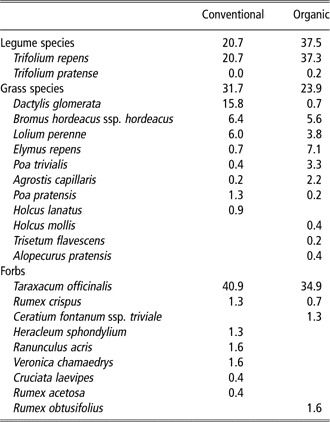
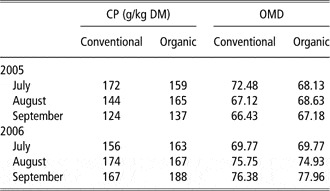
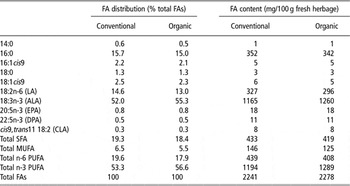
The botanical composition of the experimental pastures differed, with a higher proportion of white clover in the O pasture than the C pasture (Table 1). The nutritive value of the herbage offered was quite similar between O and C pastures (Table 2). The two pastures also exhibited very similar FA composition and content, dominated by α-linolenic acid (ALA; 18:3n-3), which represented 52% and 55% of total FA in C and O pastures, respectively (Table 3). The higher proportion of ALA in the O pasture (55.3% v. 52%) occurred to the detriment of palmitic acid (16:0) and linoleic acid (18:2n-6), which were 4.5% and 11.0% lower, respectively, in O pasture than in C pasture, leading to a better nutritional value of pasture FA in O pasture than in C pasture.
Botanical composition of the pastures used for fattening organically reared v. conventionally reared pasture-fed lambs (% of total biomass)

Variation in CP and OMD of the herbage offered to organically reared and conventionally reared pasture-fed lambs

OMD = organic matter digestibility; DM = dry matter; CP = crude protein.
Distribution of FA (% total FAs) and FA content (mg/100 g herbage) of the pastures used for fattening organically reared or conventionally reared pasture-fed lambs

FA = fatty acid; LA = linoleic acid; ALA = α-linolenic acid; EPA = eicosapentaenoic acid; DPA = docosapentaenoic acid; CLA = conjugated linoleic acid; SFA = saturated FA; MUFA = monounsaturated FA; PUFA = polyunsaturated FA.
Lamb performance and carcass characteristics
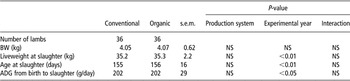
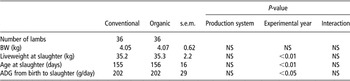
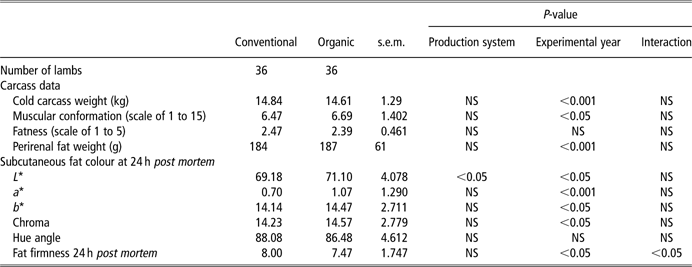
Lamb ADG between birth and slaughter was similar in 2005 and 2007 (196 and 197 g/day, respectively) and lower than in 2006 (216 g/day; Table 4). Age at slaughter was therefore similar in 2005 and 2007 (157 and 162 days, respectively) and higher than in 2006 (148 days). Liveweight at slaughter was similar in 2006 and 2007 (35.9 and 35.8 kg, respectively) and higher than in 2005 (34.0 kg). Cold carcass weight was therefore similar in 2006 and 2007 (15.08 and 15.40 kg) and higher than in 2005 (13.69 kg; Table 5). However, carcass fatness was similar between years (2.35, 2.33 and 2.60 in 2005, 2006 and 2007, respectively). Muscular conformation was similar in 2005 and 2007 (6.67 and 7.17, respectively) and higher than in 2006 (5.92). Perirenal fat weight was similar in 2005 and 2006 (175 and 156 g, respectively) and higher in 2007 (225 g).
Performance of organically reared and conventionally reared pasture-fed lambs
ADG = average daily gain.
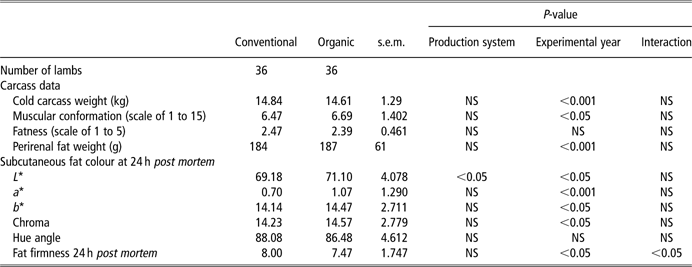
Carcass quality of organically reared and conventionally reared pasture-fed lambs
L* = lightness; a* = redness; b* = yellowness.
Despite these between-year differences, mean ADG between birth and slaughter, mean age and weight at slaughter were similar for C and O lambs (Table 4). Similarly, mean cold carcass weight, conformation, fatness and perirenal fat weight did not differ between C and O lambs (Table 5). Carcass morphology was similar between C and O lambs (data not shown).
Sensory qualities of meat and carcass
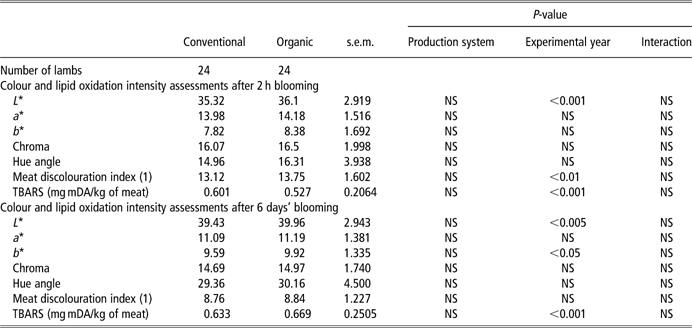
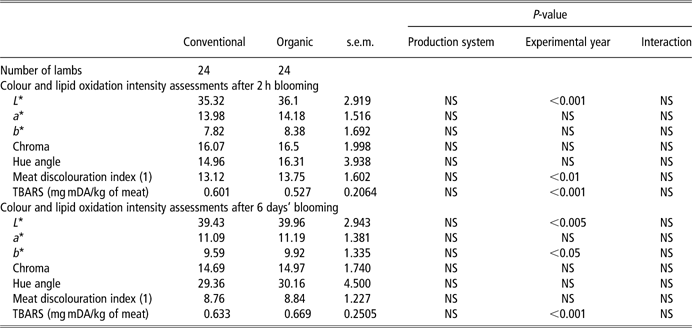
Lightness of subcutaneous fat was higher in O than C lambs (P < 0.05), whereas other subcutaneous fat colour characteristics (redness, yellowness, chromaticity and hue angle) did not differ (Table 5). Analysis of subcutaneous fat firmness showed an interaction between production system and experimental year. Fat firmness did not differ between O and C lambs in 2005 and 2006, but in 2007 subcutaneous fat was softer in O lambs than C lambs (6.83 v. 8.58, respectively, P < 0.05). There was no difference between production systems in the Ll muscle colour or lipid oxidation intensity (Table 6).
Longissimus thoracis et lumborum muscle colour and lipid oxidation intensity in organically reared and conventionally reared pasture-fed lambs
L* = lightness; a* = redness; b* = yellowness; TBARS = thiobarbituric acid reactive substances.
(1) The index of meat discolouration intensity is measured using the difference in the proportion of light reflected at 630 and at 580 nm.
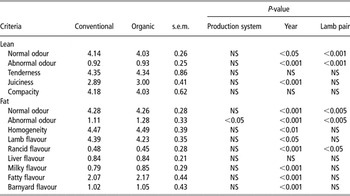
The experienced panellists judged that the fat part had a higher intensity of abnormal odour in O chops than C chops (Table 7). They did not find significant differences between production systems in any of the other criteria evaluated, irrespective of whether on the fat or lean part of the chop.
Sensory evaluation of lamb chops from organically reared and conventionally reared pasture-fed lambs
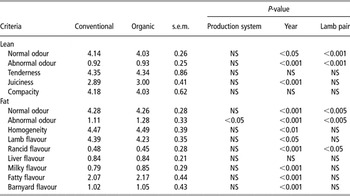
The panellists also found differences between pairs of lambs in the intensity of normal and abnormal odour in both the lean and the fat parts of the chops, and in the intensity of rancid flavour of the fat part (Table 7). For these variables, the effect of lamb pair was not significantly related to pre-experimental pair characteristics (birth weight and ADG between birth and weaning), nor to mean slaughter age of the lambs forming the pair.
Muscle FA
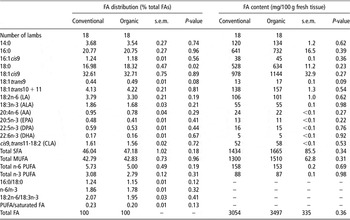
The distribution of FA (expressed in % total FA) and their content (expressed in mg/100 g fresh tissue) in Ll muscle is given in Table 8. Muscle lamb FA were dominated by saturated FA (46% to 47% of total FA) and monounsaturated FA (42.8%), but total polyunsaturated FA (PUFA) were found at appreciable levels (7.8% and 8.8% in O and C lambs, respectively) without significant differences between treatments in the ratio of n-6 PUFA : n-3 PUFA. Comparison between C and O lambs did not reveal significant differences in terms of FA distribution or FA content, except for 18 : 0, which proportionally to total FA was 7.9% lower in C lambs than in O lambs (P < 0.02). Muscle total FA content, which amounted to 3.1 to 3.5 g/100 g fresh tissue, was not significantly different between C and O lambs.
Distribution of FAs (% total FAs) and FA content (mg/100 g fresh tissue) of Longissimus thoraci et lumborum muscle in conventionally reared v. organically reared pasture-fed lambs

FA = fatty acid; LA = linoleic acid; ALA = α-linolenic acid; AA = arachidonic acid; EPA = eicosapentaenoic acid; DPA = docosapentaenoic acid; DHA = docosahexaenoic acid; CLA = conjugated linoleic acid; SFA = saturated FA; MUFA = monounsaturated FA; PUFA = polyunsaturated FA.
Discussion
Despite between-year differences in animal performance and carcass characteristics at slaughter, the management of herbage allowance at pasture ensured a similar average growth pattern, age at slaughter, cold carcass weight and degree of fatness for O and C lambs, thus avoiding confounding effects of growth pattern, age at slaughter and fatness level on the meat and carcass quality evaluation.
One of the main results of this study is that the intensity of abnormal odour of the fat part of the chop was higher in O lambs than in C lambs, confirming our initial hypothesis. This result may be due to the higher proportion of white clover in O lambs’ diet, linked to a higher proportion of white clover in the O pasture. Recent research has demonstrated that meat from pasture-fed lambs has a stronger and less-preferred odour and flavour when the lamb has grazed a white clover-rich diet compared with a grass-rich diet (Schreurs et al., Reference Schreurs, Marotti, Tavendale, Lane, Barry, Lopez-Villalobos and Mcnabb2007a and Reference Schreurs, Mcnabb, Tavendale, Lane, Barry, Cummings, Fraser, Lopez-Villalobos and Ramirez-Restrepo2007b). Grazing white clover actually induces higher concentrations of skatole and indole in the fat than grazing ryegrass. These compounds, which are responsible for off-flavours and off-odours, are formed in the rumen from microbial deamination and decarboxylation of tryptophan, and their concentration in the fat is therefore increased when the forage proteins present high solubility and rapid degradation in the rumen (Schreurs et al., Reference Schreurs, Marotti, Tavendale, Lane, Barry, Lopez-Villalobos and Mcnabb2007a and Reference Schreurs, Mcnabb, Tavendale, Lane, Barry, Cummings, Fraser, Lopez-Villalobos and Ramirez-Restrepo2007b). Although there are strong reasons for having high proportions of white clover in organic livestock systems to compensate for avoiding mineral fertilisers and to reduce reliance on bought-in concentrate feed, the outcome of this study demonstrates that this may increase the occurrence of off-odour in the end-product meat.
There were differences between lamb pairs in the intensity of normal and off-odour in both the chops’ lean and fat parts, and in the intensity of rancid flavour in fat. Lamb growth rate and age at slaughter can vary strongly in pasture-fed lambs (Prache and Thériez, Reference Prache and Thériez1988), and a previous study using groups of lambs with contrasting ages at slaughter (means of 101 v. 217 days) demonstrated that age at slaughter and growth rate strongly influenced lamb meat flavour and odour (Rousset-Akrim et al., Reference Rousset-Akrim, Young and Berdagué1997). Whether the between-animal variability in less contrasting conditions, such as those in the present study where the age at slaughter on an individual basis ranged between 116 and 197 days, can be predicted from lamb growth rate, birth weight or age at slaughter cannot be answered by the present data, as differences between lamb pairs were not significantly related to these pair characteristics. We would probably have to increase sample size to shed further light on the determinants of this inter-individual variability in animal response. It should, however, be noted that between-pair differences may involve a session effect, as the lamb chop sensory evaluation necessitated six sessions per year as two pairs of lambs were evaluated at each session.
In one among 3 years (2007), subcutaneous fat was softer in O lambs than C lambs. This may also be due to a higher proportion of white clover in the diet of O lambs. A recent study found a higher proportion of PUFA and a lower proportion of saturated fatty acid (SFA), and therefore a higher PUFA : SFA ratio in subcutaneous fat from lambs grazing a legume-rich pasture compared with lambs grazing a ryegrass pasture (0.155 v. 0.085; Lourenço et al., Reference Lourenço, Van Ranst, De Smet, Raes and Fievez2007). We did not find this difference in the intramuscular fat; however, as pointed out by Lourenço et al. (Reference Lourenço, Van Ranst, De Smet, Raes and Fievez2007) and in line with their results on subcutaneous and intramuscular fat depots, subcutaneous fat is more responsive to changes in dietary FA supply or rumen metabolism than intramuscular fat.
The colour of subcutaneous fat and Ll muscle was fairly similar between treatments. Subcutaneous fat was slightly lighter in O than C lambs, but the difference was imperceptible to the naked eye (1.92 point). Similarly, there was no between-treatment difference in meat myoglobin and lipid oxidation. These outcomes are in line with results obtained by Petron et al. (Reference Petron, Raes, Claeys, Lourenço, Fremaut and De Smet2007) who found no differences in the meat colour or meat lipid oxidation in lambs fed either intensive ryegrass, legume-rich or botanically diverse pastures. TBARS levels were low, in line with those obtained by Petron et al. (Reference Petron, Raes, Claeys, Lourenço, Fremaut and De Smet2007) and Santé-Lhoutellier et al. (Reference Santé-Lhoutellier, Engel and Gatellier2008). Pasture-fed lambs are known to exhibit lower TBARS levels than lambs fed concentrate-based diets, partly because of differences in the vitamin E levels of meat (Santé-Lhoutellier et al., Reference Santé-Lhoutellier, Engel and Gatellier2008).
Analysis of muscle FA confirmed the interest of pasture-feeding on the nutritional value of meat FA, as reported earlier in meat-producing ruminants such as lambs (Aurousseau et al., Reference Aurousseau, Bauchart, Calichon, Micol and Priolo2004, Reference Aurousseau, Bauchart, Faure, Galot, Prache, Micol and Priolo2007a and Reference Aurousseau, Bauchart, Galot, Prache, Micol and Priolo2007b). The composition of their saturated and polyunsaturated FA met the recommendations of the European Food Safety Authority (2010) and the French Nutrition Society (Legrand et al., Reference Legrand, Bourre, Descomps, Durand and Renaud2001), that is, a value of n-6 PUFA : n-3 PUFA ratio lower than 5 and a limited level of 16 : 0, a proatherogenic FA, compared with 18:0, which seems to favour the prevention of cardiovascular disease (Mensink et al., Reference Mensink, Zock, Kester and Katan2003; Seidel et al., Reference Seidel, Deufel and Jahreis2005; Tholstrup, Reference Tholstrup2005). The higher proportion of 18 : 0 in meat FA from organically reared pasture-fed lambs could be explained by a higher rumen bio-hydrogenation of dietary PUFA. Such a stimulation of PUFA bio-hydrogenation could be the result of differences in the botanical composition between the organically grown pasture and the conventionally grown pasture, with a higher proportion of plant species lowered or deprived in molecules that downregulate activities of rumen hydrogenases or the production of hydrogenases by different rumen microflora.
The sanitary-health aspects of the meat were not addressed in the present study, and warrant further investigation. In addition, as modern consumers, particularly those buying organic products, are increasingly environment conscious, studies urgently need to address the issue of the carbon footprint of meat produced under organic or conventional production systems.
Conclusions
This study provides experimental evidence of a greater risk of the occurrence of off-odour in lamb chops from organically reared lambs compared with conventionally reared lambs. This risk is probably linked to a greater proportion of white clover in organically grown pastures. Furthermore, the greater proportion of white clover in the diet may increase the risk of softer subcutaneous fat. However, as white clover is invoked as an explanation for these results, it is worth noting that low-input conventional systems may also be concerned by a greater risk of the occurrence of these sensory defects. Moreover, as the proportion of white clover can vary greatly in both organic and conventional pastures, there is a clear need for further work actively controlling the proportion of white clover in the diet in order to assess the dose–response curve between this proportion of white clover and the sensory quality of lamb chops and subcutaneous fat. Questions also remain concerning the determinants of inter-individual variability in animal response, and more results are needed to explore this matter further. The challenge now is to further experiment with management strategies in order to help minimise the occurrence of these defects while taking advantage of the presence of white clover for the animal nutrition and the natural pasture fertilisation. We found a generally better human nutritional quality of meat FA from both organically reared and conventionally reared pasture-fed lambs than previous reports in the literature on meat from lambs given concentrate-based diets, and it should be stressed that organic farming works to specifications guaranteeing pasture-feeding. Organically reared lambs presented a slight advantage in that they presented higher levels of stearic acid, which may have positive effects in the prevention of the risk of atherosclerosis in humans.
Acknowledgements
We thank J. Ballet, R. Jailler, C. Legay, J. Pourrat and all the staff at the experimental abattoir for their assistance. This study was funded by the National Institute for Food Origin and Quality, the FEOGA Massif-Central and the Institut National de la Recherche Agronomique Internal Committee for Organic Farming.