Introduction
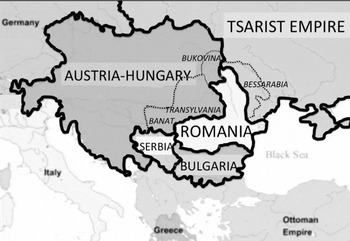
The attempt to modernise and industrialise Eastern European states at the end of the nineteenth, beginning of the twentieth century was accompanied by political upheaval and huge social imbalances. New institutions and practices were often superimposed on essentially manorial relations and under their influence old inequities, far from being removed, were enhanced and perpetuated under a new guise. These transformations resulted in the build-up of great social tensions, which ruptured the social fabric in devastating outbursts of violence, the most egregious of which were the peasant uprisings and episodes of anti-Semitic violence that punctuated the period 1880–1914. Rural relations were, however, not invariably strained and violent across the region with some provinces and countries being more flammable than others. The present article explores the potential for rural combustibility along the complex imperial frontier that up until 1877 divided the Ottoman, Tsarist and Austro-Hungarian Empires. The borderlands of Austria-Hungary (Transylvania and Bukovina) and of the Tsarist Empire (Bessarabia) as well as the fledgling states that emerged from the European fringes of the Ottoman Empire (Romania, Serbia and autonomous Bulgaria) shared multiple ethnic groups and evinced economic and developmental similarities. Agriculture was the main branch of the economy, land cultivation was rudimentary, the rural population was mostly illiterate and low skilled, and landed elites dominated limited-franchise politics. However, what these countries and imperial provinces did not share was the same degree of social combustibility. Of all the mentioned borderlands, Romania was by far the most explosive with a major peasant uprising in spring 1907 inflicting heavy human casualties and loss of property and threatening to destabilise the state. The Austro-Hungarian borderlands underwent peasant emancipation and land redistribution without major social upheavals. Tsarist Russia was convulsed by revolution and violent peasant uprisings between 1905 and 1907, but its eastern borderland, the province of Bessarabia, remained comparatively peaceful both during the Russian turmoil and during the 1907 Romanian peasant uprising, which started just across the Tsarist border. Serbia and Bulgaria, the two Balkan states south of the Danube River, experienced localised flares of rural unrest but on a small scale and bearing no comparison with the virtual social implosion experienced by their northern neighbour Romania. So the above-mentioned complex frontier divided the relatively peaceful frontier provinces of two empires and several nation-states of recent formation, two of which had relatively lower levels of rural unrest, whilst the outwardly most developed and successful of them almost caved in amidst great social turmoil. This article proposes a cross-border comparison of the specificities of agriculture, land-tenure and state-building around this complex frontier with a view to accounting for the different degrees of rural flammability that shaped social relations across this border region.
Map of the borderlands in Europe, 1900. Source: http://www.euratlas.net/history/europe/1900/.

Peasant troubles literature
There is copious literature on peasant uprisings and rebellions featuring classic studies by Charles Tilly, Eric Hobsbawm, Eric Wolf and Theodor Shanin. Structuralist analyses attempting to lay down the laws governing rebellious behaviour have added to our understanding of what makes the difference between loyalty and all-out violence. Such are Barrington Moore's seminal study Social Origins of Dictatorship and Democracy: Lord and Peasant in the Making of the Modern World and, one decade later, the broad comparative collective volume edited by Henry A. Landsberger, Rural Protest: Peasant Movement and Social Change. There is also cognate bibliography, which does not specifically refer to the rural world, like Albert O. Hirschman's seminal study Exit, Voice, Loyalty, which forms the basis and provides the terminology of subsequent studies of peasant resistance.Footnote 1 More recent research inquires into the parameters of peasant rebellious behaviour: see for instance the joint article by Evgeny Finkel, Scott Gehlbach and Tricia D. Olsen, ‘Does Reform Prevent Rebellion? Evidence From Russia's Emancipation of the Serfs’,Footnote 2 which explores the role of reforms in fostering peasant unrest by increasing expectations, or Marcus J. Kurtz's 2000 article, ‘Understanding Peasant Revolution: From Concept to Theory and Case’,Footnote 3 which delves into the theoretical and empirical issues surrounding the conceptualisation of the term ‘peasant’. This wealth of research has laid down the main arguments regarding social instability and rebellions, ranging from the sudden onslaught of capitalist relations on a traditional society, rapid and predatory commercialisation of agriculture, to frustrated expectations for further reform and abrupt deterioration of the peasant standard of life, or a certain type of land tenure such as family-size tenancy, which was considered to be more vulnerable and volatile.Footnote 4
Studies on Eastern European peasant unrest concentrate for the most part on Russia and Poland, while individual contributions such as those by Chirot, Mitrany and Roberts also cover the peasant question in Romania and the 1907 peasant uprising. John Lampe and Marvin Jackson's Balkan Economic History, 1550–1950: From Imperial Borderlands to Developing Nations remains a cornerstone of economic and historical analysis of this border region and a great source of statistics. There is, however, no study that looks comparatively, from a cross-border perspective, at land tenure patterns and the potential for rural violence along the complex frontier between the three empires, Habsburg, Tsarist and Ottoman. This is where the present article makes its principal contribution in focusing on these imperial borderlands, which appear to be fairly similar on the face of it but nevertheless evince widely divergent degrees of social unrest.
As James C. Scott pointed out, peasant uprisings were not an everyday occurrence. Most of the times peasants would seek to circumvent or ‘mitigate the impact of existing rules and structures’.Footnote 5 When uprisings did occur, it was because a complex of factors more powerful than self-preservation instinct, fear of reprisals and concern for daily business and the prospects of the annual crop acted as a trigger for violent protest. The present article therefore examines the structural factors and the play of circumstances that constituted such a powerful trigger to overcome peasant inertia. In doing so, it does not go against the grain of theorisations of peasant rebellions, rather it offers a more nuanced and comparative view of several case studies, which on the face of it seemed to share the same problems and tensions but in practice evolved very differently.
The Romanian peasant uprising
In spring 1907 a devastating peasant uprising engulfed the fledgling Romanian Kingdom, shook it up from its very foundations and made a mockery of its strenuous, decade-long efforts in projecting the image of a civilised modern state. The uprising was (and still is to date) the most violent and destructive episode in Romanian history ever to occur in peacetime (not even the 1989 revolution killed as many and destroyed as much). Although at its peak the uprising only lasted a couple of weeks, it engulfed the whole country, threatened to destabilise the state and saw extremes of violence perpetrated on the part of both the rebellious peasants and the repression army. The conflict was only suppressed by using heavy artillery against diehard peasant bands.Footnote 6
The young Romanian state, just like fellow Balkan peers, Serbia and autonomous Bulgaria, was carved out of the fringes of the Ottoman Empire following the Treaty of Berlin of 1878. It was a state of recent formation that had to build institutions from scratch and strove to make a name for itself internationally. A large percentage (80%) of its population was made up of peasants, who in their great majority were illiterate and landless, or owned fewer than five hectares of land. More than half of the cultivable land was in the hands of a few thousand great landowners, who held both economic and political power. Romanian agriculture had radically changed character around the mid-nineteenth century, whereby a predominance of livestock growing and a traditionally pastoral, transhumance-based economy was, within a few decades, replaced by the most extensive, export-oriented cereal growing agriculture of the whole region.
Yet the territories around the complex frontier encompassing Romania were, similarly, predominantly agricultural, underdeveloped, with peasantry living for the most part barely above subsistence level. Why is it that such a major social upheaval happened in Romania only? Why did this not cross the border into the underdeveloped regions of the two empires, or south of the Danube into the two equally young and inexperienced Balkan states? If comparative rural poverty characterised the region as a whole, why was it more bearable in some places but not in others? What elements in the systems around this frontier made the difference between relative calm and all-out violence? What combination of factors conspired to turn isolated flares of discontent into a major, country-wide explosion?
Romania emancipated its peasantry in 1864, when a number of peasants received small grants of land, which were from the very beginning insufficient to make a living on and only dwindled further through hereditary fragmentation. The result was that less than half of the cultivable land was divided between several million peasants, while the other half remained in the hands of a small number of landowners. Increasingly, towards the end of the nineteenth century, the great landowners turned into absentee landlords and preferred to rent their land to capitalist entrepreneurs, who would then extract the rent plus a profit for themselves out of the local peasants. Land rental became a form of real-estate speculation with rent prices going up every year, so that by the beginning of the twentieth century they had increased several times while the price of peasant labour remained unchanged or even decreased. By the end of the nineteenth century cereal exports increased almost five times while the maize consumption of the average Romanian peasant dropped from 230 to 146 kilograms of maize per head per year whereas the bare minimum for subsistence was between 350 and 400 kilograms (in Germany the minimum quantity was deemed to be 450 kgs).Footnote 7
Contemporary critics and subsequent historians accounted for the 1907 outburst of peasant discontent in terms of this exploitative system of land tenure, which was predicated on land lease and chronic land hunger. What such an explanation fails to clarify is why peasant emancipation did not have the same effect in the neighbouring countries and, similarly, why land lease, which was practised in both Tsarist Bessarabia and Habsburg Hungary, was not equally conducive to the same savage exploitation.
Cross-border similarities
The imperial provinces adjacent to the complex frontier (Transylvania and the Banat for Hungary, Bukovina for Austria and Bessarabia for the Tsarist Empire) and the newly formed Balkan states on either side of the Danube (Romania, Bulgaria and Serbia) shared commonalities of under-development and low literacy rates.
Bulgaria had a 30% rate of literacy around 1900.Footnote 8 In Romania less than a quarter of the total population (22% by the 1899 census) was literate; in Serbia the literacy rate ranged between ‘27% in the northern districts and 12% in the south-east’.Footnote 9 In the Hungarian half of the Habsburg Empire, the rate of literacy varied between 20% and 74% in Transylvania and the Banat (Romanian counties had lower rates of literacy, between 20% and 46%).Footnote 10 In Tsarist Bessarabia ‘only 156 out of 1,000 were able to read and write in 1909’,Footnote 11 that is, less than 16% of the total population. As well as urban-rural there were also inter-ethnic variations: the German and Jewish population were the most literate in the province, which was a consequence of religious injunction but also, in the case of the German population, of colonisation privilege.Footnote 12
The three fledgling Balkan states (two fully independent – Romania and Serbia, one autonomous – Bulgaria) evinced similarities of under-development. As Lampe pointed out, ‘the intensive crop cultivation and stock-raising that might have added value to agricultural exports and freed labour for industrial employment did not happen in any of the pre-war Balkan states’.Footnote 13
The imperial borderlands on either side of Romania were similarly underdeveloped by comparison with the rest of the two empires. The counties buttressing the triple border on the Hungarian side of the frontier were in their great majority among the poorest and most underdeveloped regions of Habsburg Hungary. Only in the Ruthene and Croat inhabited territories were some of the indices of development (level of taxes paid, ability to take out loans and insurance, literacy rates, railway density) lower than in these border regions.Footnote 14 The region was predominantly divided into small properties (between 5 and 100 hold = 2.5 to 50 hectares) and was outside the big rental loop: the renting system was practised on a considerable scale in particular in central and western Hungary, where the large estates predominated.Footnote 15
In Tsarist Bessarabia, with the notable exception of the well-off colonists in the south, agriculture retained its traditional character until after the First World War. An American report for the Hoover Commission of 1919 highlighted the under-development of land cultivation in Bessarabia while remarking on the black-earth quality of the soil:
the working of the land is very primitive and out of date in comparison with the western countries. Agricultural machines are known only to a few rich landowners, but the greater part of the machines were destroyed by the Bolsheviks. The same is the case with fertilizers, while the soil is rich and it produces without any fertilizer, its producing capacity could be greatly increased by chemicals, but so far only large landowners took advantage of this, the great majority, if using any fertilizer at all, they are using manure. Much improvement is seen in this respect, however, in the Cetatea Alba and Ismail Districts.Footnote 16
Similarly, wine growing, which would in later years turn the province into the Soviet ‘wine cellar’, was at the turn of the century traditionally pursued, as the peasants, who formed the ‘majority of vine growers, [were] not yet acquainted with the methods of modern technique, and work[ing] their land as their ancestors did before them’.Footnote 17
Cross-border differences
For all their apparent similarities, the countries and provinces around the complex frontier under review differed from one another in essential ways and it is precisely these differences that can provide an answer to the question of rural combustibility. This is where the broader comparison can distinguish between relevant and irrelevant differences, that is, those differences that played a part in creating social combustibility and those that did not.
Ratio of large vs small property
As regards the pattern of land tenure, there is a distinct cleavage between Romania and the Austro-Hungarian and Tsarist borderlands, on the one hand, and Bulgaria and Serbia, on the other. This is reflected in the distribution of land.
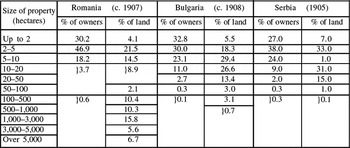
According to Lampe and Jackson, the structure of Balkan landownership at the beginning of the twentieth century was as follows:
Land tenure in Serbia, Bulgaria and Romania at the beginning of the twentieth century.

Footnote 18 Footnote 19 Footnote 20 Footnote 21
Serbian and Bulgarian agriculture were, thus, dominated by the small peasant property. Before acquiring autonomy and subsequently independence from the Ottoman Empire, Serbia and Bulgaria had been integrated in the Ottoman timar system of land tenure, which resembled in some respects the European feudal system, but also differed from it in important ways. The timar system was predicated on providing Ottoman military with non-hereditary grants of land in exchange for military service, while the land itself belonged to the Sultan. The timar holders could not sell or otherwise bequeath the land onto their offspring, and merely levelled taxes on the local peasantry. By contrast, the peasantry, who were not owners of their land, had hereditary rights attached to it and could even sell it with the permission of the timar holder. As Nina Kršljanin has shown in the case of Serbia, this in itself amounted to a paradoxical situation whereby ‘the serf seemingly had more rights to his land than the feudal lord’.Footnote 22 Gradually the timar system was replaced by the more oppressive chiflik system, in which the previous timar holders acquired hereditary rights to the land and could exact labour dues from the peasantry.Footnote 23 The nineteenth century saw the gradual dissolution of the chiflik system in both Serbia and Bulgaria as part of the national struggle for independence.Footnote 24
Moreover, the two Balkan countries relied on cattle breeding rather than grain, unlike Romania, which completely did away with cattle growing and geared its entire economy towards producing and exporting grain. These considerations paradoxically make the comparison between Romania and its fellow post-Ottoman Balkan states the least revealing in the context of this cross-border comparison. A look at the geography of Bulgaria and Serbia tells us that they could never have engaged in the kind of extensive grain cultivation Romania did. Given the hilly and mountainous relief that dominated their territories, the two states of necessity concentrated on cattle growing, although Bulgaria did have a stretch of fertile plains along the right bank of the Danube River. Romania's territory was, by contrast, dominated by fertile plains, which were eminently suited to land cultivation. The state, as we shall see further on, became the victim of its own richness: the great Romanian landowners made the conscious decision to practise extensive mono/biculture agriculture rather than diversify: local and regional initiatives to diversify crops failed to resonate with central authorities and to result in a change of agricultural strategy.Footnote 25 The great landowners in Romania went for profit at all costs, which were then shifted on to the peasants. It was the landowners’ greed as well as their disinclination to modernise and diversify that turned the screw on the Romanian peasants.
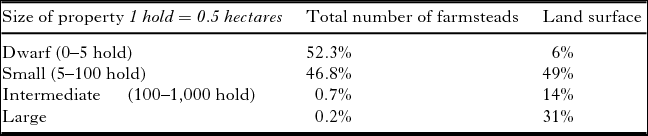
A basic polarisation of land division between small property and great property is evident in both Romania and Austria-Hungary. According to 1895 statistics, in the Hungarian half of the Habsburg Monarchy land had the following distribution:Footnote 26
Land tenure in dualist Hungary in 1895.

Within the vital category of small properties (5–100 hold), properties of 5–10 hold represented 9% of all property land, those of 10–20 hold – 14%, those of 20–50 hold formed 16% of the land, and those of 50–100 hold – 6.55% of the total land.Footnote 27 This meant that half the landed properties were small and they took up half of the agricultural land; the other half were dwarf properties (and landless peasants), but they only cultivated 6% of the arable land; while the large and intermediate properties represented barely 1% of the properties and yet occupied 20% of the land. In the Transylvanian borderland 45% of the population owned 5.3 hectares of land per family in the post-emancipation period.Footnote 28
In Austrian Bukovina, a mountainous, thickly-wooded province, with minimal arable land, land tenure was dominated by forestry and the property distribution, according to 1907 statistics, was as follows:Footnote 29

Across the border in Tsarist Bessarabia, by 1909 cultivable land was split between peasant tenure (48.6%), the large property (mainly native boyars but also non-natives, who received grants of land for services done to the Tsar), who held 43.2% of the arable land, and state, church and other institutions (8.2%).Footnote 30 Following the peasant emancipation of 1869, Bessarabian peasants received between eight and thirteen desiatins (one desiatin = 1.09 hectares) of land.Footnote 31 This was a generous endowment given that, at the time, 5 hectares of land were considered the minimum for subsistence cultivation. Owning enough land to make ends meet meant that the Bessarabian peasants were much less likely to be dependent on the great landowners and stood a better chance of being self-sufficient.
Emancipation from serfdom – the small script
There were fundamental distinctions in the systems of land tenure around the multiple frontier and they had to do with the way in which peasant emancipation was effected in each country. Serbia and Bulgaria form a special case, as the Ottoman system of land tenure was different from that of European serfdom. In its final stages, as the timar system gave way to the chiflik system, there appeared more similarities with the European counterpart of Gutherrschaft: Ottoman janissaries accumulated land and forced the peasants to pay high rent and provide kuluk, that is, mandatory free labour in exchange for using the land).Footnote 32 With the acquisition of autonomy and then independence from the Ottoman Empire, land tenure was purged of the superimposed stratum of Ottoman landlords and consisted only of independent peasant land holdings. In Serbia, for instance, amidst fears and rumours that the Ottoman system would merely be replicated with Serbian, instead of Ottoman, landlords, land reform legislation emphatically stipulated the impossibility of a return to the timar system under any guise.Footnote 33 Thus, because peasant emancipation in the two Balkan states was bound up with the struggle for national independence, the result was a clean cut from the old system of land tenure and the removal of the entire class of great landowners. As the young states came into being, there was no longer a reactionary stratum of great landowners who would seek to protect their vested interests at the expense of the peasantry.
In Austria-Hungary emancipation took place following the 1848–9 revolution and had the explicit aim of creating a self-sufficient, self-standing peasantry; in Tsarist Bessarabia, owing to the tug-of-war between imperial authorities and provincial elites, land reform was introduced against the wishes of the great landowners and for the benefit of the peasantry; in Romania emancipation was warped from the very beginning as, under the appearance of empowerment, it tied the peasant to the land and to the former landowner. This initial design of the reforms translated into different geographies of land exploitation.
As we have seen in the previous section, all around the triple frontier between Austria-Hungary, Tsarist Russia and Romania the majority of peasant population had up to 5 hectares of land. This applied to Tsarist Bessarabia as well, where, although the initial distribution was generous (between eight and thirteen hectares), by the turn of the century some properties would have inevitably dwindled to the minimum of two hectares stipulated by the emancipation law.
The basic differences lay in the terms of land ownership and the vital extras without whose availability peasant tenure could not be truly self-sufficient and independent: access to pastureland, watering places and forest. In Austria-Hungary peasant emancipation presupposed full land ownership (freedom to sell or mortgage), which in itself could be a double-edged sword: it could help peasants take out loans and invest in better agriculture or, and this happened all too often, get hopelessly into debt, sell off and become landless and pauperised.Footnote 34 In Tsarist Bessarabia the land distributed through the 1869 land reform was inalienable, it belonged to the commune and could only be moved around within the commune. Emancipatory legislation prevented the hereditary atomisation of peasant property and some peasant categories such as the răzeși introduced their own rules (the minorat, or bestowing the whole land to the youngest male heir) to prevent land fragmentation and consequent impoverishment.Footnote 35 In Romania the law of 1864 stipulated that the peasant could not sell or take out a loan on his land for a period of thirty years. In 1884 the constitution was modified so the period of inalienability was extended by another thirty-two years.Footnote 36 This stipulation only went out of use in 1929.Footnote 37 In the Serbian case, protective legislation such as the law of the minimum homestead worked in the same direction of preventing the atomisation of peasant land, although peasants still found ways around it and got into debt at the hands of usurers.Footnote 38
Irrespective of the variety of combinations obtaining around the frontier in the systems of land tenure (full ownership versus limited ownership, with or without redemption dues, smaller or bigger plots of land), one of the vital differences between explosive Romania and the comparatively peaceful imperial borderlands surrounding it was access to pastureland, watering places and forest. While seldom smooth and unproblematic in practice, access to these three resources was legislated in both the Austro-Hungarian and the Tsarist borderlands. By contrast, in Romania pasture and forest remained overwhelmingly in possession of the great landowners and was the lynchpin of the exploitative system of land tenure that led to the 1907 peasant uprising.Footnote 39
As one of the Romanian political leaders in Transylvania, Dr Parteniu Cosma, President of the Romanian National Party in Hungary and director of the Albina Bank in Hermannstadt (Sibiu), put it in the wake of the Romanian peasant troubles of 1907:
one cannot cultivate land without livestock and without a house and economic appurtenances. You cannot build a house and live in it without wood for timber and fire. You cannot keep livestock without pastureland. [In the case of Romania] these have remained in possession of the former landowner, who will continue to exploit the peasant as he likes.Footnote 40
By contrast, common forest and pastureland played a central role in Hungarian agriculture. According to Hungarian agricultural statistics dating from 1900, in Transylvania 52.3% of total forestland and 55.9% of total pastureland were common land, while in the Banat 17.7% of forestland and 62.7% of pastures were for public use.Footnote 41
Similarly, in Tsarist Bessarabia, access to forestland contributed to a more bearable condition of the peasantry, the province being one of the few Tsarist provinces that had a share of the meagre 8% of Tsarist Empire peasants who could comfortably live off their land.Footnote 42 The land reform law of 1869 stipulated that, although forestland was not included in the redistribution,
land covered by shrubs and bushes, meadows and pastures, which the peasants had been using according to old custom, remained in peasant possession. In the plains the land covered by reeds and thatch, from where the peasants got their fuel, remained the property of rural communes. . . . The land reform law also stipulated that watering places for cattle such as ponds, streams, ravines, wells and springs, constituted communal property of the landowner together with the village community. In case the landowner wants to keep them for himself, then he will have to provide at his own cost other watering places for peasants’ cattle and these places must be located as close to the village as those he kept for himself. Should these new watering places be farther out, then they must be separated out from pasture land and fields, making good roads across private property for villagers’ cattle to pass.Footnote 43
By 1919 Bessarabian ‘peasant fraternities owned about 10% of the forests’.Footnote 44
Power dynamics
The terms of peasant emancipation depended to a considerable extent on the hierarchies of power in place in the countries around the frontier as well as on the presence or absence of an imperial centre. On the whole, the peasants in the Austro-Hungarian borderlands gained, in an indirect way, from being part of the empire and from the general political friction of nationality politics. For instance, one of the consequences of the national struggle between Hungarian and non-Hungarian political elites was the creation of a network of national banks.Footnote 45 In the same way, Bessarabian peasants benefitted from the tug-of-war between provincial elites and the imperial centre in St Petersburg. Similar to the terms of the land reform, which were clearly laid down in the peasants’ favour, litigations between peasants and local potentates often were resolved in favour of the former. As an imperial borderland, Bessarabia had different rural dynamics than regions in the hinterland of the Tsarist Empire, the default reaction of Tsarist central authorities being that of stabilising the province and not antagonising the local peasant population. In the case of both the Austro-Hungarian Empire and the Tsarist Empire, the imperial centre acted as a moderating influence on regional power dynamics in its borderlands and kept in check or curbed the exploitative tendencies of the regional elites. This was not the case in the fledgling Kingdom of Romania, where the acquisition of state independence meant all the power was now concentrated in the hands of the great latifundia owners turned statesmen, who legislated and ran the country in accordance with their economic and personal interests, with no higher agency to hold them to account. As a Romanian county prefect admitted in private conversation in 1900, ‘in our country the interests of the great landowners do not allow for the emancipation of the peasantry’.Footnote 46 The only time that Romanian boyars had to negotiate the legal terms of their relations with the peasantry was under Russian occupation in 1831–2, when Count Pavel Dmitrievich Kisseleff, the Russian governor who was in charge of the Principalities, endeavoured with limited success to mitigate some of the most exploitative aspects of the Organic Statutes proposed by the great Romanian boyars.Footnote 47
Bulgaria and Serbia provide us with a third variation on imperial power dynamics, which is specifically Ottoman. As part of former Pashaliks, Bulgaria (autonomous since 1878, independent from 1908) and Serbia (autonomous since 1830, independent since 1878) had had their noble elites sidelined or altogether removed by Ottoman rule. In Serbia, the power of the local elites, the knezevi, was curbed following the two Serbian uprisings against Ottoman rule at the beginning of the nineteenth century. Under the leadership of Miloš Obrenović, ‘in the 1820s the knezevi tried to amass land and demand labour services from the peasants’, but were prevented by Obrenović, who wished to retain his monopoly on power and who also proceeded to abolish the Ottoman feudal rights of the Sipahis. As Michael Palairet has pointed out, ‘these measures prevented the emergence of large-scale landed estates, so the Serbian state came to rest on small-scale peasant landownership’.Footnote 48 Serbian state-driven economic policies kept agriculture to an underdeveloped subsistence level, but were ‘not intentionally repressive towards the peasantry’.Footnote 49 The Serbian peasantry mattered to such an extent that the saying went that ‘it was possible to rule against but not without the peasants’.Footnote 50
In Bulgaria a strong peasant movement coalesced at the end of the nineteenth and beginning of the twentieth century, giving voice and channelling much of the existing peasant discontent. A tithe imposed in the early 1900s triggered widespread peasant protests to the effect that northern Bulgaria was placed under martial law and clashes with the peasants resulted in almost one hundred dead and several hundreds wounded. The protests never spread out to engulf the whole country, although they did occasionally reoccur. The leaders of the Bulgarian agrarian movement generally tried to keep protests peaceful and to use legal channels.Footnote 51
Romania, by contrast, had never been divested of its political elite by Ottoman rule and this was due to the special status of the Romanian Principalities within the Ottoman Empire: just like Egypt, the Romanian Principalities retained their autonomy while being under the suzerainty of the Ottomans. This meant that historical elites remained in place and domestic affairs were not impinged upon as long as the demanded tribute kept flowing to Constantinople. It was not until after the First World War that Romania would get its first peasant party, although some feeble attempts dated back to the 1890s.
The different architectures of power in which these political elites were embedded also shaped their response to the commercialisation of agriculture. This response was, as Barrington Moore argued, ‘critical in determining whether or not there was large-scale unrest’.Footnote 52
Leasehold systems
Literature on the Romanian peasant uprising as well as contemporary testimonies point to the system of large-scale land-lease as one of the main causes of peasant discontent.Footnote 53 In Romania this system proliferated to cancerous proportions and was instrumental in the ruthless exploitation of the peasant population. Great estates took up almost half the cultivable surface in Romania and were in their majority rented out to big capitalists. In Moldavia, where the uprising started, the estates were monopolised by capitalist entrepreneurs of Jewish faith. They amassed so much land and were able to dictate prices and wages to such an extent that the best part of the province came to be referred to as ‘Fischerland’ (the land dominated by the Fischer brothers). Countrywide, the leaseholders were not exclusively Jewish, but rather a medley of nationalities and confessions. Some were Romanian citizens, others were not.Footnote 54 In southern Romania, in Wallachia, the leaseholders were mostly Greek, Armenian and Romanian. According to G. D. Creangă, in Romania the property over 50 hectares was leased out in proportion of 56.9% and the number of leaseholders who rented estates of over fifty hectares, was 3,332. Out of these, 2,417 were Romanian; 443 were foreign citizens; and 472 were Jews.Footnote 55 In this context the ‘Jews’ category does not refer to foreign nationals of Jewish faith, but to Romanian subjects of Jewish faith, who were at the time debarred from Romanian citizenship.
The oppressive feature of the system resided not in the predominance of the leasehold system or the percentage of foreigners or Romanian subjects of Jewish faith among the leaseholders, but in the set of practices that defined the rental system and the legal framework it was embedded into. As contemporary authors pointed out, exploitative practices were common to all leaseholders, irrespective of their nationality or religion.Footnote 56 Notwithstanding the competition between foreign and autochthonous capital and the chicanery between landlords and leaseholders, when it came to dealing with the peasants, they all acted in the same way:
Leaseholds are numerous in those counties where the landed property belongs to a small number of people, who cannot themselves cultivate it, or where the number of peasants who do not have enough land is so high that they are forced to pay any rent in order to get more land. This critical situation is exploited by leaseholders and entrepreneurs, in that they persuade the landowners to lease out their land to them for higher rent; then they seek to extract this land rent twofold or threefold from the peasants, forcing them to ever more onerous agricultural contracts, which brings the leaseholders a profit of 100%–200%.Footnote 57
Leaseholding across the frontier
As pointed out earlier in this article, Romania differed radically in this respect from its Balkan neighbours, Serbia and Bulgaria. South of the Danube there were no latifundia and, as a result, no large-scale leaseholding. Cultivation was therefore dominated by the small peasant property. Romania evinced more similarities with the imperial borderlands to the east and west, leaseholds being present in both Habsburg Hungary and Tsarist Bessarabia. However, in neither of the two neighbouring countries did the leasehold system result in colonial exploitation of the peasantry and explosive social relations. If the system was not in itself extractive and oppressive, what were the features that rendered the Romanian brand of land leaseholding so toxic and socially combustible?
In Hungary the haszonbéres or leaseholding system mainly affected the great property, which was concentrated in central and western Hungary, while large-scale leaseholding was rare in the eastern borderlands. According to the map of land tenure in Transylvania published in Magyar Korona országainak Mezőgazdasági Statisztikája for the year 1900, the land renting system (haszonbéres/Pacht) was minimal with a predominance of small property. Although great and middle property varied much throughout the region, they never went beyond one third of the property. Transylvania is described in these statistics as dominated not by cultivable land (Ackerland) but by meadows, pastureland and especially woodland.Footnote 58
In Hungary leaseholds dated back to the early nineteenth century and started out as investments made by big merchants, who sold the produce of the rented estates. The nature and extent of Hungarian leaseholds underwent vital changes after the emancipation of the peasantry. Peasant emancipation made leaseholding a necessity for many, even big, landowners, who had lost their serf workforce and were in ever-greater need of money.Footnote 59 This is reflected in the comparatively low percentage of pure leaseholds (as opposed to mixed leaseholds), the average being around 25% of the land in 1895, while in 1911 latifundia were rented out in proportion of 36.8% and 47% of their income came from rentals.Footnote 60 The usual procedure was for the landowners to lease out part of their land while retaining some for their own usage. Cases where whole estates were rented out were rare and occurred when the owner happened to be under-age or, if of age, engaged in a profession, or if there were several owners who did not want to divide the land. Integral rental was more often than not a sign of social downfall as with members of the middle gentry, who were more likely to lease out their estates and live off the rent, squandering it, getting into debt and eventually losing their estates altogether.Footnote 61
While there was countrywide variation in technology and cultivation, leaseholds in Hungary do not seem to have had the bad fame that they had across the border in Romania. Whereas authors like Zoltán Kaposi, who concentrated on the special case study of the large estates owned by Austrian or German citizens in South Transdanubia, have pointed out that the best improvements were made and model agriculture was conducted on those estates that were cultivated by their own owners,Footnote 62 others such as Julianna Puskás invoked 1895 Hungarian statistics that showed that, countrywide, leaseholds were better equipped with machinery and used more modern tilling techniques.Footnote 63 Kaposi also points out that leasehold contracts in South Transdanubia were very explicit in terms of cultivation and crops to be grown by the leaseholders, which shows that, even if rented, the land and its exploitation continued to be controlled by its lawful owners.
In Romania leaseholding was a ruthless extractive system. Most lease contracts were for a period of three to five years, and never for more than twelve years. Hereditary leaseholds were rare. This in itself was a disincentive to make any investment as the contract period was too short to see it pay off. More egregiously still, the actual leasehold contracts actively discouraged such initiatives by stipulating that all investments would remain part of the estate and the leaseholder would not be able to redeem them at the end of the contract.Footnote 64 The obstacles placed by the great landowners in Romania on investment into agricultural modernisation as well as the short duration of the contracts were instrumental in shaping Romanian land tenure relations in this period and defining its exploitative character. In the words of Radu Rosetti, this resulted in a general tendency among leaseholders in both Moldavia and Wallachia ‘not so much to exploit land intensively as to exploit the peasant completely. The first priority of landowners and leaseholders today is to figure out how much work they can extract out of the peasant without paying for it, only speculating the peasant's need for 1. pastureland; 2. land for food; 3. woodland.’Footnote 65
The rapid succession of leaseholders and the auction-like system of securing a leasehold (the estate going to the highest bidder, with leaseholders outbidding one another) resulted in a spiraling increase of land rent for the peasants. Thus a 1907 inquiry into the level of land rent paid on 142 estates out of 210 concluded that between 1870 and 1906 land rent had increased to between 150% and 500%.Footnote 66 This was not accompanied by a commensurate increase in the level of work payment or by a change in the style of agriculture practised. There was, moreover, no legislation that precluded such rampant exploitation.
Tsarist Bessarabia provides us with a further element of contrast to the Romanian case. Leaseholds were quite common in Bessarabia. Foreign monastery lands, for instance, were leased out but usually to the local peasants rather than to big capitalist entrepreneurs and the lease contracts were tightly regulated. As regards Jewish would-be monopolies of leaseholds, more research needs to be done in this regard, but the available data so far points to the fact that there were quite a few Jewish leaseholders in Bessarabia as the restrictions against Bessarabian Jews were by no means watertight. Interdictions to settle in rural areas, to buy or lease land, or to reside in border areas were the subject of negotiation and bribery, and the Jews constituted a valuable source of illegal income for the local administration and for the meagrely paid police.Footnote 67 Jews took land on lease by means of proxies and the Bessarabian landowners, even the most anti-Semitic, were only too willing to lease their estates to them. The tendency was not, however, to accumulate land, but rather to cultivate intensive crops such as vine growing, tobacco and fruit trees.Footnote 68
Unlike Hungarian leaseholds, which tended to be hereditary and progressive in their methods of cultivation, Bessarabian leaseholds had as bad a name as their Romanian counterpart: although more often longer term than leaseholds in Romania, Bessarabian estate rentals were equally wasteful and neglectful, as emphasised by Count Urusov, the governor of Bessarabia between 1903 and 1904:
In Bessarabia an estate is a share of land stock yielding a large dividend and easily transferrable, a marketable commodity circulating among enterprising persons owing to the rapid upward movement in the price of land. . . . the frequently changing chance tenant avoids investing his capital for making improvements on the land of another. He carries on his farming in a rapaciously wasteful manner, and at the expiration of his lease he returns the estate to its owner in an exceedingly ruined condition. Bessarabian landowners very often lease their land for long terms without incommoding the tenant by making his tenure conditioned on his cultivating the land with his own stock, on the use of fertilizers or, in general, on the adoption of any definite agricultural system. The Bessarabian tenant is therefore not so much a farmer as he is a middleman and a responsible agent for subletting separate sections of the estate to the neighbours in need of land. His object is to get, during his lease term, a maximum amount of differential rent from his peasant sublessees. Such use of land on lease cannot deserve encouragement in any respect. The estates in such cases deteriorate, the relations with the neighbours become still worse and, therefore, most cases of agrarian friction usually centre around lands held on long-term leases by separate persons.Footnote 69
There were similar attempts to capitalise on peasant indebtedness to secure workhands for agricultural labour and this led to rural tensions and local conflict,Footnote 70 but these incidents never escalated into a province-wide conflagration. This was owing to a combination of factors that were present in the Bessarabian case and completely absent across the border in Romania. As pointed out earlier, Bessarabian peasants had more land at their disposal than their Romanian peers to begin with and, because of the checks in place, land fragmentation occurred at a slower rate. Most importantly, Bessarabian peasants had access to pasture and forest and as such stood a better chance of being self-sufficient and independent of the great landowners. As Arbure, the author of a late-nineteenth-century monograph on Bessarabia, showed, Bessarabian peasants were, on the whole, much less likely to sell their labour in exchange for more land or pasture.Footnote 71 This was in stark contrast to the vulnerability and utter dependence of Romanian peasants on the great landowners or their exploitative leaseholders. In addition to a more peasant-favourable attitude on the part of the Tsarist authorities, in Bessarabia there was also the possibility of intra-imperial emigration, which was actively encouraged in the Tsarist Empire. Although internal mobility was relatively high in Romania, with substantial workforce migration between counties, emigration abroad was virtually non-existent.Footnote 72
Anti-Semitism
There were Jewish leaseholders in Romania, in Austria-Hungary and in Tsarist Bessarabia. Because they had access to substantial capital, they usually rented the largest estates. This was carried out legally in Austria-Hungary and Romania and illegally in Tsarist Bessarabia, reflecting the respective status of the Jewish communities around the triple frontier: full emancipation with full rights of buying and leasing of land in Austria-Hungary, lack of emancipation in Romania with a lesser status which precluded Jews from buying land but not from renting, and oppressive lack of emancipation in Russia, where neither rental nor purchase of land by Jews was legal and where even the deeply anti-Semitic legislation in place was considered too lenient by Tsarist authorities.Footnote 73
Irrespective of the legislation in place, diffuse peasant anti-Semitism was present throughout the provinces that formed the triple frontier between Romania, Austria-Hungary and Bessarabia. In the context of chronic lack of cheap rural credit, the root of rural anti-Semitism lay in the conflation between the negative effects of the new money economy on the village world and Jewish money-lenders and publicans. The extension of the franchise in the Austrian half of the Habsburg Monarchy in 1906 further fuelled anti-Semitism, which came to be used as an effective political weapon and mobilisation strategy.Footnote 74 In Romania, where franchise was limited, there had been a strong anti-Semitic discourse in place ever since the middle of the nineteenth century, as emancipatory legislation became a condition for the international recognition of the Danubian Principalities and later on of the independent Romanian state.Footnote 75 Russia was, by far, the most openly anti-Semitic of all the countries around the triple frontier and Bessarabia in particular acquired tragic notoriety for two pogroms that took place in the early 1900s in its capital Kishinev. It is important to stress, however, that these pogroms were a fundamentally urban occurrence, had nothing to do with land tenure relations and did not extend into the countryside; they were the consequence of local nationalist press instigation, criminal tolerance and belated reaction on the part of the authorities. The handful of Jewish agricultural colonies, concentrated mainly in northern Bessarabia, were never affected by pogroms.Footnote 76 Even the much-maligned Jewish leaseholds in Bessarabia were much less instrumental in exploitation and rural unrest than their counterparts in Romania. As Count Urusov testified:
A Jewish tenant runs his farm business in such a way as to avoid any friction with neighbours, and affords no ground for litigation and disputes, endeavouring to settle every difficulty in a peaceful way without resort to the courts or the authorities. A Jew will not collect his debts by such methods as seizing the grain in the stacks, selling his neighbour's property, and the like. He bides his time, jogs the debtor's memory, chooses the right occasion, and gets his bill without the aid of the police or the sheriff. He does not mar the mutual relations of owner and neighbour, and creates no basis for disputes and hostility. On account of all this, I have for example never received or heard any complaints from the people of the province against Jewish tenants.Footnote 77
Regarding the 1907 peasant uprising in Romania, there was an apparent anti-Semitic dimension to it as the troubles started on estates rented out to Jewish leaseholders. However, it was not the anti-Semitism of the peasants, who were fundamentally after more land and fairer work contracts, which fuelled the uprising; it was rather the anti-Semitism of the local authorities, whose delayed reaction allowed the localised disturbances to gain momentum and spread out. Further proof that the uprising was not essentially a pogrom was the fact that the worst violence occurred not in north-eastern Romania, where Jews made up 10% of the population, but in the southern regions, where there were hardly any Jews.Footnote 78
On the whole, it seems that anti-Semitic feeling was in some cases an aggravating circumstance, but definitely not the main motor and cause of peasant unrest in any of the borderland provinces around the complex frontier under discussion.
Additional factors
Patterns of land tenure and the terms of land reform policies were, of course, not the only factors that made the difference between peaceful attempts to address and redress inevitable problems and frictions, on the one hand, and generalised, all-out violence, on the other. A country's policing infrastructure and capabilities as well as the burden of taxation and the existence of much needed safety valves such as emigration and community strategies for preventing land fragmentation also played an important role in this dynamics of rural combustibility. For reasons of space, the present article has concentrated mainly on land tenure and the system of social relations this was embedded into. This research is part of a broader project looking at the interconnection of peasant violence and anti-Semitism in the borderland region of the three empires.Footnote 79 In this project I address at length the administrative underpinnings of the region and how they contributed to containing or, conversely, fostering peasant unrest. Thus, in Romania, local administrative corruption and a very feeble rural policing system allowed simmering unrest to boil over into general uprising.Footnote 80 By comparison, the Austro-Hungarian borderlands were much more effectively policed and the feedback loop of complaint and redress functioned more smoothly. While more research needs to be done on the policing system of Tsarist Bessarabia, as regards the Balkan states, the available literature shows that Serbia was much more strongly policed than its Balkan peers and Bulgarian state infrastructure evinced similar weaknesses to that of Romania.Footnote 81 While state infrastructure and administrative capacity were important in containing unrest, their potential malfunctioning does not by itself explain the existence of widespread peasant discontent, likely to go ablaze on the least provocation.
Conclusions
This article has sought to provide a structural, comparative explanation of the unequal spread of large-scale rural violence across the complex frontier between two empires, Habsburg and Tsarist, and the fledgling states that emerged out of the Balkan fringes of the Ottoman Empire: Romania, Bulgaria and Serbia. This cross-border comparison allows us to assess the role in fostering conflict played by structural factors such as patterns of land tenure, size of land for the average peasant, literacy rates, initial terms of emancipation, and land exploitation techniques (subsistence farming, lease holding). The picture gained is not a black-and-white one, and comparative poverty and underdevelopment were to be found all around the complex frontier. The peasantry in Romania were decidedly worse off than their peers across the border, but one would be hard pressed to find a peasant utopia in any of the countries bordering on Romania. When does rural poverty become combustible? What does the turn of the screw consist in? The present article has argued that, despite skin-deep similarities, the vital differences consisted in, first, the initial terms of peasant emancipation legislation and whether or not these made subsistence farming possible or, on the contrary, created oppressive debt bondage by lack of access to basic resources (pasture, water, forest); and, secondly, the existence of a complaint-and-redress loop or, alternatively, limitations on great landowner power and leverage. The article has also contended that practices such as the large-scale land lease, which was traditionally considered to be the main cause of rural exploitation in explosive Romania, were not in themselves deleterious or conducive to large-scale exploitation and discontent, but only in conjunction with the above-mentioned factors.
Acknowledgements
This article is part of a broader project looking at the percolation of rumour and violence across the triple frontier between Austria-Hungary, Tsarist Russia and Romania between 1880 and 1914. I am much indebted to the Leverhulme Trust in the UK for generous funding for this project between 2013--16 as part of the Leverhulme Early Career Fellowship Scheme. I would also like to thank Professor Keith Snell and the anonymous referees of Rural History for their constructive comments and suggestions, which added much value to the present contribution. Thanks are also due to the organisers and participants of the conferences where earlier drafts of this article were presented and important feedback was received: the Telciu Summer Conference in Romania as well as my co-panellists on the Rural History conferences in Girona and Valencia, Professor James Simpson, Professor Juan Carmona, and Professor Sokratis Petmezas. I am particularly thankful to Dr Daniel Brett and Dr Nina Kršljanin for sharing their research and ideas with me.