Introduction
The continuing effects of the Great Recession have led many states to consider making radical changes to their economic policies. One such change is the elimination of the state-level income tax. In 2013 alone, Nebraska, Kansas, North Carolina, Louisiana and Oklahoma considered eliminating their state income tax, whereas Missouri and Indiana considered making dramatic reductions in their state income tax rates (Blanton 2013; Hammel 2013; Lehrer 2013). In 2014 and 2015, other states such as Ohio, Arizona, Maine and South Carolina (Brown Reference Brown2014; Higgs Reference Hu and Young2014; Sanchez and Rau Reference Sasser2014; Sinquefield Reference Sinquefield2015a, Reference Stone2015b) joined in the conversation. Faced with continued shortfalls, however, other states are considering raising taxes. Notable among these are the following: Illinois, which is considering moving from a flat tax to a progressive tax that would increase taxes for the majority of taxpayers (Malm Reference Merryman2014); New Jersey, which is reconsidering a so-called millionaires tax (Hanna Reference Herz2014); Minnesota, which added an additional tax bracket on its highest earners (Stone Reference Tach and Halpern-Meekin2014); Pennsylvania, which is considering increasing income taxes by more than 40% (Levy Reference Macek, Khattak and Quercia2015); and Alaska’s plan to adopt a personal income tax (Herz Reference Higgs2016).
Understanding how tax policy affects revenues, migration and growth is critical to determining whether policy changes should be made. Standard economic theory suggests that subnational (i.e. state) income taxes negatively influence migration as well as economic growth, and that subnational governments are limited as to how much re-distribution they can successfully engage in (Oates Reference Pazniokas1968; Musgrave Reference Oates1969), especially if their high-income earners are mobile (Wildasin Reference Wildasin1993). The theory suggests that this kind of re-distribution creates “adverse locational incentives” and drives the wealthy away while attracting lower-income populations (Wildasin Reference Wildasin1993, 51). However, although the theory is clear, the evidence supporting it is mixed and inconclusive.
There are many reasons why the empirical evidence is inconclusive. For one, the results of the populations most often studied (the elderly or the extremely affluent) are not generalisable to the larger population. For another, the magnitude of the policy change is not always sufficient to generate a capturable effect. Many of these challenges are overcome in this study – an analysis of the adoption of a state income tax by Connecticut in 1991. This policy change serves as a natural experiment because Connecticut is the first state in almost 40 years to completely overhaul its tax policy and because the change is large enough to affect the population as a whole. In addition, Connecticut is situated in the densely populated north-east corridor. This likely translates into citizens with higher migration elasticities because residents are not limited to living in just one area of the region.
This analysis comprises five years of migration data leading up to, and nine years of migration data following, Connecticut’s adoption of the income tax, the period 1986–2000. It examines all domestic migration data at the county level in Connecticut, Massachusetts, Pennsylvania, New Jersey and New York, thereby expanding the scope of the previous literature, most of which is focussed on specific populations that presumably are more mobile, such as the wealthy and the elderly. This analysis benefits further from the fact that the data are from metropolitan New York City, an area that has been identified as having a particularly mobile population. A great deal of the area workforce is commuter workforce. In fact, this region has some of the highest commuter times in the nation. In 1995, the average commute in the United States was 20.7 minutes (Hu and Young Reference Jacklin1999), whereas the average commute in the New York consolidated metropolitan statistical area (CMSA) was 32.37 minutes (Macek et al. Reference Madden2001). This trend continues, and the areas surrounding New York City still have the longest commuting times in the country (Roberts Reference Rork and Wagner2011). Thus, the region presents greater opportunities for low-cost migration. In addition, New York, New Jersey and Connecticut top the list of states in which citizens feel that their state taxes are too high, and Massachusetts is in the top ten (Saad Reference Saad2014a). Similarly, Connecticut, New Jersey and Massachusetts are in the top 10 states in which residents report that they would like to move (Saad Reference Sanchez and Rau2014b). This analysis thus addresses the question of whether Connecticut’s adoption of an income tax changed the migration patterns, incentivising current residents to exit the state and discouraging potential residents from entering.
Although standard economic theory suggests that people will migrate when their expected utility, often measured as income balanced by the cost of living, goes below what it would be elsewhere minus the costs of the move itself (Varner and Young Reference Varner and Young2012), the literature does not include consistent evidence that this in fact happens. Building on the existing theory and empirical analyses, I expect to find that Connecticut will experience increased emigration (departures), decreased immigration (arrivals) and decreased net migration after the 1991 adoption of a state income tax.Footnote 1 However, I expect that the effect will be greater on immigration than emigration because emigration based on taxes requires people to move who otherwise might not have moved, whereas immigration captures people who are more likely to be moving anyway and who, therefore, can examine their options, taking state income taxes into account. This expectation is consistent with the existing literature, which suggests that not as much emigration occurs as the theory predicts, in large part because emigration often requires changing jobs, and moving is very costly. However, if people are moving into an area and have a variety of substitutes, it is expected that the effects on immigration will be greater. Using a spatial error panel model (SEPM) with fixed effects, the results suggest that Connecticut’s adoption of an income tax did result in less immigration and lower net migration and no statistically significant effect on emigration. This research adds to the literature by examining how the public policy decision of adopting an income tax influences the location decisions of workers.
This article proceeds with a summary of the relevant literature on the relationship between subnational income taxes and migration. This is followed by background on Connecticut’s 1991 adoption of a statewide income tax that provides context on why and how Connecticut came to that policy choice. The article then lays out the hypotheses being tested and the methodology and data being used to test them. It concludes with a discussion of both the results and the potential policy ramifications.
Income tax and migration
The study of state or subnational income taxes largely falls into one of two categories: the ability of income taxes to affect income re-distribution and personal income and/or the impact of income taxes on migration; these streams of research are interconnected and are briefly discussed here. There is no consensus in the literature on the role that income taxes play for either of these considerations.
One of the reasons why Connecticut and other states have chosen to adopt income taxes is that they are considered more equitable; they are more progressive than other commonly used tax instruments such as sales taxes and property taxes. However, such regional measures are also presumed to be self-defeating. Not only does the theory suggest that the wealthy will emigrate and that the poor will immigrate (Oates Reference Pazniokas1968; Musgrave Reference Oates1969; Musgrave 1971), but also that this migration will create a void of high-skill workers, which will increase the wages of those positions and exacerbate wage inequality within the state (Feldstein and Wrobel 1998). Because of this migration, it is argued, re-distributive efforts should be done at the national, not subnational, level (Musgrave 1971; Feldstein and Wrobel 1998). A simulation study of migration elasticities finds that even with “modest migration elasticities, the costs of state-level redistribution are substantial … At higher migration elasticities, the costs of state action can be tremendous” (Giertz and Tosun Reference Goldstein2012, 23). There is no universal support for this view, however. Young and Varner (Reference Young and Varner2011) and Varner and Young (Reference Varner and Young2012) find that millionaire taxes, which are strictly progressive, are successful in addressing re-distribution and improving equity without causing wealthy residents to emigrate.
Moreover, within the rich literature on the effect of income taxes on economic growth and levels of personal income, the most common findings are that income taxes do not retard growth (Reed and Rogers 2004; Leigh 2008; Chernick 2010) and that, in some cases, progressive income taxes are associated with greater growth (Leigh 2008; Alm and Rogers 2011).Footnote 2
Although income taxes may create incentives for emigration, they also may finance government services that make maintaining one’s current residence more attractive (Thompson Reference Thompson2011). This in combination with the high cost of moving leads to the common, and counterintuitive, result referred to as the “same-sign problem” (Conway and Rork Reference Conway and Rork2006; Thompson Reference Thompson2011), the finding that taxes result in reduced immigration and reduced emigration, and thus prevent people from coming and going. Conway and Houtenville (Reference Conway and Houtenville1998) are among the first to identify the same-sign problem. Elderly migration was studied, carefully modelling amenities, and emigration was in keeping with their hypothesis that elderly will behave in keeping with the Tiebout (Reference Tiebout1956) hypothesis, but that immigration, which should have the opposite sign (as policies that attract should also help retain), had the same sign. This result reinforces the need to model immigration and emigration separately, as is done here.
Migration decisions
The decision of whether or not to move and to where is affected by many factors, and among them are employment opportunities, taxes, amenities and the tangible and intangible costs of physically moving. Furthermore, migration is apparently not an easy decision to make. The literature points to numerous reasons why migration is estimated to be inelastic: it is expensive to move (Wildasin Reference Wildasin1993; Thompson Reference Thompson2011), people do not want to have to change jobs (Winklemann and Winklemann 1998), people prefer shorter commute times (Kahneman et al. Reference Kennedy2004) and people have strong community ties they do not want to sever or abandon (Dahl and Sorenson 2010). As previously mentioned, many of these considerations are offset when the region under study is within the greater New York City area (Young and Varner Reference Young and Varner2011).
Many studies have found little evidence of tax policy affecting migration decisions (Day and Winer Reference Day and Winer2006; Liebig et al. 2006; Young and Varner Reference Young and Varner2011; Varner and Young Reference Varner and Young2012). A recent study examined the effect of the so-called millionaires tax on the most wealthy citizens of the state of New Jersey (Young and Varner Reference Young and Varner2011). The authors highlight that their study is an almost ideal test case because of the regional mobility in New Jersey and because the wealthy are presumed to have higher migration elasticities and to be more responsive to changes in tax burdens (Wildasin Reference Wildasin1993; Rork and Wagner Reference Saad2012; Afonso Reference Afonso2015). Young and Varner (Reference Young and Varner2011) use a difference in differences (DID) model to capture the effect of the millionaires tax on emigration, comparing those in the top 1% of earners with those within the top 5% of earners in the state. Those in the top 5% of earners are not responsible for paying the tax, but it is nonetheless expected that they will have similar responses to other policy changes happening within the state. They find a negative effect on migration in both treatment and control groups but, also, that the difference attributed to the millionaires tax did not lead to substantial, if any, emigration. Although that study focusses on just the wealthy – the most migration-elastic population – it provides a good comparison with the analysis undertaken in this study because of the regional advantages mentioned above and the use of DID statistical technique.
However, there are other studies that present findings more in line with the traditional view that people will move when the expected utility of living elsewhere surpasses the utility of living where they are and the cost of moving (Feldstein and Wrobel 1998; Feld and Kirchgässner 2001; Bakija and Slemrod 2004; Coomes and Hoyt Reference Coomes and Hoyt2008; Varner and Young Reference Varner and Young2012; Afonso Reference Afonso2015). Feld and Kirchgässner (2001) study the impact of income taxes on migration patterns within Swiss cantons, which are subnational units comparable with American states and local governments. They find that even after controlling for quality of infrastructure and private amenities, which people base their migration decisions on, their respective tax burdens do have an impact, especially for the wealthy. Afonso (Reference Afonso2015) looks at a highly mobile group of residents, military personnel, and finds that they do immigrate to low-income tax states and that the effect grows with the wage. This echoes previous findings that the wealthy have higher migration elasticities (Feld and Kirchgässner 2001; Giertz and Tosun Reference Goldstein2012).
Although the debate over the effect of taxes on migration decisions rages on, there is evidence that the mobility of a tax base also impacts tax policy. For example, Rork and Wagner (Reference Saad2012) find that states with larger elderly populations and with more high-income workers have lower top marginal tax rates because they are more mobile (higher migration elasticities).
Multiple state taxation
A difficult component in the study of the effect of income taxes and migration is how income is taxed in one state when it is earned in another. As mentioned above, in some states, this is largely a nonissue, but in Connecticut that is not the case. Living in one state and earning a wage or income in another can lead to taxation by multiple states: the state you live in and the state where you work. This is largely dealt with in one of two ways, reciprocity agreements and tax credits. Reciprocity agreements result in incomes being taxed as if the state of residence is also the state in which the income is earned. One of the primary reasons for reciprocity agreements is the notion that because both labour and capital have become more mobile, thereby increasing tax competition, reciprocity agreements help lower the incentives for neighbouring states to compete and prevent a race to the bottom (Rork and Wagner Reference Saad2012). Reciprocity agreements have been shown to have an impact on where people migrate within multistate metropolitan statistical areas (MSAs), although even without a reciprocity agreement people tend to choose to live in the state with the lower tax rates (Coomes and Hoyt Reference Coomes and Hoyt2008). In the region being studied here, only New Jersey and Pennsylvania have a reciprocity agreement.
The second way in which states try to avoid multiple state taxation is through the use of tax credits for income that has been taxed already by another state (see Goldstein Reference Greenblatt1991 for an in-depth discussion). All five states in this analysis have such tax credits in place, and Connecticut’s tax credit calculation is representative of that in the other states. The taxpayer calculates what percentage of his or her earned income is subject to another state’s income tax and then multiplies that percentage by his or her total Connecticut income tax liability. The taxpayer is then given a credit for either the Connecticut tax liability portion or the income tax paid to the other jurisdiction, whichever amount is smaller. In the case of income being earned in New York, because of the differences in tax rates, a taxpayer deducts the liability that would have been paid to Connecticut. [See Connecticut Department of Revenue Services (2013) for an example of this calculation.] The tax credit in Massachusetts and Pennsylvania is calculated the same way, except that neither calculation permits any city or local government income taxes to be considered, that is New York City’s income tax (Pennsylvania Code 2006; Massachusetts Department of Revenue 2013). New York and New Jersey, similar to Connecticut, allow the tax credit to apply to income taxes by local governments (New Jersey Department of the Treasury 2012; New York State Department of Taxation and Finance 2012).
Connecticut’s individual income tax
Connecticut adopted its state income tax in 1991 at an initial flat rate of 1.5% (which grew to the rate of 4.5% in 1992). Before 1991, the most recent adoption of a state income tax was by New Jersey in 1976 (Dye Reference Dye1999). That Connecticut is the only state to have adopted an income tax in almost four decades, combined with its location in a region with increased mobility opportunities, makes it an ideal case study for the effects of subnational income taxes on migration.
The adoption of Connecticut’s income tax
Connecticut’s adoption of an income tax in 1991 was not straightforward. Historically an anti-income tax state, Connecticut is one of only four states that never ratified the Sixteenth Amendment to the US Constitution, which authorised the federal government to tax individual income (Greenblatt Reference Hanna2013). During the late 1960s and early 1970s, as a wave of states adopted individual income taxes – Michigan and Nebraska in 1967, Maine and Illinois in 1969 and Ohio, Pennsylvania and Rhode Island in 1971 – Connecticut also attempted to do so. A state income tax policy was passed by the General Assembly in 1971 but was quickly repealed because of massive citizen protest and outcry (Foster Reference Geballe and Hall1991). Connecticut’s seemingly incomprehensible adoption of a state income tax has been characterised as resulting from “the severity of the state’s fiscal crisis, a self-confident, independent governor, and especially, fifteen years of determined and effective organizing by Connecticut progressives” (Rapoport Reference Remez2001).
In 1990, Connecticut was in the midst of a recession, and the poor economic condition of the state encouraged incumbent governor William O’Neill (Dem.) not to run for re-election. Governor since 1980, O’Neill had been a passionate opponent of adoption of an income tax policy (Madden Reference Malm1983). However, when his successor, Lowell Weicker (Indep.), assumed office in January 1991, the state was facing such a serious budget crisis that Weicker was confident that Connecticut was ready for an income tax policy. “‘A confluence of things is coming together that is making the budget situation in Connecticut as nightmarish today as it was wonderful in the 1980’s,’ said William A. McEachern, a University of Connecticut economist” (Johnson Reference Johnson1989). Proponents of the income tax policy found allies in unlikely places. For example, there was broad-based support from the business community: the Connecticut Business and Industry Association, the Insurance Association of Connecticut and the Greater Hartford Chamber of Commerce all endorsed the income tax (Uchitelle Reference Uchitelle1990; Remez Reference Roberts and Whited1991).Footnote 3
Nonetheless, the income tax policy was not initially well received in 1991: Democrats opposed it as not truly signalling tax reform, and Republicans opposed it on principal as a new tax (Kennedy Reference Keveney2003). The inability of the governor’s income tax plan to get passed led to a state shutdown (Keveney Reference Levy1991). Because of the shutdown and the governor’s persistence, it did eventually get passed, however, in August 1991. After initially failing to pass in the House on a vote of 81–69, it passed in the Senate on a vote of 19–18 and then passed in the house on a vote of 75–73.
Despite passage and subsequent adoption of the income tax, it did not have broad public support. Polls taken in late 1991 indicated that 65% of voters opposed the income tax, with even lower approval rates for the governor (a 68% unfavourable rating) and the legislature (77% unfavourable rating) (Jacklin Reference Jacklin1991a). During the largest protest rally in Connecticut’s history, drawing some 50,000 people, threats of violence were made to those elected officials who supported the income tax (Jacklin Reference Johnson1991b).
Even before the close of the 1991 calendar year, state lawmakers had passed laws to repeal the income tax, which were vetoed by the governor (Pazniokas Reference Rapoport1991), who had decided to serve for only one term and not run for re-election. Despite the public outrage, passage of the income tax did not appear to affect the outcome of the following election (Johnson Reference Johnson1992), and a decade later most elected officials were in favour of maintaining the income tax (Rapoport Reference Remez2001). However, a bloc of opposition remains, primarily among political conservatives who favour increased consumption taxes and not an income tax (Muska 2006).Footnote 4
Connecticut’s adoption of an income tax has not been reported on in the academic literature, but its impact has been considered by several think tanks and policy institutes. One such institute, the Yankee Institute for Public Policy, located in East Hartford, Connecticut, published a study in 2006 on what it viewed as the failure of Connecticut’s experiment with an income tax (Muska 2006). If the primary objectives of the income tax were to “fix” the state’s fiscal condition and lower other taxes to help grow the economy, it has failed, according to the institute, citing continuing deficits, increased tax burdens, ineffective spending caps, minimal job growth, high emigration, state budget increases and reduced median family income.
Another group, the Washington Policy Center based in Seattle, published an op-ed on Connecticut’s adoption and experience with an income tax during Washington State’s consideration of the same. The op-ed highlighted what the policy centre viewed as Connecticut’s loss of a competitive advantage for high-income workers due to its adoption of an income tax. “People are voting with their feet – and their U-Haul vans” (Cullen Reference Cullen2010). In addition, in response to a no-income tax state considering adoption, a third group, the National Taxpayers Union Foundation based in Alexandria, Virginia, conducted a study of the economic impact of income taxes by the six states that had most recently implemented one. Connecticut was used as an example for comparison (Dye Reference Dye1999). The study found that adoption of state income taxes increases the size of state government, retards growth of the state economy and lowers per capita personal income within the state. However, study data went only to 1992, meaning that Connecticut’s inclusion was somewhat inappropriate and was an anomaly showing none of the above relationships.
Connecticut and tax competition
The choice of Connecticut for this analysis was not based solely on the fact that it is the most recent state to have adopted an income tax; another consideration is that it is likely to engage in tax competition. Its neighbours, states such as New York, New Jersey, Pennsylvania and Massachusetts, compete with it and each other for residents. In fact, according to a recent study of migration patterns, 30% of people moving out of New York end up in New Jersey, Pennsylvania or Connecticut (Thompson Reference Thompson2011). Another study examining the potential effect of a millionaires tax in New Jersey characterises the area as an “ideal case study” because of the fact that people are able to move between states without severing their social ties and jobs (Young and Varner Reference Young and Varner2011, 260). The authors aptly point out that other states with high-income earners, California, for example, have fewer states to compete with because their metropolitan areas are usually not proximate to the borders of another state, and they argue that the “intangible costs” of leaving a state such as California are much higher than those in the New York metropolitan area (Young and Varner Reference Young and Varner2011).
Hypotheses and methodology
The conditions of this analysis present an ideal opportunity to capture the effect of an income tax on emigration and immigration. Connecticut’s adoption of a state-level income tax should have, according to standard economic theory, resulted in both increased emigration and reduced immigration,Footnote 5 especially in comparison with its closest geographic competitor states, New York, New Jersey, Massachusetts and Pennsylvania. The potential advantage that Connecticut may have had for attracting new residents before 1991 was forfeited somewhat, but only somewhat, because of the existence of income tax credits for income taxed by other states and the lack of reciprocity agreements in the region. Therefore, for example, a labourer who had been residing in Connecticut but worked in New York would not have been paying Connecticut incomes taxes but would have been paying New York income taxes on that portion of his or her income earned in New York. Nonetheless, I expect to see the adoption of a state income tax affect migration both in and out of Connecticut.
Hypotheses
My first hypothesis is that, after 1991, the rate of immigration into Connecticut will decrease compared with that of its neighbours. This decrease being the result of people moving into the region finding Connecticut less attractive than it had been, because of its increased tax burden. My second hypothesis is that, after 1991, Connecticut’s emigration rate will increase but that the magnitude of the increase will be small. This is because, as previously discussed, even though it is reasonable to believe that a higher rate of taxation will lead to the exit of labour from a state, there are many factors that make exiting a state costly, thus lessening this tendency.
The impact on immigration is expected to be higher because “[h]ouseholds moving to a MSA have less jurisdictional friction than existing residents, since, by definition, they are already moving somewhere and therefore are incurring the relevant transaction costs, like selling a house, finding a job, choosing schools, and leaving neighbors and communities” (Coomes and Hoyt Reference Coomes and Hoyt2008, 921). This study is particularly relevant because 31 of the counties in four of the states are a part of the CMSA that includes New York City. In addition, there is evidence that taxes do not cause emigration, but are factored into the decisionmaking of people already migrating (Thompson Reference Thompson2011). It should be expected, given both the evidence in the literature and the examination of costs, that immigration will be more affected than emigration. This suggests that net migration to Connecticut will fall after the adoption of the state income tax.
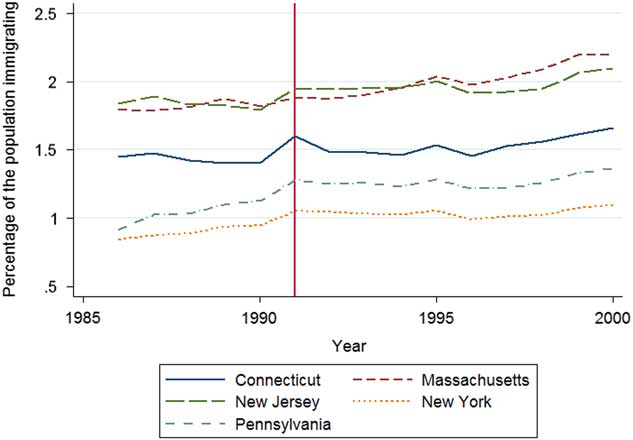
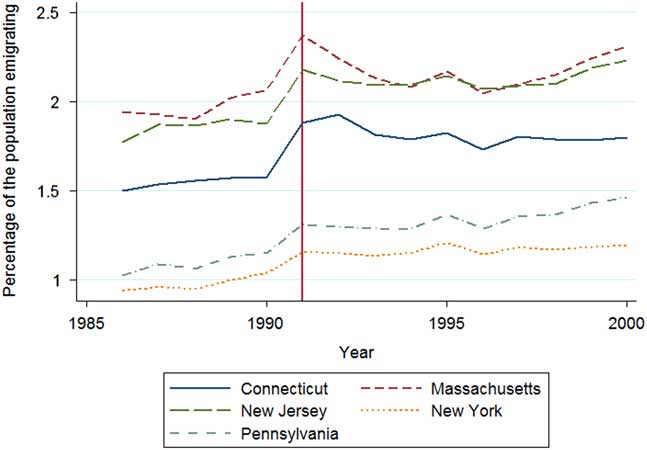
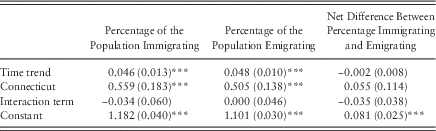
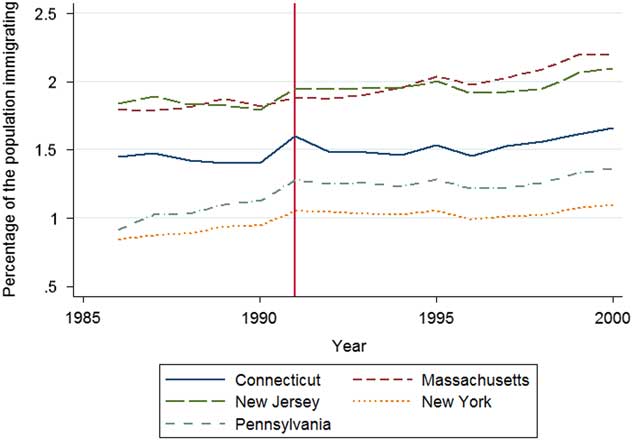
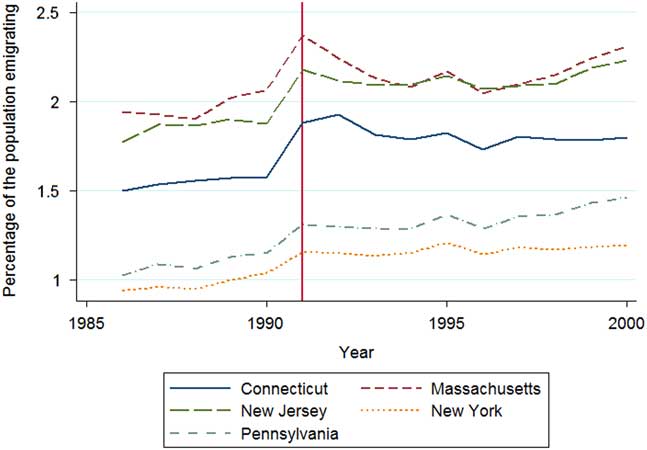
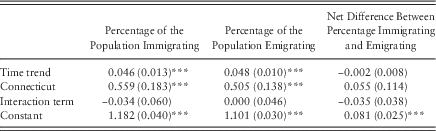
Figures 1 and 2 present the immigration to and emigration from each of the states as a percentage of the state’s population over the period. They show that the migration trends in Connecticut are similar to the other four states before the adoption of the income tax in 1991. This is key to the analysis presented here. In addition, Table 1 presents the results of a regression of a time trend variable, a binary variable for Connecticut, and an interaction term of those two variables during the pre-treatment period, 1986–1991. The interaction term is not statistically significant for immigration, emigration or the net difference. Thus, the null hypothesis of equivalence in migration patterns before Connecticut’s adoption of an income tax is not rejected. This also suggests that the adoption of the income tax is not driven by migration.
Immigration, 1986–2000.
Emigration, 1986–2000.
Pre-treatment period regression to test for equivalence of migration trends
Note: Asterisks denote significance at the ***1%, **5% and *10% levels.
My third hypothesis, related to Connecticut’s geographical location, is that migration within counties closer in proximity to New York City is more likely to be affected by Connecticut’s adoption of an income tax. The expectation is that such counties are more likely to house people who work and reside in different states and, therefore, where tax competition is greatest (i.e. why this region is an ideal case study) (Young and Varner Reference Young and Varner2011).Footnote 6
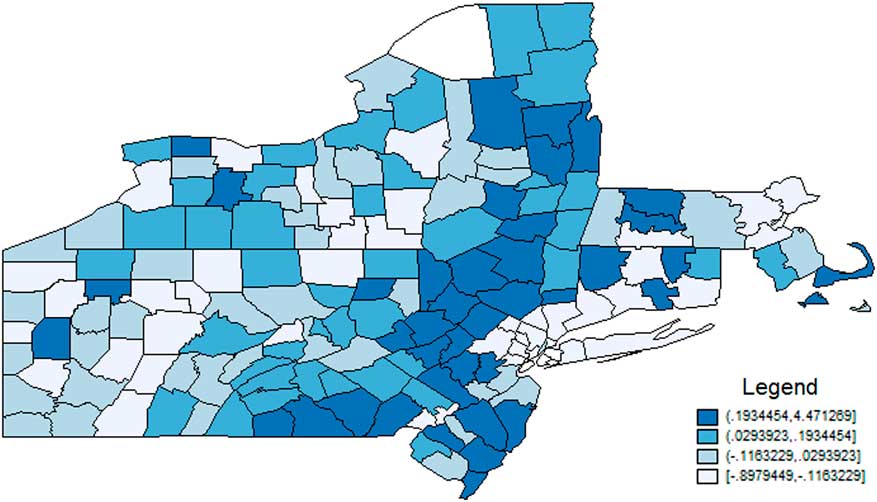
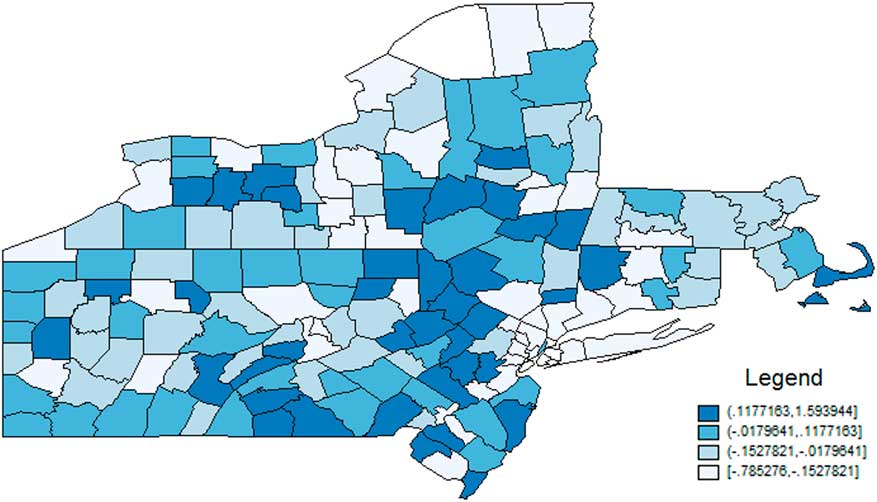
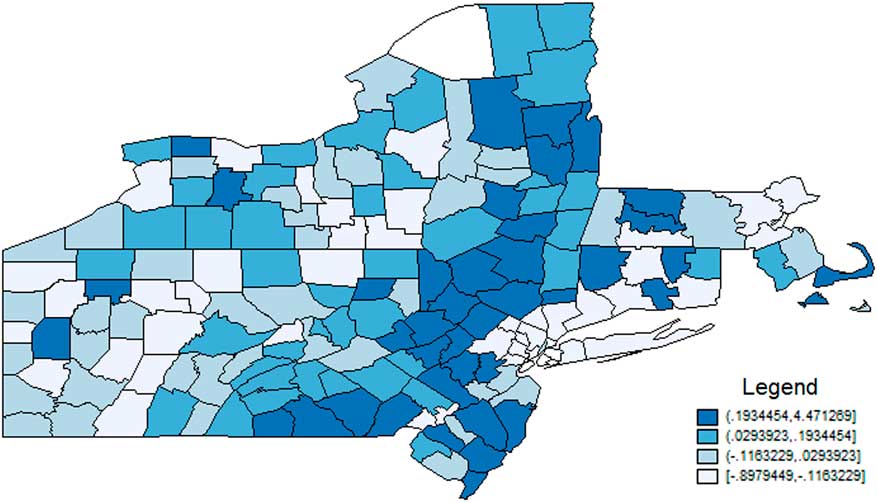
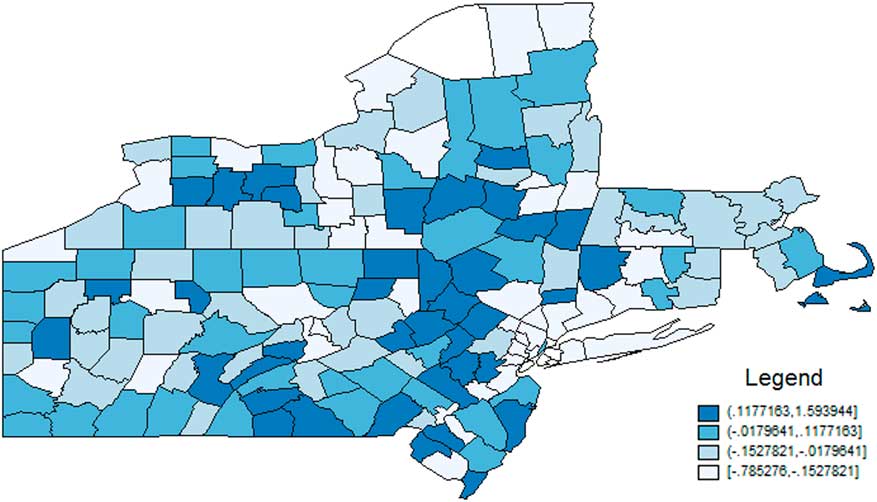
Another way of examining the data is to look at it spatially. Figures 3 and 4 present choropleth maps of the counties being examined for 1990 and 1999Footnote 7 and show net migration in terms of the percentage of the population that has migrated. The maps do not change dramatically over this 10-year period. Looking at Connecticut specifically, only one of its eight counties changes which quartile of net migration it falls into. Another interesting aspect of the migration patterns presented in Figures 3 and 4 is that the New York City region consistently loses domestic labour, having the lowest quartile of net migration in both periods. These figures do suggest that there are spatial elements to migration that would not be captured by state-level analysis, but they do not present any support for the third hypothesis that proximity to the New York MSA will increase the adverse effects of an income tax adoption on Connecticut counties. In addition, they show that there is a loss in migration in the Metropolitan New York City region, especially in the state of New York.
Net migration in 1990 as a percentage of total population.
Net migration in 1999 as a percentage of total population.
Methodology
To test these three hypotheses, I use two types of models: a DID model and a SEPM. They both use county-level data from Connecticut, New York, New Jersey, Pennsylvania and Massachusetts over the years 1986–2000. The migration data come from the IRS’s Statistics of Income County to County Migration data files (2013). County-level data are chosen because they allow for more precise inclusion of local tax burdens and services and provide a way to test H3, whether those closer to New York City will see different impacts. The benefit to examining county-level data is reinforced by Figures 3 and 4. It also allows for the policy differences to be controlled for. Both models use state and year fixed effects in order to control for location-specific attributes, such as weather and culture, which are presumed not to change over time (Sasser Reference Sinquefield2009). Although the SEPM is the primary model of interest, DID is discussed first and then the SEPM is framed in its context.
Difference in difference estimators are used to capture the effect of a policy shock or a dramatic change to an economic environment that is discrete, conditions that often are referred to as a natural experiment (Roberts and Whited Reference Roberts2012). They are designed to identify a treatment effect, which in the case of this study is the adoption of an income tax in Connecticut. When modelling the relationship, it is crucial to consider how you expect the treatment to progress over time. If you can assume that the treatment effect will be the same for every year following the treatment, you can just include a binary variable that is equal to 1 if the year follows the treatment. However, if you expect the effect of the treatment to change over time, you can also include binary variables for every year following the treatment. In this case, I expect that the treatment will change over time, primarily for emigration, and that it will take time to sell a home, find a job and so on. This expectation is contra Young and Varner (Reference Young and Varner2011), who argue that the effect of tax policy changes on migration will manifest quickly because rational residents will not accept the higher tax burden by delaying response.
The model used controls for not just whether a county has been treated (an income tax has been adopted) but also for many other factors that are anticipated to affect migration. It is adapted from the model proposed by Bertrand et al. (Reference Bertrand, Duflo and Mullainathan2004), which is designed for multiple treatment groups and time periods.
 $${\rm Model\ 1\,\colon\,}\,MIG_{{igt}} {\rm \, {\equals}\, }\beta _{{\rm 0}} {\rm {\plus}}\beta _{{\rm 1}} TR_{{gt}} {\rm {\plus}}{\mib DM}_{{it}} {\bf{\Lambda }} {\rm {\plus}}{\mib{EXP}} _{{{\mib{it}} }} {\mib{{\rm P}}} {\rm {\plus}}{\mib{YR}} _{{\mib{t}} } {\rm {\plus}}{\mib{ST}} _{{\mib{g}} } {\rm {\plus} }{\varepsilon}_{{igt}} $$
In this model, i, g and t are indices for county, state and year, respectively. MIG igt is the dependent variable for migration. It is operationalised multiple ways in order to capture differences in migration patterns. Migration is examined three ways: as the percentage of the population that has immigrated, emigrated and the net migration within the year.Footnote 8 TR gt is a binary variable that identifies whether the treatment has affected state g in the year t; therefore, it equals 1 for Connecticut counties starting in 1992 and 0 otherwise.Footnote 9 Thus, β 1 is the estimated treatment effect. YR t are year effects; ST g the group (or state) effects;Footnote 10 and ɛ igt the error term. DM it is a vector of two demographic characteristics: employment in manufacturing as a percentage of the population and employment in service industries as a percentage of the population.Footnote 11 EXP it is a vector of county-level expenditures, including countywide per capita expenditures on education, public welfare, health and hospitals, and all other expenditures. In the second specification, two additional independent variables are included: whether the county belongs to the CMSA and an interaction term between CMSA and treatment. These variables are key to testing the third hypothesis of whether proximity to New York City affects the migration of Connecticut counties after the income tax was adopted.
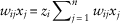
These relationships are then modelled a second way using a SEPM, which incorporates the possibility of spatial correlation by spatially lagging the error terms. With SEPM, the second model will remain the same with one exception, the error term. In the second model, the error term, ɛ igt , is re-labelled as u igt , where u igt =F(W)u igt +ɛ igt . W is the spatial weights matrix (N×N); thus, F(W) is a function of the spatial weights matrix. The weights matrix is a first-order, row-standardised queen contiguity matrix (Merryman Reference Musgrave2008).Footnote 12 The weights are simply the average value of all the neighbouring counties (w ij =0 unless county i and j are neighbours).Footnote 13 For the first model, F(W)=0; for SEPM, F(W)=λW. λ is the spatial correlation between the errors; if it is 0, there is no spatial correlation. However, if it is above 0, the standard errors will be biased.
The SEPM is the most appropriate model because there is a presumed spatial relationship. If there is competition and a large commuter population, it is unreasonable to assume that there will be no spatial relationships. SEPM is chosen because the effects of any of the primary independent variables of interest and of the dependent variable on its neighbours are unclear. For example, the treatment seems like a likely candidate to spatially lag – but is the spatial lag high because the county in question is on the border of Connecticut and, thus, likely to receive a positive bump from Connecticut adopting an income tax or because the county in question is in Connecticut? These two possibilities are likely to have very different estimated impacts. SEPM allows spatial correlation to be controlled for without specifying the variables that have spillover effects.
Data
The migration data come from the IRS’s Statistics of Income County to County Migration data files (2013). These are the same data used by Coomes and Hoyt (Reference Coomes and Hoyt2008) to measure policies on migration. Although imperfect, these data present an opportunity to study migration at smaller units of analysis and capture the migrating population as well as the portion of the migrating population filing a tax return, although this latter measure may exclude as much as 8% of the labour force (Huang and Kim 2000).Footnote 14 These data also include the number of tax returns involving persons emigrating and immigrating from every county in the nation.Footnote 15
The data are aggregated by county of interest. To calculate the percentage migration variables, the number of migrating returns in the county is divided by the county’s population. To create the net migration measure, the percentage emigrating is subtracted from the percentage immigrating. These migration measures echo the measures used by Conway and Rork (Reference Conway and Rork2006, 103), who also look beyond net migration because the “decision to move out of a state could be asymmetric with the decision to move into a state, which is missed if one focuses only on net in-migration”.
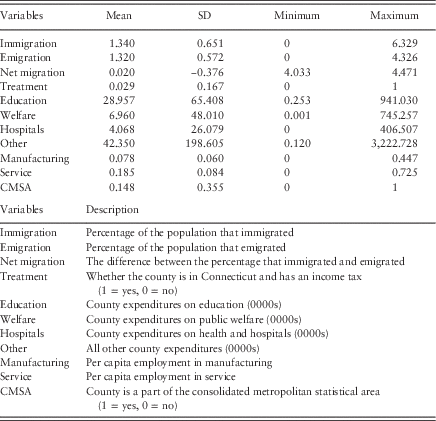
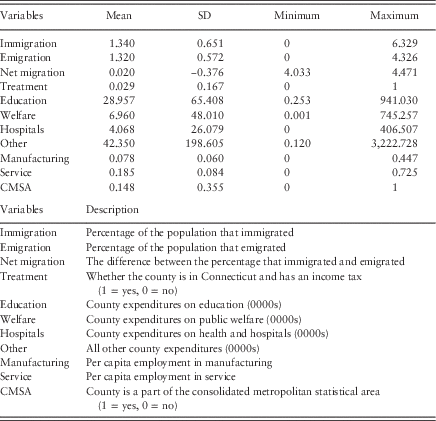
Manufacturing and service industry data are from county business pattern data collected by the US Department of Commerce, Bureau of the Census (2013).Footnote 16 Expenditure data also come from the Census Bureau’s County Area Finances data set (US Department of Commerce, Bureau of the Census 2013).Footnote 17 It is presented in both real dollars and per capita terms. The variables selected also echo the model created by Conway and Rork (Reference Conway and Rork2006). CMSA is taken from the US Department of Commerce, Bureau of the Census’s Historical Statistical Area Delineations (1983, 1990, 1993, 1999). The summary statistics for these data are presented in Table 2.
Summary statistics
Note: CMSA=consolidated metropolitan statistical area.
Discussion of results
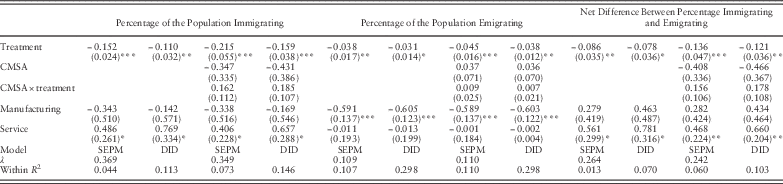
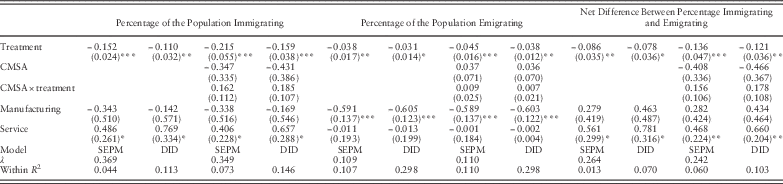
The results of this analysis are presented in Table 3. Table 3 is broken into three sections: the first displays the effect of the adoption of Connecticut’s income tax on percentage of the population immigrating into the county (referred to as immigration from hereinafter), the second displays its effect on emigration and the third the effect of it on net migration. Within each section, the results of both models (SEPM and DID) and specifications are presented. The results of the SEPM are the primary ones of interest, and the results of the DID are presented as a robustness check. The same basic results are found for both SEPM and DIDs, as are the two specifications.
The effect of Connecticut’s income tax on county-level migration between 1986 and 2000 using fixed effects models
Note: Asterisks denote significance at the ***1%, **5% and *10% levels. Each model includes county and year fixed effects. Each model also includes expenditures for education, public welfare, health and hospitals and all others. The standard errors are located below the estimated coefficients.
CMSA=consolidated metropolitan statistical area; SEPM=spatial error panel model; DID=difference in differences.
The results of the effect of the adoption of the income tax on immigration have the expected relationship. The sparser specification, before belonging to the CMSA is controlled for, reveals a decrease in expected immigration by 0.15%. Once CMSA and the interaction between CMSA and the treatment are controlled for, the expected decrease in immigration is 0.22%. Although these effects may seem modest, the mean immigration into a county in the sample is only 1.34%. Another way of understanding these numbers is to consider the average loss in residents this translates into; based on the average population of Connecticut’s counties, this represents a loss of approximately 895 potential residents a year.Footnote 18 This is in keeping with the first hypothesis as well as traditional economic theory. The estimated effect on immigration by the DID is similar – a decrease of 0.11 and 0.16%, respectively. The results are statistically significant at the 1% level.
The second hypothesis is that emigration will increase after the adoption of an income tax. The effect of the 1991 adoption of Connecticut’s income tax is estimated not to have an effect on emigration in all three models and specifications except the sparse SEPM where emigration is expected to decrease after Connecticut adopted an income tax by 0.04%. This relationship is not compelling because it is only statistically significant at the 10% level and is sensitive to specification and model. However, this result is in keeping with the literature, which has found a same-sign problem (Conway and Houtenville Reference Conway and Houtenville1998; Conway and Rork Reference Conway and Rork2006; Thompson Reference Thompson2011), where both immigration and emigration decrease. Once again, the mean emigration over this period is 1.32%, and therefore a 0.04 increase is insignificant in practice. This is in keeping with the hypotheses that the effect of the adoption of an income tax would have a larger impact on immigration than emigration.
The magnitude of the estimated effects suggests that net migration will also decrease over this period, and this is what the results of the models report as well. This is in keeping with expectations. The robust SEPM suggests that the effect of Connecticut’s adoption of an income tax is a 0.14% decrease in net migration; once again the sparse and DID models estimate more conservative impacts (between 0.08 and 0.12). This estimate is extremely high given that the mean net migration over the period is 0.02. This suggests that, although counties were on average net gainers over the period, Connecticut counties became net losers (by an expected 570 residents) after the income tax was adopted.
To test the third hypothesis that counties closer in proximity to New York City will be more affected by the adoption of an income tax than their counterparts, the second, more robust, specification includes whether the county is a part of the CMSA and an interaction effect for CMSA and the treatment. Neither variable has a statistically significant relationship on emigration. However, both have a statistically significant impact on immigration and net migration. Being a part of the CMSA reduces immigration and net migration, but treated Connecticut counties within the CMSA are less negatively affected. This is likely due to Connecticut having one of the lowest income tax burdens in the region and any income earned in New York City (both state and local) is deducted from the income taxes due to Connecticut, thus that income is likely not taxed by Connecticut at all (discussed in the Multiple State Taxation section).
A larger manufacturing sector is estimated to decrease percentage of the population emigrating and immigrating. This is most likely a result of the fact that lower-income people have lower migration elasticity (Rork and Wagner Reference Saad2012). A larger service sector is estimated to increase both immigration and net migration. This, too, is expected; it is likely a higher-income service industry (making its workers more elastic), and it may be reasonable to assume that the larger the service industry, the more desirable the community.
More importantly, λ, which is the measure of spatial correlation between the residuals, is positive and statistically significant in all three specifications. Finally, also as expected, the standard errors increased in magnitude with SEPM – however, the effects of interest are still statistically significant. This reinforces not just the theoretical need for controlling for spatial relationships, but the existence of space as a factor.
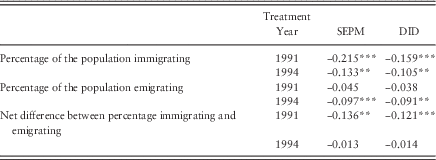
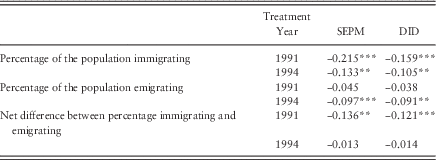
Additional robustness checks are performed to help ensure that there are no other confounding changes that impact migration during the long horizon, that the results are sensitive to the treatment year or the analysis period, and whether migration within the region is more heavily affected by the adoption of Connecticut’s income tax. Table 4 presents the coefficients for the treatment variable for the robust specifications of the SEPM and DID models with alternate treatment years. First, it presents the results when the initial treatment year is set to 1991 rather than 1992, the year the income tax was adopted. The results are consistent. Second, it presents the same models with the treatment year lagged to 1994 where the results are consistent for the effect of the adoption of an income tax on immigration, but deviate on the effect for emigration. The estimated impact on emigration is a statistically significant decline. This is in keeping with a portion of the migration literature that finds the same-sign problem (Conway and Houtenville Reference Conway and Houtenville1998; Conway and Rork Reference Conway and Rork2006). The estimated decline in emigration is sufficiently large that the net migration is no longer statistically significant.
The effect of Connecticut’s income tax with treatment beginning in 1991 and with treatment lagged to 1994
Note: Asterisks denote significance at the ***1%, **5% and *10% levels. Each model includes county and year fixed effects. Each model also includes consolidated metropolitan statistical area (CMSA), interaction term of CMSA and treatment, manufacturing, service and expenditures for education, public welfare, health and hospitals and all other.
SEPM=spatial error panel model; DID=difference in differences.
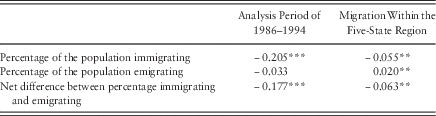
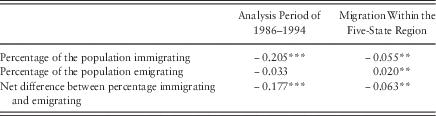
Table 5 presents the results of the robust SEPM models first, restricting the window of analysis to 1986–1994 and, second, restricting the migration data to migration that happened within the five-state region. The results of the reduced treatment window support those reported in Table 3, finding that the adoption of an income tax had a negative effect on immigration and net migration and had no statistically significant effect on emigration.Footnote 19 The results of the analysis of the emigration and immigration happening within the five states being analysed largely support those found in Table 3, with immigration and net migration being negatively affected by the treatment. However, the effect of the income tax is found to have a statistically significant impact on emigration and suggests that emigration rose as a consequence of the income tax.Footnote 20 This is in contrast to the limited support found for emigration decreasing after the adoption of the income tax.
The effect of Connecticut’s income tax on county-level migration: two alternate specifications of the spatial error panel model (SEPM)
Note: Asterisks denote significance at the ***1%, **5% and *10% levels. Each model includes county and year fixed effects. Each model also includes consolidated metropolitan statistical area (CMSA), interaction term of CMSA and treatment, manufacturing, service and expenditures for education, public welfare, health and hospitals and all others.
These results, like a great deal of the literature examining subnational income taxes on migration, find only partial support for standard economic theory. Immigration and net migration are reduced, but tax flight or increased emigration is not supported.
Policy implications and conclusions
Although it seems unlikely that states such as Tennessee or Texas are going to adopt an income tax anytime in the near future – although in 1999 Tennessee had a Republican governor who advocated adopting an income tax – this research suggests that a state income tax may not have as large an impact on migration as expected.Footnote 21 Specifically, the results presented here suggest that the risk of tax flight (or emigration) may be overstated. The results support the theory that subnational taxes deter immigration but do not speak to the demographic characteristics of lost immigrants. Standard economic theory suggests that it is high-income earners who will be lost, but that hypothesis is not tested in this analysis. It is clearly an important matter that needs to be examined, and doing so will require better data.
The second application of these results, which also seems unlikely but is being discussed with more frequency, is the impact that abolishing a state income tax would have on migration. The effect of state tax policy appears to have a minor, at best, effect on emigration, and the direction of the effect is inconclusive based on these results. One explanation for the lack of effect is that the increased revenue is used on services resident’s value. However, the potential for the elimination of a state income tax to have an effect on immigration is still great, based on the same reasoning presented here. Not only did the adoption of an income tax decrease immigration into Connecticut counties, it continues to enjoy one of the lowest tax burdens in the region,Footnote 22 which may serve to buffer the negative effects of adopting an income tax. However, the same constraints on emigration will still exist: it is expensive, people have ties to their community, etc. It may make the state more attractive to those already moving, but is less likely to attract people who are not. If states wish to increase their net migration, a natural extension of this research would be to examine whether states by lowering the personal income tax rates below those of their neighbours could do so without eliminating income taxes as is often discussed.
Acknowledgements
The author thanks the Editors, the three anonymous referees, her panelists and the audience at the Association of Budgeting and Financial Management (2013) for their comments and suggestions.