The aim of this article is to investigate the working-class strata that supported the radical political attitudes of the convulsive Republican years in Barcelona, and especially the attitudes of the anarchist sphere.Footnote 1 The aim is to determine the sociological and territorial features of the radicalized CNT (Confederación Nacional del Trabajo or National Confederation of Labour, the anarchist union), which generated the 1936 revolution at the beginning of the Spanish Civil War (1936–39). Many years of research on a key city of twentieth-century working-class revolutions and hundreds of books on the Spanish Civil War have done little to identify the armed workers who took the streets to defeat the fascist coup. It is not known where those workers came from, what their skills were or in what neighbourhoods or under what conditions they lived. What is known is that the revolution which they found unexpectedly in their hands was to a great extent an anarchist enterprise. It has been assumed offhandedly that their everyday settings were in generic ‘working-class neighbourhoods’. In the end, however, urban space has been neglected in the accounts of working-class revolutionary Barcelona. Indeed, most Spanish working-class historians have also overlooked the role of urban space as a variable in working-class collective processes, something which makes comparisons with other Spanish cities an especially difficult task.Footnote 2
In recent years a good scholarly literature has appeared on 1930s anarchism in diverse Spanish cities, and especially in Barcelona.Footnote 3 Nevertheless, the city focus, that is to say, the city location of working-class political and union attitudes, has been absent. Only the work of two British historians, Rider and Ealham, and one recent congress and an atlas have started to make some significant advances on the subject of Barcelona.Footnote 4 One crucial aspect involves immigration. The figure of the radical non-Catalan anarchist immigrant was a racist representation spread by part of the Catalanist press in the 1930s. The historian Vicens Vives, the father of modern Catalan historiography, referred to the figure of the anarchist immigrant as the ‘foreign, socially irresponsible element’ who stoked the fire in working-class Barcelona of the end of the nineteenth century. Historians of recent decades have moved away from these views of immigrant workers and looked at the militants of the CNT in a more balanced way. Anarchist workers were Catalans and non-Catalans and it is difficult to establish any immigration factor in the radical CNT of the 1930s. Nevertheless, up to now this view has not been based on an in-depth demographic study of union membership and militancy,Footnote 5 and this article also seeks to shed further light on this matter.
The inter-war urban explosion
In order to contextualize the working-class revolutionary Barcelona, the first thing to be said is that the city of the 1930s was really very different from that of the beginning of the century. Barcelona, which was a big city before World War I, became a veritable metropolis by 1930. During the inter-war years the city acquired a real industrial structure, orienting itself towards a greater industrial diversification. The weight of the consumer goods industries, which had been dominant in the city in 1900, decreased in relation to the capital-goods and other intermediate industries by 1930. In 1900, textile manufacturing formed the strongest industrial sector in the city's employment structure. As a whole, textiles, leather, paper, graphic arts and alimentary industries quadrupled the employment in the metalwork, chemical, building and timber industries. In 1930, however, the quotient between these two groups of industries was completely balanced.Footnote 6 Barcelona had become consolidated as an industrial working-class city. The working-class population probably doubled between 1905 and 1930. According to Pere Gabriel, the years of expansion in World War I were the principal period of upsurge. In 1930, two out of three households in the census were formed by manual workers. The diversification of the working-class population was another undeniable change. In 1930, 32.3 per cent of the overall working population was employed in metal crafts and building, surpassing for the first time the population labouring in the textile and garment industries, which totalled 30 per cent.Footnote 7
The urban inter-war growth was truly explosive. Barcelona, with 600,000 inhabitants at the beginning of World War I, reached the figure of 1 million inhabitants in 1930 and 1,062,157 at the beginning of the Civil War (1936). Consequently, the urban population almost doubled in that short period. The population of greater Barcelona rose from 30 per cent of the Catalan population in 1910 to 40 per cent in 1936. The annual growth rate of the population in the 1920s was in fact the highest since the middle of the nineteenth century, and that of the suburban municipalities was even greater. The immigration waves in the 1910s and 1920s were almost the sole cause of the demographic increase because of the weakness of Barcelona's natural growth.Footnote 8 After the massive immigrant arrivals in the years of World War I, there was another even more massive wave in the twenties, composed not only of Catalan, Valencian and Aragonese people but also people from Murcia and Andalusia. The bulk of Catalan economic growth came from the rising demand for housing and services of this new population of Barcelona. The increased purchasing capacity of the working-class population, most of which lived in urban areas, also had a multiplying effect.Footnote 9
For its part, the urban landscape likewise changed substantially. House building reached previously unknown levels, which were higher than those of industrial growth. The extraordinary activity of this manpower-intensive sector had far-reaching effects on a whole series of other sub-sectors, such as concrete and metalworks, which were typical of the diversification process in those years. The growth of the demand generated by the urban explosion also affected public works. The city council was the main party responsible for the rise in public expenditure in Catalonia in the inter-war years.Footnote 10 New public works reorganized the internal urban space with a view to adapting the city to the new expansive cycle. Transformations connected with the 1929 International Exhibition were unquestionably the primary cause of the investment increase. Private investment in urban infrastructure also made a qualitative leap in the inter-war years. The real change in house building in Barcelona occurred at the end of World War I, and from that time urban growth became explosive.Footnote 11 The leap in house building in Barcelona at the end of the war is a striking illustration of the impressive change in urban growth, as may be seen in Figure 1. Whereas the number of buildings rose only 7 per cent between 1910 and 1920, the increase in the next decade reached 32 per cent.Footnote 12 The average number of building permits in the period 1917–36 was four times that of the period 1897–1916. The main impetus was imparted in an intense short cycle in the early twenties. The housing boom was in perfect correspondence with the inter-war housing cycle of many other Spanish and European cities. The difference was that the inter-war building cycle was of greater significance in Barcelona as a result of the standstill which had come about there in the opening decades of the century. Driven by the immigration boom and the public works policy, the extraordinary development of the building sector also stimulated other industrial sub-sectors, such as concrete production, building materials, metal constructions, timber and lumber.
House building in Barcelona, 1897–1935

Urban growth was not spatially homogeneous. The old historical city raised its densities to previously unknown overcrowding levels. Neighbourhoods such as La Barceloneta, Santa Mónica, Raval Central and Sant Pere-Santa Caterina reached densities of over 1,000 inhabitants per hectare. The Eixample (the middle-class areas beside the city centre) and the suburban ring, however, were the districts most affected by the building boom. These were the formative years of what I have called the ‘second suburbs’ (segundas periferias) and of an intense growth of the old suburbs in El Llano (the ring of industrial villages aggregated to the city in 1897). Until that time, urban growth had occurred mainly by extension of the existing street plan. From then on, however, it was more discontinuous and fragmented. The 1920s were decisive from both quantitative and qualitative standpoints. The bulk of the new working-class subdivisions colonizing the outskirts of the city in more and more peripheral sites were established in those years. All these new suburbs, which were precariously urbanized and usually formed by tiny one-family houses and small alleys, made up the new living spaces of the working people; consequently, the new ecological niche of the working-class which emerged in this way added itself to the old suburban industrial villages and the dense Old City neighbourhoods.Footnote 13
An internally differentiated world: working-class figures
Barcelona's working class was a very consistent group from the sociological standpoint. Socially immobile, only one out of ten blue-collar sons was able to move upwards to non-manual positions in the inter-war years. Indeed, crossing the border into white-collar status meant the adoption of lifestyles – involving cultural, familial and housing aspects – which were closer to those of the middle classes than to those of the manual workers.Footnote 14
Inside the blue-collar world, however, lifestyles were highly segmented by skill and immigration, so Barcelona's working class was differentiated internally. Indeed, distinction by skill was very clear. The wage gap between skilled workers (one in five urban workers in the 1930 census) and unskilled workers did not change between 1914 and 1930 (wages were between one third and one half higher for skilled workers). The rise in wages was especially notable from the end of World War I and during the early twenties, and once again – although to a lesser extent – in the Republican period (1931–36). This involved an unquestionable rise in real wages, totalling about 40 per cent on the average. While in 1914 only the skilled workers' wages in a few industrial sectors could cover the family expenses, by 1936 this was the rule for the whole skilled workforce. However, for many unskilled workers it was still difficult to make both ends meet.Footnote 15 Moreover, unemployment in the 1930s, which affected especially the building sector with its large number of unskilled workers (who were the worst-paid workers and the last-comers to the labour market), made it impossible for the real wages of many unskilled workers (day-labourers or jornaleros) to approach those of the skilled workers. The rate of unskilled illiterate workers more than doubled that of skilled workers. This obstructed the unskilled workers' way to higher wages and blocked their upward mobility, which was further impeded because their nuptiality was much more endogamic than that of the skilled workers. The analysis of marriage records shows that only one out of five unskilled workers' sons could pass the craft boundary in the inter-war years. Non-family cohabitation rates, that is to say, the co-residence of families not tied by kin (subletting), were also 40 per cent higher in the jornalero households. Rates of jornalero households in shanty towns and other forms of very cheap housing were 58 per cent higher.Footnote 16
Barcelona's working class was marked by immigration: the head of three out of four working-class households had been born outside the city. The more recently the immigrants had reached the city, the more proletarian they were. Indeed, income, skills and immigration were tightly interwoven in the city's social hierarchy. Catalans commonly held the best-paid jobs and occupations. Moreover, they formed the social elites and all the non-manual classes were predominantly Catalan. To be sure, there were also workers among the Catalans, but although they totalled 60 per cent of the artisans and skilled workers, they formed a slight minority among the unskilled workers. The opposite was the case among the population born outside Catalonia. There was a low proportion of non-Catalans in the sphere of the non-manual classes. Non-Catalans were more commonly employed in skilled manual labour and, as mentioned, they already outnumbered the Catalans in the unskilled labour sphere. The immigrants came from the regions of Valencia and Aragon, and after 1910 also from Murcia and Almeria (these people were called generically murcianos, or Murcians), and indeed they showed a much more clearly working-class composition. The Valencian and Aragonese immigrants formed 28 per cent of the unskilled working class, while the Murcians and Almerians formed 16 per cent. Three out of four Murcian or Almerian household heads living in the city were unskilled workers. Overall, one out of three unskilled households in 1930 were formed by non-Catalans who had reached the city after 1910.Footnote 17
The predominance of Catalans in skilled labour also becomes evident on studying non-census sources. Two out of three skilled workers who married in the city in 1934–35 were born in Catalonia. Nevertheless, in a sample of metalworkers affiliated to the CNT and to the UGT (the socialist Unión General de Trabajadores or General Union of Workers) just before the Civil War, Catalan workers represented 70 per cent of all skilled workers. An analysis of the workforce of Maquinista Terrestre y Marítima (the biggest metalworks company in Barcelona) shows that immigrant origin, skills and wages were closely linked, forming a type of labour structure which may also be observed in other industrial sectors. Whereas the Catalan worker, literate, more skilled and with better support networks in the city, tended to occupy the highest tiers of the wage pyramid, non-Catalan unskilled workers, and especially the late-comers to the city, occupied the lowest and most unstable tiers.Footnote 18 The building sector shows the same picture. If we study union data either by company or by district branches, two out of three masons were Catalan. On the other hand, Catalans formed a minority in the sphere of building labourers, in which the overwhelming majority were immigrants. An important sector in which the skilled-worker ratio was very high and literacy almost complete was the graphic crafts. Of the skilled workers in this sector (typographers, typesetters, printers, plate-press operators, lithographers, linotype operators and photo-engravers), 76 per cent were born in Catalonia. In the artisanal crafts connected with small business, the Catalan worker rates reached 80 per cent, with an absolute literacy level. The only exception was in the textile industries. Here, according to the padrón, 71 per cent of the occupations connected with textile manufacturing (foremen and stewards, dyers and dressers, weavers, warpers, spinners) were working people born in Catalonia. A more complete estimate using CNT and UGT membership data from the middle of 1936 with respect to the ram de l'aigua or ‘water sector’ (that is to say, dyers, dressers and other textile crafts using water) leads to the same conclusion: the study of these affiliated workers at the padrón, shows that 77 per cent were Catalan.Footnote 19
There was also an immigration divide among unskilled workers. Indeed, the distinction by fortune, social mobility and lifestyle between the immigrant jornaleros, and especially immigrants from the south-eastern Spain, and the Catalan jornaleros was very apparent. The data from the padrón of 1930 show clear distances between the unskilled Murcian or Almerian workers who had reached the city from 1910 and the unskilled Catalan workers. Illiteracy rates were 70 per cent higher for the former than the latter. Household size and number of children were also 37 per cent and 71 per cent higher, respectively. Likewise, the living standards of unskilled immigrants from Murcia and Almería were especially low in other respects, such as poverty, health and mortality.Footnote 20 Upward mobility for the most recent wave of immigrant workers was more blocked than for Catalans. The study of marriage records from 1934–35 shows that four out of ten Catalan unskilled workers' sons succeeded in crossing the skill divide in the course of one generation. An additional group of 10 per cent was even able to emerge from the manual work sphere. Improvement expectations were not the same for the recently immigrated day-labourers' sons: only one out of six could get a better-paid skilled job in the course of one generation, which is equivalent to just half the expectation of the Catalan day-labourers' sons.Footnote 21
In short, it was not only more common to find Catalans in the best-paid jobs and skilled occupations: the distinction with respect to non-Catalan immigrants as a sociological group was also notable. Given all this evidence, I have considered three different figures of Barcelona's male working-class world with specific socio-cultural features: the artisan and skilled worker, the Catalan unskilled worker and the recently arrived non-Catalan immigrant worker. Female workers are difficult to study because census sources provide information on their jobs only occasionally.
The everyday city
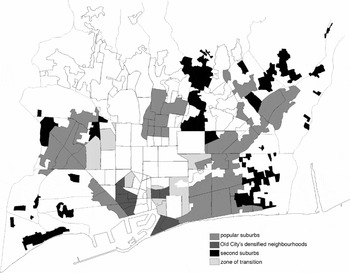
A geographical study of the 1930 padrón shows that there were three main spatial settings in which these working-class figures came to unfold their everyday life (see Figure 2). These three settings encompassed 80 per cent of all the working-class families. The first and most important setting, encompassing 250,000 workers, was that of the old popular outlying working-class districts of El Llano de Barcelona (suburbios populares). Unskilled workers were in the majority here, many of them being old residents in the city, but skilled workers also formed an important social component. Even office workers and small shopkeepers were not uncommon. In fact, popular suburbs were actually ‘small cities’, forming a blend of popular social strata, factory and workshop activities and shopping premises, which was very typical of many popular quarters in the nineteenth century. The second setting was that of the densified neighbourhoods of the Old City centre. In many ways they shared the same features of a ‘popular mix’, but the existence of poor housing conditions, recent immigration, households with women as the primary breadwinners and ancient shops and artisans' workshops entailed a more complex structure. The second suburbs (segundas periferias) were the third spatial setting. These were brand new spaces at the city outskirts. Recently arrived immigrant unskilled workers and precarious housing conditions set the keynote. The traditional popular mix of the other two settings was substituted by a much clearer working-class homogeneity. The latter two settings, which showed similar population figures, added up to the same working-class population as the popular suburbs setting.
The three working-class stages

Working-class figures and working-class settings have been studied in four main fields of everyday life: residential segregation, housing, mobility and sociability. Residential segregation between rich and poor was quite pronounced. It had been rising between 1900 and 1930. There was a big spatial opposition between the social extremes, that is, the 20 per cent formed by the middle and upper classes and the 50 per cent formed by unskilled workers (dissimilarity indexes Id = 59, 40).Footnote 22 In contrast to unskilled workers, skilled workers – forming 11 per cent of the census population – were much more mixed (Id = 18, 33, segregation index Is = 13). Skilled workers were very apparent, for instance, in the central districts of the rich Eixample area. Spatial segregation was particularly evident in the immigrant enclaves. If the well-to-do distanced themselves from the unskilled workers, within the working-class world there was a crucial segregation, that is to say, a much clearer separation of some of the unskilled workers and especially of those who had most recently immigrated, in the proletarian ghettos. The most outstanding segregation and concentration indexes were in fact those of the Murcian (Is = 33, location quotient = 3,3; 3,9) and Andalusian immigrants. The spatial distance between these two groups and the Catalans was quite clear (Id = 37, 32). In no other place was the isolation of the neighbourhood so clear as in the second suburbs.
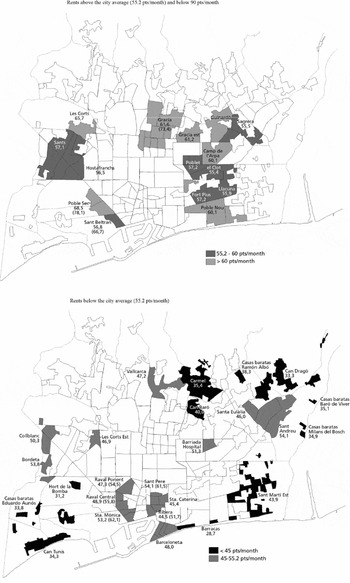
The three different tiers of the working-class letting market coincided exactly with the three different working-class settings which I have previously defined (see Figure 3). Almost all the barrios or neighbourhoods of the lower rents, under the line of 45 pesetas, were included in the bottom tier of the second suburbs. The middle tier, between 45 and the 55.2 pesetas of the city-wide working-class letting average, delimited precisely the working-class densified barrios of the Old City. The upper tier, above the 55.2 pesetas line, was concentrated mainly in the popular suburbs, where housing conditions were more varied and apartments generally bigger, with higher rents and comparatively better-furnished houses. In the tiny Old City subdivided flats and in the second suburbs' small one-family houses, the presence of immigrant workers was also dominant. This was also common in the decisive subletting market. The differences between the Catalan day-labourers' and the south-eastern Spanish day-labourers' households stood out. Co-habitation, which affected one out of three Catalan jornalero households, was the rule for seven out of ten Murcian or Almerian jornalero households. Of the former, 14 per cent, and of the latter, 40 per cent shared dwellings between two or more non-kindred families. By the same token, a Murcian or Almerian day-labourer's household was twice as likely to live in infra-housing than a similar Valencian or Aragonese household, and four times more likely than a Catalan one. My own estimates from eviction proceedings also set the various popular figures on clearly differentiated levels: 52 pesetas per month was the average rent of a recently immigrated unskilled worker; rising to 64 pesetas for a Catalan unskilled worker, 71 pesetas for a skilled worker and 85 pesetas for a white-collar worker.Footnote 23
a. The high step of working-class housing rents, 1931–36
b. The low step of working-class housing rents, 1931–36

The journey to work was also related to income and skill: the higher the wage the longer the journey to work. Skilled workers were the most tramway-dependent. In comparative terms they were living the farthest away from their jobs: more than half lived over 2 kilometres from their work (the average journey was 3 km for the nine factories of the study). Walking to work and occasional tramway use, on the other hand, was the everyday experience of most day-labourers (2 km), women and apprentices (less than 1 km). Given the lack of industries there, walking was the common experience in the second dormitory suburbs, as the analysis of journeys to work shows in the case of La Torrasa.Footnote 24
The analysis of residential mobility, friendship and kin relations, courtship space and neighbourhood use of public space, shows the survival of a world of proximity.Footnote 25 Nevertheless, once again we find striking internal differences between working-class figures and working-class settings. Skilled workers were clearly less residentially mobile. Long distances were involved when they moved, and they left their original neighbourhood. But in the new neighbourhood they could re-create new communitarian friendship networks. There they found brides and experienced the barrio community in many ways. In comparative terms, skilled workers were the most communitarian and ‘neighbourly’, showing more residential persistence in the neighbourhood, and their kin, courtship and friendship relations were at least as tight and close as those of the unskilled workers who were most closely attached to their barrio. Not much more residentially mobile (but with very short-distance moves), the Catalan unskilled workers showed a communitarian behaviour which could hardly be distinguished from the skilled-worker pattern. The biggest behavioural gaps in neighbourhood community relations were those of non-Catalan unskilled workers. Although their friendship and courtship patterns do not appear to be very different from those of the other two working-class figures, they were much more residentially mobile (with rates of over 20 per cent yearly) and, with the exception of those living in the second suburbs, they were less supported by kin networks. On the eve of the Civil War, they had fewer opportunities to take root firmly in the neighbourhood space. Popular suburbs were the more stable working-class setting from the community standpoint. With kin and friendship support rates similar to those of the Old City quarters, popular suburbs also had the highest marriage endogamy. These were likewise the spaces that offered the best prospects of residential longevity. At the other end, second suburbs were by contrast the most unstable working-class neighbourhoods and those with the lowest endogamy rates. In compensation, all the primary sociability issues to which I have referred – kin, friendship, neighbours – were channelled through an intense street life. The street became the necessary extension of the house, a genuine melting pot of urban practices.
Many data underline the specificity of the particular everyday lifestyles of the various working-class setting and figures studied. I found this division to be decisive. The recent immigrant workers were the worst accommodated among the three worker figures, the most residentially unstable in the same neighbourhood, the least supported by kin networks, the most compelled to intensive and non-normative use of public space and the least related to the local sociability facilities. If we except the support of kin networks (even stronger than in popular suburbs), these are the same features we find in the second suburbs. In no other place was the impression of physical isolation and the segregation of ‘communities of equals’ clearer. Cheap housing rents and the worst urban conditions (lack of piped water, sewerage, street pavement) were also concentrated there.
Figures and spaces of the revolution
After the Dictadura (dictatorship) interval (1923–30), the anarchist union (CNT) once again became the hegemonic force, representing more than two-thirds of the city's working population.Footnote 26 In the 1930s, the leadership of the revolutionary faísta faction (the FAI or Iberian Anarchist Federation vanguard which was to channel the revolution) fostered a CNT attitude of open insurrectionary opposition to the new Republican order. Membership dropped by 50 per cent during the Republican years (1931–36). In the new CNT of the eve of 1936, which was at once smaller and more revolutionary, the second suburbs showed the higher affiliation rates. Actually, if we consider affiliation in the three main sectors of manual work in Barcelona – textiles, metalworks and building, representing 52 per cent of the membership – we see the full CNT predominance in the second suburbs: for each UGT (the more moderate socialist union) worker there were six workers of the three big anarchist unions. In the popular suburbs, however, the position of cenetistas or adherents of the CNT was quite different: for each worker affiliated to the UGT there were just two workers affiliated to the CNT. By June 1936, the UGT started to compete with the CNT in this traditional working-class setting.Footnote 27 This latent rivalry was to become much more overt during the Civil War, when the wave of new membership produced by the decree of compulsory union affiliation increased the number of ugetistas (UGT adherents) to almost the same figures as those of the cenetistas. If one considers militancy instead of membership, the image is also quite clear. The second suburbs were the comparatively denser residential setting of CNT militancy, almost quadrupling the relative weight of the UGT in this setting. The Old City quarters and the popular suburbs presented, however, a much more balanced situation. The picture becomes even clearer if we include significant militants in the surrounding municipalities, where the bulk of the CNT militants lived in the new neighbourhoods created in the inter-war years.Footnote 28
The second suburbs, therefore, were not only the urban spaces of higher CNT membership but also those of the most active CNT militancy. Examples of these cenetista strongholds were numerous, from La Torrassa, La Colónia Castells or La Trinitat, to the four Casas Baratas groups. However cenetistas and ugetistas shared extensive areas of the city, either in the Old City or in the popular suburbs. Although the CNT was strong in the most proletarianized neighbourhoods of the Old City, such as the Barrio Chino or La Barceloneta, this strength tended to decrease in the northern areas of El Raval. The cenetistas also dominated extensive spaces in the most working-class popular suburbs such as El Clot and El Poble Nou, but they were much more closely rivalled by the ugetistas in the more socially mixed suburbs such as Poble Sec or Gràcia. In 1936 the role of the popular suburbs as exclusive fortresses of the CNT (the numerically most important setting of the Barcelona working class) was diminishing because of the increasing competition of other more moderate union and political tendencies.
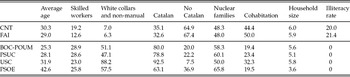
Higher rates of unskilled and recent immigrant workers among the CNT membership explain why the principal CNT strongholds were the immigrant-proletarian ghettos. This is the main conclusion which may be drawn when the union affiliates of a significant number of industrial sectors are studied, name by name, in the 1930 padrón. The cenetistas were unskilled workers in a higher proportion than the ugetistas in sectors such as metalworks, construction, paper, graphic arts and possibly transport. Excepting textiles, their origins lay outside Catalonia in more than two out of three members studied, who usually belonged to families which had reached the city in the previous 20 years (the same conclusion may be drawn from studying the surrounding municipalities of Santa Coloma, Sant Adrià and El Prat). Co-habitation and illiteracy rates doubled those of the UGT membership. An analysis of union leaders and militants shows the same trend, a contrast which becomes especially significant on comparing radical cenetistas and treintistas (the group of more moderate cenetistas which split away from the CNT at the beginning of the Republic) (see Table 1). The CNT militants were predominantly male, three out of four working as unskilled jornaleros.Footnote 29 Non-Catalan immigrants were over-represented among this militancy: almost two-thirds of the militants were born outside Catalonia. On the other hand, the UGT and treintista militants (members of the SS.OO. or Sindicatos de Oposición (Opposition Unions) to the CNT) were more likely to be skilled workers than the cenetistas, showing a notable proportion of white-collar workers, and they were born generally in Catalonia. These differences were also reflected in their lifestyles: illiteracy, co-habitation and overcrowding were more evident among the CNT militants than among the UGT and SS.OO., and while the CNT used the second suburbs and, to a lesser extent, some neighbourhoods of the densified Old City as their principal residential settings, the latter used the Eixample and the popular suburbs as their main living settings.Footnote 30
Leaders and militants of CNT, UGT and SS.OO. 1930–36 (%)

Source: Fernandez de Sas and Pagès (coord.), Diccionari biogràfic; Íñiguez, Enciclopedia histórica; AGCS: the UGT and SS.OO. militants' names come from lists kindly provided by Eulàlia Vega and David Ballester.
The significance of an environment that made the new barrios at the city outskirts the real anarchist hotbeds and turned the immigrant workers into the main core of the revolutionary CNT is even more striking on studying the geographical spread of the more political and radical anarchists, that is to say, of the militancy in the FAI and the Juventudes Libertarias (JJ.LL. or Libertarian Youth, the young faístas). The second suburbs were in fact the foremost strongholds of revolutionary radicalism. Affiliation to FAI grupos de afinidad (affinity groups) was 2.4 times higher in these second suburbs than would be expected on the basis of the working-class resident population.Footnote 31 The Old City membership was in line with the overall city average whereas the membership in the popular suburbs was 22 per cent lower than could be expected (see Figure 4). Eight out of ten faístas found in the 1930 padrón were unskilled workers and lived in households or were household heads of non-Catalan origin (over two out of three of the militants were born outside Catalonia). Of the militants, 80 per cent had come to Barcelona after 1911 and their average time of residence in the city was about 13 years. The young faístas of the JJ.LL. had a territorial distribution in which the outlying barrios also stood out.Footnote 32 At the beginning of 1937, the only working-class setting in which the presence of Libertarian youth was clearly higher than the city average was the second suburbs, which doubled the Barcelona average. Of all the Libertarian youth, 40 per cent were militants at the JJ.LL. centres in the outlying barrios. The same thing may be observed in the case of the political-cultural facilities promoted by these anarchist groups, the ateneos libertarios (Libertarian athenaeums). The ateneos list of 1936 shows that one third of the 50 centres were located on the map in the same constellation of peripheral neighbourhoods.Footnote 33
Residential location of outstanding anarchists, socialist and communist militants in the different urban stages, 1930–36

On the other hand, the socio-spatial outline of prominent militants of the working-class non-anarchist political parties was at the diametrically opposite extreme. Barcelona's map, drawn with the addresses of militants of the philo-Trotskyist BOC (Bloc Obrer i Camperol) and POUM (Partit Obrer d'Unificació Marxista), the socialist-nationalist USC (Unió Socialista de Catalunya), the communist PSUC (Partit Socialista Unificat de Catalunya), the socialist PSOE (Partido Socialista Obrero Español) and the nationalist Partit Català Proletari, shows its residential epicentre in the bourgeois Eixample, while the popular suburbs alone were of any importance. The second suburbs, on the other hand, formed a completely marginal militant setting (see Figure 4).Footnote 34 Indeed, on comparing spatially the anarchist militants and other working-class militancy, we discover two different Barcelonas, one ‘populist’Footnote 35 and the other ‘radical-anarchist’, of completely opposite character. These were two Barcelonas, however, with some common spaces of confluence in the overcrowded neighbourhoods of the Old City and especially in the popular suburbs, which were the real disputed working-class setting. Similar opposition may be observed in an analysis of the sociological features of the militancy. When the militants of these political parties were manual workers, which was rather uncommon, they were predominantly skilled workers and born chiefly in Catalonia. With the exception of the PSOE, non-Catalan immigrants were a minority. Likewise, their socio-cultural patterns and their everyday lifestyles reflected features which were more oppositional than confluential. There was no illiteracy and neither was household co-habitation or overcrowding as pronounced as in the case of the CNT-FAI militants (see Table 2). Spoken and written language, as evidenced in the press, meetings and proceedings, was the final distinguishing element (the Spanish language in the case of CNT and FAI, and the Catalan language in most of the cases of UGT, socialist or communist political parties and leftist Catalanist parties).
Anarchist, socialist and communist leaders and militants: social and immigrant profile and housing, 1930–36 (%)

Source: Fernandez de Sas and Pagès (coord.), Diccionari biogràfic; Íñiguez, Enciclopedia histórica: and AGCS, PS Barcelona.
Given the significant radicalism in the proletarian outskirts, their participation in the foremost collective actions of the 1930s is not surprising. The first action was the rent strike of the summer of 1931.Footnote 36 It achieved an intense following in these barrios (the eviction requests multiplied in all the working-class areas in the summer months but the rate of unpaid rents was 75 per cent higher in the second suburbs than in the popular suburbs and the Old City neighbourhoods). The four Casas Baratas housing estates, which started the rent strike spontaneously, actually kept it going until 1939. The strike was also important in some of the more overcrowded immigrant neighbourhoods of the Old City, such as La Barceloneta. From the end of 1933 to the beginning of 1935, the second suburbs were the protagonists of the first urban transport movements.Footnote 37 The picture is equally clear on considering the specifically political struggles. The peripheral suburbs played a leading role in the insurrectional cycle of the beginning of the 1930s, especially in the December 1933 uprising. The epicentre of the uprising in the Barcelona area was the Collblanc-La Torrasa peripheral suburb. Libertarian communism was declared and for four days the anarchist groups seized and held the surrounding city of L'Hospitalet.Footnote 38 It was the prelude to the events of July 1936. This radicalization of the peripheral spaces of Barcelona's anarchism is not surprising and it should be seen in relation to that of the Madrid second suburbs in the 1930s. Indeed, the comparative political behaviour of these spaces in the inter-war years could be considered. If, in inter-war Paris, home ownership and more socially varied working-class peripheral spaces made a banlieue rouge where Marxist politics and populist front parties had a huge impact, the Barcelona jornalero outskirts created a black-and-red belt.Footnote 39
The radical character of the immigrant outskirts was plainly expressed in the months of the revolution. From 19 July the active presence of very dynamic neighbourhood committees (Comités Revolucionarios de Barriada) controlled many aspects of everyday life, from food distribution to voluntary enlistment of militiamen (milicianos) to defend the revolution on the Aragon front. More than 60 per cent of the young Barcelona milicianos of the CNT-FAI at the battle front came from the immigrant quarters of the city, in either the Old City's overcrowded neighbourhoods or, mainly, the second suburbs.Footnote 40 In relative terms, the second suburbs doubled the Barcelona average of anarchist milicianos. While the overcrowded old neighbourhoods recruited 40 per cent more anarchist milicianos than the Barcelona average, the popular suburbs recruited a good deal less than the mean. The map of the milicianos with respect to the rest of the workers and the popular political organizations was again clearly different from that of the cenetistas.Footnote 41 The hegemony of the young anarchist militiamen in the second suburbs was indisputable: of every four milicianos resident in the city outskirts, three were anarchists and only one came from non-anarchist political organizations. On the other hand, balance was the rule in the two other working-class settings. The main feature of the milicianos was their unskilled immigrant profile: two-thirds of the Barcelona anarchist militiaman households were headed by non-Catalan men who had reached Barcelona after 1910, which doubled the expected rate. Overcrowding and co-habitation were clearly higher among these households than was usual in Barcelona's working-class districts. The most disadvantaged neighbourhoods, where there were greater urban shortages on all levels, were those which supplied the greatest numbers to the various anarchist columns. The inter-war outskirts, the strongholds of radical anarchism, would also suffer the greatest repression after the so-called May Days of 1937, when the revolutionary attainments of the ‘short summer of anarchy’Footnote 42 were finally suspended, and they were the areas which would consequently fill Barcelona's prisons with Republican government prisoners until almost the end of the Civil War. Indeed, the residents of the second suburbs more than doubled the expected relative rate and their social and labour profile fitted the features of the radical world to which I am referring.Footnote 43 The final act of the tragedy, when the fascist troops entered Barcelona in January 1939, would be the elimination of every form of resistance. Of the cenetistas executed at the Camp de la Bota at the end of the war, 71 per cent were non-Catalan immigrant workers, born almost exclusively, like the anarchist milicianos, of non-Catalan families.Footnote 44
Epilogue
In conclusion, the unskilled recent immigrant worker and the neighbourhoods where this working-class figure was predominant, the second suburbs and, secondarily, some overcrowded quarters of the Old City, were the key protagonists of the revolutionary radicalism (and after the May Days the real losers). The figure of the radical anarchist immigrant has been ignored by the populist front historiography of recent decades. Most of the cenetista immigrants reached the city in the last immigrant wave which had been set into motion by World War I. However, it must be said that the average anarchist immigrant of the inter-war years seldom had political ideas of his own on arriving in Barcelona. If it is true that the CNT-affiliated immigrants who I have studied in the 1930 padrón and the militants, the CNT and FAI leaders and the young Libertarian milicianos, belonged in most cases to the most recent immigrant wave, they had nevertheless been living in the city for an average of 10 to 15 years. As they were all relatively young in the period 1930–36, it is obvious that most of them had arrived as children or teenagers and, therefore, that they heard about the CNT at an early age and possibly joined the anarchist union when they were just starting to work in Barcelona (as is confirmed by many biographies). With the exception of some older workers who had joined the union in the golden years of the CNT at the end of World War I, most of the workers must have become affiliated from 1930, when they had already acquired some experience in the city's labour world. Unlike the Catalan workers who were skilled and decided to join other working-class unions or political parties in higher rates, non-Catalan unskilled immigrant workers found the radicalized CNT of the 1930s, the FAI and the JJ.LL. more attractive. As Juan Suriano has pointed out with respect to turn-of-century Buenos Aires, radical anarchism provided the political language of misery and dissatisfaction to immigrant workers who were frustrated in their desire for upward mobility. The real wage rise (and repression) brought about the anarchist decline in inter-war Buenos Aires. The real wage rise at the end of World War I and during the Republican years turned away from the radical anarchism of the 1930s a far from negligible number of Barcelona's skilled workers (although certainly less than in the case of Argentina since the increase was not so substantial). These Barcelona workers saw in other working-class options, in Catalanism or in a more passive behaviour, positions which were closer in harmony with what they perceived as an improved standard of living.Footnote 45
The determination of the social subject and the urban spaces of anarchist radicalism in Barcelona are a useful tool for re-examining the conventional views of the revolution of 1936. As opposed to a ‘populist’ inter-class sociological vision of the inter-war working-class world and contrary to an analysis denying the existence of a revolution in the city (an analysis which considers solely the collaboration of the popular forces in the Republican anti-fascist Frente Popular), a socio-spatial analysis explains the diversity of urban experiences within the urban world, its fragmentation in diverse strata with different everyday lifestyles, political perceptions and collective action patterns, and the key revolutionary role of the immigrant unskilled workers. Leaving aside the real depth of the Barcelona revolution, the ‘Short Summer of Anarchy’ of 1936 was above all a ‘revolution of the poor’, a poor who represented a substantial part but not the total mass of the city's working class. After living in the city for an average of about ten years or a bit longer, these immigrant workers and their families remained unskilled jornaleros and still lived under tough conditions. Simply put, these immigrants and these revolutionary outskirts with blocked expectations of upward mobility had less to lose. In many respects, their city stood at the opposite side of town from the populist city. Indeed, what is found on comparing the radical anarchist Barcelona with the city of the rest of the working-class unions and political parties is not a town forming a common front against fascism but a divided city, from either the spatial or the sociological standpoint. Actually, there was a real split in the working-class city. It was not only a geographical split segregating the second suburbs from the other working-class settings but also an internal split in Barcelona's working-class world between the skilled and unskilled workers, between the immigrant and the native workers. The May Days were the final expression of these three deep ruptures produced in the inter-war years.
As opposed to a ‘communitarianist’ (or a firmly partisan) vision of Barcelona's revolutionary course as a simple divorce between the anarchist leaders and a betrayed grassroots militancy, as a split between the committees and ‘the working-class neighbourhoods’ (as idealized anarchist neighbourhoods full of dense communitarian sociability networks), a socio-spatial analysis shows that not all the working-class neighbourhoods formed such communities. During the 1930s a differentiated working-class composition, a distinct everyday lifestyle and a divergent political behaviour divided the political action patterns of many of the traditional working-class neighbourhoods (which moved away progressively from the radical cenetismo and became more and more open to other political and union options) from the proletarian immigrant outskirts, which were ready to fight for social change.Footnote 46 Indeed, the areas with more firmly rooted radical anarchism – the second suburbs – were in the strict sense the least ‘neighbourly’ of the city: these were the areas of higher residential mobility, with less dense courtship networks, with greater distances to the workplaces and the least equipped with sociability centres which would strengthen the community. The revolution was not a reality which was evenly felt in all the working-class neighbourhoods. It was not a project of all the Barcelona workers but primarily of a radical segment of the working-class world, a very important segment, of course, but not the only one. This was probably something that should have been considered internally by the supposedly traitorous CNT leaders and many members and militants who opted for collaboration, for calls of anti-fascist unity and for progressive integration in the Republican order from the opening months of the revolution (obviously, there were more decisive external reasons for setting aside the revolution, for example the difficulties of carrying it out under conditions of war in a city that would become isolated from the rest of the country, and the unlikely prospect of receiving support from the rest of the democratic European countries).
The attitude of increasing collaboration shown by the CNT during the revolution and the war period was a sign that many leaders of the top committees, the more or less ‘passive’ or ‘moderate’ members (many of whom, being card-holding members, voted for Esquerra Republicana and the Frente Popular alliance), the re-affiliated treintistas, and many of the former radicals converted to realism by the Civil War, also had their own everyday life spaces and their own sociological features. The outskirts of the revolution materialized not only the split in the working-class and the popular city, the separation between popular frontism, a large and socially mixed working-class world, and the radical behaviour of the unskilled immigrants of the proletarian ghettos. They also expressed the internal split of Barcelona's working-class world into two worlds which the urban explosion made explicit within the anarchist union itself. This article does not deal with this more silent cenetista world but many militants matched this profile in numerous union branches, committees, factories and neighbourhoods. They were, in a sense, the followers of the golden CNT years in Barcelona, a city broken by immigration and inter-war urban explosion, both socially and spatially.