INTRODUCTION
Lately, there is much evidence to suggest that a prolonged state of oxidative stress is one of the contributory factors that trigger life-style diseases such as cancer, cardiovascular diseases and diabetes (Jain, Reference Jain2006). Oxidative stress, which results from the disproportion between the production of free radicals and antioxidant defences (Halliwell, Reference Halliwell1994) in favour of free radicals (generated during parasitic infections, inflammation and aerobic metabolism), implicates parasitic diseases to be a causative source of oxidative stress (Ozbilge et al. Reference Ozbilge, Aksoy, Kilic, Saraymen, Yazar and Vural2005; Chikibova and Sanikidze, Reference Chikibova and Sanikidze2006). Several studies have reported on the presence of oxidative stress in humans and animals infected with parasites (Demirci et al. Reference Demirci, Delibas, Altuntas, Oktem and Yonden2003; Wen et al. Reference Wen, Dhiman, Whorton and Garg2008; Vega-Rodríguez et al. Reference Vega-Rodriguez, Franke-Fayard, Dinglasan, Janse, Pastrana-Mena, Waters, Coppens, Rodriguez-Orengo, Jacobs-Lorena and Serrano2009) as well as the antioxidant defence mechanism that exists between parasites and the mammalian host (Turrens, Reference Turrens2004). However, most of these studies are based on blood parasites and research on intestinal parasites linking to oxidative stress is still scanty, especially in the South East Asian region. Having this in mind, we had carried out and recently published a study which provided evidence that oxidative stress is elevated in Malaysians infected with intestinal parasites (Chandramathi et al. Reference Chandramathi, Suresh, Anita and Kuppusamy2009). Stool examinations revealed that about 47·5% of these subjects were infected with the polymorphic protozoa, Blastocystis hominis which is found in both pathogenic and non-pathogenic forms (Tan et al. Reference Tan, Suresh and Smith2008). However, in the previous study, the parasites isolated were from infected persons who did not show any clinical symptoms. Even so, our previous study had posed 3 outstanding questions. First, the studied subjects were found to have mixed infection with other intestinal parasites as well. Therefore there is a necessity to further investigate whether the B. hominis alone, especially the asymptomatic forms, can cause an elevation in the oxidative stress levels. Second, it is also necessary to standardize the stress factors in the studied human population such as diet, life-style and environment which may influence the elevation of metabolites resulting from free-radical activities. Third, there is a vital need to investigate the reliability of the non-invasive approach in assessing the oxidative stress biomarkers compared to the commonly used invasive sample, blood. Hence, we aimed to use an in vivo rat model (Sprague-Dawley) infected with B. hominis to investigate the above-mentioned areas.
MATERIALS AND METHODS
Source and isolation of Blastocystis hominis cysts
The B. hominis isolate used in the current research was obtained from an asymptomatic human. Cysts were isolated using the Ficoll-Paque technique according to the method described by Zaman and Khan (Reference Zaman and Khan1994). Harvested cysts were washed in sterile saline and further incubated for 48 h in saline supplemented with 100 units/ml penicillin-streptomycin and stored at room temperature. These steps were repeated 2–3 times prior to the inoculation step, in order to eliminate possible bacterial contamination. In addition, some of the cysts were further introduced into Jones' medium to assess the growth of the parasite and any accompanying bacteria. Only purified cysts without any bacterial accompaniment were used in the study.
Inoculation of Blastocystis hominis cysts in the animal model
In the current study, 4-week-old Sprague-Dawley rats with a mean weight of 75 g were separated into uninfected (control) and infected groups consisting of 6 rats respectively. All rats were housed in individual cages. A week prior to the experiment they were pre-screened and found to be negative for intestinal parasitic infections. Ten thousand cysts in 1 ml of sterile saline (without penicillin-streptomycin) were orally inoculated into each rat in the infected group. For the controls, only sterile saline was inoculated. Permission to perform all animal experiments was given by the University Malaya Animal Ethics Committee.
Detection of Blastocystis hominis in stool samples
Stool samples from all of the rats were collected daily until the 14th day and thereafter on alternate days until the 30th day, for the examination of B. hominis. Samples were examined directly under the microscope to check for the presence and burden of the parasitic infection. Two pellets of faeces randomly selected from each rat were emulsified in 5 drops of normal saline. A drop of this mixture was then transferred onto a slide, covered with a cover-slip and observed under a light microscope. The number of B. hominis (vacuolar form) per field under 400×magnification was then counted. The number of fields examined per visualization was 10 respectively. Stool samples were also cultured in Jones' medium and checked after 24 h to confirm the presence and propagation of this parasite (Suresh and Smith, Reference Suresh and Smith2004). On the last day of the experiment (30th day), all rats were euthanized and the contents of the stomach, small intestine, caecum and large intestine were also examined for the parasite.
Urine and blood sample collection for biochemical analysis
Morning urine samples were collected for the same duration as mentioned for the stool sample collection. Blood samples were collected only on the last day of the experiment, after euthanizing all the rats. Briefly, each rat was put in a closed cylindrical jar and overdosed with diethyl ether until loss of the righting reflex. This step takes approximately 75 seconds. Short exposure of rats to anaesthetics namely diethyl ether was reported to have insignificant effect on cytochrome P450 enzymes (Plate et al. Reference Plate, Crankshaw and Gallaher2005) which are known to play important role in oxidative stress (Gonzalez, Reference Gonzalez2005). However, in the present study, any possible anaesthetic influence on the results was eliminated by using a standardized euthanizing method to all the subjects including the control group. Besides this, drawing blood from the rats' tail on a daily basis was avoided because it may cause infection and stress to animals and thus affect the results.
Biochemical assays
Hydrogen peroxide (H2O2), which was proposed by previous studies to be a biomarker of the hydroxyl radical, was measured using the ferrous ion oxidation xylenol orange version-2 (FOX-2) method (Banerjee et al. Reference Banerjee, Madhusoodanan, Nayak and Jacob2003). This method is based on the oxidation of ferrous ions to ferric ions (by oxidizing agents in the samples that contain H2O2) which bind with xylenol orange to give a coloured complex. This coloured complex was calculated spectrophotometrically and the results were expressed in μmol/l using H2O2 as the standard.
Advanced oxidation protein products (AOPP) are used as a marker of free radical-induced protein damage. AOPP is formed by the action of chlorinated oxidants, such as hypochlorous acid and chloramines. It was measured spectrophotometrically according to the method of Witko-Sarsat et al. (Reference Witko-Sarsat, Friedlander, Nguyen Khoa, Capeillere-Blandin, Nguyen, Canteloup, Dayer, Jungers, Drueke and Descamps-Latscha1998). The AOPP concentrations were calculated referring to the standard curve prepared using chloramine T and expressed as μmol/l of chloramine T equivalents.
Lipid hydroperoxide (LHP), the intermediary metabolite in free radical-induced lipid peroxidation, was measured according to the method of Esterbauer and Cheeseman (Reference Esterbauer and Cheeseman1990), with minor alteration. In this method, the LHP present in the sample reacts with 1-methyl-2-phenylindole (MPI) under acidic conditions. The resulting blue-coloured chromophore was measured spectrophotometrically using 1,1,3,3- tetraethoxypropane and the values were expressed as μmol/l.
The non-enzymatic antioxidants or reductants in samples were determined using the ferric-reducing antioxidant power (FRAP) assay, according to the method used by Benzie and Strain (Reference Benzie and Strain1996). Antioxidants in the sample would reduce ferric ion-tripyridyltriazine (Fe2+-TPTZ) to ferrous ion-tripyridyltriazine (Fe3+-TPTZ) at low pH. The resulting blue-coloured ferrous-tripyridyltriazine complex can be measured spectrophotometrically. Determinations of reductant concentration were done based on the standard curve of ferrous sulphate heptahydrate (FeSO4·7H2O) and values were expressed as μmol/l.
Statistical analysis
All data were analysed using SPSS version 13. Values are expressed as mean±S.E.M. and the significant difference between the subject groups were analysed using Student's t-test. Correlations between the parameters for both control and parasite- infected subjects were identified by Pearson's correlation coefficients test and differences were considered significant when P<0·05.
RESULTS
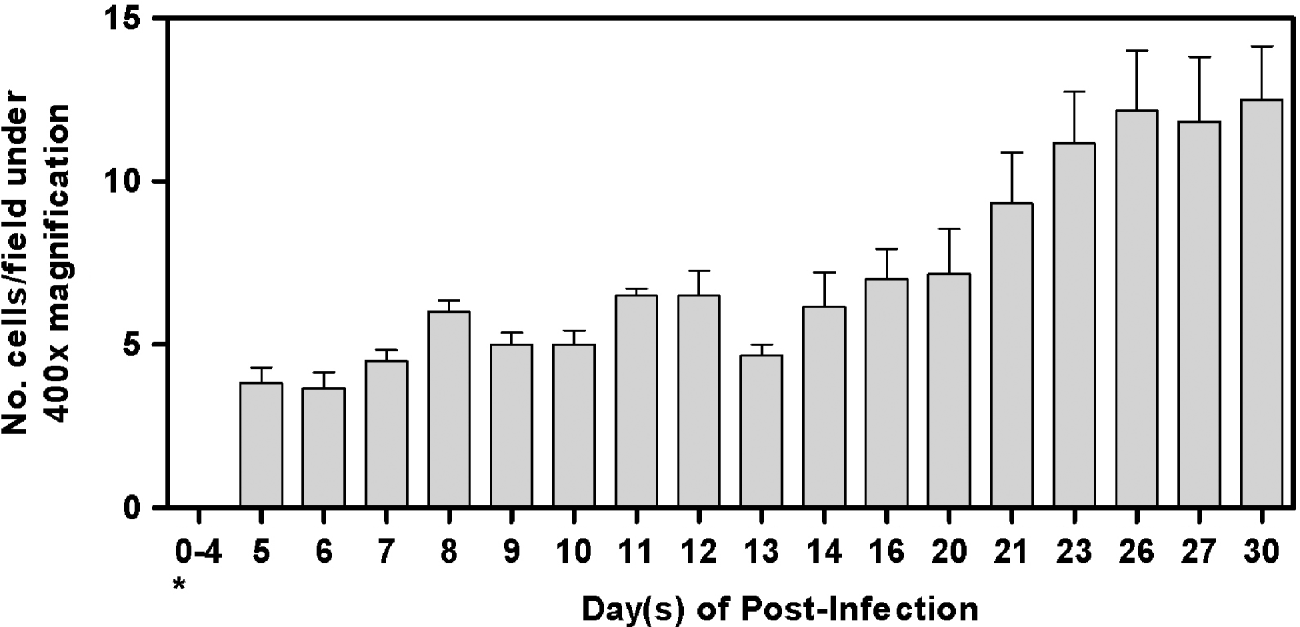
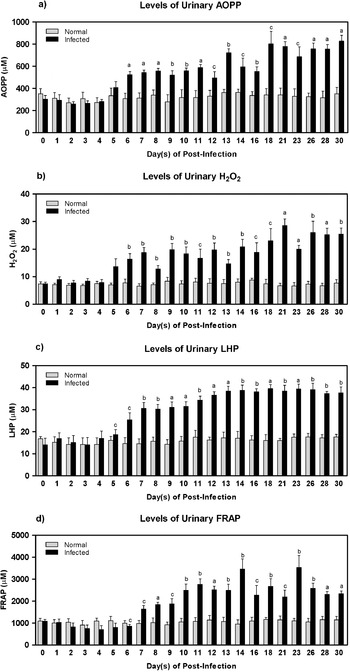
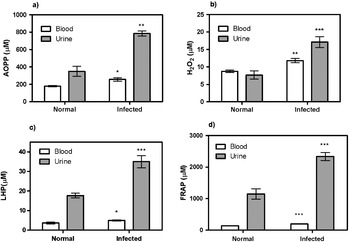
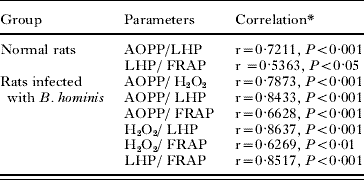
Rats from both normal and infected groups did not show any weight loss. The mean weight of the normal rats, before and after saline inoculation was 72 and 182 g respectively. The infected rats weighed 71·5 and 181·5 g, before and after cyst inoculation respectively. Examination of the contents from different parts of the gastrointestinal track confirmed that only the caecum and large intestine were positive for infection (results not shown). Fig. 1 shows the number of B. hominis (vacuolar form) per field under 400×magnification using direct microscopic examination. Day ‘0’ refers to the day on which any inoculation was done. The rats became infected with B. hominis on the 5th day post-inoculation. Generally, the burden of infections continued to increase until the last day of the experiment (Day 30). Fig. 2 illustrates the levels of AOPP, H2O2, LHP and FRAP in normal and infected rats. In controls, levels of oxidative indices were stable throughout the experiment. Whereas, in the infected rats, all 4 parameters were significantly higher (from Day 5 to Day 30) compared to Day 0. Fig. 3 shows the comparison of oxidative indices between blood and urine samples with their respective controls. Correlation analysis of AOPP, H2O2, LHP and FRAP levels in the study groups are shown in Table 1. Most of the parameters in this study showed a positive correlation when interrelated with each other.
Parasite burden in stool samples of rats according to days of infection. *Day ‘0’ refers to the day before any inoculation was carried out. Data are expressed as mean±SEM.

Levels of urinary oxidative indices: (a) AOPP, (b) H2O2, (c) LHP and (d) FRAP in normal and infected rats. Data are given as mean±SEM by Student's t-test (SPSS version 13). aP<0·001, bP<0·01, cP<0·05 is the comparison done against Day 0.

Comparison of oxidative indices: (a) AOPP, (b) H2O2, (c) LHP and (d) FRAP in blood and urine of both normal and infected rats. Data are given as mean±SEM by Student's t-test (SPSS version 13). *P<0·05, **P<0·01, ***P<0·001 is the comparison between infected and normal groups.

Correlation analysis of AOPP, H2O2, LHP and FRAP levels in the study groups

* Pearson's correlation coefficients test; differences were considered significant when P<0·05.
DISCUSSION
B. hominis, one of the most common intestinal protozoan parasites of humans, is known to show diverse morphologies and reproductive processes (Govind et al. Reference Govind, Khairul and Smith2002). The extreme debate regarding its role in the pathogenicity had led to the recent findings on both phenotypic and genotypic characteristics of asymptomatic and symptomatic human-derived B. hominis isolates (Tan et al. Reference Tan, Suresh and Smith2008). The current study was carried out to demonstrate other vital aspects of this parasite's pathogenecity including its effect towards the imbalance of free radicals:antioxidants in the host body.
Generally, when a host's immune system is triggered by an infection of parasites, a massive production of ROS or oxidative burst is activated by macrophages that are coupled with the inflammatory system (Rosen et al. Reference Rosen, Pou, Ramos, Cohen and Britigan1995). This acts as a first line of defence or immune response against the infection. Numerous studies have reported on the occurrence of intestinal inflammation caused by intestinal parasitic infection such as Trichuris sp. (Taylor et al. Reference Taylor, Zaph, Troy, Du, Guild, Comeau and Artis2009), Giardia sp. (Kohli et al. Reference Kohli, Bushen, Pinkerton, Houpt, Newman, Sears, Lima and Guerrant2008) and B. hominis (Garavelli et al. Reference Garavelli, Scaglione, Merighi and Libanore1992; Zuckerman et al. Reference Zuckerman, Watts, Ho and Meriano1994).
Simultaneously, macrophage or phagocyte activation causes the release of reactive species which lead to lipid peroxidation, protein damage and DNA strand breaks (Ohshima and Bartsch, Reference Ohshima and Bartsch1994). These damaged metabolites can be transported systemically throughout the host's body. A range of oxidation products are found in urine and are considered to reflect local and systemic oxidative stress (Kirschbaum, Reference Kirschbaum2001).
In the present study, infected rats did not show any solid symptoms such as diarrhoea, soft stool or weight loss in spite of the time-dependent increase of parasitic burden. This is possibly due to the asymptomatic isolate used to infect the rats. However, elevated levels of pro-inflammatory IL6 and IL8 cytokines in the serum of the infected rats indicate that inflammation at the site of infection may have occurred (personal communication). IL-6 and IL-8 have been reported to play an essential role in directing mechanisms which regulate inflammation (Moldawer, Reference Moldawer1994). In addition, the elevated levels of urinary AOPP, H2O2, and LHP in rats infected with B. hominis indicate that their overall oxidative damage level was higher compared to the uninfected rats. To date, this is the first study which demonstrates the oxidative damage caused by B. hominis infection in an in vivo animal model. Similar observations have been reported on other protozoan infections such as giardiasis and microsporidiosis (El-Taweel et al. Reference El-Taweel, El-Zawawy, Said and Sharara2007) which showed that infected groups had elevated levels of malondialdehyde (MDA) and myeloperoxidase. MDA is an end product of lipid peroxidation whereas myeloperoxidase is an enzyme that facilitates free radical-induced protein damage resulting in the production of AOPP (Witko-Sarsat et al. Reference Witko-Sarsat, Friedlander, Nguyen Khoa, Capeillere-Blandin, Nguyen, Canteloup, Dayer, Jungers, Drueke and Descamps-Latscha1998; Koh et al. Reference Koh, Park, Takahashi, Suzuki and Taniguchi2000).
Besides this, H2O2 produced during the activation of phagocytic cells by infections, is not harmful but it can convert into hydroxyl radical (•OH) when exposed to ultraviolet light or ferrous ion (Halliwell, Reference Halliwell1994) thus, it is often used as an indirect measurement of hydroxyl radicals (Banerjee et al. Reference Banerjee, Madhusoodanan, Nayak and Jacob2003). In the current study, high H2O2 levels in B. hominis-infected rats correlated with elevated oxidative damage products such as AOPP and MDA. Our results can be supported by the findings of a previous study which demonstrated the presence of H2O2 in the mouse hepatocytes infected with the trematode, Schistosoma mansoni. Visualization of oxygen radicals using a fluorescent tracer confirmed that hepatocytes of the entire infected liver succumbed to oxidative stress (Abdallahi et al. Reference Abdallahi, Hanna, De Reggi and Gharib1999).
The FRAP level indicates the total amount of non-enzymatic antioxidants such as lipid-soluble vitamins, namely vitamin E and vitamin A or provitamin A (beta-carotene), and the water-soluble vitamin C, uric acid, bilirubin and glutathione. Interestingly, our results showed that in the infected rats, the FRAP level on Day 6 onwards increased concurrently with other oxidative damage markers. This may lead to speculation that a high level of free-radical activity, which is stimulated to eradicate infection, will trigger the host's antioxidant regulatory mechanism in order to promote the level of antioxidants or reductants. Besides this, due to the insolubility and affinity for precipitation at high concentrations, the accumulation of uric acid in developing eggs of Ascaris lumbricoides (intestinal helminth) was suggested to be used in maintaining an osmotically constant environment in the water-impermeable eggs (Farland and Macinnis, Reference Farland and Macinnis1978). Therefore, one should not rule out the adaptation of such activity in B. hominis (vacuolar or cyst forms) and the possibility of releasing the uric acid into the blood stream of the host.
On the other hand, there was a significant decrease in the FRAP level during the last week of the study. In contrast, the results of parasitic burden and other oxidative damage parameters (AOPP, H2O2 and LHP) showed a consistent increase till the 30th. These observations lead to the assumption that when the burden of parasitic infection increases, the antioxidant status of the host may be overwhelmed by free radical-induced oxidative damage.
On the last day of this study, all rats were euthanized and the levels of oxidative indices in blood and urine samples were compared between the infected and uninfected groups. All the markers were significantly higher in both blood and urine samples of the infected rats compared to the controls. This observation suggests that in future, urine can be a substitute to blood which is difficult to collect and bleeding rats may influence the results especially in studies assessing oxidative stress status.
Apart from this, correlation analysis showed a significant positive association between the various oxidative indices tested, especially in the infected group. This implies that B. hominis infection affects oxidation and leads to an increase in oxygen radicals which may subsequently react with a broad variety of organic substrates causing oxidation of lipids and proteins. A positive correlation of FRAP with other oxidative damage indices such as H2O2, LHP and AOPP in the infected group indicates that the host's antioxidant regulatory system has always been combating the oxidative burst induced by infection. However, the significant decrease in FRAP levels along with the increase of parasitic burden during the last week of study duration may imply that the antioxidant regulatory system is overwhelmed by the disease or infection.
In conclusion, the present findings confirm our recent publication (Chandramathi et al. Reference Chandramathi, Suresh, Anita and Kuppusamy2009) that intestinal parasitic infection correlates well with oxidative stress status which can be assessed using a non-invasive sample (urine). To the best of our knowledge, this is the first study to establish an in vivo model which confirms that B. hominis could solely trigger free radical-induced damage particularly to lipid and protein. Therefore, the pathogenesis of B. hominis needs to be re-examined to understand more deeply the consequences of such an infection in the human body. The study underscores the importance of including Blastocystosis in routine parasitological investigation, especially when it can easily be acquired from contaminated water, food and possibly from animals (Leelayoova et al. Reference Leelayoova, Siripattanapipong, Thathaisong, Naaglor, Taamasri, Piyaraj and Mungthin2008; Chuong et al. Reference Chuong, Suresh, Mak, Init and Kathijah1996). The findings in this study also implicate treatment protocols in patients with asymptomatic Blastocystosis since, the long-term presence of such organisms may trigger unwarranted oxidative stress leading to life-style diseases. Furthermore, this study may influence future researchers to consider free radical-associated pathways to be the target for interventions of new drugs against parasitic infection related diseases.
ACKNOWLEDGEMENTS
This study was funded by the University Malaya grant UMRG 086-09HTM.