Heraclitus of Ephesus is often credited with the adage that “change is the only constant in life.” This may be truer during the COVID-19 pandemic than it has been in ages. Bill George (Reference George2020), former chair and CEO of Medtronic, suggested the pandemic “is changing work forever,” including an increased use of temporary and part-time workers, accelerated digital transformation, fewer middle managers and consultants, and a renewed focus on outcomes of work rather than employee inputs. Others have surmised that mandatory on-the-job medical screening could become the norm, business travel could be changed forever, and the standard 9-to-5 schedule could become a thing of the past (Connley etal., Reference Connley, Hess and Liu2020). Although it may be impossible to know what changes will occur, it seems clear that change is inevitable.
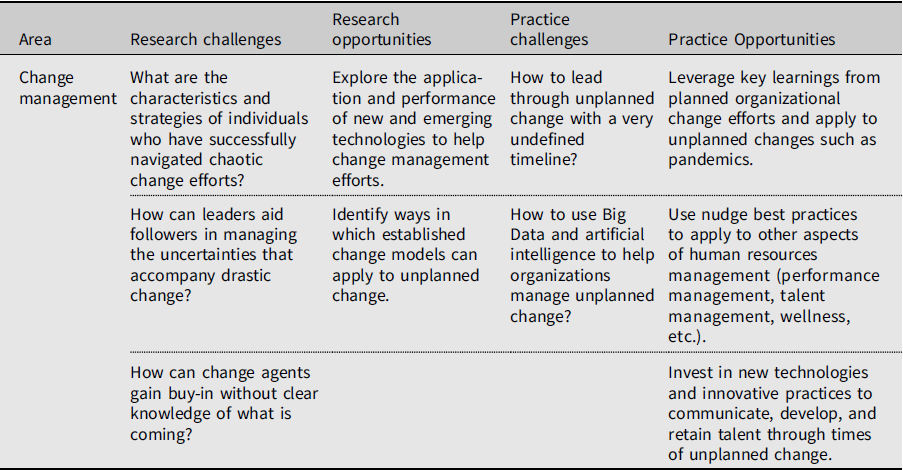
With this in mind, the purpose of this commentary is to call attention to an oft-overlooked area that can provide considerable benefit during the current and future pandemics, not only in its own right but also in combination with the areas highlighted by Rudolph etal. (Reference Rudolph, Allan, Clark, Hertel, Hirschi, Kunze, Shockley, Shoss, Sonnentag and Zacher2021)—that is, change management. Change management is defined by the Association of Change Management Professionals as the “practice of applying a structured approach to transition an organization from a current state to a future state to achieve expected benefits” (Association of Change Management Professionals, 2014, p. 9). Although it is subsumed under the broader umbrella of organization development, an area that is quite clearly under the purview of industrial and organizational (I-O) psychology, change management remains too often an afterthought when considering what I-O psychologists can offer to the workplace. As Truxillo etal. (Reference Truxillo, Bauer and Erdogan2016) note, “Given the importance of the human element in successful planning and implementation of change, I/O psychology has a lot to contribute to organizational change management” (pp. 545–546). In line with Rudolph etal., we provide details on how I-O psychology can contribute to pandemics via change management and provide the corresponding information that would accompany their tables (see Tables 1 and 2).
Table 1.
Summary of Change Management, “Subtopics,” and Prototypical Headline
Table 2.
Summary of Research and Practice Challenges and Opportunities Associated With COVID-19
Much of the research on organization development and change management has focused on intentional, deliberate change. Examples include, the “change as three steps” model (i.e., unfreeze—change—refreeze; Cummings etal. (Reference Cummings, Bridgman and Brown2016)Footnote 1, McKinsey 7-S framework (McKinsey & Company, 2008), Bridges’ transition model (Bridges, Reference Bridges1980), and Kotter’s eight-step process (Kotter, Reference Kotter1995). All of these involve deliberate steps to enact successful change efforts. Nevertheless, what is occurring during a pandemic, such as that with the COVID-19 pandemic, is likely far from intentional, or if it is, it is certainly reactive versus proactive. Moreover, there is uncertainty and change to a greater extent than usual. In addition, the turbulence is longer lasting, with uncertainty continuing for months or longer.
H. P. Lovecraft wrote, “The oldest and strongest emotion of mankind is fear, and the oldest and strongest kind of fear is fear of the unknown” (as cited in Joshi & Schultz, Reference Joshi and Schultz2001, p. 255). With COVID-19, much remains unknown, leaving individuals to feel uncertain in what they can, should, and must do. Unfortunately, uncertainty can lead to poor decision making, negative affect, and diminished well-being (see Anderson etal., Reference Anderson, Carleton, Diefenbach and Han2019). Thankfully, research on organization change has revealed that there are things that organizational decision makers can do to ease some of the uncertainty that employees may experience with respect to the workplace and actions that they can take to minimize pushback and ensure that changes are embraced and new policies and procedures followed.
The speed at which change has occurred has likely made some organizations realize they should have taken the steps that would have helped them be more successful. For example, Kim and Ployhart (Reference Kim and Ployhart2014) researched the effects of staffing and training on 369 firms’ productivity and profit over a 12-year span that covered before, during, and after the 2008 recession. From a change standpoint, this means all organizations were faced with the same unplanned change (much like organizations now with COVID-19). Not surprisingly, Kim and Ployhart found that those firms who invested in selected staffing and internal training prerecession both outproduced and outperformed their competitors. Moreover, they recovered more quickly after the recession due to the generated slack resources that protected and aided the firms. Thus, even those who were not actively engaged in or planning an organizational change were more resilient because they were hiring the right people and had ongoing employee development. This is great news for companies that have done just this, but what about those companies that did not make staffing and training a priority? Are they destined to fail?
Fortunately, the answer is no, as change efforts can still be successful despite lack of foresight. The very change models referenced above that focus predominately on planned organizational change can provide guidance for unplanned change as well. For example, all of the models referenced emphasize the need for generating buy-in from those disrupted by the change, whether through communication channels, coalition building, and shared values, among others. By doing so, there should be less resistance to change and more acceptance of it. As Burke (Reference Burke2002) aptly noted, “The phenomenon of resistance to change is not necessarily that of resisting the change per se but is more accurately a resistance to losing something of value to the person—loss of the known and tried in the face of being asked, if not forced, to move into the unknown and untried” (p. 92). Undoubtedly, the need for individuals to embrace change and support necessary initiatives to keep businesses afloat is of dire importance during pandemics.
Beyond the well-established theories of planned change, another approach that may yield even better results through unplanned change is nudge theory (Thaler & Sunstein, Reference Thaler and Sunstein2009). Nudge theory is a mindset and tactic that can be used to frame changes in a more attractive and effective manner. The basic theory is that “nudging” change along is much more effective than trying to enforce it in a traditional sense. So, instead of telling your employees what to do and how to change, you pave the way for them to choose to do so by themselves, thereby building commitment to the change while empowering employees and encouraging autonomy. As an example, qChange is having great success with using nudge theory to develop leaders and transform organizations, particularly through times of unplanned change.
Finally, and importantly, change management not only offers promise as an aid in and of itself; it can also serve as an aid in the important areas mentioned by Rudolph etal. (Reference Rudolph, Allan, Clark, Hertel, Hirschi, Kunze, Shockley, Shoss, Sonnentag and Zacher2021). For example, as employees are transitioning to increased telework and the use of virtual teams, the principles associated with change management can help employees understand and embrace the necessary adjustments. Likewise, change management has clear connections with the area of leadership, with the role of and influence of various leadership roles often highlighted as essential for organizational change efforts. For example, given their centrality in organizations, those in middle management are seen as being crucial in communicating messages and shaping responses to potential changes (Wooldridge etal., Reference Wooldridge, Schmid and Floyd2008). Similarly, in their meta-analysis on transformational leadership and employee reactions to organizational change, Peng etal. (Reference Peng, Li, Wang and Lin2020) found that transformational leaders improved their employees’ positive reactions to change. Specifically, they positively influenced their followers’ commitment to change, openness to change, and readiness to change, as well as reduced their followers’ negative reactions of resistance to change and cynicism about change. For the individual leader, these findings affirm the central and necessary role of well-developed leaders, especially during times of organizational change. We suggest additional research on the critical role of leadership during times of change, particularly unplanned change such as what we are experiencing now during the COVID-19 pandemic.
In sum, we propose that I-O psychology research, and change management research in particular, can be beneficial in helping organizations manage the changes they face during pandemics. We encourage researchers to look to this literature as they explore the areas highlighted by Rudolph etal. (Reference Rudolph, Allan, Clark, Hertel, Hirschi, Kunze, Shockley, Shoss, Sonnentag and Zacher2021) as well as explore how findings from the extant research can be used to assist organizations during these periods of unrest.






Heraclitus of Ephesus is often credited with the adage that “change is the only constant in life.” This may be truer during the COVID-19 pandemic than it has been in ages. Bill George (Reference George2020), former chair and CEO of Medtronic, suggested the pandemic “is changing work forever,” including an increased use of temporary and part-time workers, accelerated digital transformation, fewer middle managers and consultants, and a renewed focus on outcomes of work rather than employee inputs. Others have surmised that mandatory on-the-job medical screening could become the norm, business travel could be changed forever, and the standard 9-to-5 schedule could become a thing of the past (Connley etal., Reference Connley, Hess and Liu2020). Although it may be impossible to know what changes will occur, it seems clear that change is inevitable.
With this in mind, the purpose of this commentary is to call attention to an oft-overlooked area that can provide considerable benefit during the current and future pandemics, not only in its own right but also in combination with the areas highlighted by Rudolph etal. (Reference Rudolph, Allan, Clark, Hertel, Hirschi, Kunze, Shockley, Shoss, Sonnentag and Zacher2021)—that is, change management. Change management is defined by the Association of Change Management Professionals as the “practice of applying a structured approach to transition an organization from a current state to a future state to achieve expected benefits” (Association of Change Management Professionals, 2014, p. 9). Although it is subsumed under the broader umbrella of organization development, an area that is quite clearly under the purview of industrial and organizational (I-O) psychology, change management remains too often an afterthought when considering what I-O psychologists can offer to the workplace. As Truxillo etal. (Reference Truxillo, Bauer and Erdogan2016) note, “Given the importance of the human element in successful planning and implementation of change, I/O psychology has a lot to contribute to organizational change management” (pp. 545–546). In line with Rudolph etal., we provide details on how I-O psychology can contribute to pandemics via change management and provide the corresponding information that would accompany their tables (see Tables 1 and 2).
Summary of Change Management, “Subtopics,” and Prototypical Headline
Summary of Research and Practice Challenges and Opportunities Associated With COVID-19
Much of the research on organization development and change management has focused on intentional, deliberate change. Examples include, the “change as three steps” model (i.e., unfreeze—change—refreeze; Cummings etal. (Reference Cummings, Bridgman and Brown2016)Footnote 1, McKinsey 7-S framework (McKinsey & Company, 2008), Bridges’ transition model (Bridges, Reference Bridges1980), and Kotter’s eight-step process (Kotter, Reference Kotter1995). All of these involve deliberate steps to enact successful change efforts. Nevertheless, what is occurring during a pandemic, such as that with the COVID-19 pandemic, is likely far from intentional, or if it is, it is certainly reactive versus proactive. Moreover, there is uncertainty and change to a greater extent than usual. In addition, the turbulence is longer lasting, with uncertainty continuing for months or longer.
H. P. Lovecraft wrote, “The oldest and strongest emotion of mankind is fear, and the oldest and strongest kind of fear is fear of the unknown” (as cited in Joshi & Schultz, Reference Joshi and Schultz2001, p. 255). With COVID-19, much remains unknown, leaving individuals to feel uncertain in what they can, should, and must do. Unfortunately, uncertainty can lead to poor decision making, negative affect, and diminished well-being (see Anderson etal., Reference Anderson, Carleton, Diefenbach and Han2019). Thankfully, research on organization change has revealed that there are things that organizational decision makers can do to ease some of the uncertainty that employees may experience with respect to the workplace and actions that they can take to minimize pushback and ensure that changes are embraced and new policies and procedures followed.
The speed at which change has occurred has likely made some organizations realize they should have taken the steps that would have helped them be more successful. For example, Kim and Ployhart (Reference Kim and Ployhart2014) researched the effects of staffing and training on 369 firms’ productivity and profit over a 12-year span that covered before, during, and after the 2008 recession. From a change standpoint, this means all organizations were faced with the same unplanned change (much like organizations now with COVID-19). Not surprisingly, Kim and Ployhart found that those firms who invested in selected staffing and internal training prerecession both outproduced and outperformed their competitors. Moreover, they recovered more quickly after the recession due to the generated slack resources that protected and aided the firms. Thus, even those who were not actively engaged in or planning an organizational change were more resilient because they were hiring the right people and had ongoing employee development. This is great news for companies that have done just this, but what about those companies that did not make staffing and training a priority? Are they destined to fail?
Fortunately, the answer is no, as change efforts can still be successful despite lack of foresight. The very change models referenced above that focus predominately on planned organizational change can provide guidance for unplanned change as well. For example, all of the models referenced emphasize the need for generating buy-in from those disrupted by the change, whether through communication channels, coalition building, and shared values, among others. By doing so, there should be less resistance to change and more acceptance of it. As Burke (Reference Burke2002) aptly noted, “The phenomenon of resistance to change is not necessarily that of resisting the change per se but is more accurately a resistance to losing something of value to the person—loss of the known and tried in the face of being asked, if not forced, to move into the unknown and untried” (p. 92). Undoubtedly, the need for individuals to embrace change and support necessary initiatives to keep businesses afloat is of dire importance during pandemics.
Beyond the well-established theories of planned change, another approach that may yield even better results through unplanned change is nudge theory (Thaler & Sunstein, Reference Thaler and Sunstein2009). Nudge theory is a mindset and tactic that can be used to frame changes in a more attractive and effective manner. The basic theory is that “nudging” change along is much more effective than trying to enforce it in a traditional sense. So, instead of telling your employees what to do and how to change, you pave the way for them to choose to do so by themselves, thereby building commitment to the change while empowering employees and encouraging autonomy. As an example, qChange is having great success with using nudge theory to develop leaders and transform organizations, particularly through times of unplanned change.
Finally, and importantly, change management not only offers promise as an aid in and of itself; it can also serve as an aid in the important areas mentioned by Rudolph etal. (Reference Rudolph, Allan, Clark, Hertel, Hirschi, Kunze, Shockley, Shoss, Sonnentag and Zacher2021). For example, as employees are transitioning to increased telework and the use of virtual teams, the principles associated with change management can help employees understand and embrace the necessary adjustments. Likewise, change management has clear connections with the area of leadership, with the role of and influence of various leadership roles often highlighted as essential for organizational change efforts. For example, given their centrality in organizations, those in middle management are seen as being crucial in communicating messages and shaping responses to potential changes (Wooldridge etal., Reference Wooldridge, Schmid and Floyd2008). Similarly, in their meta-analysis on transformational leadership and employee reactions to organizational change, Peng etal. (Reference Peng, Li, Wang and Lin2020) found that transformational leaders improved their employees’ positive reactions to change. Specifically, they positively influenced their followers’ commitment to change, openness to change, and readiness to change, as well as reduced their followers’ negative reactions of resistance to change and cynicism about change. For the individual leader, these findings affirm the central and necessary role of well-developed leaders, especially during times of organizational change. We suggest additional research on the critical role of leadership during times of change, particularly unplanned change such as what we are experiencing now during the COVID-19 pandemic.
In sum, we propose that I-O psychology research, and change management research in particular, can be beneficial in helping organizations manage the changes they face during pandemics. We encourage researchers to look to this literature as they explore the areas highlighted by Rudolph etal. (Reference Rudolph, Allan, Clark, Hertel, Hirschi, Kunze, Shockley, Shoss, Sonnentag and Zacher2021) as well as explore how findings from the extant research can be used to assist organizations during these periods of unrest.