The perinatal period (or transition period), being 3-week before parturition (BP) and 3-week after parturition (AP) (Grummer, Reference Grummer1995), is of significance for the health of dairy ruminants. Two pathophysiological characterisations exist during the period, namely, negative energy balance (NEB) and oxidative stress. The crosstalk between them is an interesting and important research topic, and the oxidative phosphorylation taking place in mitochondria presents a critical link.
Sirt3, a Sirtuins family member, is a highly conserved mitochondria protein with NAD+-dependent deacetylase activities, playing a role in regulation of energy metabolism and mitochondrial function (Bause & Haigis, Reference Bause and Haigis2013). Its expression will be induced during times of energy deficiency, like fasting and caloric restriction. Sirt3 enhances the activity of Mn-SOD (or SOD2) by deacetylation at lysine residues (Qiu et al. Reference Qiu, Brown, Hirschey, Verdin and Chen2010), an enzyme catalysing the dissimilation of O−2 to form less toxic H2O2 and O2. Except for Mn-SOD, Sirt3 also regulates activities of the glutathione system and thioredoxin system, making it a master regulator of mitochondrial reactive oxygen species (ROS) detoxification. Thus far, there has been scant information regarding the expression levels and biological activities of Sirt3 in ruminants. The present study aims to describe the expression pattern of Sirt3 during perinatal period in the liver of dairy goats, so as to lay a foundation for the further functional role investigations of the protein.
Material and methods
The experimental procedures were approved and overseen by the Hunan Agricultural University Institutional Animal Care and Use Committee.
Animals and management
Ten dairy goats, in good health conditions as determined by licenced veterinaries, in 1–2 parities, in late pregnancy according to breeding records, were selected. Those goats were raised in a semi-pasture and semi-captive way. The goat feed compositon included 8·9% water, 91·1% dry matter, 8·4% crude protein, 4·7% crude fat, 11·3% crude fiber, 24·2% neutral detergent fibre,11·2% acid detergent fiber and 11·3% ash.
Sample collection and processing
Blood samples were collected by jugular venipuncture between 14:00 p.m. and 16:00 p.m. every 1 week. The serum was harvested by centrifuging at 1000 × g for 10 min, and stored at −80 °C for further use. Serum enzyme activities of Mn-SOD and NEFA levels were measured by following the instructions of commercial kits (Nanjing Jiancheng Bioengeering Institute, Nanjing, China).
Liver biopsy was manipulated by a standard operating procedure published previously (Yao et al. Reference Yao, Peng, Jiao, Liu, Xing, Jia, Yuan and Liu2017). Liver samples were snap-frozen in liquid nitrogen for future use.
RT -q PCR for Sirt3
Sirt3 gene expression was estimated by RT-qPCR with 5′-GGGAACTATAGGCCCAATGC-3′ and 5′-GAGCTTTGAGTCAGGGATGC-3′ as primers. Conditions are 95 °C for 10 min, followed by 40 cycles of 95 °C for 15 s and 60 °C for 1 min. The 2−△△Ct method was used for assessment of Sirt3 expression in different time points with β-actin as a reference gene.
Western blotting for Sirt3
Proteins from liver tissue were extracted by RIPA Lysis and Extraction Buffer. The same level of protein was loaded on gels for SDS-PAGE, and electrotransferred to a PVDF membrane (Millipore, MA, USA). The PVDF membrane was blocked with 5% skimmed milk powder, and thereafter was incubated with primary antibodies (Abcam, Cambrige, UK) at 4 °C overnight. Secondary antibodies (Cell Signaling Technology, MA, U.S.) were diluted at 1:3000, and incubated with at 37 °C for 30 min. Bands were revealed by enhanced chemiluminescence (ECL), and exposed on an ECL hyper film in FUJIFILM LAS-3000 (Tokyo, Japan). Protein quantification was determined by densitometry using Alpha software (FUJIFILM, Stockholm, Sweden).
Statistical analysis
Data are presented as means ± sem. Sirt3 expressions at different time were tested for significance (P < 0·05) by Student's t test using Excel 2016 (Microsoft, Redmond, WA, US). Correlation analysis was also operated by Excel 2016.
Results
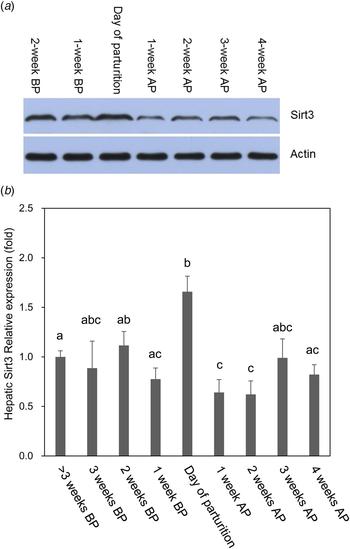
The dynamic protein profile of Sirt3 in the liver of dairy goats during perinatal period is presented in Fig. 1. Overall, the relative expression of Sirt3 was stable from >3-week BP to 1-week BP, and peaked on the day of parturition, then declined during the first 2-week after parturition, and returned to basal level. In particular, compared with >3-week BP, relative expression of Sirt3 in 1-week AP and 2-week AP was significantly lower (P < 0·05), but its expression on the day of parturition was significantly higher (P < 0·01). Compared with 2-week BP, Sirt3 expression was reduced from 1-week AP to 2-week AP (P < 0·05). Its expression on the day of parturition was higher than the rest except for 3-week BP, 2-week BP and 3-week AP. From 3-week AP on, the expression of Sirt3 showed no difference with that before kidding.
Hepatic Sirt3 protein profile during perinatal period in dairy goats. Sirt3 expression at different timepoints was analysed by western blotting with β-actin as a reference protein (a). Data are presented as means ± sem (b). Each data represents ≥5 replicates except for the day of parturition (n = 2). Data not sharing a common letter indicated there was a significant difference (P < 0·05, or P < 0·01).

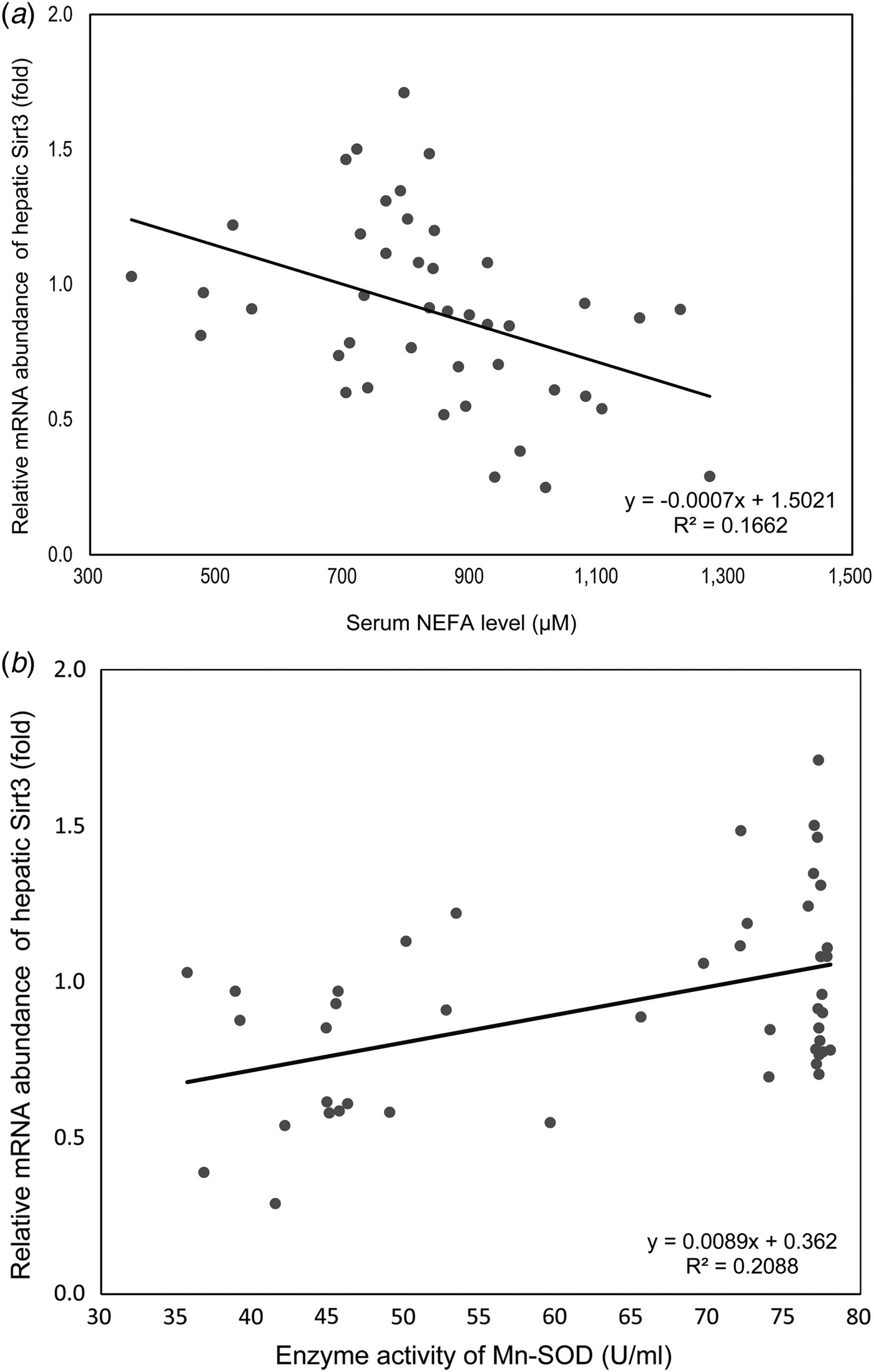
Correlative analysis between Sirt3 mRNA abundance and the serum NEFA levels showed a negative association with the correlation coefficient r = −0·41 (Fig. 2a). Correlative analysis between Sirt3 mRNA abundance and the activities of Mn-SOD in serum showed a positive association with the correlation coefficient r = 0·46 (Fig. 2b).
Corelative analysis between Sirt3 mRNA abundance and serum NEFA level and Mn-SOD activity. Correlative analysis between the Sirt3 mRNA abundance and serum NEFA levels demonstrates a negative association with the correlation coefficient r = −0·41 (a). There is a positive association between the Sirt3 mRNA abundance and serum Mn-SOD activity with the correlation coefficient r = 0·46 (b).

Discussion
During perinatal period, most dairy ruminants will suffer from NEB. The NEB is caused by the increasing requirement of extra energy for milk production at a time of reduced feed intake. It has been recognised as the pathologic basis for the most common metabolic syndromes (Sun et al. Reference Sun, Zhang, Wu, Shu, Xia, Xu and Zheng2014), e.g., fatty liver and ketosis, as it triggers the lipid mobilisation in adipose tissue. NEFA generated in adipose tissue surge into blood, and are absorbed and processed by the liver. On one hand, drastic NEFA oxidation will lead to the production of ROS and free radicals in excess. On the other hand, intermediate metabolites of NEFA like acetoacetic acids and β-hydroxybutyric acids are inducers of oxidative stress in ruminant hepatocytes (Song et al. Reference Song, Li, Gu, Fu, Peng, Zhao, Zhang, Li, Wang and Li2016; Du et al. Reference Du, Shi, Peng, Zhao, Zhang, Wang, Li, Liu and Li2017a, Reference Du, Yang, Xu, Peng, Zhang, Lei, Gao, Dong, Shi, Sun, Wang, Li, Li and Liub). Once the homeostasis between oxidation and antioxidation is disequilibrated, oxidative stress will take place.
Oxidative stress during the perinatal period has been confirmed in cows and goats (Radin et al. Reference Radin, Šimpraga, Vince, Kostelić and Milinkovićtur2015). There is evidence that oxidative stress in the liver is involved in the pathophysiology of metabolic syndromes in dairy cows (Song et al. Reference Song, Li, Gu, Fu, Peng, Zhao, Zhang, Li, Wang and Li2016; Du et al. Reference Du, Shi, Peng, Zhao, Zhang, Wang, Li, Liu and Li2017a). Mitochondria are the main sites where ROS and free radicals are generated, and Sirt3 appears to be one of the major regulators of antioxidation defence there. The oxidative stress after parturition seems to be more serious than that occurring in late pregnancy because the marker of oxidative stress malondialdehyde (MDA) increased postpartum (Radin et al. Reference Radin, Šimpraga, Vince, Kostelić and Milinkovićtur2015). Though increased NEFA and ketobodies postpartum may account for this, our present observation that Sirt3 was significantly down regulated during the first 2-week after kidding may also contribute to the worse oxidative stress postpartum. Besides its role in regulation of antioxidation defence, Sirt3 is also a key regulator of the β-oxidation of fatty acids and synthesis of ketone bodies (Hebert et al. Reference Hebert, Dittenhafer-Reed, Yu, Bailey, Selen, Boersma, Carson, Tonelli, Balloon, Higbee, Westphall, Pagliarini, Prolla, Assadi-Porter, Roy, Denu and Coon2013), which are interrelated biological processes during perinatal period. Thus Sirt3 can be a target for controlling oxidative stress during the period, especially the first 2-week post partum.
Our data revealed a positive association between serum Mn-SOD activity and expression of Sirt3. The result was reasonable given that there was plenty of evidence that Sirt3 could activate Mn-SOD by deacetylation at lysine residues. The association between those two also highlighted the significance of hepatic Sirt3 on systemic anti-oxidation defence, indicating that restoration of Sirt3 expression might be a promising strategy for the remission from oxidative stress during perinatal period.
Serum NEFA levels were negatively associated with hepatic Sirt3 expression. Du et al. demonstrated that incubation of NEFA with bovine hepatocytes in primary culture significantly reduced the mRNA and protein levels of Sirt1, another Sirtuins family member (Du et al. Reference Du, Yang, Xu, Peng, Zhang, Lei, Gao, Dong, Shi, Sun, Wang, Li, Li and Liu2017b). Of note, dairy cows with fatty liver had a significantly decreased Sirt1 expression (Du et al. Reference Du, Yang, Xu, Peng, Zhang, Lei, Gao, Dong, Shi, Sun, Wang, Li, Li and Liu2017b). However, whether Sirt3 expression would be inhibited by NEFAs needs further investigations.
Conclusions
In summary, decreased hepatic Sirt3 expression during the first 2-week after parturition might aggravate oxidative stress postpartum. The positive association between hepatic Sirt3 expression and serum Mn-SOD activities suggest a systemic role of hepatic Sirt3 on anti-oxidation defence.
The project was financially supported by the National Natural Science Foundation of China (No. 31502135), China Postdoctoral Science Foundation (No. 2017M612561), Research Foundation of Education Bureau of Hunan Province (No. 16B124) and Scientific Research Foundation for the introduction of talent in Hunan Agricultural University (15YJ05).