

INTRODUCTION
Paralacydonia is a genus described by Fauvel (Reference Fauvel1913), and was initially included in the Phyllodocidae and later transferred to the subfamily Lacydoniinae, in Phyllodocidae (Fauvel, Reference Fauvel1914, Reference Fauvel1923, Reference Fauvel1953). Hartman (Reference Hartman1959) and Hartman & Barnard Reference Hartman and Barnard1960 considered the genus as belonging to the Lacydoniidae. Pettibone (Reference Pettibone1963) established the family Paralacydoniidae to accommodate the monotypic genus Paralacydonia. For the establishment of Paralacydoniidae as a separate family, based on morphological data, Pettibone (Reference Pettibone1963) noted similarities between paralacidoniids and nephtyids, such as the parapodia supporting long lamellae, and the well separated rami with cilia between the notopodium and neuropodium. This finding persuaded subsequent authors to maintain this species within the Paralacydoniidae, a position that is maintained in this study. Molecular analysis using 18S rDNA data and 16S rDNA maximum-likelihood strongly supported a close relationship of the Lacydoniidae with the Paralacydoniidae (Böggemann, Reference Böggemann2009).
Only the type species Paralacydonia paradoxa Fauvel, Reference Fauvel1913, described from the Mediterranean, is usually accepted in Paralacydoniidae. Three other species, Paralacydonia weberi Horst, 1923, Paralacydonia mortenseni Augener, Reference Augener1924 and Paralacydonia paradoxa japonica Kitamori, Reference Kitamori1965 were synonymized with P. paradoxa. Uschakov (Reference Uschakov1958, Reference Uschakov1972) considered both as being the same species. However, no revision has been done to confirm or reject these proposed synonymies (Blake, Reference Blake, Blake, Hilbig and Scott1997), perhaps because of the difficulty in locating the type material.
Paralacydoniids are small worms that burrow in soft sediments, and although they inhabit deep water (to 5498 m depth), they have also been recorded at only 2 m depth (Kitamori, Reference Kitamori1965). Their body is elongated; the first parapodium is uniramous and the following parapodia are biramous. The notochaetae are simple; the neurochaetae are compound spinigers usually with one or two simple capillaries. Paralacydonia paradoxa has been recorded in the Pacific, including the Indo-Pacific, and the Atlantic Oceans. In the Atlantic, this species was known from the North Atlantic to the Gulf of Mexico until 2007, when Rizzo & Amaral (Reference Rizzo and Amaral2007) recorded it for the first time for the South Atlantic Ocean (Brazil, State of São Paulo). The present report is the first from the State of Rio de Janeiro.
MATERIALS AND METHODS
The material examined was provided from two campaigns of the Habitats Project–Campos Basin Environmental Heterogeneity coordinated by CENPES/PETROBRAS. The first campaign was carried out from 2 May to 15 July 2008, and the second from 31 January to 17 March 2009. The vessel used was RV ‘Emma McCall’. Samples were collected from different campaigns (HAB3–11; 13), Stations (A–I 1–11; Cang 6–9; Canac 6–9), replicates (1–3) and strata (0–2, 2–5 or 5–10 cm). The specimens were collected using box-corers. Polychaetes were sorted from the sediment, washed and fixed in 4% formol, stored in 70% ethanol and then identified. The collection depths ranged between 25 and 3250 m. The material collected was deposited in the Invertebrate Zoology Laboratory of the State University of Rio de Janeiro, in the Polychaeta Collection (UERJ).
Measurements and observations were carried out with the use of a Motic K400 stereomicroscope and an Opton microscope. An LEO 1450VP Carl Zeiss (Oberköchen, Germany) scanning electron microscope was used to obtain SEM micrographs after the biological material was dehydrated in an ethanol series: 70%, 80%, 90%, 100% (twice), critical point-dried with CO2 using a PELCO CPD 2 critical-point dryer, and coated with 10–15 nm gold using a Cressington Sputter Coater 108.
SYSTEMATICS
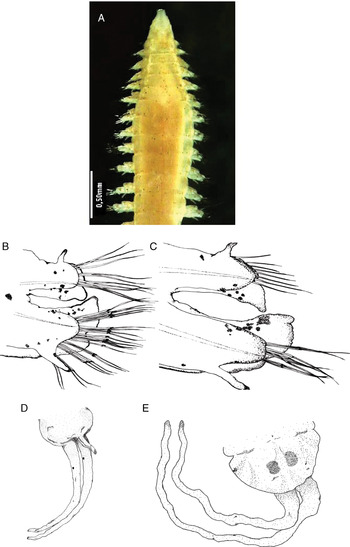
Paralacydonia paradoxa: (A) anterior region, dorsal view; (B) chaetiger 15, anterior view (400×); (C) chaetiger 40, anterior view (400×); (D) pygidium with three slender anal cirri (400×); (E) pygidium with two slender anal cirri, the third one was lost, and ocellar patches (400×).

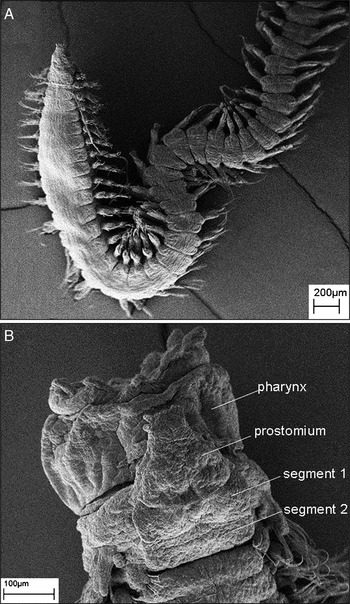
Paralacydonia paradoxa (SEM): (A) anterior and median region, dorsal view; (B) prostomium, first and second segments, and eversible pharynx, dorsal view.

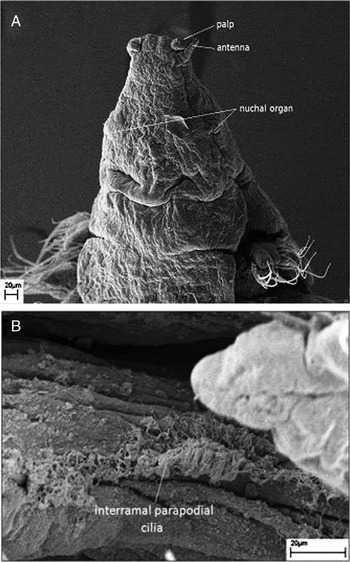
Paralacydonia paradoxa (SEM): (A) anterior end, including prostomium, cephalic appendages and nuchal organ, dorsal view; (B) interramal cilia from median parapodium.

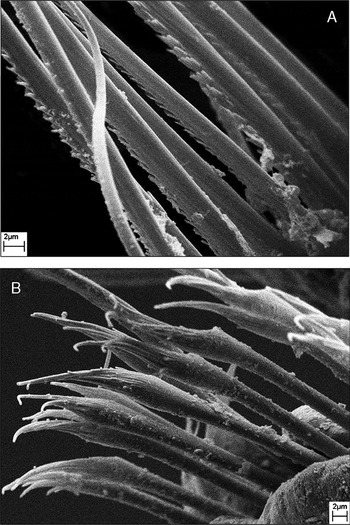
Paralacydonia paradoxa (SEM): (A) details of simple notochaetae, capillary; (B) details of compound neurochaeta, spiniger (upper: blade; lower: shaft).

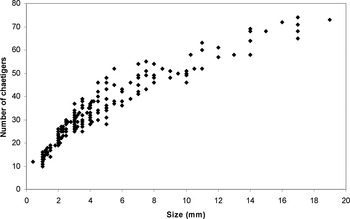
Relation between number of chaetigers and total length.

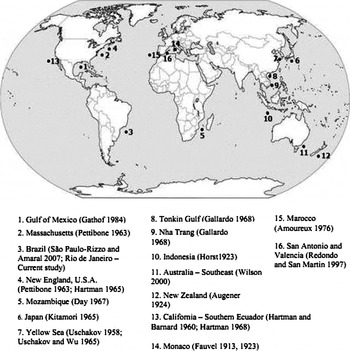
Distribution records of Paralacydonia paradoxa.

Paralacydonia paradoxa Fauvel, Reference Fauvel1913: 54, figure 10; Fauvel, Reference Fauvel1923: 198, figure 74e–I; Hartman & Barnard, Reference Hartman and Barnard1960: 86, plate 6, figures 1–3; Pettibone, Reference Pettibone1963: 184, figure 46; Hartman, Reference Hartman1965: 65; Day, Reference Day1967: 350, figure 15.3e–h; Gallardo, Reference Gallardo1968: 59, plate XI, figures 4–6; Hartman, Reference Hartman1968: 329, figures 1–3; Uschakov, Reference Uschakov1974: 216, plate XXXIV 4–9; Amoureux, Reference Amoureux1976: 11; Gathof, Reference Gathof, Uebelacker and Johnson1984: 34-5, figure 34-3a–I; Blake, Reference Blake, Blake, Hilbig and Scott1997: 352, figure 14.1; Redondo & San Martín, Reference Redondo and San Martín1997: 228, figures 1a–g; Rouse & Pleijel, Reference Rouse and Pleijel2001: 130–131, figure 31.1–31.2; Rizzo & Amaral, Reference Rizzo and Amaral2007: 39, figures 1–2.
Paralacydonia weberi Horst, 1923: 221, figures 1–2; Fauvel, Reference Fauvel1953: 129, figure 65e,f; Wilson, Reference Wilson, Beesley, Ross and Glasby2000: 141–143, figure 1.81a–e.
Paralacydonia mortenseni Augener, Reference Augener1924: 311, figure 3a–c; Augener, Reference Augener1927: 344.
TYPE SPECIES
Paralacydonia paradoxa Fauvel, Reference Fauvel1913, by monotypy.
DIAGNOSIS
Prostomium conical and elongated, bearing distally two pairs of bi-articulated cephalic appendages: one dorsal pair of antennae, and one ventral pair of palps. Muscular pharynx, unarmed, smooth, distally papillate. First segment achaetous, appendages absent. First chaetiger with neuropodium only, following chaetigers biramous, with notopodium and neuropodium connected by a ciliated ridge. Parapodium well-developed, with postchaetal and prechaetal lobes. Notochaetae simple, capillary; neurochaetae compound, spiniger.
MATERIAL EXAMINED
Off Rio de Janeiro, Campos Basin–UERJ 0446 (7 specimens): RV ‘Emma McCall’, box-corer, 3 July 2008, 23°37′51.37″S 41°19′46.78″W, 390.2 m, Station HAB7, A6, R1, 0–2; UERJ 0452 (3): RV ‘Emma McCall’, box-corer, 3 July 2008, 23°37′51.37″S 41°19′46.78″W, 390.2 m, Station HAB7, A6, R1, 5–10; UERJ 0453 (2): RV ‘Emma McCall’, box-corer, 7 July 2008, 21°44′17.18″S 40°05′24.22″W, 402.7 m, Station HAB7, H6, R2, 5–10; UERJ 0454 (2): RV ‘Emma McCall’, box-corer, 28 June 2008, 21°49′59.01″S 40°06′20.80″W, 469.4 m, Station HAB7, Canac6, R2, 2–5; UERJ 0455 (1): RV ‘Emma McCall’, box-corer, 3 July 2008, 23°37′52.86″S 41°19′49.02″W, 388.9 m Station HAB7, A6, R3, 0–2; UERJ 0456 (7): RV ‘Emma McCall’, box-corer, 3 July 2008, 23°37′52.75″S 41°19′48.91″W, 390.6 m, Station HAB7, A6, R2, 2–5; UERJ 0457 (4): RV ‘Emma McCall’, box-corer, 4 July 2008, 22°58′55.87″S 40°48′31.98″W, 386.8 m, Station HAB7, C6, R2, 5–10; UERJ 0458 (17): RV ‘Emma McCall’, box-corer, 3 July 2008, 23°37′51.37″S 41°19′46.78″W, 390.2 m Station HAB7, A6, R1, 2–5; UERJ 0459 (5): RV ‘Emma McCall’, box-corer, 3 July 2008, 23°37′52.75″S 41°19′48.91″W, 390.6 m, Station HAB7, A6, R2, 0–2; UERJ 0461 (4): RV ‘Emma McCall’, box-corer, 3 July 2008, 23°37′52.86″S 41°19′49.02″W, 388.9 m, Station HAB7, A6, R3, 5–10; UERJ 0462 (1): RV ‘Emma McCall’, box-corer, 7 July 2008, 21°44′17.11″S 40°05′24.26″W, 401.6 m, Station HAB7, H6, R3, 5–10; UERJ 0463 (14): RV ‘Emma McCall’, box-corer, 3 July 2008, 23°37′52.86″S 41°19′49.02″W, 388.9 m, Station HAB7, A6, R3, 2–5; UERJ 0464 (7): RV ‘Emma McCall’, box-corer, 4 July 2008, 22°58′55.87″S 40°48′31.98″W, 386.8 m, Station HAB 7, C6, R2, 2–5; UERJ 0465 (1): RV ‘Emma McCall’, box-corer, 9 July 2008, 22°33′31.81″S 40°26′45.50″W, 396.2 m, Station HAB7, D6, R2, 2–5; UERJ 0466 (6): RV ‘Emma McCall’, box-corer, 8 July 2008, 22°19′05.64″S 40°05′48.65″W, 402.3 m, Station HAB7, F6, R1, 2–5; UERJ 0467 (1): RV ‘Emma McCall’, box-corer, 27 June 2008, 21°49′57.87″S 40°06′19.89″W, 481.4 m, Station HAB7, Canac6, R1, 5–10; UERJ 0468 (1): RV ‘Emma McCall’, box-corer, 4 July 2008, 22°58′56.71″S 40°48′30.96″W, 399.7 m, Station HAB7, C6, R3, 5–10; UERJ 0469 (2): RV ‘Emma McCall’, box-corer, 7 July 2008, 21°44′17.11″S 40°05′24.26″W, 401.6 m, Station HAB7, H6, R3, 2–5; UERJ 0470 (1): RV ‘Emma McCall’, box-corer, 4 July 2008, 22°58′55.82″S 40°48′31.84″W, 387.4 m, Station HAB7, C6, R1, 0–2; UERJ 0471 (2): RV ‘Emma McCall’, box-corer, 3 July 2008, 23°37′52.75″S 41°19′48.91″W, 390.6 m, Station HAB7, A6, R2, 5–10; UERJ 0472 (7): RV ‘Emma McCall’, box-corer, 8 July 2008, 22°19′06.28″S 40°05′47.89″W, 404.6 m, Station HAB7, F6, R3, 5–10; UERJ 0473 (3): RV ‘Emma McCall’, box-corer, 8 July 2008, 22°19′05.64″S 40°05′48.65″W, 402.3 m, Station HAB7, F6, R1, 0–2; UERJ 0474 (4): RV ‘Emma McCall’, box-corer, 11 July 2008, 22°33′29.37″S 40°26′46.46″W, 393.4 m, Station HAB7, D6, R3, 2–5; UERJ 0475 (2): RV ‘Emma McCall’, box-corer, 4 July 2008, 22°58′56.71″S 40°48′30.96″W, 399.7 m, Station HAB7, C6, R3, 2–5; UERJ 0476 (5): RV ‘Emma McCall’, box-corer, 8 July 2008, 22°19′06.92″S 40°05′50.44″W, 403.9 m, Station HAB7, F6, R2, 5–10; UERJ 0477 (6): RV ‘Emma McCall’, box-corer, 8 July 2008, 22°19′05.64″S 40°05′48.65″W, 402.3 m, Station HAB7, F6, R1, 5–10; UERJ 0478 (10): RV ‘Emma McCall’, box-corer, 8 July 2008, 22°19′06.92″S 40°05′50.44″W, 403.9 m, Station HAB7, F6, R2, 2–5; UERJ 0479 (9): RV ‘Emma McCall’, box-corer, 8 July 2008, 22°19′06.28″S 40°05′47.890″W, 404.6 m, Station HAB7, F6, R3, 2–5; UERJ 0480 (2): RV ‘Emma McCall’, box-corer, 4 July 2008, 22°58′55.82″S 40°48′31.84″W, 387.4 m, Station HAB7, C6, R1, 2–5; UERJ 0481 (1): RV ‘Emma McCall’, box-corer, 22 May 2008, 22°47′08.64″S 39°55′28.17″W, 2513.9 m, Station HAB4, E11, R3, 2–5; UERJ 0482 (1): RV ‘Emma McCall’, box-corer, 6 July 2008, 21°41′58.41″S 40°06′21.70″W, 404.7 m, Station HAB7, H6, R1, 5–10; UERJ 0483 (1): RV ‘Emma McCall’, box-corer, 7 July 2008, 21°44′17.11″S 40°05′24.22″W, 402.7 m, Station HAB7, H6, R2, 2–5; UERJ 0534 (1): RV ‘Emma McCall’, box-corer, 8 July 2008, 22°20′46.35″S 40°03′44.10″W, 705.2 m, Station HAB7, F6, R3, 2–5; UERJ 1206 (7): RV ‘Emma McCall’, box-corer, 1 February 2009, 23°37′45.124″S 41°19′53.647″W, 400.5 m, Station HAB8, A6 R2, 2–5; UERJ 1207 (2): RV ‘Emma McCall’, box-corer, 5 February 2009, 21°44′8.948″S 40°5′12.087″W, 402 m, Station HAB9, H6, R3, 2–5; UERJ 1208 (3): RV ‘Emma McCall’, box-corer, 31 January 2009, 22°25′45.820″S 40°17′47.734″W, 380 m, Station HAB8, E6, R1, 2–5; UERJ 1209 (10): RV ‘Emma McCall’, box-corer, 31 January 2009, 22°58′47.506″S 40°48′41.096″W, 376.6 m, Station HAB8, C06, R3, 2–5; UERJ 1210 (1): RV ‘Emma McCall’, box-corer, 31 January 2009, 22°25′45.820″S 40°17′47.734″W, 380 m, Station HAB8, E6, R1, 0–2; UERJ 1211 (10): RV ‘Emma McCall’, box-corer, 1 February 2009, 23°37′44.033″S 41°19′50.860″W, 390.5 m, Station HAB8, A6, R3, 2–5; UERJ 1213 (1): RV ‘Emma McCall’, box-corer, 4 February 2009, 21°10′59.534″S 40°13′4.046″W, 683 m, Station HAB9, I7, R3, 0–2; UERJ 1214 (4): RV ‘Emma McCall’, box-corer, 1 February 2009, 23°37′45.124″S 41°19′53.647″W, 400.5 m, Station HAB8, A6, R2, 0–2; UERJ 1217 (1): RV ‘Emma McCall’, box-corer, 1 February 2009, 23°37′44.087″S 41°19′54.079″W, 390.7 m, Station HAB8, A6, R1, 5–10; UERJ 1218 (3): RV ‘Emma McCall’, box-corer, 1 February 2009, 23°37′44.033″S 41°19′50.860″W, 390.5 m, Station HAB8, A6, R3, 5–10; UERJ 1221 (2): RV ‘Emma McCall’, box-corer, 31 January 2009, 22°58′47.873″S 40°48′40.214″W, 380.6 m, Station HAB8, C6, R1, 5–10; UERJ 1222 (1): RV ‘Emma McCall’, box-corer, 11 July 2008, 22°33′20.763″S 40°26′52.631″W, 393.4 m, Station HAB7, D6, R3, 0–2; UERJ 1231 (1): RV ‘Emma McCall’, box-corer, 5 February 2009, 21°44′8.948″S 40°5′12.087″W, 402 m, Station HAB9, H6, R3, 5–10; UERJ 1232 (1): RV ‘Emma McCall’, box-corer, 5 February 2009, 21°44′8.790″S 40°5′12.005″W, 405 m, Station HAB9, H6, R1, 2–5; UERJ 1233 (3): RV ‘Emma McCall’, box-corer, 10 February 2009, 22°18′57.253″S 40°5′55.321″W, 400 m, Station HAB9, F06, R3, 0–2; UERJ 1234 (1): RV ‘Emma McCall’, box-corer, 10 February 2009, 22°18′57.253″S 40°5′55.321″W, 400 m, Station HAB9, F06, R3, 5–10; UERJ 1236 (5): RV ‘Emma McCall’, box-corer, 31 January 2009, 22°33′22.101″S 40°26′49.791″W, 401 m, Station HAB8, D6, R2, 2–5; UERJ 1237 (2): RV ‘Emma McCall’, box-corer, 7 February 2009, 21°49′49.417″S 40°6′7.338″W, 474 m, Station HAB9, Canac 6, R3, 2–5; UERJ 1238 (11): RV ‘Emma McCall’, box-corer, 10 February 2009, 22°18′57.253″S 40°5′55.321″W, 400 m, Station HAB9, F6, R3, 2–5; UERJ 1239 (4): RV ‘Emma McCall’, box-corer, 1 February 2009, 23°37′45.124″S 41°19′53.647″W, 400.5 m, Station HAB8, A6, R2, 5–10; UERJ 1240 (2): RV ‘Emma McCall’, box-corer, 7 February 2009, 21°49′50.119″S 40°6′8.332″W, 476 m, Station HAB9, Canac 6, R1, 5–10; UERJ 1241 (2): RV ‘Emma McCall’, box-corer, 1 February 2009, 23°37′44.087″S 41°19′54.079″W, 390.7 m, Station HAB8, A06, R1, 0–2; UERJ 1242 (1): RV ‘Emma McCall’, box-corer, 31 January 2009, 22°25′46.389″S 40°17′45.725″W, 387.1 m, Station HAB8, E6, R3, 0–2; UERJ 1244 (5): RV ‘Emma McCall’, box-corer, 4 February 2009, 21°13′25.522″S 40°15′10.531″W, 417 m, Station HAB9, I06, R1, 5–10; UERJ 1245 (1): RV ‘Emma McCall’, box-corer, 9 July 2008, 22°33′23.203″S 40°26′51.671″W, 396.2 m, Station HAB7, D6, R2, 0–2; UERJ 1246 (7): RV ‘Emma McCall’, box-corer, 31 January 2009, 22°25′46.389″S 40°17′45.725″W, 387.1 m, Station HAB8, E6, R3, 2–5; UERJ 1247 (2): RV ‘Emma McCall’, box-corer, 31 January 2009, 22°33′22.234″S 40°26′49.928″W, 400 m, Station HAB8, D06, R1, 2–5; UERJ 1248 (4): RV ‘Emma McCall’, box-corer, 31 January 2009, 22°18′50.882″S 40°5′41.019″W, 386 m, Station HAB8, F6, R2, 0–2; UERJ 1249 (11): RV ‘Emma McCall’, box-corer, 1 February 2009, 23°37′44.087″S 41°19′54.079″W, 390.7 m, Station HAB8, A6, R1, 2–5; UERJ 1250 (1): RV ‘Emma McCall’, box-corer, 31 January 2009, 22°33′22.234″S 40°26′49.928″W, 400 m, Station HAB8, D06, R1, 0–2; UERJ 1251 (1): RV ‘Emma McCall’, box-corer, 31 January 2009, 22°58′47.873″S 40°48′40.214″W, 380.6 m, Station HAB8, C6, R1, 2–5; UERJ 1252 (1): RV ‘Emma McCall’, box-corer, 31 January 2009, 22°25′46.389″S 40°17′45.725″W, 387.1 m, Station HAB8, E6, R3, 5–10; UERJ 1253 (1): RV ‘Emma McCall’, box-corer, 31 January 2009, 22°58′47.873″S 40°48′40.214″W, 380.6 m, Station HAB8, C6, R1, 0–2; UERJ: 1254 (3): RV ‘Emma McCall’, box-corer, 7 February 2009, 21°49′49.453″S 40°6′8.116″W, 474.8 m, Station HAB9, Canac 6, R2, 5–10; UERJ 1255 (1): RV ‘Emma McCall’, box-corer, 10 February 2009, 22°26′48.264″S 40°10′6.916″W, 700.7 m, Station HAB9, E7, R3, 0–2; UERJ 1256 (2): RV ‘Emma McCall’, box-corer, 31 January 2009, 22°58′47.668″S 40°48′38.325″W, 393.6 m, Station HAB8, C06, R2, 2–5; UERJ 1257 (9): RV ‘Emma McCall’, box-corer, 1 February 2009, 23°37′44.033″S 41°19′50.860″W, 390.5 m, Station HAB8, A6, R3, 0–2; UERJ 1258 (1): RV ‘Emma McCall’, box-corer, 31 January 2009, 22°25′45.849″S 40°17′45.934″W, 385 m, Station HAB8, E6, R2, 2–5; UERJ 1259 (5): RV ‘Emma McCall’, box-corer, 31 July 2009, 22°58′47.506″S 40°48′41.096″W, 376.6 m, Station HAB8, C06, R3, 0–2; UERJ 1260 (4): RV ‘Emma McCall’, box-corer, 5 February 2009, 21°44′8.790″S 40°5′12.005″W, 405 m, Station HAB9, H6, R1, 5–10; UERJ 1261 (1): RV ‘Emma McCall’, box-corer, 30 January 2009, 22°18′49.424″S 40°5′39.500″W, 383.8 m, Station HAB8, F6, R1, 5–10; UERJ 1262 (6): RV ‘Emma McCall’, box-corer, 31 January 2009, 22°18′49.424″S 40°5′39.500″W, 383.8 m, Station HAB8, F06, R1, 2–5; UERJ 1263 (3): RV ‘Emma McCall’, box-corer, 5 February 2009, 21°44′8.689″S 40°5′6.317″W, 404 m, HAB9, H6, R2, 0–2.
DESCRIPTION
Two hundred and fourteen complete specimens, body ranging from 1.5–18 mm in length and from 0.1–0.7 mm in width, reaching 74 chaetigers; the size is related to the number of chaetigers (Figure 5). Body whitish on smaller specimens, yellowish on largest ones when preserved in ethanol (Figure 1A). Small brownish points scattered on prostomium and along body, including parapodia (Figure 1A–C). Body elongated, slender (Figure 2A). Prostomium subconical, wider than long; oblong in adult. Pair of antennae located dorsally on distal part of prostomium, and pair of short, ventrally positioned palpi on end of prostomium; both bi-articulated (Figure 2B). Median antenna absent. Pair of nuchal organs as small knobs located laterally on prostomium (Figure 3A). Small eyes, subdermal, located in dorsal region between prostomium and peristomium; eyes seen by transparency in juveniles. Peristomium slightly fused to prostomium, involved or restricted ventrally to the mouth. Pharynx muscular, cylindrical, distally composed by nine soft conical papillae, these of same size (Figure 2B); jaw and paragnaths absent. First segment achaetous and without cirri (Figure 2B). Second segment (= first chaetiger) uniramous with neuropodia and neurochaetae (Figure 2B); following segments biramous. Notopodium approximately 1/3 shorter than neuropodium. Noto- and neuro-podia supported by an acicula and connected by a ciliated ridge (Figure 3B). Parapodia more slender and longer toward posterior region, composed of pre- and post-chaetal lamellae, both incised in the median portion and directed toward the inter-ramal region (Figure 1B, C). Prechaetal lamellae shorter than postchaetal lamellae; postchaetal lamellae slightly rounded on basal portion, becoming conical distally. Four to 14 notochaetae simple, capillary, with a face bearing transverse row of minute spines (Figure 4A). Neurochaetae predominantly spiniger, from 6 to 19, articulation of heterogomph type, with shaft fringed (Figure 4B); one or two simple, marginally spinulate neurochaetae may be present on the inferior position of the neuropodial fascicles. Dorsal and ventral cirri, both digitiform, ventral cirrus almost three times the size of dorsal cirrus (Figure 1B, C). Pygidium bulbous, slightly rounded, with three slender anal cirri, including pair of long cirri in lateral position and single short cirrus (1/6 length of lateral cirri) in central position (Figure 1D); single anal cirrus, when present, positioned above lateral cirri (usually lost in adult specimens). Juvenile specimens have two ocellar patches on pygidium (Figure 1E).
GEOGRAPHICAL DISTRIBUTION
Circumtropical (Figure 6). Pacific Ocean: from California to southern Ecuador; Indo-Pacific: Japan, Yellow Sea, Tonkin Gulf, Nha Trang (Vietnam), Indonesia, south-east Australia, New Zealand, Mozambique; Mediterranean: Monaco (type locality), San Antonio and Valencia (Spain), Morocco; Atlantic Ocean: New England (Massachusetts), Gulf of Mexico, and Brazil (off States of Rio de Janeiro, São Paulo and Paraná). At depths from 2 to 5498 m.
DISCUSSION
The type locality of Paralacydonia paradoxa is south of Monaco (Mediterranean), between 48 and 52 m depth. The holotype was not designated from any of the three specimens collected (Fauvel, Reference Fauvel1913: 55). The species was recorded for the first time in the South Atlantic (south-eastern Brazil) from depths of 156 to 400 m by Rizzo & Amaral (Reference Rizzo and Amaral2007). Because the comparison is based on phenotypic characters, this species has been considered eurybathic, having been recorded from 2 to 5498 m, with a circumtropical distribution and incursions into temperate waters (Figure 6). However, recent genetic studies of other polychaete families have pointed to complexes of cryptic species (e.g. Westheide & Hass-Cordes, Reference Westheide and Hass-Cordes2001; Westheide & Schmidt, Reference Westheide and Schmidt2003).
In the absence of genetic studies of paralacydoniids across wide geographical and bathymetric ranges, the purpose of this study is to quantify morphological characters from a restricted area. The specimens from off Rio de Janeiro show similarities to earlier descriptions of P. paradoxa. The size seems to be related to the number of chaetigers (Figure 5). However, some small differences between the present material and other descriptions can be noted. Comparing SEM images revealed differences in relation to the nuchal organ and its position on the prostomium. In the specimens examined here, a pair of nuchal organs that are present as small, slightly inflated knobs located laterally on the prostomium were clearly seen; whereas Rouse & Pleijel (Reference Rouse and Pleijel2001: figure 31.2b) found, in addition to a lateral pair, possibly a second pair, in a lateral depression on the posterior side of the prostomium.
The prostomial appendages have generated controversy among researchers, having been sometimes called antennae (Fauvel, Reference Fauvel1913; Hartman & Barnard, Reference Hartman and Barnard1960; Pettibone, Reference Pettibone1963; Hartman, Reference Hartman1965, Reference Hartman1968; Day, Reference Day1967; Gallardo, Reference Gallardo1968; Blake, Reference Blake, Blake, Hilbig and Scott1997; Redondo & San Martín, Reference Redondo and San Martín1997) or cephalic appendages or tentacles (Fauvel, Reference Fauvel1923; Uschakov, Reference Uschakov1974), and so may cause noise when used in analyses to try to establish the phylogenetic position of paralacydoniids in relation to other polychaete families. Nowadays, the presence of a dorsal pair of antennae and a pair of ventral palpi is well accepted (Wilson, Reference Wilson, Beesley, Ross and Glasby2000; Rouse & Pleijel, Reference Rouse and Pleijel2001). Palps are homologous structures that are largely supported in cladistic analyses, including paralacydoniids (Rouse & Fauchald, Reference Rouse and Fauchald1997) and did not change. An issue that still needs to be resolved is related to the peristomium: whether it is limited only to the ventral side of mouth (Rouse & Pleijel, Reference Rouse and Pleijel2001), or whether it also surrounds the mouth dorsally.
The presence of small subdermal eyes was noted in both juveniles and adults. Small eyes were also noted by Day (Reference Day1967), Gathof (Reference Gathof, Uebelacker and Johnson1984) and Redondo & San Martin (1997), but were not reported in other studies (Fauvel, Reference Fauvel1953; Hartman & Barnard, Reference Hartman and Barnard1960; Hartman, Reference Hartman1965; Gallardo, Reference Gallardo1968; Uschakov, Reference Uschakov1974; Blake, Reference Blake, Blake, Hilbig and Scott1997; Wilson, Reference Wilson, Beesley, Ross and Glasby2000).
The chaetae have not been examined in detail by earlier authors, and it is possible that they may show differences. Observations based on optical microscopy have indicated the presence of simple capillary notochaetae and compound spiniger neurochaetae. However, details seen only by means of SEM, such as transverse rows of minute spines located on the inferior face of the capillary chaetae and the presence of a fringe on the basal article of the spinigers, are characters that have been insufficiently observed.
Although a median papilla was mentioned by Rouse & Pleijel (Reference Rouse and Pleijel2001), it has not been observed in our specimens. It is possible that the median papilla mentioned by these authors is the scar of insertion of the third cirrus located centrally. We observed a third anal cirrus, about 1/6 the length of the lateral pair; a similar third cirrus was reported by Gallardo (Reference Gallardo1968: 59). This structure cannot be considered a papilla, because it is not a short rounded protuberance, but rather resembles one of the lateral cirri, only shorter. However, this third cirrus is usually lost in adult specimens (Pettibone, Reference Pettibone1963). Other authors have mentioned only a pair of long anal cirri (Uschakov, Reference Uschakov1974: figure 8; Blake, Reference Blake, Blake, Hilbig and Scott1997; Redondo & San Martín, Reference Redondo and San Martín1997; Wilson, Reference Wilson, Beesley, Ross and Glasby2000; Rizzo & Amaral, Reference Rizzo and Amaral2007).
These and other morphological characters, along with molecular studies, will be required to confirm or reject the hypothesis that P. paradoxa may be a single species with intraspecific variations, or a complex of cryptic species.
ACKNOWLEDGMENTS
This study was coordinated by CENPES/PETROBRAS through the Habitats Project–Campos Basin Environmental Heterogeneity. Our thanks to PETROBRAS for making it possible to collect and analyse the biological material. We appreciate the use of facilities and assistance at the Department of Zoology, Institute of Biology, State University of Rio de Janeiro (UERJ). Our thanks also to the Laboratório de Microscopia Eletrônica: Professor Luiz Henrique Monteiro Leal, Instituto de Biologia Roberto Alcântara Gomes (IBRAG), and also to Alan Cesar Nunes de Moraes for support with the SEM images. Thanks to Robin Wilson and Markus Böggemann for helpful comments and suggestions. Janet W. Reid revised the English text.