The treatment of bipolar disorder (BD) has changed drastically over the past 50 years. Early treatment models were primarily psychoanalytic in nature, based on the belief that mania was a more severe form of depression and a defense against an unpleasant psychological state (Klein, 1968). After the discovery of the therapeutic benefits of lithium by Cade in 1949, and further research indicating a strong role for genetics (see Goodwin & Jamison, 1990), treatment models shifted considerably based on the assumption that BD was completely influenced by biological factors and controlled (if not “cured”) by biological treatments. However, at the end of the 20th century, a growing research base indicated that pharmacotherapies are not usually adequate as stand alone treatments for BD. They often fail to bring about timely and complete remission from an acute episode (Hlastala et al., 1997) and to prevent the recurrence of new episodes (Goldberg, Harrow, & Grossman, 1995; Markar & Mander, 1989; Prien et al., 1984). In addition, recent research suggests that psychosocial factors, such as stressful life events (for reviews, see Hlastala, 2003; Hlastala & Frank, 2000; Johnson & Roberts, 1995), social support (Johnson, Sandrow, et al. 2000), and familial expressed emotion (Miklowitz, Goldstein, Nuechterlein, Snyder, & Mintz, 1988), influence the course of illness. This body of research has contributed to a more thorough understanding of the multiple factors influencing the onset of new episodes and recovery from mania and depression. Current state of the art treatment goes beyond basic medication management and incorporates a more comprehensive model emphasizing the complex interaction between psychosocial influences and biological factors as determinants of the long-term course of illness.
A comprehensive biopsychosocial treatment model is crucial, because the effects of BD can be devastating. In adults, BD is the sixth leading cause of disability among the physical and psychiatric disorders (Murray & Lopez, 1996; Woods, 2000). In adolescents, the majority exhibit substantial impairment in school, family, and social functioning (Lewinsohn, Klein, & Seeley, 1995). Bipolar adolescents also tend to exhibit greater impairments when compared to adolescents diagnosed with other psychiatric disorders. For example, Geller and colleagues (2000) found that youths with BD had greater psychosocial deficits, including interpersonal difficulties with their parents and peers, than youths with attention-deficit/hyperactivity disorder (ADHD) or community controls.
Bipolar patients have greater risk of suicide-related morbidity and mortality than any other patient population (Goodwin & Jamison, 1990). Twenty-five to 50% of patients with BD attempt suicide at least once during their lifetime (Jamison, 2000), and approximately 15 to 20% of bipolar individuals die by suicide (American Psychiatric Association, 1994; Goodwin & Jamison, 1990). Suicide is a considerable risk in early-onset BD as well. Lewinsohn and colleagues' community-based study indicated that 44% of bipolar adolescents had already attempted suicide one or more times. Some studies have also shown that bipolar adolescents have a higher rate of suicidality when compared to bipolar adults (McElroy, Strakowski, West, Keck, & McConville, 1997).
BD has profoundly negative effects on the individual, whether adolescent or adult, as well as their families. The majority of individuals with BD exhibit a recurrent and severe form of psychopathology, high risk of suicide, and a large degree of functional impairment. Thus, a large portion of this population requires a comprehensive treatment program that integrates psychopharmacological with psychotherapeutic interventions.
In adults, psychosocial therapies specific to the treatment of BD have only been developed and tested recently. In the past 10 to 15 years, a handful of psychotherapeutic approaches have received research attention, including psychoeducation (Colom et al., 2003), cognitive behavior therapy (CBT; Lam et al., 2003; Scott, Garland, & Moorhead, 2001; Zaretsky, Segal, & Gemar, 1999), family focused treatment (Miklowitz, George, Richards, Simoneau, & Suddath, 2003), and interpersonal and social rhythm therapy (IPSRT; Frank et al., 2005). Data from these studies suggest that adjunctive psychotherapy acts to speed recovery (Zaretsky et al., 1999), delay relapse (Frank et al., 2005; Lam, Hayward, Watkins, Wright, & Sham, 2005; Miklowitz et al., 2003), decrease suicide attempts (Rucci et al., 2002), and increase medication adherence (Cochran, 1984) in adults with BD.
In children and adolescents, current practice parameters specify that “a comprehensive multimodal treatment approach combining psychopharmacology with adjunctive psychosocial therapies is almost always indicated for early-onset BD” (American Academy of Child and Adolescent Psychiatry, 1997). Yet, at this time, there are no empirically validated psychotherapies for adolescents with BD. Preliminary findings on the application of family psychoeducational treatments to bipolar youth are promising (Fristad, Gavazzi, & Mackinaw-Koons, 2003; Miklowitz et al., 2004). However, a broader array of treatments, including individually oriented interventions, is needed to reflect the range of adolescent patient needs seen in real-world clinical practice.
To meet this clinical need, we are currently adapting IPSRT (Frank, 2005) to be more developmentally relevant to adolescents (aged 12–18) with BD. Detailed below is a description of IPSRT, the empirical evidence supporting its efficacy in adults, and the developmental modifications being made to the treatment to increase its relevance to adolescents with BD.
IPSRT
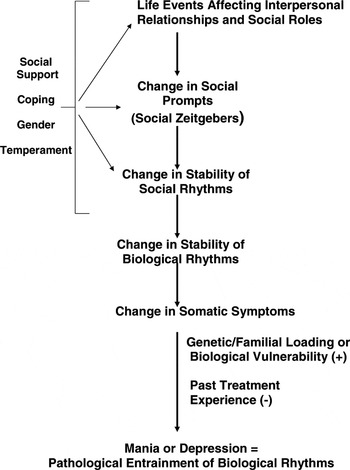
IPSRT (Frank, 2005) is a manual-based psychotherapy that grew out of the instability model of BD (Goodwin & Jamison, 1990) and the Social Zeitgeber theory of mood disorders (Ehlers, Frank, & Kupfer, 1988; Ehlers, Frank, Kupfer, & Monk, 1993). Together, these models suggest that at least one aspect of the biological diathesis for BD is a vulnerability of the circadian system and an increased susceptibility of neurotransmitter systems to dysregulation. In these models, psychosocial stressors are hypothesized to precipitate and/or exacerbate bipolar episodes through their ability to disrupt social and sleep routines. In vulnerable individuals (i.e., those with a bipolar biological diathesis), social routine disruption leads to a disruption of circadian systems resulting in new episodes of mania or depression (see Figure 1).

Schema for social zeitgeber theory.
Research in the past decade has provided support for this hypothesis by elucidating the roles that stressful life events (Hlastala & Frank, 2000; Hlastala et al., 2000; Johnson & Roberts, 1995), social support (Johnson, Meyer, et al., 2000; Johnson, Winett, Meyer, Greenhouse, & Miller, 1999), social routine disruption (Malkoff-Schwartz et al., 1998, 2000), and sleep disturbance (Wehr, 1989, Wehr, Sack, & Rosenthal, 1987) play in the onset and maintenance of mania and depression in adults. Adult patients with BD experiencing high amounts of psychosocial stress remit significantly slower (Johnson & Miller, 1997) and relapse significantly quicker (Ellicott, Hammen, Gitlin, Brown, & Jamison, 1990) than those with lower levels of stress. Similarly, patients with lower levels of social support take longer to recover from a depressive episode (Johnson, Meyer, et al., 2000). In addition, life events characterized by social rhythm disruptions (e.g., transmeridian air travel, birth of a child) have been found to precipitate manic episodes in individuals with bipolar I disorder (Malkoff-Schwartz et al., 1998, 2000). Further, sleep loss has been shown to trigger the onset of mania in patients with bipolar illness (Barbini, Bertelli, Colombo, & Smeraldi, 1996; Wehr et al., 1987).
Informed by these theoretical models and research findings, IPSRT attempts to address three interrelated pathways to symptom exacerbation in bipolar patients: medication nonadherence, disruptions in social and sleep routines, and psychosocial stressors (particularly those in the interpersonal realm). IPSRT addresses the interplay between the interpersonal and the biological spheres by helping patients see how psychosocial stressors and social role transitions can disrupt the daily routines that are important to the maintenance of circadian integrity. Specifically, IPSRT focuses on clarifying the patient's understanding of the relationship between psychosocial stressors and mood fluctuations, the importance of maintaining regular daily rhythms, the identification of potential precipitants of rhythm dysregulation, and the identification and management of affective symptoms. By addressing the interpersonal problem areas in the patient's life, IPSRT attempts to reduce the number, severity, and negative impact of interpersonally based stressors that the patient experiences. Additionally, IPSRT encourages patients to explore their feelings about having a serious life-long disorder, to grieve for the loss of their formerly healthy self, and to come to terms with how the disorder has affected their lives.
Interpersonal Interventions in IPSRT
The interpersonal techniques employed in IPSRT correspond with those described in Klerman and Weissman's description of interpersonal psychotherapy (IPT) for unipolar depression (Klerman, Weissman, Rounsaville, & Chevron, 1984; Weissman, Markowitz, & Klerman, 2000). IPT is a time-limited, manual-based psychotherapy that focuses on the relationship between current interpersonal problems and depressive symptoms. IPT does not presume that psychopathology arises exclusively from problems within the interpersonal realm; however, it emphasizes that these problems occur within an interpersonal context that is often interdependent with the illness process (Weissman et al., 2000). Thus, the primary focus of treatment is to identify and alleviate the interpersonal problems that are most specifically related to the patient's affective symptoms. The interpersonal problem areas consist of grief, interpersonal role disputes, interpersonal role transitions, and interpersonal deficits. A brief overview of the application of each problem area in adults with BD follows.
Grief in Adults
In IPSRT, grief is selected as the interpersonal problem area when patients describe the onset of depressive or manic symptoms in association with the death of a significant person in their life. The death of a spouse, parent, child, sibling, or close friend is a highly vulnerable time for an individual with BD, not only because of the significant psychological stress resulting from the event but also because social rhythms usually become drastically disrupted. For example, a man who experiences the death of his wife after 15 years of marriage, loses a significant stabilizer of his social rhythms. Most likely, over the course of their marriage, he and his wife had developed regular times of conversation (e.g., in the morning after waking up and before going to sleep), eating, and sleeping. This social routine pattern would undoubtedly become disrupted after his wife's death. Further, adults who have already experienced many recurrent episodes may be fearful that they will sink into a long protracted depression. During this difficult time, the IPSRT therapist can help the patient undergo the mourning process successfully. If the chosen interpersonal problem area is grief (either normal or unresolved), the primary goals of treatment are to facilitate the mourning process and to help the patient reestablish interests and relationships that can substitute for what has been lost (see Frank, 2005; Weissman et al., 2000, for specific strategies).
In addition to grief over actual losses, many adult bipolar patients mourn the “lost healthy self.” They often split their lives into two: before their diagnosis and after their diagnosis. Because of the severity of bipolar episodes, its life-long nature, the unpleasant side effects of medications used to treat the illness, and the deterioration in social functioning that often occurs over time, bipolar patients may need to compromise their ideals to make certain they stay healthy. In this case, the IPSRT therapist's task is to help the patient grieve for the healthy self that would be in better control of his/her moods, more successful in career or other responsibilities, and have more stable and meaningful relationships with their family and significant others (Frank, 2005).
Interpersonal Disputes in Adults
In IPT, an interpersonal dispute refers to any close relationship in which there are nonreciprocal expectations (Weissman et al., 2000). For example, a mother who expects her teenage daughter to confide in her about all the details of her life, while the teenage girl feels that she wants to keep certain details private and figure out how to solve her problems independently or with guidance from her friends. In this example, the mother and daughter each have different expectations about the relationship, which provokes conflict between them. In individuals with mood disorders, a transactional relationship exists between affective episodes and interpersonal problems, in that interpersonal disputes can provoke and/or exacerbate affective episodes and mood disordered individuals tend to “generate” stressful life events and/or interpersonal problems as a consequence of their illness (Hammen, 1990).
Anecdotal evidence suggests that adult bipolar patients have more overt interpersonal disputes with others than do patients with unipolar depression (Frank, 2005). This increased level of conflict with others may be a consequence of the attitude of entitlement and narcissism that is seen especially during the manic/hypomanic phase of the illness. Also, the chaotic and recurrent nature of the disorder can lead to a significant decline in social functioning over time (Gitlin, Swendsen, Heller, & Hammen, 1995). The general treatment goals for interpersonal role disputes are to help the patient first identify the dispute that is most related to his/her symptoms and modify the maladaptive communication patterns or reassess expectations (or both) to satisfactorily resolve the dispute (see Frank, 2005; Weissman et al., 2000, for specific strategies).
Role Transitions in Adults
A role transition is any major life change where an individual transitions from one social role to another (Klerman et al., 1984). The multiple roles that people hold within their family, community, work, and society as a whole work to define their sense of self. Thus, circumstances necessitating a rapid and significant change in one or more roles (e.g., married father to divorced man and single parent, working woman to stay at home mother, etc.), may be experienced as a loss. Many role transitions across the life span, such as the transitions from childhood to adolescence to independent adult to responsible parent to “empty nester,” are completely normative, but can be extremely stressful for individuals with mood disorders. Mood episodes often result when a person has difficulty with the changes required to make the necessary transition or when a person correctly recognizes failure in a particular role but is unable to change the behavior or to change roles (Weissman et al., 2000).
In IPSRT, role transitions become the focus of treatment if the change in social roles has a significant effect on the patient's affective symptoms, interpersonal relationships, social rhythms, and/or self-image. Treatment for role transitions include evaluating the old role, encouraging the expression of feelings such as guilt, anger, and loss, developing new social skills, and increasing the number and quality of social supports. A considerable emphasis is also placed on understanding how this role transition is influencing the patient's social rhythms and affective symptoms. Sometimes the lifestyle changes that need to be made to manage the patient's symptoms of BD necessitate a role transition. Some patients may need to rethink their choices of social and work roles and make some changes to decrease stress and overstimulation (Frank, 2005).
Interpersonal Deficits in Adults
Some adult bipolar patients present with significant and pervasive deficits in interpersonal skills that usually have a bidirectional relationship with their affective symptomatology. Unlike the chronic socially isolated form of interpersonal deficits frequently observed among unipolar patients (especially those with chronic depression) bipolar patients tend to be more “chronically dissatisfied” with other people in their lives. The excessive irritability that often accompanies both the manic and depressive poles can lead to pervasive interpersonal conflict and the tendency to either vilify or idealize others. This interpersonal pattern often results in a pattern of conflictual relationships or, ultimately, in social isolation (after the patient has burnt down all their social bridges).
Sleep and Social Rhythm Interventions in IPSRT
The social rhythm stabilization interventions are the most significant departure from traditional IPT for depression. By increasing lifestyle regularity and decreasing overstimulation, these interventions promote “balance” in the patient's life and work to stabilize the patient's circadian rhythms. Interventions aimed at regularizing social and sleep routines center around the social rhythm metric (SRM; Frank et al., 1994), a self-report form that requires patients to record 17 daily activities (e.g., time out of bed, first contact with another person, mealtimes, bedtime) that act to set the circadian system. (see Figure 2 for a simpler, five-item version of the SRM used in the Systematic Treatment Enhancement Program for Bipolar Disorder Study [STEP-BD]; Sachs et al., 2003). The patient also rates whether each activity occurred alone or with others present, how stimulating (i.e., quiet vs. interactive) these others were, and completes a mood rating for each day. In the first 3 to 4 weeks of treatment, the patient completes “free-running” SRMs to find those rhythms that are particularly unstable. Working with the SRM, the patient begins to see the dynamic interplay among instabilities in daily routines, patterns of social stimulation, sleep–wake times, and mood fluctuations. The data from the SRM are also integrated with the information obtained when documenting the history of the patient's bipolar illness and the role that life events, medication nonadherence, and circadian rhythm disruptions may have played in precipitating his/her manic and depressive episodes.

Social Rhythm Metric-II—Five-Item Version (SRM II-5).
Structure of IPSRT
IPSRT is divided traditionally into three phases. In the initial phase (the first three to four sessions), the therapist collects a thorough history of the patient's bipolar illness, reviews the relationships with all of the important individuals in the patient's life (i.e., the interpersonal inventory), initiates the SRM (Monk, Flaherty, Frank, Hoskinson, & Kupfer, 1990) to analyze the regularity of the patient's social routines, educates the patient about the importance of medication in the management of BD, and negotiates the interpersonal problem focus from among the four problem areas traditionally addressed in interpersonal psychotherapy for unipolar disorder (i.e., grief, interpersonal role transition, interpersonal dispute, or interpersonal deficits). During the intermediate phase, the therapist helps the patient develop strategies to stabilize daily rhythms, manage affective symptoms, and resolve the identified interpersonal problem area. The therapist also provides a forum for the patient to mourn lost “highs,” struggle with denial, and find a balance between spontaneity and stability. During the final phase of IPSRT (i.e., the last few sessions), the therapist focuses on termination of psychotherapy, reviews treatment successes as well as patient vulnerabilities, and helps the patient to identify strategies for future management of interpersonal problems and symptom exacerbations.
Efficacy of IPSRT in adults with BD
To date, the efficacy of IPSRT has been examined in two controlled studies. A large randomized controlled trial testing the efficacy of IPSRT has recently been completed in Pittsburgh (i.e., the Maintenance Therapies in Bi-polar Disorder Study, MTBD; MH29618, E. Frank, PI) and the results of this trial were reported in 2005 (Frank et al., 2005). IPSRT is also being studied in the multisite STEP-BD (Sachs et al., 2003) sponsored by the National Institute of Mental Health. The final results from the psychosocial treatment arm of STEP-BD are currently being analyzed. Therefore, below, we will discuss the study design, results, and implications of the MTBD study, through which we tested our hypothesis that IPSRT would be associated with shorter time to stabilization and longer time to recurrence than the contrast condition, an intensive clinical management (ICM) paradigm.
In the MTBD study, 175 acutely ill patients with bipolar I disorder were randomly assigned to one of four psychosocial treatment strategies in addition to a manual-driven pharmacotherapy protocol: acute and maintenance IPSRT, acute and maintenance ICM, acute IPSRT followed by maintenance ICM, or acute ICM followed by maintenance IPSRT. ICM, which acted as the “control” psychotherapy condition, is a nonspecific but active psychosocial intervention consisting of 10 elements: education about BD, education about medications used to treat BD, detailed inquiry about symptoms, detailed inquiry about somatic symptoms and/or medication side effects, medical and behavioral management of side effects/somatic symptoms, education about basic sleep hygiene, discussion of strategies to manage early warning signs of recurrent episodes, use of rescue medication when indicated, empathic listening and nonspecific support, and availability of a 24-hr on-call service. Therefore, ICM is by no means an inactive, “placebo” condition.
Acutely ill patients were randomly assigned to one of four treatment strategies: acute and maintenance IPRST (IPSRT/IPSRT), acute and maintenance ICM (ICM/ICM) acute IPSRT followed by maintenance ICM (IPSRT/ICM), or acute ICM followed by maintenance IPSRT (ICM/IPSRT). All study participants received protocol-driven pharmacotherapy. Participants who experienced a new affective episode during the preventative maintenance phase remained in their randomly assigned psychosocial treatment and were treated pharmacologically according to the polarity of the new episode. Patients were seen weekly in the preliminary phase. In the preventative phase, patients who remained clinically remitted were seen biweekly for the first 3 months and then monthly for an additional 21 months.
Our results indicate that IPSRT is an efficacious adjunctive treatment for bipolar I disorder. We found that patients who received IPSRT showed significantly greater stability of daily social routines and sleep/wake cycles during acute treatment than patients in an ICM condition (Frank et al., 1997, 2005). These findings suggest that IPSRT is efficacious in regularizing the daily life styles of recovering bipolar patients. Regarding our primary outcome of interest, the data suggest that IPSRT has different effects on the long-term course of illness than we originally hypothesized (Frank et al., 2005). We did not find a significant difference between acute IPSRT and ICM in time to remission. In addition, contrary to our hypotheses, we did not find a significant difference between maintenance IPSRT and ICM in time to recurrence. However, after controlling for covariates of survival time, we found that participants who were assigned to IPSRT during the acute treatment phase survived significantly longer without a new affective episode during the maintenance phase. Of importance, we also found that acute-phase IPSRT is associated with increasing SRM scores, and that higher SRM scores in the acute phase are significantly associated with longer survival time in the maintenance phase. This suggests that increased regularity of daily routines is a mediator of the effects of acute-phase IPSRT on likelihood of recurrence.
Developmental Adaptations for Adolescents with BD
IPSRT is currently being adapted to use with adolescents with BD. We are in the first phase of treatment development and piloting IPSRT-A in youths aged 12 to 18 diagnosed with a bipolar spectrum disorder (i.e., bipolar I, II, or not otherwise specified). Below, we document the adaptations that are developmentally indicated to apply IPSRT for use with adolescents.
Interpersonal problem areas
For adolescents, the interpersonal interventions of IPSRT-A correspond with the developmental adaptations made for interpersonal psychotherapy for depressed adolescents (IPT-A; Mufson, Dorta, Moreau, & Weissman, 2004). IPT-A was successfully adapted from the original IPT for depressed adults to better meet the needs of depressed adolescents. Several developmental theorists and researchers have identified changes in social roles and expectations as one of the most important domains of adolescence (Dahl, 2004; Steinberg & Morris, 2001; Weisz & Hawley, 2002). In addition, research has clearly documented the critical role interpersonal events and interpersonal skills play in the development and sequelae of adolescent mood disorders (Hammen, 1999; Marx & Schulze, 1991; Stader & Hokason, 1998). Interpersonal therapy focuses on current interpersonal issues that are significant areas of concern and importance to adolescents, such as individuation from parents, developing romantic relationships, and managing peer pressures (Mufson & Dorta, 2000). Adolescents are often very focused on and accustomed to discussing the interpersonal events that occur in their lives. Therefore, a focus on interpersonal problems that exacerbate mood symptoms is developmentally salient to teens.
Research indicates that IPT-A is an efficacious treatment for adolescent depression. After an open clinical trial (Mufson et al., 1994) and 1-year follow-up provided promising results for IPT-A (Mufson & Fairbanks, 1996), Mufson, Weissman, Moreau, and Garfinkel (1999) conducted a controlled, 12-week clinical trial of IPT-A in 48 adolescents who met criteria for DSM-III-R major depressive disorder. Adolescents (ages 12–18) who received IPT-A reported a greater decrease in depressive symptoms and a greater improvement in social functioning and problem-solving skills compared with adolescents in the control condition. Moreover, 75% of the adolescents who received IPT-A compared with 46% in the control condition were recovered by week 12. IPT-A has also proven to be efficacious in a study of depressed adolescents residing in Puerto Rico (Rossello & Bernal, 1999) and an effective treatment for depressed adolescents in school-based health clinics (Mufson, Dorta, Wickramaratne, et al., 2004).
A greater proportion of adolescents with BD exhibit significant interpersonal problems than depressed adolescents (Lewinsohn et al., 1995); therefore, the interpersonal interventions of IPSRT-A are not only developmentally relevant to adolescents, but disorder relevant (i.e., to the psychosocial factors contributing to the maintenance and or worsening of the bipolar illness course). The primary interpersonal areas (grief, interpersonal disputes, role transitions, interpersonal deficits) and the developmental modifications specific to adolescents with BD are described below.
Grief in adolescents
Several developmental differences exist between adult and adolescent grieving. Whereas an adult's grief is generally characterized by a sustained period of intense sadness, anger, and anhedonia, adolescents experience similar feelings but for briefer episodes interspersed by a return to normal activities (Christ, 2000). However, these intense feelings may recur throughout different periods of their development (Christ, Siegel, & Christ, 2002). Adolescents' reactions to the death of a loved one are shaped by their developmental capacities (Balk & Corr, 2001) and the available support from their living family members and peers (Hogan & DeSantis, 1994). Early adolescents' reactions (12–14 years) are often characterized by ambivalent expressions of dependence and independence and sometimes by expressions of selfish egocentrism (Christ, 2000), which can lead to conflict with surviving family members. An early adolescent may be experiencing complicated bereavement if s/he exhibits persistent anhedonia, school refusal, starting substance abuse, shifting to a more delinquent group of friends, precocious sexual behaviors, or persistent physical symptoms without an underlying cause (Christ et al., 2002). Middle adolescents (15–17 years), on the other hand, tend to be more constrained in their behavior, more understanding of situational demands, and often exhibit more empathy concerning their parents' needs than early adolescents (Christ et al., 2002). Because developmental tasks during this age include establishing intimate relationships outside the family and moving toward greater independence from the family, the grieving adolescent can be devastated if close friends misunderstand their grief or reject them because of their loss (Gray, 1989). A complicated grief reaction may be present if the mid-adolescent experiences adultlike grief beyond 6 months, development of more marked mood swings, withdrawal from peer interactions, persistent poor academic performance, and/or increasing high-risk behaviors with drugs, sex, and criminal activities (Christ et al., 2002).
In IPSRT-A, grief is the chosen problem area when the adolescent's mood symptoms are associated with abnormal grief reactions. However, a grief focus can also be used to promote a successful grieving process during a normal bereavement period especially because the period after a death of a loved one is an especially risky time for an adolescent with BD. The specific treatment goal with the problem area of grief is to help the adolescent cope with the real loss, resolve the positive and negative aspects of the adolescent's relationship with the deceased, and improve upon other relationships that can act to provide the support, companionship, or guidance that was lost (Mufson, Dorta, Moreau, et al., 2004). In addition, the adolescent may need help in expressing feelings, learning about the normal process of grief, and allowing the adolescent to experience the grief. As with adults, another large portion of the work should focus on helping the adolescent keep his or her social rhythms as stable as possible (Frank, 2005). This can be especially important after the death of a parent or sibling who lived at home which is extremely disrupting to the family routine.
As discussed earlier, the other potential focus of the grief problem area is to help the bipolar adolescent grieve for the lost healthy self. Many patients with early onset BD have a more chronic history and never had a premorbid period of healthy functioning. A majority of youth with early onset BD have emotional and behavioral disturbances, including ADHD and oppositional defiant disorder (Kovacs & Pollock, 1995), predating the onset of their BD. These adolescents are less likely to feel like their lives changed drastically around the time of the diagnosis. However, the adolescent and his/her parents may need to process the implications of having a severe and often debilitating mental illness at such an early age, how this has affected the adolescent's cognitive and psychosocial development, and what are appropriate expectations for the adolescent's future.
A smaller portion of patients present with a more “classic” acute onset occurring in adolescence. These teenagers are more likely to have met all their developmental milestones in a timely manner and have a normal to high level of psychosocial functioning prior to the onset of their illness. An example of a previously high-functioning adolescent with an acute onset of mania follows.
Case example of grief for the lost healthy self in an adolescent
Jack, a 14-year-old boy beginning the second semester of his freshman year in high school, presented to the IPSRT therapist in an episode of mania after recently being discharged from a psychiatric inpatient unit. He had no history of any emotional or behavioral problems before the onset of this, his first, manic episode. He lived with his biological parents and older brother in a warm, loving, and supportive family environment. Before his manic episode, Jack was a straight A student, participated in several academic clubs, a different sport every season, and was extremely active in his church youth group. He was, by any definition, a very high-achieving successful adolescent with dreams of becoming a doctor. Unfortunately, his manic episode was a severe one, with florid psychosis and bizarre behavior that was unlike anything his family had ever seen before. Fortunately, however, his symptoms were very responsive to medications and he improved rapidly. As he returned to school to finish up his freshman year, he was troubled by medication side effects (especially fatigue and lethargy), intermittent periods of hallucinations and mild delusional thinking, and his belief that he should complete all of his missed coursework and tests so that he could retain his perfect grade-point average (GPA). With the help of his IPSRT therapist he was able to decide that it was more important to stay healthy than to have a perfect GPA, and that he could still maintain a good GPA and his health if he had regularly scheduled studying times to avoid procrastination and last-minute “cramming.” He also worked with his therapist to plan his extracurricular activities for the upcoming year so that he had a balanced weekly routine that was not overstimulating.
Interpersonal disputes in adolescents
A typical, healthy teenager usually has a wide range of relationships of varying intensity with family members (including parents, grandparents, siblings, cousins), teachers, coaches, friends, and romantic partners. These relationships are of vital importance during the developmental stage of adolescence. Adolescents' friendships play an increasingly important role during this period because they aid in the development of skills from a variety of domains including social competency, motor performance, and cognitive abilities (Hartup, 1996). They provide an opportunity for the adolescent to gain increasing independence from his/her parents by testing their broadening skills and changing view of the world with individuals other than their family. Because of their importance, disputes with friends can contribute to the development of depressive episodes (Lewinsohn et al., 1994; Vernberg, 1990). However, although peers play an increasingly important role in adolescents' lives, there is some evidence indicating that parental relationships have stronger contributions than peer relationships to depression in youth at risk for mood problems (Aseltine, Gore, & Colten, 1994).
Research on interpersonal functioning and other psychosocial predictors of episode onset, recovery, and relapse in adolescents with BD is very limited. One study followed youth with prepubertal onset BD for 4 years (Geller, Tillman, Craney, & Bolhofner, 2004). The findings from this study indicated that bipolar youth had significantly greater impairment than ADHD youth on child–parent and child–peer interactions (Geller et al., 2000). In addition, low maternal warmth predicted earlier relapse (Geller et al., 2004), which is consistent with the more extensive literature implicating interpersonal stress within the family (i.e., expressed emotion) as a significant predictor of relapse in adults with BD.
Typically, when the chosen problem area is interpersonal disputes, the focus of work is on the bipolar adolescent's relationship with his/her parents. The grandiosity, oppositionality, and excessive risk taking that is indicative of mania/hypomania is often very frustrating and scary for the parent of a bipolar teen. Thus, parents may, understandably, become more intrusive and set stricter limits, which conflicts with their adolescent's developmental drive towards increasing autonomy. These nonreciprocal expectations can cause extensive conflict and exacerbate the adolescent's bipolar symptoms.
Medication nonadherence is a significant issue for adolescents with BD, and is often driven by interpersonal disputes with parents. Strober, Morrell, Lampert, and Burroughs (1990) found that 35% of adolescent bipolar patients were nonadherent to their lithium regimen over an 18-month period. The relapse rate for adolescents who were nonadherent (92.3%) was nearly three times the relapse rate of adolescents who continued to take their lithium (37.5%). A statistical analysis of the predictors of medication nonadherence was not completed. However, Strober et al. reported anecdotal evidence of increased levels of “ambient stress and interpersonal discord” in the families of nonadherent patients. Sometimes older adolescents may refuse to take their medications because they are striving for independence and separation from their parents. In such cases, the IPSRT therapist works with the adolescent to identify this pattern and find ways that the adolescent can strive for independence without compromising his/her recovery. It can also be helpful to involve the parents in therapy to work out a mutually agreeable plan where the parents can feel more confident that their child is taking their medication, while the adolescent does not feel like their parents are “breathing down their neck.”
Case example of interpersonal disputes in adolescents
Leslie, a 15-year-old girl with bipolar I disorder, presented to her IPSRT therapist after being discharged from the hospital for treatment of mania. Although many of her manic symptoms improved significantly in the hospital, she continued to be quite irritable, impulsive, and oppositional, especially with her parents. The interpersonal inventory revealed significant nonreciprocal expectations regarding family rules, limit setting, and normative teenage behavior. Her chief complaints were that her parents would “totally overreact about everything” and “won't let me do anything that normal teenagers get to do.” She believed that she was mature enough for her parents to “give me a place to live, food to eat, spending money, and let me do whatever I want.” Her parents were quite scared by her impulsive behavior while she was manic, which included running away for a weekend and experimenting with illegal substances. Thus, they were, understandably, excessively hypervigilant about potential symptoms of mania.
For Leslie, interpersonal interventions centered on several themes. Of primary importance, was the need to lower the general level of hostility and number of disputes in the household. Initial work focused on clarifying Leslie's and her parent's expectations of age-appropriate behaviors and responsibilities and their relationship to her symptoms of BD. Over two separate sessions, her parents were educated about Leslie's developmental drive towards autonomy and how to better distinguish her early manic symptoms (which were more specific than irritability) from more normative teenage moodiness. Moreover, her parents were encouraged to “choose their battles” and allow Leslie to express her autonomy in safe ways (i.e., style of dress, which was a frequent arguing topic) but enforce strict limits on potentially dangerous behaviors (i.e., hanging out with known drug-using friends). As Leslie's manic symptoms improved, the therapist worked with her to modify her expectations of what a supportive parent should act like (including setting appropriate limits) and worked towards putting herself “in her parents'” shoes. The latter continued to be significantly difficult for Leslie, and was often discussed throughout the therapeutic process with varying levels of success. Finally, communication analysis, examining which of her current interpersonal “strategies” to dealing with her parents worked and did not work, modeling, and role playing were used to help Leslie learn how to express herself better so that she could negotiate more effectively with her parents.
Role transitions in adolescents
The developmental period of adolescence, spanning “that awkward period between sexual maturation and the attainment of adult roles and responsibilities” (Dahl, 2004, p. 9) consists of a series of significant role transitions. In fact, recent developmental theorists have argued that adolescence is characterized by more biological, psychological, and social role changes than any other stage of life except infancy (Holmbeck et al., 2000). Adolescence begins with the biological/physical changes of puberty in the social status of a child (requiring significant adult monitoring) and ends in the physical and social status of an adult (requiring self-responsibility for his/her actions). Erikson (1968) delineated the normative transitions during adolescence, including passage into puberty, the shift from group relationships to dyadic relationships, the initiation of sexual desires and relationships, increasing independence from parents and family, taking steps necessary to support oneself financially, and taking responsibility for one's future through work, career, or college planning. This series of role transitions occurs in concert with the multiple biological changes of puberty, resulting in a complex and sometimes stressful developmental period. Because of this, adolescence was classically viewed as a period of “heightened storm and stress” (Hall, 1912). However, more recent research indicates that the vast majority of adolescents transition through this developmental period without any significant problems (Arnett, 1999). Unfortunately, these considerable biopsychosocial transitions can put youth with BD at risk for considerable behavioral and emotional problems.
In addition to the normative and predictable transitions of adolescence, unexpected events such as illness or changes in social status or family structure (e.g., parental divorce), can trigger and/or exacerbate affective symptomatology in bipolar youth. Conversely, depression and manic symptoms can impair the youth's ability to successfully negotiate a role transition. Even positive life changes, such as graduation from high school or starting college, can trigger episodes of mania or depression because of the psychological stress involved in the loss of familiarity and comfort with the current stage of life (Mufson, Dorta, Moreau, et al., 2004). Moreover, such role transitions are often accompanied by significant changes in social routines that place the teenager at specific risk for a manic episode (Malkoff-Schwartz et al., 1998, 2000).
Similar to work with adults, a role transition is identified as the problem area if the interpersonal history and review of life events suggests that the onset or significant exacerbation of depression or mania coincides with a social role changing event. The primary goals and strategies are the same as those used with adults except for parental involvement. Parents are educated about the relationship between the role transition and the adolescent's symptoms. Frequently, parents need to be educated about normal developmental tasks for an adolescent, the feelings that this transition may elicit in the parents, and ways to cope with their feelings (Mufson, Dorta, Moreau, et al., 2004). In IPT-A, Mufson, Dorta, Moreau, and colleagues (2004) include an additional focus on transitions specific to family structural change, such as parental divorce and issues specific to single parent families. This emphasis was added because of its high prevalence among mood disordered adolescents and the unique problems it creates in family functioning (Mufson, Moreau, Weissman, & Klerman, 1993).
Case example of role transition in adolescents
David, a 15-year-old boy with bipolar II disorder, presented to his IPSRT therapist in an episode of depression. He described his onset of depressive symptoms after the breakup with his girlfriend, Jennifer. They had a very intense relationship, and spent almost every moment together outside of school. After the breakup, David felt abandoned and betrayed because his friends sided with Jennifer and stopped inviting him to their social activities. Interpersonal work focused on mourning the loss of his former role as “Jennifer's boyfriend,” examining the positive and negative aspects of this former role, and his perception of his new role as an individual with his own interests and aspirations. He also learned ways to repair some of his friendships that were interrupted after the breakup. Further, with encouragement and roleplaying, he learned skills to make new friends who engaged in afterschool activities he enjoyed.
Interpersonal deficits in adolescents
The developmental period of adolescence is characterized by significant changes in the adolescent's interpersonal relationships with others, leading Weisz and Hawley (2002) to articulate that “developmental change within the social domain is a defining feature of adolescence” (p. 30). Therefore, one of the primary tasks during this developmental period is for the adolescent to learn successful strategies to navigate his/her way through the social world. Unfortunately, the onset of a severe, relapsing and remitting (if not chronic) mental illness before or during adolescence can drastically change this normative developmental trajectory and can interfere with the successful accumulation of interpersonal skills.
At this point in time, the specific effects that BD has on social skills development in adolescents are not known. Specific research regarding the transactional relationship between interpersonal problems and bipolar symptomatology during adolescence has not been conducted. However, Geller and colleagues (2000) found that prepubertal children with BD had significant deficits in their interactions with parents and peers. Fifty-six percent had no or few friends compared with 25% of ADHD youth and 6% of community controls. In addition, 63% of bipolar children were rated as having poor social skills compared to 30% of ADHD youth and 5% of community controls. Whether these deficits persisted during euthymic periods and/or how these deficits affected their development into adolescence was not reported.
As with adults, interpersonal deficits are not usually chosen as the specified problem area in the beginning of treatment. We often focus initially on the interpersonal dispute that is most related to the adolescent's current problems (often this is with their parents). As this relationship improves, work can focus on transferring/generalizing the interpersonal skills learned to other significant relationships in the adolescent's life. General strategies for interpersonal deficits include reviewing current and past relationships, exploring interactions with the therapist, identifying repetitive patterns and problems in relationships, highlighting strengths and skills, and building interpersonal skills (Mufson, Dorta, Moreau, et al., 2004).
Case example of interpersonal deficits in adolescents
Jennifer, a 17-year-old girl with bipolar II disorder, presented to her IPSRT therapist in a major depressive episode. Jennifer struggled with long periods of dysthymia interspersed with 3- to 4-month-long episodes of depression and 1- to 2-week periods of hypomania since the seventh grade. After conducting the interpersonal inventory, it became apparent that Jennifer's episodes were often precipitated and/or exacerbated by interpersonal problems with her parents or friends. Jennifer reported having a large number of friends, with whom she spent an extensive amount of time, however, she never confided in them or sought support from them about her problems, because she believed that “no one would understand me because my problems are so much bigger than theirs.” Her inability to disclose her feelings and seek support from others was apparent from a very early age even with her parents and siblings.
After the initial phase of therapy, it became apparent that this pattern was exacerbated by her difficulty in labeling and identifying her own emotional states. This problem, along with her considerable social immaturity and difficulty expressing herself verbally, made therapy quite challenging. Although Jennifer was 17 and typically would require/want less parental involvement in her therapy, her mother was asked to participate in about two-thirds of the sessions. In between sessions, Jennifer and her mother were asked to watch movies together and discuss the emotional content of the characters and her and her mother's feelings. During sessions, the therapist modeled with the mother discussing an interpersonal situation, labeling their feelings, and explaining why they felt that way. Jennifer was then encouraged to express how that situation might make her feel.
After she became more proficient in understanding her emotional response to events, the primary focus of work switched back to improving her long-standing pattern of nonreciprocal relationships and the connection to her symptoms. She redefined her expectations of how others might react to her disclosures. Through additional roleplaying, she learned appropriate ways of communicating with her friends/family and how to seek emotional support from important people in her life. Her mother was a key player in these interventions, and worked successfully at home to support her emotional communication. By the end of therapy, Jennifer continued to struggle with obtaining support from her friends, but was significantly more effective in appropriately expressing herself and seeking support at home.
Sleep and Social Rhythm Interventions With Adolescents
The research literature indicates that many adolescents in our society are sleep deprived. Adolescent sleep patterns have changed significantly in recent decades as a result of social and occupational demands, resulting in irregular schedules and sleep debt (Wolfson & Carskadon, 1998). Several biopsychosocial changes that occur during adolescence contribute to these sleep problems and can either precipitate or exacerbate symptoms of BD. First, adolescents experience a normal developmental shift in circadian patterns toward an “owl-like” tendency for later bed- and wake-up times (Carskadon, 2002). Second, adolescents' developmental drive towards increasing autonomy can result in a desire to stay awake after younger siblings and parents have gone to sleep. Third, modern technology, such as instant messaging, increases teenagers' abilities to communicate with their friends around the clock. These developmental factors push adolescents toward later bedtimes. This tendency, combined with earlier start times for junior high and high schools, contributes to increasing sleep debt as the school week progresses.
Although accumulating sleep debt is a problem for many adolescents, another contributor to circadian instability is the pattern of rapidly shifting sleep/wake schedules between school nights and weekend/vacations (Carskadon & Mancuso, 1988). It is common for adolescents to stay up until 3 a.m. on weekend nights and sleep in until 1 or 2 p.m. on a Saturday and Sunday only to attempt (without much success) to fall asleep at a reasonable hour on Sunday night in order to wake up at 5:30 or 6:00 a.m. on Monday morning. This disruption in sleep/wake schedules has been documented to adversely affect emotional, behavioral, and cognitive functioning in healthy adolescents (Wolfson & Carskadon, 1998). Given the extensive research literature indicating a clear role for circadian rhythm dysfunction in BD (Goodwin & Jamison, 1990), these commonly occurring sleep deficits and social routine disruptions would be particularly detrimental for adolescents with BD.
As with adults, the primary method for stabilizing social rhythms is through the use of the SRM (Monk et al., 1990). The adolescent version of the SRM is significantly shorter than the original 17-item SRM used in the Maintenance Therapies in Bipolar Disorder Study. It is based on the shorter, 5-item version (SRM-5; Monk, Frank, Potts, & Kupfer, 2002) with three other items added to promote healthy adolescent behaviors (i.e., exercise, homework, extracurricular activity of patient's choice; see Figure 3). Most of the work is a collaborative process with the adolescent to find the right balance. For example, how much time with friends, “down time,” time spent doing homework, and sleep is ideal?

Social Rhythm Metric (adolescent version).
The most common intervention focuses on minimizing changes in the adolescent's sleep schedule on the weekends. This negotiation process can be tricky, and must ultimately make sense to the adolescent or s/he will not adhere to the plan. Usually, we suggest one night (ideally Friday) of later bedtime of 1 to 2 hr. However, we recommend that the patient sleep in the next morning no later than 1 to 2 hr past the usual wake time. If the adolescent returns to his/her regular sleep/wake schedule for the rest of the weekend, s/he will be less likely to have a significant shift in his/her circadian rhythms and will have fewer problems returning to their weekly school schedule (R. Dahl, personal communication, 2005). Other common interventions include planning and scheduling for abrupt changes in social rhythms at the beginning and end of the school year. We usually work with the adolescent and his/her parents far in advance of summer to schedule structured activities that will provide routine and optimal levels of stimulation for the adolescent over the summer break.
Management of Resistance to Social Rhythm Tracking/Interventions
In our experience so far, we have found most adolescents “buy in” to the idea that their mood is affected by their sleep routine. Most teens recognize that they become, at a minimum, more irritable on days after a significant disruption in their sleep routine. Teens that are able to cognitively understand the rationale for stabilizing their sleep and social routines and believe that their routine has observable effects on their mood usually are willing to work on a minimum of three target activities (e.g., out of bed, go to bed, have dinner). We often use the approach of trying one week as an “experiment” to really concentrate efforts on increasing routine (particularly in regards to sleep). If they are willing to try it for 1 week, then the therapist elicits the teen's feedback regarding the pros and cons of being more routine and problem solves with the teen in a collaborative way to choose realistic, doable target times.
There are a minority of teens who refuse to complete the SRM-A or forget repeatedly to bring in the SRM-A. Rather than engaging in a power struggle, the therapist can shift more of the focus in therapy onto the interpersonal interventions and increasing rapport with the goal of returning to using the SRM-A when the teen's motivation to use the SRM-A has increased. If the teen is simply just forgetful, brainstorming solutions about when/where to fill out the SRM-A, reminders, and/or involvement of their parent can be helpful.
Family Involvement With Adolescents
Although IPSRT-A is primarily an individual treatment, parents play a significant role in their adolescent's treatment. The level of parental involvement depends on several factors including the cognitive and social developmental level of the adolescent and the interpersonal problem area chosen as the focus of treatment. Younger adolescents who are in an earlier stage of cognitive development need more parental involvement to act as an external reinforcer of therapy interventions and treatment gains. However, older adolescents who are gaining increased cognitive skills may benefit from a greater focus on individual work focusing on increasing the patient's autonomy and ability to successfully negotiate through their interpersonal problems with friends and family (Holmbeck et al., 2000)
The primary goals of introducing brief family interventions into IPSRT-A are to enhance the resolution of interpersonal problem areas, to educate the family about BD, and to engage the family to work together with the adolescent to improve his/her symptomatic and functional outcomes. Although it is not necessary for parents to be involved in the work related to the relevant interpersonal problem area, specific disputes within the family may improve more rapidly when the parents are brought into the process. This may be especially relevant for younger adolescents who are more reliant on their parents' influence than older adolescents.
Parents are also involved during the educational process and taking the history of the illness. Adolescents often have difficulty remembering details regarding the onset and offset of their mood episodes, the life events that may have precipitated these episodes, their previous interpersonal functioning, and medication usage. Thus, parents can be very helpful during the history taking process, and can help the adolescent to integrate the details of what can often be a chaotic and confusing history.
Although the adolescent is educated about BD throughout the course of IPSRT-A, the bulk is provided when the parents have joined the treatment sessions. Similar to family-focused treatment for adolescents (Miklowitz et al., 2004), family education issues focus on the following: education regarding BD and its treatments; the relationship between social/circadian rhythm disruption and mood symptoms; exploration of teen's and family's discomfort with diagnosis; how to distinguish between age-appropriate moodiness and symptoms of BD; individuation issues with an impaired/high risk adolescent; medication adherence strategies; lifestyle regularity strategies; guidance with behavioral management efforts. Parental involvement is especially important for younger adolescents who may become overwhelmed by some of the more specific information regarding medication and its side effects. In addition, clear, understandable education regarding the circadian system, social rhythms, and their relationship with symptoms of mania and depression are especially important so that the adolescent and his/her parents become invested in working on stabilizing the adolescent's routine. Often, the parents need to increase routine in their own lives (e.g., having a routine of a daily family dinner) in order to influence their adolescent's social rhythms. This is more relevant for younger adolescents whose schedules are more likely to be influenced by their parents than older adolescents.
Similarities and Distinctions Between IPSRT and CBT for BD
IPSRT and CBT have many similarities; they both focus on the here and now, incorporate behavioral interventions to help manage symptoms, provide education about BD, and help the patient to redefine their expectations regarding relevant areas of their life. Yet, IPSRT places a significantly greater emphasis on how the adolescent's expectations specific to their interpersonal lives influence their relationships with others and their bipolar symptoms. The IPSRT therapist encourages the adolescent to change their expectations through many strategies: education, encouraging the teen to put him/herself “in the other person's shoes” and understand the other person's perspective, encouraging the teen to understand how their current view of the person affects the relationship dynamic, looking for similar patterns of nonreciprocal expectations in previous or other current relationships, and discussing how changing their expectations may result in decreased negative feelings toward that person and an improved relationship. These topics are addressed through discourse during session, and do not entail specific written homework to instruct the teen to challenge their cognitions. Adolescents are encouraged to try out different ways of approaching difficult interpersonal situations in-between sessions, but are not expected to bring back written homework evaluating their attempts.
Conclusions
Recent advances have been made in understanding the complexities of BD across the life span. Comprehensive treatment models addressing the interaction between biological and psychosocial factors in the onset and maintenance of mania and depression have been developed and tested in adults within the past decade. One of these treatments, IPSRT, draws upon research findings demonstrating the important interplay between psychosocial stressors, circadian rhythm disruption, and affective symptoms in individuals with BD. The empirical evidence supporting its efficacy in preventing relapse in adults with BD is promising; however, more research is clearly needed to replicate this finding. To date, IPSRT has been tested only in individuals with bipolar I disorder. We are currently planning a study of IPSRT alone in adult patients with bipolar II disorder, but it remains to be seen whether this model applies equally to individuals presenting with bipolar II disorder or BD not otherwise specified.
Given that adolescents with BD exhibit a recurrent and severe form of psychopathology, high risk of suicide, and a large degree of functional impairment, theoretically based psychotherapies that address the psychosocial and developmental factors implicated in the onset and maintenance of early onset BD are clearly needed as well. Characterized by more biological, psychological, and social role changes than any other stage of life except infancy (Holmbeck et al., 2000), adolescence is a significant developmental period when the risk for onset of mood disorders rises precipitously. Unfortunately, much of the existing research on psychopathology occurring during this developmental period views psychological disturbance as “either the grown-up version of childhood disorder or the immature or prodromal counterpart of adult pathology” (Steinberg, 2002, p. 124). The primary focus of research on BD during childhood and adolescence has focused on phenomenology and the developmental considerations to be made when making a diagnosis. A comprehensive developmentally based, biopsychosocial model of early onset BD has not received much research attention. Therefore, we do not know if the theoretical model on which IPSRT is based adequately addresses the most salient factors related to the course of illness during this developmental period.
To address some of these concerns, we have placed a strong emphasis on nesting IPSRT-A within a developmental framework. The primary targets of IPSRT-A, interpersonal stress, and circadian rhythm dysregulation, are developmentally relevant for adolescents. Theoretical models and empirical findings suggest that stressful life events may play an even greater role in the onset of bipolar episodes among individuals who have experienced fewer episodes (Post, 1992) or are younger in age (Hlastala et al., 2000). In addition, the negotiation of interpersonal stressors is particularly salient during this developmental period. Moreover, interventions targeting lifestyle regularity are especially relevant for adolescents, because they often have very dysregulated sleep and social routines that would be especially harmful for a teenager with BD. The most significant adaptations of IPSRT-A include increased parent involvement (especially in younger adolescents), the addition of developmentally specific interpersonal interventions based on adaptations made to IPT-A, modification of the SRM to increase adherence and relevance with adolescents, and a greater number of handouts to aid in the psychoeducation process.
IPSRT-A relies heavily on the interpersonal interventions articulated by Mufson and colleagues, which were developed for adolescents with depression. However, there are some key differences between adolescents with BD and those with a unipolar mood disorder that required additional modifications. ADHD, oppositional defiant disorder, conduct disorder, and psychosis occur more commonly in adolescents with BD (Birmaher et al., 2006; Bowring & Kovacs, 1992). Therefore, we have found that parents of BD adolescents require significantly more education to help them understand their teen's behaviors in the context of their disorder/s (rather than just being unruly or difficult) and guidance regarding behavior management strategies, if necessary, to keep their teen safe. Adolescents with BD have a high suicide rate (Goldstein et al., 2005; Lewinsohn et al., 1995), and require more vigilance in regard to monitoring of suicidal or homicidal thoughts and behaviors than adolescents with unipolar depression. Further, therapy with a hypomanic or manic adolescent focuses more on interventions regarding social/routine stabilization and symptom management than on interpersonal work.
At this point in time, we have not completed our pilot study of IPSRT-A, and therefore, do not know whether IPSRT-A will have beneficial effects on recovery, relapse, and/or interpersonal, school, or overall functioning in adolescents with BD. After the completion of the pilot phase, a small-scale randomized clinical trial comparing 20 weeks of IPSRT-A (12 weekly plus 4 biweekly sessions) to treatment as usual in adolescents with a bipolar spectrum disorder (bipolar I, II, or not otherwise specified) will be conducted at the University of Washington. Participants' symptomatic and psychosocial functioning will be assessed at baseline, monthly during the intervention, and at 6-month follow-up.
Because patients' mood, behavior, and energy can seem like moving targets, BD has been called a “disorderly disorder” (Frank, Swartz, & Kupfer, 2000). The highs and lows can intermingle together or alternate rapidly on a weekly, daily, or even hourly basis. Some participants enter treatment in a manic/hypomanic episode, while others enter in a depressed or mixed state. Further, adolescents with BD often show more rapid cycling between mania and depression than their adult counterparts (Geller et al., 1995). This complexity adds an increased level of difficulty to the measurement of outcome in adolescents with BD. We are piloting the use of distinct measures of manic (Young Mania Rating Scale; Young, Biggs, Ziegler, & Meyer, 1978), depressive (Beck Depression inventory; Beck & Steer, 1990), and general symptomatology (Brief Psychiatric Rating Scale in Children; Hughes, Rintelmann, Emslie, Lopez, & MacCabe, 2001; Overall & Pfefferbaum, 1982). Because scores on the Y-MRS and the BDI will vary depending on the polarity of the presenting episode, we will use the BPRS-C as the primary outcome measure.
We are also using two measures of interpersonal functioning: the Social Adjustment Scale-Self Report (Weissman & Bothwell, 1976), a measure of social and school functioning in adolescents, and the Conflict Behavior Questionnaire (Prinz et al., 1979), a 20-item questionnaire designed to measure conflict and negative communication between the parent and adolescent. These measures will allow us to better examine whether IPSRT-A is having important targeted effects, such as increasing participants' interpersonal functioning with parents and peers and decreasing interpersonal conflict at home. Ultimately, we hope the findings from this research will add valuable information to the clinical armamentarium for BD across the life span.