Introduction
It is well-known that caregivers of people with dementia may suffer from high levels of psychological distress, such as depressive symptoms and feelings of burden (Schulz et al., Reference Schulz, O’brien, Bookwala and Fleissner1995; Pot et al., Reference Pot, Deeg and Van Dyck1997; Pinquart and Sörensen, Reference Pinquart and Sörensen2003; Black and Almeida, Reference Black and Almeida2004; Cuijpers, Reference Cuijpers2005). Psychological distress is in itself bothersome for caregivers, but is also associated with physical health problems, psychiatric morbidity, and reduced quality of life, which may result in a decrease in quality of care, neglect or even aggressive behavior towards the person with dementia (Clyburn et al., Reference Clyburn, Stones, Hadjistavropoulos and Tuokko2000; Bell et al., Reference Bell, Araki and Neumann2001; Connell et al., Reference Connell, Janevic and Gallant2001). In addition, caregiver burden has been found to be a predictor of nursing home placement of the person with dementia (Pot et al., Reference Pot, Deeg, Van Dyck and Jonker1998; Yaffe et al., Reference Yaffe2002; Etters et al., Reference Etters, Goodall and Harrison2008). Therefore, it is important to look for ways to prevent or reduce caregivers’ psychological distress as early as possible in the caregiving process. The more so because the number of people with dementia living in the community will increase considerably over the next decades and, as a result, the number of family caregivers will also increase (Prince and Jackson, Reference Prince and Jackson2009).
Interventions that include a combination of intervention strategies (multi-component interventions) and that address both the person with dementia and their caregiver (dyadic or combined interventions) seem to have good potential for caregiver outcomes (Acton and Kang, Reference Acton and Kang2001; Brodaty et al., Reference Brodaty, Green and Koschera2003; Ayalon et al., Reference Ayalon, Gum, Feliciano and Areán2006; Olazarán et al., Reference Olazarán2010; Brodaty and Arasaratnam, Reference Brodaty and Arasaratnam2012; Van't Leven et al., Reference Van't Leven, Prick, Groenewoud, Roelofs, De Lange and Pot2013). For example, these interventions consist of a combination of counseling, case management and skills training (Gitlin et al., Reference Gitlin2003). Although many studies on a wide variety of interventions have been conducted, evidence on their effectiveness is still rather limited due to conceptual and methodological issues such as small sample sizes. Effects on behavioral problems, cognition and mood in people with dementia and mood and burden in their caregivers are not always in the same direction and often rather small (Moon and Adams, Reference Moon and Adams2013; Van't Leven et al., Reference Van't Leven, Prick, Groenewoud, Roelofs, De Lange and Pot2013). An example of an effective multi-component and dyadic intervention is the one developed by Teri et al. (Reference Teri2003), which combined a physical exercise program with teaching caregivers behavioral management techniques and doing pleasant activities (Teri et al., Reference Teri1998; Logsdon et al., Reference Logsdon, Mccurry and Teri2005). This study showed positive effects on the mood and physical functioning of people with Alzheimer's disease (Teri et al., Reference Teri2003). The effects on caregivers’ health were not studied, while doing pleasant activities and physical exercise by caregivers themselves have been found to improve caregivers’ well-being in earlier research (Schulz et al., Reference Schulz2002; Parker et al., Reference Parker, Mills and Abbey2008).
We carried out a RCT (Prick et al., Reference Prick, De Lange, Scherder and Pot2011) to investigate whether an adjusted and elaborated version of the intervention of Teri et al. (Reference Teri2003) for community-dwelling people with dementia and their family caregivers, had a beneficial impact on caregivers’ mental health outcomes in the Netherlands. After a pilot study, using a translated version of the Teri intervention, we made changes to the original intervention components and duration to adapt the intervention to the Dutch care situation (Prick et al., Reference Prick, De Lange, Vant Leven and Pot2014). Because the evaluation of the pilot study showed that a proper execution of the intervention took more than one hour, we decided to drop the time-consuming behavioral management training based on the ABC model of behavior change and to concentrate on physical exercise, education, and a much more expanded version of the pleasant activities training. This choice was further motivated by the fact that cognitive reframing (based on the ABC theory) has already been shown to be effective (Vernooij-Dassen et al., Reference Vernooij-Dassen, Draskovic, Mccleery and Downs2011), whereas the effectiveness of physical exercise and pleasant activities training for people with dementia and their caregivers in the community was less well studied. Furthermore, the number of home visits was decreased to eight instead of the original twelve in order to comply with Dutch health insurance regulations about the number of home visits typically reimbursed, and the frequency of home visits in the first month was decreased to one instead of two home visits per week to reduce burden by a perceived lack of leisure time among the dyads that participated in the pilot study.
The purpose of the present study was to investigate the effects of this multi-component dyadic intervention on caregivers’ mood, burden, general health, and salivary cortisol levels; the effects on people with dementia will be published elsewhere.
Methods
Design
A RCT with three measurements (baseline, post-measurement after three months and a follow-up six months after baseline) was conducted. Before the start of the study, informed consent was requested from both the caregiver and the person with dementia. All people with dementia signed their own informed consent. After the baseline assessment a total of 111 dyads were randomly allocated to the intervention (n = 57) or comparison group (n = 54). Within two weeks after the baseline assessment the intervention started. The data were collected at the participants’ homes. Outcome measures in people with dementia and caregivers were assessed separately without each other's presence. Because most dyads lived together, the non-participant was asked to stay in another room. The Medical Ethics Committee of the VU University Medical Centre approved the study protocol (registration number 2008/320). The study design has been extensively described elsewhere (Prick et al., Reference Prick, De Lange, Scherder and Pot2011).
Procedure: randomization and blinding
We made use of the block randomization method to randomize the dyads into groups that result in equal sample sizes to ensure a balance in sample size across the two groups over time, which is a method of true randomization. An independent researcher made the random allocation schedule (in blocks of 20 dyads), using Random Allocation Software, version 1.0 (Saghaei, Reference Saghaei2004). Self-evidently, dyads, and coaches were aware of the treatment assigned. Although at the start of each measurement, examiners were blinded to the group allocation and dyads were asked not to disclose their group allocation, in practice group allocation became clear to the examiners during the intervention period.
Study population
One hundred forty-six community dwelling people with dementia and their family caregivers were recruited between November 2008 and June 2012 throughout the Netherlands via Alzheimer Cafés (public meetings for people with dementia, their caregivers and others), case managers, flyers and advertisements in newspapers, and on the Internet.
Family caregivers were defined as spouses, adult relatives or friends who live with or spend a minimum of four hours every day with the person with dementia. They had to have enough understanding of the Dutch language and needed to have at least some depressive symptoms (Centre for Epidemiologic Studies-Depression (CES-D) score >5) to be included in the study. Exclusion criteria for the caregivers were physical disorders that hampered assistance with the exercises, presence of psychotic symptoms, and use of antidepressants. Trained research assistants queried these exclusion criteria systematically during the intake to determine caregiver's eligibility.
The inclusion criteria for people with dementia were a diagnosis of dementia made by a physician (for instance a general practitioner, psychiatrist, geriatrician or a neurologist), a minimum age of 55 years, living at home with a caregiver, and willing to participate in the home visits. Exclusion criteria for people with dementia were the use of antidepressants, the presence of psychotic symptoms, Mini-Mental State Examination (MMSE) score < 14, and receiving more than two days respite care in a day care facility. For interested people with dementia, it was not required to ask their physician for permission to participate in this study.
Intervention
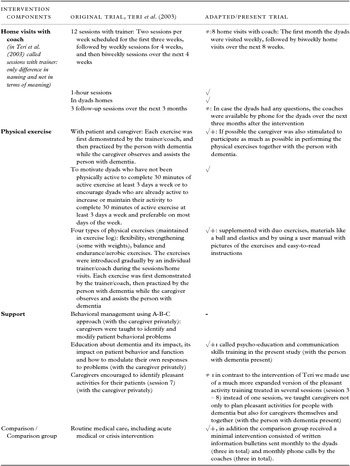
In our translated, adjusted and elaborated version of the intervention of Teri et al. (Reference Teri2003), dyads allocated to the experimental group received an intervention consisting of two components: a physical exercise component and a support component (Table 1). In line with Teri, the goal of the physical exercise component was to motivate dyads who have not been physically active to complete 30 minutes of active exercise at least 3 days a week or to encourage dyads who are already active to increase or maintain their activity to complete 30 minutes of active exercise at least 3 days a week and preferable on most days of the week. The physical exercises were with the person with dementia and caregiver together. Caregivers were taught to guide the person with dementia in a personalized program of four types of physical exercises: flexibility, strengthening, balance, and endurance exercises. Each exercise was first demonstrated by the coach, and then practiced by the person with dementia while the caregiver observes and assists the person with dementia. If possible the caregiver participated as much as possible in performing the physical exercises together with the person with dementia. To improve the attractiveness of the exercises for people with dementia, we added and integrated materials such as a ball, weights, and elastics to the original exercises. Alongside the instruction visits, all dyads received a user manual with pictures of the exercises and easy-to-read instructions. This manual also included specific home visits worksheets with information and psycho-education for each visit. The support component, taught in the presence of the person with dementia and the caregiver, included three elements: (a) psycho-education, (b) communication skills training and (c) pleasant activities training. The goal of psycho-education was to educate the dyad about dementia and its impact on the person with dementia and caregiver and how to deal with it. The communication skills training taught the caregiver techniques for facilitating the dyad's communication such as tips about speed, tone of voice, and the use of short sentences in communication. Pleasant activities training stimulated the implementation of pleasant activities in daily life for the person with dementia and the caregiver. In contrast to the intervention of Teri we made use of a much more expanded version of the pleasant activity training: we treated the pleasant activity training in several sessions (session 3–8) instead of one session and we taught caregivers not only to plan pleasant activities for people with dementia (planned together with the person with dementia as much as possible) but also for caregivers themselves and together (with the person with dementia present).
Overview intervention components original and adapted/present trial

Notes: √: exactly reproduced; √+: reproduced with supplement; ≠ : completely different reproduced ; -: not reproduced.
During three months, a personal coach visited the dyads for eight one-hour-long home visits. The first month the dyads were visited weekly, followed by biweekly home visits over the next eight weeks.
Each intervention component was delivered with both the person with dementia and the caregiver present. In case caregivers did not live with the person they cared for (in the case of their children, for example), they were asked to come to the care receiver's home during the intervention visits. The coaches were five trained MSc students of the VU University at the Department of Clinical Psychology who followed a special training program on geropsychology and an extensive training to provide the intervention. To ensure that all coaches followed the treatment protocol in the same way, a psychologist supervised all coaches during their first home visit and during two of the other home visits (chosen on the basis of pragmatic time schedule reasons of the psychologist) by joining the coaches during these visits. Furthermore, a supervision psychologist organized three supervision meetings for the coaches.
Comparison group with minimal intervention
In addition to the usual care, participants who were assigned to the comparison group also received a minimal intervention. This minimal intervention consisted of written information bulletins sent monthly to the dyads (three in total) and monthly phone calls by the coaches (three in total). These bulletins provided general information not included in the intervention in the experimental group such as information about car driving and general health in dementia. The goal of the ten minute phone calls was emotional support by listening.
Measures
General characteristics
Socio-demographic and clinical characteristics were recorded at baseline: age, gender, education level, type of dementia, cognitive functioning, former physical activity level in the person with dementia and client– carer relationship (spouse or other). The education level was determined on a seven-point scale varying from less than elementary school (0) to technical college and university (6) (Verhage, Reference Verhage1964). In people with dementia, the global level of cognitive functioning was determined with the Dutch version of the MMSE (Folstein et al., Reference Folstein, Folstein and Mchugh1975; Kok and Verhey, Reference Kok and Verhey2002). The previous physical activity level in the person with dementia was determined on a three-point scale varying from 0 times a week, moderate (1–2 times a week during minimal 30 minutes per time) and intensive (3 or more times a week during a minimal 30 minutes per time) during youth (<18 years old), during middle age (18–55 years old) and over the last ten years before participating in the intervention study.
Primary outcome
To measure the mood of the family caregivers, the Dutch version of the CES-D was used (Radloff, Reference Radloff1977; Bouma et al., Reference Bouma, Ranchor, Sanderman and Van Sonderen1995). This is a self-assessment questionnaire that identifies depressive symptoms over the last week. The CES-D consists of 20 items that can be answered on a 4-point Likert scale, which varies from 0 (never/incidentally) to 3 (most of the time/always). The range of the total score is 0–60. Higher scores indicated more severe depressive symptoms during the past week. The Dutch version of the CES-D has a good reliability and the Cronbach's α is 0.86 in this study.
Secondary outcomes
The Dutch Self-Perceived Pressure from Family Care (SPICC) was applied to measure caregivers’ feelings of role-overload (Pot et al., Reference Pot, Van Dyck and Deeg1995; Reference Pot, Deeg, Van Dyck and Jonker1998). This is a self-assessment questionnaire, which consists of nine items that can be answered with “Yes!,” “Yes,” “More or less” (1 point) or “No!,” “No” (0 points) creating a total score ranging from zero to nine. Higher scores indicated more perceived caregiver burden. The SPICC has a good reliability and the Cronbach's α is 0.78 in this study.
The Dutch version of the Revised Memory and Behavior Problem Checklist (RMBPC) was used (Teri et al., Reference Teri, Truax, Logsdon, Uomoto, Zarit and Vitaliano1992; Teunisse et al., Reference Teunisse, De Haan, Walstra, De Rooij and Zwart1997). This is a 25-item self-assessment questionnaire providing a caregiver-report measure of observable behavioral problems in people with dementia (frequency scale) in relation to caregiver distress (reaction scale). For the frequency scale, caregivers were asked to rate the frequency of each problem on a 0 (never) to 4 (daily or more) 5-point Likert scale, with a higher score indicating the occurrence of more behavioral problems. The scale consists of three largely independent, homogeneous subscales: memory-related behavioral problems (seven items, α 0.80 in this study), depressive behavior (ten items, α 0.83 in this study) and disruptive behavior (eight items, α 0.70 in this study). The overall Cronbach's α is 0.86 in this study. The reaction upset items were scored on a four point Likert scale (0 = no upset to 3 = extremely upset) in the Dutch version of the RMBPC (Teunisse et al., Reference Teunisse, De Haan, Walstra, De Rooij and Zwart1997), with a higher score indicating more perceived stress in caregivers. For behaviors that do not occur, a score of 0 (no upset) was assigned.
Self-rated general health was assessed using the standard single-item scale (1 = excellent; 2 = good; 3 = fair; 4 = poor; 5 = very poor). A higher score indicates worse general health. This frequently used measure has been shown to correlate highly with physician ratings of health (LaRue et al., Reference Larue, Bank, Jarvik and Hetland1979) and to be sensitive to health changes over time (Rakowski et al., Reference Rakowski, Fleishman, Mor and Bryant1993; Wagner et al., Reference Wagner, Lacroix, Grothaus and Hecht1993).
Salivary cortisol was collected at baseline and post-measurement to measure the physiological responses to stress, i.e. changes in the activity of the hypothalamic-pituitary-adrenal (HPA) axis, reflected in cortisol secretion (Kirschbaum, 1994). Caregivers were given written and oral instructions for collecting salivary samples at home. Samples were obtained directly after awakening and 30 minutes after awakening at baseline and post-measurement. Caregivers were instructed not to eat and drink or smoke during these 30 minutes and to write down the exact time of cortisol sampling on a paper on which the above mentioned restrictions were also printed. Samples were collected with a cotton dental roll and stored in a capped plastic vial (Salivette; Sarstedt, Etten-Leur, the Netherlands). Saliva samples were stored at −20 °C until analysis. Salivary free cortisol levels were analyzed using competitive immunoassay (Architect, Abbott Laboratories, Diagnostics Division Abbott Park, Illinois, USA). The intra-and inter-immunoassay variability were 4–9% and 6–11% respectively. All laboratory measurements were performed by the VU University Medical Centre clinical chemistry department. Cortisol level at the time of morning awakening (CAL) and cortisol awakening response (CAR) were determined. The CAR was defined as the change in cortisol level from the first to the second salivary sample (directly after awakening and 30 minutes later).
Data analysis
All data were analyzed using IBM SPSS Statistics 20. First, descriptive statistics were calculated for participants in the intervention and comparison group and all the baseline variables were analyzed for the differences between the comparison and experimental group by means of independent-sample t-tests for continuous variables and χ2 tests for categorical variables. Second, the baseline characteristics of dropouts and completers were compared using independent-sample t-tests and χ2 tests.
Thirdly, the effectiveness of the intervention on all outcomes was evaluated between the two groups using GEE (Zeger et al., Reference Zeger, Liang and Albert1988; Twisk, Reference Twisk1997; Reference Twisk2013). GEE is comparable to linear regression analysis with a correction for the dependency of the individual observations over time. For all GEE-analyses an exchangeable correlation structure was used and all analyses were adjusted for the baseline value of the outcome. The characteristics of the caregiver (baseline values for CES-D, age, gender, education level, and relationship to the person with dementia) were identified a priori as potential covariates. Two analyses (crude and adjusted analysis) were conducted to examine the effects of the intervention over time. The crude analysis determined the effect of the intervention over time while controlling for baseline values. The adjusted analysis determined the intervention effect over time when the covariates were added to the model. To evaluate the influence of covariates on the intervention effect, constructing interaction terms between the group and all covariates assessed possible effect modification. In both GEE crude and adjusted analyses, first an overall intervention effect was estimated and second, the intervention effect at the different time-points.
Due to having only two measurements, differences of scores in both CAL and CAR from baseline through post measurement were evaluated between the two groups by using repeated measures analysis of covariance (ANCOVA) with baseline values of CAL or CAR respectively as covariate. Logarithms of the CES-D and CAR were used, because of the skewness in the data.
At all stages of data analysis, the intention to treat (ITT) analyses were performed, including all participants as originally allocated after randomization.
Compliance analyses
In addition to ITT analysis, compliance analyses were performed for dyads using GEE. First, we evaluated the outcomes of dyads who completed all homework assignments of practicing exercise and planning pleasant activities: 30 minutes of active exercise at least 3 days a week and implementation of pleasant activities in daily life for both the person with dementia and the caregiver for at least six weeks (“per protocol principle”). Second, we evaluated the outcomes of dyads with full compliance for exercise homework only (completed 30 min of active exercise for at least 3 days a week). Finally, we evaluated the outcomes of dyads with full compliance for planning pleasant activities only (implemented pleasant activities in daily live for both the person with dementia and the caregiver for at least two weeks). All dyads included in all three compliance analyses completed minimally six of the eight home visits.
Results
Enrolment and dropouts
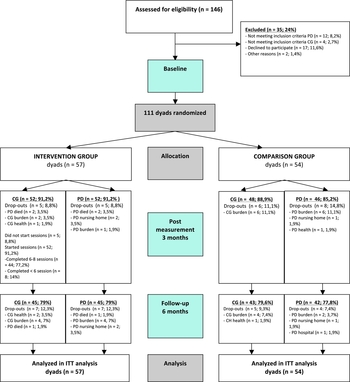
Figure 1 represents the participant flow. To detect an effect size of d > 0.40 between the experimental and comparison condition with α = 0.05 and β = 0.80, 78 dyads in each group would have been needed, 156 dyads in total (100%). Of the 146 dyads recruited for this study, 111 fulfilled the inclusion criteria (71% of the number needed), and were randomized to the experimental group (n = 57) or comparison group (n = 54). In total, 100 (90%) caregivers completed the post-measurement, and 88 (79%) caregivers completed the six month follow-up measurement. During the first three months, five caregivers dropped out in the experimental group and six caregivers in the comparison group. After six months, seven caregivers dropped out in the experimental group and five caregivers in the comparison group. The reasons for dropping out were health problems, death of the person with dementia or burden. We found one significant result between caregiver dropouts and caregiver completers. Compared with caregiver completers, caregiver dropouts had a significant lower education level (p = 0.03). There were no significant differences between caregiver dropouts in the experimental group and comparison group.
Flow chart of the progress of the present study performed in the Netherlands (2008–2012).

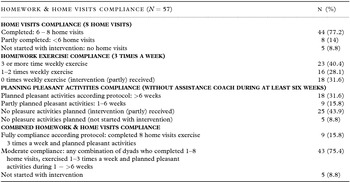
In the experimental group, 44 dyads (77.2%) completed all eight home visits. Five dyads (8.8%) did not start with the home visits because of death or nursing home placement of the person with dementia.
Sample characteristics
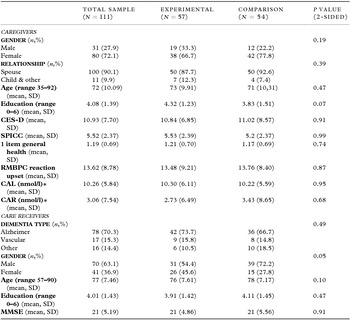
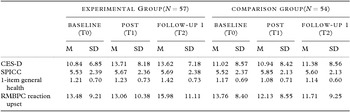
At baseline, caregivers were primarily female spouses (72%) and most of them finished at least secondary school (84%). Their age ranged from 35 to 92 years (M = 72; SD = 10.09) and the mean CES-D score was 10.93 (SD = 7.70). Their care receivers were primarily male spouses (70%) with dementia of the Alzheimer type varying from 57 to 90 years (M = 77; SD = 7.46) and a mean MMSE score of 21 (SD = 5.191). No significant differences were found between the comparison and the experimental group on any of the characteristics or outcomes in a caregiver or person with dementia, showing that the randomization was successful (Table 2). The mean scores and standard deviations for both primary and secondary outcomes at different assessment moments are presented in Table 3.
Baseline characteristics of the caregivers and their care receivers

Notes: M = mean; SD = standard deviation; CI = confidence interval; CES-D = center for epidemiologic studies-depression; SPICC = self-perceived pressure from informal care; RMBPC = revised memory and behavior checklist; MMSE = Mini-Mental State Examination; CAL = cortisol activity level; CAR = cortisol awakening response; *CAL and CAR based on experimental (n = 44) and comparison (n = 39).
Unadjusted means (M) and standard deviations (SD) on the independent variables

Notes: M = mean; SD = standard deviation; T = time; CES-D = center for epidemiologic studies-depression; SPICC = self-perceived pressure from informal Care; RMBPC = revised memory and behavior checklist.
Intention to treat analysis
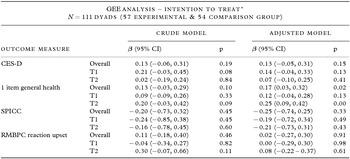
GEE analysis among 111 dyads revealed no differences over time for both groups on mood (CES-D), burden (SPICC), one item general health, and RMBPC reaction upset (Table 4). After adjusting for caregivers’ characteristics, general health outcomes showed a significant overall effect over time (p < 0.05) with higher general health scores for caregivers referred to the experimental group indicating poorer health.
Intention to treat intervention effects at baseline, three and six months on CESD, one item general health, SPICC, RMBPC reaction upset, and cortisol

Notes: *adjusted for baseline outcome; Reference group is comparison group at all measurements; Crude model: adjusted for baseline value of outcome measure. Adjusted model: model further additionally adjusted for age of the caregiver, gender of the caregiver, education level of the caregiver, relationship with care receiver and baseline values for CES-D / β = regression coefficient; CI = confidence interval; T1 = post measurement; T2 = follow up; CES-D = center for epidemiologic studies-depression; SPICC = self-perceived pressure from informal care; RMBPC = revised memory and behavior checklist; because of skewed data we used logarithms of CES-D.
Compliance analyses
As shown in Table 5, fully compliant with the intervention (completed 8 home visits, exercised 3 times a week and planned pleasant activities according protocol: per protocol analysis) were 9 dyads (15.8%) and 43 dyads (75.4%) were moderate compliant with the protocol (any combination of dyads who completed 1–8 home visits, exercised 1–3 times a week and planned pleasant activities during 1 – >6 weeks). Five dyads (8.8%) did not start with the home visits because of death or nursing home placement of the person with dementia. Compliance analyses, including a “per protocol analysis,” showed no benefits of the multi-component dyadic intervention on any of the outcomes of family caregivers.
Compliance with the homework (exercise and pleasant activities planning) and the presence of home visits of dyads assigned to the experimental group

Cortisol analysis
Two caregivers (one comparison and one from the experimental group) were excluded because the cortisol levels were far outside the normal range (>55.2 nmol/l). Two caregivers (both from the comparison group) were excluded due to a wrong collection of the salivary sample at home. Due to a missing post-measurement, 22 caregivers were excluded (11 from the experimental group and 11 from the comparison group). One caregiver (comparison group) was excluded because of the use of artificial saliva (substitute for natural saliva).
No significant differences of scores in CAL (F = 0.004, p = 0.949) and CAR (F = 0147, p = 0.702) from baseline through post measurement were found between the two groups by using ANCOVA.
Discussion
We studied the effects of a multi-component dyadic intervention aimed at decreasing psychological distress in family caregivers of community dwelling people with dementia in a RCT. The intervention consisted of physical exercise, psycho-education, communication skills training, and pleasant activities planning. Caregivers were primarily female spouses with a minimum level of depressive symptoms. Their family members were primarily male and diagnosed with Alzheimer's Disease. Analyses showed no effects of the intervention on primary and secondary outcomes of caregivers of people with dementia in both ITT and compliance analyses.
In this study, many requirements for a high quality RCT were met. Both groups were similar at baseline and the dropout rates were reasonable and acceptable (circa 20%) for this vulnerable target group (Bell et al., Reference Bell, Kenward, Fairclough and Horton2013). Furthermore, we recruited caregivers with some depressive symptoms at baseline in order to be able to show the possible intervention effects. Nevertheless, no significant effects for the experimental group were found on primary and secondary outcomes. In contrast, even depression scores appear to rise over time in the treatment group and health significantly improved in favor of caregivers referred to the comparison group. It could be that the multi-component dyadic intervention raised caregivers’ awareness of the physical and mental incapacities of their loved ones. This might have hampered an improvement by the intervention in the experimental group. Furthermore, half of the caregivers indicated that they missed private time with the coach without the person with dementia being present. During conversations in the context of the support intervention component, these caregivers indicated they felt controlled by their care receiver when talking about their thoughts and feelings. This might be confronting for the caregivers and have hampered an improvement by the intervention in the experimental group and maybe even rising depression scores and poorer health scores. In contrast, Teri et al. (Reference Teri2003) caregivers had some private time with the coach when receiving the support component. In our adjusted and elaborated version of the intervention of Teri et al. (Reference Teri2003) we decided to concentrate on physical exercise, education, and pleasant activities training, and to skip the time consuming Activating events Beliefs Consequences (ABC) training. It could be that cognitive reframing (based on ABC theory) was the active intervention component causing positive results in the study of Teri et al. (Reference Teri2003).
This study has some limitations. The sample size according to the power calculation was smaller than intended. This was due to the difficulties in recruiting participants in spite of tireless efforts. However, the present sample size is still reasonable in the field of geriatric research (Armijo-Olivo et al., Reference Armijo-Olivo, Warren and Magee2009) and it might be expected based on the scores found that even with more participants we would have found no significant effects. Furthermore, the compliance to exercise and pleasant activities homework varied between the dyads, being somewhat better for the exercise component than the pleasant activities support component of the intervention. Adherence to all homework treatment components was low: only nine dyads (15.8%). Teri and colleagues do not specifically report the adherence to pleasant event training, and so we could only compare the exercise adherence. Treatment compliance in Teri et al. (Reference Teri2003) showed that 91% of the dyads randomized to the experimental group attempted their exercise homework, which is higher than our compliance: 68% of the dyads attempted their exercise homework. In Teri et al. (Reference Teri2003) only 9% of the intervention group dyads did not complete any exercise homework in contrast to 32% in our present study. Some caregivers indicated that following all components was too time consuming and that it was difficult to motivate the person with dementia to exercise outside the home visits of the coach. A possible explanation for the differences between the compliance to the various homework components is that dyads have different needs with regard to intervention components and these needs will differ per specific country or region by different health and social care systems. Thus, each psychosocial intervention will benefit different types of family caregivers (Cooke et al., Reference Cooke, Mcnally, Mulligan, Harrison and Newman2001). Therefore, a better match of intervention components to the needs of the person with dementia and the family caregiver is important (Van't Leven et al., Reference Van't Leven, Prick, Groenewoud, Roelofs, De Lange and Pot2013). To support the dyad's in their daily lives it is advisable to ask both person with dementia and caregiver for their intervention preferences after well provided information about different intervention opportunities. For future research, before matching the intervention components, we advise a well analysis of the personal needs of the person with dementia and the caregiver.
With regard to the present study, the physical exercise component was the most frequently named reason to participate in the study. However, the consequence was that we recruited dyads with people with dementia who were already active (almost eighty per cent of the people with dementia were moderate to intensively active alongside the intervention), which may have resulted in less room for improvement and in possible sampling bias as has been reported in other physical activity studies in older people (Harris et al., Reference Harris, Victor, Carey, Adams and Cook2008). We tried to minimize this point by encouraging persons who were already active to increase or maintain their activity to achieve 30 minutes or more or moderate intensity exercise on most days of the week. Furthermore, these dyads may have had less interest and motivation to participate in the other intervention components (communication skills training and pleasure activities planning). For future research, it is advisable to align intervention components with the needs and wishes of possible participants and to ensure that there is enough room for improvement regarding the intervention component(s) that are preferred.
For some caregivers the intervention was too much of a burden because of the amount of time needed to be invested. This may be partly due to the usual dementia care, specific for the Netherlands. In the Netherlands, caregivers and people with dementia have good access to education such as well-organized Alzheimer Cafés (public meetings in community centers throughout the Netherlands for people with dementia, their caregivers and others), and dementia management. Many people with dementia living at home receive home visits of a case manager: one third of our participating dyads had help of such a professional personal coach. Furthermore, they often received one or more days respite care in a day care facility: half of our participating dyads received one or two days respite care in a day care facility. On top of this usual care, we examined the effectiveness of the multi-component dyadic intervention. Self-evidently, this is different from the usual care provided in the USA where the study of Teri et al. (Reference Teri2003) was conducted (along the intervention participants in the US study only received non-specific advice and support routinely provided by nurses and primary care physicians or community support service and no structural day care or dementia management) although the effects on caregivers have not been reported. In future studies, the impact of usual care provided in a specific country or region needs to be taken into account when the effects of new interventions will be studied.
Although no significant results were found for caregivers assigned to the experimental group, caregivers participating in the intervention often positive commented on the pleasure and support they received (Prick et al., Reference Prick, De Lange, Vant Leven and Pot2014). In additional qualitative research, caregivers indicated that with regard to the physical exercise component, they experienced pleasure, better mood, more self-esteem and increased awareness of the importance, and improvement in the quality of the relationship with the person with dementia. With regard to the support component, the named benefits by the caregivers were increased awareness of the importance of pleasant activities and decreased loneliness. These results are in accordance with the literature, that in spite of the absence of evidence of a beneficial impact of psychosocial interventions on caregivers’ psychological distress, caregivers generally reported feelings of satisfaction about the received support (Thompson and Briggs, Reference Thompson and Briggs2000; Brodaty et al., Reference Brodaty, Green and Koschera2003; Schoenmakers et al., Reference Schoenmakers, Buntinx and Delepeleire2010).
In the extension of this discussion point, it could also be that the choice for the present outcome measures could partly explain our present findings (Moniz-Cook et al., Reference Moniz-Cook2008). The instruments used were focused on measuring caregivers’ psychological distress. The intervention might have been more directed at the quality of the relationship by stimulating doing things together in an enjoyable way (physical exercises and pleasant activities) instead of primarily reducing caregivers’ psychological distress. Unfortunately we were not able to check because we did not include measures to capture the positive outcomes of the present intervention. For future research, we suggest to add measures on positive outcomes, such as pleasure, quality of relationship, self-management, and resilience.
In conclusion, this study showed no benefits of a multi-component dyadic intervention of physical exercise, psycho-education, communication skills training, and pleasant activities planning on psychological distress of family caregivers. Our findings show the importance of the following aspects for studies on the effectiveness of multi-component dyadic interventions: the impact of usual dementia care in a specific country or region of implementation on the effectiveness of the intervention under study; the fulfillment of the wishes and needs of participants by providing specific intervention components; participants’ room for improvement regarding these components, and the inclusion of positive outcome measures such as pleasure and quality of relationship associated with the intervention components. These aspects might be taken into account, to further improve future research on the effectiveness of multi-component dyadic interventions for the psychological well-being of family caregivers of people with dementia.
Conflict of interest
None.
Description of authors’ roles
Anna-Eva Prick coordinated the study and data collection, co-designed the study, analyzed the data and wrote the paper. Anne Margriet Pot was the principle investigator, designed and supervised the study and assisted with data-analysis and writing the paper. Jacomine de Lange was a member of the project group, designed the study and assisted with writing. Jos Twisk assisted with data analysis. All of the authors provided comments, read and approved the final manuscript.
Acknowledgments
We would like to thank the Dutch Health Insurers Innovation Foundation for their financial support. Furthermore, we would also like to thank all of the participants and research assistants who contributed to the study and the Mental Health research program of the EMGO Institute for Health and Care Research.