Introduction
There is growing interest in the psychopathological consequences of natural disasters for older adults in the context of worldwide aging (Cherniack, Reference Cherniack2008). As older adults form an increasing proportion of those exposed to natural disaster (Cherniack, Reference Cherniack2008), it is important to understand their needs at all phases of disaster response (Guha-Sapir et al., Reference Guha-Sapir, Vos, Below and Ponserre2011).
The research on disasters and older adults primarily focuses on events such as earthquakes, storms, and floods in the United States, China, and Taiwan (Norris et al., Reference Norris, Kaniasty, Conrad, Inman and Murphy2002b, Jia et al., Reference Jia, Tian, Liu, Cao, Yan and Shun2010; Paranjothy et al., Reference Paranjothy2011). These events can vary in suddenness, level of exposure to danger, dislocation, or economic impact (Cherniack, Reference Cherniack2008). Cyclones, hurricanes, and floods are usually associated with advance warning in contrast to earthquakes and tsunamis that result in sudden impact. Older adults often form a disproportionately higher percentage of casualties and have less ability to relocate at short notice with potential consequences of psychological morbidity post disaster (Kilijanek and Drabek, Reference Kilijanek and Drabek1979).
There is some debate in the literature on the comparative risk of natural disasters on older adults when compared with younger adults. Some studies have suggested that increasing age is associated with an overall greater risk of mental health outcomes during a disaster (Yang et al., Reference Yang2003; Jia et al., Reference Jia, Tian, Liu, Cao, Yan and Shun2010). This is possibly because older adults are often in worse health before a disaster, and less able to seek assistance after a natural disaster, with increase in resulting morbidity and mortality (Ticehurst et al., Reference Ticehurst, Webster, Carr and Lewin1996; Jia et al., Reference Jia, Tian, Liu, Cao, Yan and Shun2010). The older adults also appear to have a greater sense of loss, with even a minor injury provoking the fear of loss of self-reliance (Goldstraw et al., Reference Goldstraw, Strivens, Kennett, Lie, Geddes and Hwaites2012). By contrast, other studies have reported no age-related differences in mental health outcomes for older adults post disaster (Knight et al., Reference Knight, Gatz, Heller and Bengtson2000).
There have been four hypotheses for older adults’ varying psychological responses to natural disasters. The inoculation hypothesis suggests that prior experiences of disaster result in decreased emotional reactivity to subsequent disaster exposure, placing younger adults at high risk of adverse mental health outcomes (Thompson et al., Reference Thompson, Norris and Hanacek1993). The maturation hypothesis suggests that older adults develop an adaptive coping style with greater resilience to psychological distress than younger adults (Knight et al., Reference Knight, Gatz, Heller and Bengtson2000). The burden hypothesis suggests that it is the middle-aged adults, rather than the older adults, who are at the highest risk of psychological distress because of greater social and financial responsibilities in the wake of a natural disaster (Thompson et al., Reference Thompson, Norris and Hanacek1993; Cherry, Reference Cherry2009). Lastly, the exposure hypothesis proposes that older adults are at the greatest risk of mental health outcomes because of a lower likelihood of receiving advanced warnings, reluctance to evacuate, disruption to accustomed patterns of life, and a sense of deprivation resulting from their personal, physical, and social losses post disaster (Ticehurst et al., Reference Ticehurst, Webster, Carr and Lewin1996; Yang et al., Reference Yang2003; Jia et al., Reference Jia, Tian, Liu, Cao, Yan and Shun2010).
Similarly, when attempting to define what constitutes an older adult, no one clear definition of older age is available. The most commonly cited cut-off for older adults in the literature is the age of 60–65 years (Tinker, Reference Tinker1993). However, there is variability within the literature. Cross-culturally, there are differences in the cultural loading of age, with frailty and disability contributing to whether an individual is considered an “older adult.” For the purpose of this study, we used the current United Nations cut-off for older population, i.e. age more than 60 years (WHO, 2014).
We undertook a systematic review and meta-analysis to better determine the evidence of any of the four competing hypotheses. In particular, we examined whether older adults are at an increased risk of adverse mental health outcomes, including post-traumatic stress disorder (PTSD) symptoms, psychological distress, and depressive symptoms after exposure to a natural disaster compared with younger adults. This information could help to inform the planning of age-specific services and resources from the context of disaster.
Methodology
Search and selection strategy
We conducted a systematic literature review of the following databases from database inception to 24 March 2014 to identify peer-reviewed studies reporting on age cohort differences for mental health outcomes in response to a natural disaster: MEDLINE, CINAHL, PubMed, PsycINFO, ANZRC, and Health Source – Nursing Academic Edition, Scopus, Embase, LILAC, PILOTS, and Cochrane databases. The search used the following key terms: “natural disaster,” “aged,” “mental Health,” and “well-being.” The list of comprehensive search terms is provided in Supplementary Table S1 (available as supplementary material attached to the electronic version of this paper at www.journals.cambridge.org/jid_IPG). Only publications in peer-reviewed journals and English language were considered.
Inclusion and exclusion criteria
Inclusion and exclusion criteria were established (Supplementary Table S1), and three authors reviewed the papers (Georgina Parker, David Lie, and Dan Siskind). Studies were included if they presented a clear hypothesis, including comparison of age cohorts as a factor for mental health outcomes after natural disaster exposure. In addition, the study had to clearly define age cohorts when assessing the impact of a natural disaster. The literature review included studies that used definition of age as more than 60 to 65 years as the cut-off for older adults. Studies were excluded if they had insufficient data, either as published in the paper or following attempts to contact the authors, or if they were of insufficient quality (see section on Quality Evaluation). As the study goal was to examine impact of natural disasters on mental health, we excluded subtypes of disasters that were secondary to human error, terrorism, or technological failure.
Statistical analysis
The data from the included papers were extracted by Georgina Parker, and validated by Steve Kisely and Dan Siskind. Specific mental health outcomes were included in the meta-analysis if they were reported in at least two included studies. We used Review Manager Version 5.3 to calculate a pooled estimate of the association of age cohorts and mental health outcomes reported post disaster. Meta-analyses were undertaken for rates of PTSD, depression, anxiety disorders, and adjustment disorders. Further, sensitivity analyses were performed to examine the effect of sudden impact (earthquakes and tsunamis) versus advanced warning events (cyclones, floods, and storms) and quality of research. To check for heterogeneity between studies, both the Q and I2 tests of heterogeneity were used as well as visual inspection of forest plots. The Q and I2 statistics provide an estimate of the percentage of variability due to heterogeneity rather than chance alone. We used the random effects model for all the analyses given the heterogeneity of the data.
For any outcomes where there were at least ten studies, we tested for publication bias using funnel plot asymmetry where low p-values suggest publication bias.
Quality evaluation
As there is no agreed quality assessment tool for epidemiological prevalence studies, we adapted a modified assessment tool based on published STROBE and JHNEBP guidelines (von Elm et al., Reference Von Elm2008; Dearholt et al., Reference Dearholt, Dang and Philbrick2013) provided in Supplementary Table S2 (available as supplementary material attached to the electronic version of this paper at www.journals.cambridge.org/jid_IPG). The evaluation conducted by Georgina Parker, David Lie, and Dan Siskind allowed for an overall rating of high, moderate, or low for each study based on key objectives. These included design, sampling, bias control, methodology, data extraction, and suitability of analysis.
Results
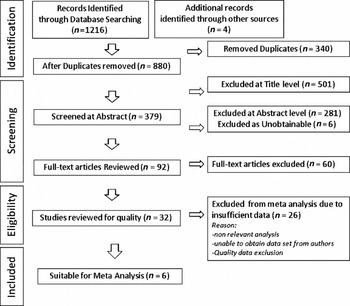
In the initial electronic searches, 1,216 citations were identified, of which 92 papers were potentially relevant and assessed for eligibility (Figure 1). We excluded 80 papers that did not meet inclusion criteria, leaving 12 papers for formal review. A review of the reference lists of these 12 papers and a hand search of additional papers identified no additional papers. The 12 papers were reviewed for quality. Six were appraised as high, one as moderate, and five as of low quality. The six low and moderate quality papers were excluded and only the six studies assessed to be of high quality were included in the meta-analysis. Consensus was reached for all the ratings.
Older adults mental health and natural disasters flow diagram.

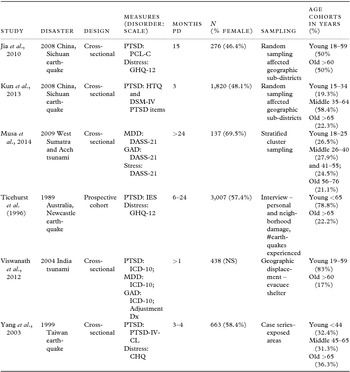
Studies included retrospective cohort, prospective cohort, and case-control designs. The samples came from five countries, including two high-income (Australia and Taiwan), one upper-middle income (China), and two lower-middle income (India and Indonesia) countries as defined by the World Bank (2013). Four studies were on earthquakes (Ticehurst et al., Reference Ticehurst, Webster, Carr and Lewin1996; Yang et al., Reference Yang2003; Jia et al., Reference Jia, Tian, Liu, Cao, Yan and Shun2010; Kun et al., Reference Kun, Tong, Liu, Pei and Luo2013) and two were on tsunami (Viswanath et al., Reference Viswanath2012; Musa et al., Reference Musa2014).
The available papers reported on disasters occurring between 1984 and 2009. Mental health outcomes included PTSD, generalized anxiety disorder (GAD), depressive symptoms, and psychological distress as measured by the General Health Questionnaire (GHQ). The GHQ-12 was utilized in both validated English and Chinese versions. Multiple measures of symptoms of PTSD, and Major Depressive Disorder (MDD), GAD were used, including both questionnaire and structured clinical interview diagnosis, as identified in Table 1. There was a mix of both structured clinical interviews and self-report questionnaires that have been validated and associated with PTSD, MDD, and GAD. Details on study quality, type of disaster, study design, measures used, sample size and gender, time post disaster, and age cohorts used are provided in Table 1.
Included studies

Notes: GAD = generalised anxiety disorder; PTSD = post-traumatic stress disorder; MDD = major depressive disorder; GHQ-12 = General Health Questionnaire; CHQ = Chinese Health Questionnaire; PTSD-IV-CL = PTSD DSM-IV checklist; ICD-10 = International Classification of Disease, version 10; DSM IV = Diagnostic and Statistical Manual, version IV; HTQ = Harvard Trauma Questionnaire; IES – Impact of Event Scale; PCL-C = PTSD Checklist, civilian version; DASS-21 = Depression, Anxiety and Stress Scale 21; PD = post-disaster time between initial exposure and administration of questionnaires Where multiple times are provided, the study administered questionnaires at those times; NS = not stated. All included studies were of high quality.
Description of samples
All included studies used the age of 60 or 65 years as the lower limit for an “old” or “older adult.” Some studies further stratified the population into young, middle aged, older, and old-old adults (Table 1).
Description of exposure
There was variability in how each study measured exposure to the disaster. Two studies used random sampling of geographic regions known to be affected or unaffected by the disaster to evaluate sample population exposure (Jia et al., Reference Jia, Tian, Liu, Cao, Yan and Shun2010; Kun et al., Reference Kun, Tong, Liu, Pei and Luo2013) (Table 1). Other studies used a self-report questionnaire where individuals rated the degree of exposure based on perceived life threat, experience of loss of life, personal injury, and loss or damage to property.
PTSD symptoms
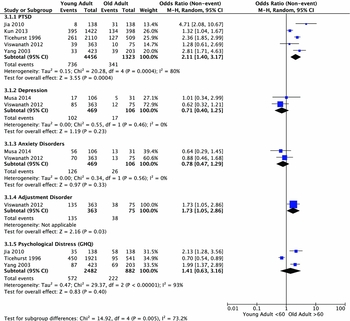
Data suitable for the meta-analysis of the prevalence of PTSD symptoms post disaster were available for five studies, all of which examined sudden impact disasters (Ticehurst et al., Reference Ticehurst, Webster, Carr and Lewin1996; Yang et al., Reference Yang2003; Jia et al., Reference Jia, Tian, Liu, Cao, Yan and Shun2010; Viswanath et al., Reference Viswanath2012; Kun et al., Reference Kun, Tong, Liu, Pei and Luo2013). Random effects comparison identified significant differences between older adults and younger adults for PTSD symptoms. Older adults (OR = 2.11, 95% CI = 1.40–3.17) were more likely to experience PTSD symptoms after exposure to a natural disaster than young adults (Figure 2).
Forest plot of mental health outcomes for young and old adults.

Depressive symptoms
Data suitable for the meta-analysis of effects of depressive symptoms were available from two studies (Viswanath et al., Reference Viswanath2012; Musa et al., Reference Musa2014). There were no significant differences in the risk of depressive symptoms in older adults compared with other age groups (OR = 0.71, 95% CI = 0.40, 1.25).
Anxiety symptoms
Data suitable for the meta-analysis of effects of anxiety symptoms were available from two studies (Viswanath et al., Reference Viswanath2012; Musa et al., Reference Musa2014). Meta-analysis identified no difference between older and younger adults for anxiety disorders (OR = 0.78, 95% CI = 0.47, 1.29).
Adjustment disorder
Data were available on the effects of adjustment disorder symptoms from a single tsunami study (Viswanath et al., Reference Viswanath2012). Older adults were more likely to experience symptoms of adjustment disorder after exposure to tsunami event than younger adults (OR = 1.73, 95% CI = 1.05, 2.86).
Psychological well-being
Data suitable for the meta-analysis of effects of natural disaster on psychological well-being as rated by the GHQ were available for three studies (Ticehurst et al., Reference Ticehurst, Webster, Carr and Lewin1996; Yang et al., Reference Yang2003; Jia et al., Reference Jia, Tian, Liu, Cao, Yan and Shun2010). No significant difference was identified between older and younger age groups (OR = 1.41, 95% CI = 0.63, 3.16).
Publication bias
We were unable to test for publication bias, as there were insufficient studies for any of the outcomes.
Discussion
The current review included studies published between 1996 and 2014, comparing the mental health outcomes after exposure to a natural disaster among younger and older adults. Our results identified that older adults had an increased risk of PTSD following natural disasters. Older adults were 2.11 times more likely to experience PTSD symptoms and 1.73 times more likely to experience adjustment disorder symptoms than younger individuals when exposed to a natural disaster of sudden onset. These findings are therefore most consistent with the exposure hypothesis where older adults are at the greatest risk of worse outcomes because they are less likely to receive advanced warnings or evacuate, and experience greater disruption or perceived loss.
There are a number of well-documented risk factors for PTSD that may particularly affect older people. These include loss of livelihood, as older people may have more difficulty with re-establishing income and savings; prior exposure to trauma from previous life events; lack of social support; female gender; and trauma severity (Brewin et al., Reference Brewin, Andrews and Valentine2000). Older persons have been noted to be over represented in the casualties in sudden onset natural disasters (Tanida, Reference Tanida1996; Nishikiori et al., Reference Nishikiori, Abe, Costa, Dharmaratne, Kunii and Moji2006), implying an increase in exposure to bereavement (including traumatic bereavement) of peers and spouses of older people. Older people may also experience greater difficulty in escaping from a sudden disaster because of limited mobility. Women live longer than men, leading to a female gender skew among older people, with female gender a known risk factor for PTSD (Brewin et al., Reference Brewin, Andrews and Valentine2000).
Further, the prevalence of PTSD most likely differs from age cohort, country to country, and region to region. Some research on the baseline prevalence of PTSD in non-disaster community samples has identified that as age increases beyond 55 years, the prevalence of PTSD reduces (Creamer et al., Reference Creamer, Burgess and Mcfarlane2001). This suggests that the higher rate PTSD among older adults following a natural disaster found in this review is due to the effects of the natural disaster, and not due to a baseline higher prevalence when compared with younger adults.
Our findings are at odds with a previous meta-analysis, where younger age was associated with greater PTSD symptoms (Brewin et al., Reference Brewin, Andrews and Valentine2000). A possible explanation is that the review did not directly compare age groups and was not restricted to natural disasters, with the vast majority of papers covering motor vehicle accidents, violent crime, or war. This points to the need to consider each type of disaster separately and is one of the reasons that the present study was restricted to natural disasters.
Strengths and limitations
Given the aging of the population, it is increasingly important to understand the effect of natural disasters on older adults. To our knowledge, this is the first published systematic review focusing on the mental health sequelae for older adults exposed to natural disaster. Although this result is obtained from only small number of papers, the outcome is from an accumulated sample size of over 5,700 participants.
There are several limitations to our study. First, there are constraints common to epidemiological studies of disasters in general. Disaster research is a relatively new phenomenon with a relative lack of standardized methodologies (Rodriguez et al., Reference RodriGuez, Quarantelli and Dynes2006). This diversity in study design was reflected in the studies we found in our search, particularly in relation to differences in the type and severity of disaster, level of dose exposure, intervals between exposure and assessment, sampling methodology, and outcome measures. The review identified a need for standardized validated scales that can be used not only cross culturally, such as the GHQ, but have been also validated for older populations, such as the Geriatric Anxiety Inventory (Pachana et al., Reference Pachana, Byrne, Siddle, Koloski, Harley and Arnold2007).
This analysis chose to examine specifically the relationship between older adults and natural disasters. In the aftermath of 9/11 there have been significant research investments examining the response of older adults to human-made/technological disasters (Bonanno et al., Reference Bonanno, Galea, Bucciarelli and Vlahov2007). Promising results have emerged from this research supportive of middle-age adult vulnerabilities and older adult resilience. However, it has been documented that human-made/technological disasters may have different and more marked consequences than natural disasters on mental health outcomes (Norris et al., Reference Norris, Friedman, Watson, Byrne, Diaz and Kaniasty2002a). For this reason, this analysis excluded research from significant human-made or technological disaster events in an attempt to capture the differential vulnerability of older adults with natural disasters alone. Our group is currently undertaking a meta-analysis of the effects of human-made disaster on older persons.
In common with gerontic research in general, there was a lack of standardized age range and common understanding of biological, social, and psychological factors that contribute to the concept of “old age” (Roebuck, Reference Roebuck1979). It has been observed that effects of age on post-disaster outcomes may vary across cultures even for the same type of disaster (Norris et al., Reference Norris, Kaniasty, Conrad, Inman and Murphy2002b), as what constitutes midlife in one cultural settings may be “old” in another. There is no one definition for older age in some settings as it has been shown to be more appropriate to use lower cut-off ranges for defining an older adult to account for cultural variability, frailty, cognitive, and physical disability differences (WHO, 2014). Several studies were excluded due to lower age cut-off for older adults ranging from 45–55 years. This was done with the intention to capture the response of “older adults” rather than the adult population alone.
A variety of measures were used for diagnostic case finding. One study (Jia et al., Reference Jia, Tian, Liu, Cao, Yan and Shun2010) used a published symptom checklist, the PTSD Checklist (Blanchard et al., Reference Blanchard, Jones-Alexander, Buckley and Forneris1996). Three studies used unpublished checklists, with two (Yang et al., Reference Yang2003; Kun et al., Reference Kun, Tong, Liu, Pei and Luo2013) based on Diagnostic and Statistical Manual, 4th Edition (DSM-IV) (American Psychiatric Association (APA), 2000) and one (Viswanath et al., Reference Viswanath2012) based on International Classification of Diseases, version 10 (ICD-10) (WHO, 2004). Another (Ticehurst et al., Reference Ticehurst, Webster, Carr and Lewin1996) used a self-report scale of distress (Horowitz et al., Reference Horowitz, Wilner and Alvarez1979). There are psychometric issues to consider when using symptom checklists as surrogates for diagnostic case-finding, the gold standard being a semi-structured diagnostic interview.
One study used ICD-10, while four others used DSM-IV criteria. As these criteria are divergent, there is a risk of discrepancies on case inclusion between studies (Peters et al., Reference Peters, Slade and Andrews1999). The majority of the scales used in the included studies were not validated, which may increase the risk of false positive or false negative cases of PTSD. Even for validated scales, scales that have been validated in working-age adults may not necessarily be suitable for older individuals. This highlights the importance of considering scales that have been validated not only cross-culturally but also to account for age-related variability, as has been done for the Geriatric Anxiety Inventory (Pachana et al., Reference Pachana, Byrne, Siddle, Koloski, Harley and Arnold2007).
It is possible that the discrepancies between case finding instruments may have contributed to the heterogeneity we observed in the meta-analysis. Although we attempted to take heterogeneity into account using a random-effects model, our results should be treated with caution.
Two studies reported a three to four months time gap between the traumatic event and the screening for PTSD (Yang et al., Reference Yang2003; Viswanath et al., Reference Viswanath2012), while another reported a 15-month time gap (Jia et al., Reference Jia, Tian, Liu, Cao, Yan and Shun2010). The other three studies did not report the time gap. DSM-IV criteria specify a minimum six-month delay between the traumatic event and a diagnosis of PTSD (APA, 2000). Any diagnosis prior to this time would be an acute stress reaction. Based on these diagnostic criteria, it is possible that at least two studies were reporting acute stress reaction rather than PTSD. For studies with a longer time gap between traumatic event and screening, there is the possibility that some cases of PTSD may have spontaneously remitted (Chapman et al., Reference Chapman2012). However, one study (Musa et al., Reference Musa2014) reported on rates of depression, anxiety, and stress, but not PTSD, in two geographically distinct regions that were exposed to separate natural disasters five years apart from each other. Rates of reported mental health disorders were not significantly different in the two regions. These differences in time gap may have also contributed to the heterogeneity of our results, which again should be treated with caution, even with the use of a random-effects model.
A final limitation is that we were only able to identify a small number of studies, and these were all of sudden impact disasters. This meant that we were unable to examine whether other types of natural disaster of slower impact, such as flooding, had a different effect on mental health outcomes. In addition, we were not able to assess the grade of exposure to the traumatic event as only one study (Kun et al., Reference Kun, Tong, Liu, Pei and Luo2013) provided data on exposure by age. We were unable to test for gender effects as no studies reported data on age by gender. The small number of studies also meant that we were unable to test for publication bias.
Implications and further directions
Our findings suggest that there is a significant vulnerability of older adults to experience PTSD after exposure to natural disasters relative to the younger adult population. However, these findings also demonstrate that mental health outcomes such as depression and anxiety are not automatically worse for older adults. Indeed, the experience of some communities is that “older people” may be an under-recognized source of resilience and response in time of crisis (Davey and Neale, Reference Davey and Neale2013). Resources targeted at personal preparation and mitigation of impact should therefore be appropriate to all ages.
Appropriate planning could minimize disruption to disability and health services on which older people rely, potentially reducing consequent psychiatric morbidity. Consideration should include design of shelters that are accessible for older persons, contact systems that enable checks on the well-being of older adults, and triage systems that allow rapid reconnection with their family and meet their basic needs, including physical health.
Further studies on the impact of natural disasters on older persons are needed. This research should ideally include diagnosis through semi-structured diagnostic interview. It should also include improved standards for degree of exposure to disaster and latency of investigation. Strategies to improve comparison across studies in research specific to understanding age as a risk factor could be improved by reporting data in standardized age-bands, controlling for age-relevant variables such as measures of cognitive and physical performance, health status, gender, and bereavement status, and the use of measures validated among older populations. There is also a need for standardized validated scales that can be utilized cross-culturally and have been validated for age-specific differences. Given the potential confounding effects of gender, disability, prior trauma, and bereavement, these will need to be controlled for when analyzing the contribution of older age to the epidemiology of disaster-related PTSD.
Further research should aim to understand that there may be age-specific differences in the prevalence of PTSD and other target disorders prior to exposure to natural disasters. Better studies examining the impact of age among those exposed to disasters could look to include a control sample of non-exposed participants from the same country of relevant ages or provide details of the known prevalence data for that country. Studies could also look to link some baseline data for participants in each age cohort, i.e. those enrolled in other studies prior to affect to assess post-disaster outcomes.
Conclusions
Recent decades have seen a global rise in the number of older adults affected by natural disasters, implying that an increasing number of the older adults will find themselves “in harms way” amid community disruption and distress. Service providers need to be prepared to meet the mental health needs of older persons, and be particularly vigilant after natural disasters to ensure in particular early detection and management of PTSD.
Conflict of interest
None.
Description of authors roles
Authors G Parker, D Lie, and D Siskind designed the study and developed the search protocol with input from B Raphael and D Crompton. G Parker conducted the systematic review with assistance from D Siskind, D Lie, and M Martin-Khan. G Parker extracted data with assistance from S Kisely and D Siskind. G Parker and S Kisely analyzed the data. D Lie, D Siskind, G Parker, and S Kisely wrote the discussion with input from B Raphael and D Crompton.
Supplementary Material
For supplementary material accompanying this paper, visit http://dx.doi.org/10.1017/S1041610215001210