

Introduction
The National Institute for Health and Clinical Excellence (NICE) in the UK recommends that inpatient services, with specific expertise in obsessive-compulsive disorder (OCD), are appropriate for a small proportion of individuals with OCD in the National Health Service (National Collaborating Centre for Mental Health (NCCMH), 2006). This refers to individuals who are likely to be severe and have failed one or more trials of cognitive behaviour therapy as an outpatient or in their home, usually in combination with pharmacotherapy. This recommendation is on the basis of expert opinion and the principles of stepped care rather than any randomized controlled trial.
Treating adults with OCD in an inpatient or residential setting (without nursing staff) has the advantage of being able to provide CBT more intensively than for outpatients. There are also potential advantages in developing a therapeutic environment in which there are opportunities for staff and residents to positively reinforce acts of courage by compassion in doing exposure and behavioural experiments “in the moment”(Veale, Gilbert, Wheatley and Naismith, Reference Veale, Gilbert, Wheatley and Naismith2014). Another potential advantage is the removal from a family environment where there may be high levels of expressed emotion or criticism. An inpatient unit with nursing staff may however be a necessity if there is a risk to life, severe self-neglect, extreme handicap or a reversal of the sleep-wake cycle.
The majority of people with severe OCD, however, are not a risk to life or do not need 24-hour nursing care. Professor Isaac Marks therefore converted the ward to a residential unit in 1991 as it became more cost-effective not to have any staff after hours (other than an emergency service). McKenzie and Marks (Reference McKenzie and Marks2003) reported on the outcomes over 11 years from 1987 to 1998 and found no loss of gains when the service became a residential unit.
A number of services, mainly in the USA, UK and Germany, provide inpatient or residential services, of which only a few with large datasets have published their outcomes (Adams, Riemann, Wetterneck and Cisler, Reference Adams, Riemann, Wetterneck and Cisler2012; Bjorgvinsson et al., Reference Bjorgvinsson, Wetterneck, Powell, Chasson, Webb and Hart2008; Boschen, Drummond, Pillay and Morton, Reference Boschen, Drummond, Pillay and Morton2010; Gonner, Limbacher and Ecker, Reference Gonner, Limbacher and Ecker2012; Langner et al., Reference Langner, Laws, Roeper, Zaudig, Hauke and Piesbergen2009; Stewart, Stack, Farrell, Pauls and Jenike, Reference Stewart, Stack, Farrell, Pauls and Jenike2005). However, only few evaluations have indicated specific predictors of treatment outcome or early discharge. Adams et al. (Reference Adams, Riemann, Wetterneck and Cisler2012) found that beliefs of high pretreatment responsibility for illness and threat estimation were negatively correlated with posttreatment reduction in obsessive-compulsive symptoms. Stewart et al. (Reference Stewart, Stack, Farrell, Pauls and Jenike2005) reported that higher OCD symptom severity and a younger age at OCD onset predicted non-response. Marital status has also been found to predict better outcome in an in-patient setting (Boschen, Drummond, Pillay and Morton, Reference Boschen, Drummond, Pillay and Morton2010). More recently, a systematic review of CBT as treatment for outpatients with OCD has indicated that the following variables predict worse patient outcomes posttreatment: unemployment; being single or unmarried; increased anxiety symptoms; increased OCD severity; and hoarding symptomatology. Unfortunately, limitations in the methodologies of papers included in the systematic review meant that these findings could not be considered reliable (Knopp, Knowles, Bee, Lovell and Bower, Reference Knopp, Knowles, Bee, Lovell and Bower2013).
Prior to 2007, local commissioning funded the service. Since 2007, NHS England has commissioned a Highly Specialized Service (HSS) for OCD and Body Dysmorphic Disorder (BDD) at a national level (Drummond et al., Reference Drummond, Fineberg, Heyman, Kolb, Pillay and Rani2008). In order to receive HSS funding, a patient must have a Yale-Brown Obsessive Compulsive Scale (Y-BOCS) score of ≥30 (Goodman, Price, Rasmussen and Mazure, Reference Goodman, Price, Rasmussen and Mazure1989). Additionally, individuals must have had an inadequate response to at least two trials of cognitive behaviour therapy, two trials of an SSRI, and one trial of augmentation of the SSRI. Thus, in this study, the HSS residents are a sub-group of severe treatment refractory residents within the total sample treated in the service. Although there were residents in this category at the unit before 2007, they were not formally identified as such and were funded by their local service. After 2007, residents can still be funded by their local service and are usually in the severe category but either do not fulfil all the treatment refractory criteria for HSS funding or are from Wales or Scotland.
Residents are admitted for one of two treatment programmes: the majority attend a 12-week programme, with the possibility of an extension of up to 4 weeks (the “standard” programme) but from 2003, a minority of suitable residents were offered an intensive CBT programme of up to 2 weeks duration as there is some evidence that a time intensive programme is effective for selected clients (Oldfield, Salkovskis and Taylor, Reference Oldfield, Salkovskis and Taylor2011). The decision as to which programme a patient enters is usually based on social reasons (for example, an urgent need to maintain their employment) and strong client preference.
The aims of this study were primarily to examine treatment outcomes for our standard programme over 12 weeks. It was hypothesized that residents would make significant gains in treatment, which would be maintained at follow-up. Second, the study aimed to examine whether treatment is successful for severe treatment-refractory residents. Third, we sought to examine whether outcomes following an intensive 2-week programme differ from standard treatment; the hypothesis being that residents in 2-week treatment would have similar scores to those in standard treatment. A fourth aim was to explore whether there were any predictors of self or early discharge and of treatment outcome in our residential setting over the past 11 years. This case series furthers previous research by measuring outcomes from the largest sample size from an OCD residential unit to date. Furthermore, no previous studies have examined predictors of self or early discharge in an inpatient or residential setting.
Method
This is a large open case series of all OCD residents admitted to the unit during the period 2000–2012.
Participants
A total of 472 residents were admitted to the unit between February 2001 and September 2012 for treatment of OCD. Of these, 418 were admitted to the standard programme, and the remaining 54 to a 2-week intensive programme. Eighty-five of the 418 residents from 2007 entering standard treatment were for severe treatment refractory OCD. Patients with BDD or other anxiety disorders admitted during this time frame were not included in this analysis.
Materials
The following measures were used:
Yale-Brown Obsessive-Compulsive Scale (Y-BOCS; Goodman et al., Reference Goodman, Price, Rasmussen and Mazure1989). The Y-BOCS is a 10-item clinician-rated scale used to measure the severity of obsessive-compulsive symptoms and response to treatment. Each item is scored from 0 (no symptoms) to 4 (extreme), items are summed to give a total score with a range of 0 to 40.
Obsessive Compulsive Inventory (OCI; Foa, Kozak, Salkovskis, Coles and Amir, Reference Foa, Kozak, Salkovskis, Coles and Amir1998). The OCI is a 42-item self-report scale for measuring distress caused by OCD symptoms, for which items are rated on a 5-point Likert scale ranging from 0 (not at all) to 4 (extremely).
Beck Depression Inventory (BDI; Beck, Reference Beck1993). The BDI is a 21-item self-report measure of depressive symptoms rated from 0 (least intensity) to 3 (highest intensity). The BDI has a maximum score of 63, with30 or more indicating severe depression.
Beck Anxiety Inventory (BAI; Beck and Steer, Reference Beck and Steer1990). The BAI is a 21-item self-report measure of severity of anxiety symptoms. Item scores range from 0 (not at all) to 3 (severely), maximum scores range from 0 to 63, with 26 or more indicating severe anxiety.
Interventions
For standard treatment, the planned duration of admission was 12 weeks, although some residents could receive an extension of 2–6 weeks if they had motivation and commitment to change but who still had considerable symptom severity at 12 weeks. Participants received up to 4 individual CBT sessions per week. Ad hoc exposure/behavioural experiments are arranged with other staff. Developments in CBT for OCD (Salkovskis, Reference Salkovskis1999; Salkovskis, Richards and Forrester, Reference Salkovskis, Richards, Forrester, Goodman, Rudorfer and Maser2000) were included in the individual therapy. Treatment also included group behavioural experiments, occupational therapy and activity scheduling sessions. The frequency and content of the group therapy has changed over the years and currently includes weekly Compassionate Mind training (Gilbert and Procter, Reference Gilbert and Procter2006) and a community meeting. There was at least one home visit or assessment with a resident's family. Medication was generally stabilized before admission although some participants discontinued medication and some others had their medication optimized during admission. The 2-week programme was similar to an out-patient intensive programme of 20 hours of therapy (Oldfield et al., Reference Oldfield, Salkovskis and Taylor2011). All residents were encouraged to travel home over the weekend to carry out behavioural experiments.
Procedure
All residents were interviewed at assessment with the Structured Clinical Interview for DSM-IV (First, Spitzer, Gibbon and Williams, Reference First, Spitzer, Gibbon and Williams1995). Outcome data, including demographic information, were routinely collected from residents admitted to the service. Therapists administered the Y-BOCS and residents self-completed the BDI, BAI, OCI. For each measure, scores were analysed at 4 key time points: score at admission (or at screening prior to admission when missing); score at discharge; score at 3-month follow-up (or 1-month when missing); and score at 12-month follow-up (or 6 month when missing). Due to the non-completion levels at follow-up, follow-up analyses were not run for this treatment.
Statistical analysis
Means and frequencies of demographic variables were calculated for each group. Multinomial logistic regressions were used to identify predictors of self or early discharge and of missing data. Self or early discharge was coded as a categorical variable with three levels (under 5 weeks treatment; 5–9 weeks treatment; over 9 weeks treatment). This approach was taken because the aim was to focus on residents who self discharged or were discharged early in the main part of treatment (0–12 weeks), and therefore wanted to minimize the effects of differences between residents who received extensions beyond 12 weeks and those who did not. Where measures were missing at different time points, multiple imputation was used to draw estimates of missing data from both existing data and predictors of self or early referral (White, Royston and Wood, Reference White, Royston and Wood2011). The following variables were entered into the multiple imputation model as predictors of missing data: source of funding (HSS or non-HSS); type of treatment (standard or 2 week); self or early discharge (treatment of under 5 weeks, 5–9 weeks, or over 9 weeks); employment status (employed or not employed); taking of antipsychotic drugs on admission (as an indicator of severity); alcohol abuse as indicated by the SCID; current Major Depressive Episode as measured by the SCID; and scores at admission on the following measures: BDI, BAI, OCI, Y-BOCS, and score on the single avoidance item of the Y-BOCS. Thirty imputations were run.
Comparisons of Y-BOCS, BDI, BAI and OCI outcomes between residents admitted for 2-week treatment and those admitted for standard treatment were made using linear mixed models and post hoc t-tests. Linear mixed models were run to indicate whether there were significant effects of treatment group, time, or an interaction between group and time, on outcome scores. Post hoc tests included paired t-tests comparing outcomes over time for those in the 12-week treatment programme, HSS residents in the standard treatment, and all those in the intensive treatment group. Between group t-tests comparing outcome scores at different measurement points were also run. Due to the large number of post hoc tests, and the resulting potential for increased type I error, Bonferroni corrections were used, yielding a significance level of 0.017.
The imputed dataset was used to calculate Y-BOCS percentage change scores from admission to discharge, and follow-ups. In addition, frequencies of participants making either of the following:
-
1) No change.
-
2) Improvement by a 25% Y-BOCS score decrease. A minimum of 25% reduction on the Y-BOCS is regarded as a partial response (Pallanti et al., Reference Pallanti, Hollander, Bienstock, Koran, Leckman and Marazziti2002). It is widely used criteria in randomized controlled trials and correlates with a reduction in functional disability and improvement in health related quality of life (Hollander, Stein, Fineberg, Marteau and Legault, Reference Hollander, Stein, Fineberg, Marteau and Legault2010; Pallanti et al., Reference Pallanti, Hollander, Bienstock, Koran, Leckman and Marazziti2002).
-
3) Reliable Clinical Change (RCC). This was calculated as a 10-point Y-BOCS decrease (see Supplementary Table 8) (Fisher and Wells, Reference Fisher and Wells2005).
-
4) Becoming asymptomatic.
Multiple regressions were carried out for all residents admitted to standard treatment in order to identify predictors of treatment outcome (Y-BOCS score at discharge). Based on previous research findings, the following variables were selected as possible predictors of Y-BOCS at discharge: age at admission; Y-BOCS score pre-treatment; marital status; employment status; number of days stay at the unit; BDI score at admission; avoidance item score on the Y-BOCS; and whether or not the resident was taking anti-psychotics (as a marker for treatment refractoriness). A forced entry method of multiple regression and pair-wise deletion were selected.
Results
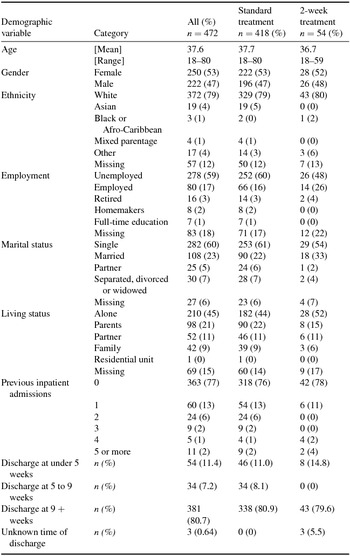
Table 1 shows demographic data for all the residents admitted according to treatment programme (standard vs. 2 week intensive). Black and minority ethnic groups made up 10% of admissions. Only 17% were employed and 28% were married or had a partner. It was not possible to give a reliable breakdown of comorbid diagnoses in the whole sample as a result of missing data.
Demographic data for all residents admitted between 2001–2012

Reasons for early discharge in standard programme
Across the 11-year period being evaluated, 84 (20.1%) of the 418 participants who entered standard treatment were discharged early or self-discharged. Of these, 25 (6%) were categorized as in need of nursing care or unsuitable for the unit (for example, if they became suicidal, severely self-neglectful or abused alcohol). Forty (9.6%) were discharged early as they were not able to engage in treatment; 7 (1.7%) were discharged early due to significant over-valued ideation; 2 (0.5%) disliked the social environment; and 10 (2.4%) were discharged early for undocumented reasons that could not be traced. Reasons for self or early discharge of participants in the intensive treatment group were not collected.
Predictors of self or early discharge
Multinomial logistic regressions revealed that four variables significantly predicted self or early discharge at under 5 weeks (n = 46) in comparison to 9+ weeks (n = 338): taking anti-psychotics on admission (B = 1.09, S.E (B) = 0.43, Wald χ2 (1) = 6.51, p < .05), employment status (B = 16.63, S.E (B) = 0.43, Wald χ2 (1) = 1544.15, p < .001), current or past alcohol abuse (B = 17.23, S.E (B) = 0.61,Wald χ2 (1) = 790.79, p < .001), and current or past major depressive episode (B = -1.47, S.E (B) = 0.45, Wald χ2 (1) = 10.84, p < .01). Those taking anti-psychotics on admission were 2.98 (C.I. = 1.29, 6.91) times more likely to self-discharge or be discharged early than those who were not. Those who were employed were 1.66 (C.I. = 0.73, 3.81) times more likely to discharge early than those with a different employment status (e.g. unemployed, student, long-term sick leave). Residents with an alcohol abuse problem were 3.03 (C.I. = 0.91, 1.01) times more likely to discharge early than those not consuming alcohol at an abusive level. Finally, those with a history of major depressive episode were 4.37 (C.I. = 0.10, 0.55) times more likely to discharge early than those with no history of depression. Taking anti-depressants on admission, ethnicity, marital status, living status, and general anxiety disorder were not found to be predictive factors of early discharge. There were no significant predictors of early discharge between weeks 5 – 9 (n = 34) in comparison to self or early discharge post week 9 (n = 338).
Main effects and interactions
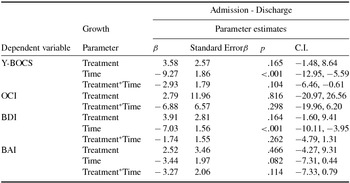
Table 2 shows the outcomes from linear mixed models run to test for a main effect of treatment group (standard v 2 week) and time, as well as whether or not there was a significant interaction between the two variables. There was a significant main effect of time for YBOCS, OCI, and BDI outcomes. There were no significant main effects for BAI outcomes, and not significant interactions between the variables for any outcome measures. There were no significant differences between the treatment groups outcomes at any measurement points in treatment post hoc comparisons (Supplementary Table 7).
Linear growth models for change in outcomes from admission to discharge by treatment group (standard v 2 week programme)

Outcomes for all residents in standard treatment programme
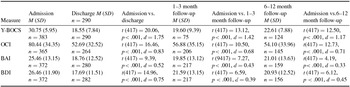
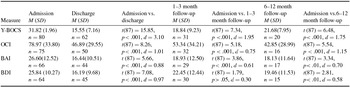
For participants receiving the standard treatment, missing data across outcome measures prior to multiple imputation averaged out at 10.8%, 33.3%, 57.3%, and 65.1% at admission, discharge, 1–3 month follow-up and 6–12 month follow-up, respectively. The exact n for each measure and time point is provided in Tables 3–5. Because of the large amount of missing data in the long term, we re-analysed using Last Observation Carried Forward (LOCF). LOCF provides a slightly more conservative outcome (e.g. about 2 points higher on LOCF compared to Multiple Imputation (Supplementary Tables 9, 10, 11). Of the 418 participants in standard treatment, 38 (9.1%) received extensions beyond 12 weeks. The mean length of stay was 10.7 weeks (range 0–165 days). There were 5 outliers staying longer than 18 weeks or 126 days). The outcome measures for the standard programme across time, and corresponding post hoc paired t-tests, are shown in Table 3. The average reduction of Y-BOCS outcome was 12.2, and Y-BOCS outcomes appear to have significantly decreased over time. Scores for the OCI, BDI and BAI are also significantly decreased over time in comparison to measures at admission.
Outcome measures for 12-week treatment programme across time based on multiple imputation

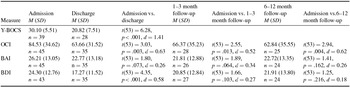
Outcome measures for HSS for severe treatment refractory patients in 12-week programme

Outcome measures for intensive treatment programme across time

Outcomes of HSS funded residents
The outcomes of those who were funded with severe treatment refractory criteria, and corresponding post hoc paired t-tests, are shown in Table 4. The average reduction on the Y-BOCS was 16.27 and scores decreased by at least 25% from admission to end of treatment for 77/85 (90.6%) of the residents. The cohort showed significant improvements over time across all measures that were generally maintained at follow-up. Only the BDI outcome was not significantly lower at 1–3 month follow-up in comparison to admission, and on average BDI scores had significantly decreased again by 6–12 month follow-up.
Outcomes of residents in the intensive treatment programme
Table 5 shows post hoc comparisons of outcomes over time for residents receiving the intensive treatment programme. Y-BOCS and OCI outcomes remained significantly lower posttreatment than they were at admission. The BDI outcomes were not significantly lower at follow-up in comparison to admission, and BAI outcomes were also not significantly different to admission at all posttreatment.
Symptom reduction on the Y-BOCS
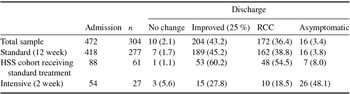
Table 6 shows frequencies and percentages of residents who reached various categories of improvement. Just under 50% of residents reached 25% improvement on their Y-BOCs outcomes at discharge. A larger proportion of HSS residents in comparison to locally funded residents improved, and a smaller proportion of those in the intensive treatment programme improved. This pattern is reflected in the numbers who reached reliable clinical change. Despite this, almost 50% of the intensive treatment group were asymptomatic by discharge.
Summary of the percentage of patients allocated to the various categories of outcome at discharge by treatment condition

Predictors of treatment outcome
Multiple regression indicated that overall Y-BOCS scores pretreatment did significantly predict Y-BOCS outcomes posttreatment, (B = .46, SE (B) = .11, β = .36, p < .001). Those with higher pretreatment Y-BOCS scores also had higher posttreatment Y-BOCS scores. The following variables were not significant predictors of Y-BOCS scores at discharge: Age at admission (B = -.05, SE (B) = .05, β = -.07, p = .36); marital status (B = .59, SE (B) = .43, β = .11, p = . 12); employment status (B = -.41, SE (B) = .65, β = -.05, p = .53); number of days stay in unit (B = -.01, SE (B) = .02, β = -.03, p = .68); BDI score on admission (B = .03, SE (B) = .06, β = -.05, p = .60); prescription of antipsychotics at the time of admission (B = 2.07, SE (B) = 1.15, β = .13, p = .07), and degree of avoidance as measured by the Y-BOCS (B = -.24, SE (B) = .65, β = .-.03, p = .71).
Discussion
Consistent with previous findings, the Y-BOCS and OCI scores significantly decreased from admission to discharge, with a large effect-size for within group comparisons. The average reduction of Y-BOCS outcome was 12.2 for standard treatment residents, and 16.27 for treatment refractory residents, which imply larger reductions in symptomatology than previous findings (Adams et al., Reference Adams, Riemann, Wetterneck and Cisler2012; Bjorgvinsson et al., Reference Bjorgvinsson, Wetterneck, Powell, Chasson, Webb and Hart2008; Boschen et al., Reference Boschen, Drummond, Pillay and Morton2010; Gonner et al., Reference Gonner, Limbacher and Ecker2012; Langner et al., Reference Langner, Laws, Roeper, Zaudig, Hauke and Piesbergen2009; Stewart et al., Reference Stewart, Stack, Farrell, Pauls and Jenike2005). Symptoms of anxiety and depression also reduced at a moderate level, which is representative of previous findings. There was a slight deterioration in outcomes by 6–12 month follow-up, contradicting Stewart et al.'s (Reference Stewart, Stack, Tsilker, Alosso, Stephansky and Hezel2009) finding of continued improvement post-treatment. The intensive treatment option fared well immediately after treatment with no significant differences with the standard programme. However the follow-up data should be treated with great caution because of the amount of missing data.
Those taking anti-psychotics, who were employed, and had a history of past alcohol abuse or depression on admission were more likely to self-discharge or be discharged early. No predictive factors of outcome could be identified in keeping with previous research (Castle, Deale, Marks and Cutts, Reference Castle, Deale, Marks and Cutts1994; Gonner et al., Reference Gonner, Limbacher and Ecker2012; Knopp et al., Reference Knopp, Knowles, Bee, Lovell and Bower2013). Of interest, prescription of antipsychotics at the time of admission did not significantly predict Y-BOCS outcome; however, the p-value (.07) suggests it could approach significance with a higher-powered sample size.
Taking anti-psychotics or having a history of depression may be markers for more severe handicap. It is possible, but unlikely, that stopping an anti-psychotic prior to admission would reduce the risk of early discharge. Being employed suggests that there may be pressures to return to work and there is therefore a need to explore the support of the employer before admission. There is some loss of gains at 1-year follow-up.
Limitations
Inevitably data from large service evaluations are fragmented and likely to have missing data. The analysis adjusted for missing data by using multiple imputation for missing outcomes after discharge. We repeated the analysis using LOCF and a slightly more conservative outcome was found. However, both methods have to be interpreted with caution and the effect size at follow-up may be inflated. It is not known if those who return at the 1-year follow-up stage are more likely to have continuing problems than those who do not and so the follow-up data should generally be treated with great caution.
We used Bonferroni correction for the post hoc test outcomes. There was insufficient data to determine whether some factors such as age of symptom onset and duration of previous admissions were predictors of outcome. Because of the lack of blinding, some therapists may be positively biased in their rating of the Y-BOCS. However, the changes in the Y-BOCS were generally supported by changes in the OCI. The data are difficult to compare against other inpatient or residential services as the participants were not randomized and may differ greatly in the type of population admitted (for example, whether they require nursing care) and how missing data were handled. However, the results are broadly in keeping with other services. Equally it is difficult to compare outcomes on the 2-week v standard programme as they were not randomized – those on the 2-week programme were highly selected and one would be cautious with interpreting the data. Residents on an intensive programme may be more motivated and have a more urgent need to reduce their OCD symptoms (e.g. childcare, employment). Further research is especially required on long-term outcomes.
Conclusions
In general these data support the principle of stepped-care – that is failure to treat at a less intense setting (e.g. out-patient) can be effectively treated in a residential setting at least in the short term. This could theoretically be tested by a randomized controlled trial of clinical and cost-effectiveness that compares a residential setting to continuing as an outpatient or having intensive home visits. However, the setting may be dictated by clinical need (e.g. the need to separate from a family) and patient preference – making it difficult to recruit and interpret the data from such a trial. Stronger evidence is required for the long-term maintenance of gains in this population.
Acknowledgements
Financial support
We acknowledge salary support from the National Institute for Health Research (NIHR) Biomedical Research Centre for Mental Health at South London and Maudsley NHS Foundation Trust and the Institute of Psychiatry, King's College London.
Supplementary materials
To view supplementary material for this article, please visit http://dx.doi.org/10.1017/S1352465815000259




Comments
No Comments have been published for this article.