

Introduction
The provision of emergency health services at public events provides unique challenges in the health care planning context. Health care at mass-gathering events has three aims: (1) providing primary care; (2) providing emergency care; and (3) responding to major incidents.Reference Kerr, Jackson and Parke 1
The 10KSA event (Riyadh, Saudi Arabia) was a holistic health awareness initiative held in 2015, with a focus on breast cancer. On December 12, 2015, participating women came to the Students Sports Complex at Princess Nourah bint Abdulrahman University (Riyadh, Saudi Arabia) to take part in an afternoon of awareness and educational activities. The highlight of the event was the formation of the World’s Largest Human Breast Cancer Awareness Ribbon. The event organizers planned to have 10,000 women take part in the ribbon formation, which was an 8-hour outdoor and indoor event. The event was planned and arranged in advance by the organizers; however, the request to provide medical coverage occurred only one week prior to the event. Herein, detailed planning and implementation of the mass-gathering medical coverage for this event is provided, as well as the Emergency Medical Service (EMS) responses and observed outcomes.
Report
Event Planning
Upon receiving the official request, a site visit to the venue was performed to meet the organizers and determine the details of the planned activities, including the area layout and the number and nature of the attendees. The event included multiple activities, with a stage for an Olympic gymnastics show, multiple booths for health education, and an area assigned for the ribbon formation (an open stadium). Multiple tents were installed to host the booths. The attendees comprised women 14 years of age or older. Registration was open to the public through a website and online links.
The medical coverage plan was formulated after reviewing the literature on mass-gathering medical coverage. Team members were selected, allocations were assigned, and required supplies were requested. The entire team had two briefing meetings ahead of the event. The first meeting was regarding the event, location, and anticipated activities. The second meeting was regarding the plan, team assignment, team allocation, and management pathways.
Previous reports have shown that weather conditions, event type and venue, crowd mobility and density, and crowd mood affect the numbers and types of patient presentations.Reference Milsten, Maguire, Bissell and Seaman 2 Being enclosed by a boundary has been reported to be associated with higher rates of patient presentations.Reference Arbon, Bridgewater and Smith 3 Given the anticipated cold, dry weather on the evening of the event, nature of planned activities, and Riyadh’s dusty weather, the expected presentations mainly related to bronchial asthma exacerbation, hypoglycemia, hypothermia, and trauma.
The entire team received a copy of the offline EMS medical protocols outlining the basic management of common presentations. The documents were printed, emailed, and distributed to the team, as well as to the contact numbers of the whole team. The contact list and medical coverage plan was submitted to the event organizers two days prior to the event.
Site Facilities
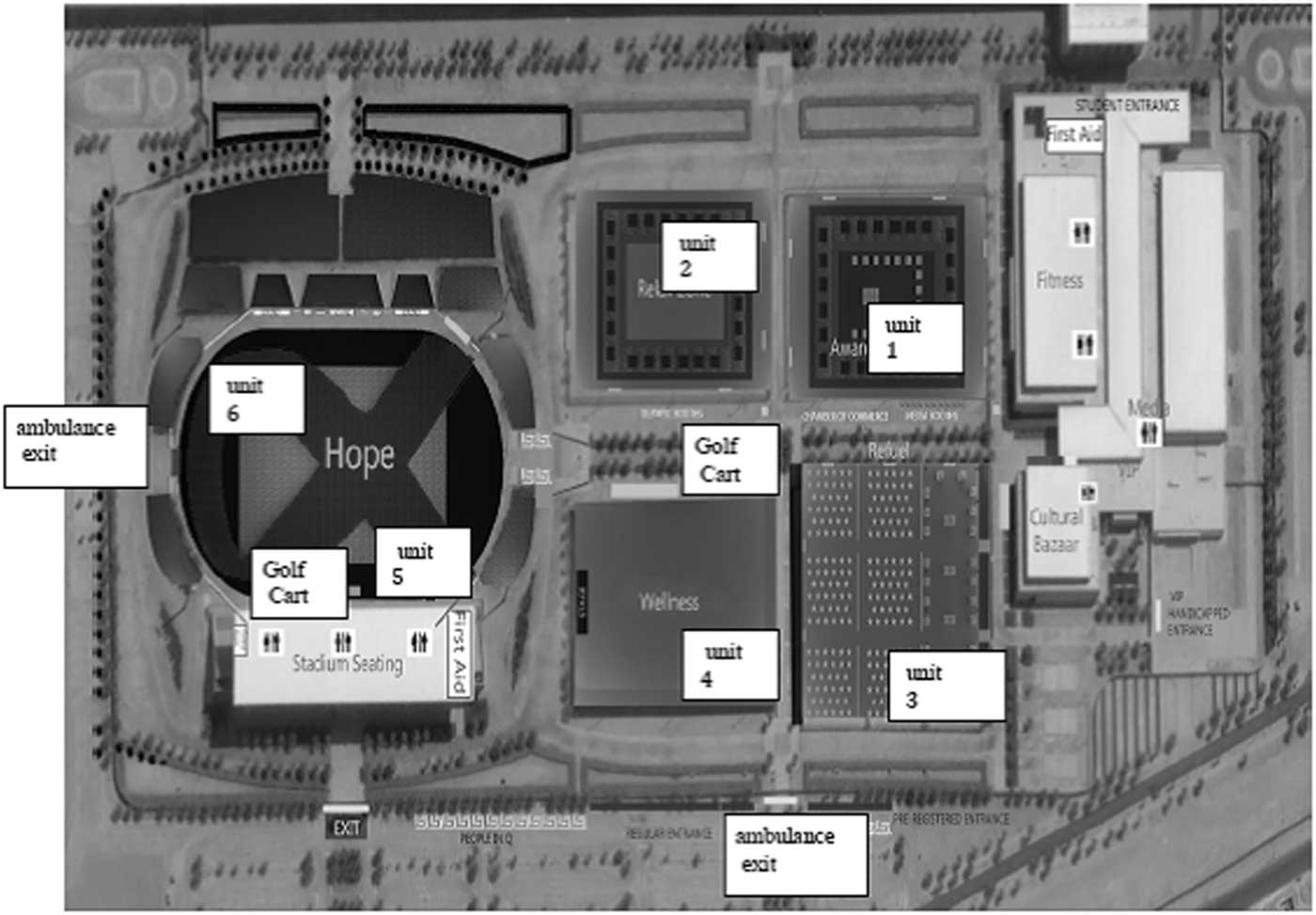
The event was held in a 22,000-m2 (236,806.0 ft2) sport complex with indoor and outdoor areas, including: an open stadium; baseball, squash, and open aerobic courts; training rooms; and three clinics. The complex had its own public facilities (ie, bathrooms and showers). Concrete walls with three entry/exit points surrounded the complex. The outdoor area was divided into five major areas by the organizers: the awareness area, refuel area, wellness area, relax zone, and hope area (Figure 1).
Outdoor Area of the 10KSA.

Medical Coverage
The hospital was responsible for providing the medical oversight for the 10KSA event, even when it was not operational. Medical care was provided by emergency medical technicians (EMTs), paramedics, nurses, and physicians through staffed ambulances, first-aid posts, and clinics. The hospital was still undergoing commissioning; thus, it was not able to receive any patients from the scene. The Saudi Red Crescent Authority (SRCA; Riyadh, Saudi Arabia) was contacted, which agreed to send two ambulances to transfer patients to the closest hospital (hospital ambulance was not able to transfer patients due to logistic issues).
Since the hospital was not yet operational, an online medical control was assigned to an emergency medicine consultant. She was also the team leader and stationed in one of the clinics. In addition, an emergency medicine resident was assigned to oversee the teams in the open areas; the teams were divided into groups, and each group was assigned to an area. Communication was via cellular phones.
Medical coverage was provided by two family medicine consultants, one emergency medicine consultant, one emergency medicine resident, 10 nurses from the institute, 10 volunteer nurses from the organizing partners, two female paramedics, and six male paramedics. The physicians were assigned to the clinics (inside the complex) equipped with beds, an otoscope, an ophthalmoscope, and weighing scales. The nursing teams were distributed to the first aid stations over six locations (Figure 1), with one in each activity corner and two in the stadium. Each station had the following: an oxygen cylinder, nebulizing machine, c-collar, glucometer, sphygmomanometer, basic dressing and splinting materials, and a wheelchair. The stations were composed of chairs, a table, and a sign indicating the presence of a first aid station. Hospital team members wore hospital scrubs and lab coats printed with a logo, making recognition easy. Their role was to manage simple cases onsite with reference to the pre-established, offline EMS medical protocols. For cases causing concern, they contacted the transport team (two nurses) to either take the patient to the clinic or the ambulance, if necessary. The transfer team used a mini-ambulance golf cart and wheelchairs. Prior to any transport request, the medical control doctor was contacted for approval.
Two female paramedics provided oversight for the stations and were labeled as mobile teams. One of them was in charge of controlled medications (narcotics and antiepileptics), which were kept in a small locked bag in limited quantities; the other carried the defibrillator machine with resuscitation medications. Administration of controlled medication was restricted to physicians only, after filling a controlled medication prescription form intended for in-scene administration only (controlled medications were not to be taken home).
Six male paramedics were assigned to three ambulances, which were allocated to be near each of the entrance/exit doors (two Type III and one Type II). The ambulances were fully equipped and were planned to be used as temporary treatment areas when care could not be provided inside the area, and for patients requiring intravenous fluids or nebulization. Transport ambulances belonging to SRCA were stationed beside the hospital’s, and they were in charge of transferring patients to a hospital, if required.
Since the event was located in an isolated area and the hospital was closed during event hours, a prepared stock of necessary consumables (ie, bandages and splints) and medications (ie, normal saline, dextrose, and pain killers) were kept in a mobile drawer in the clinics, with a defibrillator. Basic splints and bandages were also available in the first aid stations, and the transport team was in charge of restocking as needed.
A pharmacist was assigned to be in the hospital until 12:00am to dispense any extra needed medications. One male paramedic and EMT were in charge of restocking the medication, which required driving to the hospital, collecting the needed amount, returning to the venue, and giving the medications to the transport team.
Method
The team maintained written records for all patients using a carbonated prehospital care report (PCR) notebook issued to each paramedic, physician, and first aid station in advance. All PCRs were collected immediately after the event. The reports were reviewed afterward by the EMS section head that was aware of the targeted end points (number of cases, severity, and presentation); all reports were included and all variables were known by the reviewer (ie, age, gender, and severity of presentation) and no data abstraction forms were used.
Results
A total of 10,000 women attended the event and 8,264 women participated in the ribbon formation. The weather was cold and dry, and the temperature reached 10°C that night. The gates opened at 3:00pm and remained open until 12:00am.
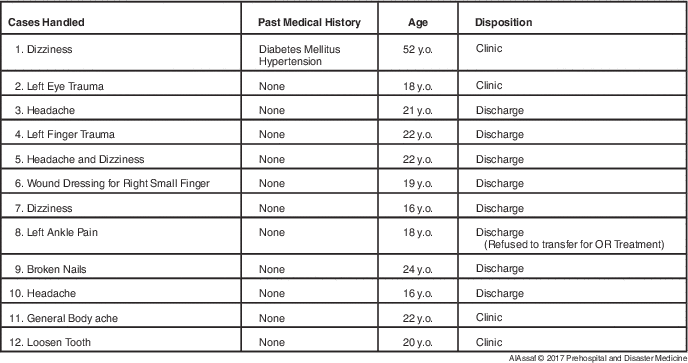
The patient presentation rate (PPR) was calculated as follows: (Number of attendees who presented to the on-site health service/Total number of attendees at the event) ×1000. A total of 41 patients presented to the health care areas; thus, the PPR was: 4.1 patients/1,000 persons in attendance (Table 1). Out of the 41 patients, four patients (9.8%) presented directly to the clinics with complaints of dizziness, left eye trauma, general body aches, and a loose tooth. A total of 37 patients (90.2%) presented to the first aid units, with 18 (48.6%) patients requesting a blood pressure check, five (13.5%) requesting a blood sugar level check, and six (16.2%) requesting a general check-up with no specific complaints. In addition, one patient had ankle pain and refused to go to the clinic.
Patient Presentations

Note: At least 18 patients requested a blood pressure check. Five patients requested a blood sugar check. There were an estimated four to six patients who requested a check-up, but were not documented.
The transport to hospital rate (TTHR) was calculated as follows: (Number of attendees transported to the hospital by ambulance/Total number of attendees at the event) ×1000. The observed TTHR was zero.
Although there were many physical activities and the participants had to walk for long distances, the injury rate was very low at this event. Crowd-related complaints were nil. No serous presentation was encountered and no patient was transferred to the health care facility.
Discussion
Many aspects of this event posed challenges to the provision of medical care, including the layout of the venue, number of attendees, cold weather conditions, female-only nature of the event, distance from the closest functional hospital (in perfect conditions, the closest private hospital was a 16-minute drive and the closest governmental hospital was a 26-minute drive), the presence of a non-operational hospital during event hours, and the short notice. One of the major challenges experienced was that men were not allowed to enter the venue; thus, all care was provided by the limited number of female paramedics, nurses, and physicians.
Large mass gatherings pose significant planning, logistical, operational, and public health challenges. The PPR, types of injuries or illnesses, and composition of event medical facilities can vary considerably.Reference Feldman, Lukins, Verbeek, MacDonald, Burgess and Schwartz 4 Factors reported to be associated with higher rates of patient presentation include high humidity conditions, unseated crowds, and unfenced events.Reference Kerr, Jackson and Parke 1 , Reference Milsten, Maguire, Bissell and Seaman 2 , Reference Parrillo 5 Therefore, a higher PPR was anticipated for the current event, as the crowd was mobile and confined to an isolated area, with the presence of many activities. The observed PPR was more than that typically reported in the literature.
Reported PPRs vary significantly, with values ranging from 0.14 to 90.0; however, the PPR for most reported events ranges between 0.5 and 2.0.Reference Leonard 6 This PPR (4.1) was more than the average, which may be explained by the nature of the event attendees (mostly active, young, and healthy) and the nature of the event (multiple physical activities, being confined in one place). No alcohol or drugs were allowed, as per Saudi rules and regulations, eliminating a major contributor to a high incidence of injuries. Furthermore, the observed patient TTHR of zero per 10,000 attendees was less than that previously described.Reference Milsten, Maguire, Bissell and Seaman 2 , Reference Levitin 7 It has been previously reported that on-site physicians can decrease the number of patient transports,Reference Levitin 7 which may have contributed to the findings.
Respiratory illnesses, minor injuries, heat-related injuries, and minor problems (ie, headaches, blisters, and sunburn) comprise 75% of patient presentations in literature.Reference De Lorenzo 8 In contrast, the majority of patient presentations at this event were check-up requests, with one reported eye trauma and one insignificant ankle trauma. Most of the patients presented to the first aid units, and the majority did not require transport either to the clinic or the outside. The multiple first aid units distributed over the location rendered it easier for attendees to seek medical care and decreased crowding in the health care areas. Having clear protocols and being fully equipped helped in managing all the cases without the need to call medical control. In addition, a cold-weather event generally produces lower casualty rates,Reference De Lorenzo 8 - Reference Reardon 10 and that may have helped during this event.
The American College of Emergency Physicians (ACEP; Irving, Texas USA) outlined several variables that should be considered by event planners, including: alcohol and drug availability, the “type” of people participating, age distribution of the attendees, event duration and the time of day, whether mobile or stationary, expected attendance, event type, presence of fireworks/torches/bonfires, physical barriers, location characteristics, whether outdoor or indoor, and the weather conditions.Reference Leonard 6 In addition, Levitin added access routes to and from the site and the number (and visibility) of first aid stations to this list.Reference Levitin 7 The physical layout of the event can determine the crowd flow, access roads for rapid transport by EMS and staging areas, and other physical barriers, which can be uncommon and require different models.Reference Chang, Koval, Freer and Kraus 11 , Reference McCann 12 For this event, the physical layout and access routes to the sport complex added an extra challenge to the team; there was only one street that the area could be accessed by, limiting access to the venue. There were no alternative routes, as roads were closed for the event (busses transferred attendees from certain pre-allocated gathering points to the venue). In addition, the entry and exit was limited to one door, which posed a danger for stumbling and overcrowding. A side door was chosen to be the exit route for patients from the open areas and another door was assigned to be the exit route for patients from the indoor complex to avoid this obstacle.
Debate has continued regarding the level and extent of patient care services at such large, public gatherings.Reference Donegan 13 The most commonly reported arrangement of care services allocates resources centered around first aid posts or medical centers, the number of which depend on the size and geography of the event, and mobile first aid teams are located throughout the venue.Reference Levitin 7 The recommended capabilities among patient care providers at mass gatherings are as follows: (1) basic first aid within four minutes; (2) Advanced Life Support within eight minutes; and (3) evacuation to a medical facility within 30 minutes.Reference Sanders, Criss, Steckl, Meislin, Raife and Allen 14 The plan for this team allocation was to provide the following: (1) basic first aid with two minutes; (2) Advanced Life Support within five minutes; and (3) evacuation to medical facilities, which varied based on the traffic and weather conditions.
The amount and type of equipment needed at a given event will be determined in large part by the expected casualties and level of medical personnel available. However, there is no current standard for the minimum medical equipment to provide.Reference De Lorenzo 8 During the preparation, the team strived towards having more, rather than less, equipment, as access to additional resources was difficult (the hospital and warehouse were closed during weekends and after working hours). The team faced a challenge in getting the equipment, consumables, and medication into the venue, as no cars were allowed to go in, and poor communication existed between the organizers and security personnel.
Limitations
The attendees were mainly healthy women; hence, the overall presentation rate cannot reflect the expected number of presentations in other kinds of events with a wider attendee base, including children and the elderly, as well as men.
Being in a confined space made seeking medical advice outside of the venue difficult for attendees; since there was no nearby hospital and the transportation was limited (must have a male driver), the on-site medical coverage was the only option.
The present findings may not be generally applicable to other mass gatherings with different venues, multiple EMS systems, or different weather conditions.
Conclusion
Medical coverage for large mass-gathering events is challenging; the larger the crowd and the service area, the riskier the job. Having several first aid units distributed in the crowded area, and having physicians on board, is of great value in providing the best timely care for attendees. The types of patient presentations at this event were somewhat similar to those encountered at similar gatherings, but in lower rates and with fewer sick patients.