Introduction
The Commander Islands are a group of islands of ancient volcanic origin located in the Bering Sea between Attu Island of the Aleutian Islands and the Kamchatka Peninsula in the Russian Far East (Fig. 1). The archipelago consists of Bering (1667 km2) and Medny (186 km2) Islands, two islets Toporkov (0.25 km2) and Ary Kamen’ (0.08 km2), and several small inshore cliffs. The climate here is very wet, with mild winters, cold summers and a very short growing season from June to September (Krestov Reference Krestov2004). As a result, the vegetation of the Commander Islands differs sharply from that of the nearby territories of Kamchatka, with a treeless tundra-like appearance and the absence of shrubby thickets of Betula ermanii, Duschekia fruticosa and Pinus pumila. The vegetation and climate of the archipelago are more similar to those of the Aleutian Islands and together they can be assigned to the oceanic climatic sector of the subarctic vegetation zone (Tatewaki Reference Tatewaki1963; Krestov Reference Krestov, Kolbek, Šrůtek and Box2003, Reference Krestov2004). However, the species composition of the vascular plants of the Commander Islands is generally boreal and dominated by the widely distributed circumpolar, Eurasian, and northern Pacific taxa (Vasiliev Reference Vasiliev1957; Tatewaki Reference Tatewaki1963; Krestov Reference Krestov2004; Mochalova & Yakubov Reference Mochalova and Yakubov2004). Based on this, Takhtajan (Reference Takhtajan1986) placed the archipelago within the circumboreal floristic region (Okhotsk-Kamchatka Province), whilst Tatewaki (Reference Tatewaki1963) allocated the Commander and Aleutian Islands their own botanical area within the subarctic zone, which he named ‘Hultenia’.
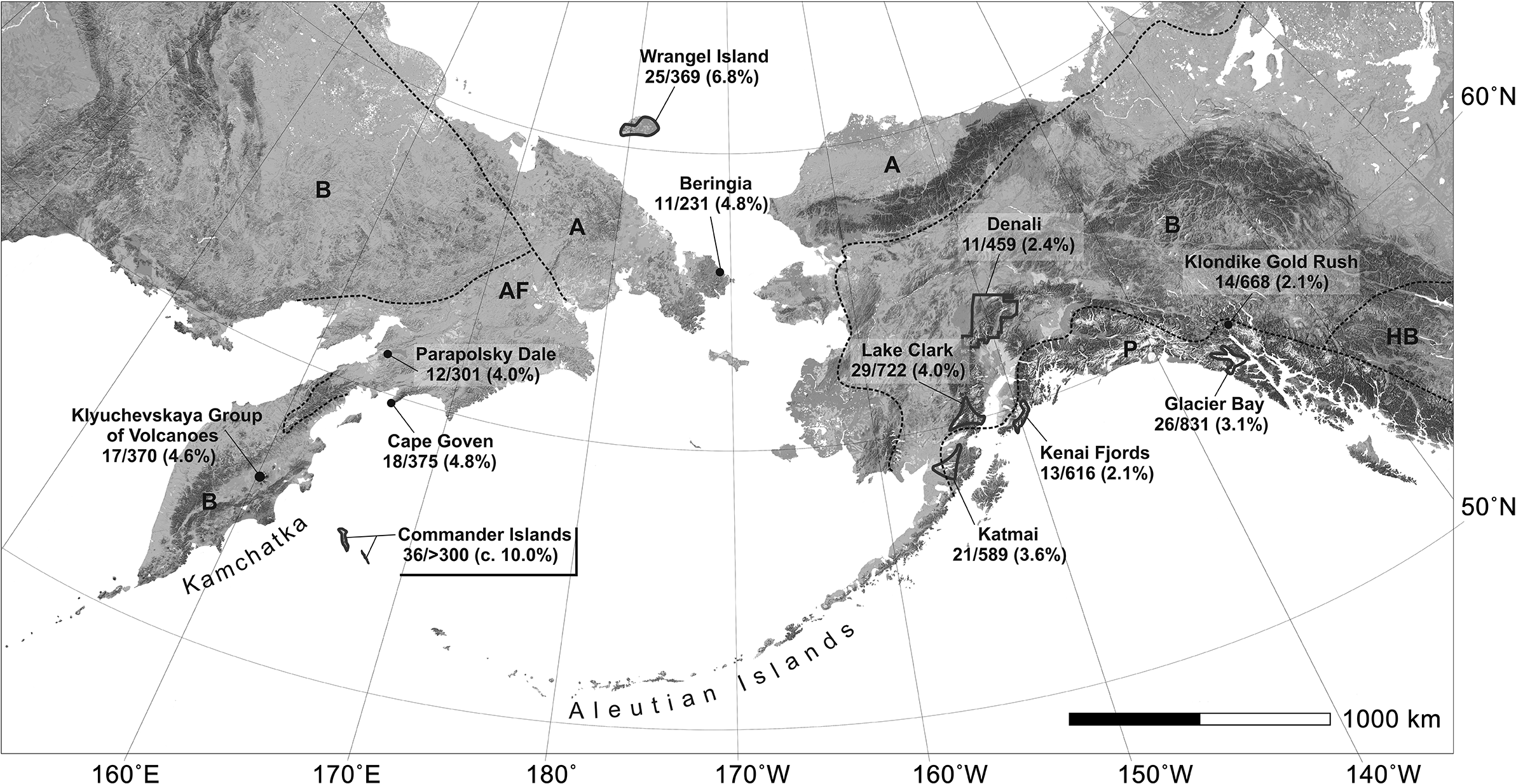
The local lichen biotas of the North Pacific and of the adjacent Chukchi Sea coast used in this study. The outlines of the biotas ±correspond to the investigated areas, and not to the borders of the national parks etc. Numbers before slash indicate the number of species of Teloschistales; numbers after slash indicate the number of all lichen species; the proportion of Teloschistales species out of the total number of lichens is given in parentheses. A = Arctic tundra; AF = forest tundra; B = boreal forests; HB = hemiboreal forests; P = Pacific coastal boreal rainforests.

Prior to the study described, lichenologists have visited the Commander Islands on only two occasions (Almquist Reference Almquist and Nordenskiöld1887; Trass Reference Trass1963) and the diversity of lichens there is poorly known. Nevertheless, two species of Teloschistaceae, Caloplaca caesiorufella (Nyl.) Zahlbr. and C. etesiae (Nyl.) Zahlbr., were described from the archipelago by Nylander (Reference Nylander1885) based on the collection of E. Almquist.
Between 2019–2022, D. Himelbrant and I. Stepanchikova, sometimes with A. Zueva, carried out a field study of the entire lichen biota of the Commander Islands. Since the lichens of Hultenia are poorly known and the identification of many species is problematic, the treatment of all taxonomic groups is still far from complete; however, some of our results have been published recently (Frolov et al. Reference Frolov, Himelbrant, Stepanchikova and Prokopiev2021a; Printzen et al. Reference Printzen, Holien, Kantelinen, Myllys, Ratschow, Stepanchikova, Weber and Timdal2023; Stepanchikova et al. Reference Stepanchikova, Himelbrant, Prokopiev, Pankova, Zhukova, Gainetdinova and Zueva2023). In the course of our study, a surprisingly high relative diversity of Teloschistaceae in the archipelago was noted, and subsequent analysis revealed that its lichen biota encompasses the highest number of species of the order Teloschistales (sensu Wijayawardene et al. Reference Wijayawardene, Hyde, Dai, Sánchez-García, Goto, Saxena, Erdoğdu, Selçuk, Rajeshkumar and Aptroot2022) among investigated local biotas in the North Pacific, including Alaska, Chukotka and Kamchatka. Here we 1) describe the Teloschistales diversity on the Commander Islands and try to interpret its outstanding position in the region, and 2) describe the distribution of the Teloschistales species throughout the different habitat types within the archipelago.
Materials and Methods
Sampling
Fieldwork was carried out in temporary sample plots with an area of c. 100 m2 each (10 × 10 m if possible or otherwise within the natural boundaries of a community) where all substrata were investigated and apparent presence or absence of species was recorded. The sample plots were located along the routes of field excursions. The routes were planned in such a way that the territory and landscapes of the archipelago could be explored as uniformly as possible. The sample plots were selected to cover all represented vegetation types. Within each vegetation type, preference was given to the most promising sites in terms of lichen diversity, taking into account the availability of suitable substrata and the degree of disturbance of the community. Such promising sites (hotspots) have been shown to be most useful for revealing lichen diversity (Vondrák et al. Reference Vondrák, Malíček, Palice, Bouda, Berger, Sanderson, Acton, Pouska and Kish2018).
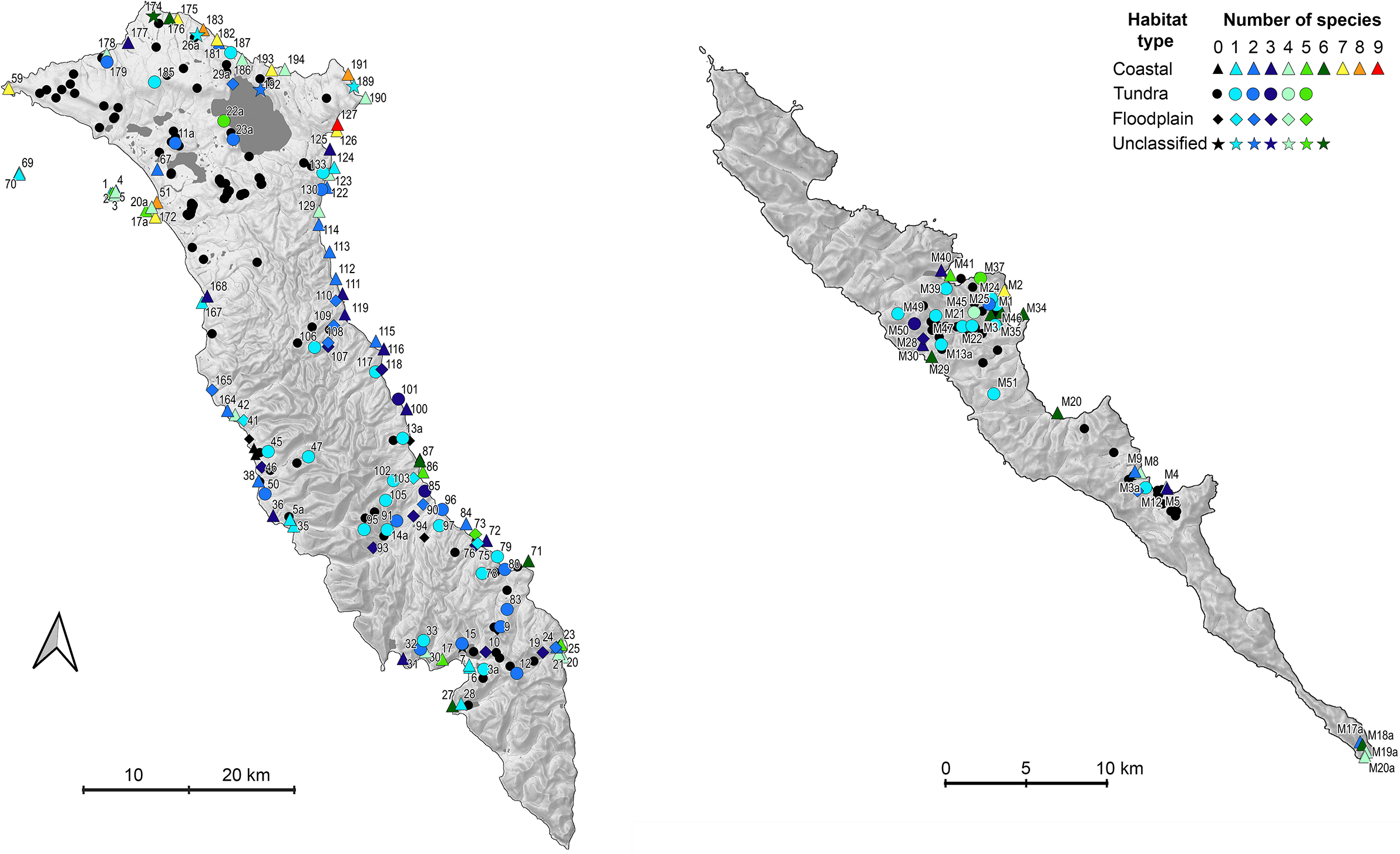
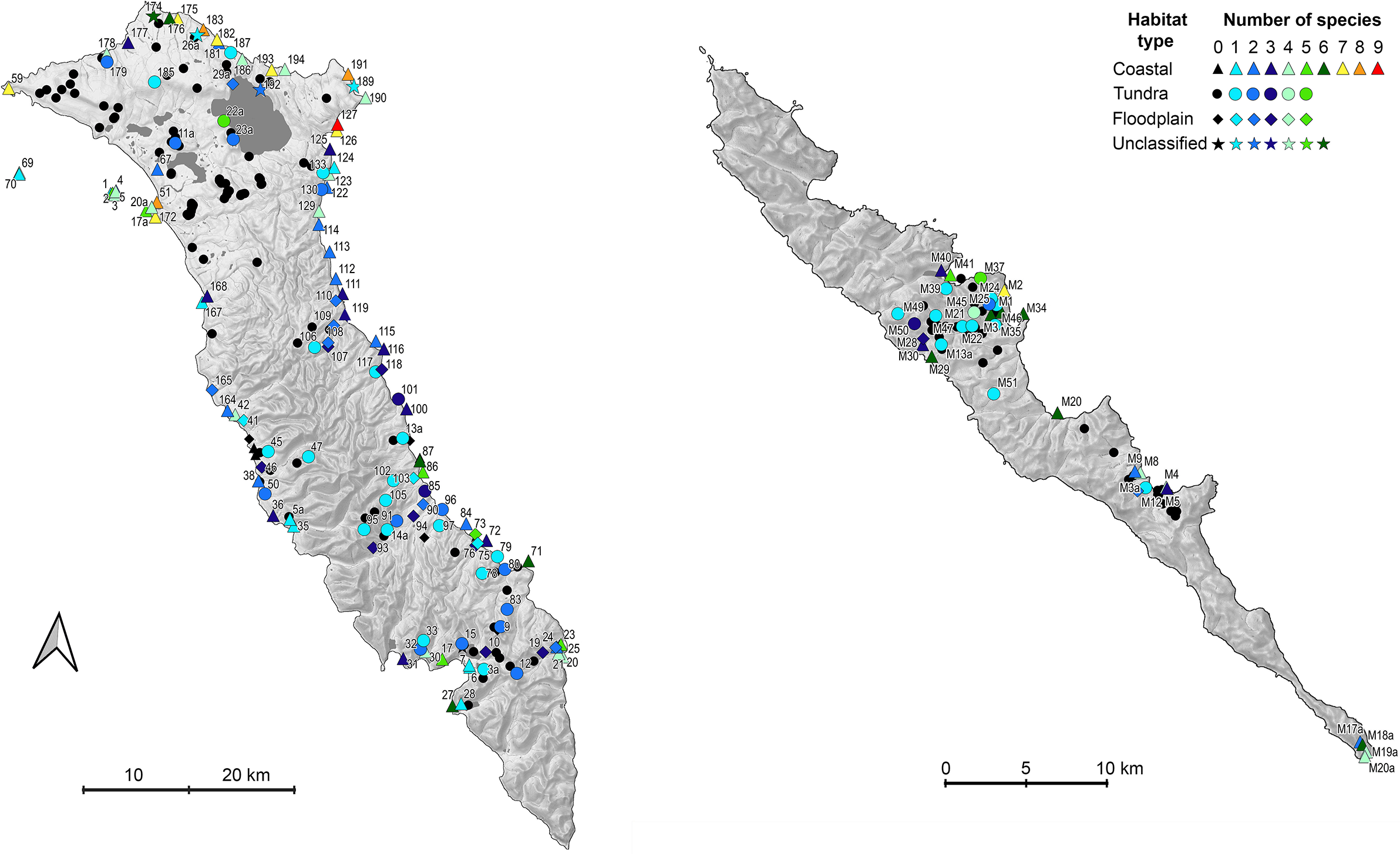
A total of 297 plots were investigated (Fig. 2). All plots contained lichens, and Teloschistales were recorded on 154 of them (Supplementary Material Table S1, available online): 120 on Bering Island and the surrounding islets of Toporkov and Ary Kamen’, and 34 on Medny Island. Altogether 598 specimens of the Teloschistales were collected. They are deposited mainly in LE, LECB, VBGI, and in Frolov’s personal herbarium.
Geographical location of the studied sample plots on Bering (left) and Medny (right) Islands, of the Commander Islands archipelago in the Russian Far East.
Phenotype evaluation and chemistry
Phenotype evaluation and morphological terminology follow Vondrák et al. (Reference Vondrák, Frolov, Arup and Khodosovtsev2013), Frolov et al. (Reference Frolov, Himelbrant, Stepanchikova and Prokopiev2021a) and the LIAS glossary (available at https://glossary.lias.net/wiki/). Results of the measurements are given as (min–) x̄ 1 – x̄ 2 – x̄ 3 (–max) or as min– x̄ 2 –max, where min/max are extremes from all measurements, x̄ 1 is the lowest specimen arithmetic mean observed, x̄ 2 is the arithmetic mean of all observations, and x̄ 3 is the highest specimen arithmetic mean observed. Total number of measurements (n), number of samples assessed (N), and standard deviation from all measurements (SD) are given in square parentheses for each character measured as [n, N, SD] or as [n]. The secondary metabolite patterns were identified using HPLC-UV-MS as described by Frolov et al. (Reference Frolov, Himelbrant, Stepanchikova and Prokopiev2021a). Calculations of the relative composition of the secondary compounds are based on absorbance at 270 nm according to Søchting (Reference Søchting1997).
Sequencing and phylogenetic reconstructions
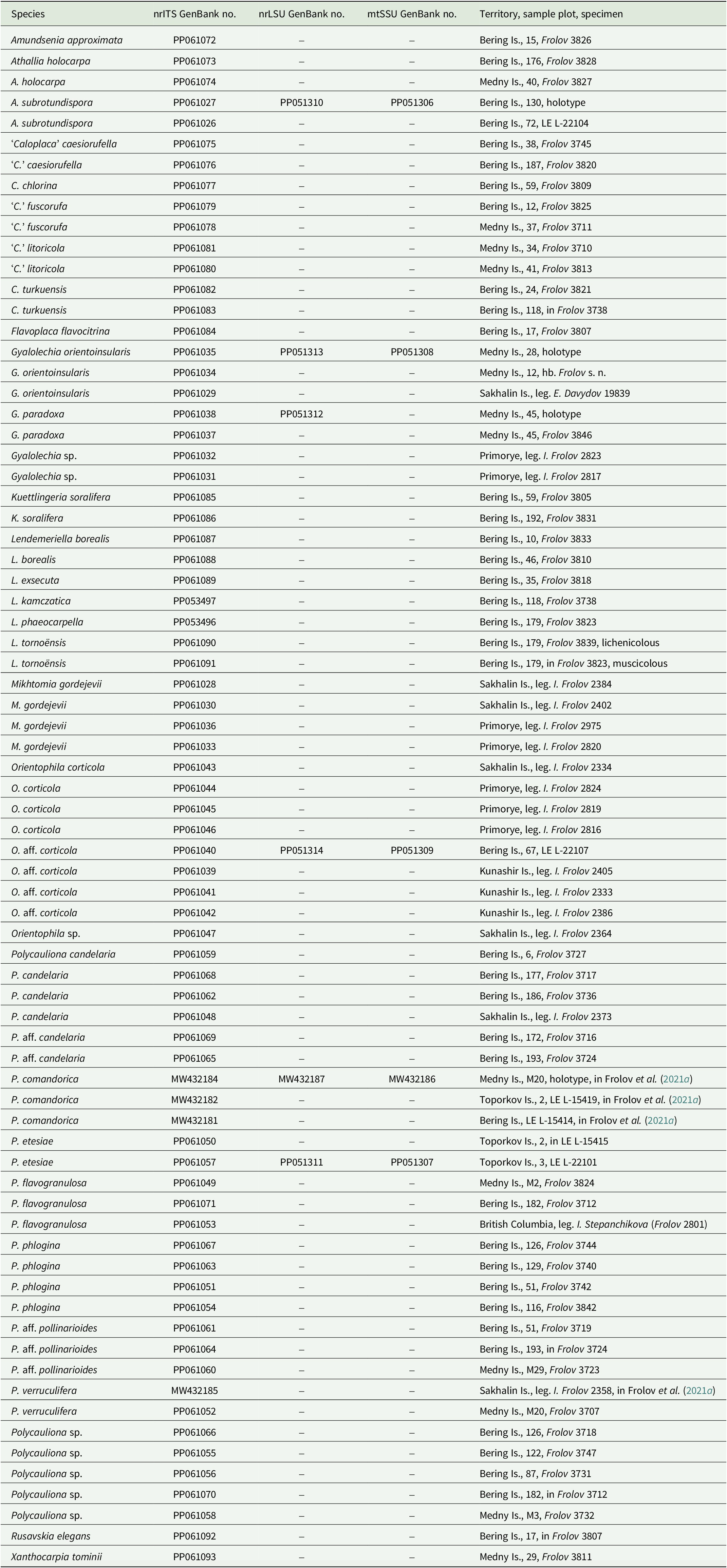
Since the lichens of the Russian Far East are still inadequately explored, molecular barcoding to check the identity of the specimens has been used in addition to morphological and biochemical analyses. Such an approach, recently termed ‘integrative floristics’ (Fedosov et al. Reference Fedosov, Afonina, Ignatov, Ignatova, Kazanovsky, Kuznetsova, Mamontov, Konstantinova, Koltysheva and Kubešová2022), allows a more reliable and thorough study of diversity and is beginning to be widely used in lichenology (e.g. Leavitt et al. Reference Leavitt, Hollinger, Summerhays, Munger, Allen and Smith2021; Munger et al. Reference Munger, Baugh, Henrie, Hollinger, Crepeau and Leavitt2022). Barcode nrITS sequences were obtained for 74 specimens of 33 species and uploaded to GenBank; nrLSU and mtSSU sequences were also obtained for the newly described species (Table 1). DNA was extracted with a CTAB-based protocol (Aras & Cansaran Reference Aras and Cansaran2006). Primers for PCR amplification were ITS1F (Gardes & Bruns Reference Gardes and Bruns1993) and ITS4 (White et al. Reference White, Bruns, Lee, Taylor, Innis, Gelfand, Sninsky and White1990) for ITS, AL1R (Döring et al. Reference Döring, Clerc, Grube and Wedin2000) and LR5 (Vilgalys & Hester Reference Vilgalys and Hester1990) for nrLSU, and mtSSU1 (Zoller et al. Reference Zoller, Scheidegger and Sperisen1999) and mtSSU7 (Zhou & Stanosz Reference Zhou and Stanosz2001) for mtSSU. The PCR settings followed Ekman (Reference Ekman2001). Sequencing was performed at the Centre for Molecular and Cell Technologies, Research Park of St Petersburg State University (St Petersburg, Russia) and at Evrogen JSC (Moscow, Russia).
GenBank Accession numbers and voucher information of the new sequences of Teloschistales obtained in this study. Also included are species and specimens from outside the Commander Islands, used in the phylogenies of the corresponding groups.

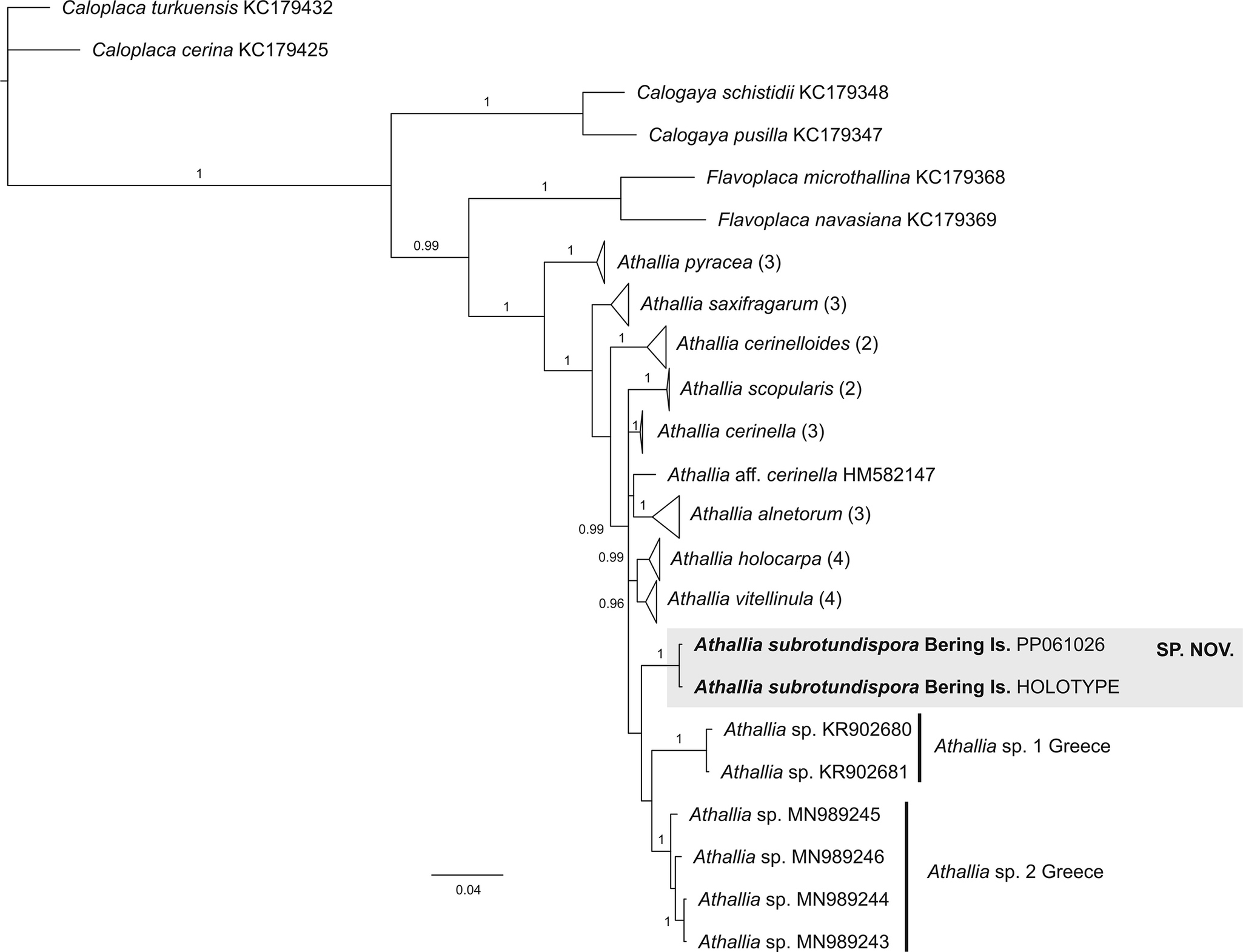
Newly obtained sequences were edited in FinchTV v. 1.4.0 (Geospiza Inc., Seattle, USA) and BioEdit v. 7.2.5 (Hall Reference Hall1999). All ITS sequences generated for the study were subjected to an initial ‘blastn’ search against the nucleotide collection of GenBank, and to a search against our own database of Teloschistales sequences, to confirm species identity. Accession numbers of sequences downloaded from GenBank and used in the analyses of the ITS and concatenated alignments are provided in Supplementary Material Tables S2 and S3, respectively (available online). Where needed, datasets were aligned online using MAFFT v. 7 (Katoh & Standley Reference Katoh and Standley2013; available at http://mafft.cbrc.jp/alignment/server/), with the L-INS-i method (Katoh et al. Reference Katoh, Kuma, Toh and Miyata2005) selected automatically by the program. To exclude ambiguously aligned positions, the concatenated alignment was subsequently analyzed by the gappyout algorithm as implemented in the TrimAl software package (Capella-Gutierrez et al. Reference Capella-Gutiérrez, Silla-Martínez and Gabaldón2009). In the concatenated dataset, three partitions corresponding to three DNA loci were analyzed separately. Models of nucleotide substitutions for each locus or partition were selected using the corrected Akaike information criterion implemented in jModelTest v. 0.1.1 (Posada Reference Posada2008). The GTR + G model was selected for the analyses of the nrITS alignments of the genera Athallia, Orientophila and Polycauliona, and the SYM + G for Gyalolechia. For the analyses of the concatenated alignment, the SYM + I + G model was selected for the nrITS partition, GTR + I + G for the nrLSU, and HKY + I + G for the mtSSU. Phylogenetic reconstructions were carried out using Bayesian inference in MrBayes v. 3.2.6 (Ronquist & Huelsenbeck Reference Ronquist and Huelsenbeck2003) and the analyses were run on the CIPRES Web Portal (http://www.phylo.org/portal2/). MrBayes analyses were performed using two independent runs with four MCMC chains (three cold and one heated) in each run. Trees were sampled every 500th generation. Analyses were stopped when the average standard deviation of split frequencies between the simultaneous runs dropped below 0.01 (445 000 generations for Athallia, 345 000 for Gyalolechia, 440 000 for Orientophila, 925 000 for Polycauliona, and 175 000 for the concatenated alignment). The first 25% of trees was discarded as burn-in, and the remaining trees were used for the construction of a 50% majority-rule consensus tree.
Habitat types
We assigned each sample plot to one of the three habitat types (Fig. 2) similar to that undertaken by Vondrák et al. (Reference Vondrák, Frolov, Davydov, Yakovchenko, Malíček, Svoboda and Kubásek2019) in their study of Teloschistaceae diversity in the Altai-Sayan region. These three habitat types are supported by the classification of the Commander Islands vegetation proposed by Krestov (Reference Krestov2004) and Mochalova & Yakubov (Reference Mochalova and Yakubov2004). Each of our habitat types approximately corresponds to several of their vegetation units.
-
1) Coastal habitats include all plant communities and substrata related to a narrow strip along the seashore: supralittoral rocks, outcrops on seashore slopes with a sparse cover of grasses and forbs (Leymus mollis, Poa turneri, Saxifraga cherlerioides etc.), occasional shrubs of Salix spp. and Sorbus sambucifolia, and driftwood on pebbly and sandy shores. Altogether 81 localities with Teloschistales and seven without Teloschistales belong here.
-
2) Tundra habitats are the most common on the archipelago and include different types of tundra vegetation with dwarf shrubs, grasses and forbs (Arctous alpina, Artemisia furcata, Calamagrostis sesquiflora, Empetrum nigrum, Vaccinium uliginosum etc.), thickets or solitary shrubs of Rhododendron aureum, Salix spp. and Sorbus sambucifolia, and rocky outcrops and screes on the tops and slopes of mountains and ridges. Altogether 48 localities with Teloschistales and 128 without Teloschistales belong here. They occur at altitudes from almost sea level to c. 650 m a.s.l.
-
3) Floodplain habitats include dense thickets of shrubs (Salix alaxensis, S. arctica subsp. crassijulis, S. lanata, Sorbus sambucifolia etc.) and forb meadows with Aconitum maximum and Filipendula camtschatica etc. along the rivers. Altogether 21 localities with Teloschistales and six without Teloschistales belong here. They occur from the river mouths at sea level to c. 75 m a.s.l.
Four localities with Teloschistales and two without Teloschistales were not assigned to any of these three habitat types (unsorted).
Species’ biogeographical elements
Species of the Teloschistales recorded in the selected local biotas of the North Pacific were assigned to one of nine biogeographical elements depending on their distribution patterns, mainly following Oxner (Reference Oxner1974), Ahti (Reference Ahti and Seaward1977), Kurokawa (Reference Kurokawa2006) and Galloway (Reference Galloway and Nash2008). These data are based on the assumption of absence of species in large regions for which we have either insufficient or no data. This makes our grouping of species by biogeographical elements preliminary. Several species were not assigned and were kept as ‘unclear’ due to insufficient information. For some species, our assignment is rather approximate and does not take into account some details of their distribution (see comments under elements below).
-
1) The Amphi-Pacific biogeographical element includes species distributed in the boreal and temperate regions of North-East and East Asia, and western North America (Ahti Reference Ahti and Seaward1977; Søchting Reference Søchting2004). Some authors (e.g. Kurokawa Reference Kurokawa2006) refer to it as the Beringian or Amphi-Beringian element; however, we prefer to keep the latter terms for species with a more northern Arctic distribution.
-
2) Arctic-alpine circumpolar (Oxner Reference Oxner1974) is widely distributed in tundra ecosystems of the Northern Hemisphere (Arctic and alpine localities in mountains outside the Arctic). Some species we include here are in fact bipolar (e.g. Lendemeriella tornoënsis), are also known in the northern boreal zone (e.g. ‘Caloplaca’ caesiorufella), are not reliably known in mountains outside the Arctic (e.g. ‘Caloplaca’ fraudans), or are not strictly circumpolar (e.g. ‘Caloplaca’ fuscorufa). This element more or less corresponds to the Holarctic, bipolar, alpine, and boreal arctic-alpine elements of Kurokawa (Reference Kurokawa2006) and Galloway (Reference Galloway and Nash2008).
-
3) Boreal North-East Asian is distributed mainly in the boreal zone of the Russian Far East with a small number of localities known further west (southern Siberia). This is a more ecologically restricted variant of the eastern Eurasian (Ahti Reference Ahti and Seaward1977) or northeast Asiatic (Kurokawa Reference Kurokawa2006) elements.
-
4) Circumboreal is distributed in the boreal zone and the forest belt in mountains of the Holarctic and can be occasionally found in forest-steppe and the southern part of tundra. It corresponds to the circumpolar (Ahti Reference Ahti and Seaward1977) and boreal (Kurokawa Reference Kurokawa2006) elements.
-
5) The endemic (Kurokawa Reference Kurokawa2006; Galloway Reference Galloway and Nash2008) element includes species that are quite common on the Commander Islands and are not known elsewhere.
-
6) Maritime North-East Asian is distributed along the shores of North-East Asia (Commander and Kuril Islands, Sakhalin). This is a variant of the eastern Eurasian (Ahti Reference Ahti and Seaward1977) or northeast Asiatic (Kurokawa Reference Kurokawa2006) elements, more closely associated with the coast.
-
7) Maritime Western North American is distributed along the shores of western North America (from California to SE Alaska and the Aleutian Islands). This is a variant of the western North American element (Ahti Reference Ahti and Seaward1977), more closely associated with the coast.
-
8) North American is more widely distributed across the continent than the previous element; zonal preferences of the species are not entirely clear. These species can probably be attributed to one of the North American elements proposed by Ahti (Reference Ahti and Seaward1977).
-
9) Widespread is distributed in various biomes, often in both the Northern and Southern Hemispheres. It corresponds to the cosmopolitan element (Galloway Reference Galloway and Nash2008), but is probably not so widely distributed.
Comparison of species diversity of the local biotas and description of species distribution across the sample plots; accumulation curves
The local lichen biotas of the following territories were used for comparison (Fig. 1): 1) Russia, Kamchatka Territory: the Klyuchevskaya group of volcanoes (Himelbrant et al. Reference Himelbrant, Stepanchikova, Kuznetsova and VYu2014), Parapolsky Dale (Himelbrant et al. Reference Himelbrant, Stepanchikova, Ahti and VYu2019a; Frolov et al. Reference Frolov, Vondrák, Konoreva, Chesnokov, Himelbrant, Arup, Stepanchikova, Prokopiev, Yakovchenko and Davydov2021b) and Cape Goven (Himelbrant et al. Reference Himelbrant, Stepanchikova, Ahti and VYu2021; with Caloplaca turkuensis (Vain.) Zahlbr. and Lendemeriella phaeocarpella (Nyl.) I. V. Frolov et al. additionally identified); 2) Russia, Chukotka Autonomous Area: the lower reaches of the Chegitun River and the Utaveem River in Beringia National Park (Makarova & Katenin Reference Makarova and Katenin2009) and Wrangel Island (Dobrysh Reference Dobrysh, Golubkova and Urbanavichus2000; Kristinsson et al. Reference Kristinsson, Zhurbenko and Hansen2010; Evdokimov et al. Reference Evdokimov, Afonina, Konoreva, Obabko, Mamontov, Chesnokov, Frolov and Babiy2022; Frolov et al. Reference Frolov, Evdokimov and Kataeva2022; with Parvoplaca aff. tiroliensis (Zahlbr.) Arup et al. additionally identified); 3) USA, Alaska: Katmai National Park and Preserve (McCune et al. Reference McCune, Arup, Breuss, Di Meglio, Di Meglio, Esslinger, Magain, Maidlikowska, Miller and Muggia2018), Lake Clark National Park and Preserve (McCune et al. Reference McCune, Arup, Breuss, Di Meglio, Di Meglio, Esslinger, Magain, Maidlikowska, Miller and Muggia2018), Kenai Fjords National Park and Preserve (McCune et al. Reference McCune, Arup, Breuss, Di Meglio, Di Meglio, Esslinger, Miadlikowska, Miller, Rosentreter and Schultz2020), Glacier Bay National Park and Preserve (Spribille et al. Reference Spribille, Fryday, Pérez-Ortega, Svensson, Tønsberg, Ekman, Holien, Resl, Schneider and Stabentheiner2020), Klondike Gold Rush National Historic Park (Spribille et al. Reference Spribille, Pérez-Ortega, Tønsberg and Schirokauer2010), and Denali National Park and Preserve (Stehn et al. Reference Stehn, Walton, Nelson, Hampton-Miller and Roland2015). Only data on Teloschistales from these papers were used to compare local biotas in the HCA and PCA (see below). The comparison of regions assumes that the same taxonomic concepts were correctly applied in the different study areas. We are quite familiar with the concepts applied by Ulf Arup and Jan Vondrák to Teloschistales in some areas of North America (McCune et al. Reference McCune, Arup, Breuss, Di Meglio, Di Meglio, Esslinger, Magain, Maidlikowska, Miller and Muggia2018, Reference McCune, Arup, Breuss, Di Meglio, Di Meglio, Esslinger, Miadlikowska, Miller, Rosentreter and Schultz2020; Spribille et al. Reference Spribille, Fryday, Pérez-Ortega, Svensson, Tønsberg, Ekman, Holien, Resl, Schneider and Stabentheiner2020) and use the same ones here. In addition, several areas in Asia were investigated by the authors of the present paper (Himelbrant et al. Reference Himelbrant, Stepanchikova, Kuznetsova and VYu2014, Reference Himelbrant, Stepanchikova, Ahti and VYu2019a, Reference Himelbrant, Stepanchikova, Ahti and VYu2021; Frolov et al. Reference Frolov, Vondrák, Konoreva, Chesnokov, Himelbrant, Arup, Stepanchikova, Prokopiev, Yakovchenko and Davydov2021b, Reference Frolov, Evdokimov and Kataeva2022; Evdokimov et al. Reference Evdokimov, Afonina, Konoreva, Obabko, Mamontov, Chesnokov, Frolov and Babiy2022).
For hierarchical cluster analysis (HCA) based on the Ward method for cluster agglomeration and Pearson’s distance, the R package dendextend was used (Galili Reference Galili2015). For the principal component analysis (PCA) and k-means clustering approach, the R package pcaMethods was used (Stacklies et al. Reference Stacklies, Redestig, Scholz, Walther and Selbig2007). The R package ggplot2 (Wickham Reference Wickham2016) was used for visualization.
R package ggplot2 was used to produce boxplots, and the ‘metaMDS’ function (default settings) from the R package vegan was used for the non-metric multidimensional scaling (NMDS) and ordination diagram (Oksanen et al. Reference Oksanen, Simpson, Blanchet, Kindt, Legendre, Minchin, Hara, Solymos, Stevens and Szöcs2022). The analysis was based on the presence-absence matrix of species within sample plots. Before performing the ordination, we excluded from the analysis rare species that appeared in fewer than five sample plots. The species richness scores (number of species that occurred in the sample plot) were also projected on the NMDS-ordination space using the ‘ordisurf’ function (default settings) from vegan.
We used a generalized linear model (GLM) to investigate the relationship between species richness and habitat type. The GLM was specified with a Poisson distribution using the ‘glm’ function in R. To test the significance of habitat type in predicting species richness, we analyzed deviance (ANOVA, with the R function ‘anova’) on the fitted GLM. The ANOVA utilized a chi-squared test to compare the deviance of the full model, which included habitat type as a predictor, against a null model containing only the intercept. This analysis determined whether statistically significant differences in species richness exist among the various habitat types. Both the ‘glm’ and ‘anova’ functions are from the stats package in base R (R Core Team 2024).
Following the significant ANOVA results, we conducted post hoc pairwise comparisons to identify specific differences between habitat types. These comparisons were performed using the estimated marginal means (EMMeans) approach, implemented via the R package emmeans (Lenth Reference Lenth2024). To account for multiple comparisons, Tukey’s Honest Significant Difference (HSD) test was applied. This method provides an effective control for Type I error rates across the multiple pairwise contrasts among habitat groups. The function ‘emmeans()’ performs pairwise comparisons of the EMMs for each type of habitat, with Tukey’s adjustment for multiple comparisons.
Species accumulation curves were calculated utilizing the ‘specaccum’ function in vegan, which estimates the cumulative number of species recorded as more sample plots are added. The ‘random’ method parameter shuffles the order of samples to produce an average curve (the number of permutations is 100). Subsequently, we applied the ‘fitspecaccum’ function from the same package to fit non-linear, self-starting species accumulation models. This function first fits a model based on the results from ‘specaccum’ and then proceeds to fit the non-linear model. We chose a non-linear regression model based on the Arrhenius equation.
Results and Discussion
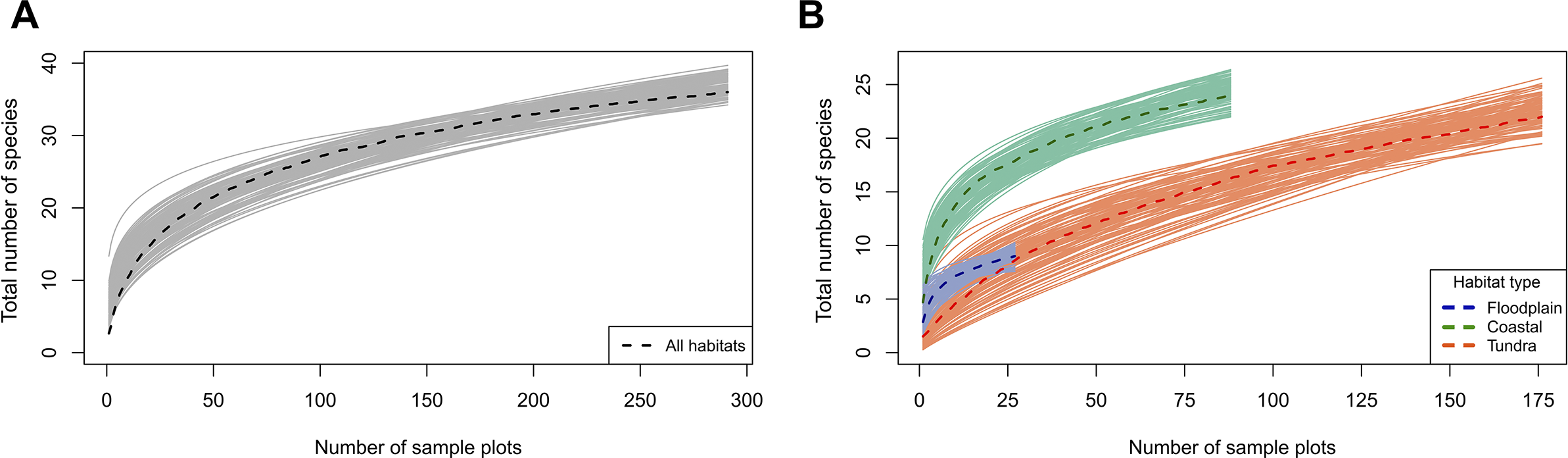
Thirty-six species of the order Teloschistales in 14 genera and two families were recorded from the Commander Islands. One species belongs to the family Brigantiaeaceae and the rest to the family Teloschistaceae, of which 14 species in five genera and four species with unclear generic affiliation belong to the subfamily Caloplacoideae, and 17 species in eight genera belong to Xanthorioideae; no members of Teloschistoideae were recorded. Polycauliona and Lendemeriella are the most species-rich genera and encompass nine and seven species respectively. Three species belong to the genus Caloplaca s. str., and the genera Athallia and Gyalolechia include two species each. Other genera are represented by only one species; four species do not have a definite generic affiliation at this time. A species accumulation curve (Fig. 3A) has a form approaching that of biotas with a well-studied species richness, indicating a high level of detection of the Teloschistales diversity in the Commander Islands.
Species accumulation curves for the Teloschistales diversity detected on the Commander Islands, with all sample plots investigated during fieldwork (with and without Teloschistales). A, all habitats together. B, three habitat types separately.

‘Caloplaca’ caesiorufella and Polycauliona candelaria are the most common species on the archipelago, being recorded from more than 70 plots (c. 50% of the localities studied containing Teloschistales; Supplementary Material Table S4, available online). Athallia holocarpa, P. aff. pollinarioides, P. verruculifera and Rusavskia elegans are less common but still frequent, being recorded from c. 30–45 plots (c. 20–30%). Caloplaca turkuensis, Lendemeriella borealis, P. comandorica and P. flavogranulosa were collected from 15–20 plots (c. 10–15%). However, most of the species (26) are rare and recorded from 1–13 plots; 15 of these species were recorded from only 1–2 plots (Supplementary Material Table S4).
Two species of the Teloschistales collected on the Commander Islands are new to Russia: ‘Caloplaca’ litoricola and Polycauliona flavogranulosa. Four species are new to the Russian Far East: ‘Caloplaca’ fuscorufa, C. turkuensis, Kuettlingeria soralifera and Xanthocarpia tominii. Four species are proposed as new to science: Athallia subrotundispora, Gyalolechia orientoinsularis, G. paradoxa and Polycauliona comandorica (the latter in Frolov et al. (Reference Frolov, Himelbrant, Stepanchikova and Prokopiev2021a)); three of these (A. subrotundispora, G. paradoxa and P. comandorica) are currently known only from the Commander Islands.
Teloschistales diversity in three habitat types
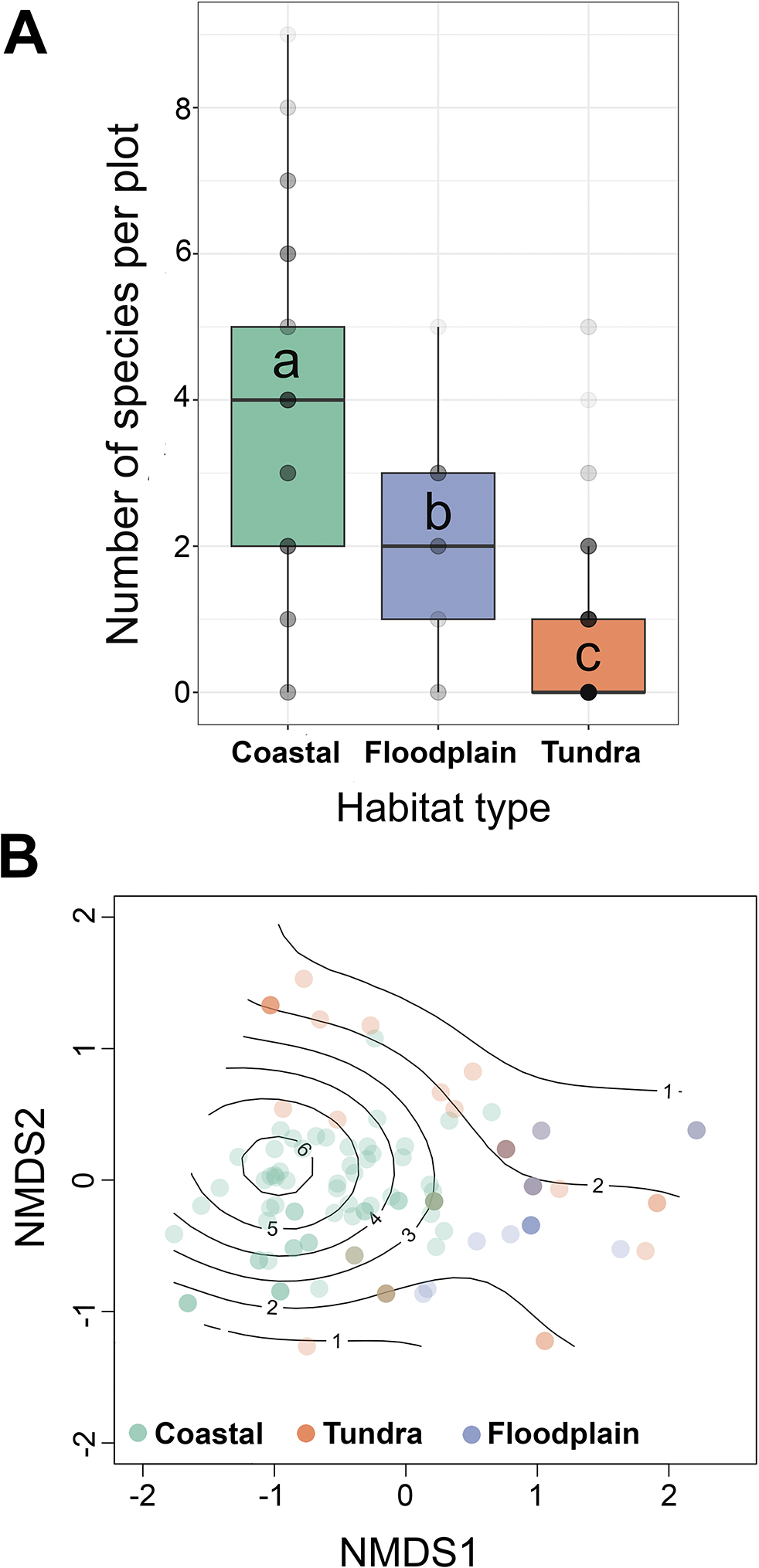
The species accumulation curves for the separate habitat types (Fig. 3B) approximate the shape of the logistic function in their terminal parts, even in floodplains where relatively few plots were studied. This indicates sufficient identification of species diversity across all habitat types, allowing the comparison of species richness and composition between these habitat types. The GLM analysis revealed that habitat type significantly predicts species richness, with the overall model being statistically significant (Supplementary Material Table S5, available online). The ANOVA results further confirm that the predictor variable ‘habitat type’ significantly affects species richness. Including habitat type in the model reduced the deviance by 188.91, indicating that it explains a substantial part of the variation in species richness (Supplementary Material Table S6, available online). Post hoc pairwise comparisons using Tukey’s HSD method demonstrated significant differences in species richness among all pairs of the three habitat types (Supplementary Material Table S7, available online). These findings strongly support the conclusion that habitat type is statistically significantly correlated with species richness at the plot level (Fig. 4A & B).
Teloschistales species richness on the sample plots of different habitat types on the Commander Islands. A, boxplots, with all investigated sample plots analyzed (with and without Teloschistales); boxes represent the interquartile range (25–75%) of the species number per plot; the horizontal line inside the box represents the median; dots represent the number of species per plot, the darker the dot, the greater the number of plots with a particular number of species; letters inside the boxes indicate the statistically significant different habitat types. B, NMDS ordination diagram of sample plots; only those with Teloschistales are analyzed; isolines approximate the number of species per plot.

Coastal habitats have the highest total number of species (24) and the greatest number of species per plot (Fig. 4A & B); Polycauliona is a characteristic genus for that habitat type. Tundra habitats support a similar number of species in total (21) but individual sample plots are noticeably poorer and most of them have 0–2 species (Fig. 4A & B). The species accumulation curve for tundra habitats is flatter than that for coastal and floodplain habitats (Fig. 3B), which also indicates poorer individual plots. Compared to coast and floodplain, tundra habitats have numerous rare species recorded only on 1–3 plots and, as a result, different tundra plots have a reasonably unique species composition, whereas species composition in floodplain and coastal plots is more homogeneous. This can be seen on the NMDS ordination diagram (Fig. 4B), where the coastal and floodplain plots make more or less compact groups whereas the tundra plots are scattered across the diagram. The genus Lendemeriella is the most species rich in tundra habitats. Floodplain habitats have the lowest number of species (7), but the number of species per plot is comparable to that in tundra, and unlike tundra habitats, only a small number of floodplain plots did not support species of Teloschistales (Fig. 4A & B). This is also confirmed by the species accumulation curve, which for floodplain habitats approximates the shape of the logistic function faster than in tundra (Fig. 3B).
Data on species distribution by habitat type and some characteristics of Teloschistales diversity in three habitat types are summarized in Supplementary Material Tables S4 and S8 respectively (both available online). On the Commander Islands, species of the Teloschistales with more or less restricted geographical ranges (western North American, North-East Asian and endemic) are mainly maritime lichens and occur in coastal habitats. Arctic-alpine circumpolar species strongly predominate in tundra plots. Circumboreal and amphi-Pacific species prefer floodplain sites. Species with wide and unclear ranges occur mainly in coastal plots (50% of all species in this habitat type), less in tundra (33%) and very few in floodplain plots (14%). Arctic-alpine ‘Caloplaca’ caesiorufella is common in all habitat types. Half of the species occurring in coastal habitats, almost half in floodplain and only c. 20% in tundra habitats have vegetative diaspores. Crustose species dominate in all habitat types, but in coastal areas large foliose, placodioid and fruticulose species are also common and demonstrate the characteristic anatomical structure described by Poelt & Romauch (Reference Poelt, Romauch, Frey, Hurka and Oberwinkler1977). Floodplain habitats support only corticolous and lignicolous species. Saxicolous species predominate in coast and tundra habitats, and lignicolous species in coastal plots with driftwood. Muscicolous and lichenicolous species were recorded only in tundra habitats.
Teloschistales diversity on Bering and Medny Islands
For reasons beyond our control, Bering Island and the adjacent small islets were investigated more thoroughly than Medny Island (226 vs 71 sample plots), and this is probably the reason why the number of Teloschistales species recorded on Bering was greater than on Medny (30 and 21 respectively). Nevertheless, six out of 36 species collected on the Commander Islands were found only on Medny Island (Supplementary Material Table S4), the most prominent example of which is the maritime western North American supralittoral ‘Caloplaca’ litoricola, recorded in four plots on Medny. The arctic-alpine Lendemeriella nivalis was found only at three sites on Medny and the other four species recorded only on Medny Island are even rarer.
The nearest known locality for ‘Caloplaca’ litoricola is on Amchitka Island, one of the Aleutian Islands (Wetmore Reference Wetmore1996), and it probably occurs on Attu Island, the closest Aleutian island to Medny. The distances from Medny to Attu and Amchitka are 340 and 780 km respectively, whereas the distance between Medny and Bering is only 50 km. The climate of Bering and Medny is very similar, the former being a little drier and colder (Krestov Reference Krestov2004). Therefore, the reasons for the absence of ‘C.’ litoricola on Bering are unclear. This western North American species might have reached Medny recently and has not had time to spread further west.
Three out of six species recorded only on Medny Island occurring on bryophytes in tundra habitats are Gyalolechia paradoxa, Lendemeriella nivalis and Parvoplaca tiroliensis. Due to reindeer grazing, the tundra of Bering Island is badly damaged and, as a result, lichens are less abundant and less diverse than on Medny, which has not been inhabited by reindeer. This might explain the absence on Bering of at least some of these muscicolous species. Another possible explanation is simply the general rarity of such Teloschistales on the Commander Islands (Supplementary Material Table S4).
Teloschistales diversity in the local biotas of the North Pacific
The 12 most studied local lichen biotas of the North Pacific and of the coast of the Chukchi Sea were chosen for a comparison of their Teloschistales diversity (Fig. 1). The number of all recorded lichen species (not taking into account non-lichenized fungi) in the biotas of the American part of the region varies from 459 in Denali to 831 in Glacier Bay; this is much higher than in the Asiatic part, where this number varies from 231 in Beringia National Park to 375 in Cape Goven. The selected territories in North-East Asia are much smaller than those in Alaska, and this is most likely the main reason for the difference in species richness between these biotas. However, another possible reason is the harsher climatic conditions of the Asiatic part of the North Pacific, which is generally colder and drier than the American part (Supplementary Material Table S9, available online).
The proportion of Teloschistales species of the total number of lichens in the local biotas of Alaska varies from 2.1–4.0%, slightly lower than in North-East Asia where it varies from 4.0–4.8% on the continent, increasing to 6.8% on Wrangel Island in the Arctic and reaching c. 10% on the Commander Islands, which have the greatest species richness of Teloschistales in the North Pacific (Supplementary Material Table S10, available online); the number of species here (36) is noticeably higher than in the richest biotas of the Pacific coast of North America, namely Glacier Bay (26 species of Teloschistales) and Lake Clark (29). In the Asiatic part of the region, the archipelago can be compared only with Wrangel Island (25).
A total of 82 species of Teloschistales were recorded in the selected local lichen biotas of the North Pacific (see Supplementary Material Table S10). Many taxa (41 species, or 50%) were recorded in only one of the selected local biotas. By contrast, only 12 species (15%) were found in six or more local biotas. None of the species were recorded in all of the 12 selected biotas, but Polycauliona candelaria and Rusavskia elegans were found in 11 biotas.
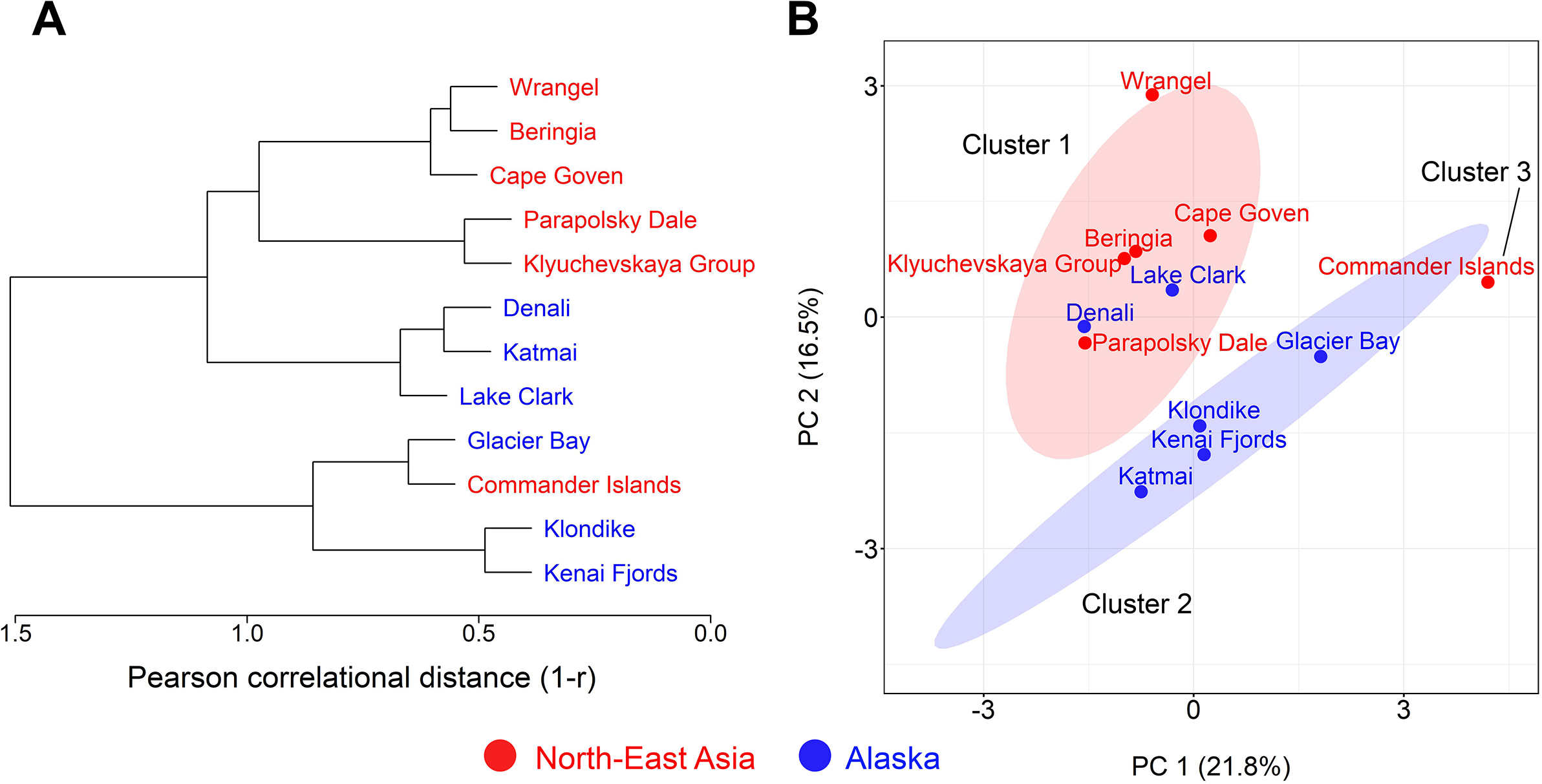
The species composition of the Teloschistales in the selected local lichen biotas was compared by means of HCA and PCA. Both analyses provide similar results. On the HCA dendrogram, local biotas form two main clusters (Fig. 5A). The first cluster consists of both American and Asiatic biotas located in boreal and arctic ecosystems (Fig. 1). The second large cluster consists of three American biotas located in the ecosystem of the Pacific Coast, namely Glacier Bay, Kenai Fjords and Klondike, together with the Commander Islands sister to Glacier Bay. On the PCA score plot (Fig. 5B), the biota of Katmai is closer to the biotas of the American Pacific coast than to boreal Lake Clark and Denali, as it was in the HCA. Such an inconsistent position of this biota could be explained by the location of Katmai in the transition zone between boreal and Pacific ecosystems (Fig. 1). According to PCA and k-means clustering, the biota of the Commander Islands forms a separate cluster which is, however, still closer to American than to Asiatic biotas (Fig. 5B).
Teloschistales species composition similarity between 12 local lichen biotas of the North Pacific and adjacent Chukchi Sea coast. A, HCA dendrogram (Ward’s method, Pearson’s distance). B, PCA score plot resulting from the unsupervised k-means clustering.

The biogeographical elements of the Teloschistales in the Commander Islands and other local biotas of the North Pacific and the role of Hultenia as a migration route for lichens
Teloschistales of the selected lichen biotas of the North Pacific can be divided into nine biogeographical elements, depending on their distribution patterns (Supplementary Material Tables S4, S10 & S11, available online). Seven elements occur on the Commander Islands, whereas most of the selected biotas consist of 3–4 elements (only Kenai Fjords and Glacier Bay have five and six elements respectively, and Beringia has only two). As in the other biotas of the region, the arctic-alpine circumpolar (12 species) and widespread (6) elements prevail in the archipelago. The Commander Islands also have two species of the circumboreal element; this element occurs in most biotas of the North Pacific. Other taxa have more restricted geographical ranges. One species (Lendemeriella kamczatica) belongs to the amphi-Pacific element, which should be characteristic of the target region, but it is recorded only in one other local biota (Glacier Bay; see Supplementary Material Tables S4 & S10). Of particular interest are four species of the maritime western North American biogeographical element (‘Caloplaca’ litoricola, Polycauliona aff. candelaria, P. flavogranulosa and P. aff. pollinarioides) and two species of the maritime North-East Asian element (Gyalolechia orientoinsularis and Orientophila aff. corticola). The Commander Islands are the most western and eastern distributional limits of these American and Asiatic species respectively. Two species, Polycauliona comandorica and P. etesiae, are quite common on the Commander Islands, but not known outside the archipelago, and are currently considered to be potential local endemics. Two additional species (Athallia subrotundispora and Gyalolechia paradoxa) are currently known only from the Commander Islands, but since they are very rare, we treat their distribution as unclear.
Thus, besides the species distributed in both Asia and North America (widespread, arctic-alpine circumpolar, circumboreal and amphi-Pacific), the Commander Islands host four species of the Teloschistales distributed only along the western coast of North America, from northern California to SE Alaska and the Aleutian Islands, as well as two species known only on the coast of North-East Asia (Sakhalin and the Kuril Islands). This may indicate that the islands of the Aleutian Arc act as a bridge for lichens to move between continents, and nowadays the Commander Islands are a junction of migration routes for some Asiatic and American lichen species. The importance of the Aleutian and Commander Islands as a flora bridge, which mainly serves to transport the eastern elements to the west and vice versa, was pointed out for vascular plants by Tatewaki (Reference Tatewaki1963). He distinguished these islands as a special botanical area, Hultenia, and demonstrated the transitional feature of plant distribution in this area expressed by a decrease in the number of Asian species from west to east and American species from east to west (see also Krestov Reference Krestov2004). However, Krestov (Reference Krestov2004), recognizing the role of Hultenia in the migration of some vascular plants, considers it insignificant in comparison to the Bering land bridge because of the severe climate and active volcanism on the islands of the Aleutian Arc. In addition, it is believed that the Aleutian and Commander Islands have never formed a continuous land bridge. The role of Hultenia in species migration between continents was also demonstrated for liverworts by Bakalin (Reference Bakalin2009), who suggested that all of the above obstacles are not as significant for these organisms due to their smaller size, poikilohydry, and light spores. These latter features are also characteristic of lichens.
In contrast to the lichens of the order Teloschistales, species of vascular plants and liverworts with an Asiatic distribution are dominant on the Commander Islands, in comparison with North American species, most of which have their western limits east of Tatewaki’s line between the Commander Islands and Attu Island (Tatewaki Reference Tatewaki1963; Krestov Reference Krestov2004; Bakalin Reference Bakalin2009); the species composition of both vascular plants and liverworts on the Commander Islands is more similar to that of Kamchatka than Alaska. As shown above, for lichens of the order Teloschistales, the situation is the opposite (Fig. 5A & B).
Endemism in the Commander Islands is extremely low. There are, for example, very few endemic species of vascular plants (Krestov Reference Krestov2004) and no endemic liverworts (Bakalin Reference Bakalin2009). Two species of Teloschistales (Polycauliona comandorica and P. etesiae) are potentially endemic for the archipelago or for a wider but nevertheless finite region (probably Hultenia and the maritime part of Beringia). This may indicate that the Commander Islands could be a centre (or part of a larger centre) of speciation in lichens or a refugium for relict taxa in the North Pacific.
Conclusions
The Commander Islands, with 36 species of Teloschistales, can be considered a hotspot for diversity of this lichen order in the North Pacific. This is probably due to the geographical position of the archipelago in a chain of islands between North-East Asia and Alaska. In addition, also influential are the different types of landscapes and climatic traits. All these support the meeting on the archipelago of species 1) distributed in the arctic-alpine and boreal regions of both Asia and North America, 2) occurring in Asia and absent in North America, 3) occurring in North America and absent in Asia and 4) endemic species. However, the species richness for Teloschistales does not apply to the entire lichen biota of the Commander Islands, which is among the poorest in the region, maybe due to the lack of forest vegetation and the severe climatic conditions.
Our data indicate that the Commander and Aleutian Islands may play an important role in lichen migrations between Asia and North America, as previously shown for vascular plants and liverworts. Unlike the vascular plants of the Commander Islands, the species composition of which shows the general boreal character and greater affinity to Kamchatka, arctic-alpine lichen species predominate among the Teloschistales of the archipelago and the species composition of the order is closer to that of SE Alaska than to Kamchatka.
Annotated List of Species
Species are listed in alphabetical order. Sample plot numbers correspond to those in Fig. 2 and Supplementary Material Table S1 (available online). Sample plots are divided into four groups depending on habitat types (coastal, tundra, floodplain and unsorted). Details on species distribution by habitat types can be found in Supplementary Material Tables S4 (available online).
-
Amundsenia approximata (Lynge) Søchting et al. (Fig. 6A) – A single locality at 150 m alt. in gravel tundra on Bering Island. Substratum: siliceous rock. ITS obtained (Table 1). This is an arctic-alpine circumpolar species with few known records outside the Arctic, namely in the Alps and Altai (Søchting et al. Reference Søchting, Garrido-Benavent, Seppelt, Castello, Pérez-Ortega, de los Ríos Murillo, Sancho, Frödén and Arup2014; Nimis et al. Reference Nimis, Hafellner, Roux, Clerc, Mayrhofer, Martellos and Bilovitz2018; Vondrák et al. Reference Vondrák, Frolov, Davydov, Yakovchenko, Malíček, Svoboda and Kubásek2019). Sample plot: tundra – 15.
-
Athallia holocarpa (Hoffm.) Arup et al. – 28 localities on Bering and Medny Islands. Prefers coastal habitats (19 localities), less common in tundra (9) and absent in floodplain habitats. Substratum: mainly on siliceous rocks and driftwood, rarer on old bones, concrete and treated wood. ITS obtained (Table 1). Widely distributed in the Holarctic; records from other parts of the world need confirmation (Arup Reference Arup2009). Sample plots: coastal – 17, 20a, 21, 51, 71, 87, 127, 176, 182, 183, 191, M1, M2, M4, M18a, M29, M34, M40, M41, M46; tundra – 11a, 14a, 22a, 23a, 47, 85, 106, M37, M49.
-
Athallia subrotundispora Stepanchikova, Himelbrant & I. V. Frolov (described below in Taxonomy) – In two localities on Bering Island, on driftwood on the coast and on siliceous stones in gravel tundra at 115 m alt. So far it is known only from the Commander Islands, but we have not assigned it to a biogeographical element because of its rarity. Sample plots: coastal – 72; tundra – 130.
-
Brigantiaea fuscolutea (Dicks.) R. Sant. – Six localities at 155–490 m alt. in tundra on Bering and Medny Islands. Substratum: plant debris on soil and rocks. The species is distributed from the northern boreal to the Arctic zone in the Northern Hemisphere and is also known from mountains in New Zealand and southern South America, and subantarctic islands (Hafellner Reference Hafellner1997). Treated as arctic-alpine circumpolar. Sample plots: tundra – 9, 33, 78, M13a, M37, M50.
-
Bryoplaca tetraspora (Nyl.) Søchting et al. – In two localities at 550 m and 650 m alt. in gravel tundra on Bering Island. Substratum: bryophytes on soil. This is an arctic-alpine to boreal-montane, circumpolar species (Nimis et al. Reference Nimis, Hafellner, Roux, Clerc, Mayrhofer, Martellos and Bilovitz2018); treated as arctic-alpine circumpolar. Sample plots: tundra – 95, 105.
-
‘Caloplaca’ caesiorufella (Nyl.) Zahlbr. – Together with Polycauliona candelaria, this is the most common Teloschistales species in the archipelago, being recorded in 73 localities in all habitat types. It was found in 73% of floodplain localities, 46% of coastal localities and 42% of tundra localities (Supplementary Material Table S4). Substratum: mainly driftwood and bark of various shrubs, rarer on treated wood, old reindeer dung and plant debris. ITS obtained (Table 1). This is an arctic, subarctic and northern boreal circumpolar species (Søchting et al. Reference Søchting, Lorentsen and Arup2008) with few known records in the Alps (Nimis et al. Reference Nimis, Hafellner, Roux, Clerc, Mayrhofer, Martellos and Bilovitz2018). Treated as arctic-alpine circumpolar. It does not belong to Caloplaca s. str. (sensu Arup et al. Reference Arup, Søchting and Frödén2013) and does not have a clear generic affiliation. Sample plots: coastal – 7, 17a, 28, 30, 38, M3, M5 etc.; tundra – 9, 23a, 32, 79, 80, M3a, M21 etc.; floodplain – 10, 19, 29a, 41, 46, 73, M28 etc.
-
Caloplaca chlorina (Flot.) H. Olivier – Two localities on Bering Island, one on the coast and the other in an unassigned locality on a lake shore. Substratum: siliceous rocks and boulders. ITS obtained (Table 1). This is mainly a Holarctic species (Šoun et al. Reference Šoun, Vondrák, Søchting, Hrouzek, Khodosovtsev and Arup2011), with one Southern Hemisphere record in Brazil (Aptroot et al. Reference Aptroot, de Souza, Cáceres, dos Santos and Spielmann2022), although this needs to be confirmed by molecular data. In Siberia, so far it is known only in the Altai and Sayan Mts (Vondrák et al. Reference Vondrák, Frolov, Davydov, Yakovchenko, Malíček, Svoboda and Kubásek2019). In Europe, C. chlorina is distributed from forest steppe to the southern tundra (Šoun et al. Reference Šoun, Vondrák, Søchting, Hrouzek, Khodosovtsev and Arup2011; Frolov & Konoreva Reference Frolov and Konoreva2016). We have not assigned it to a biogeographical element. The species belongs to Caloplaca s. str. (sensu Arup et al. Reference Arup, Søchting and Frödén2013). Sample plots: coastal – 59; unsorted – 192.
-
‘Caloplaca’ fraudans (Th. Fr.) H. Olivier – Two coastal localities on Bering Island. Substratum: driftwood. This is an arctic circumpolar species preferring or confined to maritime sites (Arup Reference Arup1995; Søchting et al. Reference Søchting, Lorentsen and Arup2008). In North America along the coast, it was recorded from the Arctic southwards (Arup Reference Arup1995). Treated as arctic-alpine circumpolar. It does not belong to Caloplaca s. str. and does not have a clear generic affiliation. Sample plots: coastal – 87, 100.
-
‘Caloplaca’ fuscorufa H. Magn. (Fig. 6B) – Two localities at 445 m and 650 m alt. in gravel tundra on Bering and Medny Islands. Substratum: siliceous rocks and stones. ITS obtained (Table 1). This is an arctic-alpine and most likely circumpolar species (e.g. Arup et al. Reference Arup, Arneng and Søchting2007; Søchting et al. Reference Søchting, Lorentsen and Arup2008; Vondrák et al. Reference Vondrák, Palice, Khodosovtsev and Postoyalkin2010a, Reference Vondrák, Frolov, Davydov, Yakovchenko, Malíček, Svoboda and Kubásek2019; Frolov & Konoreva Reference Frolov and Konoreva2016; McCune et al. Reference McCune, Arup, Breuss, Di Meglio, Di Meglio, Esslinger, Magain, Maidlikowska, Miller and Muggia2018). It does not belong to Caloplaca s. str. and is a sister to the genus Blastenia (Vondrák et al. Reference Vondrák, Frolov, Košnar, Arup, Veselská, Halıcı, Malíček and Søchting2020). Sample plots: tundra – 12, M37.
-
‘Caloplaca’ litoricola Brodo (Fig. 6C) – Four localities in the supralittoral zone of Medny Island. Substratum: siliceous rocks. ITS obtained (Table 1). This is a strictly littoral species which occurs along the western coast of North America from Washington to SE Alaska and the Aleutian Islands (Arup Reference Arup1995; Wetmore Reference Wetmore1996; Talbot et al. Reference Talbot, Talbot, Thomson and Schofield1997). The record from India (Joshi & Upreti Reference Joshi and Upreti2011) needs confirmation. Treated as maritime western North American. It does not belong to Caloplaca s. str., nor does it have a clear generic affiliation yet. Sample plots: coastal – M2, M20, M34, M41.
-
Caloplaca stillicidiorum (Vahl) Müll. Arg. s. lat. – 13 localities in all habitat types on Bering and Medny Islands but prefers coastal habitats (10 localities). Substratum: driftwood and treated wood, soil and turf on rocks, old bones. Šoun et al. (Reference Šoun, Vondrák, Søchting, Hrouzek, Khodosovtsev and Arup2011) reported several lineages within C. stillicidiorum that may be separate species. The lineage of our specimens has not been studied, so the species has not been assigned to a biogeographical element. The species belongs to the Caloplaca s. str. Sample plots: coastal – 21, 25, 51, 86, 175, 183, 191, M3, M5, M46; tundra – 11a; floodplain – 119; unsorted – 174.
-
Caloplaca turkuensis (Vain.) Zahlbr. – 17 localities in all habitat types on Bering Island but prefers floodplain habitats (12 localities). Substratum: bark of shrubs (mainly Salix spp.), driftwood and old reindeer horns. ITS obtained (Table 1). The species occurs in mixed deciduous and coniferous forests from forest-steppe to tundra, and from lowlands to the alpine belt in mountains, and also occurs on wayside trees in Europe, Siberia and western North America (Šoun et al. Reference Šoun, Vondrák, Søchting, Hrouzek, Khodosovtsev and Arup2011; Himelbrant et al. Reference Himelbrant, Stepanchikova, Motiejūnaitė, Kuznetsova, Tagirdzhanova and Frolov2019b; Vondrák et al. Reference Vondrák, Frolov, Davydov, Yakovchenko, Malíček, Svoboda and Kubásek2019). In our experience, it prefers mixed or coniferous forests in the boreal zone or in forest belts in mountains; in the Czech Republic it grows in the upper forest belt with beech and spruce (Vondrák, in litt.), and in the Ural Mts and Siberia it grows in coniferous or mixed pine-birch and larch-birch forests (Vondrák et al. Reference Vondrák, Frolov, Davydov, Yakovchenko, Malíček, Svoboda and Kubásek2019). Findings in the arctic tundra and the alpine belt are rare (Hansen et al. Reference Hansen, Poelt and Søchting1987; McCune et al. Reference McCune, Arup, Breuss, Di Meglio, Di Meglio, Esslinger, Magain, Maidlikowska, Miller and Muggia2018). On this basis, we treat the species as circumboreal. The species belongs to Caloplaca s. str. Sample plots: coastal – 86, 111; tundra – 45, 85, 102; floodplain – 10, 19, 24, 46, 73, 75, 93, 94, 107, 118, 119, 165.
-
Flavoplaca flavocitrina (Nyl.) Arup et al. – Four coastal localities (siliceous outcrops) and one locality in tundra (concrete construction). ITS obtained (Table 1). It is widely distributed throughout the Holarctic and is also known in Australia (e.g. Arup Reference Arup2006; Vondrák et al. Reference Vondrák, Frolov, Davydov, Urbanavichene, Chesnokov, Zhdanov, Muchnik, Konoreva, Himelbrant and Tchabanenko2016; Spribille et al. Reference Spribille, Fryday, Pérez-Ortega, Svensson, Tønsberg, Ekman, Holien, Resl, Schneider and Stabentheiner2020); the species is very common along the seacoast in the south of the Russian Far East (Davydov et al. Reference Davydov, Yakovchenko, Galanina, Paukov, Frolov and Ahti2021; Chesnokov & Konoreva Reference Chesnokov and Konoreva2022). Sample plots: coastal – 17, 59, 71, 127; tundra – 22a.
-
Gyalolechia orientoinsularis I. V. Frolov, Himelbrant, Stepanchikova & Davydov (described below in Taxonomy) – Two localities in floodplain habitats of Medny Island. Substratum: bark of Sorbus sambucifolia. The species is also known from Sakhalin Island in the Russian Far East and most likely belongs to the species with an Eastern Asian maritime distribution. Treated as maritime North-East Asian. Sample plots: floodplain – M12, M28.
-
Gyalolechia paradoxa Himelbrant, Stepanchikova & I. V. Frolov (described below in Taxonomy) – A single locality at 145 m alt. in tundra with dwarf shrubs and terricolous lichens on Medny Island. Substratum: muscicolous and lichenicolous on epigaeic Psora rubiformis (Wahlenb. ex Ach.) Hook. So far it is known only from the Commander Islands and has not been assigned to a biogeographical element because of its rarity. Sample plot: tundra – M45.
-
Kuettlingeria soralifera (Vondrák & Hrouzek) I.V. Frolov et al. (Fig. 6D) – Two localities on Bering Island, one on the coast and the other in an unassigned locality on a lake shore. Substratum: siliceous rocks and boulders. ITS obtained (Table 1). The species is known from Europe, southern Siberia and North America, where it occurs in both humid and arid conditions (Vondrák & Hrouzek Reference Vondrák and Hrouzek2006; Wetmore Reference Wetmore2009; Vondrák et al. Reference Vondrák, Frolov, Davydov, Yakovchenko, Malíček, Svoboda and Kubásek2019). It has not been assigned to a biogeographical element. Sample plots: coastal – 59; unsorted – 192.
-
Lendemeriella borealis (Vain.) S. Y. Kondr. – 20 localities in all habitat types on Bering and Medny Islands: 12 localities in floodplain habitats (55% of all localities in floodplains), 7 localities in tundra (15% of all localities in tundra), and a single coastal locality. Substratum: bark of various shrubs (Betula ermanii, Rhododendron aureum, Salix spp., Sorbus sambucifolia, Vaccinium ovalifolium). ITS obtained (Table 1). The species is circumboreal with scattered records in tundra (e.g. Hansen et al. Reference Hansen, Poelt and Søchting1987; Frolov & Konoreva Reference Frolov and Konoreva2016). Sample plots: coastal – 114; tundra – 13a, 32, 80, 91, 96, 101, M25; floodplain – 10, 19, 46, 73, 75, 90, 93, 94, 107, 109, 110, 118.
-
Lendemeriella exsecuta (Nyl.) S. Y. Kondr. – A single locality on siliceous outcrops on the coast of Bering Island. ITS obtained (Table 1). This is an arctic-alpine species with a circumpolar distribution (e.g. Søchting et al. Reference Søchting, Lorentsen and Arup2008; Vondrák et al. Reference Vondrák, Frolov, Davydov, Yakovchenko, Malíček, Svoboda and Kubásek2019). Sample plot: coastal – 35.
-
Lendemeriella kamczatica (Savicz) I. V. Frolov (combined below in Taxonomy; Fig. 6E) – 13 localities on Bering and Medny Islands, 7 localities in floodplain habitats (32% of all localities in floodplains) and 5 localities in tundra (10% of all localities in tundra). Substratum: bark of various shrubs (Sorbus sambucifolia and Vaccinium ovalifolium, one specimen on Salix sp.). ITS obtained (Table 1). The species has an amphi-Pacific distribution occurring along the Pacific coast in the boreal and temperate regions of North-East Asia, from Kunashir and Sakhalin Islands to Kamchatka, and North America from northern California to SE Alaska (Khodosovtsev et al. Reference Khodosovtsev, Kuznetzova and Himelbrant2004; Søchting Reference Søchting2004; Spribille et al. Reference Spribille, Fryday, Pérez-Ortega, Svensson, Tønsberg, Ekman, Holien, Resl, Schneider and Stabentheiner2020; I. Frolov, unpublished data). Sample plots: tundra – 91, 101, M22, M25, M45; floodplain – 29a, 73, 103, 108, 118, M12, M28.
-
Lendemeriella nivalis (Körb.) S. Y. Kondr. – Three localities in the tundra of Medny Island at 290–460 m alt. Substratum: bryophytes on soil and rocks. This is a circumpolar arctic-alpine species (Søchting et al. Reference Søchting, Lorentsen and Arup2008). Sample plots: tundra – M37, M39, M51.
-
Lendemeriella phaeocarpella (Nyl.) I. V. Frolov et al. (combined below in Taxonomy; Fig. 6F) – A single locality in tundra on Bering Island at 50 m alt. Substratum: bryophytes on soil. ITS obtained (Table 1). The species has a bipolar distribution (Søchting et al. Reference Søchting, Lorentsen and Arup2008), but it is treated as arctic-alpine circumpolar. Sample plot: tundra - 179.
-
Lendemeriella sorocarpa (Vain.) S. Y. Kondr. (Fig. 7A) – A single floodplain locality on Bering Island at 50 m alt. Substratum: bark of Sorbus sambucifolia. The species has a circumpolar arctic-alpine distribution but also occurs in the forest belt in mountains (Tønsberg Reference Tønsberg1993; Wetmore Reference Wetmore2004; Kristinsson et al. Reference Kristinsson, Zhurbenko and Hansen2010; Frolov & Konoreva Reference Frolov and Konoreva2016; Nimis et al. Reference Nimis, Hafellner, Roux, Clerc, Mayrhofer, Martellos and Bilovitz2018; Vondrák et al. Reference Vondrák, Frolov, Davydov, Yakovchenko, Malíček, Svoboda and Kubásek2019). Sample plot: floodplain – 108.
-
Lendemeriella tornoënsis (H. Magn.) S. Y. Kondr. – Three localities in tundra on Bering and Medny Islands at 50–650 m alt. Substratum: bryophytes on both soil and a siliceous stone and plant debris, but one specimen was surprisingly lichenicolous on Miriquidica subplumbea (Anzi) Cl. Roux growing on a siliceous stone. The latter specimen has an almost identical ITS sequence as a free-living muscicolous specimen of L. tornoënsis from the same locality but differs in two base pairs (Table 1). Its morphological features also agree with free-living L. tornoënsis. The species has a bipolar distribution with two records from the Southern Hemisphere unsupported by molecular data (Galloway Reference Galloway2001; Etayo et al. Reference Etayo, Sancho, Gómez-Bolea, Søchting, Aguirre and Rozzi2021). It is treated as arctic-alpine circumpolar. Sample plots: tundra – 12, 179 (both muscicolous and lichenicolous), M37.
-
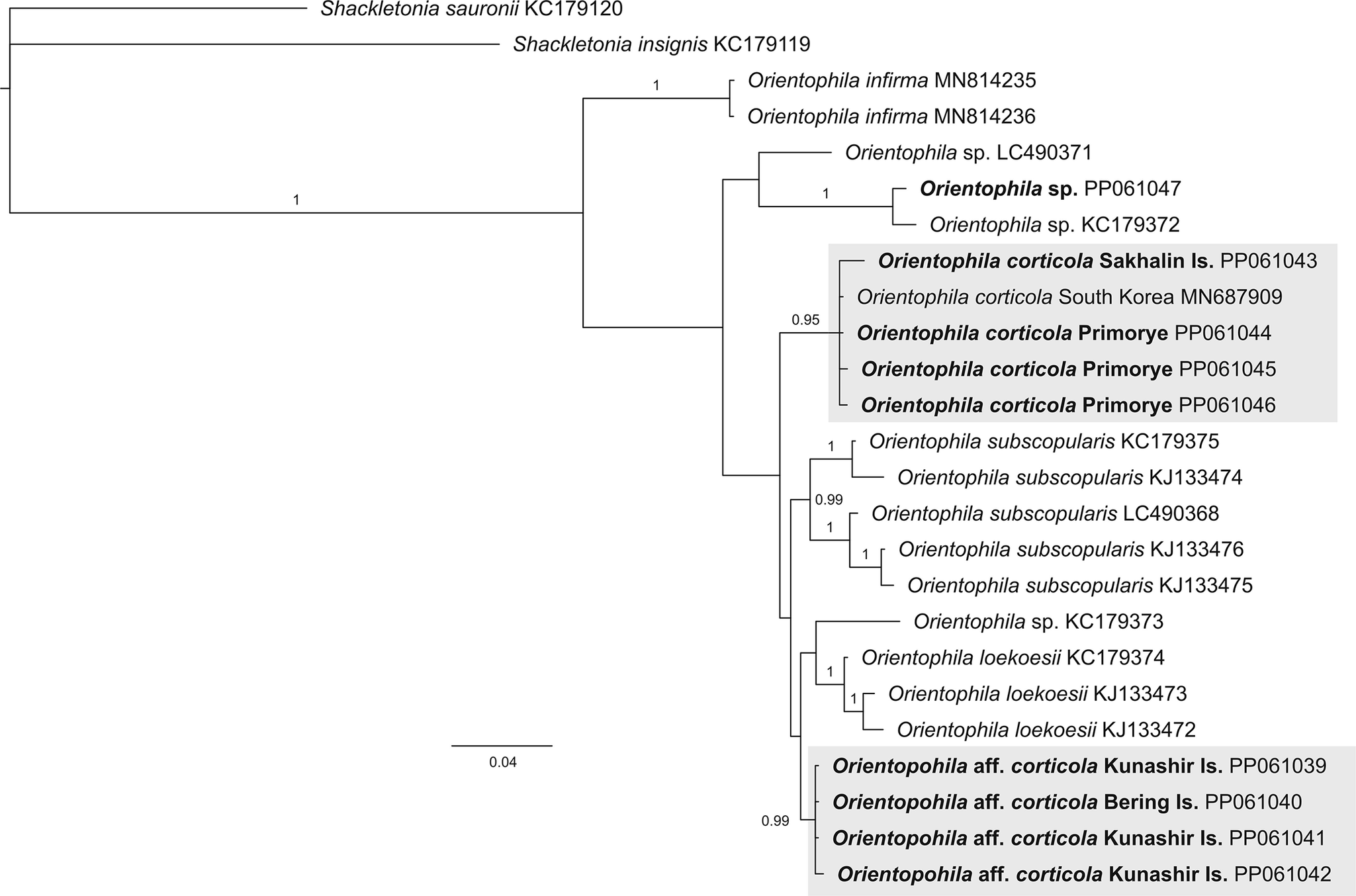
Orientophila aff. corticola B. G. Lee (see comments in Taxonomy) – Two coastal localities on Bering Island. Substratum: bark of Salix sp. and Sorbus sambucifolia. Known only from Bering and Kunashir (Southern Kuril) Islands and most likely has a North-East Asian maritime distribution. Sample plots: coastal – 67, 112.
-
Parvoplaca tiroliensis (Zahlbr.) Arup et al. – A single locality at 145 m alt. in tundra with dwarf shrubs and terricolous lichens on Medny Island. Substratum: bryophytes on siliceous rocks. This is an arctic-alpine species with a circumpolar distribution (Arup et al. Reference Arup, Vondrák and Halıcı2015). Sample plot: tundra – M45.
-
Polycauliona candelaria (L.) Frödén et al. (Fig. 7B) – Together with ‘Caloplaca’ caesiorufella this is the most common species in the archipelago, being recorded in 75 localities in all habitat types. It prefers coastal habitats (63 localities, i.e. 78% of all coastal localities) and occurs only in 6 tundra and 3 floodplain localities. Substratum: usually siliceous outcrops and driftwood, very rarely on concrete, peat over siliceous outcrops, and worked timber, and once on bark of Salix alaxensis; often ornithocoprophilous. ITS obtained (Table 1, Fig. 8). The species is distributed worldwide. Sample plots: coastal – 2, 3, 5, 5a, 6, M2, M3 etc.; tundra – 15, 22a, 50, 83, M35, M50; floodplain – 24, 73; 119; unsorted – 26a, 174, 189.
-
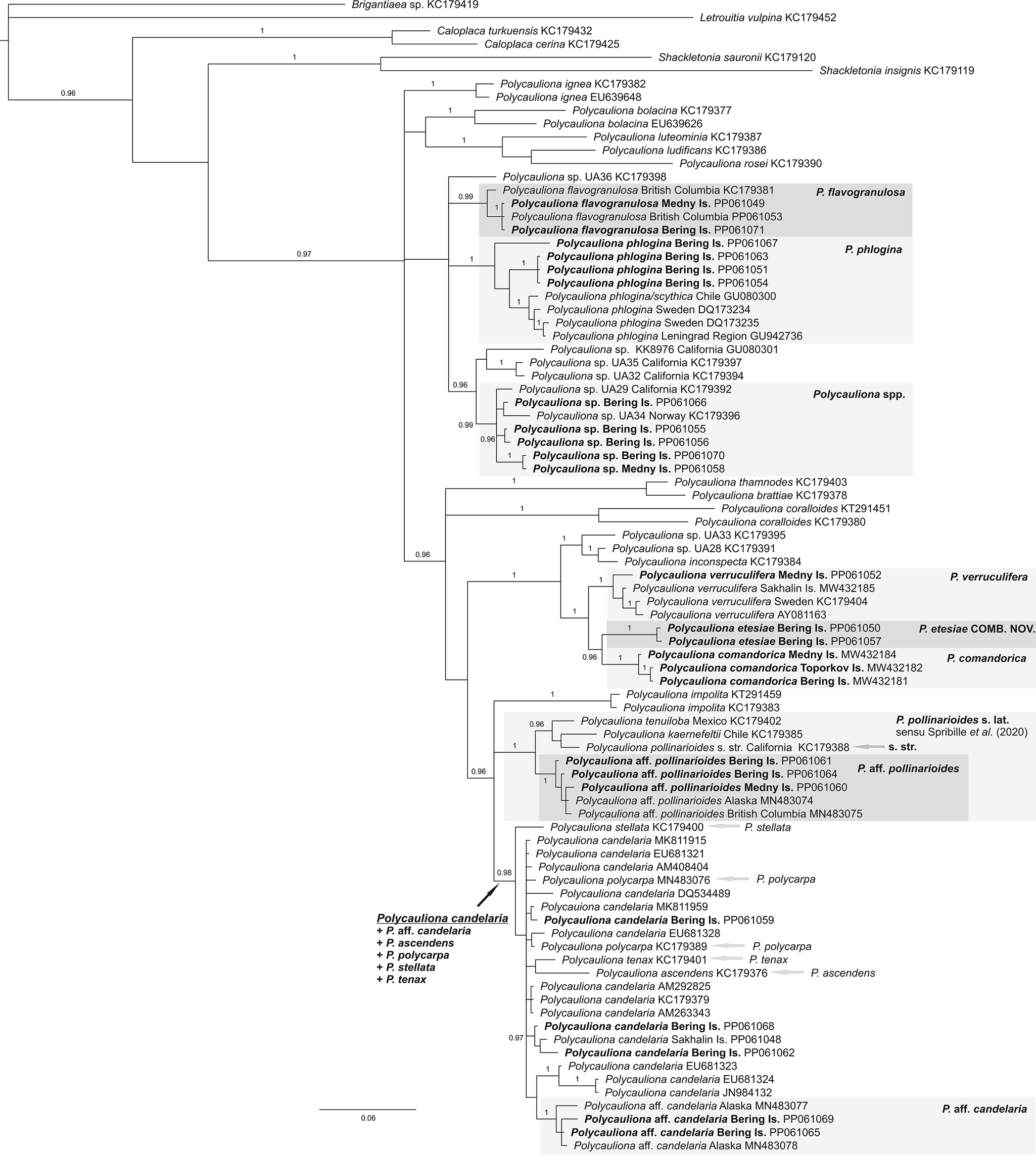
Polycauliona aff. candelaria (Fig. 7C) – Eight localities mainly on the coast (7) and rarely in the tundra (1) of Bering Island. Substratum: siliceous outcrops and stones, driftwood; often ornithocoprophilous. The species corresponds to Polycauliona sp. which was first mentioned by McCune et al. (Reference McCune, Arup, Breuss, Di Meglio, Di Meglio, Esslinger, Magain, Maidlikowska, Miller and Muggia2018) and later by Spribille et al. (Reference Spribille, Fryday, Pérez-Ortega, Svensson, Tønsberg, Ekman, Holien, Resl, Schneider and Stabentheiner2020) from SE Alaska as sister to P. candelaria, while our analysis with extended sampling put the species on a longer branch into a large clade that included several lineages of P. candelaria as well as P. ascendens (S. Y. Kondr.) Frödén et al., P. polycarpa (Hoffm.) Frödén et al., P. stellata (Wetmore & Kärnefelt) Arup et al., and P. tenax (L. Lindblom) Frödén et al. (Fig. 8). In total, ITS sequences of P. aff. candelaria have six synapomorphies against those of P. candelaria used in the analyses (Fig. 8). Morphologically, P. aff. candelaria is somewhat intermediate between P. candelaria and P. pollinarioides and, like other authors, we hesitate to proceed with describing a new species due to the overlap of its morphological features with these taxa. Polycauliona aff. candelaria is treated as maritime western North American. Sample plots: coastal – 125, 127, 172, 177, 181, 191, 193; tundra – 22a.
-
Polycauliona comandorica Himelbrant et al. – 15 localities in the supralittoral zone or higher on the coasts of Bering and Medny Islands (19% of all coastal localities). Substratum: siliceous outcrops, rare on peat over these outcrops and on driftwood; ornithocoprophilous. ITS obtained (Table 1, Fig. 8). This is a strictly supralittoral species, currently known only from the Commander Islands (Frolov et al. Reference Frolov, Himelbrant, Stepanchikova and Prokopiev2021a), and considering the outstanding habitus of this fruticulose species, which is not easy to miss in the field, its distribution outside Beringia is unlikely. Therefore, it is treated as endemic. Sample plots: coastal – 2, 3, 5, 17a, 20, 27, 69, 126, 183, 190, 193, 194, M19a, M20, M20a.
-
Polycauliona etesiae (Nyl.) I. V. Frolov, Himelbrant & Stepanchikova (combined below in Taxonomy; Fig. 7D) – Five localities in the supralittoral zone on the coast of Bering Island. Substratum: siliceous outcrops; ornithocoprophilous. For details of the species’ distribution, see Taxonomy below. Treated as endemic. Sample plots: coastal – 2, 3, 5, 69, 193.
-
Polycauliona flavogranulosa (Arup) Arup et al. (Fig. 7E & F) – 19 localities in the supralittoral zone of the coast of Bering and Medny Islands (24% of all coastal localities; Supplementary Material Table S4). Substratum: siliceous outcrops and stones, and once on concrete; often ornithocoprophilous. ITS obtained (Table 1, Fig. 8). This is a strictly supralittoral species, which is rather common along the western coast of North America, from northern California to SE Alaska, but with only one known locality on the westernmost tip of the Alaskan Peninsula (Arup Reference Arup1993, Reference Arup1995). Sample plots: coastal – 4, 20, 23, 27, 51, 59, 71, 127, 172, 175, 182, 183, M2, M18a, M19a, M20, M20a, M29, M34.
-
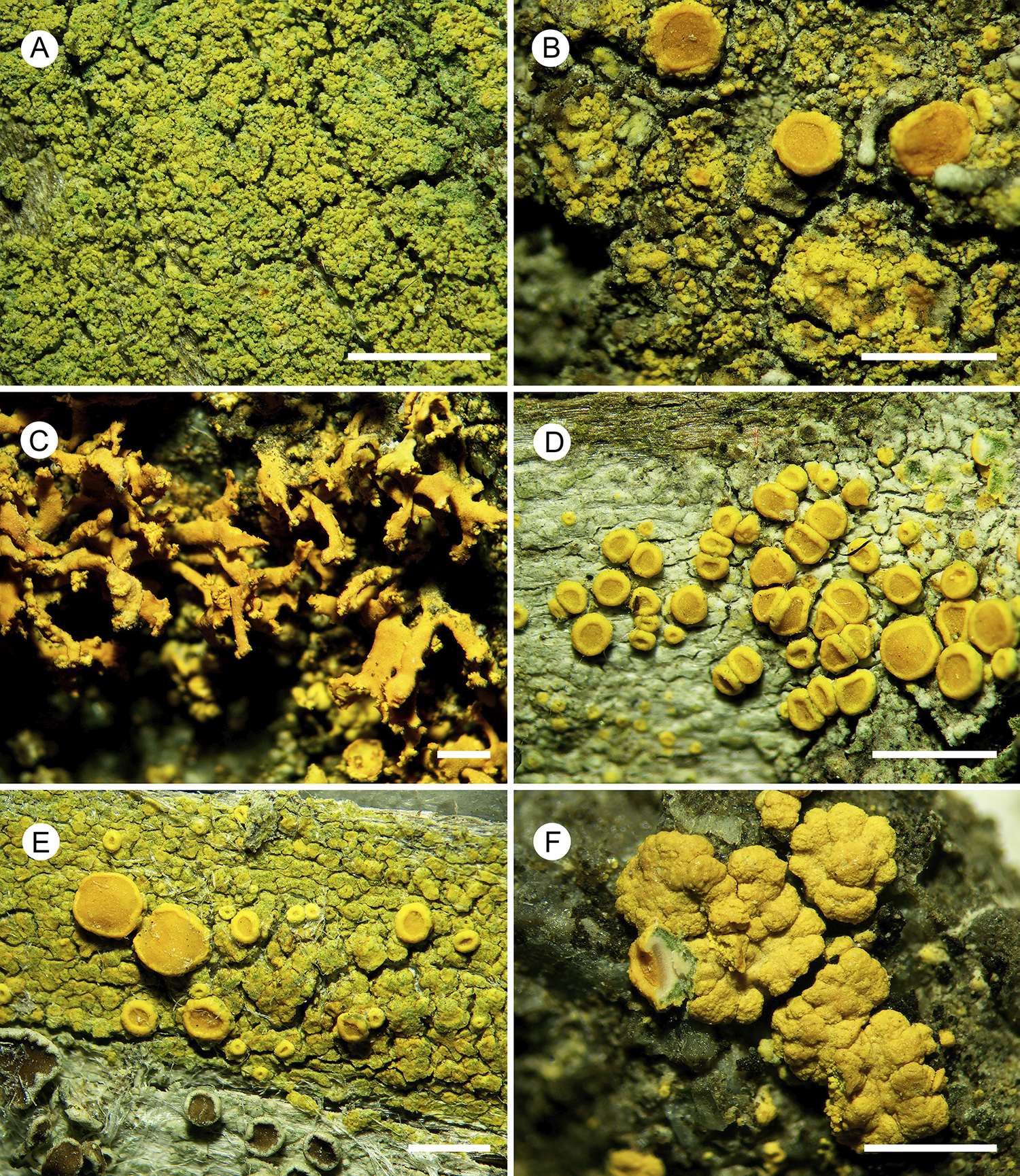
Polycauliona phlogina (Ach.) Arup et al. (Fig. 9A & B) – Seven localities on Bering Island, six on the coast and one on an unassigned anthropogenic plot. Substratum: driftwood, concrete, siliceous outcrops, whale bones. The ITS sequences of the specimens from the Commander Islands (Table 1) are not identical to those available in GenBank forming two additional lineages within a monophyletic clade of P. phlogina (Fig. 8). The species is widely distributed but seems to prefer maritime regions with a temperate climate. It is confirmed by molecular data from coastal and inland Europe, coastal Canada and Chile (Arup Reference Arup2006; Vondrák et al. Reference Vondrák, Říha, Arup and Søchting2009, Reference Vondrák, Šoun, Søgaard, Søchting and Arup2010b, Reference Vondrák, Redchenko, Himelbrant, Stepanchikova and Kuznetsovac ); records not confirmed by molecular data are also known from high inland mountains in India and the coastal regions of Oregon and the Southern Kuril Islands (Joshi & Upreti Reference Joshi and Upreti2008; McCune Reference McCune2017; Konoreva et al. Reference Konoreva, Chesnokov, Yakovchenko, Ohmura and Davydov2020; Kumar et al. Reference Kumar, Sharma, Joseph, Ngangom and Nayaka2021). Treated as widespread. Sample plots: coastal – 20a, 51, 116, 126, 127, 129; unsorted – 174.
-
Polycauliona aff. pollinarioides (L. Lindblom & D. M. Wright) Frödén et al. (Fig. 9C) – 27 localities mainly on the coast (25 localities, i.e. 31% of all coastal localities) and rarely in the tundra (two localities) on Bering and Medny Islands. Substratum: siliceous outcrops and driftwood, rarely on worked timber of buildings, on concrete and peat over outcrops; often ornithocoprophilous. Polycauliona pollinarioides (L. Lindblom & D. M. Wright) Frödén et al. was known as an epiphyte from a small number of localities in coastal scrub and riparian communities in California (Lindblom Reference Lindblom, Nash, Ryan, Diederich, Gries and Bungartz2004). Recently, Spribille et al. (Reference Spribille, Fryday, Pérez-Ortega, Svensson, Tønsberg, Ekman, Holien, Resl, Schneider and Stabentheiner2020) also reported the species as corticolous, lignicolous and saxicolous on supralittoral rocks in coastal SE Alaska and British Columbia. However, their ITS sequences were not identical to those of P. pollinarioides s. str. published by Arup et al. (Reference Arup, Søchting and Frödén2013), and Spribille et al. (Reference Spribille, Fryday, Pérez-Ortega, Svensson, Tønsberg, Ekman, Holien, Resl, Schneider and Stabentheiner2020) took a broad view of P. pollinarioides by including P. kaernefeltii (S. Y. Kondr. et al.) Frödén et al. and P. tenuiloba (L. Lindblom) Frödén et al. because of the high similarity of the ITS sequences of these species (Fig. 8; Spribille et al. Reference Spribille, Fryday, Pérez-Ortega, Svensson, Tønsberg, Ekman, Holien, Resl, Schneider and Stabentheiner2020). Our three ITS sequences (Table 1) include a small number of unclear bases, but otherwise they are identical to the specimens from Alaska and British Columbia. Our sequences, together with those obtained by Spribille et al. (Reference Spribille, Fryday, Pérez-Ortega, Svensson, Tønsberg, Ekman, Holien, Resl, Schneider and Stabentheiner2020), have 11 synapomorphies compared to the single sequence of P. pollinarioides s. str. Specimens from the Commander Islands, Alaska and British Columbia form a separate highly supported lineage ‘P. aff. pollinarioides’ sister to the supported clade including P. pollinarioides s. str., P. kaernefeltii and P. tenuiloba (Fig. 8), and possibly belong to a new species. However, we hesitate to describe it due to the uncertainty of its morphological differences from P. pollinarioides s. str. and the inadequacy of the available molecular data for the latter species, as well as for P. kaernefeltii and P. tenuiloba (a single ITS sequence for each species). Polycauliona aff. pollinarioides is treated as maritime western North American. Sample plots: coastal – 2, 17, 20, 23, 25, 27, 42, 51, 71, 123, 127, 172, 175, 178, 182, 183, 193, M2, M3, M4, M8, M17a, M18a, M20, M29; tundra – 22a, M1.
-
Polycauliona verruculifera (Vain.) Arup et al.– 39 localities in the supralittoral zone of the coast of Bering and Medny Islands (49% of all coastal localities). Substratum: mainly siliceous outcrops, rarely driftwood, and once on peat above siliceous outcrops; often ornithocoprophilous. ITS obtained (Table 1, Fig. 8). This is a strictly littoral species, which is more or less circumpolar in the Arctic, but also occurs in the boreal and temperate regions of Europe, Asia, and on both the west and east coast of North America (Arup Reference Arup1995). Treated as widely distributed. Sample plots: coastal – 1, 2, 3, 4, 5, 17a, 20, 23, 27, 30, 31, 36, 42, 59, 69, 70, 124, 126, 172, 175, 176, 177, 178, 182, 183, 186, 190, 191, 193, 194, M2, M8, M18a, M19a, M20, M20a, M29, M34, M41.
-
Polycauliona sp. (Fig. 9D & E) – 11 localities on the coast of Bering and Medny Islands (14% of all coastal localities). Substratum: mainly driftwood, rarer on worked timber of buildings and siliceous outcrops; often ornithocoprophilous. These crustose specimens are variable in morphology and ITS sequences (Table 1). Several morphotypes could be distinguished (e.g. Fig. 9D & E) which are not supported by our phylogenetic analysis. All our sequences belong to the same highly supported clade, together with crustose Polycauliona sp. UA29 and sp. UA34 collected by Arup et al. (Reference Arup, Søchting and Frödén2013) from coastal California and Norway respectively (Fig. 8). At least some of our specimens seem to be conspecific with Polycauliona spp., as noted by McCune et al. (Reference McCune, Arup, Breuss, Di Meglio, Di Meglio, Esslinger, Miadlikowska, Miller, Rosentreter and Schultz2020) from coastal SE Alaska, British Columbia and Oregon. Due to these uncertainties, we hesitate to assign this taxon/these taxa to any biogeographical element. Sample plots: coastal – 86, 87, 122, 123, 126, 127, 176, 182, 191, M3, M46.
-
Rusavskia elegans (Link) S. Y. Kondr. & Kärnefelt – 45 localities on Bering and Medny Islands mainly on the coast (41 localities, i.e. 51% of all coastal localities), rarely in the tundra (3), and one anthropogenic locality remains unassigned. Substratum: usually siliceous outcrops and stones, rarely driftwood, worked timber of buildings, concrete, and old bones; often ornithocoprophilous. ITS obtained (Table 1). The species is distributed worldwide. Sample plots: coastal – 17, 17a, 20a, 21, 23, M2, M3 etc.; tundra – 3a, 50, M50; unsorted – 174.
-
Xanthocarpia tominii (Savicz) Frödén et al. (Fig. 9F) – A single locality on the coast of Medny Island. Substratum: siliceous outcrops. ITS obtained (Table 1). Records of this species supported by molecular data are published from Eurasia, Canada and Antarctica (Vondrák et al. Reference Vondrák, Říha, Redchenko, Vondráková, Hrouzek and Khodosovtsev2011, Reference Vondrák, Frolov, Davydov, Yakovchenko, Malíček, Svoboda and Kubásek2019; Haughland et al. Reference Haughland, Hood, Thauvette, Toni, Cao, Birch, Wasyliw, Hjartarson, Villeneuve and Stordock2022; Yiğit et al. Reference Yiğit, Güllü and Halıcı2022). We have not assigned the species to a biogeographical element. Sample plot: coastal – M29.
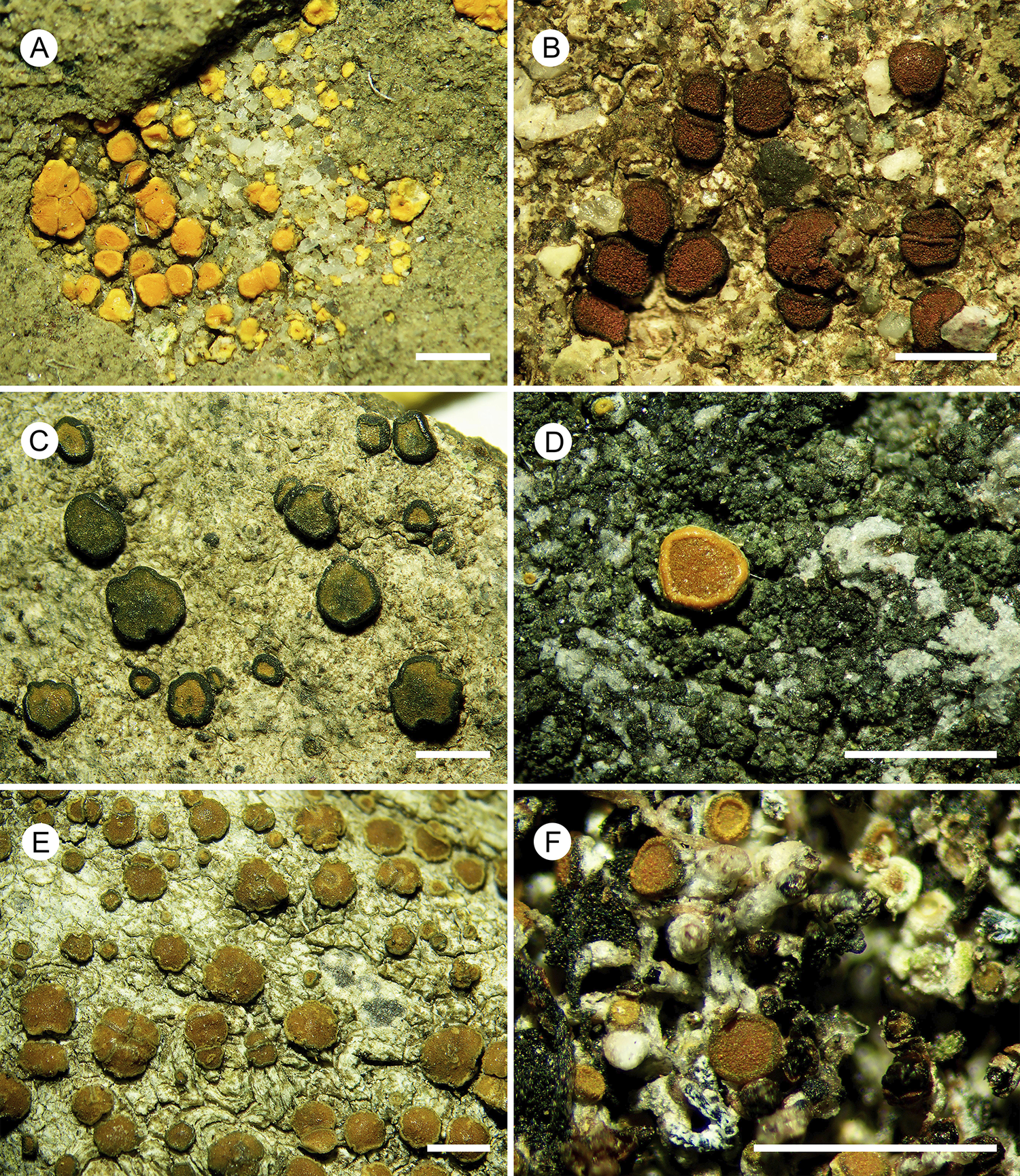
A–F, selected species of the Teloschistales from the Commander Islands. A, Amundsenia approximata (LECB s. n.). B, ‘Caloplaca’ fuscorufa (LECB s. n.). C, ‘C.’ litoricola (LECB s. n.). D, Kuettlingeria soralifera (LECB s. n.). E, Lendemeriella kamczatica (LECB s. n.). F, L. phaeocarpella (LECB s. n.). Scales: A–F = 1 mm. In colour online.

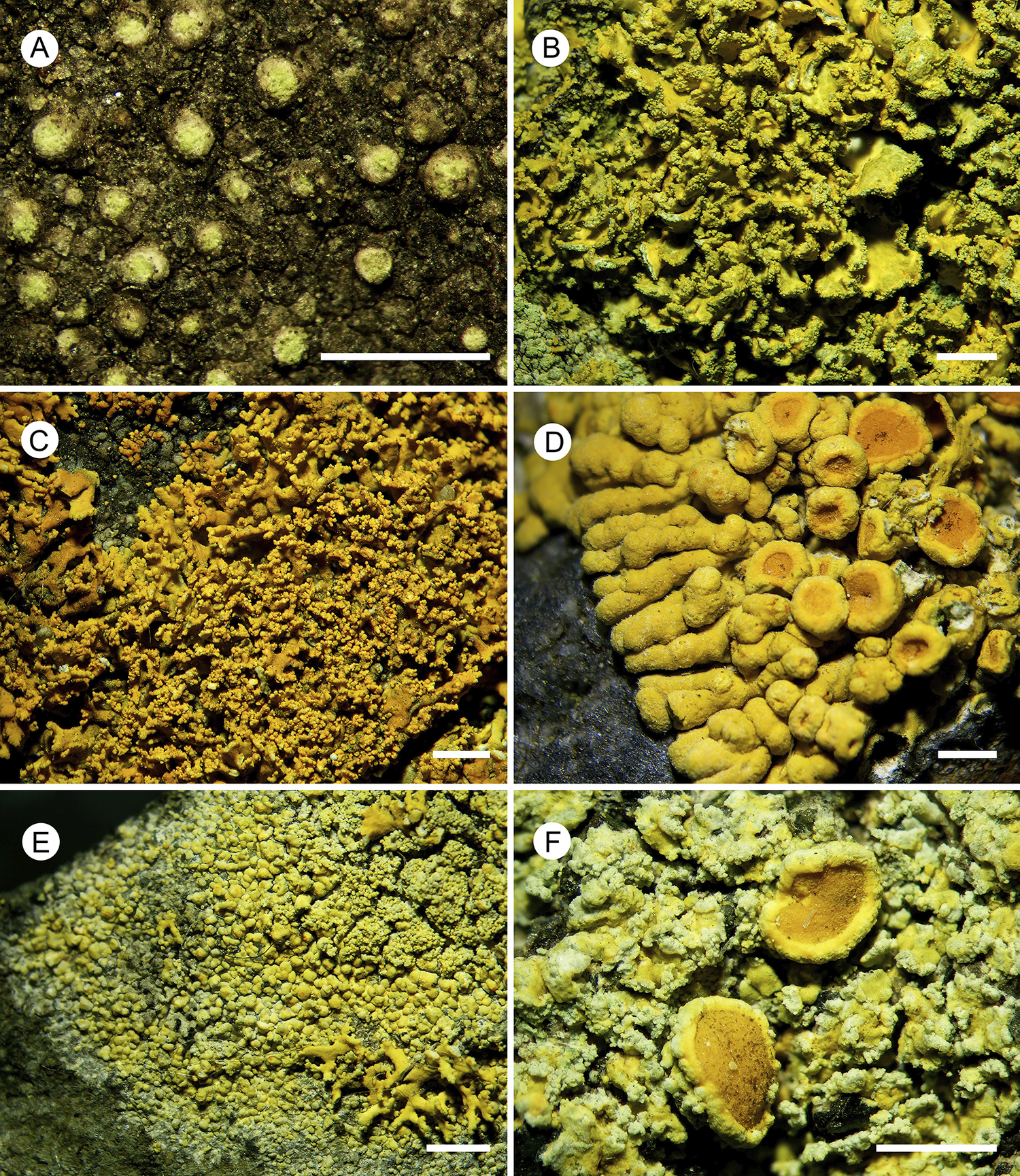
A–F, selected species of the Teloschistales from the Commander Islands. A, Lendemeriella sorocarpa (LECB s. n.). B, Polycauliona candelaria (LECB s. n.). C, P. aff. candelaria (LECB s. n.). D, P. etesiae (LE L-22101). E & F, P. flavogranulosa (LECB s. n.). Scales: A–F = 1 mm. In colour online.

Phylogeny of the genus Polycauliona based on the Bayesian analysis of nrITS. Species recorded on the Commander Islands are highlighted in grey rectangles, and the specimens from the archipelago are indicated in bold; numbers at branches represent posterior probability values ≥ 0.95.

A–F, selected species of the Teloschistales from the Commander Islands. A & B, Polycauliona phlogina (LECB s. n.). C, P. aff. pollinarioides (LECB s. n.). D & E, Polycauliona sp. (LECB s. n.). F, Xanthocarpia tominii (LECB s. n.). Scales: A–F = 1 mm. In colour online.

Key to species of Gyalolechia s. lat. occurring in the East Asia
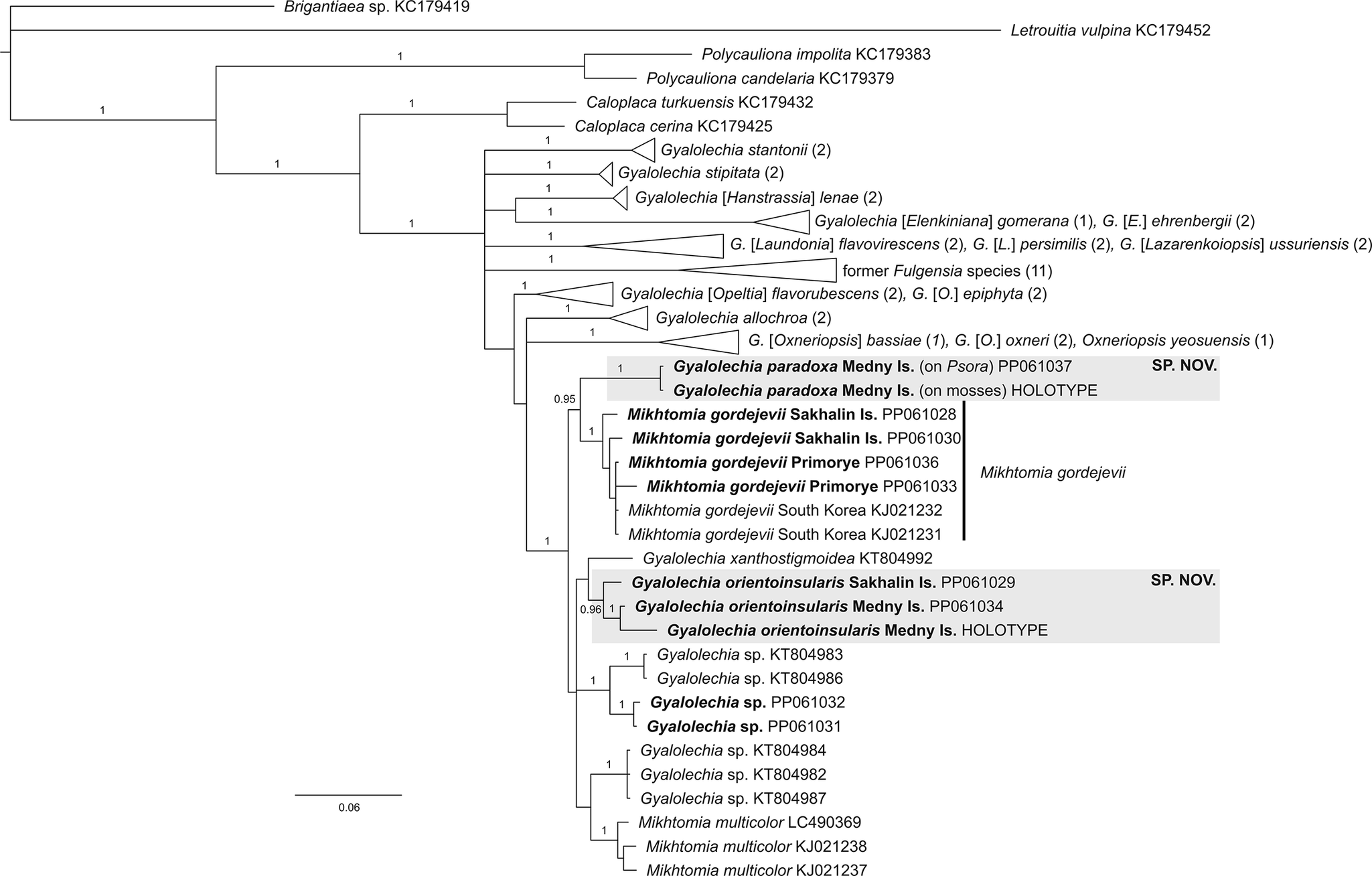
Here we include species known in the Russian Far East, Japan, Korea and eastern China. By Gyalolechia s. lat. we mean Gyalolechia sensu Arup et al. (Reference Arup, Søchting and Frödén2013), where we also include the smaller genera into which this entity was later split (see Kondratyuk et al. Reference Kondratyuk, Popova, Kondratiuk and Lőkös2022), namely Elenkiniana S. Y. Kondr. et al., Hanstrassia S. Y. Kondr., Laundonia S. Y. Kondr. et al., Lazarenkoiopsis S. Y. Kondr. et al., Mikhtomia S. Y. Kondr. et al., Opeltia S. Y. Kondr. & Lőkös and Oxneriopsis S. Y. Kondr. et al. In our opinion, the concepts behind these genera have not been well defined; moreover, some lineages within Gyalolechia s. lat. remained orphans, specifically G. allochroa (Y. Joshi et al.) Søchting et al., G. stantonii (W. A. Weber ex Arup) Søchting et al., and G. stipitata (Wetmore) Søchting et al. As a result, we prefer the wider circumscription of the genus Gyalolechia proposed by Arup et al. (Reference Arup, Søchting and Frödén2013). However, since the concept of this genus has not settled down yet, we proceed as follows. If species have ever been combined in Gyalolechia, we use those combinations; otherwise, we employ current names as they appear in Index Fungorum.

Taxonomy
New species
Athallia subrotundispora Stepanchikova, Himelbrant & I. V. Frolov sp. nov.
MycoBank No.: MB 850640
Similar to Athallia holocarpa and crustose Polycauliona spp. but differing in having widely ellipsoid to subglobose ascospores, 14–16(18) × 10–11 μm, with septa 6–7 μm wide. Thallus inconspicuous or poorly developed of tiny greenish areoles. Prothallus absent or well developed, ochre. Apothecia 0.5–1.5 mm diam. on rock and 0.5–0.8 mm diam. on wood, zeorine, adnate to substipitate, abundant, usually crowded and contiguous; disc orange; thalline exciple greyish or with yellow tinge usually on underside of apothecia and inconspicuous. Pycnidia not seen.
Type: Russia, Kamchatka Territory, Aleut District, Commander Islands, NE part of Bering Island, plane top of local elevation SE of Staraya Gavan’ Bay, alt. 115 m, 55°13′12.1″N, 166°14′32.4″E, gravel tundra with spots of Empetrum nigrum and Arctous alpina, on siliceous stones, 28 July 2022, D. Himelbrant, I. Stepanchikova & A. Zueva (LE L-22099—holotype; H, hb. Frolov—isotypes). GenBank Accession numbers of the holotype sequences: PP061027 (nrITS), PP051310 (nrLSU), PP051306 (mtSSU).
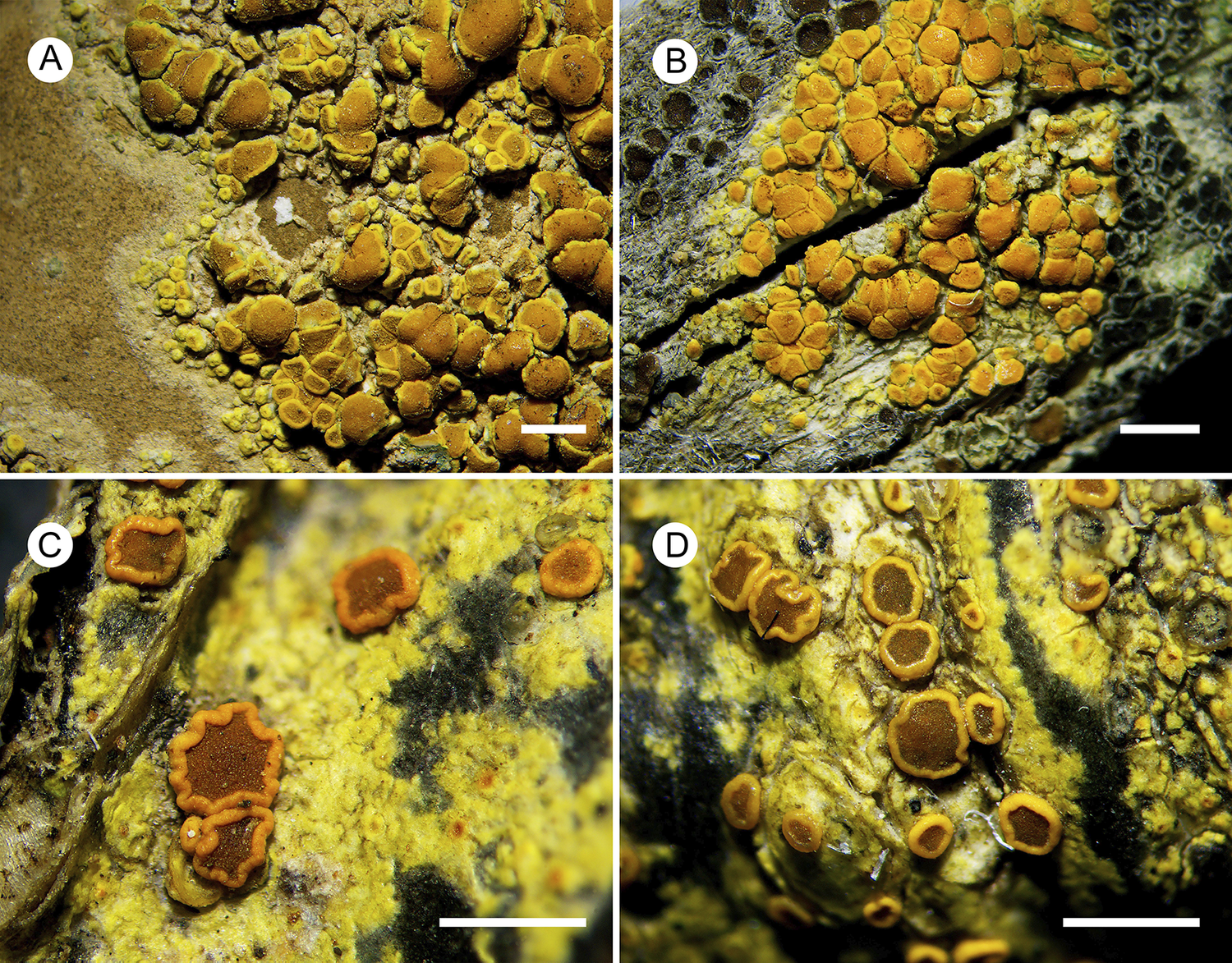
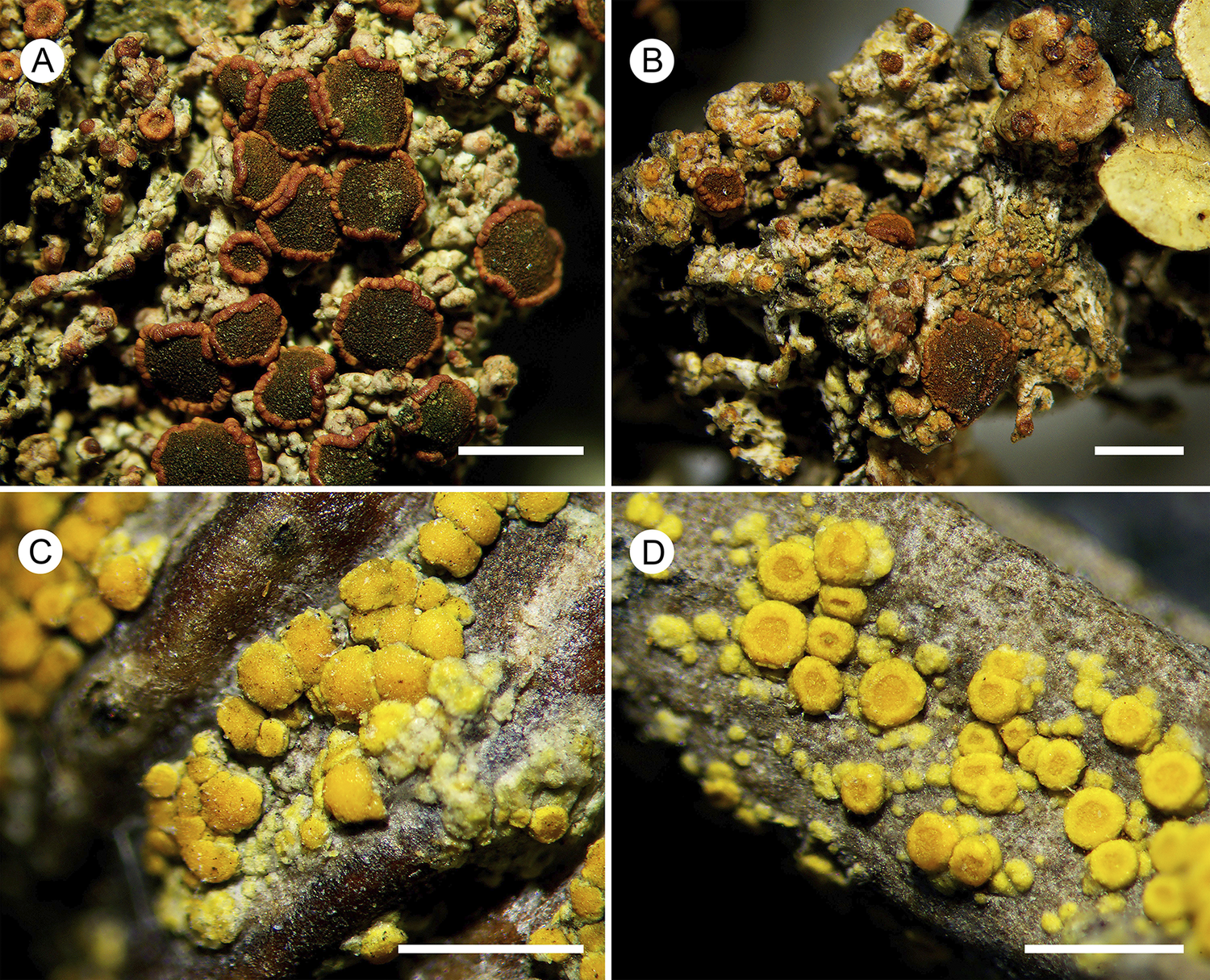
A–D, newly described species. A, Athallia subrotundispora on stone (holotype). B, A. subrotundispora on driftwood (LE L-22104). C, Gyalolechia orientoinsularis (LECB s. n.). D, G. orientoinsularis (holotype). Scales: A–F = 1 mm. In colour online.

Thallus up to 2.5 cm diam., inconspicuous and usually developing only under apothecia, or tiny greenish areoles c. 0.1–0.2 mm diam. and c. 120–200 μm thick occurring on the edge or in the centre of thalli; when on wood, thallus endoxylic, visible as a white border around apothecia. Vegetative diaspores absent. Prothallus on wood absent, on rock well developed, clearly distinguishable on the edge of thallus or between apothecia, ochre.
Apothecia abundant, adnate to substipitate, usually crowded and contiguous, round to angular, zeorine, on rock 0.55–1.15–1.55 mm diam. [10], on wood 0.45–0.61–0.80 mm diam. [10]; height of apothecia up to 0.8 mm on rock. Disc flat to convex, orange; true exciple paler than disc, yellow to yellow-orange, slightly raised above disc; thalline exciple developing mainly on underside of apothecia and often inconspicuous, greyish or greenish, sometimes with yellow tinge. Hymenium 100–125–150 μm high [10], colourless, not glutinized, without extracellular oil drops and crystals; epihymenium golden brown. Hypothecium 60–90–115 μm high [10], colourless, delimited by algal layer from below and without central conical extension downwards, with extracellular oil drops, without extracellular crystals, formed of cells variable in shape and orientation. Hymenium height/hypothecium height ratio: 1.1–1.4–1.8 [10]. Exciple c. 25–160 μm wide, formed of true exciple, 23–43–75 μm wide [10], and thalline exciple, 0–20–88 μm wide [10]. Upper part of true exciple golden brown, of thin-walled cells 6.0–8.0–12.0 × 4.0–5.9–7.5 μm [20]. Thalline exciple with paraplectenchymatous or sometimes alveolate cortex, 13–20–25 μm wide [10]; cells of cortex thin-walled ±spherical, 6.0–7.4–9.0 μm diam. [10]. Paraphyses c. 2 μm wide in lower part, upper cell significantly increased, 5.0–6.4–8.0 μm wide [10]; sometimes somewhat branched in upper part. Asci clavate, 55–70–80 × 14–17–22 μm [13]. Ascospores 8 per ascus, colourless, polarilocular, broadly ellipsoid to subglobose, (12.5–)14.3–15.2–16.1(–18.5) × (8.0–)10.0–10.3–10.6(–12.0) μm [24, 2, 1.6 & 0.9], with rounded ends. Septa (5.0–)6.3–6.4–6.5(–7.5) μm [24, 2, 0.7]. Ascospore length/width ratio: (1.32–)1.44–1.47–1.51(–1.64) [24, 2, 0.09]; septum width/ascospore length ratio: (0.36–)0.40–0.42–0.45(–0.52) [24, 2, 0.04].
Pycnidia not seen.
Chemistry
Epihymenium, upper true exciple and cortex of thalline exciple with anthraquinones, K+ purple. Thalline cortex K−, rarely in spots with anthraquinones, K+ purple. Apothecia contain parietin as a major compound and a small amount of emodin, which corresponds to chemosyndrome A of Søchting (Reference Søchting1997).
Etymology
The epithet reflects the shape of the ascospores of the new species, which is widely ellipsoid to subglobose.
Phylogeny and taxonomic position
According to Bayesian analysis of the nrITS alignment, including most of the species of the genus Athallia (subfamily Xanthorioideae) available in GenBank and two sequences of A. subrotundispora (both saxicolous and lignicolous specimens), the new species is explicitly nested within Athallia, but without distinct close relatives. It forms an unsupported clade with two undescribed Athallia species from Greece (Fig. 11).
Phylogeny of the genus Athallia based on the Bayesian analysis of nrITS with sequences of the new A. subrotundispora included (in bold). Some species with more than one sequence are collapsed into single terminals (numbers in parentheses correspond to the number of samples of a species in a given terminal). Numbers at branches represent posterior probability values ≥ 0.95.

Similar taxa
The new species, especially its wood-inhabiting form, is similar to Athallia holocarpa which is quite common on the Commander Islands. The latter species has smaller spores (9.5–15.5 × 4.8–8.4 μm vs 12.5–18.5 × 8.0–12.0 μm in A. subrotundispora), which are noticeably narrower, ellipsoid to widely ellipsoid (Arup Reference Arup2009), with a length/width ratio c. 1.8–2.0 (vs c. 1.3–1.6 in A. subrotundispora). In addition, the rock-inhabiting morph of the new species has larger apothecia (up to 1.6 mm diam. vs up to 1.0 mm diam. in A. holocarpa) and a well-developed ochre prothallus, which A. holocarpa usually does not have (Arup Reference Arup2009). The new species can be confused with western North American, mainly saxicolous Polycauliona ludificans (Arup) Arup et al. which often has a poorly developed thallus, large apothecia up to 1.6 mm diam. and large ascospores c. 12–19 × 5–10 μm (Arup Reference Arup1995); however, the latter are noticeably narrower, ellipsoid, with a length/width ratio c. 1.9–2.5 and narrower septa (c. 2–5 μm wide vs c. 5–7 μm in A. subrotundispora). Polycauliona ludificans also mostly has few to abundant pycnidia. The undescribed crustose Polycauliona sp. occurring on the Commander Islands is similar to this new species but has smaller ellipsoid spores and smaller apothecia compared to A. subrotundispora.
Ecology and distribution
The two collected specimens of A. subrotundispora have a different ecology. The saxicolous specimen (holotype) occurs on a siliceous stone in gravel tundra at an altitude of 115 m, whereas the lignicolous specimen (LE L-22104) was collected on driftwood on the edge of the supralittoral zone. Co-occurring lichen taxa include Lecanora polytropa (Ehrh. ex Hoffm.) Rabenh. and Pseudephebe pubescens (L.) M. Choisy on stones in tundra and ‘Caloplaca’ caesiorufella, Lecanora orae-frigidae R. Sant., Physcia dubia (Hoffm.) Lettau and Polycauliona candelaria on coastal driftwood. The new species is known only from Bering Island.
Remarks
The saxicolous and lignicolous specimens of the new species have a different habitus (Fig. 10A & B). The saxicolous specimen is characterized by the distinctly larger thalli (up to 2.5 cm diam. vs up to 1 cm on wood), distinctly larger apothecia (0.55–1.15–1.55 mm diam. vs 0.45–0.61–0.80 mm on wood) and the presence of a well-developed ochre prothallus (absent on wood). Nevertheless, these specimens have identical ITS sequences and very similar anatomical features, including especially wide ellipsoid to subglobose spores.
Additional material studied
Russia: Kamchatka Territory: Aleut District, Commander Islands, SE part of Bering Island, Cape Komandor, driftwood, 54°55′51.4″N, 166°31′17.1″E, 4 m, 2021, Himelbrant & Stepanchikova (LE L-22104).
Gyalolechia orientoinsularis I. V. Frolov, Himelbrant, Stepanchikova & Davydov sp. nov.
MycoBank No.: MB 850657
Similar to Mikhtomia gordejevii but differing in having a yellow to orange true exciple highly contrasting with a brown to reddish brown disc, larger conidia 3.0–4.5 × 1.5–2.0 μm and ascospores with thinner septa, 3.0–6.0 μm.
Type: Russia, Kamchatka Territory, Aleut District, Commander Islands, Medny Island, W slope of the valley of the stream flowing into Ozhidaniya Bay, alt. 128 m, 54°38′26.1″N, 167°52′11.0″E, forb meadow with Sorbus sambucifolia, 5 August 2019, D. Himelbrant & I. Stepanchikova (LE L-22100—holotype). GenBank Accession numbers of the holotype sequences: PP061035 (nrITS), PP051313 (nrLSU), PP051308 (mtSSU).
Thallus epiphytic or partly endophloedal, thin, flat, continuous or rimose to rimose-areolate with rare areoles c. 0.1–0.3 mm wide, irregular in outline, up to 2.5 cm wide, yellow; thickness of thallus c. 30–150 μm. Thallus layers often poorly distinguishable. Cortex alveolate, often poorly developed, thickness of cortex together with epinecral layer 5–25–80 μm [12]; cortex cells ±spherical, 5.0–6.3–8.0 μm diam. [20], cell wall thickness up to 1.5 μm. Algal layer 25–45–75 μm thick [11]; algal cells globose, 7.0–9.2–13.0 μm diam. [30]. Medulla inconspicuous. Vegetative diaspores absent. Prothallus often present, black, shiny.
Apothecia abundant, adnate, scattered, but sometimes contiguous, round, often with tortuous margin, usually biatorine, (0.50–)0.61–0.75–0.88(–1.0) mm diam. [27, 3, 0.15]. Disc ±flat, brown to reddish brown; true exciple paler and highly contrasting with disc, yellow to orange, raised above disc; thalline exciple usually absent or rarely poorly developed at base of apothecia. Hymenium (90–)100–100–103(–125) μm high [13, 3, 12], colourless, not glutinized, inspersed with tiny extracellular oil drops; epihymenium golden brown. Hypothecium (60–)65–125–160(–225) μm high [13, 3, 46], colourless, with central conical extension downwards (algae in apothecia usually absent), with extracellular oil drops, without extracellular crystals, formed of cells variable in shape and orientation. Hymenium height/hypothecium height ratio: 0.4–0.9–1.6 [13]. Exciple c. 40–100 μm wide, formed of true exciple, (38–)57–74–86(–105) μm wide [13, 3, 20]. Upper part of true exciple golden brown, of thin-walled cells (6.5–)9.1–9.7–11.2(–15.0) × (2.0–)3.5–4.2–4.8(–6.0) μm [30, 3, 2.0 & 1.0]. Paraphyses tightly arranged, c. 2 μm wide in lower part, gradually thickening, with the widest upper cell (3.0–)4.1–4.2–4.5(–5.5) μm wide [30, 3, 0.6]; sometimes bifurcate in upper part. Asci clavate, 50–58–70 × 13–15–17 μm [6], often without spores. Ascospores usually less than 8 per ascus (2–8), often poorly developed, colourless, polarilocular, (10.0–)12.8–13.1–13.3(–16.5) × (5.0–)6.3–6.6–7.3(–8.0) μm [30, 3, 1.8 & 0.9], with rounded ends. Septa (3.0–)4.4–4.6–4.9(–6.0) μm [30, 3, 0.7]. Ascospore length/width ratio: (1.47–)1.81–1.98–2.10(–2.46) [30, 3, 0.23]; septum width/ascospore length ratio: (0.23–)0.35–0.36–0.37(–0.45) [30, 3, 0.06].
Pycnidia abundant, immersed, of the same colour as apothecial discs, c. 150–225 μm wide. Conidia ellipsoid to bacilliform, (3.0–)3.3–3.4–3.5(–4.5) × (1.5–)1.5–1.6–1.6(–2.0) μm [30, 3, 0.4 & 0.2].
Chemistry
Epihymenium, upper true exciple, pycnidia and areoles with anthraquinones; apothecia and thallus K+ purple, disc and the inner part of margin of apothecia C+ red. The new species contains fragilin (dominates in the thallus) and 7-chloroemodin (dominates in the apothecia) as major compounds and a small amount of parietin and emodin (similar in both thallus and apothecia), which more or less corresponds to chemosyndrome B2 of Søchting (Reference Søchting2001).
Etymology
The epithet reflects the known geographical distribution of the new species on the islands of the Russian Far East.
Phylogeny and generic position
The combined nrITS + nrLSU + mtSSU Bayesian phylogeny of the subfamily Caloplacoideae (Supplementary Material Fig. S1, available online) demonstrated that the new species belongs to the genus Gyalolechia s. lat. According to the Bayesian analysis of the Gyalolechia nrITS alignment (Fig. 12), three sequences of G. orientoinsularis from Medny and Sakhalin Islands form a supported clade (PP = 0.96) without a closely related species, within a highly supported clade (PP = 1) containing Gyalolechia paradoxa sp. nov., G. xanthostigmoidea (Räsänen) Søchting et al., Mikhtomia gordejevii, M. multicolor and three undescribed Gyalolechia s. lat. species. The new species could be described within the genus Mikhtomia (Kondratyuk et al. Reference Kondratyuk, Jeong, Yu, Kärnefelt, Thell, Elix, Kim, Kondratiuk and Hur2014). The latter, however, was not accepted by either Lücking et al. (Reference Lücking, Hodkinson and Leavitt2016) or Wijayawardene et al. (Reference Wijayawardene, Hyde, Dai, Sánchez-García, Goto, Saxena, Erdoğdu, Selçuk, Rajeshkumar and Aptroot2022) and was synonymized under Gyalolechia sensu Arup et al. (Reference Arup, Søchting and Frödén2013). We prefer the wider concept of Gyalolechia proposed by Arup et al. (Reference Arup, Søchting and Frödén2013). However, making new combinations for the numerous taxa proposed by S. Kondratyuk and co-authors is associated with a number of taxonomic difficulties and is a little premature. Hence we use Kondratyuk’s names here. For further comments on the Gyalolechia taxonomy and nomenclature, see the key to species of Gyalolechia s. lat above.
Phylogeny of the genus Gyalolechia s. lat. based on the Bayesian analysis of nrITS including most of the species of the genus available in GenBank and the sequences of the new G. orientoinsularis and G. paradoxa. New sequences are in bold. Some species are collapsed into single terminals (numbers in parentheses correspond to the number of samples of a species in a given terminal). Numbers at branches represent posterior probability values ≥ 0.95.

Similar taxa
The new species can be confused with Mikhtomia gordejevii. This epiphytic lichen, common in the Russian Far East, has a dark orange to ferruginous red true exciple concolorous with (but sometimes paler or darker than) the disc. It also has smaller short-bacilliform conidia, 2.0–2.5 × 0.5–0.8 μm, and wider ascospore septa, 5–9 μm (Khodosovtsev et al. Reference Khodosovtsev, Kuznetzova and Himelbrant2004). Similar to the new species the epiphytic Gyalolechia flavorubescens (Huds.) Søchting et al. and epilithic G. flavovirescens (Wulfen) Søchting et al. usually have zeorine apothecia (usually biatorine in G. orientoinsularis) with a paler, orange to dark orange disc, a grey prothallus (black in G. orientoinsularis) and are characterized by chemosyndrome B1 (Søchting Reference Søchting2001). The phylogenetically related G. xanthostigmoidea has soralia and a true exciple ±concolorous with the disc (Vondrák et al. Reference Vondrák, Frolov, Davydov, Urbanavichene, Chesnokov, Zhdanov, Muchnik, Konoreva, Himelbrant and Tchabanenko2016). The East Asian species Mikhtomia subflavorubescens (Y. Joshi & Hur) S. Y. Kondr. et al. is characterized by its thick subsquamulose to subfoliose thallus (Joshi et al. Reference Joshi, Wang, Yamamoto, Koh and Hur2010).
Ecology and distribution
The new species was collected on the bark of Sorbus sambucifolia and Betula sp. in forb meadows with small groves or solitary shrubs or trees in two floodplain localities on Medny Island at altitudes of c. 15–130 m, and in a single locality on Sakhalin Island at 380 m alt. on the western slope of a mountain. Co-occurring lichen taxa include Biatora spp., ‘Caloplaca’ caesiorufella, Lendemeriella kamczatica and Lecanora symmicta (Ach.) Ach.
Additional material studied
Russia: Kamchatka Territory: Aleut District, Commander Islands, Medny Island, between Sen’kina and Stolbovaya Mts, valley of the creek flowing into Sen’kina Bay, 54°43′11.2″N, 167°39′26.3″E, 14 m, 2019, Himelbrant & Stepanchikova (LECB s. n.). Sakhalin Region: Sakhalin Island, Makarov District, Zhdanko Ridge, 48°5′49.0″N, 142°31′41.5″E, 380 m, 2019, Davydov 19-56 (LE s. n., hb. Davydov 19839).
Gyalolechia paradoxa Himelbrant, Stepanchikova & I. V. Frolov sp. nov.
MycoBank No.: MB 850675
Muscicolous or lichenicolous on Psora rubiformis; similar to Blastenia ammiospila (Wahlenb. ex Ach.) Arup et al. but differing in having a thin orange to orange-red thallus containing 7-chloroemodin and no atranorin, and in having ellipsoid to widely ellipsoid and subglobose ascospores, 12–19 × 8–13 μm.
Type: Russia, Kamchatka Territory, Aleut District, Commander Islands, Medny Island, W of Lake Gladkovskoe, on mountain slope, alt. 146 m, 54°44′08.7″N, 167°42′17.9″E, outliers on the slope surrounded by tundra with dwarf shrubs and lichens on solifluction soils, on mosses, 20 August 2019, D. Himelbrant & I. Stepanchikova (LE L-22098—holotype; H, PRA—isotypes). GenBank Accession numbers of the holotype sequences: PP061038 (nrITS), PP051312 (nrLSU).
A–D, newly described and putative species. A, Gyalolechia paradoxa on mosses (holotype). B, G. paradoxa on Psora rubiformis (LE L s. n.). C, Orientophila aff. corticola (LE L-22107). D, O. aff. corticola (VBGI s. n.). Scales: A–F = 1 mm. In colour online.

Thallus muscicolous or parasitic, endo- to episubstratic, continuous or rimose, rimose-areolate to areolate, with contiguous to scattered areoles c. 0.1–0.3 mm wide, orange to orange-red or whitish, often with white necrotic spots; thickness of thallus c. 70–140 μm. Epinecral layer well developed, colourless, c. 10–15 μm thick. Cortex alveolate, red in upper part and colourless in lower part, c. 10–15 μm thick; cortex cells ±spherical, 5.0–7.0 μm diam. with thin cell walls up to 1.5 μm. Algal layer c. 50–90 μm thick; algal cells globose, 8.0–10.8–14.0 μm diam. [10]. Medulla inconspicuous or algonecral, c. 20 μm thick. Vegetative diaspores absent. Prothallus sometimes present, black.
Apothecia ±abundant, sessile to adnate, scattered or contiguous, round, with thin and usually tortuous crenate margin, zeorine to biatorine, 0.75–0.97–1.3 mm diam. [10]. Disc flat to slightly convex, dark ferruginous red or ferruginous brown; true exciple slightly paler or of same colour as the disc, slightly raised above or level with the disc; thalline exciple developed on underside of apothecia and inconspicuous. Hymenium c. 130 μm high, colourless or, in case of thick cross-sections, slightly yellowish, not glutinized, and not (or slightly) inspersed with extracellular oil drops; epihymenium ferruginous red often with thick epipsamma. Hypothecium c. 200 μm high, brownish, with central conical downwards extension, with or without extracellular oil drops, cells often unclear, variable in shape and orientation. Exciple c. 50 μm wide, formed of true exciple and thalline exciple, inconspicuous from above. Upper part of true exciple ferruginous red, of thin-walled cells 7.0–10.0 × 2.0–3.0 μm. Paraphyses 1.5–2 μm wide in lower part, slightly wider or of the same width in the upper part, 2.0–2.9–4.0 μm wide [10]; often branched and anastomosed. Asci clavate, c. 70 × 15 μm, often without spores. Ascospores usually less than 8 per ascus (6–7), often deformed and poorly developed, colourless, polarilocular, ellipsoid to widely ellipsoid and subglobose, 12.0–15.1–19.0 × 8.0–10.0–13.0 μm [28, 2, 1.8 & 1.4], with rounded ends. Septa 4.0–6.2–9.0 μm [28, 2, 1.3]. Ascospore length/width ratio: 1.20–1.53–2.0 [28, 2, 0.24]; septum width/ascospore length ratio: 0.27–0.41–0.51 [28, 2, 0.07].
Pycnidia present, raised above thallus surface, and the same colour as apothecial discs, c. 200 μm wide. Conidia ellipsoid to bacilliform, 2.5–3.0–3.5 × 1.5 μm [10].
Chemistry
Epihymenium, upper true exciple, cortex of thalline exciple, pycnidia and usually thallus with anthraquinones, K+ strongly deep purple. Apothecia C+ red (both disc and exciple; chlorinated anthraquinones). The new species contains 7-chloroemodin (similar amount in both thallus and apothecia) as a major compound, emodin and parietinic acid (similar amount in both thallus and apothecia) as minor compounds, and traces of fragilin (in both thallus and apothecia), which corresponds to chemosyndrome C of Søchting (Reference Søchting2001).
Etymology
The epithet reflects the presence of some features in the new species that are not characteristic of the genus Gyalolechia, namely a chemistry more typical of the genus Blastenia and the occasionally parasitic way of life.
Phylogeny and generic position
According to the combined nrITS + nrLSU + mtSSU phylogeny of the subfamily Caloplacoideae (Supplementary Material Fig. S1), the new species is explicitly nested within the genus Gyalolechia s. lat., despite its high morphological and chemical similarity to Blastenia ammiospila. According to the Bayesian analysis of the Gyalolechia nrITS alignment (Fig. 12), two sequences of G. paradoxa obtained from both free-living muscicolous and lichenicolous thalli form a highly supported clade (PP = 1) sister to Mikhtomia gordejevii (PP = 0.95). Similar to Gyalolechia orientoinsularis, G. paradoxa could be described within the genus Mikhtomia (Kondratyuk et al. Reference Kondratyuk, Jeong, Yu, Kärnefelt, Thell, Elix, Kim, Kondratiuk and Hur2014). For comments on the Gyalolechia generic concept and the nomenclature used here, see the key to species of Gyalolechia s. lat. and the corresponding section of the G. orientoinsularis protologue.
Similar taxa
The new species is unlike any other in the genus Gyalolechia. It can be confused with Blastenia ammiospila, which differs in having a whitish thallus lacking anthraquinones and containing atranorin, and in having narrower ascospores 5–9 μm wide (8–13 μm in G. paradoxa) with slightly narrower septa 4–6.5 μm wide (4–9 μm in G. paradoxa) and an often well-developed grey thalline exciple (Søchting Reference Søchting1989; Søchting et al. Reference Søchting, Lorentsen and Arup2008; Vondrák et al. Reference Vondrák, Frolov, Košnar, Arup, Veselská, Halıcı, Malíček and Søchting2020). When lichenicolous on Psora rubiformis, the new species can be confused with ‘Caloplaca’ psoricida E. S. Hansen et al., which differs in having long, narrow spores 5.5–6.5 μm wide with a length/width ratio of c. 3 (1.2–2 in G. paradoxa), narrower septa 3–5 μm wide and lacking a crenate apothecial margin (Hansen et al. Reference Hansen, Poelt and Søchting1987).
Ecology and distribution
Muscicolous (Fig. 13A) and lichenicolous on squamules of Psora rubiformis (Fig. 13B). Co-occurring lichen taxa include Epilichen scabrosus (Ach.) Clem., Japewia tornoënsis (Nyl.) Tønsberg, Lepra dactylina (Ach.) Hafellner, Ochrolechia frigida (Sw.) Lynge and Pertusaria bryontha (Ach.) Nyl. Currently, Gyalolechia paradoxa is known only from the type locality on Medny Island.
Additional material studied
Russia: same as the type, on squamules of Psora rubiformis, 2019, Himelbrant & Stepanchikova (LE L s. n.).
Other noteworthy species
Orientophila aff. corticola B. G. Lee
Our phylogenetic analysis of the nrITS alignment, including all of the Orientophila species available in GenBank (Fig. 14), revealed that the epiphytic Orientophila specimens from the Commander and South Kuril Islands form their own highly supported clade (PP = 0.99), but without clear relationships among the other clades of the genus. We were unable to find any morphological differences between those specimens and Orientophila corticola B. G. Lee, recently described from South Korea (Lee & Hur Reference Lee and J-S2020). The latter species, previously known only from the type locality, was found to be a common lichen on the seashore of Sakhalin Island, and the Primorye and Khabarovsk Territories in Russia (I. Frolov, unpublished data). Nevertheless, it is absent on the Commander and Kuril Islands, where the new putative species is exclusively recorded, seemingly preferring a more oceanic climate than O. corticola s. str. The ITS sequences of these species differ from each other by 17 synapomorphies, and perhaps we are dealing with a semi-cryptic species (according to Vondrák et al. (Reference Vondrák, Říha, Arup and Søchting2009)). However, taking into account the possibility of intragenomic variability of the nrITS region (Bradshaw et al. Reference Bradshaw, Aime, Rokas, Maust, Moparthi, Jellings, Pane, Hendricks, Pandey and Li2023), we hesitate to formally describe this new clade as a new species pending further data. There is one mtSSU sequence for Orientophila corticola s. str. and one for O. aff. corticola (MN687910 and PP051309 respectively), which differ in two positions. However, it is unclear whether this is sufficient to separate species in Orientophila, since there are very few mtSSU sequences available for this genus.
Phylogeny of the genus Orientophila based on the Bayesian analysis of nrITS with O. corticola and O. aff. corticola included. New sequences are in bold. Numbers at branches represent posterior probability values ≥ 0.95.

Material of Orientophila aff. corticola studied
Russia: Kamchatka Territory: Aleut District, Commander Islands, Bering Island, E coast, Bol’shaya Buyanovskaya Bay, 55°08′42.5″N, 166°16′21.7″E, 6 m, 2021, Himelbrant & Stepanchikova (LECB s. n.); N part, coastal dunes W of Mt Nakoval’nya, 55°13′39.2″N, 165°59′45.7″E, 17 m, 2020, Himelbrant & Stepanchikova (LE L-22107). Sakhalin Region: Kunashir Island, 9.5 km NW of Juzhno-Kurilsk, rocks ‘Sobachki’, 44°3′24.3″N, 145°44′37.8″E, 10 m, 2019, Frolov (VBGI s. n.); 26.5 km SW of Juzhno-Kurilsk, cape Puzanova, 43°52′43.5″N, 145°36′35.1″E, 5 m, 2019, Frolov (VBGI s. n.); 22 km NE of Juzhno-Kurilsk, cape Rogachyova, 44°11′10.6″N, 146°1′54.3″E, 5 m, 2019, Frolov (VBGI s. n.); 1.5 km N of Juzhno-Kurilsk, 44°3′10.5″N, 145°51′43.4″E, 5 m, 2019, Frolov (VBGI s. n.).
Selected specimens of Orientophila corticola s. str. studied
Russia: Sakhalin Region: Sakhalin Island, Smirnykhovsky District, 4.5 km SW of Pil’vo, around Cape Korsakova, 50°0′12.4″N, 142°9′23.7″E, 0–5 m, 2019, Frolov (VBGI s. n.). Primorye Territory: Lazo District, 9.5 km S of Kievka, 42°49′8.3″N, 133°42′37.5″E, 0–5 m, 2020, Frolov (VBGI s. n.); Khasan District, Gamova Peninsula, Andreevka, 42°38′28.4″N, 131°7′49.3″E, 40 m, 2020, Frolov (VBGI s. n.); Vladivostok, Popova Island, 42°56′49.0″N, 131°43′28.1″E, 20 m, 2020, Frolov (VBGI s. n.).
New combinations
Lendemeriella kamczatica (Savicz) I. V. Frolov comb. nov.
MycoBank No.: MB 851518
Caloplaca kamczatica Savicz, Bull. Jard. Bot. Imp. Pierre le Grand 14, 124 (1914).—Placodium kamczaticum Savicz, Bull. Jard. Bot. Imp. Pierre le Grand 14, 124 (1914); alternative name for Caloplaca kamczatica Savicz (ICNafp Art. 36.3).—Blastenia kamczatica (Savicz) Oxner, Tab. Opred. Rodov Vidov Semeĭstva Kaloplakovykh (Caloplacaceae Zahlbr.) Flory Lishaĭnikov SSSR, 48 (1990); nom. inval. (ICNafp Art. 41.4); type: [Russia], Kamchatka, Nalycheva River banks near its mouth, on Alnus, August 1909, Savicz 6564, processing no. 196 (LE L-451!—lectotype selected by Søchting (Reference Søchting2004): 400; UPS—isolectotype).
(Fig. 6E)
Bayesian analysis of the nrITS alignment of the subfamily Caloplacoideae (Supplementary Material Fig. S2, available online) demonstrated that this species belongs to the ‘Caloplaca exsecuta’ group, which is currently attributed to the genus Lendemeriella (Kondratyuk et al. Reference Kondratyuk, Lőkös, Farkas, Kärnefelt, Thell, Yamamoto and Hur2020).
Lendemeriella phaeocarpella (Nyl.) I. V. Frolov, Himelbrant & Stepanchikova comb. nov.
MycoBank No.: MB 851519
Lecanora phaeocarpella Nyl., Not. Sällsk. Fauna et Fl. Fenn. Förh. 8, 128 (1866).—Lecidea phaeocarpella (Nyl.) Hue, Nouv. Arch. Mus. Hist. Nat., Paris, 5 sér. 4, 17 (1914) [1912].—Placodium phaeocarpellum (Nyl.) A. L. Sm., Monogr. Brit. Lich., Edn 2 1, 216 (1918).—Caloplaca phaeocarpella (Nyl.) Zahlbr., Cat. Lich. Univers. 7, 163 (1931); type: Rossia, Lapponia tulomensis, Kola, 1863, Fellman (H-NYL 29473, not seen).
(Fig. 6F)
Bayesian analysis of the nrITS alignment of the subfamily Caloplacoideae (Supplementary Material Fig. S2) demonstrated that this species belongs to the ‘Caloplaca exsecuta’ group, which is currently attributed to the genus Lendemeriella (Kondratyuk et al. Reference Kondratyuk, Lőkös, Farkas, Kärnefelt, Thell, Yamamoto and Hur2020).
Polycauliona etesiae (Nyl.) I. V. Frolov, Himelbrant & Stepanchikova comb. nov.
MycoBank No.: MB 850698
Lecanora etesiae Nyl., Flora, Regensburg 68, 439 (1885).—Placodium etesiae (Nyl.) Vain., Ark. Bot., Band 8 no. 4, 62 (1909).—Callopisma etesiae (Nyl.) Du Rietz, Ark. Bot., Band 22A no. 13, 23 (1929).—Caloplaca etesiae (Nyl.) Zahlbr., Cat. Lich. Univers. 7, 238 (1931).—Gasparrinia etesiae (Nyl.) Oxner, Tab. Opred. Rodov Vidov Semeĭstva Kaloplakovykh (Caloplacaceae Zahlbr.) Flory Lishaĭnikov SSSR, 28 (1990); nom. inval. (ICNafp Art. 41.4); type: [Russia, Commander Islands], Fretum Behringii, Insula Behringii, E. Almquist, Exped. Vega (H-NYL 30458!—lectotype selected by Khodosovtsev et al. (Reference Khodosovtsev, Kuznetzova and Himelbrant2004): 199).
(Fig. 7D)
Since the species is poorly known, a description based on our specimens from the Commander Islands is presented.
Thallus yellow, up to 1.5 cm, often coalescing with other thalli to cover larger areas, growing radially in roundish rosettes, verruculose to areolate in centre or covered with apothecia, up to 2–3 mm thick (including apothecia); margin consisting of radiating lobes, 1.8–2.5–3.5 × 0.5–0.6–0.9 mm [20], strongly convex, c. 0.5–0.8 mm thick, usually wider towards tips, with mostly uneven surface, usually irregularly branched, divided by deep narrow furrows, occasionally with pseudocyphellae, thin white pruina usually present and mainly developed on lobe tips. Cortex of lobes uneven, c. 30–42–50 μm thick [8], prosoplectenchymatous, consisting of irregularly tightly arranged hyphae with cells 6.0–8.4–12.0 × 3.0–3.8–5.5 μm [16], golden brown in thin upper part, colourless in lower part; pruina often present, c. 5–20 μm thick, consisting of crystals 2–10 μm wide, variable in shape; cortex absent on lower side of lobes. Algal layer c. 150 μm thick, divided into clusters by thin cords of anticlinally arranged hyphae with cells c. 15 × 5 μm; algal cells globose, 11–14.6–17 μm diam. [10]. Medulla up to c. 0.5 cm thick, lax, composed of loosely interwoven hyphae, with scattered algal cells in upper part. Vegetative diaspores absent. Prothallus absent.
Apothecia few to abundant, raised to stipitate, scattered to crowded and contiguous, round, developing in central part of thallus, zeorine, up to 3 mm diam. Disc concave to flat and slightly convex, sometimes undulate, orange, sometimes with thin white pruina; true exciple paler or of the same colour as disc, yellow to orange; thalline exciple thick, of the same colour as thallus, yellow. Hymenium c. 125–140 μm high, colourless, not glutinized, usually not inspersed with oil droplets, but rarely with stacks of crystals; epihymenium golden brown, with colourless crystals of pruina. Hypothecium c. 300–450 μm high, colourless, delimited by wavy algal layer, with extracellular oil drops, formed of cells variable in shape and orientation. Exciple c. 120–200 μm wide, in young apothecia strongly raised above disc (such apothecia almost urceolate), then only slightly raised or level with disc, formed of true exciple, c. 60–75 μm wide, and thalline exciple, c. 40–140 μm wide. Upper part of true exciple golden brown, of thin-walled cells 7.0–9.5–12.0 × 4.0–5.5–7.5 μm [13]. Thalline exciple with paraplectenchymatous cortex, c. 30–40 μm thick; cells of cortex thin-walled ±spherical, 5.0–8.4–12.0 μm diam. [11]. Paraphyses c. 2 μm wide in lower part, upper 2–3 cells often increased, with the widest upper cell 4.0–4.9–6.5 μm wide [12]; often branched and anastomosed. Asci clavate, 65–80 × 9–11 μm [6]. Ascospores 8 per ascus, colourless, polarilocular, narrowly ellipsoid to subfusiform, 11.5–13.5–16.0 × 4.0–4.6–5.5 μm [19], with rounded ends. Septa 2.0–2.8–4.0 μm [19]. Ascospore length/width ratio: 2.56–2.98–3.75 [19]; septum width/ascospore length ratio: 0.13–0.21–0.32 [19].
Pycnidia present, slightly immersed or flush with surface of the thallus, of the same colour as apothecial discs, c. 150–450 μm wide. Conidia usually bacilliform, rarely ellipsoid, sometimes slightly curved, 3.5–4.8–6.0 × 1.5–2.1–2.5 μm [28], size and shape of conidia varying significantly within the same pycnidium.
Chemistry
Epihymenium, upper true exciple, cortex of thalline exciple, pycnidia and areoles with anthraquinones, K+ purple. Apothecia and thallus contain parietin and small amounts of emodin and fallacinal, which corresponds to chemosyndrome A of Søchting (Reference Søchting1997).
Phylogeny and taxonomic position
According to Bayesian analyses of the nrITS alignment, including most of the species of the genus available in GenBank, two sequences of P. etesiae form a highly supported clade sister to P. comandorica (PP = 0.96), and are also closely related to P. verruculifera (Fig. 8).
Remarks and similar species
Phenotypic characters of our material agree with the description by Nylander (Reference Nylander1885), with the exception of the very large conidia, 3.5–6.0 × 1.5–2.5 μm, which according to Nylander (Reference Nylander1885) should be 2.5 × 0.5 μm. D. Himelbrant observed the lectotype in H-NYL in 2004 but did not measure the conidia, and now we have no possibility of repeating the observation.
Spribille et al. (Reference Spribille, Fryday, Hampton-Miller, Ahti, Dillman, Thor, Tønsberg and Schirokauer2023) demonstrated that the combination Caloplaca etesiae should be attributed to Zahlbruckner and not to Du Rietz, as it had been previously (e.g. Khodosovtsev et al. Reference Khodosovtsev, Kuznetzova and Himelbrant2004). Khodosovtsev et al. (Reference Khodosovtsev, Kuznetzova and Himelbrant2004) synonymized Polycauliona etesiae and P. brattiae (W. A. Weber) Arup et al. These species are very similar in having a yellow lobate thallus and narrowly ellipsoid spores with quite narrow septa, and in occurring on coastal rocks. Based on our current material, however, we can affirm that these taxa are distinct and P. etesiae is in general a larger lichen, having larger apothecia (up to 3 mm diam. vs up to 1.4 mm in P. brattiae according to Arup (Reference Arup1995)), a taller hymenium (125–140 μm vs 70–80 μm), a thicker hypothecium (300–450 μm vs 50–150 μm) and a thicker thallus (0.5–0.8 mm vs 0.15–0.4 mm). Polycauliona etesiae and P. brattiae have a distinct phylogenetic position (Fig. 8).
Ecology and distribution
Polycauliona etesiae grows on siliceous outcrops, on seashores in the supralittoral zone or higher, sometimes under established seabird colonies. Data on the species distribution are ambiguous. According to Du Rietz (Reference Du Rietz1929), Khodosovtsev et al. (Reference Khodosovtsev, Kuznetzova and Himelbrant2004) and Spribille et al. (Reference Spribille, Fryday, Hampton-Miller, Ahti, Dillman, Thor, Tønsberg and Schirokauer2023), P. etesiae is widely distributed along the coasts of the Bering Sea and adjacent parts of the Arctic and Pacific Oceans. However, specimens from LE and LECB cited by Khodosovtsev et al. (Reference Khodosovtsev, Kuznetzova and Himelbrant2004) for SE Kamchatka belong to a morphotype of P. verruculifera without isidia, which is quite common in the Russian Far East (I. Frolov, unpublished data). The citation of P. etesiae outside Bering Island (St Lawrence Bay, St Matthews Island and Alaska) by Du Rietz (Reference Du Rietz1929) is based on the specimens referred to as ‘Caloplaca’ polaris (Vain.) Zahlbr. by Vainio (Reference Vainio1909) in his protologue of the latter species. Du Rietz (Reference Du Rietz1929) synonymized ‘C.’ polaris under P. etesiae, but we believe that ‘C.’ polaris is a morphotype of P. verruculifera with poorly developed isidia (based on Vainio’s protologue and specimen 30403 from TUR-V). We have seen one of the specimens mentioned by Du Rietz (Reference Du Rietz1929) and by Vainio (Reference Vainio1909) from St Lawrence Bay (H-NYL 30459 sub. ‘Lecanora etesiae?’), which proved to be damaged P. verruculifera. Also, as noted by Thomson (Reference Thomson1984) and Spribille et al. (Reference Spribille, Fryday, Hampton-Miller, Ahti, Dillman, Thor, Tønsberg and Schirokauer2023), reports of P. etesiae in the American Arctic are based upon small specimens of Rusavskia elegans. Indeed, according to the accompanying photograph on the GBIF website, the specimen ‘Caloplaca’ etesiae 10781 collected by J. W. Thomson et al. on the Sagavanirktok River is in fact R. elegans. From the above, we conclude that Polycauliona etesiae is known only from Bering Island and the adjacent islets of the Commander Islands.
Additional material studied
Russia: Kamchatka Territory: Aleut District, Commander Islands, Bering Island, central part of Zasarannaya Bay, 55°19′08.1″N, 166°09′21.0″E, 5 m, 2022, Himelbrant, Stepanchikova & Zueva (LE L-22116); Toporkov Island, SW coast, 55°12′16.2″N, 165°55′55.1″E, 2 m, 2020, Himelbrant & Stepanchikova (in LE L-15415); ibid., 55°12′11.6″N, 165°56′07.8″E, 3 m, 2020, Himelbrant & Stepanchikova (LE L-15416, 22101, H); ibid., N coast, 55°12′21.5″N, 165°56′11.0″E, 8 m, 2020, Himelbrant & Stepanchikova (LE L-22102); Ary Kamen’ Island, N top of the island, 55°12′57.7″N, 165°47′27.4″E, 32 m, 2020, Himelbrant & Stepanchikova (LECB s. n.).
Supplementary Material
The Supplementary Material for this article can be found at http://doi.org/10.1017/S0024282925101035.
Acknowledgements
Prof. Mark Seaward (Bradford, UK) kindly revised the manuscript, Vladimir Kukarskikh (Yekaterinburg, Russia) kindly provided access to photographic equipment, and Irina V. Sokolova (St Petersburg, Russia) helped with nomenclature. Special thanks to Ulf Arup (Lund, Sweden) for his comments on some species. We are grateful to editor Toby Spribille and the anonymous reviewers for their valuable comments. We also would like to express our sincere gratitude to Evgeny Mamaev and Anastasia Kuznetsova and other colleagues from the Commander Islands National Park for their great support and assistance during the field trips. The curators of the following herbaria made the material available for study: LE, LECB, TUR-V (visited in 2012) and H-NYL (visited in 2004). IF worked within the framework of the national project of the Institute Botanic Garden (RAS, Ural Branch) and the institutional research project ‘Cryptogamic biota of Pacific Asia: taxonomy, biodiversity, species distribution’ of the Botanical Garden-Institute of the Far Eastern Branch of the RAS; the study of DH, IS and AZ was carried out within the framework of the institutional research project ‘Flora and systematics of algae, lichens, and bryophytes of Russia and phytogeographically important regions of the world’ (no. 121021600184-6) of the Komarov Botanical Institute RAS, and IP worked within the framework of institutional research projects (no. 124020100140-7) of the Komarov Botanical Institute RAS and Institute for Biological Problems of the Cryolithozone of the Siberian Branch of RAS (no. АААА-А21-121012190035-9). KK was supported by the long-term research development project No. RVO 67985939 of the Czech Academy of Sciences. IF and IP were also supported by the Russian Science Foundation (RSF grant no. 23-24-00207: https://rscf.ru/en/project/23-24-00207/).
Author ORCIDs
Ivan V. Frolov, 0000-0003-4454-3229; Dmitry E. Himelbrant, 0000-0002-2310-1950; Irina S. Stepanchikova, 0000-0002-7144-4050; Ilya A. Prokopiev, 0000-0001-8755-7140; Kirill Korznikov, 0000-0003-2850-1483; Anna S. Zueva, 0009-0003-1618-422X.
Competing Interests
The authors declare none.