Benefits of internet use in healthcare may include: user access to a large amount of health information;Reference Bernhardt, Lariscy, Parrott, Silk and Felter 1 increased opportunities for people to become more informed, effective, and discerning users of healthcare services;Reference Gerber and Eiser 2 greater sharing of decision making between patients and healthcare teams;Reference Robinson, Flowers, Alperson and Norris 3 increased efficiency of clinical consultations, as patients are more likely to attend with information or specific questions;Reference Gerber and Eiser 2 reduced stigma or isolation, particularly for people with rare conditions; and a means by which to inform groups neglected or missed by traditional health education, such as those in rural areas or from marginalised or disempowered groups.Reference Mann and Stewart 4 , Reference Axler, Strong, Jordens, Ankeny, Barlow-Stewart and Kerridge 5 People with chronic health conditions who use the internet have better self-care practices than those who do not, including improved cooperation with treatment regimens, reduced anxiety, and greater feelings of safety and security regarding their health.Reference Mills and Sullivan 6 – Reference Mossman, Boudioni and Slevin 8
Use of the internet as a source of healthcare information can also be associated with difficulties,Reference Axler, Strong, Jordens, Ankeny, Barlow-Stewart and Kerridge 5 , Reference Wald, Dube and Anthony 9 including wide variation in information accuracy and quality,Reference Eisenbach and Diepgen 10 unfamiliar or technical terms that may serve as barriers to knowledge acquisition and understanding,Reference Bernhardt, Lariscy, Parrott, Silk and Felter 1 and users may not trust web-based informationReference Bernhardt, Lariscy, Parrott, Silk and Felter 1 or may have difficulty interpreting its personal relevance. Some may have limited internet access,Reference Davis 11 , Reference Potts and Wyatt 12 and others may be concerned about privacy and information security.Reference Bernhardt, Lariscy, Parrott, Silk and Felter 1 In addition, for some, this abundance of information may be overwhelming and may compound stress associated with key events such as diagnosis and treatment.
The rapid increase in internet-based healthcare information, or eHealth, has not been matched with an increase in research examining the ways in which patients and their families use and experience this information, as well as associated clinical implications. This is particularly the case in paediatric cardiology where, to our knowledge, there are only two published studies on internet use among parents of children with CHD. These studies, undertaken over 10 years ago, found that between 35 and 58% of parents surveyed used the internet as a source of information about CHD.Reference Ikemba, Kozinetz and Feltes 13 , Reference Massin, Montesanti, Gerard, Massin, Montesanti and Gerard 14 eHealth literacy, defined as the ability to seek, find, understand, and appraise health information from electronic sources, and apply the knowledge gained to addressing or solving a health problem,Reference Norman and Skinner 15 has not been examined in CHD. Thus, we aimed to (a) examine eHealth literacy, beliefs, and behaviours in parents of children with complex CHD, and to (b) identify parents’ preferences for the content, format, features, and functions of eHealth resources for CHD. We planned to use these data to inform improvement of existing eHealth resources for families of children with CHD and to guide the development and implementation of innovative, evidence-based, eHealth interventions.
Materials and methods
Participants
Parents or guardians of a living child born between June 2008 and March 2011 with a congenital heart malformation requiring cardiac surgery were identified via the clinical databases at the Children’s Hospital at Westmead in Sydney, Australia. Using a cross-sectional design, all families were approached for the study at the same time. Parents were eligible to participate if aged over 18 years and able to complete the questionnaire in English.
Procedure
Approval was granted by the Sydney Children’s Hospitals Network Human Research Ethics Committee (LNR-2011-10-17). All participants provided their informed consent. An invitation letter, information sheet, consent form, questionnaire, and reply-paid envelope were mailed to all eligible families, with mothers and fathers receiving personalised packages. Reminder telephone calls were made to parents who did not return the questionnaire within 1 month. Up to seven attempts were made to contact eligible individuals, and up to two additional study packages were sent upon request.
Measures
On the basis of a literature review and expert consultation, a self-administered survey instrument was developed for the study, comprised of validated and purposely designed measures:
-
∙ Demographics (nine items): parent age, marital status, country of birth, language(s) spoken at home, education, gross annual household income, residential location, number of children, and age of the child with CHD. Income was categorised using the Australian Survey of Income and Housing. 16
-
∙ Clinical characteristics (five items): child’s cardiac abnormality, time of diagnosis, antenatal or postnatal, interventional catheterisation, other health conditions, and total duration of hospitalisation. Surgical complexity was categorised using the Risk Adjustment for Congenital Heart Surgery system, with Level 1 indicating the lowest and Level 6 the highest surgical risk.Reference Jenkins, Gauvreau, Newburger, Spray, Moller and Iezzoni 17
-
∙ General computer and internet use (six items): participants indicated whether they owned a computer and had internet access at home, as well as the frequency of general home computer and internet use, and type of internet connection. Internet use to gather healthcare information was also assessed, with all response options relating to frequency of computer or internet use ranging from 0 (“Never”) to 5 (“Every day”).
-
∙ eHealth literacy (10 items): the eHealth Literacy Scale (eHEALS)Reference Norman and Skinner 15 was used to assess perceived competence, knowledge, and skill in searching for, evaluating, and applying health information found on the internet. Response options for the original eight-item scale range from 1 (“Strongly disagree”) to 5 (“Strongly agree”), with higher scores indicating greater eHealth literacy (total possible score: 40) and assisting in the identification of people who may benefit from referrals to eHealth resources; two additional items assessed perceived usefulness and importance of eHealth resources. Internal consistency for the eHealth Literacy Scale in the present sample was high (α=0.89).
-
∙ CHD-specific eHealth use (10 items): participants indicated whether they had accessed or received information about CHD from a range of sources – for example, paediatric cardiologist, cardiac surgeon, general practitioner, and the internet. Frequency and timing of CHD-specific eHealth resource use, search strategies and terms, and topics searched were assessed. The extent to which eHealth information influenced healthcare decision making for their child (1 “No influence at all” to 5 “Completely influences my decisions”) was assessed. One item assessed whether participants had shared information about their child’s experience of CHD on a web-based platform. Participants also indicated their awareness of guidelines – for example, Hi-Ethics, TRUSTe, and Health on the Net’s Code of ConductReference Clark 18 – for, and characteristics used when, assessing the quality of eHealth content.
-
∙ Perceptions and challenges associated with use of eHealth resources (four items): perceptions of the ease with which credible internet-based information on CHD could be found (1 “Very easy” to 4 “Very difficult”) and the helpfulness of this information (1 “Not at all helpful” to 4 “Very helpful”) were assessed. Perceived benefits of CHD-related eHealth resources (17 options presented) and common challenges encountered when using eHealth resources (15 options) were also assessed, see Table 3 for a complete list of options.
-
∙ Communication about internet use with healthcare providers (nine items): participants indicated whether they had ever discussed web-based information about CHD with a member of their child’s healthcare team and, if so, how often. Two items assessed whether a paediatric cardiologist or cardiac surgeon had enquired about eHealth use for CHD. eHealth recommendation provision, use, and likelihood that a future recommendation would be pursued were also assessed. Level of comfort discussing eHealth with health professionals was assessed (1 “Not at all comfortable” to 5 “Extremely comfortable”), as well as barriers to these types of discussions – for example, limited time.
-
∙ eHealth preferences: preferred eHealth features and functions (13 options) and preferences for content presentation format – for example, words, pictures, and video – were assessed. Perceived importance of 17 potential eHealth content areas was also assessed (1 “Not at all important” to 5 “Extremely important”; see Table 4); one item assessed preferences for eHealth resources developed in Australia or overseas.
Statistical methods
Data were analysed using IBM Statistical Package for the Social Sciences (SPSS) 22.0. Differences between participants and non-participants for non-psychological variables were assessed using Pearson’s χ2-tests or t-tests, as appropriate. Descriptive statistics were used to explore demographic and clinical characteristics as well as participants’ beliefs, preferences, and behaviours regarding internet use. Pearson’s χ2-tests were used to explore associations between parent gender and internet use, t-tests to examine potential differences in eHealth literacy between mothers and fathers, and Mann–Whitney U tests to examine potential differences between mothers and fathers regarding (a) sources of CHD-related information and (b) perceived importance of different eHealth content areas. Statistical significance was set at p<0.05.
Results
Response rate and analysis of participation bias
Of 198 families eligible for the study, 27 were not contactable and 132 parents (83 mothers and 49 fathers from 86 families) returned completed questionnaires, yielding a participation rate of 50% among eligible, successfully contacted families (86/171) and a response rate of 43% for the entire eligible sample. Although mothers (42%) were more likely to participate than fathers (25%; χ2=12.13, p<0.001), participants and non-participants did not differ according to child age (p=0.88) or surgical complexity (p=0.25).
Demographic and clinical characteristics (N=132)
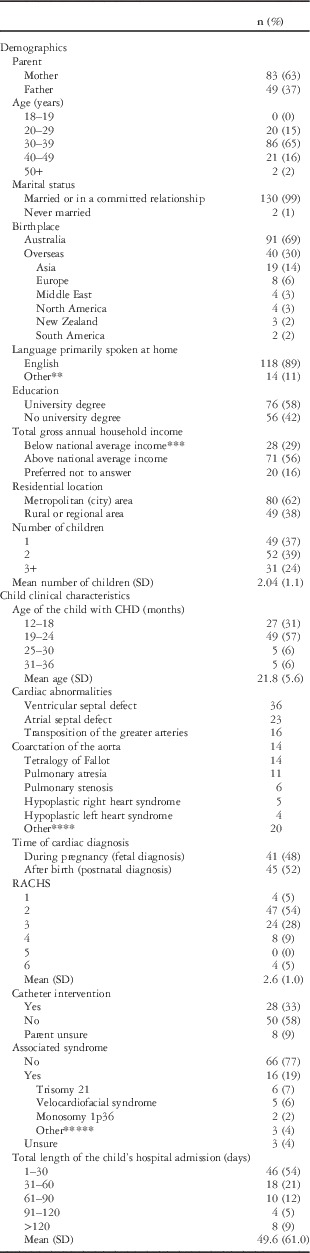
The mean age of the sample was 35.2 years (SD=7.01); 38% of the participants lived in regional or rural New South Wales and 58% had a university degree (Table 1). Approximately half of the parents (48%) had received their child’s diagnosis during pregnancy; the mean age of children with CHD at the time of survey completion was 21.8 months (SD=5.6); and the mean Risk Adjustment for Congenital Heart Surgery score was 2.6 (SD=1.0).
Sample demographics (n=132) and child clinical characteristics (n=86)Footnote *.

RACHS=risk adjustment for congenital heart surgery system
* Sample size is smaller because for 23 children both parents took part in the study
** Other languages spoken included Bengali (n=3), Tagalog (n=3), Arabic (n=2), Cantonese (n=1), Mandarin (n=2), Marathi (n=1), Persian (n=1), Portuguese (n=2), Spanish (n=1), and Vietnamese (n=1)
*** National average total gross annual household income <$1,685 per week
**** Others included patent ductus arteriosus (n=3), total anomalous pulmonary venous return (n=3), anomalous left coronary artery from the pulmonary artery (ALCAPA; n=2), atrioventricular canal defect (n=2), and one of atrioventricular septal defect, major aortopulmonary collateral artery (MAPCA), aortic valve stenosis, bicuspid aortic valve, cardiovascular ring, double-outlet right ventricle, hyperplastic aortic arch, truncus arteriosus, and unilateral absence of the left pulmonary artery
***** Other syndromes included dysplastic kidneys (n=1), Charge syndrome (n=1), and one child’s genetic condition had not yet been diagnosed
Internet use and eHealth literacy
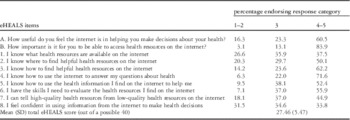
All but one participant owned a computer and had internet access at home. The most common types of internet connection were Asymmetric Digital Subscriber Line (42%), wireless (42%), or cable (12%). The mean frequency of computer use (all purposes) was 4.67 (SD=0.70) out of a total possible score of 5, indicating that most participants used a computer “every day” (77%) or at least “weekly” (15%). The mean frequency of internet use (all purposes) was 4.70 (SD=0.70), indicating use of the internet “every day” (80%) or at least “weekly” (16%). The mean frequency of internet use for health information was 2.25 (SD=1.30), with participants using the internet “rarely” (33%), “monthly” (27%), “two to three times per month” (17%), or “weekly” (16%) for health information. The mean eHealth literacy score for the sample was 27.46 out of a possible 40 (SD=5.47, median: 27.0, with a range from 15 to 40), with no difference in eHealth literacy between mothers and fathers (t=0.51, p=0.61; Table 2).
Distribution and frequency of eHealth Literacy Scale (eHEALS) scores for each of the ten items in the scale.

For items 1–8, response options ranged from 1 “Strongly disagree” to 5 “Strongly agree”
CHD-specific eHealth use
The internet (92%) and paediatric cardiologist (92%) were the most frequently accessed sources of information about CHD, with mothers (96%) more likely than fathers (82%) to use eHealth resources (χ2=8.11, p=0.004) and fathers (61%) more likely than mothers (43%) to seek information from their child’s cardiac surgeon (χ2 =4.22, p=0.04). Other top sources of CHD-related information were general practitioner (57%), paediatrician (56%), support groups (37%), other parents of a child with CHD (36%), research articles (21%), and books (21%).
The mean frequency of internet use for information about CHD was 2.13 (SD=1.04) out of a total possible score of 5, indicating that most participants (59%) used the internet “only for a specific concern or question”. Only 5% of the participants used the internet for information about CHD “weekly” or “every day”.
eHealth resources for CHD were most commonly sought around the time of diagnosis (80%), when parents were concerned about their child’s health (71%), or around the time of cardiac surgery (64%). Less than one-third (29%) of the participants used eHealth as a source of information when their child commenced a new medication. Most participants (94%) started with commercial search engines such as Google, and less than half the sample used support or advocacy group websites (43%), hospital-based websites (30%), or sought health professional advice (22%) when initiating a search. Common search terms included “CHD”, “heart disease”, or the name of their child’s heart abnormality. Only two participants were aware of the Health on the Net’s Code of Conduct (HONCode), three were familiar with TRUSTe, and one participant was aware of Hi-Ethics. Perceived indicators of eHealth resource quality included government or health institution endorsement (86%), use of referencing (72%), regular updating (64%), professional appearance (42%), and limited advertisements (32%). Commonly searched CHD-related topics were general information about their child’s heart condition (88%), long-term outcomes (73%), heart surgery (69%), challenges associated with CHD (59%), aetiology (51%), medications and treatments (46%), latest research findings (38%), support groups (23%), and psychological aspects (20%). One-quarter of the parents had previously shared their or their child’s experience of CHD on a web-based platform.
Perceived benefits and challenges of CHD-related eHealth resources and influence on medical decision making
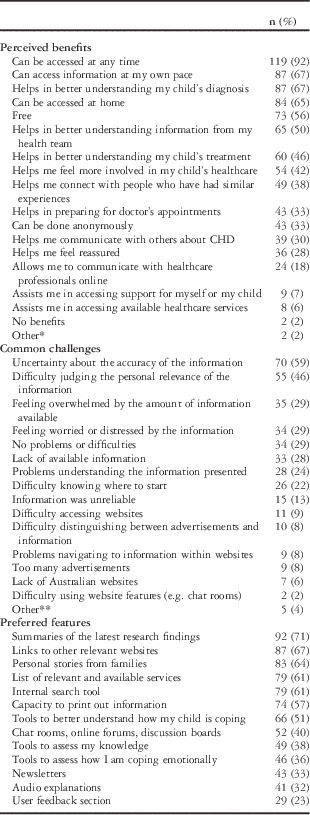
Although most parents (92%) perceived eHealth resources on CHD as “helpful” or “very helpful” (M=3.12, SD=0.54), 29% reported finding it “difficult” or “very difficult” to locate credible information (M=2.24, SD=0.58). Perceived benefits of, and common challenges encountered when using, eHealth resources are shown in Table 3; 56% of the parents reported that decisions regarding their child’s healthcare were influenced, to some extent, by eHealth resources (M=1.87, SD=0.93). This did not differ for mothers and fathers (p=0.94).
Perceived benefits, common challenges, and preferred features of CHD-related eHealth resources.

* Other benefits: parents could search for answers to questions they did not wish to ask (e.g. mortality rates); diagrams helped parents to understand the physiology of the heart
** Other challenges difficulty locating information on the latest research findings, and difficulty finding information on what to expect in the future
Communication about internet use with healthcare providers
Approximately one-third of the participants (30%) could recall their child’s cardiologist or cardiac surgeon initiating a discussion about CHD and eHealth. One-quarter of the participants reported receiving an eHealth recommendation from the doctor, predominately hospital-based websites, and almost all (97%) had accessed the recommended resource. A sizeable proportion (78%) reported initiating conversations with their child’s healthcare team about eHealth, although the frequency varied (44% rarely, 22% sometimes, 12% often, and 1% all the time). Conversations most often occurred with a paediatric cardiologist (63%), general practitioner (45%), cardiac surgeon (40%), nurse (18%), psychologist (7%), or obstetrician (7%). On average, parents felt “moderately comfortable” discussing CHD-related eHealth resources with their child’s healthcare team (M=3.00, SD=1.08), with no difference between mothers and fathers (p=0.32). A small proportion (9%) reported being “not at all comfortable” discussing eHealth findings with healthcare professionals. Barriers to doctor–patient communication included limited consultation time (23%), concern about doctor’s disapproval (18%), forgetting (13%), feeling embarrassed or afraid (9%), or previously being told by the doctor not to use the internet for information about CHD (8%). If an eHealth recommendation was provided by a doctor in the future, all but one participant said that they would “definitely” (90%) or “probably” (9%) use the recommendation.
Parents’ preferences for the content, format, functions, and features of eHealth resources for CHD
Most participants (81%) preferred eHealth resources that used a combination of “words, pictures, and video”. Only 19% preferred “words and pictures”, and one participant preferred “words only”. The three most strongly desired eHealth features were summaries of the latest research findings (71%), links to other relevant websites (67%), and personal stories from families of children with CHD (64%; see Table 3 for full list). Using the space provided in the survey for additional responses, some participants spontaneously suggested the use of basic diagrams and explanations to simplify medical jargon, whereas others expressed a need for more advanced information to accommodate users with a health or science background. In addition, one father identified a need for internet-based video-conferencing for families living in rural or remote regions, and one mother raised the notion of an “online doctor” available to answer parents’ questions.
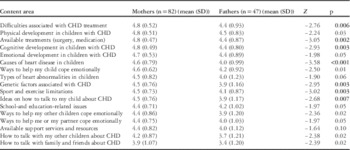
Almost all proffered content areas received a mean importance rating >4.0, indicating very high perceived importance across a broad range of topics (Table 4). Mothers rated the importance of seven out of 17 topics more highly than fathers. Spontaneously offered topics included speech and dental issues, healthcare after hospital discharge, rare forms of CHD, symptoms to look for in undiagnosed babies, and ways to improve a child’s quality of life (e.g. fun activities that do not induce exhaustion). Among all, two-thirds of the participants (67%) endorsed a need for culturally specific, Australian-based eHealth resources.
Perceived importance of eHealth content areas, with response options ranging from 1 (“Not at all important”) to 5 (“Extremely important”).

Bold typeface indicates statistically significant differences (p<0.01)
Discussion
The internet has transformed the quantity and quality of information parents of children with CHD can now access. Almost all Australian mothers and fathers in this study (91%) identified the internet as a source of CHD information – a rate higher than that previously reported in paediatric cardiology 16 , Reference Jenkins, Gauvreau, Newburger, Spray, Moller and Iezzoni 17 and other medical specialties.Reference Roche and Skinner 19 , Reference Wainstein, Sterling-Levis, Baker, Taitz and Brydon 20 Internet searches most frequently occurred during important periods in their child’s healthcare, such as diagnosis and surgery, and the information found in eHealth resources was reported to have influenced medical decision making for 56% of parents, despite a sizeable proportion (29% overall) reporting difficulty obtaining accurate or credible data, including 24% of those whose medical decision making was influenced.
eHealth resources were perceived by parents as facilitating access to information at their own pace and in their own time. Although this was viewed as a major advantage, parents also reported important challenges including problems identifying accurate or relevant information and difficulties managing emotional responses to the information found. These findings highlight challenges commonly described by parents worldwide,Reference Roche and Skinner 19 and may have been compounded in the present study by low use of hospital- (30%) or health professional-recommended (22%) resources. Families would benefit from guidance when navigating the complex landscape of available CHD-related eHealth resources, particularly during times of uncertainty and stress when processing capacities may be compromised.
Consistent with previous studies,Reference Kendall, Sloper, Lewin and Parsons 21 existing resources often did not match participants’ need for information tailored to their child’s condition. A multi-faceted approach to the communication of information via eHealth was strongly endorsed, including the creative combination of text, diagrams, graphics, and video material, as well as features to encourage user engagement and interaction, and up-to-date summaries of research in easy-to-understand language.Reference Hacker and Niederhauser 22 Medical research bodies such as the National Health and Medical Council of Australia recommend use of language set at Grades 5–7 so as to be accessible to most users;Reference D’Alessandro, Kingsley and Johnson-West 23 – 26 however, most eHealth resources are written at Grade 10 level.Reference D’Alessandro, Kingsley and Johnson-West 23 , Reference Geller, Psaros and Kerns 24 , Reference Shedlosky-Shoemaker, Sturm, Saleem and Kelly 27 According to the Institute of Medicine, nearly half of the residents in the United States are unable to navigate the complexities of the healthcare system due to limited English health literacy skills.Reference Nielsen- Bohlman, Panzer, Hamlin and Kindig 28 Use of images and videos can transcend the boundaries of literacyReference Uzark, Rosenthal, Behrendt and Becket 29 and assist users in better understanding medical concepts and treatments. Further, DeMaso et al30 found personal stories effective in improving understanding of CHD, decreasing social isolation, and promoting a more positive outlook among users.
Despite its importance, eHealth literacy, as measured using a validated scale, has not been examined in parents of children with CHD and is rarely assessed in paediatrics. Although over half the sample had completed a university degree (58%), only 38% of parents in this study reported knowing what relevant eHealth resources were available, 45% believed they could distinguish between high- and low-quality resources, and only 34% felt confident using internet-based information to make health decisions. This lack of knowledge, confidence, and skills may have important clinical implications, particularly given the frequency of internet use reported and the proportion of parents who perceived their healthcare decisions to be influenced by eHealth. The mean eHealth Literacy Scale score in the present study (M=27.5, SD=5.5) was comparable with that reported by van der Vaart et alReference van der Vaart, van Deursen, Drossaert, Taal, van Dijk and van de Laar 31 for a community-based sample of Dutch adults (M=27.6, SD=5.9), demonstrating considerable and widespread gaps in awareness of, access to, and communication about internet-based health information. Previous research in other settings has established that brief computer and eHealth educational interventions designed for people with low eHealth literacy can increase eHealth literacy and confidence, irrespective of age, ethnicity, education, and previous internet use.Reference Robinson and Graham 32 These findings have yet to be applied to paediatrics.
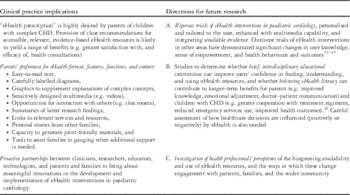
Owing to the cross-sectional study design, the data cannot elucidate the causal direction of associations. It is also impossible to rule out the influence of satisfaction with clinical care, recall bias, or socially desirable responding; however, extensive participant feedback suggests that the influence of these factors is likely to have been minimal. The higher proportion of mothers and parents with a tertiary education (58% present sample, 24% general community 16 ) may limit generalisability of the findings. Despite these limitations, identifying parents’ patterns of belief and behaviour regarding eHealth, and the features parents perceive as most important and useful, can be applied to the design, development, and implementation of new and existing eHealth resources with broad reach and effectiveness (Table 5). The results presented here suggest that healthcare workers involved in caring for children with complex CHD should actively engage with families about eHealth use, recommending high-quality, evidence-based, rigorously evaluated resources. Those involved in eHealth intervention development and implementation should aim to provide resources in a variety of formats, with graded levels of information to meet the needs of as many users as possible.
Implications for clinical practice and future research.

Acknowledgements
Sincere thanks to Claudia Nielson-Jones, BSc Psych (Hons I), from the Discipline of Paediatrics, School of Women’s and Children’s Health, UNSW Medicine, The University of New South Wales and the Heart Centre for Children, and The Sydney Children’s Hospitals Network for administrative support.
Financial Support
Associate Professer Nadine Kasparian is supported by a Career Development Fellowship from the National Health and Medical Research Council of Australia (NHMRC 1049238). This project was also generously supported by the Adolph Basser Trust.
Conflicts of Interest
None.
Ethical Standards
The authors assert that all procedures contributing to this work comply with the ethical standards of the relevant national guidelines on human experimentation (The Australian Code for the Responsible Conduct of Research) and with the Helsinki Declaration of 1975, as revised in 2008, and has been approved by the Sydney Children’s Hospitals Network Human Research Ethics Committee.