1. Introduction
In the aftermath of the end-Permian mass extinction, the Early Triassic period (∼252 to ∼247 Ma) was an interval of delayed biotic recovery both in the oceans and on land (Looy et al. Reference Looy, Brugman, Dilcher and Visscher1999; Payne et al. Reference Payne, Lehrmann, Wei, Orchard, Schrag and Knoll2004; Chen & Benton, Reference Chen and Benton2012; Hochuli et al. Reference Hochuli, Sanson-Barrera, Schneebeli-Hermann and Bucher2016). Episodes of partial recovery during Early Triassic time were cut short by minor marine extinction events in early Griesbachian time, at the Griesbachian–Dienerian boundary and at the Smithian–Spathian boundary (SSB) (Sun et al. Reference Sun, Joachimski, Wignall, Yan, Chen, Jiang, Wang and Lai2012; Romano et al. Reference Romano, Goudemand, Vennemann, Ware, Schneebeli-Hermann, Hochuli, Bruhwiler, Brinkmann and Bucher2013), as well as marked changes in the terrestrial vegetation record (Galfetti et al. Reference Galfetti, Hochuli, Brayard, Bucher, Weissert and Vigran2007b; Hochuli et al. Reference Hochuli, Sanson-Barrera, Schneebeli-Hermann and Bucher2016). These events were most likely linked to extreme global warming, resulting in lethally hot conditions, with tropical sea surface temperatures >35 °C, resulting in widespread euxinia in the oceans (Sun et al. Reference Sun, Joachimski, Wignall, Yan, Chen, Jiang, Wang and Lai2012). Highly fluctuating C-isotope records testify to rapid and large-scale perturbations in the carbon cycle (Payne et al. Reference Payne, Lehrmann, Wei, Orchard, Schrag and Knoll2004). It is suggested that full recovery of the marine ecosystem first occurred during Middle Triassic time (Chen & Benton, Reference Chen and Benton2012).
Similarly, terrestrial plants were severely affected during the end-Permian event, with taxonomic losses but, perhaps more importantly, major restructuring of the terrestrial plant communities (Lindström & McLoughlin, Reference Lindström and McLoughlin2007; Hermann et al. Reference Hermann, Hochuli, Bucher and Roohi2012b; Hochuli et al. Reference Hochuli, Sanson-Barrera, Schneebeli-Hermann and Bucher2016). Recovery on land was originally believed to have been delayed worldwide until early Anisian time (Looy et al. Reference Looy, Brugman, Dilcher and Visscher1999), resulting in a marked global coal gap (Retallack et al. Reference Retallack, Veevers and Morante1996). However, later research has shown that the composition of the terrestrial ecosystem has fluctuated between floras dominated by spore-producing plants and those dominated by gymnosperms (Looy et al. Reference Looy, Brugman, Dilcher and Visscher1999; Schneebeli-Hermann et al. Reference Schneebeli-Hermann, Kürschner, Kerp, Bomfleur, Hochuli, Bucher, Ware and Roohi2015, Reference Schneebeli-Hermann, Hochuli and Bucher2017; Hochuli et al. Reference Hochuli, Sanson-Barrera, Schneebeli-Hermann and Bucher2016).
The late Smithian was one of the hottest intervals during Early Triassic time, with extreme temperatures both in the upper tropical ocean and on land (Sun et al. Reference Sun, Joachimski, Wignall, Yan, Chen, Jiang, Wang and Lai2012). This is reflected by a pronounced negative δ13C excursion (CIE), with a magnitude of ∼6 ‰, in both carbonate and organic material (Payne et al. Reference Payne, Lehrmann, Wei, Orchard, Schrag and Knoll2004; Galfetti et al. Reference Galfetti, Hochuli, Brayard, Bucher, Weissert and Vigran2007b; Tong et al. Reference Tong, Zuo and Chen2007; Horacek et al. Reference Horacek, Koike and Richoz2009; Hermann et al. Reference Hermann, Hochuli, Mehay, Bucher, Bruhwiler, Ware, Hautmann, Roohi, ur-Rehman and Yaseen2011; Clarkson et al. Reference Clarkson, Richoz, Wood, Maurer, Krystyn, McGurty and Astratti2013; Grasby et al. Reference Grasby, Sanei, Beauchamp and Chen2013a,b; Wignall et al. Reference Wignall, Bond, Sun, Grasby, Beauchamp, Joachimski and Blomeier2016; Komatsu et al. Reference Komatsu, Takashima, Shigeta, Maekawa, Tran, Cong, Sakata, Dinh and Takahashi2016). During this Late Smithian Thermal Maximum (LSTM), upper water column temperatures at equatorial latitudes are estimated to have approached 38 °C, with sea surface temperature possibly exceeding 40 °C, as inferred from oxygen isotope ratios of conodont apatite (Sun et al. Reference Sun, Joachimski, Wignall, Yan, Chen, Jiang, Wang and Lai2012). The LSTM is succeeded by a relatively sharp positive C-isotope excursion of similar magnitude at the SSB, which has been attributed to a strong cooling of the tropical sea surface, as oxygen isotopes from conodont apatite indicate an almost 5 °C cooling of the upper water column in the equatorial ocean (Sun et al. Reference Sun, Joachimski, Wignall, Yan, Chen, Jiang, Wang and Lai2012; Romano et al. Reference Romano, Goudemand, Vennemann, Ware, Schneebeli-Hermann, Hochuli, Bruhwiler, Brinkmann and Bucher2013). The SSB is marked by extinctions amongst nektonic organisms, with severe losses amongst conodonts and ammonoids (Orchard, Reference Orchard2007; Brayard et al. Reference Brayard, Bucher, Escarguel, Fluteau, Bourquin and Galfetti2006, Reference Brayard, Escarguel, Bucher and Bruhwiler2009; Stanley, Reference Stanley2009). Faunal losses amongst benthic organisms included many so-called disaster taxa that had proliferated in the aftermath of the end-Permian crisis, e.g. bellerophontid gastropods and bivalves (Kaim & Nutzel, Reference Kaim and Nutzel2011; Sun et al. Reference Sun, Wignall, Joachimski, Bond, Grasby, Sun, Yan, Wang, Chen and Lai2015). Several models have been invoked to explain these major perturbations of the carbon cycle. Payne et al. (Reference Payne, Lehrmann, Wei, Orchard, Schrag and Knoll2004) suggested that the pronounced negative excursion in the Smithian was caused by injection of isotopically light carbon from volcanic activity in the Siberian Traps large igneous province. Such a scenario could explain records indicating global warming and ocean anoxia, followed by enhanced carbon burial resulting in global cooling as reflected in a positive excursion at the SSB (Galfetti et al. Reference Galfetti, Bucher, Ovtcharova, Schaltegger, Brayard, Bruhwiler, Goudemand, Weissert, Hochuli, Cordey and Guodun2007a, Reference Galfetti, Bucher, Martini, Hochuli, Weissert, Crasquin-Soleau, Brayard, Goudemand, Bruehwiler and Guodun2008; Saito et al. Reference Saito, Kaiho, Oba, Takahashi, Chen and Tong2013). This hypothesis is possibly supported by an increase in mercury content and the Hg/TOC (total organic carbon) ratio during the Smithian in the Sverdrup Basin, Arctic Canada, and on Svalbard (Grasby et al. Reference Grasby, Sanei, Beauchamp and Chen2013b, Reference Grasby, Beauchamp, Bond, Wignall and Sanei2016). Payne et al. (Reference Payne, Lehrmann, Wei, Orchard, Schrag and Knoll2004) further found a methane-driven scenario for the highly fluctuating Early Triassic carbon cycle unlikely. They estimated that more than 10000 Gt of methane, five times the amount estimated for the Paleocene–Eocene Thermal Maximum (Dickens et al. Reference Dickens, Oneil, Rea and Owen1995), would have been required to produce the ∼8 ‰ drop over 100 to 500 kyrs from the late Dienerian to Smithian. They instead favoured massive changes in organic carbon burial relative to carbonate carbon, with episodes of extraordinarily high organic carbon burial alternated with intervals with much lower fractionation of organic carbon burial (Payne et al. Reference Payne, Lehrmann, Wei, Orchard, Schrag and Knoll2004). However, other authors have suggested alternative scenarios to the carbon cycle perturbations. Horacek et al. (Reference Horacek, Richoz, Brandner, Krystyn and Spotl2007) argued that the Smithian CIE was caused by an overturn of a previously well-stratified ocean, releasing light dissolved inorganic carbon into the upper water column. Meyer et al. (Reference Meyer, Yu, Jost, Kelley and Payne2011) invoked that increased productivity in the water column generated a steeper surface to deep isotopic gradient, thus leading to more positive δ13Ccarb-values.
The SSB is associated with widespread deposition of organic-rich sediments in China (Chen et al. Reference Chen, Tong and Fraiser2011; Grasby et al. Reference Grasby, Beauchamp, Embry and Sanei2013a; Sun et al. Reference Sun, Wignall, Joachimski, Bond, Grasby, Sun, Yan, Wang, Chen and Lai2015), Japan, Vietnam, Arctic Canada and Far East Russia (Galfetti et al. Reference Galfetti, Bucher, Martini, Hochuli, Weissert, Crasquin-Soleau, Brayard, Goudemand, Bruehwiler and Guodun2008; Shigeta et al. Reference Shigeta, Zakharov, Maeda and Popov2009; Komatsu et al. Reference Komatsu, Naruse, Shigeta, Takashima, Maekawa, Dang, Dinh, Nguyen, Nguyen, Tanaka and Sone2014). However, as noted by Sun et al. (Reference Sun, Wignall, Joachimski, Bond, Grasby, Sun, Yan, Wang, Chen and Lai2015), the temporal correlation between marine anoxia and the C-isotope record is still unresolved. Tethyan records from Iran suggested that peak anoxia developed just prior to the most negative C-isotope values (Horacek et al. Reference Horacek, Richoz, Brandner, Krystyn and Spotl2007). SSB successions from Pakistan recorded anoxia in the uppermost Smithian when the C-isotope record shifted to positive values (Hermann et al. Reference Hermann, Hochuli, Mehay, Bucher, Bruhwiler, Ware, Hautmann, Roohi, ur-Rehman and Yaseen2011; Romano et al. Reference Romano, Goudemand, Vennemann, Ware, Schneebeli-Hermann, Hochuli, Bruhwiler, Brinkmann and Bucher2013). In Spitsbergen anoxic/euxinic conditions prevailed during the LSTM and during most of the early Spathian δ13C maximum (Wignall et al. Reference Wignall, Bond, Sun, Grasby, Beauchamp, Joachimski and Blomeier2016). In records from South China, Meyer et al. (Reference Meyer, Yu, Jost, Kelley and Payne2011), in turn, showed anoxia peaking later when the C-isotopes reached their maximum values. Sun et al. (Reference Sun, Wignall, Joachimski, Bond, Grasby, Sun, Yan, Wang, Chen and Lai2015), on the other hand, recorded anoxia from the late Smithian to the early Spathian in South China, succeeded by a sharp transition to well-oxygenated conditions. They suggested that this shift was triggered by climatic cooling and oxygen increase driven by organic carbon and pyrite burial (Sun et al. Reference Sun, Wignall, Joachimski, Bond, Grasby, Sun, Yan, Wang, Chen and Lai2015). Based on the co-variation between an ∼10–15 ‰ negative shift in δ34S in carbonate-associated sulfate and an ∼4 ‰ positive shift in δ13Ccarb in South China, Zhang et al. (Reference Zhang, Zhao, Chen, Algeo, Li and Cao2015) hypothesized that cooling-driven reinvigoration of oceanic overturning circulation led to stronger up-welling causing mixing of sulfide- and nutrient-rich deep waters into the upper ocean layer at the SSB, thus promoting both enhanced marine productivity and oxidation of advected H2S. They estimated the duration of the Smithian–Spathian cooling event to ∼75–150 kyrs.
Information on changes in the terrestrial vegetation across the SSB have primarily been obtained from palynological records in marine successions in Norway (Galfetti et al. Reference Galfetti, Hochuli, Brayard, Bucher, Weissert and Vigran2007b; Hochuli & Vigran, Reference Hochuli and Vigran2010), Tibet (Schneebeli-Hermann et al. Reference Schneebeli-Hermann, Hochuli, Bucher, Goudemand, Bruhwiler and Galfetti2012) and Pakistan (Hermann et al. Reference Hermann, Hochuli, Bucher and Roohi2012b), and these all show a shift from spore-dominated Smithian assemblages to palynofloras dominated by bisaccate pollen in the Spathian. In addition, biomarker data from South China (Saito et al. Reference Saito, Kaiho, Oba, Takahashi, Chen and Tong2013) also indicate a shift to woody gymnospermous plants around the SSB. In the record from Pakistan, Hermann et al. (Reference Hermann, Hochuli, Bucher and Roohi2012b) only recorded a temporary dominance of gymnosperm vegetation during late Smithian to earliest Spathian times, followed by a return to spore dominance (albeit lower than during the middle Smithian) during Spathian time. Both Hochuli & Vigran (Reference Hochuli, Sanson-Barrera, Schneebeli-Hermann and Bucher2010) and Romano et al. (Reference Romano, Goudemand, Vennemann, Ware, Schneebeli-Hermann, Hochuli, Bruhwiler, Brinkmann and Bucher2013) interpreted the recorded shift from spore-dominating to pollen-dominating floras in late Smithian time as a shift from humid to dry conditions around the SSB.
Here we present new sedimentological, organic C-isotope and palynological records across the SSB from several marine outcrop sections and a drill core from the Wandel Sea Basin (WSB) in North Greenland. The herein investigated successions are constrained by palynology, ammonoid biostratigraphy and δ13Corg chemostratigraphy, and provide an insight into the environmental conditions during Smithian to earliest Anisian times in the northern mid-latitudes.
2. Study area
During Early Triassic time the WSB was located around 45º N, on the northern margin of Pangaea, with the Sverdrup Basin to the west and the palaeo-Barents Sea area and Svalbard to the east and north (Bjerager et al. in press). The WSB formed the northern continuation of the Danmarkshavn Basin offshore Northeast Greenland, and the western continuation of basins in the southern part of the Barents Sea (Bjerager et al. in press). The exposed Triassic succession in the WSB spans a near complete Induan–Norian succession, which is up to 700 m in thickness (Bjerager et al. in press). The Triassic rests unconformably on Upper Permian carbonates and siliciclastic rocks of the Midnatfjeld Formation (Fig. 1) (Håkansson, Reference Håkansson1979), and is erosionally overlain by Upper Jurassic – Lower Cretaceous siliciclastic rocks of the Ladegårdsåen Group. Smithian to lower Anisian strata are well exposed in Peary Land, with sections that crop out at Dunken, Hjulspordalen and also Henry Parish Bjerg. In addition, the interval is encompassed in the fully cored Dunken-2 borehole (Fig. 1). This paper focuses on the Hjulspordalen and Dunken-2 successions.
Map of North Greenland, Peary Land and localities mentioned in the text: (1) Henry Parish W; (2) Henry Parish Bjerg S; (3) Dunken Main; (4) Dunken-X; (5) Dunken-2 core; (6) Storekløft; (7) Hjulspordalen.

3. Methods
3.a. Total organic carbon and organic C-isotopes
The total organic carbon (TOC) of the samples was measured in two ways. TOC was determined by combustion using a LECO CS-200 induction furnace after elimination of carbonate-bonded carbon by prolonged HCl-treatment at 65 °C in two stages, followed by rinsing and drying at 90 °C. Initial aliquot size was 300 mg, and samples were ground to <250 micron prior to analysis. TOC was also determined as an integral part of stable carbon isotopic analysis, where an estimation of the TOC was also carried out prior to the organic C-isotope analysis. The samples were then ground where necessary to a fine powder and then acidified with 1M hydrochloric acid and left overnight to allow inorganic carbon to be liberated as CO2. The samples were then neutralized by repetitively washing with distilled water and subsequently oven dried at 60 °C prior to δ13C isotope analysis. The total ion beam data from the organic C-isotope analysis was used to determine the carbon content of the acid-washed samples. This data along with the weight loss data from the acid washing was used to calculate the organic carbon content (TOC) for each sample. The results of the two methods are in accordance in the Dunken-2 section, albeit with the LECO CS-200 method displaying somewhat lower values throughout (Fig. 2). However, for the Hjulspordalen section the results of the two methods vary significantly within a part of the section, with the LECO CS-200 method displaying generally higher TOC values (Fig. 3).
Lithology, depositional setting, chemo- (δ13Corg) and biostratigraphy (palynology), as well as palynofloral changes, of the Smithian–lower Anisian succession of the Dunken-2 core.

Litho-, chemo- (δ13Corg) and biostratigraphy (palynology and ammonoids), as well as palynofloral changes, of the Smithian–lower Anisian succession at Hjulspordalen. Legend can be found in Figure 2.

The C-isotope analyses were performed using an elemental analyser – isotope ratio mass spectrometer (EA-IRMS; Europa Scientific 20-20 IRMS) at ISO-Analytical Limited, UK. The reference material used was IA-R001 (wheat flour, δ13CV-PDB = −26.43 ‰). For quality control purposes check samples of IA-R001, IA-R005 (beet sugar, δ13CV-PDB = −26.03 ‰) and IA-R006 (cane sugar, δ13CV-PDB = −11.64 ‰) were analysed during batch analysis of the samples. IA-R001, IA-R005 and IA-R006 are calibrated against and traceable to IAEA-CH-6 (sucrose, δ13CV-PDB = −10.43 ‰). IAEA-CH-6 is an inter-laboratory comparison standard distributed by the International Atomic Energy Agency (IAEA), Vienna. Tin capsules containing sample or reference material were loaded into an auto-sampler and dropped in sequence into a furnace held at 1000 °C and combusted in an oxygen-rich environment, raising the temperature in the region of the sample to ∼1700 °C. The gases produced on combustion were swept in a helium stream over a combustion catalyst (Cr2O3), with copper oxide wires to oxidize hydrocarbons and silver wool to remove sulfur and halides. The resultant gases, N2, NOx, H2O, O2 and CO2, were swept through a reduction stage of pure copper wires held at 600 °C. This step removed O2 and converted NOx species to N2. A magnesium perchlorate chemical trap removed water. Carbon dioxide was separated from nitrogen by a packed column gas chromatograph held at an isothermal temperature of 100 °C. The resultant CO2 chromatographic peak entered the ion source of the EA-IRMS where it was ionized and accelerated. Gas species of different mass were separated in a magnetic field then simultaneously measured using a Faraday cup collector array to measure the isotopomers of CO2 at m/z 44, 45 and 46. Both references and samples were converted and analysed in this manner. The analysis proceeded in a batch process, whereby a reference is analysed followed by a number of samples and then another reference.
3.b. Palynology
The samples were prepared at the Geological Survey of Denmark and Greenland using standard palynological methods involving digestion of 20 g of sediment in hydrochloric and hydrofluoric acid, mild oxidation and filtering of the organic residues through a 11 μm mesh filter. Two to three strew slides were mounted per sample, using glycerine gel as a mounting medium. The quantitative palynological analysis was carried out on one or more strew slides from each sample using a Leica DM 2000 transmitted light microscope fitted with a differential interference contrast system. During counting, the strew slides were scanned systematically using a ×40 lens (506097, Leica) along transverse transects, until the entire slide was scanned or until 300 specimens or more were counted. Higher magnification was used when necessary for identification of specific taxa. The remaining strew slides from each sample were systematically scanned in order to register taxa not encountered during the counting. For analysis of the palynofloral changes, the spores and pollen were grouped in three major groups: spores, non-saccate pollen and bisaccate pollen.
4. Results
4.a. Stratigraphic framework
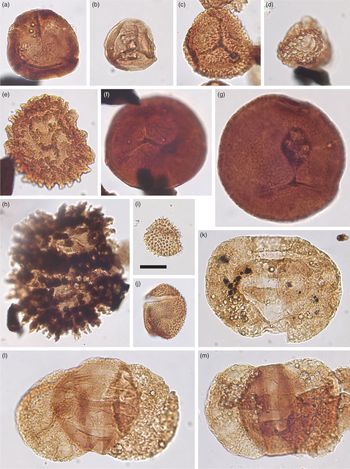
Strata exposed at the Dunken and Hjulspordalen outcrop sections (Figs 2, 3) are constrained by the presence of ammonoids, including Arctoceras blomstrandi (Fig. 4), to the middle to late Smithian Romunderi–Tardus zones (Tozer, Reference Tozer1994). The Dunken section samples were found to be palynologically barren, but the Smithian strata at Hjulspordalen contain a diverse and fairly well-preserved palynoflora dominated by spores, mainly Densoisporites spp., Lundbladispora spp. and the very characteristic Punctatisporites fungosus (Fig. 5), enabling correlation with the Naumovaspora striata Composite Assemblage Zone of Vigran et al. (Reference Vigran, Mangerud, Mørk, Worsley and Hochuli2014). The palynoflora from the lowermost part of the Dunken-2 core is very poorly preserved; however, the presence of abundant Punctatisporites fungosus indicates a Smithian age. The last occurrence of Punctatisporites fungosus occurs at 129.92 m in the Dunken-2 core, and at 29.50 m in the Hjulspordalen section, and serves as a good marker for the top of the Smithian in Peary Land (Figs 2, 3). It should be noted that P. fungosus was sporadically registered in Spathian and Anisian strata by Vigran et al. (Reference Vigran, Mangerud, Mørk, Worsley and Hochuli2014), but was only found to be abundant in the Naumovaspora striata Composite Assemblage Zone.
Ammonoids from the Smithian–lower Anisian of Peary Land. (a–c) Arctoceras blomstrandi (Lindstroem), MGUH 33328–30 all from GEUS 539291b. (d) Radioceras?, MGUH 33331 from GEUS 543701. (e) Lenotropites caurus (McLearn), MGUH 33332 from 542733. (f) Lenotropites tardus McLearn, MGUH 33333 from GEUS 542740. (g) Groenlandites cf. nielseni Kummel, MGUH 33334 from GEUS 519202. (h) Pearylandites aff. troelseni Kummel, MGUH 33335 from GEUS 519202.

Selected spores and pollen from (a–g, i–m) Hjulspordalen and (h) Dunken-2. Taxa names are followed by sample and slide number and England Finder coordinates. (a) Densoisporites playfordii, 537288:5, M52/3; (b) Densoisporites nejburgii, 537280:5, E44/3; (c) Lundbladispora willmottii, 537288:5, V53/1; (d) Rewanispora foveolata, 519201:4, J56/4; (e) Pechorosporites disertus, 537288:5, M50/4; (f) Punctatisporites fungosus, 537288:5, Z45/2; (g) Punctatisporites fungosus, 537280:5, F43/3; (h) Jerseyiaspora punctispinosa, dyad, Dunken-2 44.65 m, L43/2; (i) Anapiculatisporites spiniger, 537296:3, G27/3; (j) Eresinia spinellata, 537296:3, G44/3; (k) Lunatisporites pellucidus, 537288:5, V35/2; (l) Protohaploxypinus samoilovichii, 537288:5, U42/2; (m) Lunatisporites noviaulensis, 537288:5, F19/4. Scale bar in (i) is 20 μm and applies to all photographs.

The SSB is placed at the top of the Naumovaspora striata Composite Assemblage Zone of Vigran et al. (Reference Vigran, Mangerud, Mørk, Worsley and Hochuli2014), which is located between 129.92 and 127.07 m in the Dunken-2 core. However, at Hjulspordalen the topmost part of the Smithian and lowermost part of the Spathian is probably missing (Fig. 3). Palynological assemblages assigned to the early Spathian Pechorosporites disertus Composite Assemblage Zone of Vigran et al. (Reference Vigran, Mangerud, Mørk, Worsley and Hochuli2014) were identified in Hjulspordalen and in the Dunken-2 core. The palynofloras from Hjulspordalen are fairly well preserved, while those from Dunken-2 are poorly preserved. In Dunken-2, high abundances of unidentifiable palynomorphs also characterize the palynoflora in the lowermost Spathian, but decrease upsection. The terrestrial palynoflora differs from the underlying Smithian one, in being dominated by bisaccate pollen instead of spores. Taeniate bisaccate pollen, mainly Lunatisporites spp. and Protohaploxypinus samoilovichii, are abundant (Fig. 5). The characteristic spore Rewanispora foveolata is also common within this interval (Fig. 5). In the Dunken-2 core the Pechorosporites disertus Composite Assemblage Zone can be recognized up to 83.61 m where Cyclotriletes oligogranifer is registered for the first time, indicating assignment to the late Spathian Jerseyiaspora punctispinosa Composite Assemblage Zone of Vigran et al. (Reference Vigran, Mangerud, Mørk, Worsley and Hochuli2014), although the nominate taxon is first registered at 49.53 m (Fig. 2). The first occurrences of Anapiculatisporites spiniger and Illinites chitonoides occur at 35.23 m in the Dunken-2 core, marking the lower boundary of the Anapiculatisporites spiniger Composite Assemblage Zone of Vigran et al. (Reference Vigran, Mangerud, Mørk, Worsley and Hochuli2014).
Palynofloras indicative of the early Anisian Anapiculatisporites spiniger Composite Assemblage Zone have also been recognized in the Dunken-2B outcrop section, in the lowermost part of the Dunken-X outcrop section, in the lowermost part of the Storekløft-3 succession, at Henry Parish Bjerg W, Henry Parish Bjerg S and in two samples from Hjulspordalen (Fig. 3). At Storekløft-3 and Hjulspordalen this age assignment is further confirmed by the presence of ammonoids assigned to the early Anisian Caurus Zone of Tozer (Reference Tozer1994) (Fig. 4).
4.b. Sedimentology and depositional evolution
The Smithian–lower Anisian sedimentary succession in Peary Land forms an overall shallowing-upward succession from offshore mudstones in the Smithian to upper shoreface sandstones in the lower Anisian, with several internal transgressive–regressive trends recorded in the Dunken-2 core (Fig. 2). Bioturbation intensity in the core was assessed using the semi-quantitative six-point ichnofabric index (II) scheme of Droser & Bottjer (Reference Droser and Bottjer1986) and this is shown on Figure 2.
4.b.1. Smithian
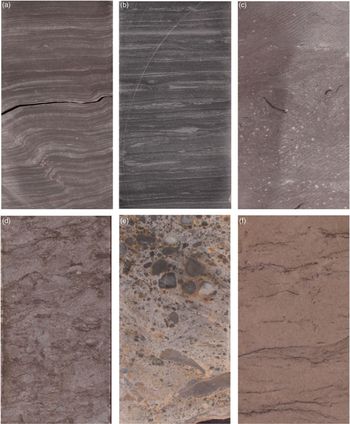
The Smithian mudstones are dark grey and laminated and contain frequent soft-sediment deformations, e.g. slump structures and contorted bedding (Fig. 6a). They are commonly without trace fossils (bioturbation intensity 1; Fig. 6a); but occasionally Planolites, Chondrites and spreite structures that may represent Zoophycos occur (Fig. 6b). Sand laminae and sand lenses with sharp boundaries increase in frequency upsection. Pyrite is also present. An erosional pebble lag, a few centimetres thick, is present in the lowermost part of the core. The mudstones are interpreted as offshore deposits on a gently sloping seafloor with frequent deposition of thin storm sand laminae or distal turbidites. The pebble lag probably represents an erosional transgressive lag, and the succeeding fine planar laminated mudstones represent a maximum flooding zone in the Smithian.
Dunken-2 core photos, core width c. 42 mm: (a) laminated mudstone with sand laminae, deformed bedding in the lower part (depth 140.2 m); (b) laminated mudstone with thin sandstone laminae and minor amounts of trace fossils of Chondrites and compressed Planolites (depth 132.3 m); (c) biomottled sandy mudstone with dispersed black and white bioclasts (depth 119.3 m); (d) intensely biomottled heterolith, sandstone dominated (depth 89.55 m); (e) pebbly sandstone overlain by pebble conglomerate, clasts comprise mainly quartzite and chert (depth 40.54 m); (f) homogeneous sandstone with common stylolites (depth 19.45 m).

4.b.2. The Smithian–Spathian boundary (SSB) interval
Just below the palynologically defined SSB interval, the bioturbation index increases from 1 to 3 in the core. A 1.2 m thick erosional and intensely biomottled sandstone bed (bioturbation index 4), with a thin coarse-grained lag at the base, occurs at 128.9 m. The biomottled sandstone contains common Planolites and Rhizocorallium and is interpreted as a regressive unit in a lower shoreface setting with a sequence boundary at the base. The equivalent interval in the Hjulspordalen section comprises shallow-marine sandstones. The biomottled sandstone is overlain by dark grey to grey, moderately bioturbated, sandy mudstone (Fig. 6c), with thin fine-grained sandstone beds and lamina. Trace fossils include Chondrites and Rhizocorallium, characteristic of the Cruziana ichnofacies, which together with the sedimentology indicate an offshore transition zone with a frequent influx of tempestites.
4.b.3. Lower to middle Spathian
The Dunken-2 core records a nearly 100 m thick Spathian interval of alternating units of massive to faintly bedded sandstones, biomottled sandstones, heteroliths and mudstones that were deposited in environments fluctuating between offshore transition and lower shoreface (Figs 2, 6d). Massive to faintly bedded fine-grained sandstones occur as distinct beds, 10 cm to about 1 m thick, interbedded with mudstones. The sandstones commonly show planar bedding, wavy bedding or ripple lamination in the top part, occasionally with a weakly to moderately biomottled top draped by mudstone. The facies occur in the intervals 108–97 m and 53–41 m, and are interpreted as mainly high-density gravity flows, with occasional low-density flows in the top part.
Biomottled sandstones, muddy sandstones and sandstone-dominated heteroliths compose the main sandstone-dominated facies types in the interval and are interbedded with mudstones. Beds vary between a few centimetres and up to 3 m in thickness, with occasionally wavy bedding and ripple lamination visible, and individual beds are commonly draped by mudstones. Water escape structures and slumping are rarely observed. The degree of biomottling varies mainly between moderate and intense, and diagnostic trace fossils include Thalassinoides, Planolites, Chondrites, Rhizocorallium and Scolicia. The sandstone distribution is dominant in the intervals 114–105 m, 102–97 m, 94–85 m, 79–71 m and 57–41 m. The sandstones are interpreted as having been deposited by gravity flows and storm beds in a lower shoreface to offshore transition setting with an intense burrowing activity in oxic seafloor conditions. The bioturbation intensity peaks around 55 m and 20 m (bioturbation intensity 5) (Fig. 2).
Mudstone-dominated heteroliths and mudstones compose units of centimetres to several metres in scale. The muddy sediments are generally moderate to intensely biomottled with visible trace fossils dominated by Chondrites and common to abundant Rhizocorallium, Thalassinoides and Planolites. Abundant thin sandstone beds, laminae and streaks are present showing faint plane bedding, wavy bedding and occasionally ripple lamination. This facies is mainly distributed in the intervals 105–102 m, 97–94 m, 85–79 m and 70–57 m, and is interpreted as having been deposited from suspension in an oxygenated offshore transition environment allowing a diverse and intense biomottling. The thin sandstone beds are interpreted as having been deposited during storms and as low-density gravity flows. An erosive pebble conglomerate, 2 cm thick, occurs at 94 m. It is clast supported with rounded clasts and a muddy sand matrix and common pyrite. It is interpreted as an erosional transgressive lag. Mudstones, plane and wavy bedded, with thin sandstone laminae compose minor parts of the interval. The facies may have a weak biomottled fabric of Chondrites, Planolites and Thalassinoides. The facies occur predominantly in the intervals 70–62 m, 50–49 m and 45–42 m. The mudstones are interpreted as having been deposited from suspension in a distal offshore transition environment.
4.b.4. Upper Spathian
A prominent pebble conglomerate, 20 cm thick, with common clasts of chert, mudstones and sandstones occurs at 40.54 m (Fig. 6e). It is overlain by a 3.3 m thick fining upwards interval of coarse-grained to fine-grained sandstones with planar, wavy and low-angle ripple laminations and common mud drapes, and a mudstone-dominated heterolith, with faint planar and wavy bedding in the top. The lower part of the interval from 41–37 m is interpreted as having been deposited in a shallow-marine wave- and current-influenced environment. The mudstone-dominated heteroliths are interpreted as having been deposited in an offshore transition environment.
4.b.5. Lower Anisian
The lower part of the Anisian is recorded in the Dunken-2 core, and in the outcrop section Dunken-2B adjacent and stratigraphically above the cored interval (Fig. 2). A regressive pebbly lag deposit marks the base of the overlying interval, 37–20 m, which consists of sandstone-dominated heteroliths. The interval shows wavy and indistinct bedding in the lower parts and an increasing degree of biomottling upwards. It is topped by a homogeneous bed, 20 cm thick, which in turn is overlain by a burrowed horizon about 40 cm thick. The biomottled sandstone-dominated heterolith is interpreted as having been deposited in a lower shoreface environment. The overlying succession is represented by quartz-dominated sandstones with common stylolites, and only minor biomottling (Fig. 6f). Occasionally, planar bedding or low-angle cross-bedding are observed. Thin muddy beds are recorded in the upper part of the core. This interval is interpreted as having been deposited in lower–upper shoreface environments.
4.c. TOC and δ13Corg
The TOC and organic C-isotope data analysed herein are shown in Table 1. The TOC values of the Dunken-2 core are generally low, <0.4 %, as indicated by both TOC techniques (Figs 2, 3). In Hjulspordalen there is some divergence between TOC values determined by the different methods. Generally TOC values are below 1 wt %, but the LECO CS-200 data are generally higher within the Smithian part of the succession (up to 2.27 wt %). TOC determined as part of stable isotopic analysis yielded very low values compared to values yielded by dedicated TOC analysis, which shows higher and more scattered values. The difference may possibly be attributed to sample size and representativity. Samples with low and unevenly distributed contents of organic carbon are commonly susceptible to representativity problems when the aliquot size is very small. Except for the section mentioned, TOC data from the two different methods agree very well.
TOC and organic C-isotope values of the samples from the Hjulspordalen and Dunken-2/2B successions

The Smithian C-isotope records exhibit relatively consistent negative values between −29.69 ‰ and −30.49 ‰ (Figs 2, 3). The Dunken Main succession exhibits similar negative organic C-isotope values, reaching a minimum value of −31.16 ‰. In addition, similar negative organic C-isotope values were retrieved from the lowermost part of the Dunken-2 core, with values varying between −31.06 ‰ and 29.02 ‰ marking the top of the Smithian negative excursion. This is succeeded by an interval with consistently more positive values, −25.40 ‰ to −24.70 ‰ in the lower Spathian, followed by increasingly more negative values, culminating at −29.90 ‰ in the upper Spathian. In the Hjulspordalen record, C-isotope values around −26 ‰ within the Pechorosporites disertus Zone are correlated with the onset of the middle–upper Spathian negative trend in the Dunken-2 record (Figs 2, 3). In the lowermost Anisian the organic C-isotope curve exhibits a return to less depleted values, up to −26.40 ‰. A sample from the top of the Dunken-2 core shows a value of −28.66 ‰ (Fig. 2). Similarly, a value of −28.38 ‰ is registered in the early Anisian Caurus ammonite Zone at Hjulspordalen (Fig. 3).
4.d. Palynofloral changes
The marine versus terrestrial palynology shows similar trends in the two records from North Greenland. Marine phytoplankton, primarily Michrystridium and Lophosphaeridium, normally compose less than 10 % of the total palynoflora in the Smithian. From the lower Spathian and upsection the relative abundance of marine phytoplankton shows a general increasing trend, but with strong fluctuations. In the upper Spathian marine phytoplankton constitute up to 50 % of the total assemblage. The generally lower abundances of marine phytoplankton in the Hjulspordalen succession indicate a more proximal position for this locality. The relative abundance of unidentifiable palynomorphs is high around the SSB, reaching a maximum abundance of >85 % in the uppermost Smithian of the Dunken-2 core.
The late Smithian terrestrial palynoflora is totally dominated by spores in both records: up to 80 % in the Dunken-2 core and around 90 % at Hjulspordalen. Cavate lycophyte spores, primarily Densoisporites nejburgii and Lundbladispora spp. are dominant, and the fern spore Punctatisporites fungosus is abundant. Other fern spores include Dictyophyllidites mortoni and Punctatisporites globosus, but these are never abundant. In the Dunken-2 core, the palynoflora changes gradually across the SBB, with increased amounts of unidentifiable palynomorphs due to poor preservation in the uppermost Smithian. Contemporaneous to this change in organic matter preservation in the uppermost Smithian, there is also a gradual increase in the relative abundance of bisaccate pollen, which continues across the SSB. In the Dunken-2 record, a gradual increase in bisaccate pollen commenced in the uppermost Smithian, prior to the SSB (Fig. 2). The gradual increase in bisaccate pollen continued in the lowermost Spathian reaching abundances of ∼90–95 % in the lower Spathian (Fig. 2). Bisaccates are represented by corystosperm pollen assigned to Alisporites spp. and Falcisporites spp., and conifer pollen Lunatisporites pellucidus, L. noviaulensis and Protohaploxypinus samoilovichii. From the middle Spathian to the upper Spathian there is a relative increase in non-saccate, primarily monosulcate pollen of ginkgoalean or cycadalean affinity in the Dunken-2 record, with a subsequent relative decrease in bisaccate pollen, while the amount of spores remains relatively stable throughout the Spathian–lower Anisian. In the lowermost Anisian, non-saccate pollen decrease again abruptly and become virtually absent in the lower Anisian (Fig. 2). Although only sporadic spore-pollen assemblages are recorded from the lower Spathian and lower Anisian at Hjulspordalen, these appear to corroborate the changes recorded in the Dunken-2 core (Figs 2, 3).
5. Discussion
5.a. Densoisporites nejburgii and climate interpretations
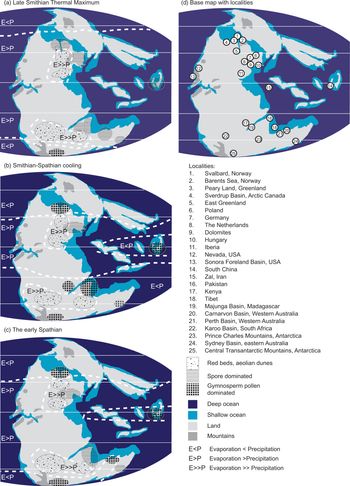
In NW Europe and elsewhere, Smithian palynofloras are dominated by Densoisporites nejburgii (Kürschner & Herngreen, Reference Kürschner, Herngreen and Lucas2010), a spore known to have been produced by pleuromeiacean lycophytes (Balme, Reference Balme1995). The palaeoecological preferences of the lycopsid Pleuromeia, described as a succulent quillwort by Grauvogel-Stamm (Reference Grauvogel-Stamm, Hauschke and Wilde1999), is not entirely clear. Species of Pleuromeia are known to have produced two different types of spores: the trilete cavate spore D. nejburgii and monolete cavate spores assigned to Aratrisporites spp. (Balme, Reference Balme1995). Anatomical features of the Pleuromeiaceae indicate that at least some species were halophytes (salinity tolerant) that inhabited coastal areas (Retallack, Reference Retallack1975). This seems to be supported by the fact that the Pleuromeiaceae also produced spores assigned to the form genus Aratrisporites, which are especially abundant in Lower Triassic shallow-marine strata (Balme, Reference Balme1995). An abundance of D. nejburgii together with an acme of acritarchs in sediments deposited during the Smithian transgression in Germany, Poland and the Dolomites further seems to corroborate a coastal preference for the Pleuromeiaceae (Schulz, Reference Schulz1964; Visscher, Reference Visscher1974; Orlowska-Zwolińska, Reference Orlowska-Zwolińska1984; Fijałkowska, Reference Fijałkowska1994; Fijałkowska-Mader, Reference Fijałkowska-Mader1999; Kürschner & Herngreen, Reference Kürschner, Herngreen and Lucas2010). Several authors have attributed D. nejburgii to xerophytic (dry-tolerant) floral elements, stating that D. nejburgii is more abundant in arid and semi-arid environments in especially low latitudes (Galfetti et al. Reference Galfetti, Hochuli, Brayard, Bucher, Weissert and Vigran2007b; Hochuli & Vigran, Reference Hochuli and Vigran2010). In general, lycopsids are considered to be hygrophytic plants, but there are examples of lycopsids that are extremely desiccation tolerant, e.g. Selaginella lepidophylla of the Selaginellaceae, which can survive prolonged drought events retaining only <10 % of its water content (VanBuren et al. Reference VanBuren, Wai, Ou, Pardo, Bryant, Jiang, Mockler, Edger and Michael2018). Hence, it is possible that the Pleuromeia that produced D. nejburgii spores was in fact xerophytic compared to many other lycopsids. Here, we use the relative abundance of D. nejburgii in palynofloras as an indicator of at least seasonally dry conditions, and complement this with other palaeoclimatic information from the Smithian to the Anisian (Table 2). The resulting interpretations for the LSTM, the Smithian–Spathian cooling and the early Spathian period, respectively, are plotted on palaeogeographic maps in Figure 8.
Palaeogeographical maps of Pangaea showing dominant vegetation as inferred from previous published palynological and palaeobotanical records and our new data from North Greenland, for (a) the Late Smithian Thermal maximum; (b) the Smithian–Spathian cooling interval; and (c) the early Spathian C-isotope maximum. The palaeomap reconstructions are modified from Schneebeli-Hermann et al. (Reference Schneebeli-Hermann, Kürschner, Kerp, Bomfleur, Hochuli, Bucher, Ware and Roohi2015). Palynological, palaeobotanical and sedimentological references can be found in the main text, and many are listed in Table 2.

Summary of terrestrial climate indications from the Smithian–lower Anisian

After: 1 – Galfetti et al. (Reference Galfetti, Hochuli, Brayard, Bucher, Weissert and Vigran2007b); 2 – this work; 3 – Clemmensen (Reference Clemmensen1980); 4 – Van der Zwan & Spaak (Reference Van der Zwan and Spaak1992); 5 – Fijałkowska (Reference Fijałkowska1994); Fijałkowska-Mader (Reference Fijałkowska-Mader1999); 6 – Orlowska-Zwolińska (Reference Orlowska-Zwolińska1984); 7 – Kürschner & Herngreen (Reference Kürschner, Herngreen and Lucas2010); 8 – Looy et al. (Reference Looy, Brugman, Dilcher and Visscher1999); 9– Borruel-Abadia et al. (Reference Borruel-Abadia, Lopez-Gomez, De la Horra, Galan-Abellan, Barrenechea, Arche, Ronchi, Gretter and Marzo2015); 10 – Saito et al. (Reference Saito, Kaiho, Oba, Takahashi, Chen and Tong2013); 11 – Hermann et al. (Reference Hermann, Hochuli, Bucher and Roohi2012b); 12 – Schneebeli-Hermann et al. (Reference Schneebeli-Hermann, Kürschner, Kerp, Bomfleur, Hochuli, Bucher, Ware and Roohi2015); 13 – Hankel (Reference Hankel1991); 14 – Hankel (Reference Hankel1993); 15 – Balme (Reference Balme1963); 16 – Dolby & Balme (Reference Dolby and Balme1976); 17 – Haig et al. (Reference Haig, Martin, Mory, McLoughlin, Backhouse, Berrell, Kear, Hall, Foster, Shi and Bevan2015); 18 – McLoughlin et al. (Reference McLoughlin, Lindström and Drinnan1997); 19 – Lindström & McLoughlin (Reference Lindström and McLoughlin2007); 20 – Fielding et al. (Reference Fielding, Frank, McLoughlin, Vajda, Mays, Tevyaw, Winguth, Winguth, Nicoll, Bocking and Crowley2019); 21 – Escapa et al. (Reference Escapa, Taylor, Cuneo, Bomfleur, Bergene, Serbet and Taylor2011); 22 – Kustatscher et al. (Reference Kustatscher, Franz, Heunisch, Reich and Wappler2014).
5.b. The Late Smithian Thermal Maximum
By comparing the Early Triassic δ18Oapatite-isotope record with temperature tolerance of animals and plants, Sun et al. (Reference Sun, Joachimski, Wignall, Yan, Chen, Jiang, Wang and Lai2012) came to the conclusion that equatorial temperatures during late Smithian time reached extreme values of up to 38 °C in the upper water column, with surface waters perhaps reaching 40 °C. The extreme heat in equatorial regions is believed to have led to the loss of calcareous algae, decreased body-size in marine invertebrates and to a near-absence of fishes in these areas (Sun et al. Reference Sun, Joachimski, Wignall, Yan, Chen, Jiang, Wang and Lai2012). A later study has recorded actinopterygian predator fishes of the genera Birgeria and Saurichthys in LSTM strata in Nevada at ∼20° N, indicating that at least some low latitudinal areas were inhabitable (Romano et al. Reference Romano, Jenks, Jattiot, Scheyer, Bylund and Bucher2017).
In northern middle latitudes, such as North Greenland, Spitsbergen and the Barents Sea area, the presence of ammonoids indicates that the upper water column was, at least at times, habitable during the LSTM (this study and Vigran et al. Reference Vigran, Bugge, Mangerud, Weitschat and Mørk1998, Reference Vigran, Mangerud, Mørk, Worsley and Hochuli2014; Galfetti et al. Reference Galfetti, Hochuli, Brayard, Bucher, Weissert and Vigran2007b). However, the general lack of bioturbation in the laminated Smithian beds in North Greenland, with only rare occurrences of Planolites and possible Zoophycos at some levels, indicates that bottom conditions were unfavourable to benthic organisms during the LSTM. Bioturbation appears restricted to beds interpreted as storm deposits. The presence of pyrite may indicate anoxic or euxinic conditions, but the very low TOC values (0.2–0.3 wt %) suggest limited production of organic material as well as limited transport of organic matter to the basin and subsequently limited burial of organic matter. Interestingly, phytoplankton abundance (acritarchs and prasinophytes) is also very low, generally around 10 % or less. In Spitsbergen, storm beds are rare in LSTM strata (Wignall et al. Reference Wignall, Bond, Sun, Grasby, Beauchamp, Joachimski and Blomeier2016). The upper Smithian Mineral Mountains strata in Utah contain frequent storm-induced deposits in an upper offshore setting, where bioturbation appears to be restricted to these storm beds (Thomazo et al. Reference Thomazo, Brayard, Elmeknassi, Vennin, Olivier, Caravaca, Escarguel, Fara, Bylund, Jenks, Stephen, Killingsworth, Sansjofre and Cartigny2019).
The hot temperatures on land during the LSTM are believed to have led to a diversity minimum amongst vertebrates and to the extirpation of Lystrosaurus (Fröbisch et al. Reference Fröbisch, Angielczyk and Sidor2010), and widespread decline in gymnosperm vegetation (Sun et al. Reference Sun, Joachimski, Wignall, Yan, Chen, Jiang, Wang and Lai2012). Extreme temperatures over land, in excess of 35 °C, favouring photorespiration over photosynthesis, was suggested to have driven most terrestrial plants out of the equatorial areas (Sun et al. Reference Sun, Joachimski, Wignall, Yan, Chen, Jiang, Wang and Lai2012).
During Early Triassic time terrestrial red beds were widespread, indicating at least seasonal arid to semi-arid conditions prevailed in these areas (Table 2; Fig. 8a). Close to the equator in the Northern Hemisphere, sedimentary LSTM successions in Iberia between 10° and 14° N consist of conglomerates and aeolian sand dunes with rare occurrences of unconfined flash flood beds, testifying to arid conditions in near-equatorial areas (Borruel-Abadia et al. Reference Borruel-Abadia, Lopez-Gomez, De la Horra, Galan-Abellan, Barrenechea, Arche, Ronchi, Gretter and Marzo2015). Arid to semi-arid conditions also prevailed in large parts of the Central European Basin at 20–30° N, and East Greenland at 30–40° N (Clemmensen, Reference Clemmensen1980; Preto et al. Reference Preto, Kustatscher and Wignall2010; Kustatscher et al. Reference Kustatscher, Franz, Heunisch, Reich and Wappler2014; Radley & Coram, Reference Radley and Coram2016). In the Southern Hemisphere, red beds and arid to semi-arid conditions have been reported from Antarctica at 60° S, India at 45–60° S and South Africa at 40–60° S (Casshyap, Reference Casshyap, Laskar and Rao1979; McLoughlin et al. Reference McLoughlin, Lindström and Drinnan1997; Neveling, Reference Neveling2004; Lindström & McLoughlin, Reference Lindström and McLoughlin2007). Both sedimentological and ichnological data suggest that the Smithian of South Africa was characterized by prolonged intervals of drought alternated with brief periods of floods (Bordy & Krummeck, Reference Bordy and Krummeck2016). The evapotranspiration rate is believed to have greatly outpaced the rate of precipitation, and the fluvial systems may have been non-perennial (Neveling, Reference Neveling2004).
In the north, in Peary Land, the xerophytic lycopsid spore Densoisporites nejburgii is only abundant in the Smithian, where it constitutes at least ∼30 % of the spore-pollen flora in Dunken-2 and 15–35 % at Hjulspordalen, while bisaccate pollen constitute ∼20 % and ∼20–30 % at these localities, respectively (Figs 2, 3). A similar pattern was recorded in the Barents Sea where Smithian assemblages are composed of between 80 and 90 % spores, and D. nejburgii also constitutes up to 30 % of the palynoflora (Galfetti et al. Reference Galfetti, Hochuli, Brayard, Bucher, Weissert and Vigran2007b; Hochuli & Vigran, Reference Hochuli and Vigran2010). Hochuli & Vigran (Reference Hochuli, Sanson-Barrera, Schneebeli-Hermann and Bucher2010) argued that Aratrisporites spp. and D. nejburgii had different ecological preferences, and that the former was hygrophytic in contrast to the latter. However, their quantitative data show the two taxa following a similar overall pattern (Galfetti et al. Reference Galfetti, Hochuli, Brayard, Bucher, Weissert and Vigran2007b). These authors considered the late Smithian in the Barents Sea area to have been an interval with fairly stable humid conditions that favoured growth of hygrophytic floral elements.
In NW and Central Europe, D. nejburgii is generally one of the dominant elements in Smithian strata (Kürschner & Herngreen Reference Kürschner, Herngreen and Lucas2010), but quantitative assessments are rarely reported. High abundances of D. nejburgii would be expected if this taxon was xerophytic, and this seems to be the case. Middle Buntsandstein palynofloras from southeastern Poland were assigned to the nejburgii Subzone by Fijałkowska-Mader (Reference Fijałkowska-Mader1999). These assemblages were dominated by ∼52–70 % spores, primarily Densoisporites nejburgii and D. playfordii. Corresponding nejburgii Zone assemblages from Germany consisted of ∼98% spores (Fijałkowska-Mader, Reference Fijałkowska-Mader1999). These palynofloras were preceded by assemblages with high abundances of acritarchs in the lower Middle Buntsandstein (Fijałkowska-Mader, Reference Fijałkowska-Mader1999). In the Netherlands, Smithian palynofloras were dominated by D. nejburgii together with a variety of other lycopsid spore taxa, together with Lunatisporites noviaulensis, and were interpreted as pioneering vegetation on relatively dry and well-drained flood plains (Van der Zwan & Spaak, Reference Van der Zwan and Spaak1992).
In the Southern Hemisphere, close to the equator, biomarker data from South China indicate a dominance of spore-producing plants during Smithian times (Saito et al. Reference Saito, Kaiho, Oba, Takahashi, Chen and Tong2013). The biomarkers retene, simonellite and dehydroabietane, which can be derived from multiple plant groups, including conifers, lycopsids and/or herbaceous bryophytes, were relatively abundant during the Smithian in South China (Fig. 7). Saito et al. (Reference Saito, Kaiho, Oba, Takahashi, Chen and Tong2013) interpreted the abundance of these biomarkers together with relatively low C/N ratio values as an indication that these biomarkers were derived from herbaceous lycopsids and/or bryophytes. In the lower mid-latitudes at ∼35° S, Tethyan assemblages from Pakistan are dominated by hygrophytic lycopsid spores assigned to Lundbladispora spp. and Densoisporites spp. (Hermann et al. Reference Hermann, Hochuli, Bucher and Roohi2012b; Romano et al. Reference Romano, Goudemand, Vennemann, Ware, Schneebeli-Hermann, Hochuli, Bruhwiler, Brinkmann and Bucher2013). In the late Smithian period Densoisporites spp. becomes totally dominant composing >80 % of the assemblages, but D. nejburgii never composes more than 10 % of the palynoflora (Hermann et al. Reference Hermann, Hochuli, Bucher and Roohi2012b). In Tibet, at ∼40° S, the Smithian assemblages are also dominated by cavate spores assigned to Lundbladispora spp. and Densoisporites spp., although D. nejburgii was not recorded (Schneebeli-Hermann et al. Reference Schneebeli-Hermann, Hochuli, Bucher, Goudemand, Bruhwiler and Galfetti2012). Further to the west, at ∼45° S, age-equivalent spore-pollen assemblages reported from the Majunga Basin on Madagascar are composed of ∼87 % spores, with an average of 30 % D. nejburgii (Hankel, Reference Hankel1993).
Correlation between terrestrial palynofloras in the Northern Hemisphere: Peary Land (this work) and the Barents Sea (Galfetti et al. Reference Galfetti, Hochuli, Brayard, Bucher, Weissert and Vigran2007b); and the Southern Hemisphere: biomarker data from South China (Saito et al. Reference Saito, Kaiho, Oba, Takahashi, Chen and Tong2013); palynology from Pakistan (Hermann et al. Reference Hermann, Hochuli, Bucher and Roohi2012b), Tibet (Schneebeli-Hermann et al. Reference Schneebeli-Hermann, Hochuli, Bucher, Goudemand, Bruhwiler and Galfetti2012) and eastern Australia (Fielding et al. Reference Fielding, Frank, McLoughlin, Vajda, Mays, Tevyaw, Winguth, Winguth, Nicoll, Bocking and Crowley2019).

In Western Australia, located at ∼50–55° S, Smithian strata belong to the Protohaploxypinus samoilovichii Zone (Haig et al. Reference Haig, Martin, Mory, McLoughlin, Backhouse, Berrell, Kear, Hall, Foster, Shi and Bevan2015), but were originally assigned to the Kraeuselisporites saeptatus Zone Balme (Balme, Reference Balme1963; Dolby & Balme, Reference Dolby and Balme1976). In the Perth Basin, assemblages from the Kockatea Shale assigned to the Protohaploxypinus samoilovichii Zone are 80–95 % dominated by spores, primarily Densoisporites playfordii and Kraeuselisporites saeptatus (Balme, Reference Balme1963; Haig et al. Reference Haig, Martin, Mory, McLoughlin, Backhouse, Berrell, Kear, Hall, Foster, Shi and Bevan2015). The Kockatea Shale probably represents the southernmost deposition of marine strata within the East Gondwana rift that stretched southwest along the western margin of present-day Australia into the interior of Gondwana (Harrowfield et al. Reference Harrowfield, Holdgate, Wilson and McLoughlin2005). The Kockatea Shale is interpreted as having been deposited in a shallow interior sea, with variable estuarine water conditions, and subjected to ephemeral or otherwise harsh conditions. In the Prince Charles Mountains in Antarctica, at ∼60° S, located further inland within the East Gondwana rift, Lower Triassic variegated beds assigned to the Lunatisporites pellucidus Zone were replaced by red beds indicating predominantly arid conditions during Early Triassic time (McLoughlin et al. Reference McLoughlin, Lindström and Drinnan1997; Lindström & McLoughlin, Reference Lindström and McLoughlin2007). In the Sydney Basin (eastern Australia) located at ∼65–70° S, zonate trilete spores constitute up to 54 % of the total palynoflora in the middle to upper Smithian, and a majority of these spores can be attributed to D. nejburgii or the morphologically similar D. solidus Segroves, Reference Segroves1970 (Fielding et al. Reference Fielding, Frank, McLoughlin, Vajda, Mays, Tevyaw, Winguth, Winguth, Nicoll, Bocking and Crowley2019; C. Mays, pers. comm. 2019). The chemical index of alteration (CIA = ∼75) indicates less intense alteration of feldspars to clay minerals, and thus less intense weathering at this time, compared to in succeeding strata (Fielding et al. Reference Fielding, Frank, McLoughlin, Vajda, Mays, Tevyaw, Winguth, Winguth, Nicoll, Bocking and Crowley2019). In the far south, at ∼80° S, probable Smithian–Spathian strata from the Transantarctic Mountains contain a low-diversity flora, interpreted to have grown under seasonally wet conditions, including the corystospermous seed fern Dicroidium zuberi and the voltzialean conifers Voltziopsis africana and V. sp. cf. angusta and very few other elements (Escapa et al. Reference Escapa, Taylor, Cuneo, Bomfleur, Bergene, Serbet and Taylor2011).
Thus, it indeed seems as if spore-producing plants were dominant globally during Smithian time. Gymnosperms were present, but in low numbers, and more forested areas seem to have been located along the southern Tethyan coast, Panthalassa and in the high southern latitudes (Fig. 8). In contrast to bisaccate pollen, which are mainly distributed by wind, spores are shed close to the parent plant and are thus primarily distributed into the marine environment via rivers. It is further important to note that there is a high probability that the gymnosperms produced higher amounts of pollen, compared to spore-producing plants. This makes the high abundance of spores globally during Smithian time even more remarkable.
Sun et al. (Reference Sun, Joachimski, Wignall, Yan, Chen, Jiang, Wang and Lai2012) suggested that high temperature was the cause of the repression of gymnosperms, but also noted that this would require air temperatures up to or above 35 °C. The occurrence of red beds in low latitudes, in high latitudes in the Southern Hemisphere and in mid-latitudes in the Northern Hemisphere, attests to predominantly hot temperatures globally on land. This could explain why gymnosperm vegetation was suppressed to high latitudes (∼80° S) in the Southern Hemisphere (Fig. 8). Repeated prolonged dry seasons would not be able to sustain trees and wet-loving ferns over large lowland areas. These plants would be restricted to wetter environments along rivers and lake margins. In accordance with VanBuren et al. (Reference VanBuren, Wai, Ou, Pardo, Bryant, Jiang, Mockler, Edger and Michael2018), who found that the lycophyte Selaginella lepidophylla could be desiccated to only 10 % of its water content for three years, and thereafter revived, prolonged drought during the LSTM would favour herbaceous drought-tolerant plants, e.g. the Pleuromeia that produced Densoisporites nejburgii. Brief wet seasons during the LSTM would allow fast regrowth of herbaceous lycopsid plants on the lowland areas as well as mass transport of spores to the basin during the wetter season. Under climatic conditions with recurrent prolonged dry intervals, woody plants that have much longer generation cycles than herbaceous spore-producing plants would perish or be suppressed to localized ‘humid spots’.
5.b. The Smithian–Spathian cooling interval
The SSB cooling interval is herein defined as the interval between the late Smithian minimum C-isotope value and the first early Spathian maximum in δ13C. During this interval, the palynological assemblages from the Dunken-2 core are dominated by unidentified palynomorphs, which increased in abundance already in the uppermost LSTM sample. The increase in unidentified palynomorphs may be linked to a marked increase in burrowing activity during the Smithian–Spathian cooling interval, which indicates that bottom conditions had improved so that benthic organisms could thrive. In contrast, acritarchs never exceed 10 % of the total assemblage and appear to decline in abundance, and no ammonoids were recovered from this interval. Bisaccate pollen appear to increase gradually in concert with the increasing δ13C-values (Fig. 2).
The difference in palynofloral composition between Peary Land and Svalis Dome (Galfetti et al. Reference Galfetti, Hochuli, Brayard, Bucher, Weissert and Vigran2007b), both situated at ∼45° N, suggests a difference in vegetation on the eastern and western coasts of the Barents Sea at this time (Fig. 7). To the west, in Peary Land, the gradual replacement of herbaceous vegetation with gymnosperms occurs without major incorporation of ginkgos/cycads, while to the east (Svalis Dome), the latter group constitute most of the corresponding initial reduction in herbaceous plants (Fig.7). This may indicate that seasonally drier conditions continued to prevail to the east of the Barents Sea. This is also suggested by Densoisporites nejburgii, which accounts for ∼16 % of the spores (mean value; (Galfetti et al. Reference Galfetti, Hochuli, Brayard, Bucher, Weissert and Vigran2007b) in the Svalis Dome record, while it was not recorded within this interval in Peary Land.
In Iberia, at 10–14° N, semi-arid conditions with primarily fluvial deposition prevailed (Borruel-Abadia et al. Reference Borruel-Abadia, Lopez-Gomez, De la Horra, Galan-Abellan, Barrenechea, Arche, Ronchi, Gretter and Marzo2015). In Utah, at 10° N, the Smithian–Spathian cooling is associated with a cessation of frequent storm beds with associated bioturbation (Thomazo et al. Reference Sun, Wignall, Joachimski, Bond, Grasby, Sun, Yan, Wang, Chen and Lai2019). This shift takes place during a maximum flooding and deepening of the depositional setting to lower offshore (Thomazo et al. Reference Thomazo, Brayard, Elmeknassi, Vennin, Olivier, Caravaca, Escarguel, Fara, Bylund, Jenks, Stephen, Killingsworth, Sansjofre and Cartigny2019).
Correlation of the Smithian–Spathian cooling interval from the Northern to the Southern Hemisphere indicates that there might be a slight difference in timing of the vegetation responses between these areas (Fig. 7). In Greenland, the gradual increase in gymnosperm pollen in North Greenland coincides with the gradual increase in δ13C and reaches a maximum when the δ13C also reaches a maximum. In Pakistan the change appears to commence slightly earlier, while δ13C-values are still very low and in addition, the maximum abundance of gymnosperm pollen is reached prior to the maximum δ13C-value (Fig. 7). This also seems to be the case in Tibet and in eastern Australia (Fig. 7). Similar to the Greenland record, D. nejburgii rarely constitutes more than a couple of per cent of the spore-pollen flora in Pakistan during the Smithian–Spathian cooling (Hermann et al. Reference Hermann, Hochuli, Bucher and Roohi2012b). In South China the gymnosperm biomarker pimanthrene is first recorded from the uppermost Smithian, and co-occurs with biomarkers interpreted as indicating herbaceous plants (Saito et al. Reference Saito, Kaiho, Oba, Takahashi, Chen and Tong2013). The appearance of pimanthrene precedes the most pronounced increase in δ13Ccarb-values (Fig. 7). A palynoflora from Kenya, at ∼40° S, assigned to the Protohaploxypinus samoilovichii Zone is dominated by ∼52 % bisaccate pollen (Hankel, Reference Hankel1991). This probably represents the cooling interval (Fig. 7). Spores make up ∼44 % and D. nejburgii was not registered (Hankel, Reference Hankel1991). In the lowermost part of the Aratrisporites tenuispinosus Zone in the Sydney Basin, bisaccate pollen grains temporarily increase to 50 % and this coincides with a major increase in C-isotope values, and Densoisporites nejburgii-type spores are still common making up <20 % of the total palynoflora (Fielding et al. Reference Fielding, Frank, McLoughlin, Vajda, Mays, Tevyaw, Winguth, Winguth, Nicoll, Bocking and Crowley2019); C. Mays pers. comm. 2019). The CIA is increased (∼95), indicating more intense alteration of feldspars, hence, stronger weathering than during Smithian time (Fielding et al. Reference Fielding, Frank, McLoughlin, Vajda, Mays, Tevyaw, Winguth, Winguth, Nicoll, Bocking and Crowley2019).
From the spore-pollen records, it appears as if conditions became more favourable for gymnosperms earlier in the mid-southern latitudes than in the mid-northern latitudes where the vegetation response was delayed. The global forestation at the SSB would help draw down CO2 from the atmosphere, accelerating the global cooling.
5.c. The early Spathian δ 13C maximum
In Peary Land, at ∼45° N, early Spathian organic C-isotope values remain relatively stable during early Spathian time, varying between −25 ‰ and −24.5 ‰ (Figs 2, 7). Pyrite was registered at some levels, but trace fossils are common. In the lowermost part, acritarchs are either absent or rare, and the amount of unidentified palynomorphs is high but decreases rapidly upsection (Fig. 2). In the succeeding samples acritarchs increase markedly, fluctuate and occasionally reach 50 % of the total assemblage. The maximum δ13C-values coincide with a palynoflora dominated by almost 90 % bisaccate pollen. Densoisporites nejburgii was not registered in the lower Spathian of the Dunken-2 core, but this may be due to the generally poor preservation and high maturity of the organic material. It was recorded in the more well-preserved assemblages from Hjulspordalen, but in very low numbers, <1 % of the spore-pollen flora. In the Barents Sea area, on the other hand, D. nejburgii remains a common element in the lower Spathian, commonly making up ∼2–8 % of the palynoflora, rarely exceeding 15 % (Galfetti et al. Reference Galfetti, Hochuli, Brayard, Bucher, Weissert and Vigran2007b). In addition, bisaccate pollen only constitute 55–60 % of the palynoflora in the lower Spathian (Galfetti et al. Reference Galfetti, Hochuli, Brayard, Bucher, Weissert and Vigran2007b), indicating regional differences within the Barents Sea, between the Svalis Dome area to the east and Peary Land to the west (Fig. 7). A comparison with the composite δ13Ccarb-record from China, which has been age constrained by U–Pb ages from ash beds (Galfetti et al. Reference Galfetti, Bucher, Ovtcharova, Schaltegger, Brayard, Bruhwiler, Goudemand, Weissert, Hochuli, Cordey and Guodun2007a), shows that the early Spathian δ13C maximum lasted until 250.55 ± 0.40 Ma (Ovtcharova et al. Reference Ovtcharova, Bucher, Schaltegger, Galfetti, Brayard and Guex2006), after which C-isotope values again began to decrease. The late early Smithian δ13Corg-record from Peary Land follows the same trend, decreasing gradually and reaching less than −28 ‰ in the upper part of the Pechorosporites disertus Zone (Figs 2, 7). During the interval with steadily decreasing C-isotope values, the spore-pollen record remains fairly stable, with a total dominance of bisaccate pollen (Fig. 7). The palynoflora does not show any obvious response to the decreasing C-isotope values (Figs 2, 7).
In East Greenland, at ∼35° N, arid to semi-arid conditions appear to have continued to prevail (Clemmensen, Reference Clemmensen1980). Further south, in the Netherlands at ∼25° N, Spathian palynofloras are characterized by in principle the same palynofloral elements as during Smithian time, but with an increase in hygrophytic spores, and were interpreted as representing moderately dry climatic conditions during Spathian time (Van der Zwan & Spaak, Reference Van der Zwan and Spaak1992). In Hungary, at ∼20° N, D. nejburgii composed almost 90 % of the spore-pollen flora at this time (Looy et al. Reference Looy, Brugman, Dilcher and Visscher1999), demonstrating that semi-arid conditions still prevailed. In Iberia, at ∼10–14° N, arid conditions with sand dunes dominated (Borruel-Abadia et al. Reference Borruel-Abadia, Lopez-Gomez, De la Horra, Galan-Abellan, Barrenechea, Arche, Ronchi, Gretter and Marzo2015).
In the Southern Hemisphere, in South China at ∼0–5° S, biomarker data suggest that gymnosperms continued to thrive while herbaceous plants only played a minor role (Saito et al. Reference Saito, Kaiho, Oba, Takahashi, Chen and Tong2013). In Pakistan, at ∼35° S, the gymnosperm-dominated assemblages were again replaced by spore-dominated palynofloras already during the early Spathian δ13C maximum (Hermann et al. Reference Hermann, Hochuli, Bucher and Roohi2012b). Bisaccate pollen decreased to between 30 and 40 % prior to a stratigraphic level correlated with a 250.55 ± 0.40 Ma age by Ovtcharova et al. (Reference Ovtcharova, Bucher, Schaltegger, Galfetti, Brayard and Guex2006) as extrapolated by Hermann et al. (Reference Hermann, Hochuli, Bucher, Bruhwiler, Hautmann, Ware, Weissert, Roohi, Yaseen and Khalil ur2012a) (Fig. 7). Thus, the change from bisaccate-dominated to yet again spore-dominated microfloras appears to take place prior to a minor shift to more negative C-isotope values (Hermann et al. Reference Hermann, Hochuli, Bucher, Bruhwiler, Hautmann, Ware, Weissert, Roohi, Yaseen and Khalil ur2012a) (Fig. 7). Densoisporites nejburgii is generally absent or composes <5 % of the palynoflora, except towards the top of the interval where it occasionally reaches ∼10 % (Hermann et al. Reference Hermann, Hochuli, Bucher and Roohi2012b). The recurrent Spathian spore dominance in the Pakistan record was interpreted to indicate increased humidity (Hermann et al. Reference Hermann, Hochuli, Bucher, Bruhwiler, Hautmann, Ware, Weissert, Roohi, Yaseen and Khalil ur2012a). In the early Spathian palynoflora from Tibet, at ∼40° S, D. nejburgii occurs in very low numbers in assemblages dominated by bisaccate pollen, Densoisporites spp. and Aratrisporites spp. (Schneebeli-Hermann et al. Reference Schneebeli-Hermann, Hochuli, Bucher, Goudemand, Bruhwiler and Galfetti2012). In eastern Australia, palynofloras with a 50/50 abundance between spores and bisaccates was replaced by assemblages containing ∼70 % spores, but in which D. nejburgii played a very subordinate role (Fielding et al. Reference Fielding, Frank, McLoughlin, Vajda, Mays, Tevyaw, Winguth, Winguth, Nicoll, Bocking and Crowley2019; Fig. 7). Hence, while gymnosperms thrived in mid-latitudes of the Northern Hemisphere during early Spathian time, they only appear to have played a significant role during the earliest Spathian in the mid-latitudes of the Southern Hemisphere (Table 2; Fig. 7). In high-latitude areas like the Transantarctic Mountains, at ∼80° S, gymnosperm forests continued to prevail (Escapa et al. Reference Escapa, Taylor, Cuneo, Bomfleur, Bergene, Serbet and Taylor2011), but these were likely separated from mid-latitudinal areas by a semi-arid belt stretching from the Prince Charles Mountains to South Africa (McLoughlin et al. Reference McLoughlin, Lindström and Drinnan1997; Neveling, Reference Neveling2004) (Fig. 8).
5.d. The middle to late Spathian and Spathian–Anisian boundary
In Peary Land the C-isotope values become more negative until they appear to stabilize just above −30 ‰ in the middle part of the Jerseyiaspora punctispinosa Zone (Figs 2, 7). Middle Spathian strata are interpreted as having been deposited closer to the coast, but the acritarch abundance remains relatively high, varying between 20 and 50 % of the total assemblages. During this interval the spore abundance remains fairly stable, but bisaccate pollen decrease on behalf of non-saccate grains, primarily Monosulcites spp., signalling establishment of a mixed flora containing conifer and corystosperm trees, along with ginkgo/cycads, lycophytes and ferns. Monosulcate grains were already present during the Smithian, but never abundant. The overall pattern is similar in the Barents Sea, with the difference that there D. nejburgii is abundant in middle Spathian (>20 % to <40 %) assemblages (Galfetti et al. Reference Galfetti, Hochuli, Brayard, Bucher, Weissert and Vigran2007b), while it is virtually absent in Peary Land. In addition, non-saccate pollen appears to have played a more significant role throughout the Smithian–Spathian interval in the Svalis Dome area, again signalling some difference in vegetation on either side of the Barents Sea (Figs 7, 8).
Around the Spathian–Anisian boundary, δ13C values again turn more positive to around −28 ‰ in the North Greenland record, and this change is again in concert with an increase in bisaccate pollen (Fig. 7). In Peary Land this occurs within an interval of lower to upper shoreface sandstones, from which only sparse palynofloras were recovered (Fig. 2). The early Anisian assemblages from Peary Land contain fairly high amounts of acritarchs, ∼20 % in Dunken-2, between 30 and 40 % in the Dunken-2B core and between 30 and 80 % at Hjulspordalen (Figs 2, 3). Bioturbation indices of between 3 and 5 indicate oxygenated conditions, and the presence of ammonoids (of the Lenotropites caurus Zone) suggests habitable conditions in the upper water column (Figs 2, 3). The spore-pollen flora is dominated by bisaccate pollen indicating the presence of forests on land (Fig. 7).
In NW Europe, at ∼25–30° N, the early Anisian period is characterized by the appearance of a new suite of gymnosperm pollen, with Triadispora spp. and Protodiploxypinus spp. becoming dominant. At this time D. nejburgii disappears and is replaced by members of Aratrisporites spp. (Kürschner & Herngreen, Reference Kürschner, Herngreen and Lucas2010). In Hungary, at ∼20° N, D. nejburgii gradually decreases in abundance during middle to late Spathian times and disappears around the Spathian–Anisian boundary (Looy et al. Reference Looy, Brugman, Dilcher and Visscher1999). Contemporaneous forest development appears to have taken place in steps during middle–late Spathian times, but in early Anisian time gymnosperms completely dominate the spore-pollen flora (Looy et al. Reference Looy, Brugman, Dilcher and Visscher1999).
In the Southern Hemisphere, the conditions during middle and late Spathian times were very similar to during early Spathian time (Table 2). In southern China (Fig. 7), at ∼0–5° S, biomarker data indicate continued dominance of gymnosperms during middle to late Spathian times (Saito et al. Reference Saito, Kaiho, Oba, Takahashi, Chen and Tong2013).
Spore-producing plants appear to continue to dominate through the middle and upper Spathian in the Pakistan record, at ∼35° S, but in early Anisian time there is a shift to a more gymnosperm-dominated flora signalling a return of forests on land (Fig. 7). In the Carnarvon Basin, Western Australia, at ∼50° S, palynofloras from the Spathian–lower Anisian are stated to be dominated by non-taeniate bisaccate pollen grains, primarily Falcisporites spp. and Alisporites spp., thus indicating the establishment of forests already from middle Spathian time (Dolby & Balme, Reference Dolby and Balme1976). In eastern Australia, at ∼65–70° S, palynofloral records indicate a slight increase in gymnosperm pollen during the middle to upper Spathian and lowermost Anisian, but spores still dominate and D. nejburgii composes <10 % (Fielding et al. Reference Fielding, Frank, McLoughlin, Vajda, Mays, Tevyaw, Winguth, Winguth, Nicoll, Bocking and Crowley2019; C. Mays pers. comm. 2019). In the far south of the Transantarctic Mountains, at ∼80° S, seasonally humid forests continued to prevail (Escapa et al. Reference Escapa, Taylor, Cuneo, Bomfleur, Bergene, Serbet and Taylor2011).
5.e. The link between δ13Corg and terrestrial vegetation
Overall the general composition of Smithian–early Anisian spore-pollen floras appear to mirror changes in δ13C (Fig. 7). In particular, the abundance of bisaccate gymnosperms appear to reflect the C-isotope variations, with only some minor deviations in timing in the lower Spathian of Peary Land and in the Smithian–lower Spathian in Pakistan (Fig. 7). This may reflect the influence arborescent vegetation has on the carbon cycle. Today, ∼30 % of the Earth’s surface is covered by forest ecosystems, and these may sequester as much as 25 % of anthropogenic carbon emissions (Anderegg et al. Reference Anderegg, Kane and Anderegg2013). In accordance with climate-vegetation modelling (Anderegg et al. Reference Anderegg, Kane and Anderegg2013), the global warming that led to the LSTM would have caused widespread drought-induced tree mortality and rapid species range contraction. The deforestation would exacerbate global warming by substantially increasing carbon emissions from dead and decomposing trees (Hicke et al. Reference Hicke, Allen, Desai, Dietze, Hall, Hogg, Kashian, Moore, Raffa, Sturrock and Vogelmann2012). Deforestation would increase near-ground solar-radiation, which would affect understorey plants and nutrient cycling (Anderegg et al. Reference Anderegg, Kane and Anderegg2013). However, exposure of previously forested land areas, especially desertification, would also affect the albedo of the disturbed areas. Normally an increase in albedo over land is considered to cause warming when other parameters are not considered, but coupled land–ocean–atmosphere modelling instead shows that global deforestation, where forests are replaced by grasslands, instead lead to a net global cooling of −1 °C (Davin & de Noblet-Ducoudre, Reference Davin and de Noblet-Ducoudre2010). This is mainly because the albedo effect spreads over the ocean, while the other effects (evapotranspiration and surface roughness) do not (Davin & de Noblet-Ducoudre, Reference Davin and de Noblet-Ducoudre2010). However, the effect over the continents will vary from equator to pole as the balance between the different processes depends on the latitude. With the present-day geography, the albedo effect is stronger in the boreal and temperate zones in the Northern Hemisphere, where land area is larger than in the Southern Hemisphere, and will therefore induce cooling. The net cooling will be strongest in areas north of 40° N, from between −2 °C and as much as −4.2 °C at latitudes 70–80° N (Davin & de Noblet-Ducoudre, Reference Davin and de Noblet-Ducoudre2010). In the tropics, however, the net cooling will be minimal <1 °C (Davin & de Noblet-Ducoudre, Reference Davin and de Noblet-Ducoudre2010).
Thus, the deforestation and desertification during the LSTM could ultimately have contributed to global cooling. The cooling effect over land would have been stronger in the mid- and high latitudes, especially in the Southern Hemisphere, than in the tropics, as the Southern Hemisphere held more land area than the Northern Hemisphere. This may explain why recovery of gymnosperm vegetation began earlier in the mid-latitudes of Pakistan than in Peary Land in the Northern Hemisphere (Fig. 7).
A dramatic decrease in weathering intensity across the SSB has been inferred based on detrital proxy data from South China (Zhang et al. Reference Zhang, Zhao, Chen, Algeo, Li and Cao2015). Based on the terrestrial palynofloral records, we propose that weathering was facilitated during the LSTM when conditions were hot and large land areas may have been exposed or only covered by herbaceous vegetation that could survive long periods of drought. However, during the LSTM erosion and transportation of sediments to the oceans would have been confined to sporadic episodes or brief wet seasons. Because of the lack of vegetation with deep roots, episodic high precipitation events would flush large amounts of weathered material to the basins. This is in accordance with Van der Zwan & Spaak (Reference Van der Zwan and Spaak1992), who interpreted monsoonal activity under sea level highstands to have been responsible for activation of an ephemeral drainage system on the northern side of the Central European Highland during Smithian–early Spathian times, and that these changes in the drainage system led to mass transport of erosional products into NW Europe. The subsequent decrease in weathering across the SSB in the tropics could thus well be an effect of densification of vegetation and root systems. The compilation of palynological, palaeobotanical and sedimentological data in Table 2 accentuates the stark contrast between the near-global deforestation during the LSTM and the return of gymnosperm forests during the Smithian–Spathian cooling interval.
6. Conclusion
New δ13Corg and spore-pollen records from Smithian–lower Anisian strata in Peary Land, North Greenland, constrained by palynology and ammonite biostratigraphy, allow for a re-evaluation of the global climatic changes from the LSTM through the Smithian–Spathian cooling interval and through the Spathian and Anisian periods. The North Greenland succession was situated at ∼45° N on the northern margin of Pangaea, and shows a remarkable shift from spore-dominated assemblages during the LSTM to gymnosperm-dominated ones in early Spathian – early Anisian times. The LSTM is one of the most extreme global warming episodes of the Mesozoic Era, believed to have resulted in extreme temperatures in the equatorial upper ocean and on land. The LSTM is followed by a rapid cooling across the SSB globally and a shift to positive C-isotope values in early Spathian time. Correlations with other SSB successions with records of terrestrial floral change in the Barents Sea, Europe, Pakistan, Tibet, South China, Australia and Antarctica show that the recovery of gymnosperms began earlier in the mid-latitudes of the Southern Hemisphere (Pakistan) than in mid-latitudes on the Northern Hemisphere. Taking both the spore/bisaccate pollen ratios and the abundances of the xerophytic lycopsid spore D. nejburgii in different areas globally into account instead suggests that the LSTM was indeed hot, but also dry. Prolonged droughts combined with extreme heat during the LSTM would favour drought-tolerant and fast-growing spore-producing plants with fast generation shifts that could take advantage of episodic wet intervals over slow-growing gymnosperms with slow generation shifts that require at least annual wet seasons. In accordance with modern coupled land–ocean–atmosphere modelling the near-global deforestation during the LSTM would increase the albedo and this would lead to a net global cooling, because the albedo effect spreads over the ocean, while the other effects (evapotranspiration and surface roughness) do not. The cooling effect would have been strongest in mid- to high latitudes, perhaps as much as −4 °C. The Smithian–Spathian cooling resulted in a change to a climate with seasonally more humid conditions primarily in mid-latitudes on both hemispheres. The recovery of gymnosperm vegetation facilitated drawdown of CO2 from the atmosphere and further exacerbated cooling. However, mid-latitude areas in the Southern Hemisphere again experienced deforestation during early Spathian time, while in the Northern Hemisphere gymnosperms continued to be dominant. The correlation between the spore/bisaccate pollen ratio and shifts in δ13Corg demonstrate the strong influence forests have on the carbon cycle and the global climate.
Author ORCIDs
Sofie Lindström 0000-0001-8278-1055, Peter Alsen 0000-0001-6218-9054, Morten Bjerager 0000-0003-3180-8857, Hamed Sanei 0000-0002-2961-9654, Jørgen Bojesen-Koefoed 0000-0001-5647-2769
Acknowledgements
Lars Stemmerik is gratefully acknowledged for providing samples from Hjulspordalen. Jens Therkelsen and Anders Pilgaard assisted during fieldwork. David Bond and Yadong Sun are thanked for their helpful comments that improved the original manuscript.