People form opinions about themselves and their governments at least partly by making comparisons with others.Footnote 1 A crucial factor in citizens’ decisions about participating in collective action is therefore information about the relative value of living under the status quo versus in an alternative setting.Footnote 2 Thus, in an increasingly interconnected world, citizens in a developing and authoritarian country often evaluate their own country and government using Western democracies as a benchmark.Footnote 3
To make comparisons, however, citizens must acquire relevant information first. Some information is undoubtedly acquired accidentally as people go about their daily lives, while at other times it is actively sought, especially from the news media. How do citizens in an authoritarian country approach media reports about foreign countries and those about their own country? In particular, who is more interested in positive reports about foreign countries or negative stories about their own country? Who pays more attention to content that is favorable of their own country or critical of other countries? And what are the outcomes of such potentially selective exposure? These are important questions about how citizens in a developing and authoritarian country acquire and are influenced by information, especially information related to foreign countries or foreign–domestic comparisons, which have rarely been studied. The existing literature on information transmission in non-democracies instead focuses on governments’ actions in domestic settings, especially propagandaFootnote 4 and censorship.Footnote 5
An obvious obstacle to studying these questions is that due to government control and meddling, domestic media in an authoritarian country, particularly the official media, are generally considered biased. In our survey reported below, 52.3 per cent of respondents said the Western media were more credible than Chinese media, while only 5.4 per cent said the opposite.Footnote 6 This perception will affect what citizens choose to consume from the domestic media. For example, citizens may not pay active attention to positive news about their own country or negative news about foreign countries from state-controlled media because they suspect that such reports are just propaganda, as vividly reflected in a widely circulated Chinese joke about China Central Television’s thirty-minute prime time news program, Xinwen Lianbo (Network News Broadcast): ‘The first ten minutes of Xinwen Lianbo are all about how busy Chinese leaders are, the next ten minutes are all about how happy Chinese people are, and the last ten minutes are all about how messy foreign countries are’.Footnote 7
The deepening internet penetration in authoritarian and developing countries, however, offers an opportunity to address this issue by providing citizens in such countries considerably more information sources,Footnote 8 including Western free media.Footnote 9 Again consider China. While foreign print media and television programming are generally not available in the country, Chinese internet users can directly visit foreign media outlets’ websites, or through circumvention tools such as virtual private networks – which are not difficult to obtain and operateFootnote 10 – if a media website is blocked. Some major international media outlets such as the New York Times (NYT), Wall Street Journal (WSJ), Financial Times (FT), BBC, Reuters and Forbes also maintain free-access Chinese language websites. This not only addresses the language problem for many Chinese readers, but articles that normally require subscriptions to read on NYT, WSJ and FT’s English websites can often be read for free in their translated versions on the Chinese sites. Moreover, many international media outlets have accounts on very popular Chinese social media and networking platforms such as Weibo (similar to Twitter) and WeChat (similar to a mobile version of Facebook), and constantly release news and information to their Chinese followers.
Although the exact number of Chinese citizens that regularly access foreign media is not known, a survey in 2005 showed that in both coastal and inland cities about 14 per cent of Chinese urban residents accessed media sources outside the government’s control, mainly foreign websites and satellite TV programs.Footnote 11 That was when China’s internet penetration rate was merely 8.5 per cent, while now over half of Chinese citizens are online,Footnote 12 and mobile internet users constitute at least 63.9 per cent of the population.Footnote 13 Therefore the share of Chinese citizens with at least some access to foreign media content should have increased. The WSJ (Chinese) alone, for instance, currently has over eighteen million followers on Weibo. Blocked newspapers such as the NYT have also developed sophisticated methods such as mirroring and mobile applications to make their articles available to Chinese readers, with the NYT’s Chinese-language website generating millions of unique users monthly from within China.Footnote 14
Foreign media thus (could) provide an important alternative information source for citizens in an authoritarian country, offering information and perspectives that are different from domestic media. Examining how citizens in an authoritarian country approach news and information from Western free media, then, can not only help answer the aforementioned questions about citizens’ selective media exposure, but also shed light on the effects of foreign free media in a country with a restricted domestic information environment, or at least their potential effects if the country’s media and information flow become less censored and foreign media content becomes more widely available.
This study analyzes the inclinations of Chinese citizens to read different types of articles from foreign media, the individual-level factors that influence such inclinations and the outcomes of their selective exposure through a novel survey experiment with 1,200 Chinese internet users from diverse socio-demographic backgrounds. We find that Chinese citizens with higher pro-Western orientations and lower regime evaluations are more interested in reading content that is positive about foreign countries or negative about China. More importantly (and somewhat counter-intuitively), reading foreign media content that is relatively positive about socio-economic conditions abroad actually improves rather than worsens pro-Western citizens’ evaluations of China and the Chinese government. We argue that this is because reputable Western media outlets’ reports are generally more realistic than overly rosy information about foreign socio-economic conditions that popularly circulates in China. Reading foreign media content can thus make some citizens who are critical of domestic situations realize that the situations in foreign countries may be more complicated than they had thought. Under such circumstances, foreign free media can enhance the stability of an authoritarian state by making regime critics less critical.
This study intends to make both substantive and methodological contributions. Substantively, it can contribute to three bodies of literature. First, by studying how citizens selectively access different kinds of foreign media content, it will naturally contribute to the literature on information exposure and motivated learning. Although there have been many studies of selective exposure and motivated reasoning in political science and communication studies,Footnote 15 the existing literature focuses on partisan learning about domestic politics in democracies, rather than learning about foreign countries or foreign–domestic comparisons in an authoritarian country. The previous literature on selective exposure has also generally found that it either has a limited effect or reinforces prior opinions, while this study shows that selective exposure can moderate existing opinions if the information people select turns out to be different than they anticipated.
Secondly, this research can contribute to our understanding of the effects of foreign media in authoritarian countries. Previous studies on the topic mostly employ qualitative evidence and focus on the media’s role in fostering pro-democratic and pro-Western values,Footnote 16 suggesting that foreign media will destabilize authoritarian regimes. Among those who use systematic data, Kern and Hainmueller examine how watching West German television entertainment programs improved East German citizens’ satisfaction with life and their own government,Footnote 17 and Lu, Aldrich and Shi argue that exposure to foreign media enhances individualism among Chinese citizens, which can in turn promote their liberal conception of democracy.Footnote 18 It is notable that few studies have examined foreign media’s informational effects on citizens’ domestic attitudes,Footnote 19 which the current research seeks to shed light on. Contrary to conventional wisdom, we find that foreign media, at least their socio-economic content, can improve citizens’ evaluations of the domestic regime and thus potentially enhance its stability. Censorship of foreign media, then, may be counter-productive for an authoritarian regime.
Thirdly, this research can also contribute to the study of citizen knowledge and information. The large political science literature on citizen knowledge is predominantly concerned with knowledge of political matters, particularly domestic political matters.Footnote 20 By examining the domestic effects of information from foreign media, this study is one of the few to extend the literature on citizen knowledge from domestic knowledge to knowledge of foreign countries, and from political knowledge to socio-economic information,Footnote 21 and the results have rich implications about how information from abroad can affect public opinion in a changing society.
Methodologically, this study complements recent efforts to introduce the patient preference trial (PPT) design to study media effectsFootnote 22 by introducing a new variant of the PPT design called Randomized Realization of Self-Selected Treatments (RRSST). In traditional experiments about media effects, subjects passively receive whatever information the experimenter provides. Such forced exposure can threaten the study’s external validity since many participants may not volunteer to be exposed to the information outside the experiment or may even actively seek to avoid it.Footnote 23 Our procedure first asks the participants to select media content that they would like to consume; then of the individuals who have selected the same media article, some are randomly chosen and given that article to read, while the others are not given the article to read. By comparing the post-treatment attitudes of individuals who have read the article with those who have the same exposure preference but were not given the article, we can see how the media content affects the opinions of individuals who are interested in accessing such information. The procedure can thus reveal the effect of media exposure after controlling for individuals’ self-selection of (intended) media exposure.
SELECTIVE EXPOSURE, FOREIGN MEDIA AND OPINION CHANGE IN A RESTRICTED INFORMATION ENVIRONMENT
At least since Lazarsfeld, Berelson and Gaudet’s analysis of citizen exposure to campaign messages in the United States, it has been widely held that people prefer to access information that conforms to their existing attitudes, beliefs and other predispositions.Footnote 24 A rich literature in media and communication studies argues that people use the media to satisfy their needs and gratifications, which leads to intentional media consumption.Footnote 25 Economic theorizing of media slant is also based on this assumption.Footnote 26 While the phenomenon is usually explained in light of Festinger’s theory of cognitive dissonance,Footnote 27 according to which individuals seek out information they anticipate they will agree with in order to maintain cognitive consistency, people can also choose congenial information because information that conforms to one’s prior expectations may be viewed as being of higher quality and utility,Footnote 28 and hence is consistent with Bayesian learning.Footnote 29
Recent empirical studies of citizens’ media consumption have generally supported the selective exposure theory.Footnote 30 For instance, Iyengar and Hahn’s experimental study finds that conservatives and Republicans preferred to read news reports attributed to Fox News and avoid those from CNN and NPR, while liberals and Democrats preferred the opposite.Footnote 31 Even critics of the strong version of the selective exposure theory, which holds that citizens actively avoid discordant information while seeking like-minded information, accept that individuals prefer attitude-congruent sources and content, although they caution that people do not always avoid attitude-challenging information.Footnote 32 Thus a relatively recent meta analysis of empirical studies of selective exposure dating back to 1986 finds that ‘[p]eople are almost two times […] more likely to select information congenial rather than uncongenial to their pre-existing attitudes, beliefs, and behaviors’.Footnote 33 In the contemporary age of the internet, cable television and social media, when information sources are significantly proliferated and specialized, and it is easy to filter content according to one’s preferences, selective exposure is likely more prevalent.Footnote 34
The current literature on selective exposure to media information, however, focuses on partisan learning in democracies. Few studies have investigated if (and how) citizens in an authoritarian country selectively acquire information from the media.Footnote 35 Further, no extant study has examined how citizens selectively approach and learn from foreign media. This study examines how Chinese citizens selectively consume foreign media content, and analyzes the effect of such selective media exposure.
Since both the motivation to maintain cognitive consistency and the desire to acquire accurate information are general rather than confined to certain social contexts, it is natural to expect that Chinese citizens also exercise selective exposure, just like their counterparts in democracies. With regards to the dimension along which Chinese citizens will divide themselves and select information differently, it is reasonable to expect that pro-Western orientation, that is, belief about whether China should learn from Western advanced democracies as opposed to maintaining her own way of governance (that is, a Chinese political and economic model) will be most applicable in the selection of information about foreign countries or foreign–domestic comparisons.Footnote 36 Evaluations of domestic situations, especially the regime, are related and should also affect individuals’ preference for exposure. Somewhat analogous to earlier findings in other countries that liberal/conservative/anti-regime citizens like to access liberal/conservative/anti-regime information, our first hypothesis is:
Hypothesis 1: Chinese citizens with higher pro-Western orientations and lower regime evaluations will be more interested in consuming content that is positive about foreign countries or negative about China.
A more important question than predictors of selective exposure is the outcome of such exposure, and here our theoretical expectations will be more divergent from existing research. Normally, if people expose themselves to information aligned with their existing beliefs and attitudes, the exposure will either have minimal effect or reinforce their predispositions, with the latter leading to the polarization of public opinion.Footnote 37 In other words, selective exposure should not moderate people’s current views. The ‘uses and gratification’ or ‘active audience’ theory, for example, has long argued that because people actively select and use the media to satisfy their needs and desires, the media has limited influence on them.Footnote 38
While studies on the outcome of selective exposure are considerably rarer than research on the predictors of selective exposure, the existing research generally lends support to the argument of limited effect or reinforcement of priors.Footnote 39 On the limited effect side, for example, Arceneaux and Johnson update the ‘active audience theory’ with a series of innovative experiments that incorporate subjects’ preferences for (or self-selection of) media content and find that, although individuals are not impervious to media influence, those who actively seek news are much less likely to be influenced by pro-attitudinal news than entertainment seekers who avoid news.Footnote 40 On the polarization side, Stroud, using survey data from a US national sample before and after the opening of Michael Moore’s anti-Bush film Fahrenheit 9/11, found that those who viewed the film had even more negative attitudes toward George W. Bush than those who intended to view the film but had not actually done so.Footnote 41 In accordance with the existing literature, it is possible that Chinese citizens will either maintain their existing opinion about the domestic regime or become more polarized after reading foreign media content. Therefore we have the following hypothesis:
Hypothesis 2a: Individuals who select to view positive content about foreign countries will maintain their existing evaluation of domestic situations or have more negative opinions after viewing such content in foreign media.
But the effect of selective exposure to foreign media in China may also be very different from what the existing literature would predict. This is because existing studies focus on the effects of information from familiar and branded domestic sources, and the nature and evaluative direction of such information generally matches the anticipation of the information recipients. If a branded information source provides unexpected information (for example, a liberal media outlet or politician endorsing a conservative politician or policy, and vice versa), the information will often be viewed as particularly persuasive and induce the recipients to accept the counter-attitudinal information.Footnote 42 In addition, as Conroy-Krutz and Moehler’s recent study of Ghana has shown, when a country’s population is characterized by limited political and informational sophistication, people are more easily persuaded by information that is different from their prior beliefs and attitudes.Footnote 43
China, as a formerly closed society, is just such a country, and well-known Western media outlets are trusted brands, particularly for those with high pro-Western orientations and low domestic evaluations. Because the availability of information from foreign media is relatively new and not as abundant as information from domestic sources, the content of Western media may differ from what the public generally expects. In particular, with regards to foreign socio-economic conditions there is a great deal of misinformation circulating in China, which often depicts foreign conditions in an overly glowing way (see below). Even Chinese state media’s socio-economic reports of the West can be quite positive, contrary to what one may expect from an authoritarian country.Footnote 44 For people without personal exposure to foreign countries (for example, international travel), such information may constitute their normal understanding of foreign countries, and the more realistic content from reputable Western media, including relatively positive reports of foreign socio-economic conditions, may make Chinese citizens (who are accustomed to overly rosy information about other countries) realize that the real situation may be more complicated than they had imagined.
This is not an obvious point, and some examples from the Chinese media and internet will be useful. They are not the most egregious ones, but are chosen here because their topics (housing and health care) match the media articles in our survey experiment. A well-circulated post of the People’s Daily, the official newspaper of the Chinese Communist Party, on its Weibo account in July 2014 said: ‘Last year Madam Li sold her two bedroom apartment in Beijing Chaoyao District for 3 million yuan, with which she bought 6 houses in Houston, the United States […] Most home purchases in the United States are below 100 thousand dollars’.Footnote 45 The information was incorrect and understated housing prices in the United States.Footnote 46 Similarly, a widely watched program from China’s national television once aired a report that touted that housing properties in Detroit, Michigan, were often as affordable ‘as a pair of shoes’, while glossing over the complexities of the city’s real estate market.Footnote 47 Note that these examples are from state media outlets that are considered government mouthpieces. A glance at the popular Weibo microblogging platform and the ubiquitous WeChat social networking platform will quickly show that misleading tales from private and anonymous sources can be wilder and more exaggerated, and not just restricted to rich countries. For instance, Weibo once had a spate of accounts from self-proclaimed and well-followed foreign ‘immigration bureaus’ that provided attractive but factually erroneous or misleading descriptions about the countries they were supposed to represent.Footnote 48 The ‘Indian Immigration Bureau’, for example, said India offered free and unlimited rides on most trains, and ‘whether it is heart disease, cold, or toothache, one can always enjoy free treatment in India’s luxurious hospitals. During the treatment there is also a nutritional allowance of US $10 per day; in other words the meals during one’s hospital stay are also free’.Footnote 49 These are not unusual examples; they reflect the Chinese public’s widespread admiration and sometimes overly rosy imagination of the outside world, which seasoned observers of the country have long noticed,Footnote 50 and is a natural phenomenon when a formerly closed society begins to open itself.Footnote 51
While Western mainstream media are not immune from biases and errors, and some foreign media coverage of certain political issues in China has raised some Chinese citizens’ suspicions about their motives,Footnote 52 Western media reports of socio-economic situations are hardly as factually far-fetched as many popular internet posts in China, given the former’s reputation concerns and familiarity with (their own countries’) situations. While research has shown that Chinese internet users are broadly susceptible to online misinformation, they also understand that such informal communications are not authoritative and therefore respond to factual corrections.Footnote 53 In addition, most Chinese people do not possess strong prior opinions about foreign countries due to their lack of personal international exposure (for example, travel), and opinion change due to new information is particularly likely when pre-existing opinions are not strong.Footnote 54
Thus when Chinese internet users who have been influenced by highly romantic descriptions of life in foreign countries read a positive but more realistic report from a reputable foreign media outlet, they are likely to realize that situations in foreign countries may be quite good, but not as glowing as they had thought. As a result, it is possible that citizens who select to expose themselves to foreign media content that is positive about foreign countries – that is, those who tend to have romantic views of foreign countries before the exposure – will in fact feel less positive about those countries and more positive about their own country after the exposure. Therefore, we have the following hypothesis, which is contrary to Hypothesis 2a and is somewhat counter-intuitive, but consistent with the above discussion and Huang’s finding that correcting overestimation of foreign socio-economic conditions can improve Chinese citizens’ domestic attitudes:Footnote 55
Hypothesis 2b: Reading foreign media content that is positive but realistic about foreign countries can improve the domestic evaluations of people who have self-selected themselves to view such content.
If positive but realistic reports about foreign countries can improve people’s domestic evaluations, a natural follow-up question is whether negative (but also realistic) media reports about foreign countries will reduce the domestic evaluations of people who have been influenced by overly bleak descriptions of life in foreign countries, since they may realize that the negative side of foreign life is not as miserable as they had thought. But while misinformation that exaggerates the hardship of life in foreign countries certainly exists in China, such communications are less popular and less often believed. As discussed in the introduction, official propaganda in an authoritarian country such as China is widely distrusted – especially propaganda that exaggerates prosperity and happiness in China and chaos in foreign countries. Negative misinformation about foreign countries from private citizens is similarly discredited, since they are often derided as ‘fifty-centers’, that is, trolls paid by the government to spread arguments in favor of the government (allegedly at fifty cents per post).Footnote 56 Since domestic (mis)information that unfairly denigrates foreign countries is less believed by Chinese citizens, we expect that international media reports that are negative but credible about foreign countries will not have a corrective effect on the opinion of people who have self-selected to view such content. Therefore the following hypothesis is consistent with the earlier literature on the effects of selective exposure:
Hypothesis 3: Reading foreign media reports that are negative but credible about foreign countries will either have no significant effect on individuals who self-select to view such content, or improve their domestic evaluations.
RESEARCH DESIGN AND DATA
Design
Logic of design
Our study integrates a survey about the respondents’ selective exposure patterns and an experiment on the effects of media exposure into one coherent framework, whereas most previous research treated the two separately. In particular, while self-selection usually poses impediments to understanding the causal effects of treatments, in the current context it is the essence of the research question, and our design enables us to determine the outcome of selective exposure, after controlling for the respondents’ self-selection of media content.
Traditional experimental studies of media effects focused on analyzing how citizens of different dispositions would react in different ways to the same information (provided by the experimenter), or how recipients of the information differed from non-recipients, without giving the participants a chance to select what information they would like to consume. This is appropriate when people’s media choices are limited (such as when the three major broadcast networks captured most television viewing in the United States). In the contemporary era of the internet and abundant information choices, the forced-exposure design may not reliably capture the real effect of information exposure outside the experiment,Footnote 57 since in real life many experimental participants may actively avoid the information provided in the experiment (for example, liberals regarding conservative media content and vice versa) and seek different (or even opposite) information.Footnote 58 This is of course how the issue of selective exposure arises in the first place. As Prior points out, ‘[i]n the most extreme case, experimental results occur only among subjects who never experience the treatment naturally – making the experimental effect entirely counterfactual’.Footnote 59
Incorporating selection is thus critical to understanding the effects of information exposure in a information-rich environment. But allowing self-selection also creates an obvious problem for isolating causation, and is at odds with the classic logic of experimental random assignment. Some scholars of media effects have recently dealt with the issue by adopting the PPT design, which was first developed in medical researchFootnote 60 and has also been used in developmental economics.Footnote 61 Arceneaux and Johnson and Levendusky measure their subjects’ media exposure preferences before randomizing them into different treatment groups, which allows them to see the different effects of the same (type of) media content on subjects with different exposure preferences.Footnote 62 Gaines and Kuklinski do not measure the subjects’ treatment preferences before administering the treatments, but randomize them into a standard random assignment condition and a self-selection condition in which the subjects can choose to be treated or not.Footnote 63 By comparing subjects in the self-selection condition with those assigned to the control condition, the researchers gauged the effect of the treatment on those who voluntarily chose the treatment. Knox et al. synthesize the above two approaches, first measuring the subjects’ exposure preferences and then randomizing them into either a forced exposure condition or a self-selection condition, and formally analyze the properties of the design.Footnote 64
We propose a new variant of the PPT design, which we call ‘Randomized Realization of Self-Selected Treatments’. According to this design, we first ask the subjects to indicate their reading preferences between contrasting articles, thus measuring selective exposure. Then of the individuals who have indicated a preference for a certain article, some are randomly chosen and given that article to read, while the others are not given the article to read. In other words, the subjects voluntarily indicate (self-select) their preferred treatment, but the realization of the treatment is exogenous and random. By comparing the post-treatment attitudes of those who are exposed to the media content with others who have the same preference but are not exposed, we can see how the media content can affect the opinion of individuals who would self-select to view such content.Footnote 65 In other words, we do not make inferences about the whole sample, but the sub-group that indicated a preference for a certain article, which reflects the self-selection nature of the study. Note that when the subjects indicate their reading preferences, they are only asked which article they would prefer to read if they were given the choice; they are not told that they would necessarily be given those readings in the study, therefore it is unlikely that those who do not receive any article to read in the study will have hard feelings that may interfere with the experiment.
As compared to some previous versions of the PPT design that have been used to study media effects, our procedure of comparing individuals with the same exposure preference but different actual experiences is conceptually more straightforward. It does sacrifice the opportunity to gauge the effects of media content on subjects who would not voluntarily choose to consume such content, as previous approaches could, but this is not the objective of the study. At the same time, this procedure avoids the potential ‘resentful demoralization’Footnote 66 of assigning subjects to treatments that are not preferred by them. Our experimental procedure is easily implementable, but as far as we are aware, such a design that integrates self-selection and randomization of treatments into a single framework has not been previously used to study media effects or public opinion in an authoritarian country.
In addition, the current state of foreign media in China represents an almost ideal situation for our experimental study. Chinese-language foreign media are gaining increasing traction in China, as indicated by their large numbers of followers on Chinese social media, as described in the Introduction. At the same time, they are relatively new and their penetration is still somewhat limited and afflicted by censorship. This is ideal because if a certain type of media is already widely accessed, then experimental participants may have already been pretreated by content from such media before undertaking the experiment.Footnote 67 However, if few people actually read foreign media, then whatever experimental effect we find is limited to the experiment. The fact that a sizable proportion of (but far from all) Chinese citizens access foreign media means that the likelihood a given participant has been pretreated by the experimental stimuli is relatively low, and our experimental result will therefore reflect both foreign media’s real and existing effects, as well as their potential role in influencing Chinese public opinion if they become more readily available in China.
Procedure of the survey experiment
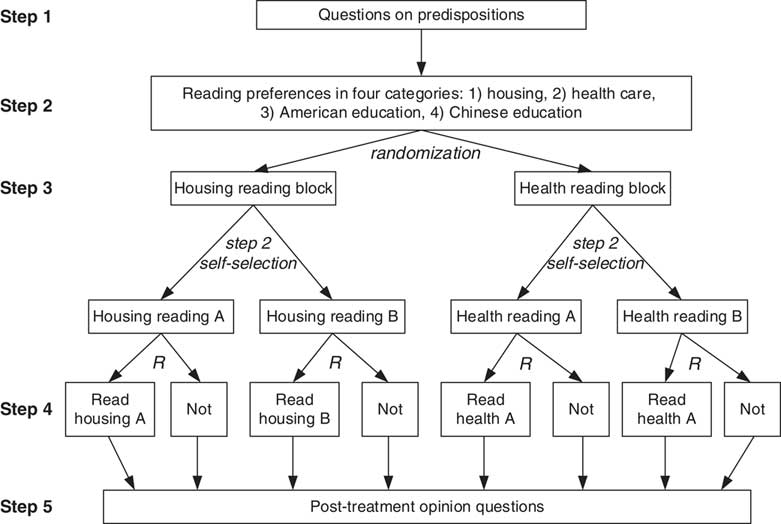
The procedure of the survey experiment is outlined in Figure 1. First, the participants were asked a set of questions measuring their political and social predispositions, including pro-Western orientation, evaluation of China’s current overall situation, evaluation of the responsiveness of the Chinese government and trust in the Chinese government. The three questions on China’s overall situation, government responsiveness and trust in the government will be aggregated into a ‘pre-treatment regime evaluation’ index in the following analysis.Footnote 68 Other questions included national pride, political interest, news consumption, political efficacy, individualism and general life satisfaction. Question wordings for all variables are contained in the Appendix.
Procedure of the survey experiment Note: The R before step 4 stands for randomization.

Following these questions on predispositions, all respondents were sequentially given four pairs of media article headlines, and asked which of the two articles from each pair they would prefer to read if they were given the choice. These sets of articles were all from major international print media or their websites. We used real media articles rather than hypothetical ones to help shed light on people’s choices in a real information environment and enhance the external validity of the study. Each pair contained two contrasting articles on a topic salient in China, that is, housing, health care and education, which have often been called the ‘three new mountains’ weighing on the Chinese people. One of the articles in each pair was positive while the other was negative about the issue in the relevant country, with the media source held constant, as shown below:Footnote 69
1. Both of the following articles were recently published in the New York Times. If you were to read one of them, which would you choose?
(a) ‘East Northport, L.I.: Good Schools, Good Neighbors’ (abstract: Housing properties in East Northport, New York, are relatively cheap, and it has good schools and great residents)
(b) ‘New York’s Middle-Class Lament: Rent’ (abstract: middle-income New Yorkers in Manhattan often live in small apartments and yet pay high rents)
2. Both of the following articles were recently published on the website of the American magazine Forbes. If you were to read one of them, which would you choose?
(a) ‘India Needs to Learn from China’s Public Health Care System’
(b) ‘Why Are India’s Private Hospitals Worthy of Emulation for China?’
3. Both of the following articles were recently published on the Wall Street Journal website. If you were to read one of them, which would you choose?
(a) ‘Chinese Students Struggle for Returns on Education in U.S.’
(b) ‘Why Are American Colleges so Attractive?’
4. Both of the following articles were from well-known foreign media websites. If you were to read one of them, which would you choose?
(a) ‘Shanghai Students again Top Global Test’
(b) ‘High Scores for Shanghai Students Are Actually a Sign of Weakness’
Most of these headlines were self-explanatory about the content of the articles. The first pair of article headlines (on housing in New York) was accompanied by short leads to make the content of the articles clearer to the respondents. To examine the respondents’ exposure preferences, in the following analysis an article is coded as 1 if it depicts foreign countries positively or China negatively, and 0 otherwise. So for the pair of articles on New York housing, the one about good schools and good neighbors is coded as 1, while the one on high rent is coded as 0.
After answering all four questions on reading preferences in the sequence shown above, the respondents were randomly divided into a housing reading block and a health reading block. To economize on the sample size, we did not construct an education reading block. In the housing block, about half of the respondents who had earlier expressed a preference for the article on good housing in East Northport were given that article to read (again by randomization); the other half who expressed the same preference were not given the article. The article on high rent in Manhattan and the two articles in the health reading block were similarly assigned. Each participant was assigned into only one block, hence reading at most one article, which was important for isolating the effect of each individual article. Note that the last two questions on reading preferences were about American and Chinese education, while all actual readings that (some of) the subjects read were about housing or health care (the first two topics in the preference questions). Therefore, no subject read any article directly after indicating her preference from the relevant pair of articles. All articles used in the experiment were either the media outlets’ own translations of the original English-language articles or directly published in the media’s Chinese-language websites in Chinese, edited somewhat to make their lengths roughly similar.Footnote 70
Afterwards, all respondents were given a distractor question unrelated to the study, and then asked about their evaluations of China’s future prospects (Future), political system (Polity), the competence of the government (Competence) and the performance of the government (Governance). These items are also summed into an aggregate post-treatment regime evaluation index in the following analysis (Aggregate).Footnote 71 Since the study adopts a between-subject design for each media article, we will compare the post-treatment regime evaluations of participants who read the article with participants who indicated a preference for that article but were not given it (or any other article) to read, after controlling for a set of covariates. We used different items for pre-treatment and post-treatment regime evaluations, because if the same questions were used for both evaluations, the respondents’ incentive to appear consistent would undermine the true effect of the treatment. At the end of the survey experiment, the respondents were asked about their socio-demographic information. Summary statistics of the variables can be found in the Appendix.
Data
The survey experiment was conducted in August 2014. The 1,200 participants were recruited from a popular Amazon Mechanical Turk-style crowdsourcing website in China, and then directed to a US-based survey website where they took the survey anonymously. Each unique IP address and each unique account at the recruiting platform was allowed only once in the survey to prevent repetitive participation.
There are a number of reasons why conducting the survey experiment with an online sample rather than a nationally representative sample is appropriate for this study. First, because foreign print media and television programming are generally not available in China, Chinese people’s exposure to foreign media is mostly through the internet, whether by visiting foreign media websites or through social media. Therefore internet users are the most natural targets of the study, and having the respondents select articles to read on their own computers and at their own locations maximizes the realism of the experiment. Secondly, about half of China’s population is now online, and the internet has become the center of activism and collective action in the country, with the middle class broadly preferring digital forms of engagement over traditional forms of political participation.Footnote 72 Understanding how the internet population’s information exposure affects their opinion is therefore particularly important. Last, given the current institutional and technological constraints in China, a nationally representative survey with stratified sampling will inevitably involve face-to-face interviews, which is problematic for many of the politically sensitive questions in the study about the Chinese government and political system. An anonymous survey with online respondents is likely to receive more truthful answers.
As shown in the Appendix, the participants had diverse socio-demographic backgrounds: they came from all walks of life, various educational backgrounds and age groups, and nearly every province of mainland China. In fact, their socio-demographic profiles were quite close to China’s general internet population on multiple key dimensions, especially occupation, gender and geographic location. The participants’ occupations, for example, include students, workers (corporate, manufacturing and service), professionals, government employees, and the self-employed, with the distribution comparable to that of Chinese internet users in general. Although the participants were younger and better educated on average than the general population, the broadness of the sample’s socio-demographic backgrounds means that the finding from the survey about the respondents’ reading preferences would nevertheless have some representativeness. In addition, the young and better-educated generations are also more politically active, and so their preferences and opinions deserve particular attention. Given the age and education differences with the general population, we urge caution in generalizing the study’s findings to the entire Chinese population or even the entire Chinese internet population. There is little reason, however, to suspect that the reactions of this study’s participants to the information treatments will be significantly different from those of similarly aged and educated internet users in China.
RESULTS
Selective Exposure
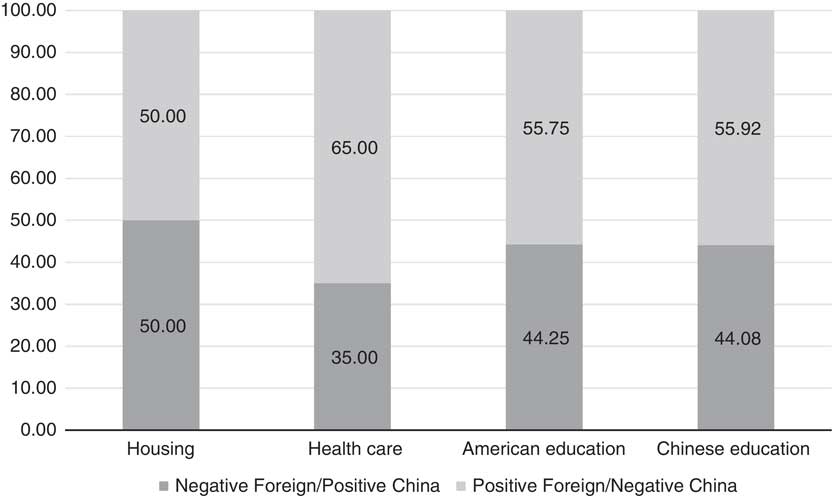
We first report results about the respondents’ exposure preferences. Although the focus here is on factors that affect individuals’ acquisition of information, it is nevertheless instructive to see the general distribution of the respondents’ exposure preferences. As Figure 2 shows, while the respondents were evenly split over the two articles on New York housing, for the other pairs the respondents were significantly more interested in reading the articles that are positive about foreign countries or negative about China. It appears that a significant share of Chinese internet users, perhaps the majority of them, are more interested in content that is positive about foreign countries and critical of their own country. While the popular press tends to focus on nationalism in China, this result (along with our discussion in previous sections) suggests that the ascendancy of the outside world in Chinese public consciousness is more noteworthy than is commonly understood.
Reading preferences

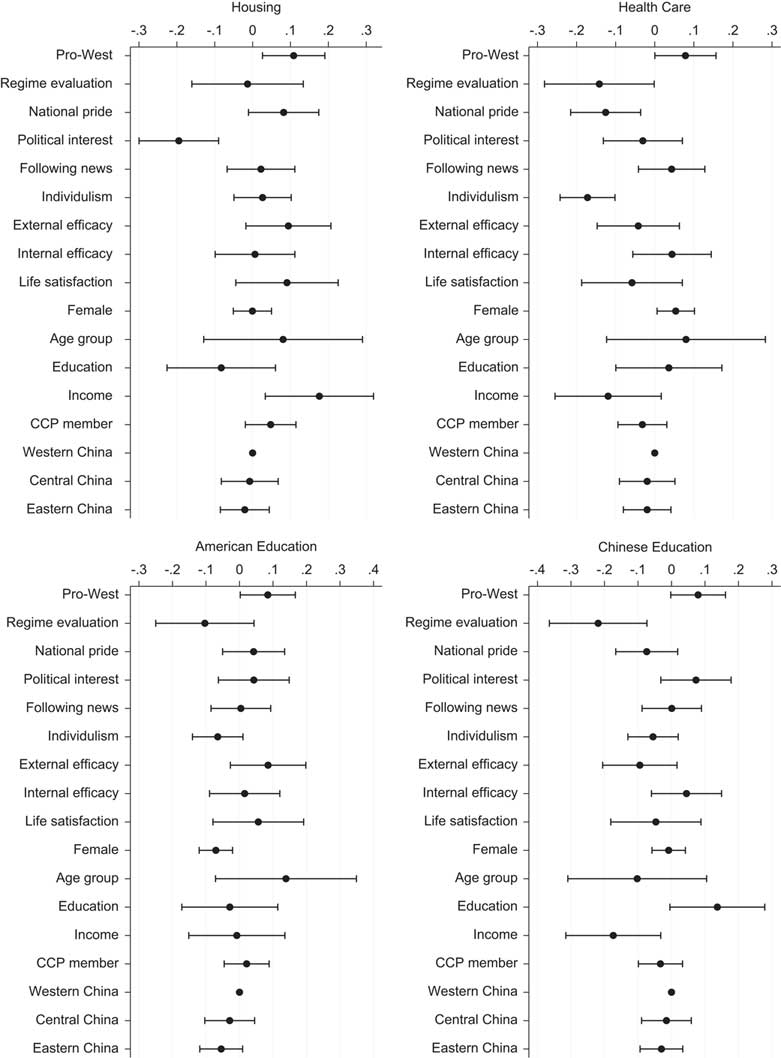
To explore the factors behind the exposure preferences, we estimate logistic regression models with the respondents’ reading preferences as the dependent variables. As mentioned earlier, a preference for articles that are positive about foreign countries or negative about China is coded as 1, while the opposite is coded as 0. Figure 3 shows the marginal effects of the key regressors on exposure preferences.Footnote 73 Since all independent variables are rescaled to between 0 and 1, each estimate in Figure 3 can be interpreted as the probability change of preferring the positive-foreign or negative-China article by moving the independent variable from the minimum to the maximum level while holding all other variables constant. The solid circles represent the marginal effects, while the capped spikes are the associated confidence intervals.Footnote 74
Marginal effects of independent variables on reading preferences

The results generally support Hypothesis 1, namely that Chinese citizens with higher pro-Western orientations and lower domestic regime evaluations are more interested in reading content that is positive about foreign countries or negative about China. The coefficients of pro-Western orientation are positively significant for three of the four reading pairs (housing, health care and American education); the coefficients of regime evaluation are negatively significant for two of the four reading pairs. We also aggregate the reading preferences for the four pairs and analyze the aggregated index with an ordered logistic regression, and both pro-Western orientation and regime evaluations are significantly correlated with the aggregate exposure preferences (see Appendix Table S8). As shown in Figure 3, the respondents were about 10 per cent more likely to select contents that were positive about foreign countries or negative about China when their pro-Western orientation was changed from the minimum to the maximum. At the same time, changing the respondents’ pre-treatment regime evaluation from the lowest level to the highest would often increase their likelihood of selecting articles that were positive about China or negative about foreign countries by about 10–20 per cent.
The control variables’ effects on the respondents’ reading preferences were less significant or consistent. In particular, it is notable that membership in the Chinese Communist Party does not affect exposure preferences, which may indicate that party membership in contemporary China is more about instrumental/material values than political beliefs. Nor did the respondents’ geographic regions affect the respondents’ exposure preferences, despite the large developmental gap between China’s eastern, central and western regions.
Effects of Self-Selected Exposure
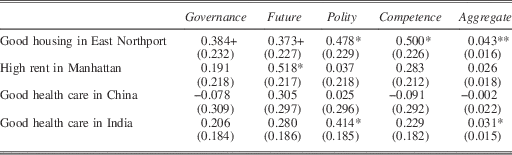
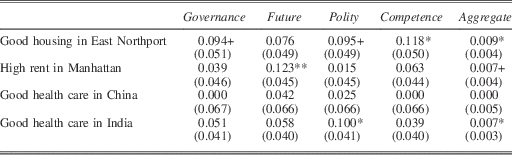
Now we examine the effects of foreign media content on regime evaluations, controlling for the self-selection of exposure. Table 1 presents the estimates of the treatment effects from the RRSST procedure, and each coefficient estimate corresponds to a unique model that compares the post-treatment evaluations of the treatment and control groups among the respondents who indicated a preference for the same article, while controlling for other covariates.Footnote 75 So, for example, models in the first row (‘Good housing in East Northport’) only include respondents who indicated a preference for the ‘good housing in East Northport’ article over the ‘high rent in Manhattan’ article, and compared those who actually read the former article with those who had the same preference but were not given that article (or any other article) to read. This method thus controls for the respondents’ characteristics and all dimensions of the information exposure, including content, source accreditation, issue and tone. The difference between the control and treatment groups is simply whether they received the exposure or not.
Effects of Information Exposure on Regime Evaluations

Note: standard errors in parentheses. The number of observations for each row (each reading preference) is, respectively, 402, 400, 250 and 545, and the number of treated observations for each row (each reading preferences) is, respectively, 89, 100, 50 and 132. The number of treated subjects for each reading preference is lower than that of the control subjects because the latter include subjects with the same reading preference but assigned to a different reading block (and still not given any article to read). The first four models (Governance, Future, Polity and Competence) are estimated by ordered logistic regressions, and the last model (Aggregate) is estimated using the OLS regression with robust standard errors. Aggregate is also rescaled to between 0 and 1 for intuitive interpretation. The analyses include respondents in the treatment group who spent at least 60 seconds reading their selected article, and by applying the 60-second time threshold, we exclude fifty-nine, forty-one, fifty-two, and sixty-four respondents in each reading group, respectively. The estimates with the full sample and other different time thresholds are reported in the Appendix. ***p<0.001, **p<0.01, *p<0.05, +p<0.10
The estimations use ordered logistics models for the four individual post-treatment regime evaluation variables (Governance, Future, Polity and Competence) due to their ordinal feature (seven-point scale),Footnote 76 and the ordinary least squares (OLS) regression with robust standard errors for the aggregate post-treatment evaluation (Aggregate), which is the summation of the four individual post-treatment regime evaluation variables. Aggregate is also rescaled to between 0 and 1 for intuitive interpretation. All variables in Figure 3 are included, except pre-treatment regime evaluation due to its high collinearity with the dependent variables. Since our goal is to study the effect of selective exposure, while some respondents in the treatment groups who were given an article to read might not have paid much attention to the article, the analyses include respondents in the treatment group who spent at least 60 seconds reading their selected article, which is a reasonable threshold for attentiveness given that each of the readings in the experiment was about 1,500 Chinese characters long. In other words, we focus on people who were somewhat interested in the topics and would be likely to access such content in real life (for more on this, see the Discussion section). Below we will also discuss the relationship between reading time and exposure effects.
In general, the results from Table 1 support Hypothesis 2b rather than 2a; that is, reading positive foreign media content about foreign socio-economic situations improved the domestic evaluations of the respondents who had self-selected themselves to view such content. As shown, reading ‘good housing in East Northport’ was positively significant for all four individual dependent variables and Aggregate, and reading ‘good health care in India’ was positively significant for Polity and Aggregate. According to the last model, aggregate regime evaluation among the respondents who read ‘good housing in East Northport’ was 4.3 per cent higher than those who had the same preference but were not given the article to read, and 3.1 per cent higher for those who read ‘good health care in India’ than those who had the same preference but were not given the article to read. While these percentages do not seem particularly high, we should keep in mind that the results were obtained after controlling for the respondents’ self-selection. Moreover, the subjects in the treatment groups were only given one article to read during the experiment, while their prior opinion was shaped by many years of information exposure to other content. The effect of a single article in the experiment in changing their opinion, conditioning on self-selection, is therefore notable.
Reading ‘good health care in India’ had no significant effect on some measures of the respondents’ domestic evaluations. This can be interpreted as providing some support for the minimum effect part of Hypothesis 2a. But it is clear that there is no support for the polarization thesis in Hypothesis 2a: reading positive content about foreign socio-economic conditions did not reduce the domestic evaluations of the respondents who self-selected such content.
The results also show that reading negative media content about foreign countries (or positive content about China) generally had no significant effect; in one case (reading ‘high rent in Manhattan’) it improved the respondents’ assessment of China’s future prospects. This is in line with Hypothesis 3, and is particularly noteworthy given its sharp contrast with Hypothesis 2b: reading positive (and realistic) content about foreign countries often improved regime critics’ domestic evaluations, but reading negative (and realistic) content about foreign countries did not reduce regime supporters’ domestic evaluations.
The most important result from Table 1 is the support for Hypothesis 2b, which may be surprising, but is consistent with our earlier theoretical discussions. Many Chinese internet users have been influenced by overly rosy descriptions of life in foreign countries, leading to an upwardly biased perception of foreign situations. They prefer to read pro-foreign content, but the actual foreign media content may well give them information that is different than they expect. For example, while the ‘good housing in East Northport’ article shows that the place has a good school system, nice neighbors and relatively low housing prices, the average price of homes for sale is about $470,000, rather than under $100,000 as one might have expected from reading the People’s Daily, let alone ‘as cheap as a pair of shoes’. Similarly, while the ‘good health care in India’ article shows that some top private hospitals in India can offer high-quality medical operations at relatively low and income-based costs (with corresponding variations in nursing conditions), it is not true that ‘one can always enjoy free treatment in India’s luxurious hospitals’, as popular internet postings in China would want people to believe.
However, overly negative descriptions of foreign life appear less frequently on the internet (or other media) in China, and those that do appear are less popular and often ridiculed. Consequently, Chinese internet users are less influenced by these inaccurate and overly negative stories about foreign countries, and the respondents who had self-selected to view negative but credible foreign media content about foreign countries would not have their perceptions about the outside world improved or domestic regime support reduced. In fact, the ‘high rent in Manhattan’ article gave them some information that raised their evaluations of China, suggesting that their prior information about the downside of housing in New York was not sufficiently negative, at least as compared to the NYT article.
In addition to the 60-second time threshold, we also used other thresholds including 0 second (no restriction), 30 seconds, 90 seconds and 120 seconds as robustness checks, and the results, reported in the Appendix, are consistent with those reported here. Naturally, the exposure had stronger effects on respondents who spent more time reading an article; the effects are noticeably weaker when respondents who did not spend sufficient time reading the articles are included in the analysis. This validates the study’s focus on selective exposure and the experimental design: the effect of exposure in real life is limited to those who are interested in the exposure. To more clearly show the heterogeneous effects of different degrees of exposure, in Table 2 we replace the dichotomous reading treatment (whether a respondent was exposed to the article) with the Reading Time variable and re-estimate the same models as in Table 1. This variable is similar to an interaction term between reading exposure and the amount of time the respondents spent on the assigned reading, with respondents in the control group coded as 0. We recode the amount of time the respondents spent on the readings into a six-category variable: 0–29 seconds (1), 30–59 seconds (2), 60–89 seconds (3), 90–119 seconds (4), and 120 seconds and above (5).Footnote 77
Effects of Reading Time on Regime Evaluations

Note: standard errors in parentheses. The number of observations for each row (each reading preference) is 461, 441, 302 and 609, respectively. The first four models (Governance, Future, Polity and Competence) are estimated by ordered logistic regressions, and the last model (Aggregate) is estimated with the OLS regression with robust standard errors. Aggregate is also rescaled to between 0 and 1 for intuitive interpretation. ***p<0.001, **p<0.01, *p<0.05, +p<0.10
The results in Table 2 generally confirm the importance of reading time. The coefficient estimates indicate that spending more time reading ‘good housing in East Northport’ significantly improved the respondents’ domestic evaluations across multiple categories: Governance, Polity, Competence and Aggregate. Similarly, spending more time on reading ‘good health care in India’ also had a significant and positive impact on two of the respondents’ domestic evaluation measures: Polity and Aggregate, and spending more time on ‘high rent in Manhattan’ improved their evaluations on Competence and Aggregate. To substantively interpret the regression findings as related to Hypothesis 2b, our most important hypothesis, increasing a respondent’s reading time on ‘good housing in East Northport’ and ‘good health care in India’ by 30 seconds would have increased their aggregate regime evaluation by 0.9 per cent and 0.7 per cent, respectively. This means that for subjects who only spent a small amount of time on the readings, the effect of the exposure was limited, but for those who spent at least one or two minutes, the effect was significant.
DISCUSSION
In this section we discuss potential concerns about the study’s findings. To start, it is important to note that the conjectured mechanism behind our findings, namely that foreign media corrects individuals’ unrealistic perceptions of foreign socio-economic conditions, was not directly tested in the experiment, although it offers a reasonable explanation of the results. Ideally, we should measure the subjects’ perceptions of foreign countries before administering the treatments, which would allow us to see more explicitly how the readings change the subjects’ perceptions. This was not done in the current experiment due to the difficulty of directly comparing people’s perceptions with the information contained in the readings: individuals’ perceptions about foreign countries are usually general and holistic (and often contained in aggregate statistics such as per capita income and general price levels), while the readings contain many details about specific issues (housing prices, health care costs, neighbors, transportation, parks, etc.) in specific locations. But future studies should indeed more explicitly take individuals’ baseline perceptions into consideration, including aggregate perceptions about foreign conditions. For example, future research can explicitly gauge how individuals with different perceptions about general foreign conditions react differently to the readings.
Another potential concern is that when estimating the effects of selective exposure (Table 1), we have compared the respondents in each treatment group who were at least somewhat attentive to their selected article with the entire corresponding control group, while some respondents in the control group might have been insufficiently attentive had they been given the article to read. In other words, the ideal comparison would be between respondents in the treatment group who spent a certain minimum amount of time on the article and respondents in the control group who would have spent the same minimum amount of time had they been given the article to read. Naturally, identifying such respondents in the control groups is not feasible. But because people with lower regime evaluations are more likely to choose positive content about foreign countries, as we established when testing Hypothesis 1, it is likely that those respondents who would be less attentive to (and less interested in) pro-foreign content were also relatively more supportive of the domestic regime. As a result, including these respondents actually raised the overall regime evaluations of the control group; therefore the treatment effects from reading self-selected pro-foreign content that we have shown above may well be underestimates. Had it been possible to restrict the comparison to respondents in the treatment groups who spent a minimum amount of time on the pro-foreign content with those in the control groups who would have spent the same amount of time on the same content if they were given the article, the treatment–control differences in post-treatment regime evaluations reported in Table 1 would be even larger.
Readers may also wonder if the experimental results reflect some kind of Hawthorne effect, by which subjects in the treatment group may answer questions in a way that caters to their perceived employer’s (researcher’s) demand. But if this were the case, those who read positive content about foreign countries should have reported lower domestic evaluations, while those who read negative content about foreign countries should have reported higher domestic evaluations. The results of our experiment, however, were almost the opposite: readers of positive content about foreign countries displayed higher domestic evaluations than those who had the same reading preference but were not given the article to read; they clearly did not intend to pander to the perceived interest of the researcher(s). Concerns about a Hawthorne effect are therefore mitigated.
Yet another potential concern is about the limited number of choices (two) that the subjects had when indicating their reading preferences. Frey shows that, when requesting information relevant to a decision-making task, people would be more likely to select a piece of supporting information when the information pool contained more items.Footnote 78 In other words, by restricting the number of items, this study may have inflated the proportion of respondents that chose incongruent information, which may have even led to a boomerang effect, in which individuals reject counter-attitudinal information by going in the opposite direction. The limited number of articles available for selection in our experiment reflects the fact that the presence of foreign media is still limited in China (so a reader’s choice is limited); it was also dictated by the availability of recent, real and directly contrasting articles on the same socio-economic issue relevant to Chinese readers in mainstream Western media. Perhaps more importantly, Frey’s result was obtained in the context of personal decision making rather than searching for political and social information, and it has been shown that the two contexts are different: individuals tend to display more selective exposure behavior when searching for political and social information than when searching for information relevant to personal decision making.Footnote 79 Therefore this concern is less relevant for our study than for a study of personal decision making. But indeed, future studies should try to include more choices, particularly when access to foreign media becomes more widely available.
Finally, one may wonder if the effects of the one-time information treatments in the experiment may be short term rather than long lasting. The study participants in the treatment groups only read one article, and the influence of a single article may or may not be long-lasting. But consumers of foreign media in real life will come across many articles similar to those in the experiment, and the accumulated effects of such information treatments will be enduring. This will be especially true if China gives foreign media outlets more freedom, and more people can freely access them on a regular basis. The existing and potential impact of foreign media revealed in this article is therefore not confined to the experimental setting.
CONCLUSION
This study investigates Chinese citizens’ selective exposure to foreign media’s socio-economic reports, and the outcomes of such exposure. The results of a survey experiment integrating randomization with self-selection of exposure preferences show that those with higher pro-Western orientations and lower regime evaluations are more inclined to read articles that are positive about foreign countries or negative about China. More importantly, reading positive content about foreign socio-economic conditions improves rather than worsens the domestic political support of citizens who self-select to view such content. This is likely because foreign media content about foreign socio-economic conditions is typically more realistic than overly rosy content about foreign countries that popularly circulates in China: being exposed to foreign media content and acquiring more accurate information therefore corrects these individuals’ upwardly biased perceptions about foreign countries, which explains their improved domestic evaluations. The opinions of citizens who self-select to view media content that is negative about foreign socio-economic conditions or positive about Chinese conditions, however, are not significantly changed by the foreign media content. As a result, selective learning moderates the polarization of public opinion, in the sense that it reduces the divergence of domestic evaluations among different groups of citizens.
Thus in an authoritarian country where the domestic mainstream media is controlled by the government, and hence largely discredited as propaganda (unless it reports positive news about foreign countries), and spontaneously produced information from society is often overly rosy about foreign countries, information from more credible foreign media can strengthen public support for the government by, ironically, reporting more accurate and realistic information about foreign countries. Robertson argues that authoritarian governments need not fear information freedom, since citizens selectively acquire information and so regime-damaging viewpoints may not be widely circulated.Footnote 80 Our findings show that giving foreign media outlets the freedom to spread information, at least socio-economic information, can actually improve regime stability because it can make regime critics (who may have unrealistic expectations of foreign socio-economic conditions and like to read positive articles about foreign countries) less critical of the domestic situation.
One may wonder if the article’s findings are only applicable to China due to its rapid socio-economic development in the past few decades. While prudence should always be exercised when generalizing findings from a single-country study to more general settings, understanding the relationship between foreign media exposure and domestic political support in the largest authoritarian country in the world is important, especially given that the country has recently more or less become the standard bearer of authoritarianism with rapid economic growth. Of course, to confirm the applicability of our findings to other countries one needs to study other countries, in which case this study may serve as a useful reference point.
An important scope condition of this study’s findings is that they are about the effects of socio-economic information provided by foreign media, particularly on issues about which the Chinese public has unrealistic perceptions about foreign conditions. Foreign media do not only report socio-economic news, and their effects will not be restricted to those found in this study. A potentially fruitful direction for future research is to investigate citizens’ selective exposure to other types of information from foreign media, especially political information, and the effects of such exposure. The political information can include foreign media reports on foreign politics (for example, how democracy functions in the outside world) – essentially the political parallel of this study’s socio-economic reports – and on an authoritarian country’s domestic politics, particularly sensitive topics such as government corruption or factional conflicts. The latter type of political information is typically the reason why foreign media are frequently banned in an authoritarian country such as China. While the current study has shown that censorship of foreign media over political information has unintended collateral effects, in that it prevents citizens from learning socio-economic information about foreign countries (the kind of information that can actually boost support of the government), it will be especially interesting to see how learning about banned political information itself – such as the recent Panama papers scandalFootnote 81 – will affect citizens in an authoritarian country.