




No CrossRef data available.
Article contents
- Abstract
- The new schemes for training
- Changes in the structure of postgraduate training
- Why is there a need for subspecialty training in interventional cardiology?
- Proposals for subspecialty training in interventional paediatric cardiology
- Proposed levels of training in cardiac catheterisation and intervention
- Delivery of training
- Number of procedures required for training
- Demonstration of competence
- Basic methods to be used for assessment
- Summary
- References
Proposals for future training in interventional paediatric cardiology
Published online by Cambridge University Press: 21 January 2005
Article contents
- Abstract
- The new schemes for training
- Changes in the structure of postgraduate training
- Why is there a need for subspecialty training in interventional cardiology?
- Proposals for subspecialty training in interventional paediatric cardiology
- Proposed levels of training in cardiac catheterisation and intervention
- Delivery of training
- Number of procedures required for training
- Demonstration of competence
- Basic methods to be used for assessment
- Summary
- References
Abstract
Training in all medical disciplines is currently undergoing a major overhaul. There is a move away from the old concept of training as an apprentice, towards more structured programmes of training. Proposals have recently been made to shorten higher specialist training to 3–4 years, thus producing “generalist” consultants to meet the growing need for service. Advanced subspeciality training can then be undertaken by those with the ability, and desire, to do so following the core training. In the near future, therefore, subspeciality training will need to meet the needs of those undertaking core training, and those wishing to develop a higher degree of expertise. It will have to be focused, to allow skills appropriate to the future practice to be undertaken as a consultant to be developed efficiently. We propose a new scheme for training in interventional paediatric cardiology as a template for subspeciality training. The scheme proposes training at three levels. The first level, basic training, is required of all trainees. Training for the intermediate level will be required for those proposing to carry out diagnostic cardiac catheterisation and basic intervention. Training at the advanced level will be needed by those who wish to carry out a wide range of interventional procedures. A curriculum is proposed for each level, detailing skills that must be attained. Attendance at procedures needs to be driven by the educational needs of the trainee, rather than the requirements of the service. Objective methods are suggested to allow assessment of competence. These should supersede log-books, which document only procedural numbers. Training may be needed for the trainers to ensure that teaching and assessment achieve agreed standards of excellence.
Information
- Type
- Proposals
- Information
- Copyright
- © 2004 Cambridge University Press
In the interests of patients and the public, systems must be in place to ensure that the aspiring professional has and maintains the requisite competence.1
The Kennedy report1 has clearly indicated that the medical profession is under an obligation to ensure that doctors in training achieve competence in their speciality. It is incumbent, therefore, on those responsible for training in each speciality to define the level of performance that must be achieved by trainees, to provide programmes for training of high quality that allow trainees to reach this standard, and to implement techniques of assessment that can discriminate whether or not competence has been attained. These challenges need to be met at a time when implementation, for those working in Europe, of the European Working Time Directive2 and the need, at least in the United Kingdom, for an expansion in the consultant grade, are set to reduce, rather than increase, the amount of time available for training. In order to maintain standards, programmes of training will have to adapt to the new patterns of working, and will need to become more efficient. The old system, based on apprenticeship, is unlikely to survive, as random exposure to clinical material, often dictated by commitments to service, may result in gaps in training or unnecessary duplication. Schemes for training in the United Kingdom, therefore, are currently undergoing a major overhaul.3 In cardiology, this change has been led by the Royal College of Physicians and the Joint Committee on Higher Medical Training. The expertise gained during this exercise is likely to have more international utility. In this review, therefore, we discuss a concept for subspeciality training, taking interventional paediatric cardiology as an example. We show how it can fit into the newly designed schemes for training for the United Kingdom, and discuss how best it can be achieved. We hope that the principles we establish will be applicable to other medical and surgical specialities and subspecialities, not only in the United Kingdom, but also within the expanding European community, and hopefully the rest of the world.
The new schemes for training
New schemes to be used in the United Kingdom have been developed for the medical specialities over the last 1–2 years by the Royal College of Physicians and Joint Committee on Higher Medical Training. The trainee is provided with a detailed curriculum that sets out the goals or objectives of training. Each area of practice is broken down into knowledge, skills, and attitudes, with an assessment of the level to be attained in each area. Thus, the level of performance that has to be achieved before a trainee is deemed competent in a particular part of the curriculum is detailed. The curriculum for generic skills, applicable to trainees in all specialities, and the specific curriculum for paediatric cardiology, were published in January 2003. They apply to trainees issued with a national training number after 1 January 2003.4, 5 Methods for acquiring the relevant knowledge and skills in each area of the curriculum are suggested. It is envisaged that opportunities will be provided for learning. Assessment, which is to be both formative and summative, will be carried out at regular intervals. Formative assessment will provide ongoing feedback in a constructive and positive manner, which should allow deficiencies to be corrected. Summative assessment will identify whether the trainee has reached the necessary level of competence to progress further in the scheme for training. Although these materials have been developed for the core curriculum in paediatric cardiology, no provision has been made to develop a similar approach for subspeciality training. We propose here, therefore, a curriculum for training in interventional paediatric cardiology that could dovetail with the existing core curriculum. Similar proposals could be developed for the other subspecialities of paediatric cardiology.
Changes in the structure of postgraduate training
Again within the United Kingdom, the consultation paper published by the Department of Health, and entitled “Unfinished business: proposals for reform of the senior house officer grade” included provisions for restructuring higher specialist training.6 The document suggested that, after graduation, doctors should undertake an integrated 2-year foundation programme of general training, followed by a programme of basic training for specialisation that provides a breadth of education and training within certain broad clinical disciplines, such as paediatrics or general internal medicine. It was then proposed that trainees should enter a shorter period of higher specialist training than at present, leading to the award of a Certificate of Completion of Specialist Training that made them eligible for appointment to “generalist” consultant posts in their chosen speciality. This could be followed by a period of more highly specialised training for those who wished to undertake it, and for which there was a service need. The suggested chronology of training was therefore as follows:
- the foundation programme of 2 years;
- the programme for basic specialist training programme of 2–3 years;
- a period of higher specialist training lasting 3–4 years;
- a final period of subspeciality training, lasting from 1 to 2 years.
Since then, the Department of Health has issued its response to the consultation process in the document: “Modernising Medical Careers: The response of the UK Health Ministers to the consultation on Unfinished business: proposals for reform of the senior house officer grade”.7 The early indications are that training is likely to be shortened still further, so that the foundation programme is followed by a run-through speciality training grade. The total duration of training required to produce a generalist consultant may be as short as 6 years:
- the foundation programme, lasting 2 years;
- the period of higher specialist training, lasting 4 years.
It is our contention that the principles we will develop below discussed would streamline subspeciality training, thereby allowing training in general paediatric cardiology to be shortened to 3–4 years, instead of the current 5 years. This would facilitate transition to the new schemes for training, and would produce an increased number of general paediatric cardiologists, which is the need of the speciality now, and for the foreseeable future. We anticipate a major change in the service needs of paediatric cardiology. It is highly likely that the visits made by consultants to distant sites, termed outreach services in the United Kingdom, will have to be rationalised. Paediatricians with special expertise in paediatric cardiology will need to be trained and appointed in large district general hospitals, organising the outreach services in collaboration with the consultants based in tertiary paediatric cardiologic centres. Specialists in adult congenital heart disease will need to be trained to provide a service for this growing population. This will allow paediatric cardiologists to dedicate themselves to provide high quality care in their own base tertiary units. Care of children with congenital heart disease will have to be coordinated between the general and the subspeciality paediatric cardiologists.
Why is there a need for subspecialty training in interventional cardiology?
The last 20 years has seen the birth and evolution of a wide range of interventional techniques in paediatric cardiology. Although procedures were initially developed in small cohorts of patients in a small number of centres, they have now become widely accepted, and are performed in almost every institution involved in paediatric cardiology. Even in the last decade, many interventions have only just passed through the initial phases of development and evaluation. As results have been collected and published, nonetheless, it has increasingly become possible to identify standards of competence and excellence. There is now an expectation both on the part of the patients, and from the perspective of clinical governance, that the treatment will meet the highest standards. We are moving, therefore, from an era of unknown results and unregulated practice to one driven by measurable standards. In adult cardiology, it is recognised that superior results are obtained when a high volume of procedures is performed by a small number of experts.8, 9 As performance is related to concentration of experience, there is a strong argument that interventions should no longer be dispersed among many members of the paediatric cardiologic team, as is commonly the practice in the United Kingdom, but concentrated in the hands of a few practitioners with a recognised interest in this subspeciality. This means a shift in practice towards the North American model. Even this model will need to be refined. We believe that, in the future, consultants are likely either to retain no practical contact with cardiac catheterisation because they provide a general clinical paediatric cardiology service or are heavily committed to another subspeciality, to perform diagnostic cardiac catheterisation and a limited range of common interventional procedures, or to maintain a strong subspeciality interest in intervention, including common, complex, and new interventions. The move towards such a specialised practice will have to be reflected in the structure of the curriculum designed for training.
Proposals for subspecialty training in interventional paediatric cardiology
We propose that exposure to interventional paediatric cardiology within the programme for training in general paediatric cardiology needs to be more structured, with the primary aim of developing understanding rather than the ability to carry out procedures. For those who want to specialise in intervention, there should be an option to become more involved during the core training, coupled with a higher level of training in a dedicated period of 1–2 years undertaken after obtaining a general Certificate of Completion of Specialist Training. A similar system operates in the United States of America and Canada. The American College of Cardiology recommends an additional year of training beyond the fellowship programme of 3 years in adult cardiology for those trainees who plan to perform coronary arterial, or other cardiovascular, therapeutic interventional procedures.10 There are accredited programmes in adult interventional cardiology, and the American Board of Internal Medicine offers an examination for an added qualification in intervention.11 In Canada, paediatric cardiologists who intend to carry out interventional catheterisation must complete a dedicated fellowship lasting from 6 to 12 months having completed their core training.12 The curriculum published in 1998 for training in adult cardiology in the United Kingdom provided for acquisition of advanced skills in the final 2 years of training, which consists of subspeciality training and general cardiology in about equal proportions.13 Such advanced training in a given subspeciality could be recorded on the Specialist Register. Although at present there is no protected time for subspeciality training in paediatric cardiology, it is normal for trainees to increase their exposure to one particular subspeciality during the final 2 years of training, often by organising a period of training abroad.
We propose that, in future, training in Interventional Paediatric Catheterisation should be offered at three levels (Table 1). The level of training to be achieved will then be chosen by the trainee at an early stage, in consultation with their educational supervisor and the director of the cardiac catheterisation laboratory, and will depend on the type of expertise the trainee hopes to achieve at the completion of the programme. The structure we propose for training in interventional paediatric cardiology could be accommodated within the programme of higher specialist training existing in the United Kingdom, or would fit in with the changes in training proposed by the Department of Health.
Table 1. Proposed levels of training in paediatric interventional cardiology.

Proposed levels of training in cardiac catheterisation and intervention
Basic training
This level is the basic requirement for all trainees. Our suggested curriculum is set out in Table 2. This level of training will include those skills required of the general paediatric cardiologist. The main aim of training should be to teach the indications, complications, and limitations of diagnostic cardiac catheterisation and common interventions, so that newly qualified consultants can make informed decisions for the benefit of their patients. Training must be targeted, with an emphasis on diagnostic cardiac catheterisation. Early exposure should, however, be sufficient to allow trainees to make an informed decision about the subspeciality they wish to pursue. It should involve at least assisting in the majority of the common interventional procedures. Competence in balloon atrial septostomy and pericardiocentesis will remain essential because of the need to provide on-call cover as a consultant. This experience is likely to be gained and consolidated outside the catheter laboratory over the 5 years of training. It is anticipated that basic training will be obtained in the first 2 years of the training programme. Once the trainee has attained competence in those areas specified in the curriculum, basic training will be considered to be complete. By the 3rd year, some trainees will require no further direct exposure to the catheterisation laboratory. Training is to be obtained by involvement in the care of patients from evaluation prior to catheterisation to discharge and follow up as outpatients. Experience in the catheterisation laboratory should be supplemented by personal reading, formal teaching, and regular attendance at case conferences that include discussion of catheter procedures and interaction with cardiac surgeons. Trainees should present cases, and discussions should stress the relationship between history, physical examination, non-invasive imaging, haemodynamic data, and angiographic appearances in planning treatment.
Table 2. Curriculum for basic training.

Intermediate training
Our suggested curriculum is set out in Table 3. Training to an intermediate level is appropriate for those with interests spread over a wide range of disciplines within paediatric cardiology. It is likely that there will continue to be a need for such consultants. Such an individual should only practice in a setting where support is available from an experienced interventional cardiologist. Such a trainee undergoing intermediate training will carry out diagnostic catheterisation, and perform a narrow range of interventional procedures. These techniques will be more straightforward procedures, such as balloon dilatation of pulmonary valves, or occlusion by coils of patent arterial ducts.
Table 3. Curriculum for intermediate training.

The guidelines established by the British Paediatric Cardiac Association for therapeutic cardiac catheterisation state that acquisition of a Certificate of Completion of Specialist Training alone should not qualify a paediatric cardiologist to undertake interventions.14 It is proposed that trainees be permitted to perform a particular intervention independently only when accreditation in that procedure has been obtained. Certification will be obtained by undertaking specific training and demonstrating competence in the particular technique. Such credentialing specific for given procedures has also been recommended in the United States of America.15 Although there are, at present, no provisions for enforcing a system of accreditation, it is anticipated that it would, in practice, be enforced by the hospitals. A trainee undergoing intermediate training would continue to have the option of extending the number of procedures for which he or she was accredited as a consultant under the supervision of a more experienced interventional cardiologist.
Advanced training
Our suggested curriculum is set out in Table 4. A high level of core knowledge must be attained, and the trainee must demonstrate an ability to perform independently cardiac catheterisation. Requirements for training at the advanced level must be completed, and a wider range of procedures must be mastered, as first operator.
Table 4. Curriculum for advanced training.

Competence must be certified in each type of procedure. All of the skills required for intermediate training are extended to more complex interventions. It is anticipated that the trainee will have continuous and intense exposure to a wide variety of interventions in the catheterisation laboratory, particularly in the final 2–3 years of higher specialist training, once the core curriculum has been completed. Many trainees will arrange a period of study abroad to concentrate on interventions. More focused exposure should be facilitated in schemes for training available within the United Kingdom, either in the 4th or 5th year of the current programmes or in a period of training lasting from 1 to 2 years undertaken subsequent to obtaining the Certificate of Completion of Specialist Training, perhaps combined with a commitment to research. Trainees will be expected to develop skills in research and should ideally pursue a higher degree in some aspect of interventional catheterisation. Training should include formal teaching on topics related to intervention, regular attendance at national and international interventional conferences, reviewing literature, participating in audit projects based on work in the catheterisation laboratory, publishing in peer-reviewed journals, and participating in trials of new equipment. The individual should be capable of teaching others in the techniques of cardiac catheterisation. It is likely that accreditation will not be gained in the rare procedures that are performed infrequently. The newly qualified consultant who has completed the advanced training should then obtain assistance from a more experienced interventional cardiologist for such procedures, where recognised expertise is available, until competence is acquired. Where a technique is being developed, and there is no recognised expertise, approval from the local ethics committee would have to be sought before embarking on the procedure.
Delivery of training
Under the current system of training in the United Kingdom, exposure to cases in the catheterisation laboratory is random, depending on allocation of sessions. Attendance at procedures is often driven by the requirements of the service, rather than the educational needs of the trainee. This system will have to change. Trainees should only attend procedures that are appropriate for their level of experience and training. Focused training will allow the trainee to progress at a faster rate, and will use the limited number of cases passing through the catheterisation laboratory more efficiently from the aspect of training. Under this proposed system, core training in the catheterisation laboratory will require less rather than more exposure to procedures, as the objectives will be more tightly and clearly defined. Taking non-interventional trainees more rapidly through their period of training in the catheter laboratory will allow them to devote more time to other subspecialities of more direct relevance to their future consultant practice, and will liberate a greater number of procedures for trainees wishing to concentrate on intervention as their career. This will inevitably involve planning catheter lists in such a way that they synchronise with training timetables. Cases of a certain level of difficulty may need to be clustered to allow efficient teaching.
At more advanced levels of training, it is important to allow a progression of responsibility in the conduct of procedures concomitant with increasing experience and skill. In addition to graded exposure to increasingly complex interventions, it is important to offer a commensurate degree of independence as an operator in more straightforward procedures, thus preparing the trainee to assume responsibility at consultant level. Where possible, supervision should be at a distance, to encourage confidence and promote decision-making skills.
Trainees and trainers should set goals at regular appraisal meetings. Both parties are then obliged to meet these goals, or make all reasonable attempts to do so within a realistic agreed time frame. If targets are not met when there has been adequate opportunity for training, questions may be asked about the suitability of the trainee for interventional training, or the ability, and commitment, of the trainer to teaching. As competence is attained in a procedure, the trainee may then leave further procedures of this type to other trainees, with an obligation to perform or supervise the procedure at intervals sufficient to maintain the level of skill attained. Those undergoing training at the advanced level should be exposed to a large volume of patients exhibiting varied pathology, including a suitable mixture of children and adults with congenital heart disease.
When multiple trainees in a centre wish to pursue advanced training in intervention, entry onto the programme should be competitive, as places will be limited by the volume of work passing through the catheterisation laboratory. The needs of trainees with similar interests may be met by arranging rotations between units, as gaps may exist in training programmes at other centres. Training programmes, therefore, will need to be coordinated at a regional, or even a national, level. Appointments for those accepted for training, at least in the United Kingdom, may also need to be made on a regional or a national basis to allow suitable rotations for training in the subspeciality. An increase in numbers of consultants, and therefore trainees, will be needed to provide such a configuration of service and training. It is important that training programmes are available for clinical teachers, so that an instructor in intervention is certified competent both as an operator and as a teacher.
Number of procedures required for training
Most training programmes have presumed that competence is achieved once a certain number of procedures has been completed. This approach has not taken into account the different rates of progress of the individual trainees. The number of procedures performed is no guarantee of proficiency. Indeed, some trainees may need a large number of procedures to reach an acceptable level of competence, whilst other trainees may need a smaller number of procedures. In Table 5, we compare the minimum number of procedures currently required to complete programmes of training in cardiology in the United Kingdom, Europe and North America. There is no consensus, and there is no body of evidence to support the figures. The average number of procedures needed to achieve competence is helpful in estimating the volume needed for training, but the average may be insufficient for many trainees.
Table 5. National and international requirements for training in cardiac catheterisation and intervention.

We need to move beyond criterions based on experience to more valid and reproducible methods of assessing competence, based on measured outcomes, and evaluation by skilled teachers.24 Our proposed programme for training in interventional paediatric cardiology, therefore, does not indicate an absolute number of cases to be performed to attain competence. We anticipate, nonetheless, that the majority of trainees seeking to gain competence in a particular procedure will need to participate in at least 10 cases involving the technique, with a graded increase in responsibility. More experienced operators may require less exposure to achieve acceptable levels of proficiency.
Demonstration of competence
In addition to establishing the curriculum for subspeciality training, and instituting efficient methods of learning, a reliable and valid process of assessment needs to be developed to ensure that standards of competence are met. It is anticipated that the trainee will gather evidence of competence during training, and will present this at annual review to demonstrate that the requirements of core training, or more advanced interventional training, have been completed. Such evidence of competence may include information similar to that already held by trainees. In the United Kingdom, it will also include the results of objective assessments currently being piloted by the Royal College of Physicians for use in all medical specialties.
Basic methods to be used for assessment
- The log-book. The trainee should maintain a log of all catheterisations performed. This will include details of the procedure performed and the level of responsibility assumed, and should be countersigned prospectively by the training consultant. As already discussed, however, the log-book does not provide adequate information on the quality of performance, and lacks validity as an assessment method. It does, nonetheless, give some indication of the breadth of the experience already gained by the trainee.
- The portfolio of educational achievements. Part of the training curriculum requires development of knowledge and skills beyond the technical aspects of the procedure. The trainee should collect evidence that such skills have been acquired in a portfolio. This portfolio may include documentation proving attendance at catheter conferences, evidence of research or teaching commitments, evidence of attending didactic teaching, or the written reflection on significant cases in which the trainee has been involved. The trainee should maintain the log-book in a more comprehensive form, whereby aspects of teaching and learning are highlighted for the procedures undertaken by the trainee.
- The 360° assessment. Trainees should arrange to undergo a structured 360° assessment that allows colleagues and patients to feed back on the performance of the trainee in relation to catheter procedures. Such questionnaires for use by the medical specialities in the United Kingdom are currently being developed by the education department of the Royal College of Physicians, and will need to be extended to subspeciality practice. Replies to the questionnaire provide both formative and summative assessment, and should be retained as proof of competence.
- The directly observed procedural skill. This is an assessment carried out by a single consultant who observes the trainee during a procedure. The trainee is assessed objectively by marking his performance in various aspects of the procedure against standard criterions. The encounter is intended to be short, and to occur as a routine part of training, so that each trainee can be evaluated on several occasions by different consultants. The idea has been developed from the mini-clinical evaluation exercise used to assess the clinical skills of residents in the United States of America.25 The objective nature of the assessment minimises variability between observers, and repeated assessments ensure reliability. Further objectivity may be achieved by involving external assessors. The concept of the directly observed procedural skill is currently being piloted in other medical specialities. A format specifically tailored to the requirements of paediatric interventional cardiology will need to be developed, with input from established catheterising cardiologists.
At present, there are no plans to introduce a knowledge-based assessment for interventional trainees. The methods of assessment will be taken together to provide evidence of competence. Any deficiencies in required skills should be identified at an early stage, so as to allow remedial action. The process of assessment should provide a comprehensive picture of the ability of the trainee. Selection of cases, procedural judgment, interpretative and technical skills, initiative, reliability, complications, ability to make independent and appropriate decisions, quality of clinical follow-up, and interaction with other physicians, patients and laboratory support staff must all be evaluated. The process should provide the trainee with opportunities for self-reflection. Assessment should not be viewed by trainees as another hurdle to negotiate, nor should it be viewed as punitive, but rather as a mechanism to allow them to improve their skills.
Summary
We have proposed a new stratified scheme for training in interventional paediatric cardiology that aims to produce trainees with a level of competence appropriate for modern practice as consultants. Training should be more focused, thus permitting skills to be developed efficiently, and higher standards to be attained. We advocate procedure-specific accreditation, both to satisfy public concerns about standards, and to protect operators. Advanced interventional training should be concentrated in the final years of training, preferably within a dedicated training programme. Number of procedures performed should no longer be used to indicate competence, but should be replaced by a range of more sophisticated methods for objective assessment.
References
Kennedy I. The Report of the Public Inquiry into children’s heart surgery at the Bristol Royal Infirmary 1984–1995. 2001:342, paragraph 29.Google Scholar
Council Directive No. 93/104/EC of 23 November 1993 concerning certain aspects of the organisation of working time.
Greenwood J. Training in cardiology – the next decade. Br J Cardiol 2003; 10: 428–430.Google Scholar
Higher medical training generic curriculum, January 2003. Office of the Joint Committee for Higher Medical Training of the Royal College of Physicians. www.jchmt.org.uk.
Higher medical training curriculum for paediatric cardiology, January 2003. Office of the Joint Committee for Higher Medical Training of the Royal College of Physicians. www.jchmt.org.uk.
SHO modernisation working group (chair Sir Liam Donaldson). Unfinished business: Proposals for reform of the Senior House Officer Grade. www.doh.gov.uk/shoconsult, 23 August 2002.
Modernising Medical Careers: The response of the UK Health Ministers to the consultation on Unfinished business: proposals for reform of the senior house officer grade. www.doh.gov.uk/shoconsultresponse.pdf, 27 February 2003.
Jollis JG, Peterson ED, Nelson CL, et al. Relationship between physician and hospital coronary angioplasty volume and outcome in elderly patients. Circulation 1997; 95: 2485–2491.Google Scholar
Hannan EL, Racz M, Ryan TJ, et al. Coronary angioplasty volume–outcome relationships for hospitals and cardiologists. J Am Med Assoc 1997; 277: 892–898.Google Scholar
Hirshfeld JW Jr, Banas JS Jr, Brundage BH, et al. American College of Cardiology training statement on recommendations for the structure of an optimal adult interventional cardiology training program: a report of the American College of Cardiology task force on clinical expert consensus documents. J Am Coll Cardiol 1999; 34: 2141–2147.Google Scholar
Parmley WW. Interventional cardiology: an added qualification to the cardiovascular boards. J Am Coll Cardiol 1998; 31: 716–717.Google Scholar
Benson L, Coe Y, Houde C, Human D. Training standards for pediatric cardiac catheterization and interventional cardiology. Canadian Cardiovascular Society. Can J Cardiol 1998; 14: 907–910.Google Scholar
Curriculum for higher specialist training in cardiology, 1998. Office of the Joint Committee for Higher Medical Training of the Royal College of Physicians.
Qureshi SA, Redington AN, Wren C, et al. Recommendations of the British Paediatric Cardiac Association for therapeutic cardiac catheterisation in congenital cardiac disease. Cardiol Young 2000; 10: 649–667.Google Scholar
Allen HD, Beekman III RH, Garson A Jr, et al. Pediatric therapeutic cardiac catheterization: a statement for healthcare professionals from the Council on Cardiovascular Disease in the Young, American Heart Association. Circulation 1998; 97: 609–625.Google Scholar
Curriculum for higher specialist training in paediatric cardiology, 1998. Office of the Joint Committee for Higher Medical Training of the Royal College of Physicians.
Hunter S, Tynan M, Silove E. Guidelines for specialist training in paediatric cardiology. British Paediatric Association and the Specialist Advisory Committee in Cardiology of the Joint Committee on Higher Medical Training of the Royal College of Physicians. Heart 1996; 75: 534–536.Google Scholar
Daniels O. Guidelines for training in paediatric cardiology. Cardiol Young 2000; 10: 76–79.Google Scholar
Guidelines for specialist training in cardiology. Council of the British Cardiac Society and the Specialist Advisory Committee in Cardiovascular Medicine of the Royal College of Physicians. Br Heart J 1995; 73: 1–24.
Recommendations of the European Board for the Specialty Cardiology (EBSC) for education and training in basic cardiology in Europe. The Executive Committee of the European Board for the Specialty Cardiology. Eur Heart J 1996; 17: 996–1000.
Pepine CJ, Babb JD, Brinker JA, et al. Guidelines for training in adult cardiovascular medicine. Core Cardiology Training Symposium (COCATS). Task Force 3: training in cardiac catheterization and interventional cardiology. J Am Coll Cardiol 1995; 25: 14–16.Google Scholar
Miller RM, O'Neill B, Johnstone D, Rae JR. Standards for training in adult cardiac catheterization and angiography. Canadian Cardiovascular Society Committee. Can J Cardiol 1996; 12: 470–472.Google Scholar
Marquis JF, Henderson M, Knudtson M, Haq A. Standards for coronary angioplasty training. Canadian Cardiovascular Society Committee. Can J Cardiol 1996; 12: 472.Google Scholar
Yu E. The assessment of technical skills in a cardiology training program: is the ITER sufficient? Can J Cardiol 2000; 16: 457–462.Google Scholar
Norcini JJ, Blank LL, Arnold GK, Kimball HR. The mini-CEX (clinical evaluation exercise): a preliminary investigation. Ann Intern Med 1995; 123: 795–799.Google Scholar
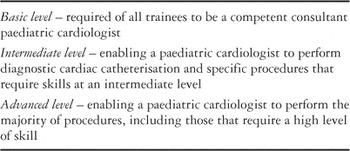
Table 1.
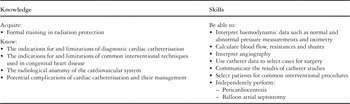
Table 2.
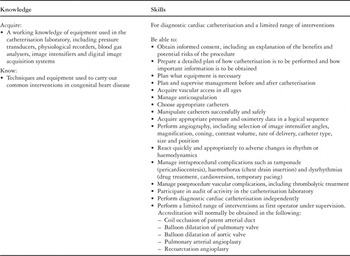
Table 3.
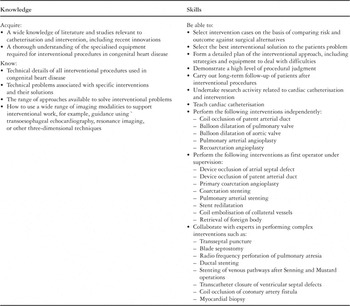
Table 4.
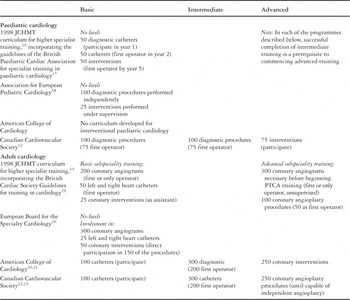
Table 5.
 You have
Access
- 5
- Cited by