Introduction
Facing the dynamic challenges of globalization, organizations around the world have explored and exploited their human capital to become and remain competitive and effective. Hence, organizations have implemented high-performance work systems (HPWS) that, in hypercompetitive markets, can substantially improve employees' skills, commitment, and productivity, leading to superior organizational performance (e.g., Paauwe, Guest, & Wright, Reference Paauwe, Guest and Wright2013; Shin & Konrad, Reference Shin and Konrad2017; Sun, Aryee, & Law, Reference Sun, Aryee and Law2007; Takeuchi, Lepak, Wang, & Takeuchi, Reference Takeuchi, Lepak, Wang and Takeuchi2007). HPWS are, at their core, a set of HR practices possessing a macro-component (strategic characteristics) and a micro-component (functional characteristics) (Wright & Boswell, Reference Wright and Boswell2002). According to the ability−motivation−opportunity (AMO) model (Appelbaum, Bailey, Berg, & Kalleberg, Reference Appelbaum, Bailey, Berg and Kalleberg2000; Peccei & Van De Voorde, Reference Peccei and Van De Voorde2019), these HR practices can be divided into three central categories: ability-enhancing practices (selective staffing and extensive training), motivation-enhancing practices (internal mobility, employment security, results-oriented appraisals, and incentive rewards), and opportunity-enhancing practices (clear job descriptions and participation) (Sun et al., Reference Sun, Aryee and Law2007). Often heralded for their benefits, HPWS nevertheless have drawbacks (Peccei, Van de Voorde, & Veldhoven, Reference Peccei, Van de Voorde, Veldhoven, Paauwe, Guest and Wright2013). This fact has placed HPWS research at an intriguing crossroad. A critical issue herein is how employees attribute meaning to internally aligned HR practices and externally aligned organizational strategies. Research has argued that the perspective of HR attribution (Nishii, Lepak, & Schneider, Reference Nishii, Lepak and Schneider2008) can bring to light both the positive and negative effects of HPWS on employee well-being (e.g., Shantz, Arevshatian, Alfes, & Bailey, Reference Shantz, Arevshatian, Alfes and Bailey2016). We explore this line of research by asking two intriguing questions: Why do employees differ from one another regarding their HPWS-related attributions? And how do HPWS positively and negatively affect employees?
The AMO model can help identify mechanisms mediating HPWS-related employee attributions. To this end, researchers have explored the topic as it concerns HR attributions (Nishii et al., Reference Nishii, Lepak and Schneider2008), self-views (Hepper, Gramzow, & Sedikides, Reference Hepper, Gramzow and Sedikides2010), ambidextrous strategic HR management (Kang, Morris, & Snell, Reference Kang, Morris and Snell2007), and the job demands−resources (JD-R) model (Demerouti, Bakker, Nachreiner, & Schaufeli, Reference Demerouti, Bakker, Nachreiner and Schaufeli2001). Hence, in our current study, we take two steps. First, we assume that employees who adopt a self-enhancement strategy in an HPWS context can develop abilities, harness motivation, and seize opportunities. However, in line with the control model of demand management (Hockey, Reference Hockey, Baddeley and Weiskrantz1993), those employees who strive to keep their performance aligned with HPWS may adopt a self-protection strategy. Hence, in this study, we consider self-enhancement and self-protection strategies adopted by employees to address why they engage in HPWS-related attributions differently. Second, we propose that the ways in which employees attribute meanings to HPWS involve two processes: an exploration-based motivational process and an exploitation-based exhausting process (Bakker & Demerouti, Reference Bakker and Demerouti2007, Reference Bakker and Demerouti2008; Brenninkmeijer, Demerouti, le Blanc, & van Emmerik, Reference Brenninkmeijer, Demerouti, le Blanc and van Emmerik2010). The former process refers to employees' HPWS-related attributions regarding job resources that help employees develop abilities, harness motivation, and seize opportunities. This process emphasizes exploration, which itself is associated with positive organizational performance. The latter process refers to employees' HPWS-related attributions regarding job demands that serve to intensify work. This process emphasizes exploitation – that is, organizations' use of employee abilities, motivation, and opportunities to reduce organizational costs and to increase organizational productivity and profitability.
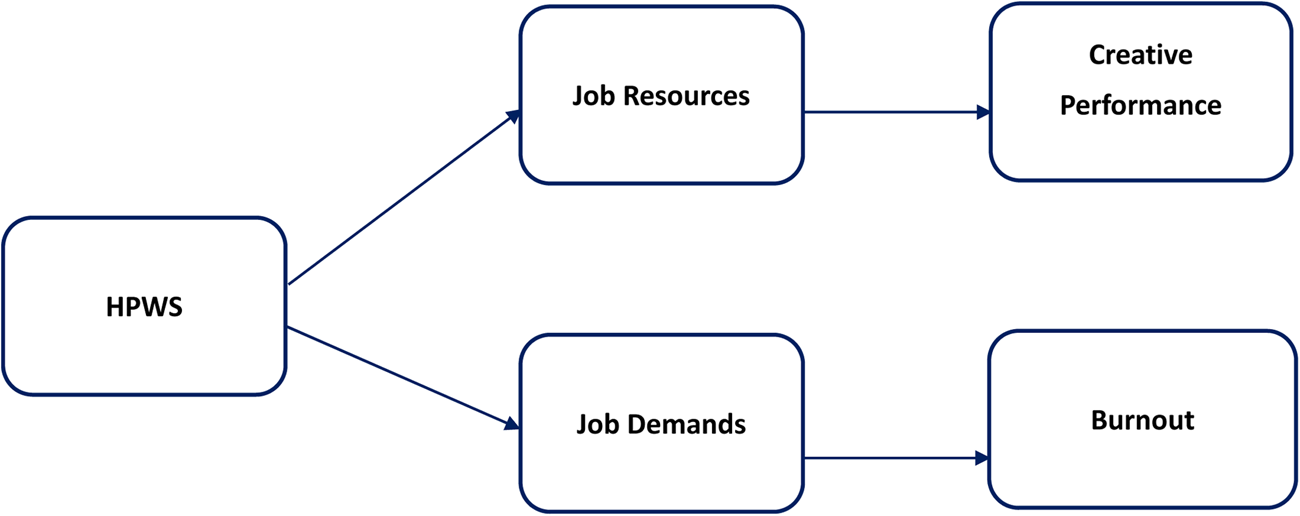
In this paper, we disentangle the paradoxical nature of HPWS through a dual-process JD-R mediation model and we show how employees can experience a positive outcome (i.e., creative performance) or a negative outcome (i.e., burnout) stemming from the employees' HPWS-related attributions. We investigate HPWS in terms of these two employee outcomes because creative performance is likely critical to organizational competitiveness (Amabile, Reference Amabile1997; Perry-Smith & Shalley, Reference Perry-Smith and Shalley2014) while burnout can harm not only employee well-being (Schaufeli, Bakker, van der Heijden, & Prins, Reference Schaufeli, Bakker, van der Heijden and Prins2009a) but also the organization itself (Halbesleben & Buckley, Reference Halbesleben and Buckley2004). In particular, we investigate and clarify the relationships between HPWS and employee outcomes from both micro- and macro-theoretical perspectives. In elucidating the JD-R mediation model, we posit that HR attribution theory is a foundation on which we can weave together various research threads pertaining to the AMO model, self-views, and ambidexterity. Our study is an answer to previous research calls (Guest, Reference Guest2011) for a rigorous disentangling of the paradoxical nature of HPWS. Figure 1 summarizes the model of the relationships proposed in the present study.
Theoretical model.

Theoretical background and hypothesis development
Most human-resource management (HRM) studies have grouped various HR practices into an overall HR system in which individual practices reinforce each other to drive employee performance (e.g., Van De Voorde, Paauwe, & Van Veldhoven, Reference Van De Voorde, Paauwe and Van Veldhoven2012). Bundling various HR practices into an HR system represents a composite-score approach (Wall & Wood, Reference Wall and Wood2005). Indeed, research has shown that when high-performance HR practices are in strong alignment with each other, the effectiveness of HPWS is greater than when poor alignment exists (Combs, Liu, Hall, & Ketchen, Reference Combs, Liu, Hall and Ketchen2006). Therefore, rather than differentiate HPWS into individual components, we treat HPWS as whole HR systems – an approach that is in line with previous research on the signaling effect of HPWS (Chuang & Liao, Reference Chuang and Liao2010; Jensen, Patel, & Messersmith, Reference Jensen, Patel and Messersmith2013; Kroon, van de Voorde, & Van Veldhoven, Reference Kroon, van de Voorde and Van Veldhoven2009).
In the case of HPWS as job-demands attribution, the ability-, motivation-, and opportunity-enhancing HPWS often take on an exploitative strategic form of HRM that, because it requires employees to devote sustained physical and psychological effort to their work, can impair their health. Likewise, the ambidexterity literature suggests that, by managing strategic HRM (Kang et al., Reference Kang, Morris and Snell2007), organizations can simultaneously pursue exploratory and exploitative learning to achieve innovations and improvement (O'Reilly & Tushman, Reference O'Reilly and Tushman2011). In conjunction with the AMO model, HPWS constitute a unique type of HR system that develops the skills, knowledge, and abilities of employees in integrated, synergetic ways and that rests on the assumption that hard-working people can, if given the opportunity, demonstrate their individual talents. Given this emphasis on individual motivation, we have chosen to investigate employee attitudinal and behavioral outcomes rather than organizational performance. Advancements in HPWS research will likely rely on HR attribution theory, which is inextricably intertwined with ability, motivation, and opportunity, and will thus shape both exploratory and exploitative strategic HRM designs in tandem with the JD-R model.
To be or not to be: the exploration and exploitation of HPWS
HR attribution theory posits that employees engage in HPWS attributions to determine whether HPWS are devoted chiefly to job resources or job demands. In the case of HPWS as job-resources attriutuion, employees' critical appraisal of ability-, motivation-, and opportunity-enhancing HPWS is more likely to emphasize resource provision than demands reinforcement; in other words, employees are more likely to ascribe HPWS to an exploratory strategic HRM than to an exploitative strategic HRM, with which organizations attempt to promote a motivational process in employees. With an explorative mindset, organizations that implement HPWS want to help employees attain new skills that promote creative performance; by contrast, with an exploitative mindset, these same organizations aim to promote the effectiveness and efficiency with which employees harness current knowledge or skills (Caniëls & Veld, Reference Caniëls and Veld2019; Kang & Snell, Reference Kang and Snell2009). The latter mindset runs the risk of generating burnout in employees. Employee creative performance (Chang, Jia, Takeuchi, & Cai, Reference Chang, Jia, Takeuchi and Cai2014) is of critical importance for organizations seeking to achieve competitive advantages and to avoid employee burnout, which quite obviously can deteriorate organizational productivity (Gulzar, Moon, Attiq, & Azam, Reference Gulzar, Moon, Attiq and Azam2014). Hence, it is imperative to investigate how HPWS affect employee creativity and employee burnout in the context of strategic HRM. Such research, if rigorously conducted, can contribute to an overall understanding of the explorative and exploitative functioning of HR systems.
With an explorative mindset (Kang & Snell, Reference Kang and Snell2009), organizations can implement HPWS to promote self-improvement in employees. Organizations that adopt exploratory strategic HRM designs are investing in new knowledge and skills of employees (ability), in directions and inducement (motivation), and in empowerment (opportunity). These investments reflect the exploratory characteristics of HPWS and are consistent with the AMO perspective (Jiang, Lepak, Hu, & Baer, Reference Jiang, Lepak, Hu and Baer2012). For example, skill-enhancing HR practices such as selective staffing and extensive training encourage employees to explore new abilities geared toward innovation (e.g., Chowhan, Pries, & Mann, Reference Chowhan, Pries and Mann2017). Motivation-enhancing HR practices such as results-oriented appraisals, incentive rewards, internal mobility, and employment security enhance employees' intrinsic motivation: these employees become more willing to engage in creative activities (e.g., Malik, Butt, & Choi, Reference Malik, Butt and Choi2015). Opportunity-enhancing HR practices such as clear job descriptions and participation increase the resources and other forms of support that organizations give their employees in order to foster team creativity through knowledge sharing (e.g., Ma, Long, Zhang, Zhang, & Lam, Reference Ma, Long, Zhang, Zhang and Lam2017).
With HPWS, organizations can encourage employees to pursue new skills that bolster creative performance (Liu, Gong, Zhou, & Huang, Reference Liu, Gong, Zhou and Huang2017); hence, in this study, we use the AMO model to theorize both HPWS and creative performance. Further, research has indicated that organizations using an exploratory approach to synergetic HR practices can promote employee creativity in the workplace (Chang et al., Reference Chang, Jia, Takeuchi and Cai2014; Chiang, Hsu, & Shih, Reference Chiang, Hsu and Shih2015; Liu et al., Reference Liu, Gong, Zhou and Huang2017; Martinaityte, Sacramento, & Aryee, Reference Martinaityte, Sacramento and Aryee2016; Zhang, Akhtar, Zhang, & Rofcanin, Reference Zhang, Akhtar, Zhang and Rofcanin2019). In keeping with the above-mentioned perspectives and reasoning, we expect that HPWS involve a set of bundled HR practices promoting creative performance in employees.
Hypothesis 1a: There is a positive association between HPWS and employee creative performance.
By contrast, organizations' adoption of an exploitative approach to the implementation of HPWS (Kang & Snell, Reference Kang and Snell2009) involves social exchanges, or reciprocity, that employees seek out (Zhang, Zhu, Dowling, & Bartram, Reference Zhang, Zhu, Dowling and Bartram2013). Thus, an exploitative strategic HRM mindset should promote organizational improvement (Medcof & Song, Reference Medcof and Song2013) through HR flexibility (Úbeda-García, Claver-Cortés, Marco-Lajara, & Zaragoza-Sáez, Reference Úbeda-García, Claver-Cortés, Marco-Lajara and Zaragoza-Sáez2016), which promotes and shapes the ability, motivation, and opportunity available to employees. Apparently, organizations implement HPWS with a view toward exploiting their employees' existing knowledge (Kang et al., Reference Kang, Morris and Snell2007; Swart & Kinnie, Reference Swart and Kinnie2010) and toward navigating turbulent business environments (Camps, Oltra, Aldás-Manzano, Buenaventura-Vera, & Torres-Carballo, Reference Camps, Oltra, Aldás-Manzano, Buenaventura-Vera and Torres-Carballo2016). Consequently, HPWS can be regarded as a set of ‘challenge job demands’ (e.g., Topcic, Baum, & Kabst, Reference Topcic, Baum and Kabst2016).
Although HR flexibility enables organizations to extend the degree to which employees engage in – and assume responsibility for – challenging task assignments, at the heart of the exploitative approach is the notion that HPWS-based ‘challenge job demands’ evolve into HPWS-based ‘hindrance job demands.’ HPWS can take the appearance of work intensification by reinforcing certain employee-borne burdens related to flexibility and thus by triggering conflicts between employees' desire for personal fulfillment and organizations' desire for efficiency and effectiveness. These conflicts reflect the exploitative characteristics of HPWS. Empirical research has uncovered considerable evidence linking HPWS to employee burnout (Godard, Reference Godard2001; Kroon et al., Reference Kroon, van de Voorde and Van Veldhoven2009; Zhang et al., Reference Zhang, Zhu, Dowling and Bartram2013) and to general anxiety and role overload (Jensen et al., Reference Jensen, Patel and Messersmith2013). For these reasons, regarding the exploitative HPWS perspective (Truss, Gratton, Hope-Hailey, McGovern, & Stiles, Reference Truss, Gratton, Hope-Hailey, McGovern and Stiles1997), we propose the following hypothesis:
Hypothesis 1b: There is a positive association between HPWS and employee burnout.
Making HPWS salient: The relationship between HPWS and job demands and job resources
The core premise in this study is as follows: the motivations that employees develop in response to their experience of HPWS shape the employees' response to HR practices (Hewett, Shantz, Mundy, & Alfes, Reference Hewett, Shantz, Mundy and Alfes2018). According to HR attribution theory (Nishii et al., Reference Nishii, Lepak and Schneider2008), the motivations that employees attach to personal development shape how they interpret HPWS. Additionally, employees' evaluation of their own motivation can shed light on their attitudes; likewise, employees' behaviors can reflect the formation of job resources and job demands in the workplace. Employees who are likely to experience HPWS may view the HR characteristics embedded within HPWS as signifying either overt exploration (of new resources) or covert exploitation (of existing resources) (Fu, Ma, Bosak, & Flood, Reference Fu, Ma, Bosak and Flood2015). In line with this conceptualization, here we closely examine (1) why stark differences characterize employees' responses to HPWS and (2) why these differences take the form of notably positive and negative interpretations of HPWS.
HPWS may promote an organization's job resources that, in the form of the eight HR practices discussed herein, fall into three basic categories: employee skills (i.e., selective staffing and extensive training), employee motivation (i.e., results-oriented appraisals, incentive rewards, internal mobility, and employment security), and employee opportunity (i.e., clear job descriptions and participation), as posited in the AMO model (Chuang, Jackson, & Jiang, Reference Chuang, Jackson and Jiang2016; Jiang et al., Reference Jiang, Lepak, Hu and Baer2012). Upon encountering HPWS, employees may react positively and may thus initiate proactive, self-starting behaviors geared toward improvement and change (Crant, Reference Crant2000; Grant & Ashford, Reference Grant and Ashford2008; Unsworth & Parker, Reference Unsworth, Parker, Holman, Wall, Clegg, Sparrow and Howard2003). Employees who want to use their skills, abilities, and knowledge to pursue personal status and career success are likely to adopt a self-enhancement strategy (Leroy, Segers, Van Dierendonck, & Den Hartog, Reference Leroy, Segers, Van Dierendonck and Den Hartog2018) that is consistent with their motivation. The self-enhancement perspective leads to the conclusion that employees are motivated to elevate their positive self-conceptions; thus, synergistic HR effects (Jiang et al., Reference Jiang, Lepak, Hu and Baer2012) may encourage employees to reassess HPWS in ways that promote employees' pursuit of professional development (i.e., career opportunities) and positive social relationships with supervisors and coworkers (i.e., supervisor and co-worker support).
In the former case, career opportunity energizes intrinsic motivation, which not only bolsters employees' future career growth but also enables employees to remodel themselves at different career stages (Kirk, Reference Kirk2015). In the latter case, the roles of leaders and co-workers fortify employees' extrinsic motivation to facilitate goal attainment or task accomplishment (Bakker & Demerouti, Reference Bakker and Demerouti2007). In general, HPWS can signify the organizational resources that act as drivers of intrinsic and extrinsic motivations: by cultivating career opportunities and social support, these resources assist employees in achieving work-related goals. This sequence of outcomes implies that the employees anticipate future career returns and long-term mutually beneficial relationships with the given organization. Therefore, we propose the following hypothesis.
Hypothesis 2a: There is a positive association between HPWS and job resources.
At the same time, we should bear in mind what Godard (Reference Godard2001, Reference Godard2004) has characterized as the downsides of HPWS, which reinforce stress on employees. Scholars have argued that HPWS can exploit employees for the sake of organizational performance (Godard, Reference Godard2001; Legge, Reference Legge1995; Peccei, Reference Peccei2004; Ramsay, Scholarios, & Harley, Reference Ramsay, Scholarios and Harley2000). Consequently, some employees view HPWS as a tool with which their organization exploits them and, in the process, jeopardizes their psychological and physical well-being (Jensen & Van De Voorde, Reference Jensen, Van De Voorde, Ashkanasy, Bennett and Martinko2016). Because employees may find other ways to constructively manage HPWS, we contend that employees' adoption of a self-protection strategy can be particularly useful. First, by protecting their well-being, employees can avoid their organization's excessive exploitation of them and can thus achieve a high degree of equilibrium. Empirical research indirectly supports the assertion that exploitative aspects characterize HPWS (Van De Voorde et al., Reference Van De Voorde, Paauwe and Van Veldhoven2012), suggesting that employees might experience emotional dissonance when they find themselves having to protect their existing resources from further depletion. Through a self-protection strategy, employees shield themselves from varying degrees of organizational exploitation, whether perceived or real.
Employees' adoption of a self-protection strategy as a response to their attribution of an exploitative nature to HPWS is not in alignment with their need for either self-fulfilling motivation or a state of balance. In dealing with the demanding aspects of HPWS, employees may have to manage a greater challenge than they can reasonably handle, resulting in a work overload (Shirom, Nirel, & Vinokur, Reference Shirom, Nirel and Vinokur2006). In theory, the exploitative aspects of HWPS implied in the literature on the JD-R model (Demerouti et al., Reference Demerouti, Bakker, Nachreiner and Schaufeli2001) and in the literature on challenge-and-hindrance stressors (e.g., Lepine, Podsakoff, & Lepine, Reference Lepine, Podsakoff and Lepine2005) suggest that organizations' HR practices can be viewed as job demands, hindrance stressors, or both (Jensen & Van De Voorde, Reference Jensen, Van De Voorde, Ashkanasy, Bennett and Martinko2016). Interactively, employees tend to associate HPWS with a quantitatively definable work overload. On the basis of these arguments and the empirical evidence, we propose the following hypothesis.
Hypothesis 2b: There is a positive association between HPWS and job demands.
The motivational process and the health-impairment process
Job demands and job resources can be categorized and experienced by employees in any job and at any level of an organization (Bakker & Demerouti, Reference Bakker, Demerouti, Diener, Oishi and Tay2018). The concepts of job demands and job resources are rooted in the core of JD-R theory (Bakker & Demerouti, Reference Bakker, Demerouti, Chen and Cooper2014), which describes how job characteristics may lead to employee motivation and exhaustion. These two powerful factors can respectively spur two qualitatively distinct psychological processes: a motivational process and a health-impairment process. The two processes may have important implications for organizations (Brenninkmeijer et al., Reference Brenninkmeijer, Demerouti, le Blanc and van Emmerik2010) and specifically for employee performance (Bakker & Demerouti, Reference Bakker, Demerouti, Diener, Oishi and Tay2018). Hence, building on this theory, we suggest that ongoing processes in HPWS may affect employee perceptions of job demands and job resources. These perceptions can then crucially guide employees toward innovative behaviors or toward burnout.
Job resources as a motivational process
When attributing exploratory characteristics to HPWS, employees tend to believe that they can fully engage in their work owing to crucial resources built into the HPWS. In line with the AMO perspective, we argue that the skill-, motivation-, and opportunity-enhancing features of HPWS create, in employees using a self-enhancement strategy, a tendency to view HR practices as investments made by organizations that believe in their employees' ability to perform well (Shantz et al., Reference Shantz, Arevshatian, Alfes and Bailey2016). Consequently, if HPWS are seen by employees as beneficial to their accumulation and development of job resources, the employees will be relatively inclined to embrace HPWS. This scenario aligns with JD-R theory; hence, we strongly suspect that HPWS can strengthen job resources and can position the resources as key determinants of motivated employee behavior, such as employee innovation (e.g., Bakker and Xanthopoulou, Reference Bakker and Xanthopoulou2013). Amabile, Conti, Coon, Lazenby, and Herron (Reference Amabile, Conti, Coon, Lazenby and Herron1996), taking a similar stance, found that supportive work environment drives employee creativity. Career opportunities can generate hope for career advancements, prompting employees to display increasingly divergent, novel solutions to work-related problems (Ostroff & Bowen, Reference Ostroff, Bowen, Klein and Kozlowski2000). In the realm of law, Malhotra, Smets, and Morris (Reference Malhotra, Smets and Morris2016) identified a positive link between promising career paths and attorneys' capacity for innovation. This reasoning and evidence align with the idea that HPWS can affect employees' exploration of job resources in ways that boost the employees' creative performance.
Oldham and Cummings (Reference Oldham and Cummings1996) and Shin and Zhou (Reference Shin and Zhou2003) asserted that supervisor or transformational leadership can enhance employee creativity. Zhou and George (Reference Zhou and George2001) and Madjar, Oldham, and Pratt (Reference Madjar, Oldham and Pratt2002) suggested that coworker supportive behavior promotes employee creativity. These findings have implications not only for the relationship between career advancement and employee creativity, but also, as we shall see, for the relationship between social support and employee creativity. In noting the motivational process of the JD-R model, we suggest that the skill-, motivation-, and opportunity-enhancing features of HPWS encourage employees to explore job resources, such as career opportunities and social supports, which in turn elicit creative performance from the employees. Correspondingly, we harness the motivational component of both the JD-R model and the literature on social exchange and creativity to propose the following hypothesis:
Hypothesis 3a: Job resources mediate the relationship between HPWS and employee creative performance.
Job demands as a process of exhaustion
Most employees who attribute the presence of HPWS in an organization to the organization's twin goals of reducing costs and of increasing demands on employees (Jensen et al., Reference Jensen, Patel and Messersmith2013) regard the HPWS as a set of exploitative HR practices. Hence, we suggest that employees who have adopted a strategy of self-protection may view HPWS from the highly critical perspective of employee coercion and exploitation (Kroon et al., Reference Kroon, van de Voorde and Van Veldhoven2009; White, Hill, McGovern, Mills, & Smeaton, Reference White, Hill, McGovern, Mills and Smeaton2003). As a result, these employees will likely interpret HPWS as the organization's way of increasing demands on employees for organizational efficiency and effectiveness. Perhaps unexpectedly, the skill-, motivation-, and opportunity-depleting features of HPWS can pose a threat to employees' health, including their psychological health, leading to job demands, emotional dissonance, and work overload, which, over time, can result in high levels of exhaustion. Emotional dissonance manifests itself when self-protected employees have to deal with structural discrepancies between HPWS-triggered emotions and emotions required for display in the workplace. As for work overload, HPWS may impose excessively high workloads on employees (Godard, Reference Godard2001, Reference Godard2004) in a bid to make them comply with assigned HR practices. Empirical research has presented evidence that the suppression of emotions can provoke burnout (Bakker & Heuven, Reference Bakker and Heuven2006; Diestel & Schmidt, Reference Diestel and Schmidt2010).
Likewise, work overload reinforces workplace obligations and constraints that heighten employees' psychological strain and particularly their risk of burnout (Brenninkmeijer et al., Reference Brenninkmeijer, Demerouti, le Blanc and van Emmerik2010; Schaufeli, Bakker, & Van Rhenen, Reference Schaufeli, Bakker and Van Rhenen2009b). These theoretical and empirical findings suggest that the exploitative features of HPWS drive those employees who embrace a self-protection strategy to perceive HPWS as a burnout risk factor – one that takes the form of certain job demands (e.g., Bakker, Van Emmerik, & Van Riet, Reference Bakker, Van Emmerik and Van Riet2008; Demerouti et al., Reference Demerouti, Bakker, Nachreiner and Schaufeli2001). In the context of health-impairment processes, these various findings suggest that the skill-, motivation-, and opportunity-depleting features of HPWS instigate perceptions of job demands that are associated with emotional dissonance and work overload, which in turn can lead to burnout. All in all, this type of demanding work environment, as fostered by HPWS, points to our next hypothesis in the current study:
Hypothesis 3b: Job demands mediate the relationship between HPWS and employee burnout.
Methods
Participants and procedures
To test the research framework of this study, the first author collected data from Taiwanese employees working in a range of fields: the service industry (34.7%), the manufacturing industry (18.7%), the semiconductor industry (11.9%), the civil service (9.6%), the mass media industry (6.8%), the financial industry (4.5%), the educational sector (3.2%), the healthcare industry (2.6%), and others (8.0%). Among the study's recruits were employees from a high-tech company, on-the-job training students in four undergraduate night courses, on-the-job training students in two in-service master's programs, and administrative staff from a national university. Altogether, the recruits encompassed a great variety of occupations. A total of 472 employees were solicited for participation in this study, resulting in a response rate of 65.9%. Of the 311 participants in the final sample, 57.6% were women. The average age was 32.45 years (SD = 8.46 years), and daily hours worked were 9.33 hours (SD = 2.23 hours). Participants fell into one of the following four education-level categories: a high school diploma at most (10.0%), a junior college degree (15.1%), a college/university degree (63.3%), and a graduate school degree (11.6%).
The scales of this questionnaire rested on published measures covering the themes of HPWS, supervisor support, coworker support, emotional dissonance, work overload, creative performance, burnout, and standard demographic variables (i.e., gender, age, education, marriage, occupation, industry, and daily work hours). The first author employed a back-translation procedure (Brislin, Reference Brislin, Triandis and Berry1980) for this study, and had all of its scales translated into Chinese by three bilingual PhD students who had studied in English-speaking countries for two or more years. To ensure that the text would undergo a further round of scrutiny, the first author engaged two Taiwanese faculty members who were proficient in English and who were specialists in HR management. Participants filled out the structured questionnaires only one time; thus, the research design yielded cross-sectional data.
Measures
All items were measured with a five-point Likert response scale ranging from 1 (strongly disagree) to 5 (strongly agree).
Human-resource practices associated with HPWS
We adopted a total of 27 item scales to measure this study's eight HR practices (Sun et al., Reference Sun, Aryee and Law2007): selective staffing, extensive training, internal mobility, employment security, clear job descriptions, results-oriented appraisal, incentive rewards, and participation. Sun and colleagues developed this 27-item scale by conducting an extensive review of the relevant literature, interviewing HR managers in China, and adopting two items from Bae and Lawler (Reference Bae and Lawler2000), who themselves had adopted the items from the original developers: Snell and Dean (Reference Snell and Dean1992) and Delery and Doty (Reference Delery and Doty1996). Additionally, Sun and colleagues conducted a pilot study consisting of both exploratory factor analysis and confirmatory factor analysis, which indicated satisfactory levels of validity and reliability. Below are several sample items from the questionnaire: ‘Considerable importance is placed on the staffing process’ (selective staffing), ‘Formal training programs are offered so that employees can increase their promotability in this organization’ (extensive training), ‘Employees have clear career paths in this organization’ (internal mobility), ‘Employees in this job can be expected to stay with this organization for as long as they wish’ (employment security), ‘This job has an up-to-date description’ (clear job description), ‘Performance is more often than not measured with objective quantifiable results’ (results-oriented appraisal), ‘Individuals in this job receive bonuses based on the profits of the organization’ (incentive rewards), and ‘Supervisors keep open communications with employees in this job’ (participation). The Cronbach's alpha coefficient is .92. To verify the distinctiveness of HPWS, we conducted a series of confirmatory factor analyses, and the results indicate that the eight-factor measurement model fit the data well (χ2 = 848.27; df = 296; RMSEA = .08; SRMR = .07; CFI = .90; TLI = .90).
Job demands
Job demands were measured according to emotional dissonance and work overload. Emotional dissonance was measured with six items developed by Van Veldhoven and Meijman (Reference Van Veldhoven and Meijman1994). An example item is ‘My work put me in emotionally upsetting situations.’ The Cronbach's alpha coefficient is .79. Work overload was measured with three items based on Karasek's Job Content Questionnaire (Karasek, Reference Karasek1985). These items can measure a quantitatively demanding aspect of an individual's work. An example item is ‘I don't have enough time to get the job done.’ The Cronbach's alpha coefficient is .74.
Job resources
Job resources were measured in reference to social support and career opportunity. Social support was divided into co-worker support (corresponding to four items) and supervisor support (corresponding to another four items) (Karasek, Brisson, Kawakami, Houtman, Bongers, & Amick, Reference Karasek, Brisson, Kawakami, Houtman, Bongers and Amick1998). A sample item for co-worker support is ‘People I work with take a personal interest in me’; a sample item for supervisor support is ‘My supervisor pays attention to what you are saying.’ The Cronbach's alpha coefficients are .88 for co-worker support and .91 for supervisor support. Career opportunity was measured with the three-item scale of Bakker, Demerouti, Taris, Schaufeli, and Schreurs (Reference Bakker, Demerouti, Taris, Schaufeli and Schreurs2003). Two sample items are ‘In my work, I have the opportunity to develop my strong points’ and ‘In my work, I can develop myself sufficiently.’ The Cronbach's alpha coefficient is .86.
Burnout
For the measurement of burnout, we adopted a five-item subscale of the Maslach Burnout Inventory – General Survey (Schaufeli, Leiter, Maslach, & Jackson, Reference Schaufeli, Leiter, Maslach, Jackson, Maslach, Jackson and Leiter1996). A sample item is ‘I feel tired when I get up in the morning and have to face another day on the job.’ The Cronbach's alpha coefficient is .89.
Creative performance
This category was measured with four items developed by Farmer, Tierney, and Kung-McIntyre (Reference Farmer, Tierney and Kung-McIntyre2003). A sample item is ‘This employee generates ground-breaking ideas related to the field.’ The Cronbach's alpha coefficient is .80.
Control variables
For the control variables, we used participants' demographic information pertaining to age, gender, education, and hours worked daily. Each of these variables could have a bearing on employee behavior (e.g., Ng & Feldman, Reference Ng and Feldman2008). Age is thought to be associated with proactive traits (e.g., Thomas, Whitman, & Viswesvaran, Reference Thomas, Whitman and Viswesvaran2010), educational level might lead to increased creative performance (e.g., Madrid & Patterson, Reference Madrid and Patterson2020), people's gender might alter their experience of work stress (e.g., Bolino & Turnley, Reference Bolino and Turnley2005), and daily hours worked might be closely associated with an employee's emotional exhaustion (e.g., Sonnentag, Binnewies, & Mojza, Reference Sonnentag, Binnewies and Mojza2008). In addition, when testing the mediating hypothesis about job demands, we controlled for job resources; likewise, when testing the mediating hypothesis of job resources, we controlled for job demands.
Analytical strategy
First, we conducted confirmatory factor analyses (CFAs) to establish the validity and robustness of the measurement model in relation to HPWS, job demands (emotional dissonance and work overload), job resources (social support and career opportunity), burnout, and creative performance. Next, we tested Hypotheses 1a and 1b by means of linear regressions, in which we regressed both creative performance on HPWS and burnout on HPWS while controlling for age, gender, education, and daily hours worked. For Hypotheses 2a, 2b, 3a, and 3b, we tested them by using PROCESS 3.3 macro (Model 4; Hayes, Reference Hayes2015) with 95% confidence intervals and 5,000 bootstrapping re-sampling. In Model 4 of PROCESS 3.3 macro, we regressed job resources on HPWS while controlling for job demands, age, gender, education, and daily hours worked; by contrast, we regressed job demands on HPWS while controlling for job resources, age, gender, education, and daily hours worked. Furthermore, to examine the significance of indirect effects, we used bootstrapping techniques that would ensure robust estimation of the indirect effects proposed in Hypotheses 3a and 3b.
Results
The CFA results demonstrated that the theoretical model fit the data well (χ2 = 294.50; df = 109; RMSEA = .07; SRMR = .05; CFI = .92; TLI = .90), and that all factor loadings were significant. A four-factor model (HPWS, combined job demands and job resources, burnout, and creative performance; χ2 = 2,958.18; df = 659; RMSEA = .11; SRMR = .09; CFI = .65; TLI = .62), a three-factor model (HPWS, combined job demands and job resources, combined burnout and creative performance; χ2 = 3,319.45; df = 662; RMSEA = .11; SRMR = .11; CFI = .59; TLI = .56), and a null model (χ2 = 8,833.88; df = 1,710; RMSEA = .12; SRMR = .13; CFI = .36; TLI = .33) showed poorer measurement fitness than did the theoretical model. These results illustrate that the focal variables in this study could be differentiated at the construct level.
Concerning the issue of common method variance in this cross-sectional data set, we have conducted Harman's single factor test (Podsakoff, MacKenzie, Lee, & Podsakoff, Reference Podsakoff, MacKenzie, Lee and Podsakoff2003). The results show that the first factor accounted for only 22.55% of this variance, indicating that common method variance was unlikely to pose a threat to the validity of the data.
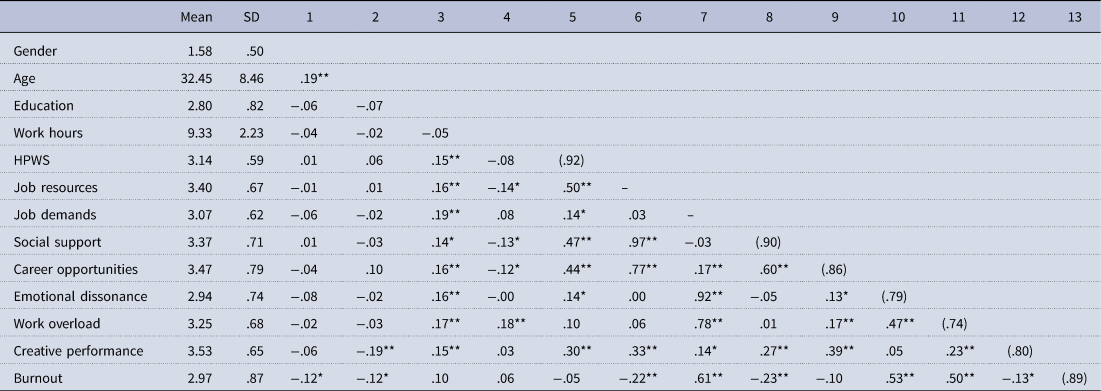
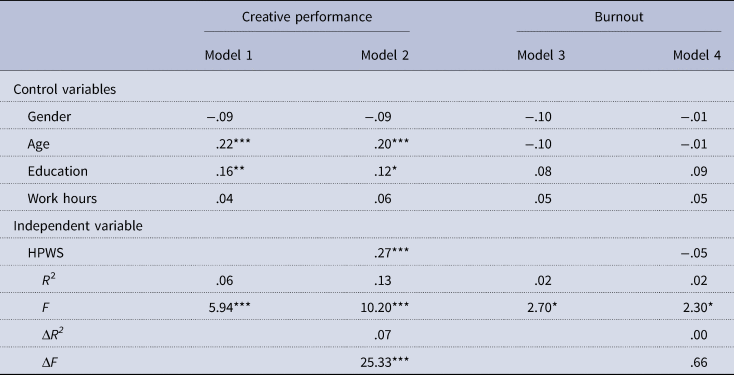
Table 1 presents the descriptive statistics of the means, standard deviations, and correlations of the study variables. Table 2 presents the linear-regression test results for Hypotheses 1a and 1b, with the four demographic variables controlled for. In support of Hypothesis 1a, results show a positive association between HPWS and employee creative performance (Model 2; γ = .27, p < .001). Hypothesis 1b predicted a positive association between HPWS and employee burnout. The results do not support Hypothesis 1b, as there was no significant association between HPWS and employee burnout (Model 4; γ = −.05, p > .05).

Hierarchical regression analysis of creative performance and burnout on HPWS
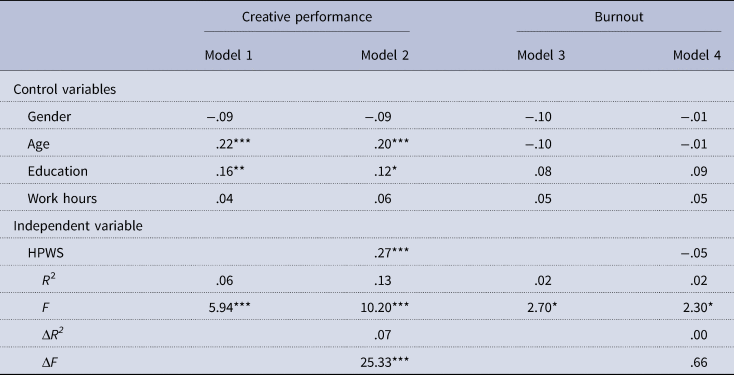
*p < .05, **p < .01, ***p < .001.
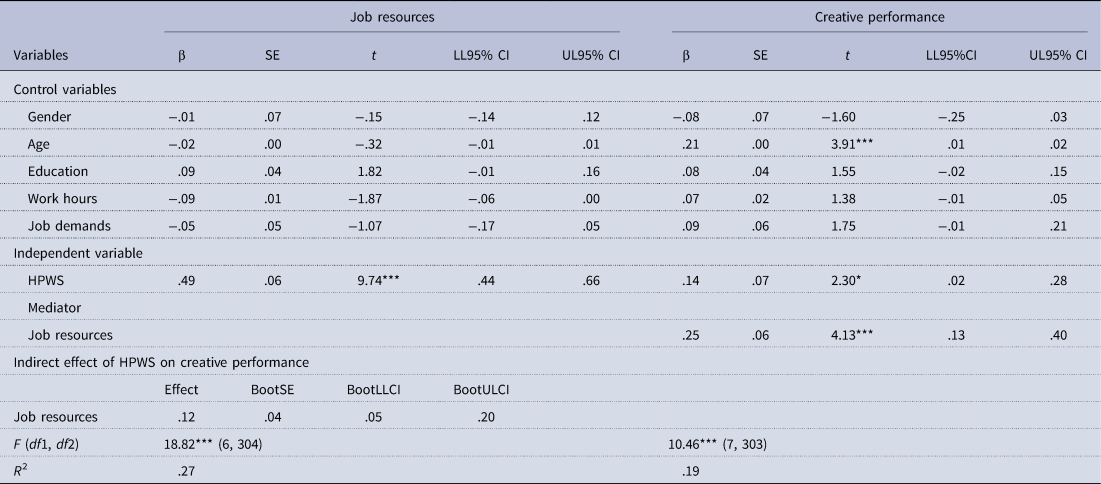
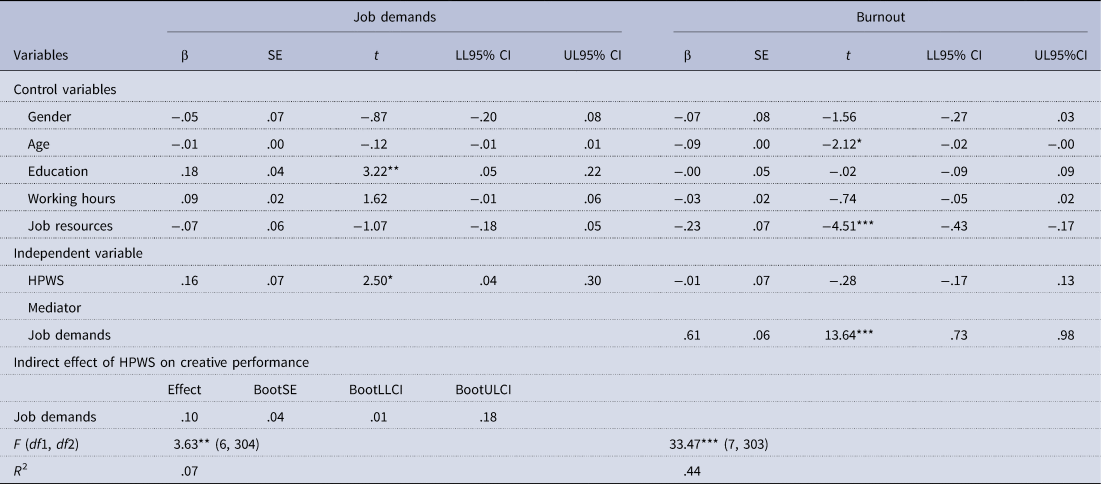
A condition for mediation by job demands and job resources is that HPWS be positively associated with these variables. Therefore, before estimating the models for burnout and creative performance, we estimated the models of Table 2 by using job demands and job resources as dependent variables. In support of Hypotheses 2a and 2b, the results show that a positive association existed between HPWS and job resources (Table 3; β = .49, t = 9.74, p < .001) and between HPWS and job demands (Table 4; β = .16, t = 2.50, p < .05).
The mediating effects of job resources
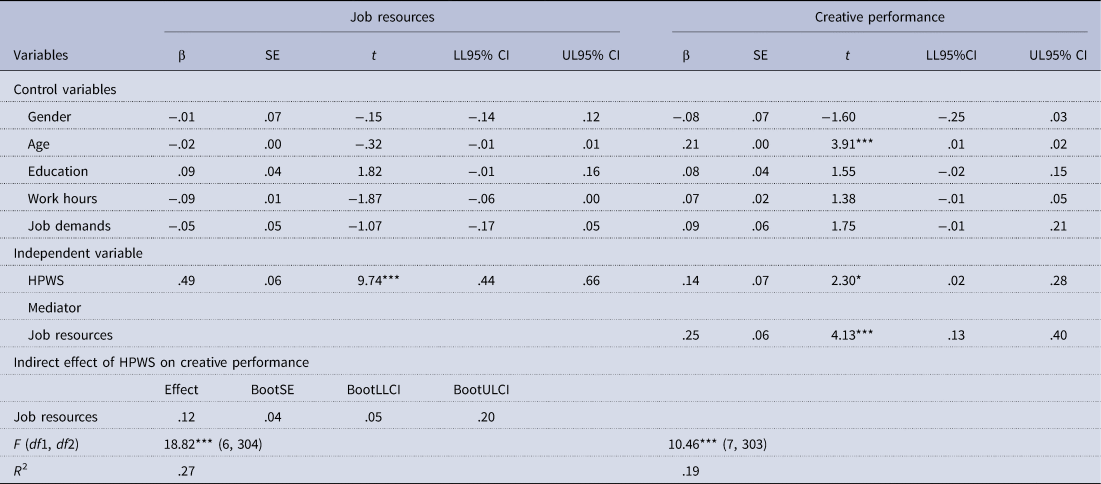
Notes: N = 311. *p < .05, **p < .01, ***p < .001. Bootstrap sample size = 5,000.
The medicating effects of job demands

Note: N = 311. *p < .05. **p < .01. ***p < .001. Bootstrap sample size = 5,000.
Regarding the mediation hypotheses, we predicted that job resources mediate the relationship between HPWS and employee creative performance and that job demands mediate the relationship between HPWS and employee burnout. In support of Hypothesis 3a, the results show that, when job demands were controlled for, job resources partially mediated the relationship between HPWS and employee creative performance (Table 3; β = .25, t = 4.13, p < .001). The bootstrapping results indicate that this mediating effect was significant: with bias 95% corrected for, confidence intervals were between .05 and .20. Regarding Hypothesis 3b, the results support it: when job resources were controlled for, job demands partially mediated the relationship between HPWS and employee burnout (Table 4; β = .61, t = 13.64, p < .001). The bootstrapping results indicate that this mediating effect was significant: with bias 95% corrected for, confidence intervals were between .01 and .18.
Discussion
We developed and tested a JD-R model that would clarify the mechanisms by which job resources and job demands contribute to employee creative performance and burnout, respectively. The results of our study illustrate that employees who attribute ability-, motivation-, and opportunity-enhancing features to their organization's HPWS (i.e., employees who perceive an exploratory HPWS) are likely to experience enhanced motivation and are thus likely to create job resources, which further build up creative performance. By contrast, employees who attribute ability-, motivation-, and opportunity-depleting features to their organization's HPWS (i.e., employees who perceive an exploitative HPWS) are likely to protect resources and are likely to counteract job demands, resulting in burnout. By modeling these two processes of HPWS-related employee attributions, we have shed light on the paradoxical nature of HPWS and on the ways in which employees' HR attributions can be profoundly significant in dynamic HPWS contexts.
We can learn two important facts from employees' attribution of certain features to HPWS. First, in line with the self-enhancement perspective (Korman, Reference Korman, Erez, Kleinbeck and Thierry2001), those employees who view HPWS as a path to work-performance success tend to adopt a self-enhancement strategy that promotes positive work attitudes and behaviors. And in line with the self-protection perspective (Korman, Reference Korman, Erez, Kleinbeck and Thierry2001), those employees who view HPWS as a path to organizational exploitation of workers tend to adopt a self-protection strategy that, by promoting avoidance of potential and feared failure, maintains the employees' positive self-views. Overall, we examine the positive and negative effects of HPWS on employees by taking into account these two strategies. We should note that, at the outset of this study, we suspected that differences among employees regarding their self-concepts would be associated with HPWS. Specifically, we suspected that our study's eventual findings would reveal HPWS to be a predictor of job resources and job demands.
The second important fact that we can learn from employees' attribution of certain features to HPWS is that employees' experience of HPWS can influence their work attitudes and behaviors. In fact, this influence is posited by the JD-R model of motivational and health-impairment processes (Bakker & Demerouti, Reference Bakker, Demerouti, Chen and Cooper2014, Reference Bakker and Demerouti2017; Schaufeli & Taris, Reference Schaufeli, Taris, Bauer and Hämmig2014). Consequently, one of our aims here is to clarify two sets of mediating effects: (1) the mediating effects that job resources have on the relationship between HPWS and employee creative performance, and (2) the mediating effects that job demands have on the relationship between HPWS and burnout.
Theoretical implications
This study contributes to theories of – and research on – HPWS. Specifically, we employ a micro-dynamics perspective to investigate how employees' perceptions of HPWS can result in employees' attribution of explorative and exploitative features to HPWS. To understand the potential relationships between HPWS and employee performance, we turn our attention to HR attribution theory, which weaves both the AMO perspective and the self-views of employees into the JD-R model. Our testing of the exploration-based motivational and an exploitation-based exhausting processes of HPWS sheds light on how employees' HPWS attributions can influence the employees' perception of job resources and job demands. Specifically, we have addressed how two types of job resources (career opportunities and social support) build up employee creative performance. At the same time, we modelled how two types of job demands (emotional dissonance and work overload) lead to employee burnout. We found that creative performance and burnout arise when employees attribute their organization's implementation of HPWS to certain organizational aims, so that the attributions evolve into employee actions. Hence, a central value of the present study lies in its macro- and micro-analysis of the paradoxical nature of HPWS.
An equally important value of the present study is its significant contribution to attribution theory in the HPWS literature focusing on how employees use self-enhancement and self-protection strategies to make sense of job demands and job resources. This proposition aligns with Guest (Reference Guest2002), who called for HRM research that shines a spotlight on employees. Rather than conduct research whose focus is HPWS-based well-being (i.e., Boxall & Macky, Reference Boxall and Macky2014; Heffernan & Dundon, Reference Heffernan and Dundon2016; Van De Voorde et al., Reference Van De Voorde, Paauwe and Van Veldhoven2012), we study attitudinal and behavioral outcomes pertinent to employee burnout and creative performance, respectively. By doing so, we use robust theories to explore certain outcomes that spring from HPWS perceptions, appraisals, and attributions. By framing a JD-R model and by illustrating how job resources and job demands play mediating roles in the relationship between HPWS and employee creative performance and burnout, we have demonstrated the bright and dark sides of HPWS simultaneously.
In harnessing the exploratory and exploitative perspectives of HRM, we acknowledge that employees are not passive: they play a proactive role in attributing HPWS to either job demands or job resources. However, a noteworthy finding from our study is that employee burnout is not significantly associated with HPWS unless job demands play a mediating role in the relationship between the two variables. Although organizations that adopt an exploitative strategy intensely mine employees' existing knowledge stocks, our current study's focus on employees' use of exploitative strategies should enrich the literature on HPWS and on organizational ambidexterity (Kang et al., Reference Kang, Morris and Snell2007). Alternatively, the core tenets of the conservation-of-resources theory (Hobfoll, Reference Hobfoll1989) may explain the insignificance of the HPWS effect on employee burnout insofar as employees who attribute start engaging in resource conservation.
Another novel theoretical contribution made by our current study is its focus on the idea of depletion relative to the AMO model (namely, the ability-, motivation-, and opportunity-depleting features of exploitation). We do not aim to topple or even criticize the traditional ‘Holy Grail’ view of the AMO model. Rather, our aim is to allow for a broad conception of HR configurations – one that incorporates a thorough, robust set of HR policies designed to manage human capital and to guide employees (Purcell & Kinnie, Reference Purcell, Kinnie, Boxall, Purcell and Wright2007). As the AMO model offers researchers an analytical framework within which they can investigate certain variables' mediating roles in the relationships between HPWS and individual performance (Peccei & Van De Voorde, Reference Peccei and Van De Voorde2019), HR practices can form an integrated system whose individual practices are internally aligned with one another and externally aligned with organizational strategies (Becker & Huselid, Reference Becker and Huselid1998; Evans & Davis, Reference Evans and Davis2005; Guthrie, Reference Guthrie2001; Huselid, Reference Huselid1995; Sun et al., Reference Sun, Aryee and Law2007). This tenet is important because it connects employee attribution, motivation, and satisfaction to HPWS implementation, thus permitting organizations to use employees' abilities, knowledge, and skills in the context of HPWS.
Managerial implications
The results of the current study have some important implications for relevant actors in the field. By far, most of these implications concern organizations' management of employees. The study's findings, by showing that HPWS can tangibly benefit individual employee outcomes, should help managers justify their organizations' use of HPWS, as these outcomes can both enhance organizational performance and reduce HR-related costs. To reduce the detrimental effects of HPWS, organizations must vigilantly monitor two types of practices: employees' HPWS attributions and organizations' HPWS implementation. By observing and responding to these practices thoughtfully, HR managers can, wherever possible, prevent HPWS from harming employees' performance and well-being and can prepare aids for those employees who resist engaging in HPWS. In these ways, organizations can effectively intervene in the HPWS-implementation stages. Also in the current study, we propose that organizations should develop a robust set of bundled HR practices through which the organizations can convey their appreciation of how well their employees develop abilities, harness motivation, and seize opportunities.
Of course, managers must be able to accurately detect employees' perceptions of assigned HR practices because the benefits of HPWS are highly dependent on the nature of these perceptions. On one hand, managers can encourage those employees pursuing personal development to regard HPWS as a set of job resources in order to sustain positive employee and organizational outcomes in these situations. On the other hand, managers should be mindful of those employees who associate HPWS with job demands. In particular, managers can develop methods for reducing any large discrepancies between these employees' abilities and HPWS requirements.
With such HR policies in place, employees may be more likely to embrace HPWS before organizations' implementation of HPWS interferes in the well-being, as well as in the performance, of the employees. Thus, organizations can reduce employee burnout. The result is a win-win situation for both organizations and their employees.
Limitations and future research
As in most research, this study has certain limitations. First, a cross-sectional design cannot establish causality and may suffer from the common method bias issue. Indeed, for a study aiming to investigate the potential causes of contextual (HPWS), state (job demands, job resources), and outcome (employee attitudes and behaviors) variables of interest, we have sought to identify and explore meaningful patterns. Hence, our study's cross-sectional design has enabled us to uncover evidence of relationships among the proposed variables (Spector, Reference Spector2019). The double-edged nature of this approach to HPWS research is deserving of attention. Moreover, given concerns about single-rater bias (Gerhart, Wright, McMahan, & Snell, Reference Gerhart, Wright, McMahan and Snell2000), it is important that the current study's hypotheses be tested with data from multiple independent subsamples and from multiple respondents within each subsample. Time-lagged or longitudinal designs may be the most robust designs for establishing accurate causal relationships among variables.
Second, our research model incorporates two mediating mechanisms. Researchers in the field should go beyond examinations of direct and indirect effects, and should start looking into factors that may moderate the effects of HPWS on attitudes, behaviors, and outcomes. We can productively analyze individual-level factors (Oldham & Cummings, Reference Oldham and Cummings1996) because individual differences can strongly affect employees' perceptions, values, and beliefs, leading to exhaustion and dips in motivation. For instance, a proactive personality, a focus on regulations, and job-crafting behaviors are possible potent moderators of the relationship between HPWS and job-demand or job-resource perceptions. We know from previous research (Batt, Reference Batt2002; Datta, Guthrie, & Wright, Reference Datta, Guthrie and Wright2005; Sun et al., Reference Sun, Aryee and Law2007) that, in the relationship between HPWS practices and firm performance, such contingent factors as leadership style and climate can foster desirable outcomes in employee work. In keeping with these findings, future research would do well to examine potential boundary conditions that explain contextual factors in the promotion or impedance of employee performance.
Also, although this study explores employee strategies related to HR attribution, self-enhancement, and self-protection, future research can strengthen our findings by further examining and validating our measurements of these focal constructs. Future research can also examine whether these constructs play mediating or moderating roles in the relationship between HPWS and employee performance. Finally, because one potential limitation of our study rests on our decision to heterogeneously draw our sample from various industries (a decision that may marginally limit the assumptions and key themes of our study), future studies can try to replicate our study's results by conducting a more detailed assessment of job levels, economic sectors, and various cultural contexts. Despite the unavoidable limitations in the current study, it effectively emphasizes the importance of demonstrating the bright and dark sides of HPWS. The results of the study advance the HPWS literature by suggesting that job resources and job demands help transform employees' perceptions of HPWS into, respectively, creative performance and burnout.
Concluding remarks
In this study, we have drawn on the theoretical lenses of HR attribution theory, the AMO model, ambidextrous behavioral approaches, and self-concept theory to create a JD-R model that disentangles the paradoxical nature of HPWS and that clarifies the mixed findings of HPWS black-box studies in the extant HPWS literature. In these regards, our study has provided considerable evidence that the ways in which employees attribute either job resources or job demands to HPWS are quite relevant to employees' performance outcomes. This study has clear theoretical and practical implications, as well as the standard limitations. Future research should continue to examine individual behavioral strategies pertaining to individual differences and, in doing so, should draw from the current study, which is an initial and important step in the exploration of these complex matters.
Acknowledgements
Great thanks are extended to Stanley Liang, Maggie Lee, and Ray Lu for their indispensable assistance in the processes of data collection and data cleaning. An earlier version of this paper was presented at the 2012 ANZAM conference.
Yuan-Ling Chen is an assistant professor in the MBA Program for International Business Communications in the College of Humanities and Management at National Ilan University. She received her PhD in organizational behavior and human resource management from I-Shou University, Taiwan. Her research interests include organizational behavior, human resource management, and proactive work behaviors.
Shyh-Jer Chen is a distinguished professor at the Institute of Human Resource Management in the College of Management at National Sun Yat-sen University. He received his PhD in labor and employment relations from the University of Illinois, Urbana Champaign. His primary research interests are HRM, strategic HRM, and family business.