

DISCUSSION POINTS
• Are solar surfaces a bad idea or tomorrow’s mainstream technology?
• What would it take for solar surfaces to become commonplace?
Introduction
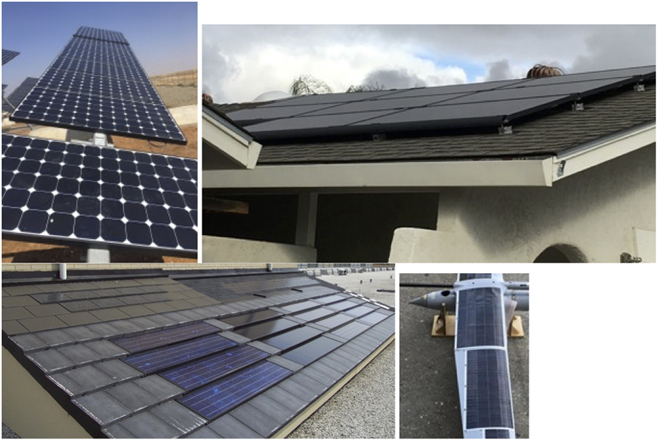
As the solar industry has grown, so have the types of systems. Examples are shown in Fig. 1. Ground-mounted systems [Fig. 1(a)] may be easily mounted on almost any land with minimal variation in system design. Building-applied photovoltaic (BAPV) systems [Fig. 1(b)] are typically mounted just above the existing roof, allowing airflow underneath to help cool the modules, with designs modified to accommodate the building structure. Building-integrated photovoltaic (BIPV) systems [Fig. 1(c)] replace one or more building components.Reference Dinwoodie and Shugar1 In this example, the shingles or tiles that would normally protect the roof are no longer needed as the BIPV system covers the entire roof and is designed to provide protection for the building. Photovoltaic (PV) systems have the potential to be integrated into most every surface. The example shown in Fig. 1(d) is of a thin-film GaAs solar-cell array built directly into the wing of a drone, providing extra value as a lightweight, high-efficiency electricity source.Reference Reese, Glynn, Kempe, McGott, Dabney, Barnes, Booth, Feldman and Haegel2 Such implementations may be referred to as vehicle-integrated PV (VIPV), automobile-integrated PV (AIPV), PV on things (PVoT), or simply “solar surfaces.” In this article, we discuss integration of PV into a wide variety of surfaces and, for simplicity, will refer to these, collectively, as solar surfaces.
Examples of types of PV systems. (a, upper left) Ground-mounted. (b, upper right) Building-applied (BAPV) in which the PV system is applied to the completed building. (c, lower left) Building-integrated (BIPV) in which one or more building elements are replaced by the solar system (in this example, the solar panels are similar to BAPV panels, but have been mounted in such a way that on the area covered by them, the shingles are not needed), and (d, lower right) surface-integrated system in which thin PV devices are built directly into the surface.

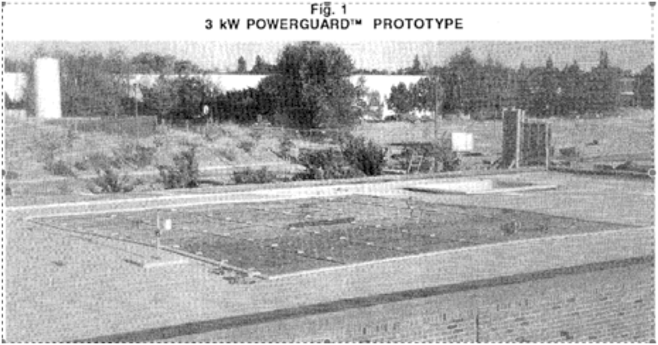
In the early days of solar PV research, the mainstream vision of solar PV implementation focused on rooftop applications, with both building-applied and building-integrated products explored. As an example of the type of BIPV product developed during that timeframe, Fig. 2 shows the PowerGuard prototype by PowerLight in 1994. The product was described as having many advantages: “…the building integration reduces the cost of a PowerGuard™ system by 14–26% rather than incurring a structural mounting cost of 18–22% to conventionally fasten the system.”Reference Dinwoodie and Shugar1 Indeed, the core of the vision of BIPV is the cost reduction potential of eliminating the racking used in a ground-mount system and eliminating the shingles or tiles that are used in a conventional roof. Additionally, in the case of the PowerGuard product, the added insulation was designed to improve the building thermal performance.Reference Dinwoodie and Shugar1
PV roofing system introduced in 1994.Reference Dinwoodie and Shugar1 © [1994] IEEE. Reprinted, with permission, from [Proceedings of 1994 IEEE 1st World Conference on Photovoltaic Energy Conversion—WCPEC (A Joint Conference of PVSC, PVSEC, and PSEC)].

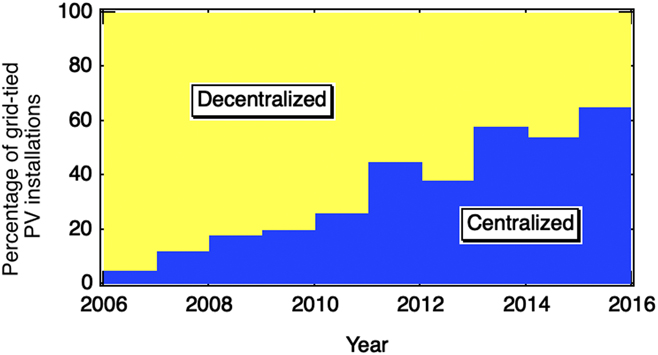
However, BIPV products such as PowerGuard have not been widely adopted, partly because building-applied products were readily available, but also because of cost and reliability problems for the BIPV products. Furthermore, after about 2006, centralized, utility-scale systems began to capture substantial market share from the decentralized rooftop markets (see Fig. 3).3
Partition of grid-tied PV installations between decentralized (yellow) and centralized (blue) installations.3

This article poses the question of whether the original vision of solar surfaces was a mistake or whether solar surfaces could still become mainstream. We start by exploring some of the challenges and how the world may have now reduced some of these barriers. We then explore various approaches and estimate the potential value if taken to the extreme approach that would minimize the use of materials (and, therefore, presumably cost). We estimate the potential markets for such applications to assess the potential for becoming a mainstream application. Finally, we discuss some of the many interesting research challenges that could enable broad use of solar surfaces and speculate how our world could be different a hundred years from now if such research were to be successful.
Challenges of solar surfaces and what has changed
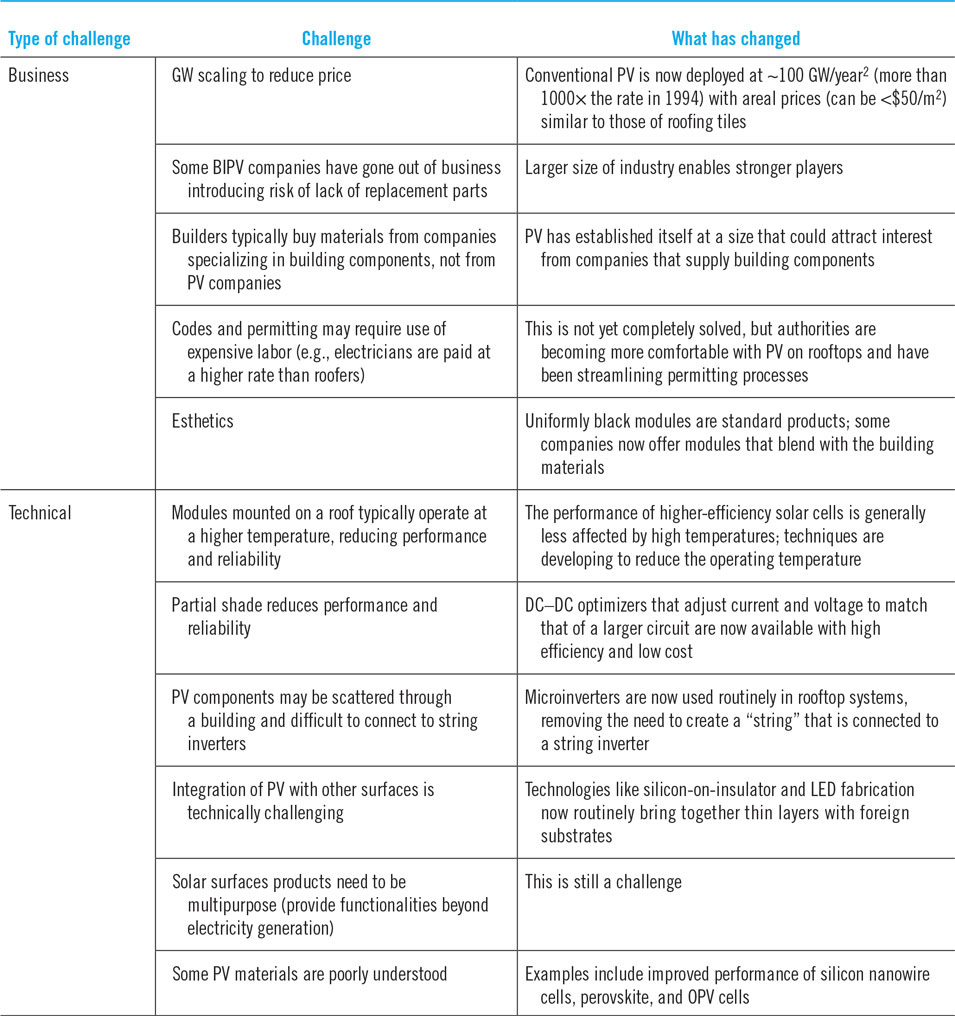
Barriers to mass deployment of solar surfaces include both business and technical challenges. Examples are summarized in Table 1. Many of the challenges are interrelated. Today’s module prices are possible because the PV industry mass produces almost a billion modules/year.3 Mainstream success of solar surfaces may require mass production on a comparable scale. The PV industry has now grown to a size and stature that may attract investment by mainstream builders, enabling low-cost and low-risk PV products to be used as the default option not only for roofing materials, but also for facades, windows, and other building components.
Some challenges of solar surfaces and how the world has changed to help address these.

Customers’ preferences for attractive esthetics are reflected in the multiple PV product designs offered by PV companies.Reference Kurtz, Wohlgemuth, Hacke, Bosco, Kempe and Smith4 Typically, changing the appearance of the module is associated with a performance penalty (such as using a back sheet that appears black from the front of the module, giving the module a uniformly black appearance, but increasing the operating temperature of the module just slightly). On the other hand, some companies are now developing modules with a white appearance or an appearance that mimics building components.Reference Ballif, Perret-Aebi, Lufkin and Rey5
BIPV products typically operate at a higher temperature when built onto the roof.Reference Kratochvil, Boyson and King6 This higher temperature reduces performance and can accelerate degradation.Reference Deceglie, Jordan, Nag, Shinn and Deline7 Historically, many modules decreased in performance by ∼0.5% for every °C increase in temperature. Today, the efficiencies of modules have increased and temperature coefficients closer to −0.4%/°C or −0.3%/°C have become more common. Technology with −0.1%/°C has been demonstrated.Reference Silverman, Deceglie, Marion, Cowley, Kayes and Kurtz8 Similarly, cells that reject sub-bandgap light and that are more efficient can operate at lower temperatures.Reference Silverman, Deceglie, Marion, Cowley, Kayes and Kurtz8 These lower temperatures can help to retain longevity of the product.
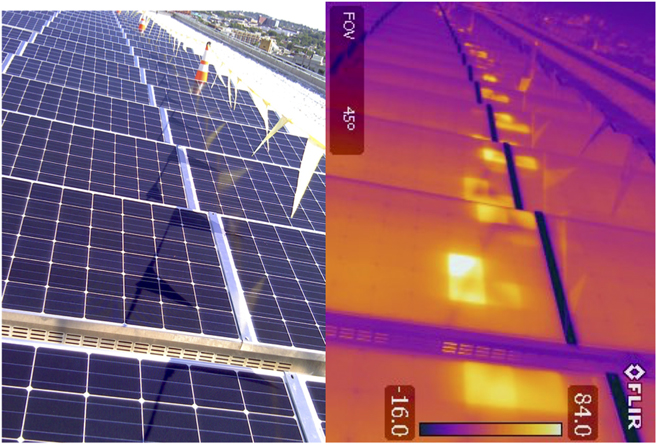
A serious problem for rooftop BIPV products is that the rooftop may be used for ventilation ducts, fans, and other rooftop services. For large buildings, the entire rooftop may be needed, leaving no space for a solar system. Single-family dwellings may have one or more chimneys, which may cause partial shade of the PV system at some hours of the day. The effect of shade can be severe as shown in Fig. 4, in which a string of caution flags casts small shadows (seen visually on the left), causing local reverse bias and heating (as shown in the righthand infrared image). This demonstrates the surprising challenges that can occur with BIPV and the possibility of new degradation modes appearing because of the localized heating.
Silicon system partially shaded by a string of caution flags. Left: visual image. Right: infrared image showing ∼30 °C local heating. Photo credit: Bill Sekulic.

The detrimental effects of partial shading can be mitigated by using DC–DC optimizers that align the currents or voltages between different clusters of cells to minimize reverse biasing effects. These DC–DC converters can work at even relatively low voltages and have been massively deployed in consumer products such as laptops to give constant voltage out of the battery. Similarly, microinverters are now commonly used on rooftops to reduce the effects of partial shading as well as to reduce the complexity of the systems. The simplicity of connecting a microinverter to each solar panel results in modular system designs that can be trivially adjusted to a roof that fits an arbitrary number of modules in contrast to the use of string inverters, which are designed to handle a specific number of modules connected in series. These same microinverters can revolutionize the modes of connection of solar windows by enabling AC connection at every window instead of requiring a DC set of wires connecting all windows to a centrally located string inverter.
The final lines in Table 1 highlight the materials science challenges of making low-cost, high-performance, high-reliability PV devices that are ideal for solar surfaces components. Substantial progress has been made in this area. Additional discussion is included in the “Research still needed” section below.
Approaches to solar surfaces
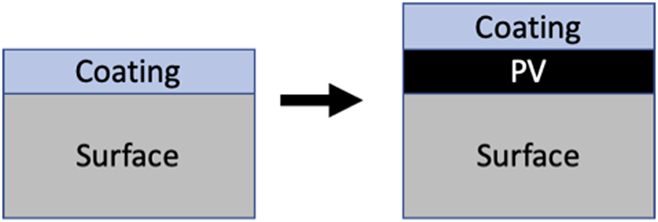
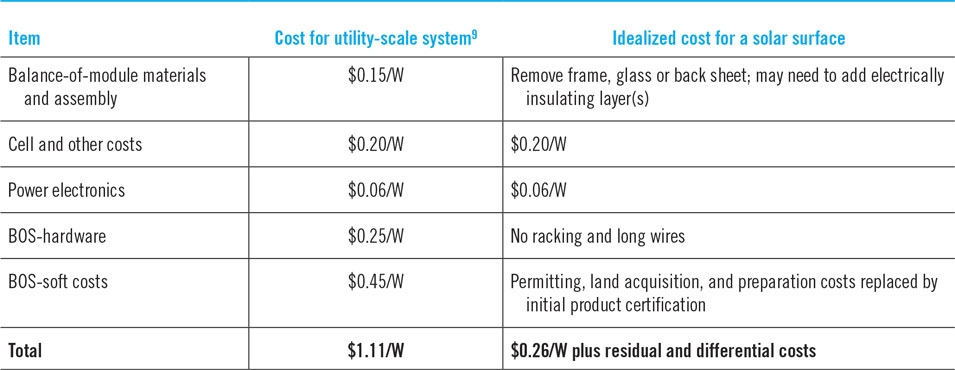
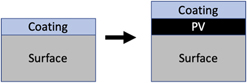
The ultimate approach to solar surfaces may be to take any surface along with its protective coating and insert the active PV layers in between as shown schematically in Fig. 5. The protective coating should be modified, but with some innovation, this differential cost may be minimized. Table 2 estimates the idealized value of this approach starting from a cost breakdown of a utility-scale plantReference Fu, Feldman and Margolis9 to identify which costs might be substantially reduced or eliminated. This crude comparison suggests that the cost of ∼$1.11/W for a utility scale system might be reduced as low as ∼$0.30/W if the cell and power electronics costs can be the same as baseline and if there is no added cost associated with modifications of the surface and the coating.
Solar surfaces generic design that minimizes use of materials by using the original surface as the structural support to replace racking and glass/frame. The coating may be modified to be more transparent and to provide the protection needed by the PV cell. An example of implementation of this generic concept for PV on a drone wing is shown in Fig. 1(d).

Idealized estimation of potential cost savings for a utility-scale PV systemReference Fu, Feldman and Margolis9 that replaces the conventional packaging with a surface.

This potential for implementing solar surfaces is currently a vision with no clear pathway of how or even whether it could be successful on a large scale. Currently, most BIPV concepts use PV modules of either a flexible or fairly conventional design and build them into the building by replacing the shingles or tiles. The primary barriers to the adoption of these existing products may be related to practical issues associated with permitting, customer acceptance (including assessment of risk, which may affect insurance and loan terms), accommodating roof penetrations, etc.
Potential market size
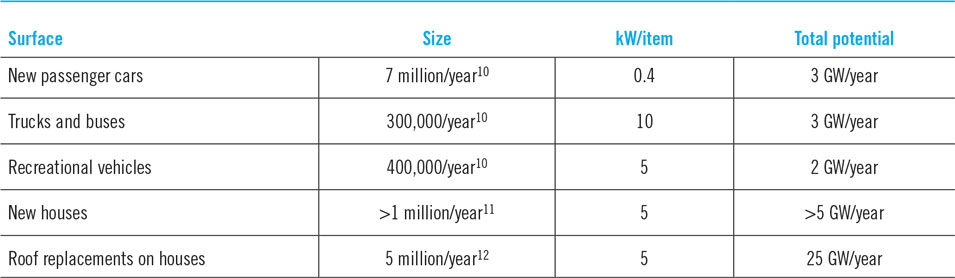
Solar surfaces products will become mainstream only if they become a low-risk, default option that is used for a significant fraction of the market to achieve mass-production low costs. Table 3 summarizes some obvious solar surfaces possibilities, concluding that the US market potential could easily be comparable to current annual deployments of PV in the United States (∼17 GW/year).

Research still needed
Although some solar surfaces products are already being introduced, future implementations will benefit from more research. Today’s world differs greatly from 100 years ago and the world 100 years from now is likely to have evolved in ways that are only a dream today. Examples of four research topics that are both scientifically interesting and could be pivotal to enabling a world with ubiquitous solar surfaces are discussed next.
Low-temperature fabrication of solar cells on any surface
Silicon solar cells are typically manufactured using temperatures that reach over 1000 °C. Chemical processes (e.g., dopant diffusion) that take minutes at 1000 °C may take decades or centuries at 100 °C (which can be a common13 operating temperature for a solar cell). To directly deposit material on many surfaces, low-temperature deposition will be essential. Examples of chemical processes that are completed at low temperature, but can be stable for decades include application of paint and use of epoxies. Paint is applied at room temperature, then after the solvent evaporates, it forms a structure that is sometimes stable for decades. Similarly, two reactive chemicals can be mixed to form a very stable epoxy. Can these fabrication techniques be applied to semiconductor materials in a way that would provide a low-cost, high-performance, reliable PV on any surface?
Solar cell transfer
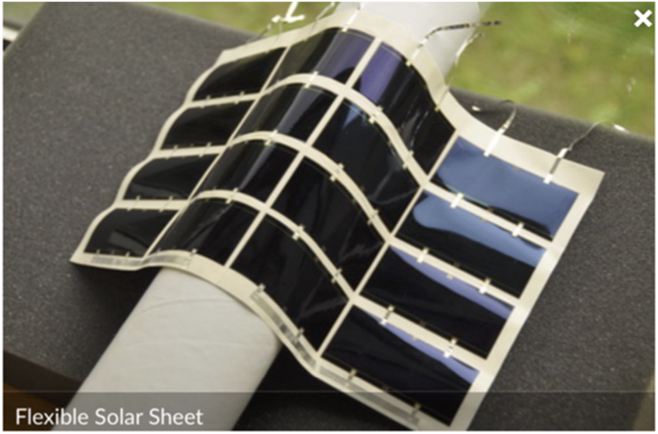
Perhaps a more practical approach is to fabricate the solar cells at higher temperatures and then transfer them to an arbitrary surface, creating something similar to plastic wrap, as in Fig. 6. Recent research efforts have enabled use of chemical etching (as in epitaxial lift-off) and mechanical fracturing (as in spalling). Then, techniques for handling the resulting thin layers need to be refined.
Example of flexible solar sheet being developed today at MicroLink Devices (printed with permission).

Development of coatings
The ideal coating for solar surfaces products would be transparent, but also protect mechanically from abrasion and chemically from moisture ingress. If the solar cell can tolerate some moisture ingress, the moisture-barrier requirements on the coating can be relaxed. Of course, any successful coating needs to be ultra-low cost and very durable. In some applications, it may be walked on; in other applications, it may be scrubbed and waxed. Making such a coating at low enough temperature to be compatible with the rest of the materials may be the biggest challenge.
Innovation at assembling the entire system
The creation of a solar surfaces product will require innovation in identifying the application, the active PV material, the process of fabricating the cells, and the design and process for fabricating the final product, including the power electronics. Such system-level work will require innovation on many fronts and may benefit from development of one or more of the capabilities just described. Solar windows are an example of how the specific application may drive the choice of materials and overall system design.
Conclusions
The challenge of cost-effectively incorporating PV into every surface with adequate durability and functionality is substantial. Perhaps the future of the world will be large fields of solar systems and wind turbines connected the world over by efficient transmission lines. But as solar and wind provide an increasing fraction of our world’s energy, our energy system is being transformed. It may become increasingly useful to be able to use every surface to capture light and the associated electricity. Success will require products that not only work well, but have a marginal cost, i.e., small enough that customers will say “Why not get the version with solar built in?” To achieve that goal, we will need materials science research and innovative system implementation into attractive products that are easy to use. Are we ready to tackle the challenge so that the world 100 years from now will have solar surfaces everywhere?
Acknowledgments
I thank R. Tatavarti for the invitation to speak at the MRS meeting, motivating this article. I also gratefully acknowledge many useful conversations with N. Haegel, M. Werner, C. Honsberg, and others on this topic.