Introduction
Cesarean delivery (CD) has become the most common major surgical procedure undertaken worldwide.Reference Yuan, Gaskins and Blaine1 In the United States alone, CD rates have risen from less than 5% of total deliveries during the 1960’s to 32% in the year 2013, and remained steady since.Reference Martin, Hamilton and Osterman2 In most organisation for economic co-operation and development countries, average rates of CD have risen from 20% of total deliveries in the year 2000 to 28% in 2013. A minority of countries including Israel, Finland and Sweden, have demonstrated a slight decline in CD rates (15.4, 15.8, 16.4%, respectively) since 2006.Reference Indicators3
It is now well established, that CD carries a risk of morbidity not only for the mother but also for the offspringReference Liu, Liston and Joseph4 which is subjected to immediate respiratory complications inclining with earlier gestational age.Reference Hansen, Wisborg, Uldbjerg and Henriksen5 In the long run, a correlation was suggested between CD and obesity in childhood [odds ratio (OR 1.32)] and adulthood (OR 1.24) for the offspring.Reference Li, Zhou and Liu6, Reference Darmasseelane, Hyde, Santhakumaran, Gale and Modi7 A recently published extensive prospective cohort study discovered a 15% increase in the risk for obesity among offspring born via CD as compared with offspring delivered via vaginal delivery (VD).Reference Yuan, Gaskins and Blaine1 These findings were shown in sibling analyses as well.Reference Yuan, Gaskins and Blaine1 Another study, demonstrated an association between CD and higher frequency of obesity and dysmetabolic traits such as higher total cholesterol, low-density lipoprotein cholesterol, leptin and apolipoprotein B levels in the offspring.Reference Hansen, Halldorsson and Olsen8 The consistency of these findings, throughout diverse comparison strategies, strongly supports the notion that mode of delivery has a true biological effect upon future obesity risk, unsubverted to variable confounders.
The exact mechanism for the apparent association between CD and offspring obesity remains unknown. Gut microbiota is involved in the development of low-grade inflammation and metabolic disorders and is considered as one environmental factor influencing host energy homeostasis and adiposity.Reference Cani9 By impacting on gut hormones, gut microbiome can modify appetite and satiety, regulate energy harvest, insulin action and fat storage.Reference Azad, Konya and Persaud10 The lack of a direct transmission of vaginal microbiota among offspring born via CD, results in a delayed Bifidobacterium and Bacteroides colonizationReference Adlerberth, Lindberg and Åberg11, Reference Dominguez-Bello, Costello and Contreras12 that may modulate chronic inflammation processes, insulin resistance and obesity.Reference Musso, Gambino and Cassader13 Other studies describe risks to offspring from not experiencing perinatal events such as labor-related stress and immune activation (type 1 and type 2 T-helper cytokines stimulation by bacteria found in the maternal birth canal and rectum) resulting in reduced cytokine levels at birth which is associated with late development of allergy and atopic predisposition,Reference Sevelsted, Stokholm, Bonnelykke and Bisgaard14 higher incidence of neonatal respiratory infections, asthma and obesity.Reference Kulas, Bursac, Zegarac, Planinic-Rados and Hrgovic15
Our current study objective is to further investigate the impact of mode of delivery on offspring obesity, by addressing the wide spectrum of endocrine and metabolic morbidities in both mother and offspring, which could mediate (or rather confound) the pathway between mode of delivery and offspring obesity.
Methods
A population-based retrospective cohort analysis was performed including all singleton-term deliveries occurring between 1991 and 2014 at the Soroka University Medical Center (SUMC).
SUMC is the largest birth center in Israel, and is the sole tertiary hospital, including the single pediatric unit, in Israel’s southern region (The Negev). In Israel, all hospitalizations are fully covered by a national health law allowing free access of all citizens to medical treatments. These facts make our cohort representative of all deliveries in the region.
This study was approved by the institutional review board (SUMC IRB committee) in accordance with the ethical standards laid down in the 1964 Declaration of Helsinki and its later amendments (revision 2013).
Primary exposure was defined based on the mode of delivery. Children delivered by a non-emergent (‘elective’) CD at term, and not while in labor, comprised the ‘exposed’ study group, whereas children delivered via a spontaneous VD served as the comparison (unexposed) group. Elective CD was defined as non-emergent CD and included cases of CD due to previous cesarean deliveries, mal-presentation and maternal request, performed in an elective setting.
As our work was focused on the possible association between CD as a mode of delivery and long-term endocrine and metabolic outcomes we excluded several entities that otherwise might have served as potential confounders. We therefore excluded parturient with gestational or pre-gestational diabetes, thyroid disease, gestational hypertension or chronic hypertension, premature rupture of membranes and Rh immunization.
Instrumental deliveries, cervical ripening and labor induction (via prostaglandins, oxytocin or Foley catheter) which may be indicative of a complicated pregnancy/delivery (i.e. pre-eclampsia, chorioamnionitis) were excluded from the analysis. Prolapse of cord, placental abruption or previa, non-progressive labor, and maternal history of perinatal deaths were also excluded from the analysis. Moreover, congenital malformations, central nervous system malformations and chromosomal abnormalities in the fetus were excluded.
Outcomes assessed included hospitalizations of the offspring, in both groups, up to the age of 18 years involving endocrine and metabolic morbidities. To better estimate the accompanied endocrine and metabolic morbidity, and since diagnoses such as diabetes mellitus, thyroid diseases or overweight do not usually necessitate hospitalization, we constructed a database that included any endocrine and metabolic morbidity, not necessarily as the primary diagnosis. These were defined according to a pre-prepared international classification of diseases (ICD)-9 list of any of the diagnoses detailed in Supplementary Table S1. Endocrine morbidity included specific diagnoses such as hypothyroidism and diabetes mellitus types I and II. Metabolic morbidity referred to medical conditions characterized by abnormal laboratory values as in the case of hypoglycemia.
The diagnosis of hypoglycemia was only given to newborns who presented with low blood serum glucose values requiring medical intervention. The hypoglycemia group did not include any children being treated for diabetes. Obesity was included in the long-term outcome as it combines both endocrine and metabolic impact.
Specific definitions: Offspring obesity – body mass index (BMI) percentile ⩾97% world health organization (WHO).16 Hypoglycemia – later hospitalizations of offspring due to hypoglycemia (blood serum glucose<54 mg/dlReference Achoki, Opiyo and English17) following the initial postpartum discharge. Diabetes mellitus – according to the Expert Committee on the Diagnosis and Classification of Diabetes Mellitus 1997 definitions.Reference Gavin, Alberti, Davidson and DeFronzo18 Congenital hypothyroidism – total thyroxine below the normal range in the newborn screening program, followed by a later low free thyroxine in a following diagnostic test.19 Acquired hypothyroidism – free thyroxine below normal range for age.Reference Lem, de Rijke and van Toor20
Follow-up time was defined as time to an event of an endocrine or metabolic-related hospitalization or until censored. Censoring occurred in the case of death (during hospitalization, other than endo-metabolic related) or at age 18 (which was calculated for each child based on the date of birth). Only the first endocrine or metabolically related hospitalization for each child was included in the analysis.
Data were derived from the birth-record (perinatal) computerized database of the department of obstetrics and gynecology, and the pediatric computerized-hospitalization database at SUMC.
The hospital’s database (‘Demog-ICD9’) includes ICD-9 codes for all medical diagnoses made during hospitalizations at SUMC. The computerized perinatal database of the obstetrics and gynecology department at SUMC includes comprehensive maternal data which is determined during the pregnancy such as maternal obesity, demographic characteristics and medical history. Pregnancy characteristics and delivery course and outcomes are recorded immediately following delivery by the obstetrician. Data are then routinely reviewed by experienced medical secretaries to insure its accuracy, before entering it into the database. Both databases (Demog-ICD9 and the perinatal database) were cross-linked and integrated according to maternal and offspring ID numbers.
Statistical analysis
Background and outcome characteristics were compared between the two groups using a t-test and Fisher χ2 tests, depending on variable type and distribution. Kaplan–Meier survival curves were used to compare the cumulative incidence of endocrine and metabolic related pediatric hospitalizations over the 18 years of follow-up, according to delivery mode. A maximum of one hospitalization was recorded for each child.
To establish an independent association between exposure (mode of delivery) and outcome (endocrine or metabolic morbidity), a Cox proportional hazards model was used to estimate the adjusted hazard ratio (aHR) and its 95% confidence interval (95% CI) which adjusted for maternal age, gestational age, birth weight and maternal group B streptococcus (GBS) ano-rectal colonization status.
In order to evaluate the role of maternal obesity, which may have served as a potential confounder, a similar Cox proportional hazards model was constructed to estimate the aHR and its 95% CI while adjusting for maternal obesity (BMI ⩾30 kg/m2), together with maternal age, gestational age, birth weight and maternal GBS ano-rectal colonization status.
Overweight and obesity outcomes, usually listed as comorbid conditions, constituted a large proportion of the pediatric endocrine and metabolic morbidity. To determine whether an independent association between mode of delivery and offspring obesity exist, two separate Cox proportional hazards models were constructed. One model adjusted for maternal age, gestational age and birth weight, and a second model adjusted for maternal obesity (BMI⩾30 kg/m2) as well.
Another Cox proportional hazards model was constructed to evaluate the independent association between mode of delivery and hypoglycemia in offspring, which adjusted for maternal obesity, maternal age, gestational age and low birth weight.
As some parturients appear more than once in the hospital’s database and in the offspring cohort (i.e. mothers whom gave birth on several occasions during the study period), a Weibull analysis was used. This analysis uses exposure-discordant sibling pairs from the same mother, in order to control for siblings. The Weibull analysis adjusted for maternal obesity, maternal age, gestational age and low birth weight.
All analyses were two sided, with an α of <0.05 considered statistically significant. All analyses were performed using Stata software version 12 (StataCorp) and SPSS software version 23 (IBM SPSS Statistics).
Results
During the study period 131,880 term deliveries met the inclusion criteria, of which 8.9% (n=11,768) were non-emergent (‘elective’) CDs and 91.1% (n=120,112) were spontaneous VDs.
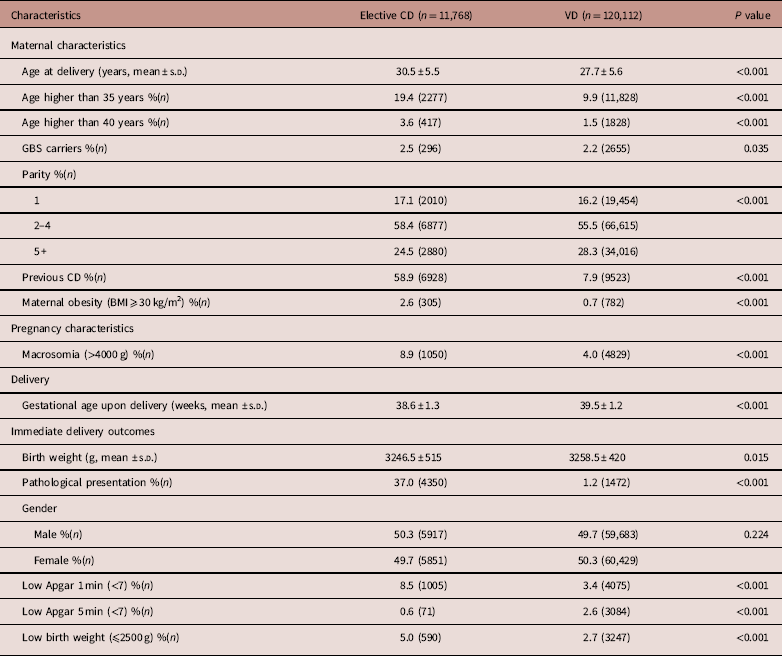
Maternal and pregnancy characteristics, which were determined during pregnancy, together with delivery course and outcomes in both groups are presented in Table 1. Women who underwent elective CD were older and more likely to be obese. They were also more likely to have had a previous CD. Pregnancies in the elective CD group were characterized by higher rates of macrosomia (8.9 v. 4%, P<0.001). Low Apgar scores (<7) at 1 min were more prevalent among the elective CD group (8.5 v. 3.4%, P<0.001), whereas low Apgar scores at 5 min were more common among the VD group (2.6 v. 0.6%, P<0.001). Low birth weight (⩽2500 g) was more common in the elective CD group (5.0 v. 2.7%, P<0.001), while mean birth weight was higher among the VD group (3258.5±420 g v. 3246.5±515 g, P=0.015). Gestational age at delivery was more advanced in the VD group (39.5±1.2 weeks v. 38.6±1.3 weeks, P<0.001).
Maternal and pregnancy characteristics, delivery course and outcomes
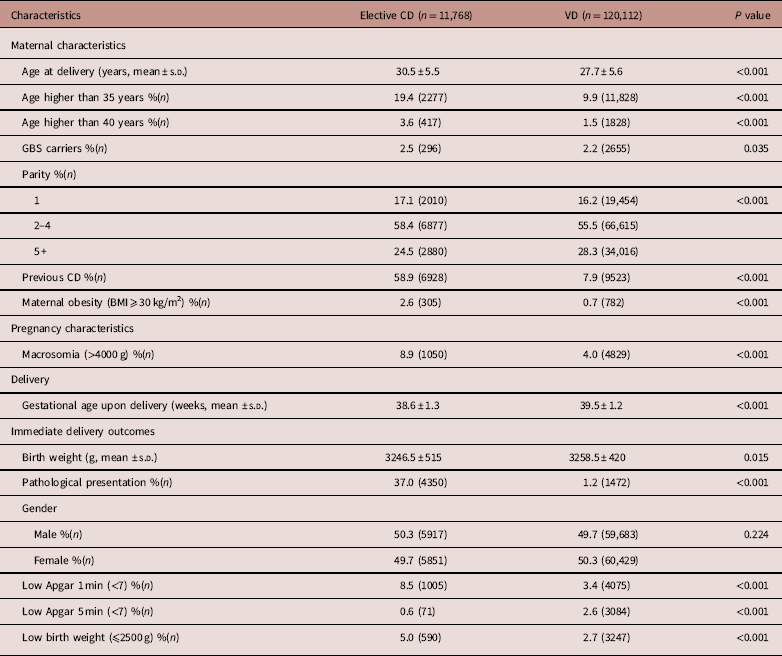
CD, cesarean delivery; VD, vaginal delivery; GBS, group B streptococcus; BMI, body mass index.
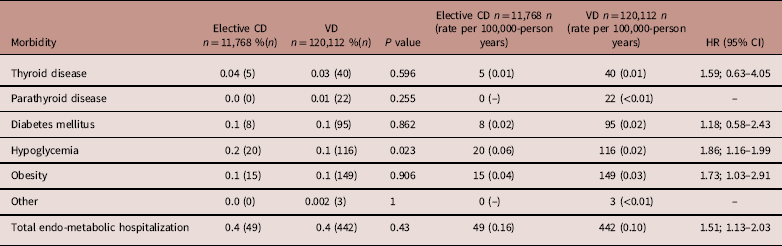
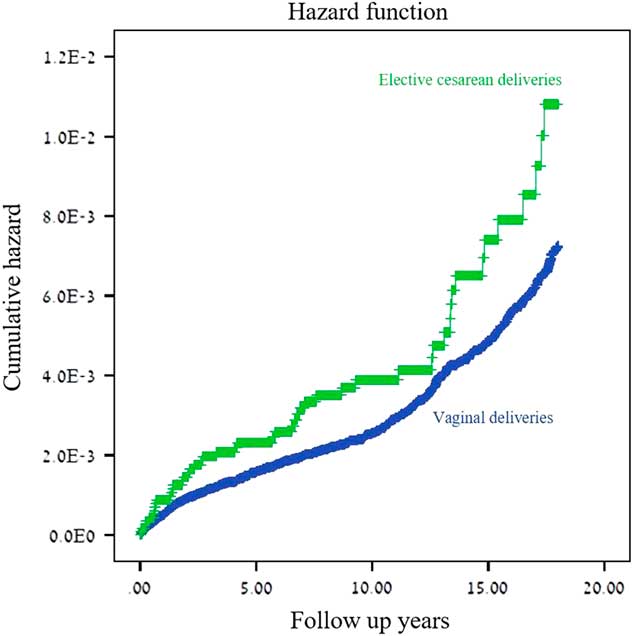
Selected pediatric endocrine and metabolic morbidities of the offspring according to mode of delivery are presented in Table 2. Crude hospitalization rate due to hypoglycemia was significantly higher in the elective CD group (0.2 v. 0.1%, P=0.023). Total endocrine and metabolic hospitalization incidence per follow-up years was higher as well (HR=1.51, 95% CI 1.13–2.03). Moreover, the Kaplan–Meier survival curve demonstrated a significantly higher cumulative incidence of endocrine and metabolic hospitalizations in the elective CD group (Fig. 1, log rank P=0.010).
Selected pediatric endocrine and metabolic morbidity of the offspring according to mode of delivery group
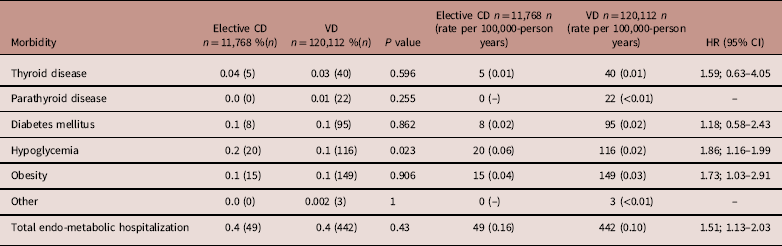
CD, cesarean delivery; VD, vaginal delivery; HR, hazard ratio; CI, confidence interval.
Kaplan–Meier survival curve demonstrating the cumulative incidence of endocrine and metabolic morbidity in children delivered by elective cesarean deliveries and vaginal deliveries.
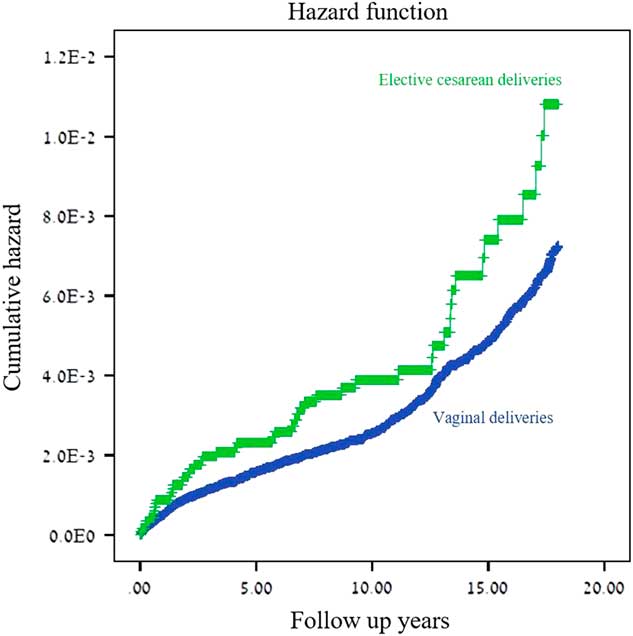
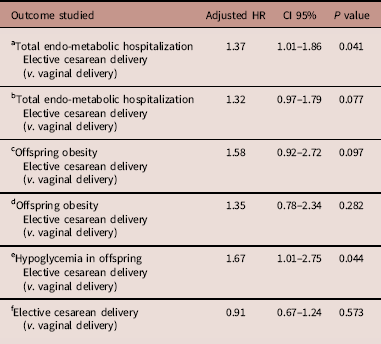
Table 3 presents the Cox proportional hazards model of the association between mode of delivery and long-term pediatric endocrine and metabolic morbidity in offspring. While the model adjusted for maternal age, gestational age, birth weight and maternal GBS ano-rectal colonization status, elective CD was noted as an independent risk factor for long-term pediatric endocrine and metabolic morbidity of the offspring (aHR=1.37, 95% CI 1.01–1.86, P=0.041).
Mode of delivery and long-term endocrine and metabolic outcome of the offspring, Cox proportional hazards model
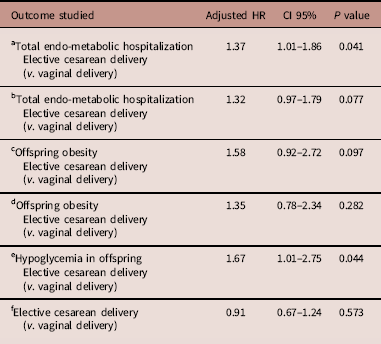
HR, hazard ratio; CI, confidence interval.
a This model adjusted for maternal age, gestational age, birth weight and maternal group B streptococcus (GBS) colonization status.
b This model adjusted for maternal obesity [body mass index (BMI) ⩾30 kg/m2], maternal age, gestational age, birth weight and maternal GBS colonization status.
c This model adjusted for maternal age, gestational age and birth weight.
d This model adjusted for maternal obesity (BMI⩾30 kg/m2), maternal age, gestational age and birth weight.
e This model adjusted for maternal obesity (BMI⩾30 kg/m2), maternal age, gestational age and low birth weight.
f A Weibull analysis was used in order to control for siblings. This model adjusted for maternal obesity (BMI⩾30 kg/m2), maternal age, gestational age and low birth weight.
However, when the model additionally adjusted for maternal obesity (BMI⩾30 kg/m2), elective CD was not noted as an independent risk factor (aHR=1.32, 95% CI 0.97–1.79, P=0.077). Instead, maternal obesity emerged as an independent predictor (aHR=2.75, 95% CI 1.63–4.62, P<0.001).
In the Cox proportional hazards models evaluating the association between mode of delivery and offspring obesity specifically, elective CD was not noted as an independent risk factor for offspring obesity whether adjusted for maternal obesity (aHR=1.35, 95% CI 0.78–2.34, P=0.282) or not (aHR=1.58, 95% CI 0.92–2.72, P=0.097).
In the Cox proportional hazards model of the association between mode of delivery and hypoglycemia in offspring, elective CD was noted as an independent risk factor for hospitalization due to hypoglycemia in offspring (aHR=1.67, 95% CI 1.01–2.75, P=0.044).
Lastly presented, is the Weibull analysis evaluating the association between mode of delivery and long-term pediatric endocrine and metabolic morbidity in offspring, while controlling for siblings. The analysis adjusted for maternal obesity, maternal age, gestational age and low birth weight. In this analysis, elective CD was not noted as an independent risk factor for long-term pediatric endocrine and metabolic morbidity of the offspring (aHR=0.91, 95% CI 0.67–1.24, P=0.573) while maternal obesity emerged, again, as a strong and independent predictor (HR=2.21, 95% CI 1.21–4.04, P=0.009).
Discussion
In this large retrospective cohort analysis of term infants, an association was detected between elective CD and long-term pediatric endocrine and metabolic morbidity in the offspring. Consecutive regression models, adjusted for maternal obesity and sibling, confirmed the association to be primarily with maternal obesity, and not with CD. In addition, crude hospitalization rate due to hypoglycemia in the offspring was found to be significantly higher in the elective CD group, which emerged as an independent risk factor for hypoglycemia in the regression analysis (Table 3).
A recently published study suggested mode of delivery to serve as a mediator between maternal obesity and future offspring obesity by shaping early-life gut microbial colonization. In the study, Firmicutes species abundance, namely of the family Lachnospiraceae, was significantly higher in offspring born by elective CD to obese mothers. On the other hand, offspring born vaginally to obese mothers, presented higher abundance of the Bacteroides species and yielded a lower risk for offspring obesity compared with elective CD at ages 1 and 3 years.Reference Tun, Bridgman and Chari21
Previously published literature demonstrated higher rates of adverse health outcomes associated with CD such as overweight and obesity.Reference Yuan, Gaskins and Blaine1, Reference Li, Zhou and Liu6, Reference Darmasseelane, Hyde, Santhakumaran, Gale and Modi7, Reference Li, Zhou and Liu22, Reference Lynch and Pedersen23 This association was suggested to be a consequence of differences in gastrointestinal microbiota colonization at birth.Reference Musso, Gambino and Cassader24, Reference Neu and Rushing25 Gut microbiota can modulate host energy homeostasis and adiposity through regulation of energy harvest and fat storage, initiation of inflammatory state of obesity and insulin resistance.Reference Musso, Gambino and Cassader13
This settles with the proposed linkage between obesity and increased capacity to harvest energy from short-chain fatty acids. Short-chain fatty acids are produced when the gut microbiota is enriched with the Firmicutes species over Bacteroides phylum.Reference Kumari and Kozyrskyj26Adiposity, body fat inflammation and diabetes development are promoted as well by the family Lachnospiraceae.Reference Cho, Yamanishi and Cox27, Reference Poroyko, Carreras and Khalyfa28
Mode of delivery entitles additional components which may affect newborn development and health. Birth setting around CD differs from VD with respect to hormonal events around birth. Stress hormone induction is lower in offspring born via CDReference Gitau, Menson and Pickles29 which may affect immune maturation. This is supported by lower number of leukocytes, neutrophils, monocytes and natural killer cells detected by blood biomarkers during early life.Reference Nikischin, Peter and Oldigs30 Other stressful perinatal events such as pre-eclampsia and low gestational age have also been linked to type 1 diabetes.Reference Dahlquist and Källén31
In our study, however, mode of delivery did not appear to play a significant role in the interaction between maternal obesity and the risk of future endocrine and metabolic morbidity of the offspring.
In the year 2015, reported obesity rates (BMI⩾30 kg/m2) among female adults in Israel reached 24.6%.32 Maternal obesity rates in our study population were 2.6% in the elective CD group and 0.7% in the VD group (P<0.001). These lower than expected rates of maternal obesity may be due to several reasons. First, only severe cases (i.e. morbid obesity) are noted in the database and thus there is probably under documentation of this disorder. Second, one should consider the association between obesity and subfertility.Reference Best and Bhattacharya33 In obese women, high levels of circulating free-estrogen can hamper follicular recruitment and ovulation.Reference Zain and Norman34 Increased level of leptin can dysregulate gonadotrophin-releasing hormone levels.Reference Pantasri and Norman35 Even when receiving oocytes from normal-weight donors, obese women are less likely to conceive compared to normal-weight recipients, suggesting a potential role of the endometrium.Reference Bellver, Melo and Bosch36 As our cohort included only women with singleton-term deliveries, obese women, whom are less likely to conceive in the first place, might have been represented to an even lesser proportion in our study population as compared with the general population.
As mentioned earlier, we found a higher hospitalization rate due to hypoglycemia in the elective CD group. During the first 8–12 h of life, plasma glucose concentrations are maintained by the breakdown of hepatic glycogen in response to increased plasma epinephrine and glucagon concentrations.Reference Lubchenco and Bard37 This shift might be spared in the absence of peripartum stress, as in elective CD. Developmental immaturity of liver mechanisms that protect against hypoglycemia during fasting, namely gluconeogenesis and ketogenesis,Reference Stanley and Baker38 might be further compromised in the setting of elective CD. These processes, however, are insufficient to explain later hospitalizations of offspring due to hypoglycemia following the initial postpartum discharge.
Our study possesses multiple strengths that could address various limitations carried by previous similar studies concerning cohort sizes and population characteristics. Differences in neonatal microbiota at time of birth associated with CD happens to be most prominent in unlabored cesarean-delivered neonates (in which the fetus has not yet descended into the vaginal canal before delivery), rather than in neonates who were delivered by a labored cesarean surgery (in which the fetus has already descended into the vaginal canal).Reference Chu, Ma and Prince39 By defining elective CD as a non-emergency procedure, we avoided parturitions in which the fetus might have already descended into the vaginal canal (labored CD), emphasizing the effect of the cesarean procedure itself, a nuance overlooked in previous studies.Reference Neu and Rushing25, Reference Azad, Konya and Maughan40 Large sample size and a long-term retrospective follow-up are additional strengths of this study.
Nonetheless, the study possesses several inherent weaknesses. First, morbidity cases under ambulatory care were not accounted for, as we included only hospital visits at SUMC. Moreover, we could not differentiate between non-visits due to moving out of the region v. being healthy. However, SUMC is the sole tertiary hospital in Israel’s southern region (The Negev), and by having the single pediatric unit in the entire area, it provides both inpatient and outpatient care for the entire population of this region. Hence, we believe that our population morbidity rates and admission frequencies are adequately represented by the hospital’s database. We acknowledge the possibility of negative migration (although the Negev region is experiencing positive immigration in the last decade), nevertheless, it is just as likely in both the study and comparison groups, and its extent cannot be measured.
Second, the use of a Weibull analysis to control for siblings has its limitations. Mothers who have undergone a previous CD have the option of proceeding with a trial of labor after cesarean (TOLAC) delivery or planned repeat cesarean delivery (PRCD). This variation between the two groups might play a residual confounder in terms of neonatal outcomes. TOLAC is associated with higher rates of neonatal sepsis and neonatal mortality as compared with PRCD, while PRCD is associated with higher rates of respiratory complications.Reference Guise, Denman and Emeis41 Whether the choice of mode of delivery after a prior CD might potentially affect neonatal endocrine and metabolic outcomes should be taken into consideration.
Third, we did not address the role of maternal diet. Diet is known to be a potent modifier of the microbiota in both adults and children.Reference Koenig, Spor and Scalfone42, Reference David, Maurice and Carmody43 Forth, each CD conducted in SUMC is preceded by administration of preoperative antibiotics, which is known to shape gut microbiota patterns. Antibiotic enhanced growth used in livestock farming, is known to improve animal weight gain, and in mice it has been shown to increase total body fat mass.Reference Cho, Yamanishi and Cox27, Reference Jukes44 Since antibiotic-enhanced growth is absent in microbiota-free animals, it is thought to be mediated by the gut microbiota.Reference Lin45 A recent study showed that infants exposed to antibiotics early in life, were significantly more likely to become overweight later in childhood compared with those who were unexposed.Reference Azad, Konya and Persaud10 In an effort to minimize its potential effect, the regression analyses also adjusted for maternal GBS colonization status. Lastly, we lacked data on breastfeeding history, also known to modify infant microbiota.Reference Jost, Lacroix, Braegger, Rochat and Chassard46
The process in which a healthy gastrointestinal microbiota is established in the offspring is pending further research. Future studies should be focused on the role of delivery mode as a mediator pathway between maternal obesity and future offspring obesity and investigate whether it holds effect on other endocrine and metabolic morbidities as well. This information could be used in the future for counseling patients who consider CD with no conventional medical indication and by doing so, lessen unnecessary CD rates together with the possible accompanying long-term endocrine and metabolic adverse outcomes mediated by it.
Supplementary materials
To view supplementary material for this article, please visit https://doi.org/10.1017/S2040174418001022
Acknowledgments
This study was done as part of the MD program requirements in the Faculty of Health Sciences, Joyce & Irving Goldman Medical School at Ben Gurion University of the Negev, Israel.
Financial Support
This research received no specific grant from any funding agency, commercial or not-for-profit sectors.
Conflicts of Interest
None.