Introduction
Neuropsychological deficits are part of the clinical presentation of geriatric depression (GD) (Lockwood, Alexopoulos, & van Gorp, Reference Lockwood, Alexopoulos and van Gorp2002). A wide spectrum of cognitive deficits in depressed elderly subjects has previously been reported (Baudic, Tzortzis, Barba, & Traykov, Reference Baudic, Tzortzis, Barba and Traykov2004; Butters et al., Reference Butters, Whyte, Nebes, Begley, Dew, Mulsant and Becker2004; Elderkin-Thompson et al., Reference Elderkin-Thompson, Kumar, Bilker, Dunkin, Mintz, Moberg and Gur2003; Lockwood, Alexopoulos, Kakuma, & Van Gorp, Reference Lockwood, Alexopoulos, Kakuma and Van Gorp2000; Lockwood et al., Reference Lockwood, Alexopoulos and van Gorp2002; Nebes et al., Reference Nebes, Butters, Mulsant, Pollock, Zmuda, Houck and Reynolds2000; Pálsson, Johansson, Berg, & Skoog, Reference Pálsson, Johansson, Berg and Skoog2000; Sheline et al., Reference Sheline, Barch, Gersing, Pieper, Welsh-Bohmer, Steffens and Doraiswamy2006).
However, GD may occur in combination with dementing disorders: (a) as part of the first clinical manifestation of a dementing disorder, (b) during a prodromal stage when such a disorder cannot be clinically diagnosed yet, (c) predisposing to the development of dementing disorders (Chodosh, Kado, Seeman, & Karlamangla, Reference Chodosh, Kado, Seeman and Karlamangla2007; Fischer et al., Reference Fischer, Zehetmayer, Jungwirth, Weissgram, Krampla, Hinterberger and Tragl2008; Gabryelewicz et al., Reference Gabryelewicz, Styczynska, Luczywek, Barczak, Pfeffer, Androsiuk and Barcikowska2007), (d) as a reaction of a patient being aware of developing dementia (Panza et al., Reference Panza, Frisardi, Capurso, D'Introno, Colacicco, Imbimbo and Solfrizzi2010).
Furthermore, as both depression and dementia present with cognitive dysfunction, the question arises whether cognitive dysfunction in depressed patients is part of the syndrome of depression itself or whether it is, to a certain extent, caused by degenerative or vascular brain lesions (Krishnan et al., Reference Krishnan, Taylor, McQuoid, McFall, Payne, Provenzale and Steffens2004). To our knowledge, only Pálsson et al. (Reference Pálsson, Johansson, Berg and Skoog2000) accounted for the development of dementia during the next three years as a covariate in their statistical analysis of this topic. Also, cognitive dysfunction—associated with depression at first sight—could be induced by depression-associated medication.
Consequently, the investigation of cognitive symptoms of depression in the elderly has to deal with the impact of dementing disorders. The present study aims to ascertain the influence of depression on processing speed and executive function to better understand whether neuropsychological dysfunction is a part of depression or is mainly due to other causes. Using data acquired during the Vienna Transdanube Aging (VITA) study, we were able to carry out analyses of subjects very nearly the same age, with and without depression, who did not develop any kind of dementia during the following 5 years. We focused on processing speed and executive function, two cognitive domains which are among the most frequently impaired in GD (Baudic et al., Reference Baudic, Tzortzis, Barba and Traykov2004; Butters et al., Reference Butters, Whyte, Nebes, Begley, Dew, Mulsant and Becker2004; Elderkin-Thompson et al., Reference Elderkin-Thompson, Kumar, Bilker, Dunkin, Mintz, Moberg and Gur2003; Lockwood et al., Reference Lockwood, Alexopoulos, Kakuma and Van Gorp2000, Reference Lockwood, Alexopoulos and van Gorp2002; Nebes et al., Reference Nebes, Butters, Mulsant, Pollock, Zmuda, Houck and Reynolds2000; Pálsson et al., Reference Pálsson, Johansson, Berg and Skoog2000; Sheline et al., 2006). As processing speed shows a significant decrement with age (Salthouse, Reference Salthouse2000; Schaie, Reference Schaie1994) and subtle executive dysfunction occurs with normal aging (Keys & White, Reference Keys and White2000), concomitant effects of aging and depression on neuropsychological functioning are discussed.
Methods
Vienna Transdanube Aging (VITA) Study
This study is based on data collected during the VITA study, which was a prospectively designed, longitudinal, population-based cohort-study of the 75-year-old inhabitants of two districts of Vienna (Austria). The principal aim of the VITA study was the early diagnosis of, and research into Alzheimer dementia (AD). To this purpose, biochemical, genetic, neuroimaging (structural MRI), neuropsychological, geriatric, neurological, and psychiatric parameters were evaluated for potential risk factors and possible early diagnostic markers. In addition, a large body of general medical and psychosocial data was recorded. An experienced neurologist, psychiatrist, and two clinical psychologists did the neurological, psychiatric, and neuropsychological assessment. For further details on methods and recruitment strategies, see Fischer et al. (Reference Fischer, Jungwirth, Krampla, Weissgram, Kirchmeyr, Schreiber and Tragl2002).
The baseline investigation (n = 606) took place between May 2000 and November 2002. Two follow-up investigations were conducted 30 months after baseline (first follow-up, n = 487) and 60 months after baseline (second follow-up, n = 413). Since age is the best predictor of cognitive decline in the elderly, the VITA age stratification design attempted to minimize variation of age: 0.2 years (mean: 75.8 years at baseline).
All subjects gave written informed consent for participating in the VITA study. Any human data included in this manuscript were obtained in compliance with the regulations of our institution.
Sample
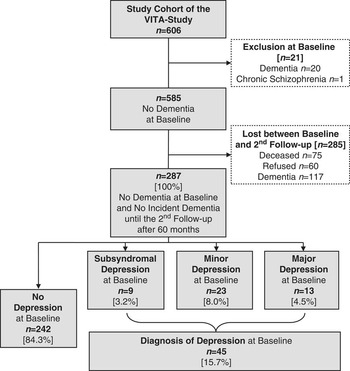
The final sample of the current study comprised a total of 287 subjects who did not develop any kind of dementia within the following 60 months (Figure 1). At baseline, the VITA study involved 606 individuals, born between May 1925 and June 1926. Twenty-one subjects were excluded at baseline because of dementia (n = 20) and chronic schizophrenia (n = 1). A further 285 subjects were excluded for various other reasons: 75 subjects deceased between baseline and the second follow-up, 106 subjects refused to participate and 117 subjects developed dementia (pure AD: n = 67; pure VD: n = 8, pure LBD: n = 2; pure FTD: n = 2; mixed AD/VD: n = 21; mixed AD/LBD: n = 14; mixed AD/VD/LBD: n = 2; mixed VD/LBD: n = 1;) up to the second follow-up. Of those 117 subjects, 70.1% (n = 82) were not depressed, whereas 29.9% (n = 35) had a diagnosis of depression at baseline.
Study population.

Assessment Procedures at Baseline
Neuropsychological Instruments
Processing Speed was measured using the Trail Making Test-A (TMT-A) (Reitan, Reference Reitan1956), in which the numbers 1 to 25 have to be connected in ascending order. Performance is assessed by the time (in seconds) taken to complete the trial correctly. The TMT-A is also known as a test of attention and visual scanning (Spreen & Strauss, 1998).
Executive Function was represented by two executive abilities, set formation and set shifting. These abilities were measured by two tests: Trail Making Test-B (set shifting) and Verbal Fluency (set formation).
Trail Making Test-B (TMT-B) (Reitan, Reference Reitan1956): The subject has to trace a trail which alternates between circles containing numbers and circles containing letters variously spread over an A4-size page. The sequence proceeds from the first number to the first letter followed by the second number and the second letter in alphabetical order. Trail Making Test-B contains 13 circles numbered 1–13, alternating with 12 circles lettered A–L. Performance is assessed by the time (in seconds) taken to complete the trial correctly. Test performance was stopped at a defined endpoint (600 s) if required. The TMT-B is also a measure of processing speed. Other skills which are required for performing the TMT-B successfully are sequencing, mental flexibility, and visual scanning (Spreen & Strauss, 1998).
Verbal Fluency (according to CERAD: Berres, Monsch, Bernasconi, Thalmann, & Stähelin, Reference Berres, Monsch, Bernasconi, Thalmann and Stähelin2000; Morris et al., Reference Morris, Heyman, Mohs, Hughes, van Belle, Fillenbaum and Clark1989): Subjects are asked to provide as many words in the category “animals” as they can think of within 60 s. This task resulted in a 1-min category fluency score. Task performance involves immediate attention, semantic memory, and the ability to retrieve from verbal knowledge (Ruff et al., 1997).
Diagnosis of a Current Depressive Episode
Depressive episodes at time of investigation were diagnosed using a questionnaire based on DSM-IV criteria (Saß, Wittchen, & Zaudig, Reference Saß, Wittchen and Zaudig1996). The presence or absence of the nine possible symptoms of a depressive episode (A1: depressed mood, A2: loss of interest or pleasure, A3: weight (or appetite) loss or gain, A4: insomnia or hypersomnia, A5: psychomotor agitation or retardation, A6: loss of energy, A7: feelings of worthlessness, A8: diminished ability to think or concentrate, A9: suicidality) was evaluated using an extended guided clinical interview (SCID) (Wittchen, Wunderlich, Gruschwitz, & Zaudig, Reference Wittchen, Wunderlich, Gruschwitz and Zaudig1996). Whether the symptoms of depression could have been initiated or maintained by an organic factor was not assessed. Symptoms were required to have been present on almost every day for 2 weeks before examination. Major depression (MD) (five to nine symptoms) was defined according to the DSM-IV. Minor depression (mD) (A1 and/or A2 but fewer than five symptoms) was defined according to Kessler, Zhao, Blazer, and Swartz (Reference Kessler, Zhao, Blazer and Swartz1997). Subsyndromal depression (ssD) was diagnosed in patients who fulfilled neither criterion A1 nor A2 but showed more than one of the remaining seven symptoms (A3 to A9) (Judd, Rapaport, Paulus, & Brown, Reference Judd, Rapaport, Paulus and Brown1994). Questions regarding history of depressive episodes and age at onset of a depressive disorder were derived from the SCID interview.
For univariate analysis and multiple regression analysis, two variables concerning the diagnosis of a current depressive episode were defined. First, “no Depression-ssD-mD-MD.” This ordinal variable was classified into four categories: no depression, ssD, mD, or MD. Second, “Depression no/yes.” This variable was dichotomized into no depression versus depression (including ssD, mD, and MD).
Depression Rating Scales
The Hamilton Rating Scale for Depression (Hamilton, Reference Hamilton1960) and the Short Geriatric Depression Scale (15-item version, Sheikh & Yesavage, Reference Sheikh and Yesavage1986), a self-rating scale for the evaluation of depression in old age, were implemented as depression rating scales.
Covariates
The following covariates were included in the analyses: sex, education, intake of antidepressants, intake of benzodiazepines, history of a depressive disorder, and cerebral comorbidity. Education was rated on a five-point scale: [1] illiterate or elementary school, [2] secondary school, [3] vocational school, [4] grammar school, and [5] university degree. “Cerebral comorbidity” is an accumulated variable which resulted from the summation of 10 possible conditions at baseline, seven derived from the subjects’ medical history: [a] stroke, [b] Parkinson's disease, [c] cerebral trauma, [d] epileptic seizure, [e] resuscitation, [f] brain surgery, [g] brain tumor; three detected with cerebral MRI: [h] meningeoma, [i] lacunae (<15 mm) and/or infarcts (>15 mm), [j] occurrence of the highest rating of periventricular hyperintensities (irregular areas extending into the deep white matter). The three comorbid factors derivied from MRI were determined by clinical radiology report (meningeoma, lacunae, infarcts) or were evaluated according to a semiquantitative method (periventricular hyperintensities, Fazekas’ criteria; Fazekas, Chawluk, Alavi, Hurtig, & Zimmermann, Reference Fazekas, Chawluk, Alavi, Hurtig and Zimmermann1987).
Consensus Diagnosis of Dementia until the Second Follow-up
The occurrence of dementia up until the second follow-up was diagnosed by applying the NINCDS-ADRDA-criteria (Alzheimer's disease) (McKhann et al., Reference McKhann, Drachman, Folstein, Katzmann, Price and Stadlan1984), the NINDS-AIREN-criteria (Vascular dementia) (Román et al., Reference Román, Tatemichi, Erkinjuntti, Cummings, Masdeu, Garcia and Scheinberg1993), the Newcastle-criteria (Lewy body dementia) (McKeith et al., Reference McKeith, Galasko, Kosaka, Perry, Dickson, Hansen and Perry1996), and the Lund Manchester-criteria (Frontotemporal dementia) (The Lund and Manchester Groups, 1994). A panel of experts had to reach a consensus based on longitudinal information obtained from psychometric test results in combination with information from the clinical dementia rating scale (Hughes, Berg, Danziger, Coben, & Martin, Reference Hughes, Berg, Danziger, Coben and Martin1982), an assessment of the instrumental activities of daily living (Lawton & Brody, Reference Lawton and Brody1969), the Fuld Object Memory Test (Fuld, Reference Fuld1980), and the Mini Mental State Examination (CERAD). Additional information was obtained from cerebral MRI (at baseline and at every follow-up), from FDG-positron emission tomography (available in 48 cases), from the diagnosis of depression (DSM-IV criteria) (Saß et al., Reference Saß, Wittchen and Zaudig1996) and, for all cases, from relevant blood parameters (e.g., blood count, electrolytes including calcium, vitamin B12, folic acid, thyroid hormones including TSH). For some subjects, information given by relatives relating to change in cognition was available (Jorm et al., Reference Jorm, Christensen, Henderson, Korten, Mackinnon and Scott1994).
Statistical Methods
For the endpoints Trail Making Test-A, Verbal Fluency, and Trail Making Test-B, univariate analyses of variance (t tests for binary variables) were calculated for all covariates and depression variables. The p value and R 2 were reported. All risk factors with a p value < .05 were further considered in a multiple regression analysis of variance. If more than one depression variable was significant, then the variable “Depression no/yes” was used for the multiple model.
Subjects needed 49–462 s to complete the TMT-B. However, eight subjects (depressed: n = 4, not depressed: n = 4) were not able to complete the test after 600 s; thus, the test was aborted and the value was set to 600. To account for these outliers in the variable TMT-B, the analyses were performed twice, first incorporating the outliers and then without the outliers. TMT-B was also classified into quartiles, and in addition to the analyses of variance, an ordinal logistic regression was calculated.
Group comparisons were done by t tests, Mann-Whitney U-test (Education) or the χ2 test (Sex). All p values < .05 were considered to indicate statistical significance. Analyses were performed using SAS 9.1 (SAS Institute, Inc., Cary, NC) and SPSS 17.
Results
Depression at Age 75 in Subjects Who Remained Nondemented Over 60 Months
Longitudinal information on subjects who did not develop any kind of dementia between baseline and the second follow-up after 60 months was available in 287 cases.
Of those 287 nondemented subjects, 242 (84.3%) were not diagnosed with depression at age 75. Subsyndromal depression was diagnosed in 9 (3.2%), minor depression in 23 (8.0%), and major depression in 13 (4.5%) subjects (see Figure 1). An overall diagnosis of depression was made in 45 (15.7%) subjects. Descriptive statistics and group comparison refer to the variable no depression versus depression (including ssD, mD, and MD).
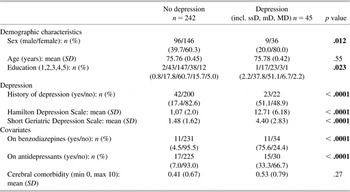
Descriptive statistics relating to the History of Depression, the Hamilton Depression Scale and the Short Geriatric Depression Scale are shown in Table 1. Subjects with and without depression differed in all three variables. The History of Depression frequency (p < .0001), the Hamilton Depression Scale score (p < .0001), and the Short Geriatric Depression Scale score (p < .0001), were significantly higher in depressed than in nondepressed subjects.
Demographic characteristics, characteristics of depression, and covariates of the study population

Bold p-values indicate statistical significance (significance level 0.05).
Demographic Characteristics and Covariates
Descriptive statistics are shown in Table 1. Subjects with and without depression differed with respect to sex (p = .012) and education (p = .023), but not regarding age (p = .55).
The intake of benzodiazepines and antidepressants differed significantly between depressed and nondepressed subjects (both: p < .0001), but there was no significant difference in cerebral comorbidity (p = .27). Cerebral comorbidity ranged from 0 to 4 in the nondepressed subjects (n = 79 with one or more than one comorbidities) and from 0 to 3 in the depressed subjects (n = 17 with one or more than one comorbidities).
Processing Speed: Results for the Trail Making Test-A
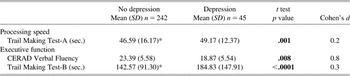
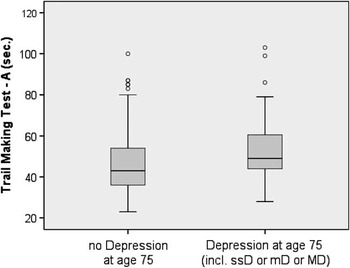
Depressed subjects had a significantly slower performance in the Trail Making Test-A than nondepressed subjects (see Table 2 and Figure 2).
Processing speed and executive function in depressed and non-depressed subjects at age 75

*Missing values: n = 4. Bold p-values indicate statistical significance (significance level 0.05).
Processing Speed [Trail Making Test-A].

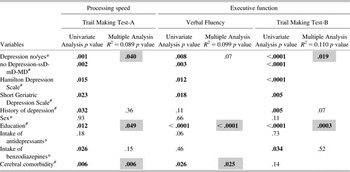
Univariate analyses showed a significant influence of Depression no/yes, History of Depression, Cerebral Comorbidity, Hamilton Depression Scale, Short Geriatric Depression Scale, Education, and the Intake of Benzodiazepines on processing speed ( = scores of the Trail Making Test-A). In the multiple model, Cerebral Comorbidity (p = .006) had the strongest influence, whereas Depression no/yes (p = .040) and Education (p = .049) showed only borderline significance (R 2 = 0.089) (see Table 3).
The influence on processing speed and executive function: Results of univariate analysis and multiple regression analysis

Univariate analyses: * t test, Analysis of variance. Bold p-values indicate statistical significance in the univariate analyses; Shaded bold p-values indicate statistical significance in the multiple analysis (significance level 0.05).
Executive Function: Results for Verbal Fluency and Trail Making Test-B
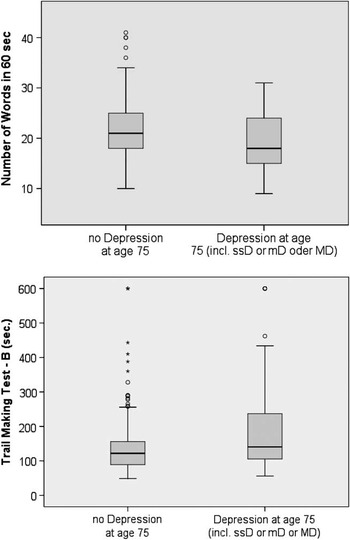
Depressed subjects had a significantly lower score in Verbal Fluency and showed a slower performance in the Trail Making Test-B than nondepressed subjects (see Table 2 and Figure 3).
Executive Function [Verbal Fluency, Trail Making Test-B].

The variables Depression no/yes, Depression no-ssD-mD-MD, Hamilton Depression Scale, Short Geriatric Depression Scale, Education, and Cerebral Comorbidity had significant univariate influences on the scores of Verbal Fluency. In the multiple model, Cerebral Comorbidity (p = .025) and Education (p < .0001) had a significant influence on Verbal Fluency (R 2 = 0.099).
The univariate analyses with regard to the Trail Making Test-B resulted in significant variables as follows: Depression no/yes, Depression no-ssD-mD-MD, History of Depression, Hamilton Depression Scale, Short Geriatric Depression Scale, Education, and Intake of Benzodiazepines. In the multiple model, Education (p = .0003) and Depression no/yes (p = .019) had a significant influence on Trail Making Test-B (R 2 = 0.110) (see Table 3).
Discussion
This study investigated the influence of GD on processing speed and executive function in nondemented subjects aged 75. The longitudinal study design enabled the selection of subjects who did not develop any kind of dementia during the following 5 years. As these individuals were not in the prodromal or early stage of a dementing process, it can be assumed that the influence of depression on cognitive function was not due to underlying ageing-associated neuropathological changes and was more likely related to depression-related state or trait differences.
Processing speed was represented by the psychometric test TMT-A; executive function was represented by two measurements: verbal fluency (animal naming) and TMT-B. GD had a significant influence on the TMT-A and TMT-B performance, but not on Verbal Fluency. Education was strongly associated with all three measurements. Cerebral comorbidity, as a third parameter, showed a significant influence on TMT-A and verbal fluency.
It has to be noted, that the comparison of studies on this topic is difficult because most authors generated cognitive domains instead of considering each neuropsychological test, as we did. These domains were defined by different tests and differ in the number of tests constituting the respective domain.
In addition, psychometric tests are, in general, allocated to more than one cognitive domain. Verbal fluency, for example, belongs to the language domain (Butters et al., Reference Butters, Whyte, Nebes, Begley, Dew, Mulsant and Becker2004) and is included in the executive domain as well (Sheline et al., Reference Sheline, Barch, Gersing, Pieper, Welsh-Bohmer, Steffens and Doraiswamy2006). For those reasons, this study did not pursue a cognitive domain-based approach.
However, the studies of Butters et al. (Reference Butters, Whyte, Nebes, Begley, Dew, Mulsant and Becker2004) and Sheline et al. (2006) made an important contribution concerning the topic “cognitive function and Late Life Depression.” Therefore, we want to summarize and highlight similarities of the findings of those two studies in comparison to our results at the beginning of the discussion:
Both, Butters et al. (Reference Butters, Whyte, Nebes, Begley, Dew, Mulsant and Becker2004) and the present study showed an significant association between “depression symptom severity,” “education”, and “vascular burden” on the one hand and “processing speed” and “executive function” on the other hand. Sheline et al. (2006) also found a significant relationship among “depression symptom severity” and “processing speed” using multiple regression analyses.
Differences have to be noted concerning the variable “vascular burden.” The present study included vascular factors in the variable “cerebral comorbidity.” Furthermore, while all above named variables showed significant association in the univariate analysis, only the variable depression yes/no and not the depression symptom severity showed a significant association in the multiple model.
In detail, in our study, processing speed, represented by the TMT-A, was influenced by cerebral comorbidity, depression, and education. Sheline et al. (Reference Sheline, Barch, Gersing, Pieper, Welsh-Bohmer, Steffens and Doraiswamy2006) examined cognitive function in late life depression and found that processing speed, represented by three psychometric tests (TMT-A, Symbol Digit Modality, and Color Naming of the Stroop task), was significantly associated with age, education, vascular burden, depression symptom severity, and race. Education was more strongly associated with processing speed than with any of the other cognitive domains, as was vascular burden. But no control group without depression was included in the analysis. Thus, no statement could be made concerning the influence of depression itself on the chosen cognitive domains.
In contrast, the study of Butters et al. (Reference Butters, Whyte, Nebes, Begley, Dew, Mulsant and Becker2004) showed that vascular burden did not contribute to any of five cognitive domains (memory, language, executive, visuospatial, and information processing speed). Processing speed (TMT-A, Digit Symbol, and Grooved Pegboard) was the only significant predictor of each other neuropsychological domain.
TMT-B, as one of two representations of executive function in our study, was significantly influenced by education and depression. Sheline et al. (Reference Sheline, Barch, Gersing, Pieper, Welsh-Bohmer, Steffens and Doraiswamy2006) found a strong correlation between education, depression symptom severity and vascular burden on the one hand and executive function (including Verbal Fluency, TMT-B, and Color Word Interference condition of the Stroop test) on the other hand.
Irrespective of geriatric depression, the influence of education on performance on TMT-A and TMT-B has previously been examined. Most of these studies concluded that education and age are independent predictors for test performance (Amodio et al., Reference Amodio, Wenin, Del Piccolo, Mapelli, Montagnese, Peelegrine and Umiltà2002; Hashimoto et al., Reference Hashimoto, Meguro, Lee, Kasai, Ishii and Yamaguchi2006; Hester, Kinsella, Ong, & McGregor, Reference Hester, Kinsella, Ong and McGregor2005). In our study, we were able to exclude age as a predictor because all participants were approximately the same age. In contrast, Bhalla et al. (Reference Bhalla, Butters, Zmuda, Seligman, Mulsant, Pollock and Reynolds2005) demonstrated that the level of education does not mitigate cognitive decline of executive function (ratio of TMT-A and TMT-B) and processing speed (Digit Symbol Test) associated with late life depression. The authors concluded that brain reserve—as indexed by the patients’ level of education—is not important for minimizing cognitive dysfunction in late life depression.
A comment on the statistics concerning the Trail Making Tests A and B in our study is necessary: To account for outliers, in a further analysis the variable Trail Making Test-B was classified into quartiles and an ordinal logistic regression analysis was calculated. The corresponding analyses produced results equivalent to those described above. Also, a correction for multiplicity was not performed. Considering the multiplicity in the multiple model, the influence of depression on TMT-A and TMT-B would further decline. In the univariate model the influence of depression on the TMT-A and the TMT-B is very high. But a correction for multiplicity would not change the statistical significance.
In our study, verbal fluency was influenced by education and cerebral comorbidity but not by depression. In contrast Yochim, MacNeill, and Lichtenberg, (Reference Yochim, MacNeill and Lichtenberg2006) showed that depression predicted verbal fluency in subjects aged 60 years and older tested 3 and 6 months later, independent of demographic variables, baseline cognition, or medical condition. They also included cerebrovascular risk factors, which significantly correlated with depression but did not independently predict verbal fluency. In the study of Butters et al. (Reference Butters, Whyte, Nebes, Begley, Dew, Mulsant and Becker2004), animal fluency was one of four measurements in the cognitive domain “language abilities.” In addition to slowed information processing, education, and ventricular atrophy made modest contributions to the variance of those measurements.
Henry and Crawford (Reference Henry and Crawford2005) summarized in their meta-analytic review concerning “verbal fluency deficits in depression” that patients with depression do perform poorly on these tasks (phonemic and semantic fluency) and even hypothesized that this is neither a consequence of executive dysfunction nor a degraded semantic store, but rather a more generalized deficit, such as cognitive slowing.
More general publications deal with verbal fluency in relation to the effect of age, education, sex, or ethnicity. There is a general agreement that higher educated subjects outperform their lower educated counterparts in animal-fluency and list more animals in one minute (Kempler, Teng, Dick, Taussig, & Davis, Reference Kempler, Teng, Dick, Taussig and Davis1998; Van der Elst, Van Boxtel, Van Breukelen, & Jolles, Reference Van der Elst, Van Boxtel, Van Breukelen and Jolles2006).
Comparing our results concerning the Cohens's d value with data reviewed by Zakzanis, Leach, and Kaplan (Reference Zakzanis, Leach and Kaplan1999), our data differed: Whereas the review shows a d value for several cognitive functions in association with Major Depression around 0.5, the Cohens's d values of TMT-A (processing speed) and TMT-B (executive function) in our study were lower (0.2, 0.3). Verbal fluency (executive function) resulted in a higher d value (0.8). One possible explanation for these differences could be that some depressed individuals in the study of Zakzanis may have been demented. Furthermore, different severity of depression could also become important as a further reason for the different results. Patients of Zakzanis et al. may have been more severely depressed than the depressed probands in the current study. This may have influenced the results.
Our results demonstrate that depression significantly influences TMT-A and TMT-B, but only effects a trend in verbal fluency. Cerebral comorbidity significantly influenced TMT-A and verbal fluency but not TMT-B. However, other possibly relevant aspects which were not considered in our study might have influenced the results. Neuropsychological impairment in depression, irrespective of subjects’ age, may be mediated by symptom related factors. Psychological theories suggest factors such as: reduced motivation, cognitive interference (e.g., intrusions), learned helplessness, increased anxiety due to previous failures in test performance, a conservative response strategy to avoid the risk of committing errors, catastrophic responses to failure, or mood related interpretation, and selective attention biases (Pálsson et al., Reference Pálsson, Johansson, Berg and Skoog2000; Porter, Bourke, & Gallagher, Reference Porter, Bourke and Gallagher2007). Such theories and aspects could aggravate underlying neurobiological abnormalities and cause cognitive changes in depression, especially in depression among the elderly.
A further, alternative explanation could be that this study examined multiple, overlapping covariates and only two, highly specific outcomes (TMT-A & B and Verbal Fluency).
Butters et al. (Reference Butters, Young, Lopez, Aizenstein, Mulsant, Reynolds and Becker2008) argue that substantial data show an association between Late Life Depression and cerebrovascular changes in a subgroup of individuals (see also Steffens & Potter, Reference Steffens and Potter2007). Lockwood et al. (Reference Lockwood, Alexopoulos, Kakuma and Van Gorp2000, Reference Lockwood, Alexopoulos and van Gorp2002) stated that depressed older people may have metabolic blood flow abnormalities and structural abnormalities in structures associated with executive functions.
Some methodological factors concerning a population-based-age-cohort study should also be considered. First, one leading limitation of population-based studies concerns sample selection. The participation rate of in the VITA-study was only 40% of the complete age cohort (Fischer et al., Reference Fischer, Jungwirth, Zehetmayer, Weissgram, Hoenigschnabl, Gelpi and Tragl2007). However, medical information of nonparticipants was gathered at baseline. There was no indication that depression or cognitive problems were more frequent in nonparticipants. As expected, differences in the frequency of survival between participants and nonparticipants were identified (Fischer et al., Reference Fischer, Zehetmayer, Jungwirth, Weissgram, Krampla, Hinterberger and Tragl2008). Second, although a same-age cohort is of advantage in tackling the question investigated in this study, it reduces the generalizability of results across age cohorts. Third, we did not exclude individuals with somatic illness or on medication, as we wanted to avoid selection of a “healthy” sample, which would not represent the age cohort we examined. Furthermore, we want to point out another two limitations: first, the mean depression severity score in our study is quite low. This may limit the validity and generalizability of our findings. Second, we analyzed processing speed using the TMT-A and executive function using the TMT-B and verbal fluency. It has to be considered that the used executive measures (TMT-B, verbal fluency) are also influenced by processing speed significantly.
One major strength of this study is its longitudinal setting, which provided information on participants who did not develop any kind of dementia for a period of five years after analysis. To our knowledge there is no other related study using such a study design. A further noteworthy strength is the population-based design of the VITA-study, which allows the inclusion of a wide spectrum of GD (from ssD to MD) in the analyses.
In conclusion, our findings show a relatively small influence of depression on processing speed and executive function in this sample of 75-year-old nondemented subjects, all of whom did not develop any kind of dementia in the following five years. By comparison, the influence of education and cerebral comorbidity was greater than the influence of depression itself.
Acknowledgements
The information in this manuscript and the manuscript itself has never been published either electronically or in print. The authors have no financial or other relationships that could be interpreted as a conflict of interest affecting this manuscript.
Supplementary Materials
To review additional data and analyses, please access the online-only Supplementary Material: Verbal Memory. Please visit journals.cambridge.org/INS, then click on the link “Supplementary Materials” at this article.