Introduction
Bilinguals need to organize and manage two languages so that production and comprehension are guided by the contextually appropriate lexicon and grammar. Two opposing theories have offered explanations of the process by which bilinguals access lexical representations from each language. According to the selective lexical access hypothesis, bilinguals search one target language-specific lexicon while suppressing activation of representations in the nontarget language (e.g., Gerard & Scarborough, Reference Gerard and Scarborough1989, Rodriguez-Fornells, Rotte, Heinze, Nosselt & Münte, Reference Rodriguez-Fornells, Rotte, Heinze, Nosselt and Münte2002). A contrasting view, the nonselective lexical access hypothesis, suggests that bilinguals simultaneously activate both of their languages during retrieval of word meanings, particularly when information from one language is also relevant to the other (Beauvillain & Grainger, Reference Beauvillain and Grainger1987). Nonselective activation has been demonstrated in a wide variety of bilingual ambiguity studies (e.g., De Groot, Delmar & Lupker, Reference de Groot, Delmar and Lupker2000; Dijkstra & van Heuven Reference Dijkstra, van Heuven, Grainger and Jacobs1998; Dijkstra, Grainger & van Heuven, Reference Dijkstra, Grainger and van Heuven1999). However, it remains unclear whether early stages of bilingual word recognition are always language-nonselective and how different types of context affect lexical processing.
Research examining the nature of bilingual lexical access has largely focused on cross-language ambiguity involving cognates and interlingual homographs (IHs). Cognates overlap orthographically, semantically, and often phonologically across two languages (e.g., piano refers to the same concept in both English and Spanish). Cognates generally produce facilitated processing compared to language unique words matched on the target language frequency of the cognate. IHs, on the other hand, have the same orthographic representation but correspond to different meanings in two languages (e.g., pie refers to a dessert in English but means “foot” in Spanish). IHs have been shown to impede semantic processing in bilinguals, presumably because the comprehender must choose between two activated but incompatible meanings of the same word (e.g., Dijkstra et al., Reference Dijkstra, Grainger and van Heuven1999). Many studies of cross-language activation have used behavioral tasks such as lexical decision or naming of words presented one at a time, often in a mixed language context. Most studies of this sort find that proficient bilinguals show some degree of activation of both languages much of the time, as predicted by the nonselective access account.
The Bilingual Interactive Activation Plus (BIA+) model of word recognition adopts a fundamentally nonselective activation hypothesis with subsequent competition for selection between activated lexical representations (Dijkstra & van Heuven, Reference Dijkstra, van Heuven, Grainger and Jacobs1998, Reference Dijkstra and van Heuven2002). The BIA+ model assumes that a bilingual's languages are stored together in an integrated lexicon such that initial activation of stored lexical representations is nonselective based on their similarity to the input (see also Anderson, Reference Anderson2005; Hintzman, Reference Hintzman1984). Activation of lexical word form candidates depends on frequency, recency of use, and language proficiency, but not the candidate's language membership. Associated semantic representations then become active as well and compete for selection. A representational layer of “language nodes” with connections from all the lexical representations in an individual's lexicon is also included to permit language membership identification of lexical items, but these nodes cannot functionally activate target language representations or inhibit words from the nontarget language. The model allows for the initial influence of bottom-up (linguistic) information, such as word frequency and sentence context on word recognition, and the later influence of top-down (nonlinguistic) information, such as task demands on the output of the word identification system (see Figure 1). Although BIA+ makes relatively straightforward predictions regarding the influence of context on word recognition and lexical access, only a few studies to date have examined how individual reader characteristics, contextual cues, and lexical cues interact. The field has not yet reached consensus about the universality of nonselective access, nor the specific factors that could lead to selective access.
The architecture of the BIA+ model of bilingual lexical access.

Effect of semantic context
A few studies have examined the influence of semantic context on the processing of language ambiguous words. Much of the literature on cognate processing has shown persistent cross-language activation in the presence of low constraint sentence context. These effects have been found to vary with respect to cross-language orthographic and phonological overlap (Duyck, van Assche, Dreighe & Hartsuiker, Reference Duyck, Assche, Drieghe and Hartsuiker2007; Pivneva, Mercier & Titone, Reference Pivneva, Mercier and Titone2014; Titone, Libben, Mercier, Whitford & Pivneva, Reference Titone, Libben, Mercier, Whitford and Pivneva2011; Van Assche, Dreighe, Duyck, Welvaert & Hartsuiker, Reference Van Assche, Drieghe, Duyck, Welvaert and Hartsuiker2011) as well as second language (L2) proficiency (Pivneva et al., Reference Pivneva, Mercier and Titone2014) and age of acquisition (Titone et al., Reference Titone, Libben, Mercier, Whitford and Pivneva2011). Some studies have demonstrated the possibility of elimination or at least reduction of cognate facilitation in more constraining sentences (Libben & Titone, Reference Libben and Titone2009; Schwartz & Kroll, Reference Schwartz and Kroll2006; Van Hell & De Groot, Reference Van Hell and de Groot2008). Yet other studies have found persistent cognate facilitation effects in highly constraining sentences (Van Assche et al., Reference Van Assche, Drieghe, Duyck, Welvaert and Hartsuiker2011), so the effect that sentence constraint has on cognate processing is still unsettled.
IH interference, on the other hand, has been more elusive in sentence contexts. Some studies have failed to find IH interference, even in low constraint sentences, whereas others have found modulations of IH interference by sentence constraint, L2 proficiency, and/or individual differences in domain-general executive control (e.g., Libben & Titone, Reference Libben and Titone2009; Pivneva et al., Reference Pivneva, Mercier and Titone2014; Schwartz & Kroll, Reference Schwartz and Kroll2006; Titone et al., Reference Titone, Libben, Mercier, Whitford and Pivneva2011). A recent event-related potential (ERP) study investigated the effect of sentence context on IH processing with sentences that strongly biased the Russian meaning of Russian–English IHs (Jouravlev & Jared, Reference Jouravlev and Jared2014). Sentences included an IH that was implausible in context given its English reading (e.g., “They went to the Mediterranean MOPE for fishing.”), the English translation of it (Match condition; e.g., “The divers explored the wildlife in the deep SEA for scientific purposes.”), or an English-unique word that was equally implausible as the English meaning of the IH (Mismatch condition; e.g., “Many fish living in the open MACE are endangered.”). The N400 component of the ERP signal was analyzed to investigate semantic processing of the IH compared to control conditions. Russian–English bilinguals produced an N400 to the IH that was intermediate in amplitude between the two control conditions, which suggests that the nontarget (Russian) meaning of the IH was available to the bilinguals when the sentence context biased this meaning. Thus, this result seems to support a nonselective view of bilingual word recognition. However, the contextual bias toward the nontarget reading of the IHs may have encouraged activation of this meaning. Other studies have examined IH processing when the context supports the target reading of IHs.
Schwartz and Kroll (Reference Schwartz and Kroll2006) used a rapid serial visual presentation (RSVP) naming paradigm in which they manipulated the degree of semantic constraint toward cognates or the target language meaning of IHs. A separate cloze probability norming task verified that sentences were either weakly or highly constrained toward the cognates or target language meaning of the IHs (e.g., low constraint: “We felt a bit nervous when we saw the fin of the shark in the distance.” where fin means “end” in Spanish; high constraint: “From the beach we could see the shark's fin pass through the water.”). They also included a control condition in which an unambiguous word from the target language matched on length and target language frequency appeared in place of the cognate or IH. The low constraint condition had shorter average naming latency of cognates compared to controls, which supports the nonselective access hypothesis. The high constraint condition, on the other hand, produced no difference between the cognate and matched control conditions. Conversely, IH latencies did not differ from control latencies in either constraint condition. However, in a lower proficiency group, error rates on IHs were elevated compared to controls in both sentence types, with a trend toward fewer errors in the high constraint condition.
These results suggest little to no interference caused by the IH in the presence of sentence context, particularly for highly proficient bilinguals. The high constraint condition seemed to diminish the amount of IH interference for the lower proficiency group as well as eliminate all cognate facilitation in both groups. Thus, the presence of strong contextual constraint seemed to allow for language-selective processing in this study (i.e., selective access). While BIA+ seems to suggest that language selection follows activation and competition, this finding indicates that competition may not always occur. BIA+ could accommodate this finding using a version of reordered access principles, under which preceding context can strongly bias one candidate over a form-related semantic competitor (Duffy, Henderson & Morris, Reference Duffy, Henderson and Morris1989; Rayner & Duffy, Reference Rayner, Duffy, O’Regan and Levy-Schoen1987; see Traxler, Reference Traxler2012, for an account of this type).
However, eye movement data under naturalistic reading conditions from Libben and Titone (Reference Libben and Titone2009) challenged this interpretation. They used on-line monitoring of eye movements and constraint conditions similar to Schwartz and Kroll's (Reference Schwartz and Kroll2006) study. Specifically, low and high constraint sentences included IHs, cognates, or control words. First fixation, gaze duration, and skipping rate were used as measures of initial activation processes (early measures) and go-past time and total time were used as measures of integration and revision processes (late measures). In the low constraint condition, first fixation, gaze duration, go-past time, and total time all indicated that participants spent more time on IHs than control words. Yet in the high constraint condition, only on gaze duration were IHs processed significantly slower than control words. This difference did not persist into ‘late’ measures. No differences were found on skipping rate. Similarly, cognate facilitation was found on ‘early’ measures for both sentence types, but only the low constraint condition produced facilitation in ‘late’ measures.
More recently, Pivneva and colleagues (Reference Pivneva, Mercier and Titone2014) used the same materials as Libben and Titone (Reference Libben and Titone2009) to investigate the influence of domain-general executive control on cross-language activation during eye movement recording. They compiled scores on antisaccade, Simon, and Stroop tasks to create a single measure of executive control for each participant. They found that participants with higher executive control experienced greater total reading time interference for IHs relative to control words while reading high constraint sentences. This effect was driven by shorter times for control words in high constraint than low constraint sentences and not by the IHs themselves, which suggests that bilinguals with greater executive control used constraining context more efficiently for language unique words. However, regardless of executive control, no effect of early IH interference was found on gaze duration, contrary to the results of Libben and Titone's study. Thus, in this study, it seems that the nontarget meaning of the IH may have only been activated late during processing (as measured by total reading time on the IH) and only in bilinguals with higher executive control. With regard to cognate processing, L2 proficiency rather than executive control modulated the amount of facilitation. Cognates produced the most facilitation compared to control words for lower proficiency participants, whereas the highest proficiency participants showed no evidence of cognate facilitation.
Like Schwartz and Kroll (Reference Schwartz and Kroll2006), Libben and Titone (Reference Libben and Titone2009) produced evidence of nonselective activation of both languages in low constraint sentences during L2 reading. Pivneva and colleagues (Reference Pivneva, Mercier and Titone2014) extended this finding to show that this interaction critically depended on domain-general executive control for IHs and proficiency for cognates. Jouravlev and Jared (Reference Jouravlev and Jared2014) also showed nonselective activation for a condition in which the semantic context biased the nontarget reading of IHs. However, Libben and Titone's results suggested that initial nonselective activation and competition may also occur in contexts highly constrained toward the target meaning but that the combined influence of semantic and language context allows for easier and faster selection of the target meaning of IHs. In contrast to Schwartz and Kroll, this later study provided evidence for an early nonselective stage of bilingual lexical activation, consistent with the default assumptions of BIA+. With the same materials and similar methods as Libben and Titone, Pivneva and colleagues then found that IH interference was undetectable, if present at all, during early lexical access and that constraint and domain-general executive control affected cross-language activation only in later stages of processing. Discrepant results among these studies demonstrate that our understanding of the effect of semantic context on cross-language activation is incomplete.
Effect of Language Context
In addition to semantic context, language context [the language(s) in which an experiment is conducted] may affect the degree of language selectivity observed across experiments (Wu & Thierry, Reference Wu and Thierry2010). Dijkstra, van Jaarsveld and ten Brinke (Reference Dijkstra, van Jaarsveld and Brinke1998) conducted a study in which participants performed a lexical decision task for one of three different stimulus sets, all of which included IHs. In the first experiment, participants made lexical decisions for a set of pure English words, IHs, and nonwords. No difference in response time (RT) was found between IHs and matched control words. Conversely, when pure Dutch words were also included in the list and participants made a ‘yes’ decision for English words only, RTs were longer for IHs compared to control words. Finally, in an experiment in which pure Dutch words were included in the list and participants made a ‘yes’ decision for both English and Dutch words, facilitation was found for IHs compared to control words. The pattern of results suggests nonselective activation only for IHs in mixed language word lists. With a stimulus set composed entirely in one language, participants showed no evidence of cross-language interference or facilitation (but see Paulmann, Elston-Güttler, Gunter & Kotz, Reference Paulmann, Elston-Güttler, Gunter and Kotz2006, for a conflicting result using word lists).
To directly examine the extent to which global language context modulates the degree of selectivity in bilingual lexical access, Elston-Güttler, Gunter and Kotz (Reference Elston-Güttler, Gunter and Kotz2005a) manipulated language context prior to an event-related potential (ERP) experiment that included IHs embedded in full sentences. They hypothesized that bilinguals are capable of selective language processing when fully adjusted to a single language setting. They called the process of adjusting to a particular monolingual language context ‘zooming in’ on a language. Their task involved making a lexical decision to a target word following a sentence that ended with a prime word that was either an IH or a matched control word. The target word that followed the sentence was the English (L2) translation of the German (native language, L1) meaning of the IH. They used both response time and the N400 to measure semantic priming to the target word. Before the reading portion of the experiment, participants viewed a film in either their L1 or their L2. The rest of the experiment was conducted entirely in participants’ L2. Only participants who had viewed a film in their L1 prior to the experimental task showed priming of the target word following the IH compared to the control word, which provides evidence of nonselective access when bilinguals are not ‘zoomed in’ on the target language. The effect disappeared by the second half of the experiment, by which time the participants were said to have adjusted to the change in language mode such that they were able to selectively access words in the target language. A subsequent experiment replicated and extended these results to show that the presence of cross-language phonology interferes with the zooming in process (Elston-Güttler & Gunter, Reference Elston-Güttler and Gunter2008).
Titone and colleagues (Reference Titone, Libben, Mercier, Whitford and Pivneva2011) used a paradigm identical to that used by Libben and Titone (Reference Libben and Titone2009) to test whether L2 age of acquisition (AoA), sentence constraint, and language context can modulate cross-language activation during L1 reading. English–French bilinguals read low and high constraint sentences in English that contained an IH, cognate, or control word. Cognate results largely paralleled those of Libben and Titone (Reference Libben and Titone2009), whereby facilitation was found across all measures but was modulated by sentence constraint in later measures. AoA also modulated cognate facilitation in that only bilinguals with an early AoA experienced early cognate facilitation and only in low constraint sentences. IH interference, on the other hand, was only found in the late comprehension measure total reading time and was not modulated by sentence context or AoA. In a separate experiment, French filler sentences were added to the stimulus set to increase the salience of L2 language cues. The presence of L2 language cues promoted cross-language activation in terms of both cognate facilitation and IH interference, primarily in later comprehension measures. The authors interpreted these results to support cross-language activation during L1 reading that is attenuated by high sentence constraint and promoted by a mixed language context that may have countered the effects of semantic context. This study highlights the interplay between these two types of context and demonstrates a need to investigate the relative roles of each in the modulation of nonselective cross-language activation during bilingual word recognition.
The Current Study
A question that remains when the outcomes of prior studies are considered is whether bilingual lexical access is strictly nonselective, especially during the initial activation of word candidates, or whether the confluence of a number of factors can influence the degree of nonselectivity. The time course and relative influence of each potential factor is poorly understood thus far. In particular, questions remain as to when and how the semantic constraint of a sentence and the global language context influence the activation, selection, and eventual integration into a sentence of the contextually appropriate meaning associated with a word form. To address these issues, the current study manipulated the semantic cues provided by a sentence in a monolingual language context (i.e., all instructions and materials were presented in English). We examined readers’ responses to interlingual homographs in sentences like (1a) and (1b).Footnote 1
(1a) While eating dessert, the diner crushed his pie accidentally with his elbow.
(1b) While carrying bricks, the mason crushed his pie accidentally with the load.
In one condition, the Spanish meaning of the homograph was semantically inappropriate, but the English meaning was semantically appropriate. We named sentences like (1a) the congruent condition because the English meaning of the IH was fully compatible with the rest of the sentence. In the other condition, the English meaning of the homograph was semantically inappropriate, and the Spanish meaning was semantically appropriate. We named sentences like (1b) the incongruent condition because the target language (English) meaning of the IH was implausible, even though the nontarget (Spanish) meaning was plausible in terms of the semantic context. We examined Spanish–English bilingual and English monolingual readers’ responses under these circumstances using eye-tracking during naturalistic reading. The goal was to examine the time course of bilingual readers’ word recognition and lexical access processes.
Grosjean (Reference Grosjean1989) observes that bilinguals are not two monolinguals in one person. Bilingual language processing can differ from that of monolinguals due to unequal proficiency across languages, less overall experience with each language, and the unique settings in which they use each language. A direct comparison between monolinguals and bilinguals may not yield interpretable results (Grosjean, Reference Grosjean1998). Therefore, we used a method by which we could both a) compare bilingual processing of language ambiguous IH stimuli to control stimuli and b) statistically control for bilingual and monolingual differences in reading speed to compare IH processing in the two groups. Similar to previous studies, we matched control words to IHs on length and frequency of the English meaning. We then used these words to generate predicted reading times (RTs) for each IH on each measure for each participant (Ferreira & Clifton, Reference Ferreira and Clifton1986). Thus, each participant served as his/her own control. First, we compared predicted RTs to actual recorded measures for the IHs. Second, this method allowed us to statistically equate monolinguals and bilinguals for differences in overall processing speed and compare the two groups directly. With these two tests, we evaluated when and how information from the L1 (Spanish) affected bilingual readers’ responses. Specifically, we aimed to examine the extent to which language-membership and semantic cues influence bilingual lexical activation and selection of word candidates from the target and nontarget languages during natural sentence reading.
Predictions
The nonselective activation hypothesis predicts that bilinguals should show an early IH interference effect due to initial activation of and competition between the two meanings of the IH. Interference would be reflected by longer gaze durations on the IH compared to predicted durations and compared to monolinguals. It also suggests that semantic context should have a strong effect on the subsequent selection stage of IH processing. If this is the case, simultaneous activation of both meanings of an IH would result in a relatively early selection of the semantically appropriate meaning in each condition. Hence, the incongruity effect for bilinguals would be attenuated compared to monolingual controls, who do not have a representation for the nontarget meaning of the IH. The effect would manifest as an interaction between language group and congruency in early reading measures.Footnote 2
In contrast, the selective lexical access hypothesis predicts that different types of context can conspire to limit the influence of contextually inappropriate information. The uniform language context of the experiment may allow for initially selective access of the target language (L2) meaning, similar to the results shown by Elston-Güttler and colleagues (Reference Elston-Güttler, Gunter and Kotz2005a, Reference Elston-Güttler and Gunter2008). If this is the case, no early interference effect should be found for bilinguals compared to predicted reading times or compared to monolinguals in either condition. Instead, an implausibility effect should be found in the incongruent condition compared to the congruent condition that should equal the monolinguals’ implausibility effect. On the other hand, semantic context may allow for selective access of the contextually-appropriate meaning. In this case, no early or late interference effects should be found for bilinguals in either condition. This would indicate that initial activation of the contextually appropriate meaning allowed for easy selection and integration of the IH into the sentence.
Method
Participants
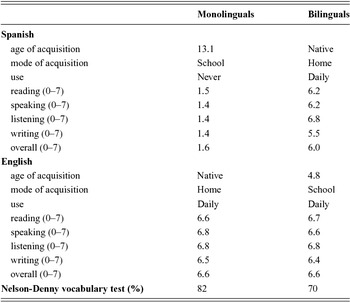
24 English monolinguals and 24 Spanish–English bilinguals (mean age = 19.6 years) were recruited from the undergraduate student body at the University of California, Davis. Participants received course credit for their participation and provided informed consent in accordance with institutional review board requirements. All participants had normal or corrected-to-normal vision and no self-reported language-related disorders. Participants also completed a language history questionnaire modeled after the Language Experience and Proficiency Questionnaire (LEAP-Q; Marian, Blumenfeld & Kaushanskaya, Reference Marian, Blumenfeld and Kaushanskaya2007) as well as the vocabulary section of the Nelson-Denny Reading Test (Brown, Fishco & Hanna, Reference Brown, Fishco and Hanna1993). The results are summarized in Table 1.
Participant data provided by language history questionnaire and proficiency testing.

Twelve of the native English speakers had limited Spanish experience in a high school class at least two years prior to the study, but were considered to be monolinguals because none had very much experience with the language and reported that they never use it. Bilinguals were considered to be highly proficient in their native language, Spanish, since they learned it in the home, continue to speak it regularly, and rated themselves as proficient users of the language (M = 6.0 on a 7 point scale). They did, however, rate themselves as slightly more proficient in English than Spanish for reading skills [t(46) = 2.06, p < .05] as well as overall skills [t(46) = 3.09, p < .01]. They reported learning English in school and receiving most of their education in English. Thus, English might be considered their dominant language, even though it was their L2 in terms of order of acquisition. While self-reports indicated that the bilinguals and monolinguals were equally proficient in English [t(46) = 0.68, ns], the monolinguals had significantly higher Nelson-Denny vocabulary scores [t(46) = 4.28, p < .001]. Since bilinguals were not as proficient in English as native speakers and considered themselves as nearly as proficient in Spanish as in English, we regard this population to be approximately equally balanced in their proficiency in the two languages. Throughout the paper, we will use the terms L1 and L2 to refer to the order in which the two languages were acquired rather than the functional dominance of one or the other language.
Stimuli
A complete list of the experimental stimuli appears in Appendix S1 in the supplementary materials. English sentences provided semantic context to support either the English meaning (congruent condition) or the Spanish meaning (incongruent condition) of an IH (see Table 2 for examples). This experimental design precluded the use of cognates since only IHs have divergent meanings in the two languages. Critical words consisted of 29 Spanish–English interlingual homographs (e.g., pie) with an average length of 5.1 letters. The average Spanish frequency as measured by log frequency per million plus one was 1.06 according to the SUBTLEX-ESP database (Cuetos, Glez-Nosti, Barbón & Brysbaert, Reference Cuetos, Glez-Nosti, Barbón and Brysbaert2011). The average English frequency using the same measure from the SUBTLEX-US database (New, Brysbaert, Veronis & Pallier, Reference New, Brysbaert, Veronis and Pallier2007) was 0.68. There was no difference in the average frequency of the Spanish and English meanings of the IHs [t(28) = 1.79, p > .10]. We chose to use balanced IHs in order to isolate the effects of semantic and language context apart from objective frequency bias, which is known to affect IH processing (e.g., Kerkhofs, Dijkstra, Chwilla & De Bruijn, Reference Kerkhofs, Dijkstra, Chwilla and de Bruijn2006).
Sample sentences across conditions and mean plausibility ratings with standard deviations.

* IH was replaced with the English translation of its Spanish meaning. Used only for plausibility norming, not in the experiment itself.
IHs were presented in experimental sentences in a non-sentence-final position. The local context of the IH within the sentence (two words prior to and two words after the IH) was held constant across conditions, but the global semantic context of the sentence was manipulated to bias the interpretation toward the language consistent or language inconsistent meanings of the IH. Thus, language context (English) remained constant throughout the experiment, whereas semantic context was manipulated across conditions.
The degree of semantic bias of each experimental sentence was assessed using a normative plausibility procedure. Twenty English monolinguals who did not participate in the main experiment were instructed to judge the plausibility of each experimental sentence on a scale of 1 to 7 (7 = highly plausible). To confirm that the sentences successfully biased only one meaning of the IH, these same subjects also normed a set of control sentences that contained the English translation of the Spanish meaning of the IH (for example, pie was replaced with “foot,” see Table 2). The results of this norming study led to the removal of three of the original 32 IH sets of sentences that did not differ in plausibility. The remaining congruent condition items and incongruent condition items with translation replacements were rated as very plausible, whereas the remaining incongruent condition items and the congruent condition items with translation replacements were rated as very implausible (Table 2). The two conditions differed significantly in plausibility [t(57) = 20.68, p < .0001].
Apparatus and Procedure
A Fourward Technologies Gen 6.6 Dual Purkinje Image Eye Tracker was used to monitor participants’ eye movements as they read. The display consisted of white font on a black background. The location of participants’ gaze was sampled every millisecond from the right eye only. Head rests were used to minimize participants’ movements. The tracker was aligned and calibrated for each participant and recalibrated as needed throughout the experiment.
Participants completed the reading task while eye movements were recorded before completing the language history questionnaire and vocabulary test. Participants were instructed to read sentences for comprehension at their normal speed and press a button when they had finished reading and understood the sentence. They were also told that a multiple choice comprehension question might appear after each sentence and, if so, that they should indicate their answer by pressing one of two buttons.
After initial calibration, six filler sentences were presented prior to the first experimental sentence, and at least two filler sentences appeared between each experimental sentence throughout the rest of the experiment for a total of ninety filler sentences. Fillers did not contain IHs, and were included to encourage natural reading and prevent participants from detecting the nature of the IHs in the experimental sentences. Sentences were counterbalanced across participants such that each IH appeared only once per participant and in different conditions across participants. Each participant read fourteen to fifteen sentences per condition for a total of 29 experimental sentences. A comprehension question appeared at random after 9% of the sentences.
Data analysis
Two regions were scored for each sentence: the critical word region, which contained only the IH, and a two word post-target region. We scored the post-target region because delayed effects of ambiguity are sometimes apparent in spillover regions (Kambe, Rayner & Duffy, Reference Kambe, Rayner and Duffy2001). Three standard eye-movement measures were computed for each participant at the IH and post-target regions: first pass time, regression path time, and total time. First pass time is the sum of fixation durations from the time the eyes first land in a region until they move to a different region and is thought to reflect an early stage of lexical access, including the initial activation of word candidates. This measure is known as gaze duration for single word regions like the IH region. Regression path time is the sum of all fixation durations from the time the eyes first land in a region until they cross the right-hand boundary of the region, including all re-fixations of prior regions. This measure is thought to reflect immediate integration difficulty that drives regressions to prior parts of the sentence for reassessment. Total time is the sum of all fixations in a region for the duration of the entire trial and is thought to reflect the late integration stage of lexical access (Rayner, Reference Rayner1998).
In order to equate the two groups on proficiency, regressions were performed on a set of 29 length and frequency-matched control words in the filler materials (Ferreira & Clifton, Reference Ferreira and Clifton1986). The average length of control words was 5.4 letters, and average English frequency was 0.69 using the same measure that was used for the IHs. Regressions were performed on control word eye movement data to estimate an intercept and a word-length coefficient for each subject and reading measure. These coefficients were then used to generate predicted reading times for IHs based on each participant's reading of language-unique words and the length of each IH. Length-adjusted residuals were calculated as the difference between raw and predicted reading times for each subject in each condition. These residuals were used in all reported analyses. For ease of interpretation, length-adjusted means were then calculated by linearly transforming length-adjusted residuals with the addition of the grand mean of all participants in all conditions for each measure.Footnote 3
By this method, each participant served as his/her own control. Therefore, the technique allowed us to test our hypothesis in two ways. First, we tested whether bilingual IH processing differed from predicted times for each participant derived from matched control words. Bilingual data on the IH region were subjected to pairwise comparisons with predicted reading times for each measure. Secondly, since the method we used statistically equated reading speeds between monolinguals and bilinguals, we directly compared IH processing in the two groups as a function of whether the nontarget language (Spanish) meaning of the IH was known to participants. For this analysis, data were subjected to 2×2 (language group by congruency) repeated measures ANOVAs for both regions with participants and items treated as random factors.
Results
Performance on comprehension questions was 96.7% and was not significantly different between groups [t(46) = 1.12, ns]. Due to track loss, 3.6% of the data were missing. Reading times greater than 1000 ms or less than 120 ms were excluded from our analyses (2.3% total). Missing data thus totaled 5.9% of all trials and were treated as missing at random. The skipping rate was 15.3%, which is the expected amount for words this length (Rayner, Reference Rayner1998), and did not differ between groups or conditions (all p > 0.1). The average number of trials remaining per condition was 11.3 (SD = 1.9), which did not differ across groups or conditions (all p > 0.3).
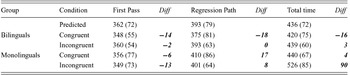
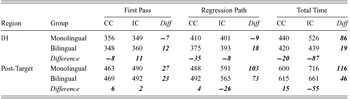
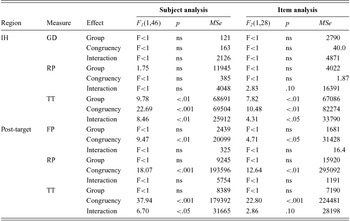
As expected, we observed a difference in English proficiency between groups, as indicated by differences in Nelson-Denny vocabulary scores as well as a main effect of language group in the first region of the sentence leading up to the IH [F1 (1,46) = 4.55, p < .05, MSe = 887132; F2 (1,28) = 4.90, p < .05, MSe = 1068745]. This finding validated our reasoning for performing the regression analyses on raw data to equate the two groups on reading speed.Footnote 4 Length-adjusted mean values for the three dependent measures by region and condition are reported in Tables 3 and 4. No significant differences were found in the bilingual data between actual and predicted reading times on the IH on any measure (all p > .2).Footnote 5 Outcomes of the ANOVA analyses between groups are shown in Table 5.
Predicted Reading Times and Length-adjusted IH Reading Times (ms) with Standard Deviations and Difference Scores (Length-Adjusted Residuals) for First Pass Time, Regression Path Time, and Total Time in Congruent Condition and Incongruent Condition.

Length-adjusted Reading Times (ms) and Difference Scores for First Pass Time, Regression Path Time, and Total Time, in Congruent Condition (CC) and Incongruent Condition (IC).

Results of Group (Monolingual vs. Bilingual) X Congruency (Incongruent vs. Congruent) Repeated Measures Analyses of Variance for Gaze Duration (GD; IH Region Only) First Pass Time (FP; Post-target Region Only), Regression Path Time (RP), and Total Time (TT) using Length-Adjusted Residuals.

Measures of ‘early’ processing
In the IH region, no significant effects were found for gaze duration or regression path time (all F < 2.83, ns, see Table 5). For the post-target region, a main effect of congruency was found on first pass time. Participants in both groups spent more time on this region in the incongruent than in the congruent condition. Likewise, the main effect of congruency was significant on regression path time in the post-target region, with both groups spending more time in the incongruent than in the congruent condition from the time they entered this region until they passed it.
Measures of ‘late’ processing
In the IH region, a language group main effect, congruency main effect, and language group by congruency interaction were all significant on total time (see Table 5). These effects were driven by a difference in the congruency effect between the two groups. The monolinguals spent significantly more time in the incongruent than in the congruent condition [F1(1,23) = 39.52, p < .001, MSe = 2281; F2(1,28) = 14.61, p < .01, MSe = 7580] whereas the difference for bilinguals was not significant [F1(1,23) = 1.37, ns, MSe = 3844; F2(1,28) = .65, ns, MSe = 8116]. A similar pattern was observed for total time on the post-target region: a congruency main effect and a language group by congruency interaction were both significant (see Table 4), with bilinguals again showing reduced effects of congruency [F1(1,23) = 5.53, p < .05, MSe = 5451; F2(1,28) = 5.73, p < .05, MSe = 8159] compared to the monolinguals [F1(1,23) = 45.17, p < .001, MSe = 4005; F2(1,28) = 17.85, p < .001, MSe = 11,533].
Discussion
Our chief aim in conducting this experiment was to assess when and how L1 information influences word recognition and lexical access for proficient bilinguals reading in their L2. We view the processing environment as reflecting a special type of lexical ambiguity. For the bilingual reader, interlingual homographs may behave like semantically ambiguous words to a monolingual (Duffy et al., Reference Duffy, Henderson and Morris1989; Rayner & Duffy, Reference Rayner and Duffy1986). If so, and assuming that reordered access principles apply, individual reader and/or contextual factors should play a role in the strength and time course of meaning activation. Specifically, we aimed to test how and when semantic and language context affect lexical access in proficient bilinguals. To evaluate this hypothesis, we examined how the agreement or disagreement between language cues and sentence-level semantic cues modulate activation of Spanish and English meanings of balanced interlingual homographs in bilinguals who were highly proficient in both languages. Hence, we manipulated congruency between the L2 global language context and semantic bias toward L1 and L2 meanings associated with interlingual homographs.
For the bilingual group, reading times on the IH did not significantly differ from predicted times derived from length- and frequency-matched control words on any measure. The comparison of length-adjusted means between monolinguals and bilinguals did not reveal any early differences in processing either. The two groups showed an equivalent congruency effect (English meaning of the IH is congruent vs. incongruent) on first pass time in the post-target region after encountering the IH. No significant differences were found between groups in the earlier processing measures, including first pass time and regression path time. Only measures of later processing at the IH and the subsequent post-target region indicated that monolinguals and bilinguals responded differently to the IHs. In particular, significant interactions of group (bilingual vs. monolingual) and congruency (English meaning is congruent vs. incongruent with the sentence context) in total time indicated that bilinguals did not continue to experience as much difficulty with the incongruent condition as the monolinguals did during later stages of processing.
Under the current set of experimental conditions, these results offer little or no support for initially nonselective access under these conditions. We tested the hypothesis of initial activation of both meanings of an IH in two ways. First, we tested whether IH reading times differed significantly from predicted times derived from length and frequency matched language-unique control words. The nonselective access account predicted that bilinguals would have longer gaze durations on IHs than control words due to the automatic activation of both meanings. The data, however, indicated no difference in gaze durations on IHs and predicted times and in fact trended in the opposite direction from the expected IH interference. Secondly, we tested whether IH processing differed between monolinguals and bilinguals reading in their L2 after statistically controlling for proficiency differences between the two groups. The nonselective account predicted that bilinguals would have longer first pass times on the IH and/or post-target region than monolinguals in both conditions because of competition between L1 and L2 interpretations of the IH. The data indicated no significant group effects on first pass time or regression path time in either region. Bilinguals spent no more time on the IH or post-target regions than monolinguals in these early measures. On the contrary, a non-significant trend in the opposite direction occurred, whereby gaze durations on the IH were also numerically shorter in bilinguals compared to monolingual participants in the congruent condition. While neither of these effects was statistically significant, they still provide no indication that bilinguals experienced cross-language interference during early processing of the IH.
The congruency main effect in first pass time on the post-target region provides the earliest indication that participants detected the incongruity between the English meaning of the IH and the prior semantic context of the sentence in the incongruent condition. Both monolinguals and bilinguals had longer first pass times in this region in the incongruent than in the congruent condition. Since no language group main effect was present, there was no evidence of activation of the Spanish meaning of the IH in bilinguals at that point in processing. Instead, it seems that both groups initially activated the English meaning of the IH regardless of semantic bias. In the congruent condition, both groups proceeded from the IH to the post-target region at about the same speed. In the incongruent condition, both groups took more time to process the post-target region, which indicates that both groups had difficulty integrating the IH into the semantic context of the sentence. Even in regression path time in the post-target region, only a congruency main effect was observed.
Only in total time for the IH and post-target regions did language group and congruency interact. In both cases, the interaction was driven by a larger congruency effect, or difference between conditions, for monolinguals. This pattern indicates that bilinguals experienced less overall processing difficulty in late stages in the incongruent condition than monolinguals did. One potential explanation of this effect could be that bilinguals can resolve semantic incongruity faster than monolinguals due to their enhanced executive control capacity (see Bialystok, Craik & Luk, Reference Bialystok, Craik and Luk2012 for a review). If this is the case, these results would provide no support for activation of the nontarget meaning, even late during lexical access when it would help to resolve the incongruity in the sentence. However, the ERP literature suggests that the bilingual N400 effect in response to semantic implausibility is often equal in amplitude (e.g., Jouravlev & Jared, Reference Jouravlev and Jared2014) and sometimes even delayed (e.g., Moreno & Kutas, Reference Moreno and Kutas2005) compared to monolinguals, which suggests that bilinguals are no better at resolving incongruity. In addition, the sentences in the current study were written such that the incongruity could only be resolved by integrating the Spanish meaning of the IH. Since only the bilinguals had knowledge of this alternate meaning, we believe a more compelling explanation of the effect is that the Spanish meaning of the IH became available to the bilinguals late in processing in the incongruent condition and was integrated into the sentence context by the time they re-fixated the critical and post-target regions. Monolinguals, on the other hand, showed sustained integration difficulty during refixations in both regions because they did not possess an alternative meaning of the IH to integrate into the sentence.
These results may be understood in terms of Grosjean's language mode hypothesis (Grosjean, Reference Grosjean1998, Reference Grosjean and Nicol2001), which suggests that bilinguals operate on a continuum between a monolingual and a bilingual mode of language processing. Under this framework, the environment establishes the relative activation levels of a bilingual's two languages based on whether they will be needed in a particular scenario. The “zooming-in” hypothesis (Elston-Güttler et al., Reference Elston-Güttler, Gunter and Kotz2005a) specifies this process as the adaptation to a particular language over time when the global language context remains constant. The English global language context of the present experiment may have exerted a strong enough influence on bilinguals’ initial IH processing to allow participants to zoom in on their L2 and operate in an English monolingual mode under these conditions. Even when language and semantic context conflicted, the semantic constraint toward the nontarget meaning of the IH did not appear to lead to rapid activation of the Spanish meaning. Therefore, semantic context seems not to have had a strong influence on early activation of lexical candidates. The influence of semantic context was apparent only in later processing of the incongruent condition, during which it encouraged reinterpretation of the IH using its semantically-congruent nontarget (L1) meaning. On the other hand, the bottom-up stimulus set composition and consistent language membership information provided by the global language context may have allowed bilinguals to zoom in on their L2 more effectively and become less susceptible to interference from their L1, especially early during lexical access.
These results appear to contrast with previous findings indicating that the bilingual word recognition system is strictly nonselective in nature, even while reading sentences in a uniform language context. In a study similar to the present experiment, Libben and Titone (Reference Libben and Titone2009) found a 22 ms interference effect in gaze duration on IHs compared to control words in a condition comparable to our congruent condition. In the current study, the 95% confidence interval on the same dependent measure [-36, 9] did not include this effect, nor did monolinguals and bilinguals differ on this measure. A few methodological differences from the current study might help to explain the different effects found. Libben and Titone (Reference Libben and Titone2009) specifically chose to use IHs with a frequency bias toward the nontarget language meanings, a factor that is known to affect ambiguity resolution both within (Rayner & Duffy, Reference Rayner and Duffy1986) and across (Kerkhofs et al., Reference Kerkhofs, Dijkstra, Chwilla and de Bruijn2006) languages. In contrast, the current study used equibiased IHs to isolate the effects of semantic and language context in particular. Secondly, the stimulus set of the current study contained fewer language ambiguous stimuli (25% of 116 total sentences vs. 50% of 128 total sentences), which may have affected participants’ ability to zoom in on the target language and restrict cross-language activation from the nontarget language. While some of these methodological differences may help to explain the discrepant findings, additional experiments using the same materials as Libben and Titone have also failed to produce early IH interference effects (Pivneva et al., Reference Pivneva, Mercier and Titone2014; Titone et al., Reference Titone, Libben, Mercier, Whitford and Pivneva2011). This suggests that frequency bias or stimulus set composition alone cannot fully explain the effect.
Finally, participants in the present study were likely more proficient in their L2 than were Libben and Titone's participants (6.6/7.0 vs. 7.5/10 according to self-ratings) and reported learning their L2 a mean of three years earlier (4.5 years vs. 7.52 years). Our participants also rated themselves as more proficient in their L2 (6.6/7.0) than in their L1 (6.0/7.0), and as such, had likely developed dominance in their L2. Several prior studies have found reduced or eliminated cross-language activation during L2 reading in participants with higher L2 proficiency than participants with lower L2 proficiency (e.g., Elston-Güttler, Paulmann, & Kotz, Reference Elston-Güttler, Paulmann and Kotz2005b; Schwartz & Kroll, Reference Schwartz and Kroll2006). Titone and colleagues (Reference Titone, Libben, Mercier, Whitford and Pivneva2011) also provided evidence against early IH interference during L1 reading in participants dominant in their L1. From this perspective, our participants may have experienced less L1 interference due to their high L2 proficiency and L2 dominance. Perhaps the English meanings of the IHs were more accessible to our participants due to higher subjective frequencies in English than Spanish for this population of bilinguals. If this is the case, the English meaning may have been accessed first according to reordered access principles, i.e., that the more frequently encountered meaning is activated prior to the subordinate meaning (Rayner & Duffy, Reference Rayner and Duffy1986). However, Pivneva and colleagues (Reference Pivneva, Mercier and Titone2014) report that their participants were less proficient in their non-dominant L2 than the sample from Libben and Titone (Reference Libben and Titone2009) and yet still showed no sign of early IH interference. Therefore, it seems that even proficiency and language dominance differences in participants among the various studies may not fully explain the different findings. More research on the way in which the form of a reader's bilingualism affects language selectivity under various conditions is needed to fully understand these effects.
Upon examination of the literature, a lack of support for early IH interference during the reading of full sentences seems to be the norm across studies that have used various methods and language combinations. Titone and colleagues (Reference Titone, Libben, Mercier, Whitford and Pivneva2011) showed evidence of IH interference on L1 reading only in late processing measures of the eye movement record (i.e., total reading time), which was promoted by the presence of cross-language cues when L2 fillers were added to the experiment. Additionally, Pivneva and colleagues (Reference Pivneva, Mercier and Titone2014) only found evidence of IH interference late in processing for bilinguals with high executive control reading highly constraining sentences. These two eye-tracking studies with English–French and French–English bilinguals, respectively, showed no evidence of initial IH interference and only evidence of late interference under certain conditions. Similarly, Elston-Güttler and colleagues (Reference Elston-Güttler, Gunter and Kotz2005a, Reference Elston-Güttler and Gunter2008) showed no evidence of IH interference on semantic priming in a uniform, ‘zoomed-in’ global language context for German–English bilinguals. Also, Schwartz and Kroll (Reference Schwartz and Kroll2006) showed elimination of IH interference on naming for highly proficient Spanish–English bilinguals and for intermediate proficiency bilinguals reading highly constraining sentences. All of these studies have provided support for conditions under which IH interference disappears and bilingual lexical access appears to be language selective rather than nonselective, at least in the early stages of processing.
Finally, the results of the present study are also comparable to the results of Jouravlev and Jared (Reference Jouravlev and Jared2014), who embedded IHs in L2 (English) sentences that biased the L1 (Russian) meaning, similar to the incongruent condition of the current experiment. An intermediate N400 ERP effect was found to IHs relative to L2-unique plausible or implausible control words. While these results provide some support for partially nonselective access, their results do not identify the time course of cross-language activation as the current study has done. If N400 differences in their study reflected the degree of integration difficulty (e.g., Brown & Hagoort, Reference Brown and Hagoort1993; Van Berkum, Hagoort & Brown, Reference Van Berkum, Hagoort and Brown1999), it is possible that the nontarget language meaning of the IH was activated post-lexically when the English meaning did not fit the semantic context. This interpretation is compatible with the results of the current study, in which bilinguals showed reduced processing difficulty relative to monolinguals in late total time measures in the incongruent condition. The interaction indicated late cross-language activation only during the integration stage of lexical access and only when the non-target language meaning was consistent with the semantic context. Thus, the present experiment shows results consistent with the majority of the literature on IH processing during reading across various methods of investigation (e.g., behavioral, eye-tracking, and ERP studies).
In addition to IH processing, several studies have investigated cognate facilitation effects in sentence contexts. In contrast to IHs, robust cognate effects have appeared across proficiency levels, language contexts, sentence constraints, and executive control capacity. While some research has suggested that increased semantic constraint can eliminate, or at least reduce, cognate facilitation (Libben & Titone, Reference Libben and Titone2009; Schwartz & Kroll, Reference Schwartz and Kroll2006; Titone et al., Reference Titone, Libben, Mercier, Whitford and Pivneva2011; Van Hell & de Groot, Reference Van Hell and de Groot2008), others have demonstrated persistent effects in even the most highly constrained sentences (Van Assche et al., Reference Van Assche, Drieghe, Duyck, Welvaert and Hartsuiker2011). Since several studies have produced dissociations between IH and cognate effects within participants (Pivneva et al., Reference Pivneva, Mercier and Titone2014; Schwartz & Kroll, Reference Schwartz and Kroll2006; Titone et al., Reference Titone, Libben, Mercier, Whitford and Pivneva2011), it is an open question as to why these two types of language ambiguous words should interact differently with context. One compelling explanation is that a representational difference may exist between cognates and other words in the bilingual lexicon (Gollan, Forster & Frost, 1997; Pivneva et al., Reference Pivneva, Mercier and Titone2014; Titone et al., Reference Titone, Libben, Mercier, Whitford and Pivneva2011; Van Assche et al., Reference Van Assche, Drieghe, Duyck, Welvaert and Hartsuiker2011). Specifically, due to their high degree of orthographic and semantic overlap, cognates may have a shared representation across both languages such that bilinguals may not process cognates in the same way as language-unique words. When the cognate representation is accessed in one language, it would necessarily co-activate the shared representation in the other language. Cognates may show more evidence of early cross-language activation for this reason. In contrast, simulation work by Dijkstra and van Heuven (Reference Dijkstra and van Heuven2002) has demonstrated that bilinguals likely develop dual representations for IHs, one for each language. Since the divergent representations could potentially be accessed separately, IHs may be less susceptible to nonselective effects. In this way, IH representations may be accessed differently than cognates and share more similarity to representations of language-unique words.
The BIA+ model allows for the possibility of contextual influences on the strength of activations across two languages. It does not, however, clearly specify the relevant factors or the nature of their influences. The present experiment suggests that both language and semantic context may play important roles in modulating language selectivity throughout the time course of lexical access. In particular, the results suggest that highly proficient bilinguals reading in their more dominant L2 adjust lexical access and semantic activations based on the particular qualities of the local semantic context and the global language environment. These results may be incompatible with a strict, bottom-up model of lexical retrieval and semantic activation in which the effects of language membership are restricted to late stages of processing. Various other studies have demonstrated influences of proficiency, semantic context, domain-general executive control, frequency bias, and language context on cross-language activation. Bottom-up orthographic and phonological cues have also been shown to reduce nonselective effects (Lagrou, Hartsuiker & Duyck, Reference Lagrou, Hartsuiker and Duyck2013; Thomas & Allport, Reference Thomas and Allport2000). An important goal for future research will be to determine the relative influence and time course of each factor's effects to produce a complete account of the locus of language selection during bilingual word recognition in context. The unfolding story across studies seems to support the possibility of language selective access under certain conditions that closely resemble the natural reading environment. It may be that a confluence of all of these factors can drive bilinguals to different positions on the language mode continuum such that both nonselectivity and selectivity are possible in different contexts.
Supplementary Material
For supplementary material accompanying this paper, visit http://dx.doi.org/10.1017/S1366728915000115