Introduction
It is now believed that dysregulation of the cell cycle of proliferation contributes to the development of many malignant tumours. The p27 protein, a cyclin-dependent kinase inhibitor, play an important role in blocking the normal cell cycle from gap1 G1 to synthesis S by negatively regulating the cyclin E/cylin-dependent kinase 2 and cyclin A/cyclin-dependent kinase 2 complexes, and thereby inducing cell growth arrest.Reference Carrano and Pagano1 Degradation of the p27 protein during the cellular proliferation process has been reported, both in vitro and in vivo, through its phosphorylation on threonine 187, mediated by S-phase kinase-associated protein 2 (a human F-box protein which is necessary for deoxyribonucleic acid (DNA) replication)Reference Gstaiger, Jordan, Lim, Catzavelos, Mestan and Slingerland2 within the post-translational ubiquitin-proteasome pathway.Reference Carrano and Pagano1, Reference Tsvetkov, Yeh, Lee, Sun and Zhang3, Reference Carrano, Eytan, Hershko and Pagano4 Thus, S-phase kinase-associated protein 2 is an important protein in controlling the p27 degradation process. Increased expression of S-phase kinase-associated protein 2 and cyclin E may accelerate cell proliferation. High levels of both these proteins have been reported to correlate with the malignant status of many tumours.Reference Latres, Chiarle, Schulman, Pavletich, Pellicer and Inghirami5–Reference Muller-Tidow, Metzger, Kugler, Diederichs, Idos and Thomas9
Nasopharyngeal carcinoma (NPC), a malignant tumour of the nasopharyngeal epithelium, is classified by the World Health Organization into three types.Reference Vokes, Liebowitz and Weichselbaum10, Reference Fandi, Altun, Azli, Armand and Cvitkovic11 World Health Organization types II and III NPCs are highly prevalent in endemic areas such as South-east Asia, northern and eastern Africa, and some North american indigenous populations. These NPCs are strongly associated with Epstein-Barr virus, although some genetic and environmental factors have been documented as playing a role in their development.
No previous reports have involved the role of cyclin E in NPC. In the present study, we assessed the messenger ribonucleic acid (mRNA) and protein expressions of S-phase kinase-associated protein 2, cyclin E and p27 protein in NPC patients, and we analysed data to determine any clinicopathological correlations.
Materials and methods
Subjects and specimens
Fresh nasopharyngeal biopsy specimens were obtained from 45 patients presenting with symptoms or signs possibly indicative of NPC. All patients underwent nasopharyngeal biopsy during their initial visit. The study population comprised 35 NPC patients (27 men and eight women) with a mean age of 50.6 years (range, 17–84 years). The non-malignant group comprised 10 patients (seven men and three women; mean age, 35.7 years; age range, 19–53 years) with a nasopharyngeal mass that was later confirmed to be negative for NPC.
Fresh tissue blocks were cut into two pieces: one was used for histopathological examination and the other was stored at −80°C for later use.
Our protocol was reviewed and approved by the local hospital institutional review board.
Ribonucleic acid extraction and reverse transcription polymerase chain reaction
For RNA preparation, tissue samples were cut into small pieces and RNA extracted using Tri-Zol reagent (Life Technologies, Gaithersburg, Maryland, USA). A total of 2 µg of RNA from each sample was reverse-transcribed into copy deoxyribonucleic acid, (cDNA) then amplified by polymerase chain reaction (Promega, Madison, WI, USA) using the following primers: for S-phase kinase-associated protein 2 primer, 5′-GCT GCT AAA GGT CTC TGG TGT- 3′ (forward) and 5′-AGG CTT AGA TTC TGC AAC TTG-3′ (reverse); for p27, 5′-AGG ATG TCA GCG GGA GCC GC-3′ (forward) and 5′-CTT CTT GGG CGT CTG CTC CA-3′ (reverse); and for cyclin E, 5′-AAT CGA CAG GAC GGC GAG GGA C-3′ (forward) and 5′-GGC AGT CAA CAT CCA GGA CAC A-3′ (reverse) (where G = guanine, C = cytosine, T = thymine and A = adenine). The level of mRNA was assessed by a densitometer (Kodak Digital Science 1D software program, Rochester, New York, USA).Reference Moore, Shen, Gao, Busuttil and Coito12 All gels containing polymerase chain reaction amplicons were scanned with the Kodak Image System and electronically evaluated with the Kodak Digital Science 1D software, which enabled comparison of the grey scales of the scanned amplicons in relation to the positive controls.Reference Mustafa, Klonisch, Hombach-Klonisch, Kehlen, Schmutzler and Koehrle13 Relative quantities of mRNA were determined. The same nasopharyngeal carcinoma tissues were used as external positive controls in all polymerase chain reaction examinations. A glyceraldehyde-3-phosphate dehydrogenase copy DNA probe was used as an internal positive control.
Immunohistochemistry
Archival, pretreatment tumour tissue was obtained from 29 patients with NPC. Primary antibodies for S-phase kinase-associated protein 2 (Santa Crux Biotechnology, Santa Cruz, California, USA), cyclin E (Santa Crux Biotechnology, Santa Cruz, California, USA) and p27 (Dako, Glostrup, Denmark) were diluted 1:50 in phosphate-buffered saline. The sections were deparaffinised and incubated overnight at 37°C, and then treated with 3 per cent hydrogen peroxide to deprive the endogenous peroxidase activity and microwaved in 10 mM citrate buffer (pH 6.0) to unmask the epitopes. After antigen retrieval, the sections were incubated with diluted primary antibodies overnight and then washed with phosphate-buffered saline. Horseradish peroxidase/Fab polymer conjugate (PicTure™-Plus kit; Zymed, San Francisco, California, USA) was then applied to the sections. After extensive washing, the sections were incubated with peroxidase substrate diaminobenzidine. Thereafter, the sections were counterstained with Gill's haematoxylin and mounted with mounting medium.
All the sections were interpreted by a pathologist (SCH) blinded to the clinical data. Between 15 and 20 high-power fields were viewed. The stain strength was graded as 0+, 1+, 2+ or 3+, and the expression percentage as weak (<5 per cent), moderate (5–50 per cent) or intensely positive (>50 per cent) depending on the number of positive tumour cells
Statistical analysis
Data were analysed using the Statistical Package for the Social Sciences software (version 13.0 for Windows, Apache, Chicago, Illinois, USA). The analysis of variance test was used to evaluate the data for S-phase kinase-associated protein 2, cyclin E and p27 protein regarding comparisons between NPC and normal tissue, and also to evaluate the other parameters in each group. Survival rates were calculated by the Kaplan–Meier method using a log-rank test. A p value less than 0.05 was considered statistically significant.
Results
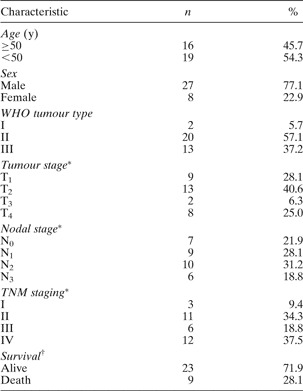
Tissue from 35 NPC cases and 10 normal subjects underwent reverse transcriptase polymerase chain reaction. All NPC patients underwent local head and neck examinations before treatment, along with staging examinations (including whole body bone scans, abdominal ultrasonography, computed tomography and magnetic resonance imaging) (Table I). The tumour–node–metastasis (TNM) staging system (International Union Against Cancer (UICC), 1997) was used for clinical staging.Reference Sobin and Fleming14 Three patients who did not complete the staging examinations or were lost to follow up were excluded from the prognostic factor analysis. The reverse transcriptase polymerase chain reaction analysis of tissue from 35 NPC patients demonstrated a 1.75-fold amount of S-phase kinase-associated protein 2 mRNA expression, a 0.34-fold amount of cyclin E mRNA expression and a 0.31-fold amount of p27 mRNA expression, compared with the positive controls (Figure 1). Compared with normal tissue, the mRNA expression levels were altered 0.85-, 0.39- and 0.73-fold, respectively. A statistically significant difference was seen for S-phase kinase-associated protein 2 and p27 protein, comparing NPC and normal nasopharyngeal tissue (p = 0.002 and p = 0.002, respectively).
Reverse transcription polymerase chain reaction analysis for cyclin E, S-phase kinase-associated protein 2 (Skp2) and p27 protein in nasopharyngeal carcinoma tissue. GAPDH was used as an internal positive control to normalize the amount of RNA. Lanes 1–9 nasopharyngeal carcinoma; GAPDH = glyceraldehyde-3-phosphate dehydrogenase; P = external positive control.

Demographic data for NPC patients

* Staging was incomplete for three patients. †Three patients were lost to follow up. NPC = nasopharyngeal carcinoma; y = years; WHO = World Health Organization; TNM = tumour–node–metastasis
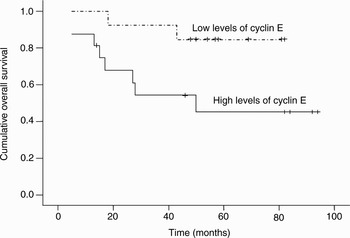
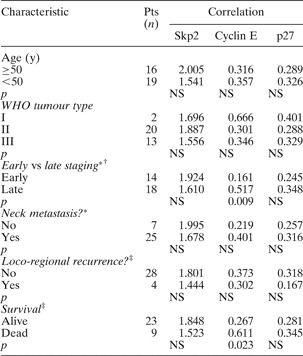
Thirty-two patients were followed up for between 42 and 105 months (mean = 56.6 months). To facilitate analysis of prognostic factors, stage I and II tumours were grouped together as early stage and stages III and IV as late stage. At the time of writing, all early-stage cases were alive, and their prognoses were significantly better than those of the late-stage cases (p = 0.002, by Kaplan–Meier method using log-rank test, not shown). Cyclin E showed a strong association with late-stage NPC (p = 0.009) and poor survival (p = 0.023) (Table II). Results for the three proteins analysed were divided into high and low levels by a cut-off point at the group median, in order to evaluate the survival period.Reference Muller-Tidow, Metzger, Kugler, Diederichs, Idos and Thomas9 By using the Kaplan–Meier method, patients whose tumour had a high level of cyclin E were shown to have a significantly poorer prognosis, compared with patients with low levels (p = 0.010, by log-rank test; Figure 2).
Kaplan–Meier curve for overall patient survival by cyclin E expression, divided into high level (solid line, n = 17, censored = 9) and low level (dotted line, n = 15, censored = 14) by a cut-off point at the group median. A significant difference in cumulative overall survival was seen, comparing patients with high and low levels of cyclin E expression (p = 0.010, log-rank).

Correlation of skp2, cyclin E and p27 expression with clinicopathological status

* Staging was incomplete for three patients. †Early staging = stages I + II, late staging = stages III + IV. ‡Three patients were lost to follow up. Skp2 = S-phase kinase-associated protein 2; y = years; NS = non-significant; WHO = World Health Organization
S-phase kinase-associated protein 2, cyclin E and p27 protein were expressed locally in the cell nucleus. Although faint expression in the cytoplasm was occasionally seen, involving an unknown mechanism, we only evaluated nuclear staining (Figure 3). Analysis of the immunohistochemical results is shown in Table III. Strong staining (i.e. grades 2+ and 3+) for S-phase kinase-associated protein 2, cyclin E and p27 protein was found in 11/29 (38 per cent), 3/29 (10 per cent) and 11/29 (38 per cent) of the tissue samples, respectively. Positive (i.e. intense or moderate) expression of the above three proteins was seen in 16/29 (55 per cent), 13/29 (45 per cent) and 17/29 (59 per cent) tissue samples, respectively. Protein expressions, as determined by immunohistochemical analysis, were not associated with clinicopathological or prognostic factors.
Photomicrographs showing immunohistochemical staining for S-phase kinase-associated protein 2 (Skp2), cyclin E, and p27 protein in nasopharyngeal carcinoma tissue. (a) Strong expression of Skp2 protein; (b) weak expression of skp2 protein; (c) moderate expression of cyclin E protein; (d) positive expression of p27 protein. Note the enhanced nuclear staining of the tumour and surrounding lymphoid cells (H&E; original magnification ×66).

Protein expression of Skp2, cyclin e and p27 by immunohistochemical analysis

Skp2 = S-phase kinase-associated protein 2; mod = moderate
Discussion
To our best knowledge, the current study is the first to report the mRNA expression for cyclin E and S-phase kinase-associated protein 2 in NPC. Our results showed a significantly elevated mRNA level for S-phase kinase-associated protein 2 but not for cyclin E, within NPC tissue, compared with normal nasopharyngeal tissue. Immunohistochemical analysis also revealed that the expression of S-phase kinase-associated protein 2 was stronger than that of cyclin E, in both the strength and positive percentage of staining. Following clinicopathological analysis, elevated levels of cyclin E mRNA were positively associated with advanced staging and poor survival of patients with NPC.
S-phase kinase-associated protein 2, an F-box protein, and S-phase kinase-associated protein one were first identified as interactors with the cyclin A cylin-dependent kinase 2 complex.Reference Fandi, Altun, Azli, Armand and Cvitkovic11 In the cell proliferation process, S-phase kinase-associated protein 2 mediates ubiquitinylation and degradation of p27 protein through cyclin-dependent kinase 2 mediated phosphorylation on threonine 187. This process has been demonstrated both in vitro and in vivo.Reference Tsvetkov, Yeh, Lee, Sun and Zhang3, Reference Carrano, Eytan, Hershko and Pagano4 S-phase kinase-associated protein 2 mRNA is probably induced by cell adhesion to the extracellular matrix.Reference Carrano and Pagano1 This protein plays an important role in the regulation of p27 protein within the cell cycle. S-phase kinase-associated protein 2 is also required for the ubiquitinylation of free form cyclin E.Reference Latres, Chiarle, Schulman, Pavletich, Pellicer and Inghirami5 Overexpression of S-phase kinase-associated protein 2 may accelerate uncontrolled cell proliferation. This effect has been reported for many malignant tumours, such as lymphomas,Reference Latres, Chiarle, Schulman, Pavletich, Pellicer and Inghirami5, Reference Chiarle, Fan, Piva, Boggino, Skolnik and Novero6 small cell lung cancer,Reference Yokoi, Yasui, Saito-Ohara, Koshikawa, Iizasa and Fujisawa7 colorectal cancer,Reference Hershko, Bornstein, Ben-Izhak, Carrano, Pagano and Krausz15 and head and neck cancer (e.g. oral cancer)Reference Kudo, Kitajima, Sato, Miyauchi, Ogawa and Takata16; furthermore, high levels of S-phase kinase-associated protein 2 have been found to correlate with the malignant status of the tumour. In our study, imunohistochemical analysis indicated positive expression of S-phase kinase-associated protein 2 protein in 16/29 (55 per cent) tumour samples. Studies of other human malignancies have found similar results, ranging from 30 to 55 per cent.Reference Kim, Lim, Kim, Shin, Park and Lee17, Reference Sui, Dong, Watanabe, Yamaguchi, Sugimoto and Tokuda18 High levels of S-phase kinase-associated protein 2 mRNA were also strongly associated with the NPC group, compared with normal controls (p = 0.002). This result may suggest that S-phase kinase-associated protein 2 acts as a proto-oncogene in the oncogenesis of NPC.
Cyclin E is a 45 kDa nuclear protein which appears in the late G1 phase of cell cycle but is then degraded after the cell enters the S phase.Reference Datta, Renshaw, Dutta, Hoffman and Loughlin8 It is believed to be the main regulator of entry into the S phase and subsequent DNA synthesis. Although numerous studies have addressed the association between cyclin E and other cancers, specific research has not previously been conducted on cyclin E expression in NPC. In our study, we found positive expression of cyclin E protein in 13/29 (45 per cent) tumours, but strong staining for this protein (on immunohistochemical analysis) in only 3/29 (10 per cent). There was no significant difference in cyclin E mRNA levels, comparing NPC with normal tissue; however, a strong association was found between cyclin E mRNA levels and late-stage NPC (p = 0.009). A possible explanation for this finding is that angiogenesis or adhesive factors play the main role in the early stages of tumour oncogenesis, whereas proliferative activity is more important in the advanced stage. The present study findings suggest that cyclin E may have a more pivotal role in cellular proliferation than angiogenesis. A similar finding was reported by Fukuse et al. for non-small cell lung cancer; a high cyclin E mRNA level was observed in the advanced tumour stage (stage IIIa) but not in the early stages.Reference Fukuse, Hirata, Naiki, Hitomi and Wada19 Another possible explanation is that overexpression of cyclin E leads to increased chromosome instability, which can induce development and progression of tumours, especially in the advanced stage.Reference Yokoi, Yasui, Saito-Ohara, Koshikawa, Iizasa and Fujisawa7, Reference Mishina, Dosaka-Akita, Hommura, Nishi, Kojima and Ogura20 We propose that cyclin E protein expression in NPC tissues may have most impact in late-stage tumours, because of its involvement with cellular proliferation.
As regards clinicopathological analysis, Brzezinski et al. reported that greater cyclin E protein expression had a positive relationship with advanced tumour staging in papillary thyroid cancer.Reference Brzezinski, Migodzinski, Gosek, Tazbir and Dedecjus21 Datta et al. detected cyclin E positive testicular germ cell tumours at higher clinical stages of this tumour.Reference Datta, Renshaw, Dutta, Hoffman and Loughlin8 Bani-Hani et al. found that cyclin E overexpression correlated with advanced stage in gastric cancer.Reference Bani-Hani, Almasri, Khader, Sheyab and Karam22 In the current study, there was a significant difference in patient survival, comparing high and lower levels of cyclin E (p = 0.010). This result may be closely related to the correlation between cyclin E expression and late tumour stage. A correlation between high cyclin E levels and shorter survival has also been reported for breast cancerReference Peters, Vidal Mdel, Gimenez, Mauro, Armanasco and Cresta23 and non-small cell lung cancer.Reference Muller-Tidow, Metzger, Kugler, Diederichs, Idos and Thomas9, Reference Mishina, Dosaka-Akita, Hommura, Nishi, Kojima and Ogura20 Our findings suggest that overexpression of cyclin E may have a negative impact on the survival of patients with NPC. Therefore, cyclin E may possibly be regarded as a prognostic factor for this tumour.
• This prospective, controlled study evaluated the expression of protein and messenger ribonucleic acid (mRNA) for cyclin E, S-phase kinase-associated protein 2 and p27 protein within nasopharyngeal carcinoma (NPC) tissue
• Elevated levels of S-phase kinase-associated protein 2 mRNA and reduced levels of p27 protein mRNA were found in NPC tissue, compared with normal nasopharyngeal tissue
• Overexpression of cyclin E mRNA had an adverse prognostic significance, correlating with advanced tumour staging and poor overall patient survival
• These results support the theory that S-phase kinase-associated protein 2 acted as proto-oncogenes in the oncogenesis of NPC
An association between low p27 expression and aggressive malignancy has been observed in many cancers (in addition to NPC). Baba et al. found reduced expression of p27 protein in NPC.Reference Baba, Tsukuda, Mochimatsu, Furukawa, Kagata and Satake24 Our previous research demonstrated that low levels of p27 protein expression correlated with high rates of early loco-regional recurrence in NPC.Reference Hwang, Su, Huang, Huang, Fang and Lui25 In the present study, we also found significantly reduced levels of p27 protein mRNA in NPC tissues, compared with normal controls (p = 0.002). These findings highlight the role of low p27 expression in NPC oncogenesis.
Conclusions
This study found elevated levels of S-phase kinase-associated protein 2 mRNA and reduced levels of p27 mRNA in NPC tissue, compared with normal nasopharyngeal tissue. High levels of cyclin E mRNA correlated with advanced staging of NPC and poor patient survival. If the results of the present report can be confirmed in larger clinical and laboratory studies, molecular genetic alterations in individual tumours may eventually be able to guide therapeutic strategies.
Acknowledgements
This study was supported by a research grant from the National Science Council of the Republic of China (92-2314-B-182A-204).