

An estimated one in six children is diagnosed with a neurodevelopmental disorder (NDD) in the United States (Boyle et al., Reference Boyle, Boulet, Schieve, Cohen, Blumberg, Yeargin-Allsopp and Kogan2011), with increasing childhood disability rates reported in Australia (Arabiat, Whitehead, & Al Jabery, Reference Arabiat, Whitehead and Al Jabery2018). Disorders such as autism spectrum disorder (ASD), intellectual disability (ID) and attention-deficit/hyperactivity disorder (ADHD) typically emerge in early childhood and are characterised by difficulties in personal, social, and educational capacities (American Psychiatric Association, 2013). Some NDDs present with challenging behaviours such as aggression and self-injury, which may increase familial stress and isolation (Catalano, Holloway, & Mpofu, Reference Catalano, Holloway and Mpofu2018; Dykens, Reference Dykens2015). Therapeutic goals for this population therefore are generally aimed at increasing personal capacities and daily functioning, and reducing challenging behaviours. Treatment at an intensity of 15 to 25 hours per week is recommended in the ASD population, with parental involvement linked with positive therapy outcomes (Roberts & Williams, Reference Roberts and Williams2016). Parental adherence to treatment may be an important predictor of a child’s therapeutic success due to generalisation of learned skills from clinic to home, resulting in lasting therapeutic effects (Dillenburger, Keenan, Doherty, Byrne, & Gallagher, Reference Dillenburger, Keenan, Doherty, Byrne and Gallagher2010; Villodas, McBurnett, Kaiser, Rooney, & Pfiffner, Reference Villodas, McBurnett, Kaiser, Rooney and Pfiffner2014).
ASD, ID and ADHD are three of the most prevalent NDDs (Hansen, Oerbeck, Skirbekk, Petrovski, & Kristensen, Reference Hansen, Oerbeck, Skirbekk, Petrovski and Kristensen2018; Matson & Cervantes, Reference Matson and Cervantes2014), with comorbidity a common occurrence associated with increased risk and severity of challenging behaviours (Jang et al., Reference Jang, Matson, Williams, Tureck, Goldin and Cervantes2013; Tonnsen et al., Reference Tonnsen, Boan, Bradley, Charles, Cohen and Carpenter2016). Given the high comorbidity associated with these three NDDs, this research includes a population of individuals with and without comorbid ASD, ID and ADHD as would be present at therapeutic interventions in the community.
With treatment adherence (defined as practice and implementation of interventions in the home setting, including therapeutic homework) linked with treatment efficacy, research is beginning to identify patterns in family therapy adherence (Nock & Ferriter, Reference Nock and Ferriter2005). For example, average homework completion has been estimated at 58% for a training intervention for children with developmental delays, meaning just over half of families in therapy are adhering to homework activities (Ros, Hernandez, Graziano, & Bagner, Reference Ros, Hernandez, Graziano and Bagner2016).
A possible barrier to parental treatment adherence is parental stress, or the psychological distress that arises from a discrepancy between the demands of parenting and perceived resources to meet these demands (Deater-Deckard, Reference Deater-Deckard1998). Parents of children with ASD report higher stress levels than parents of typically developing children and parents of children with other disabilities (Hayes & Watson, Reference Hayes and Watson2013). Several studies have shown challenging behaviour to be one of the most consistent predictors of parental stress in children with ASD, ID and ADHD (e.g., Ageranioti-Bélanger et al., Reference Ageranioti-Bélanger, Brunet, D’Anjou, Tellier, Boivin and Gauthier2012; Carroll et al., Reference Carroll, Hallett, McDougle, Aman, McCracken, Tierney and Scahill2014; Johnson, Reference Johnson2017). Child challenging behaviour is therefore implied as a potential barrier to adherence. However, it is noted that the relationship between parental stress and therapy adherence is likely complex, with stress feasibly conceived as a facilitator if treatment is perceived as an effective tool to reduce challenging behaviours without leading to an imbalance of demands and resources. Perceived treatment burden may be an important consideration when examining parental stress (Hock, Kinsman, & Ortaglia, Reference Hock, Kinsman and Ortaglia2015).
Another demographic factor linked with adherence to child therapies is single parent status (e.g., Baker, Smith, Greenberg, Seltzer, & Taylor, Reference Baker, Smith, Greenberg, Seltzer and Taylor2011), with single parents potentially finding it more challenging to implement home practice. This may reflect time-based or income-based concerns. Relationships between annual household income and therapy adherence seem unclear, suggesting that research could investigate both single parent status and household income for potential relationships with therapy adherence (Baker et al., Reference Baker, Smith, Greenberg, Seltzer and Taylor2011).
This study appears to be the first to examine parental stress, child challenging behaviour, household income, single parent status, and therapeutic adherence across multiple NDDs and intervention types. It is noted that many studies involving interventions for children with NDDs and their parents do not use an empirically validated measure for adherence, some using no measurement at all (McConachie & Fletchdr-Watson, Reference McConachie and Fletcher-Watson2015). This lack of consistent measurement presents a significant barrier to the development of effective interventions, especially parent-mediated therapies. Unlike other studies, the present study proposes a purpose-designed scale (Child Therapy Adherence Scale) to measure adherence across different types of therapies. Consistent with literature, it is expected that increased reported levels of parental stress and child challenging behaviours will be associated with lower adherence to therapeutic home-based practice. The relationship of single parent status and household income to therapy adherence will also be assessed in the current research, with single parents and those with lower household income potentially reporting lower adherence to therapeutic home-based practice.
Method
Participants
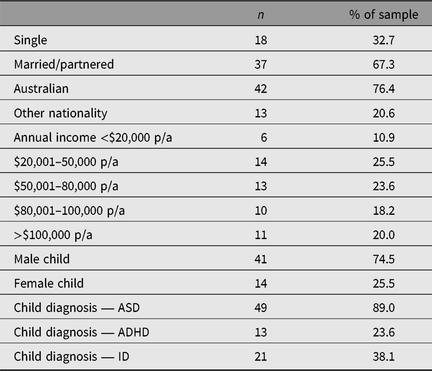
Parents of children with diagnoses of ASD, ADHD and/or ID who engaged in at least one hour of professionally delivered intervention per month were invited to participate. A total of 77 parent-child dyads were invited to participate via the social media platform Facebook. A total of 55 parents/caregivers returned completed questionnaires (Parent M age: 40.96 years, SD age: 8.02 years; Child M age: 9.91 years, SD age: 3.56 years). As seen in Table 1, participants were mostly Australian (n = 42) and female (n = 54), and the most frequently reported child diagnosis was ASD (n = 49). Ethical approval for the study was obtained from the Monash University Human Research Ethics Committee.
Parent-Child Dyad Profiling (N = 55)

Note: ‘Other’ home countries were United States, Canada and England.
Materials
A survey was used to gather information on child’s diagnosis and age, parent age and country of residence, and therapy types. Adherence to therapeutic practice and homework was assessed using a five-question survey of a 5-point Likert-type scale constructed for the present study, named the Child Therapy Adherence Scale (CTAS; see Table 2). Participants were asked to read such statements as ‘I feel confident in my ability to complete the recommended tasks or homework activities with my child each week’ and rate how often this statement applied. Responses ranged in score from 1 (never) to 5 (always), with higher scores indicating higher levels of adherence to therapeutic practice and homework. Two of the five items were reverse scored to help reduce response bias. Reliability analyses of the CTAS revealed item intercorrelations between r = .35 and r = .73 and an acceptable overall reliability of α = .83 (Cronbach, Reference Cronbach1951). This is encouraging considering its small number of items, which can cause an artificial reduction of alpha (Cortina, Reference Cortina1993). Additional psychometric analysis of the CTAS is available from the authors.
Child Therapy Adherence Scale

Parental stress was assessed utilising the Parental Stress Scale (PSS; Berry & Jones, Reference Berry and Jones1995). This scale is sensitive to stress related to parenting responsibilities independent from stress due to other sources (e.g., work and finances). An 18-item scale, participants indicated their perceived stress on a 5-point Likert scale to statements such as ‘I feel overwhelmed by the responsibility of being a parent’. Higher scores indicated higher levels of parental stress, with possible scores ranging from 18 to 90. The scale has been shown to have sound psychometric qualities, including reliability coefficients ranging from .81 to .83 and validity of .75, p < .01 (Berry & Jones, Reference Berry and Jones1995).
Child challenging behaviour was measured using Version Two of the Child’s Challenging Behaviour Scale (CCBS; Bourke-Taylor, Law, Howie, & Pallant, Reference Bourke-Taylor, Law, Howie and Pallant2009). A nine-item scale, participants responded on 4-point Likert scales to such statements as ‘My child can be stubborn and uncooperative’. Possible scores for this scale range from 9 to 36. Higher scores indicated greater severity of challenging behaviour, with the scale being shown to have sound psychometric properties (e.g., reliability coefficients of .89; Bourke-Taylor, Pallant, & Cordier, Reference Bourke-Taylor, Pallant and Cordier2017).
Procedure
A convenience sample was utilised by contacting the administrators of several Facebook pages, including those of South Australian schools, South Australian and national child intervention service providers, support groups for parents of children with NDDs, and community carer support and advocacy services. Additionally, participants were asked to ‘share’ the project advertisement to their personal Facebook networks and pages. It is noted that this project utilised a cross-sectional design with therapy adherence as criterion variable.
Results
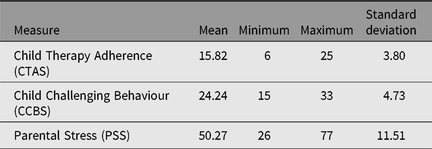
Eighty-nine percent of the children were reported to have ASD (n = 49); 23.6% ADHD (n = 13); and 38.1% ID (n = 21). All children with ADHD had a comorbid ASD diagnosis, as did 15 of the children with ID. Two children were diagnosed with all three NDDs. Other diagnoses (e.g., mood and conduct disorders) were recorded for 32.7% (n = 18) of the children in addition to their NDD. The most common interventions were speech therapy (74.5%), occupational therapy (72.7%) and psychological interventions (38.1%), such as cognitive behavioural therapy, social skills training, and play therapy. Descriptive statistics for the scales employed in this research are displayed in Table 3.
Range, Means, and Standard Deviations of Parent-Reported CTAS, CCBS and PSS

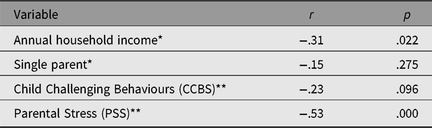
Correlations were conducted to assess relationships between therapy adherence and the variables of annual household income (ordinal), single-parent status (dummy-coded), child challenging behaviour, and parental stress (see Table 4). A significant negative relationship was found between parental stress and adherence (r = −.53, 95% CI [−.25, −.10], p = .000). This effect is considered large (Cohen, Reference Cohen1992) and suggests a strong trend for increases in parental stress to be similarly associated with decrease in therapy adherence.
Correlations With Child Therapy Attendance (CTAS Scores)

Note: *Spearman’s rho correlations as per ordinal/dummy-coded variables **Pearson’s product-moment correlations as per continuous variables
As further seen in Table 4, a significant negative relationship was also found between annual household income and therapy adherence (r = −.31, p = .022). The relationship between child challenging behaviour and therapy adherence was not significant (r = −.23, p = .096), nor was the relationship between single parent status and therapy adherence (r = −.15, p = .275), and thus these two variables were omitted from further analysis.
Multiple regression was conducted to assess parental stress and household income as predictors of child therapy adherence. In combination, the two predictors accounted for 33% of the variability in child therapy adherence, R 2 = .33, adjusted R 2 = .31, F(2, 51) = 12.67, p = .000. As seen in Table 5, parental stress was the sole significant predictor of therapy adherence (p = .000), whereas annual household income was not a significant predictor of child therapy adherence.
Multiple Regression Results for the Model Predicting Child Therapy Attendance (CTAS) Scores

Taken together, correlation and regression results suggest that single parent status and child challenging behaviours were not related to therapy adherence in these NDD parent-child dyads. Annual household income was related to (but not predictive of) therapy adherence, and parental stress was both strongly related with, and predictive of, therapy adherence.
Discussion
The present study investigated possible predictors of self-reported therapy adherence for children with NDDs. To do so, the researchers created a purpose-specific measure of adherence, the CTAS. Results showed single parent status and child challenging behaviours were not related to therapy adherence. This finding may indicate that parent ability to adhere to therapies is determined by the parent’s emotional state rather than external factors, which has implications for future research. Household income was related to, but not predictive of, adherence. Higher perceived parental stress was identified as the most significant predictor of lower adherence with child NDD treatment.
These findings are consistent with other findings showing parental stress negatively impacted the parent’s fidelity to an ASD intervention (Strauss et al., Reference Strauss, Vicari, Valeri, D’Elia, Arima and Fava2012). Another study examining the effect of different parent and socio-economic predictors of adherence to an ASD intervention also found a relationship between parental stress and adherence (Carr et al., Reference Carr, Shih, Lawton, Lord, King and Kasari2016); however, the present study extended this to include other NDDs. It may be that it is burdensome for parents to implement interventions at home without the support of a therapist present, and attempting to do so may contribute to stress and/or reduce self-efficacy.
The mechanism underlying the relationship between adherence and parental stress is not well understood; however, several theories have been proposed. Current results may reflect parents using learned strategies more in the clinical setting than at home (Moore & Symons, Reference Moore and Symons2011) due to their perception of the specialised demands of treatment. Existing studies have shown parent perception of treatment demands, relevance or burden to be a barrier to parental adherence (Hock et al., Reference Hock, Kinsman and Ortaglia2015; Kazdin, Holland, & Crowley, Reference Kazdin, Holland and Crowley1997). Particularly, parent perception of the potential family burden of the intervention was a consistent predictor of adherence across different therapy types (Hock et al., Reference Hock, Kinsman and Ortaglia2015). A parent perceiving an intervention to be burdensome, difficult or stressful may avoid enforcing practice at home. Higher levels of parental stress may also influence the amount of burden perceived by the parent and thus influence the parents’ motivation to complete practice or homework as part of their child’s intervention.
Additionally, parent motivation to complete therapy at home with their child may be hampered by competing contingencies such as care for other children, home duties or work demands (Allen & Warzak, Reference Allen and Warzak2000). In this scenario, these competing responsibilities may interfere with enforcing therapeutic practice by reducing the amount of time free to adhere to practice or these other responsibilities taking precedent. Parental stress may add to, or be moderated by, the above factors to reduce home practice and treatment fidelity. Notably, the current study did not find that either single parent status or child challenging behaviour was related to therapy adherence, and while household income was negatively related to therapy adherence, annual household income was not a significant predictor of child therapy adherence. This suggests research and practice implications regarding barriers to treatment. It may be that extensive interventions for parental stress rather than child-related barriers may prove more effective in improving the therapeutic outcomes of children with NDDs, which is supported by evidence that directly addressing parental stress may enhance the therapeutic effect of child interventions (Kazdin & Whitley, Reference Kazdin and Whitley2003; Stahmer & Pellecchia, Reference Stahmer and Pellecchia2015). Although beyond the scope of this article, it is noted that parent factors (e.g., personality and coping style) may have an impact on the experience of parental stress and should be taken into consideration when designing parent interventions.
A strength of this study is that it is the first to examine adherence across a range of NDDs and across a range of different therapy types in Australian parent-child dyads. This is advantageous not only to add to the scarce Australian-based research in this field, but also to give insight into treatment adherence in the context of current disability funding schemes such as the NDIS. Furthering our research and practice-based understanding of contributors to effective and ineffective interventions is a worthwhile investment.
Another strength of this study is the creation of a measure specifically to measure parental adherence to child treatment, as many studies either use qualitative data or do not use a specific quantitative measure (McConachie & Fletcher-Watson, Reference McConachie and Fletcher-Watson2015). Initial testing of the CTAS indicated good reliability, and further research is needed to more widely validate the scale. In its current infant form, the CTAS represents a brief scale that could be attractive to both researchers and practitioners. Practitioners may find the scale easy to implement with families, taking little clinical time to answer five questions yet garnering significant information. The CTAS may be used to measure adherence across a variety of therapy types and populations, but also in other child interventions dependent on adherence such as CBT and family therapies.
The lack of differentiation between NDDs may be considered a limitation of the current study, as experiences of parental stress may differ depending on the child’s diagnosis and presentation. However, comorbidity between ASD, ID and ADHD is common (Hansen et al., Reference Hansen, Oerbeck, Skirbekk, Petrovski and Kristensen2018), with more than half of the current sample diagnosed with ASD in combination with either ADHD, ID or both. Examining these NDDs as a group is considered to reflect the reality seen in practice.
In conclusion, this study examined the possible relationships between child challenging behaviour, parental stress, income, single parenthood and intervention adherence in parents of children with NDDs. Neither single parenthood nor child challenging behaviours was found to be related to therapy adherence. A significant positive relationship was observed between annual household income and adherence, although income was not a significant predictor of therapy adherence. A strong negative relationship was observed between parental stress and therapy adherence, with parental stress being a significant predictor of adherence. It was evident that the greater the parental perceived stress, the less adherence was reported with child therapy for NDDs. The findings of this study highlight the potential impact of parental stress on a parent/caregivers’ abilities to effectively and consistently implement treatments in the family home. Given that consistency and practice seem essential to positive therapeutic outcomes for children with NDDs, it is important that parents’ self-perceived capacity to facilitate these interventions is supported by service providers and barriers to facilitation minimised.
Acknowledgments
This research was completed in partial fulfilment of Sharna Loader’s Graduate Diploma of Psychology Advanced, Monash University.
Financial Support
This research received no specific grant from any funding agency, commercial, or not-for-profit sectors.
Conflicts of Interest
None.
Ethical Standards
The authors assert that all procedures contributing to this work comply with the ethical standards of the relevant national and institutional committees on human experimentation and with the Helsinki Declaration of 1975, as revised in 2008.