INTRODUCTION
Second generation antipsychotics (SGAs) are generally prescribed as first line antipsychotics in the treatment of psychotic disorders. Although lacking some troublesome side effects such as extrapyramidal symptoms and tardive dyskinesias, SGAs have been associated with metabolic side effects such as hyperglycaemia, hypercholesterolaemia and weight gain (Marder et al. Reference Marder, Essock, Miller and Buchanan2004).
Antipsychotic agents are known to cause adverse cutaneous reactions in approximately 5% of the individuals for whom they are prescribed (Warnock & Morries, Reference Warnock and Morries2002). The majority of adverse cutaneous events are benign, easily treated, and do not pose the patient a serious health risk. Exanthematous eruptions are the most common cutaneous reaction that can occur with any type of antipsychotic agent. Urticaria is the second most common reaction occurring with any of the antipsychotic agents. Skin pigmentation and photosensitivity are most commonly associated with the phenothiazines, in particular chlorpromazine. Pruritus occurs secondary to most adverse cutaneous reactions and is specifically reported with clozapine, olanzapine, quetiapine, risperidone, thiothixenes, and the phenothiazines (Warnock & Morries, Reference Warnock and Morries2002).
Here, a case report of the development of an all over body allergic rash following treatment with olanzapine, which reoccurred more aggressively when switched to risperidone, is discussed. Patient consent was obtained prior to publication.
PRESENTATION
A 27 year old Kuwaiti male (Mr TA) with newly diagnosed paranoid schizophrenia was hospitalised, following an assessment in prison where he was noted to have a long standing paranoid illness which had previously gone undetected and untreated. He was then transferred to a psychiatric intensive care unit (PICU) for treatment. Review of his records demonstrated past use of methadone and crack cocaine, no known drug allergies and no previous antipsychotic treatments. He did not have any significant past medical history except for chronic pain due to a previous right ankle fracture.
In the PICU, treatment was initiated with haloperidol 5 mg twice daily and following three doses he suffered an acute dystonic reaction which resolved following the administration of an intramuscular dose of procyclidine. The haloperidol was then discontinued following which his behaviour became more aggressive, his sleep pattern deteriorated and he interacted poorly with other patients and staff.
It was decided to initiate treatment with olanzapine as it is associated with fewer extrapyramidal side effects in comparison to the typical agents and can be given by intramuscular injection if oral treatment is refused. Olanzapine oral therapy was accepted and the dosage titrated to a dose of 20 mg daily over a few weeks, whilst clonazepam treatment was also continued. He started to respond to this treatment, with an improved sleep pattern and some evidence of a resolution of his delusions.
Six weeks after starting the olanzapine, an itchy rash developed over a few days which spread over his face, hands, stomach, and legs causing him discomfort. Blood tests, including a full blood count, urea and electrolytes, liver function tests, and thyroid function, were all within normal range and a urine drugs test was negative, excluding recent use of illicit drugs as a cause of the extensive rash. All other physical observations including blood pressure, pulse and temperature were within normal range. A dermatologist was contacted for further advice, who advised treatment with chlorpheniramine 4 mg four times a day and betamethasone cream. Meanwhile olanzapine was titrated down over a week and then completely stopped, during which time the rash started to resolve.
A few days following discontinuation of olanzapine, risperidone treatment was started as an antipsychotic was warranted and an atypical agent was preferred due to the history of dystonic reaction to haloperidol. Risperidone was initiated at a dose of 1 mg twice daily, but following a single oral dose of 1 mg, the rash reappeared with more aggression, with significant red lumps appearing over his face. Risperidone was immediately discontinued and a dermatologist contacted for further advice. Treatment with two doses of intramuscular hydrocortisone 100 mg, followed by continued topical steroid treatment with betamethasone and oral antihistamine chlorpheniramine was needed for two weeks to completely resolve the rash.
Other causes of the rash were also investigated, including the tablets' excipients, and if there had been any changes in washing products and bed linen. Due to the previous flare up of the rash when switching to risperidone, treatment with a new antipsychotic was not tried until the rash had completely settled. Zuclopenthixol dihydrochloride was prescribed starting at a low dose of 2 mg twice daily with close monitoring for extrapyramidial side effects (EPSE) and rash. The manufacturer of zuclopenthixol does list rash as a side effect although no particular incidence is specified (Lundbeck Ltd. 2010) so we felt it to be a reasonable choice. Oral antihistamine treatment was continued as prophylaxis for the rash as the dose of zuclopenthixol was increased.
He tolerated the zuclopenthixol and the dose was slowly titrated to 10 mg twice daily with no side effects reported. After five months of treatment with zuclopenthixol no rash was observed but he continued to display negative symptoms. His paranoia persisted, he was poorly kempt and he continued to exhibit impulsive and aggressive behaviour. Four antipsychotics had now been tried, to which he had either not responded or developed intolerable side effects, therefore the decision to initiate clozapine was taken. The dosage is currently still being optimised but as of yet he has not developed any sign of the rash, although he still remains on antihistamine prophylaxis.
DISCUSSION
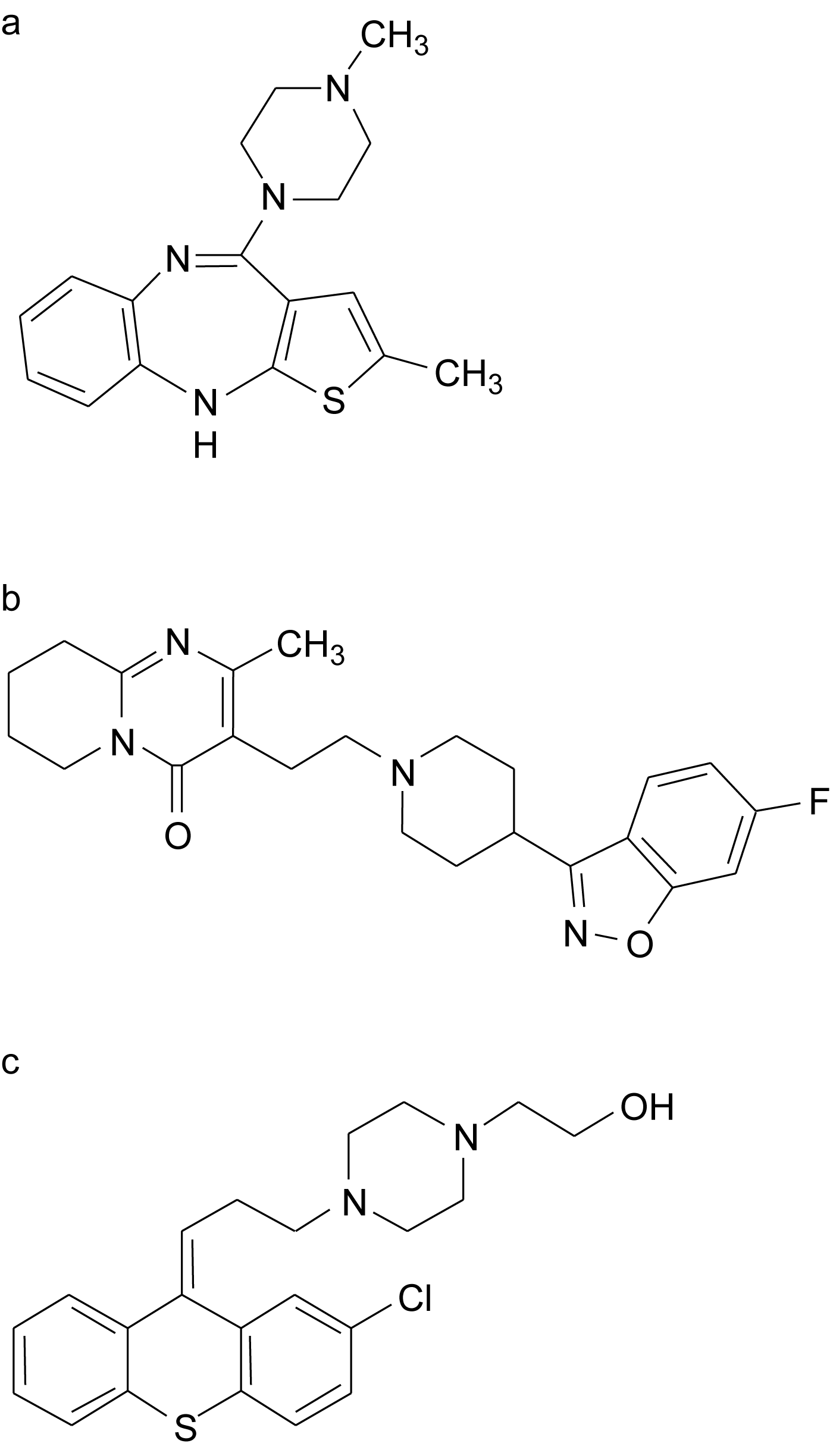
Rash is reported to be a common side effect of both olanzapine and risperidone (Eli Lilly & Company Ltd. 2010; Janssen-Cilag Ltd. 2010), with erythema also reported to be a common side effect to risperidone (Janssen-Cilag Ltd. 2010). Medline and Embase searches revealed several reports of rashes related to the individual agents of risperidone and olanzapine but not to both agents following consecutive treatment (Raz et al. Reference Raz, Bergman, Eilam, Yungerman and Hayek2001; Desarkar & Nizamie, Reference Desarkar and Nizamie2006; Chae & Kang Reference Chae and Kang2008). A comparison of the structures of the two agents can be seen in Figure 1. Olanzapine is a thienobenzodiazepine derivative and is structurally similar to clozapine, whereas risperidone is a benzisoxazole derivative which is chemically unrelated to other antipsychotics. If you compare the structures of the agents it can be seen that they are not structurally the same, ruling this out as an explanation for the cross reactivity.
Chemical structures of (a) olanzapine (C17H20N4S), (b) risperidone (C23H27FN4O2) and (c) zuclopenthixol (C22H25ClN2OS)

Furthermore, he did not get a rash when initiated on clozapine which is structurally related to olanzapine. Zuclopenthixol has a different structure again and is a thioxanthene antipsychotic agent (Fig. 1). If the receptor affinities of the antipsychotics are examined, olanzapine and risperidone share the property of having an affinity for 5HT1A and alpha2 receptors (zuclopenthixol does not), which could be a possible further explanation. However, Mr TA has tolerated clozapine (albeit alongside continued antihistamine treatment) which also shares affinity for 5HT1A and alpha2 receptors.
Other explanations of the rash in this case were also ruled out, including environmental factors and other drug treatments. Mr TA was also receiving clonazepam which in rare cases can cause urticaria and pruritis as a side effect (Roche Products Ltd. 2008). In this case clonazepam can be ruled out as a cause as Mr TA continued to receive treatment when the rash was completely resolved.
This case study highlights the need to be cautious when choosing another antipsychotic following the development of a rash and the need to closely monitor as a second reaction could be more aggressive. It is also the first report of the development of a rash to olanzapine which was exacerbated by risperidone.