Introduction
Biodiversity and biogeography of species are currently undergoing rapid and drastic changes in response to climate warming (e.g. Pecl et al., Reference Pecl, Araújo, Bell, Blanchard, Bonebrake, Chen, Clark, Colwell, Danielsen, Evengård, Falconi, Ferrier, Frusher, Garcia, Griffis, Hobday, Janion-Scheepers, Jarzyna, Jennings, Lenoir, Linnetved, Martin, McCormack, McDonald, Mitchell, Mustonen, Pandolfi, Pettorelli, Popova, Robinson, Scheffers, Shaw, Sorte, Strugnell, Sunday, Tuanmu, Vergés, Villanueva, Wernberg, Wapstra and Williams2017). Such changes are especially notable in marine systems (Hoegh-Guldberg and Bruno, Reference Hoegh-Guldberg and Bruno2010) and, in particular, Arctic systems are experiencing some of the most extensive warming rates with consequences for marine species (Renaud et al., Reference Renaud, Sejr, Bluhm, Sirenko and Ellingsen2015; Frainer et al., Reference Frainer, Primicerio, Kortsch, Aune, Dolgov, Fossheim and Aschan2017; Pecl et al., Reference Pecl, Araújo, Bell, Blanchard, Bonebrake, Chen, Clark, Colwell, Danielsen, Evengård, Falconi, Ferrier, Frusher, Garcia, Griffis, Hobday, Janion-Scheepers, Jarzyna, Jennings, Lenoir, Linnetved, Martin, McCormack, McDonald, Mitchell, Mustonen, Pandolfi, Pettorelli, Popova, Robinson, Scheffers, Shaw, Sorte, Strugnell, Sunday, Tuanmu, Vergés, Villanueva, Wernberg, Wapstra and Williams2017; Pecuchet et al., Reference Pecuchet, Blanchet, Frainer, Husson, Jørgensen, Kortsch and Primicerio2020). Nudibranch molluscs have been shown to be sensitive indicators of climate driven distributional shifts (e.g. Martynov et al., Reference Martynov, Korshunova and Savinkin2006; Nimbs et al., Reference Nimbs, Larkin, Davis, Harasti, Willan and Smith2016; Korshunova et al., Reference Korshunova, Driessen, Picton and Martynov2021a). However, to understand and reliably be able to track changes in biogeography, we need first to have a robust knowledge on the natural ranges in distribution of species.
The study of nudibranchs in Norwegian waters has a long history. The first descriptions of nudibranchs from Norway date back to the second part of the 18th century and include now well-known species as Dendronotus frondosus (Ascanius, Reference Ascanius1774) and Onchidoris muricata (Müller, Reference Müller1776). Furthermore, Johan Gunnerus described the nudibranch ‘Doris’ bodöensis from northern Norway already in 1770 (Gunnerus, Reference Gunnerus1770), which later became synonymous with the widely occurring species Aeolidia papillosa (Linnaeus, 1761). Further contributions for the understanding of Norwegian nudibranchs were made by renowned Norwegian marine biologists Michael and Georg Ossian Sars and Swedish zoologist Sven Lovén (Sars, Reference Sars1829; Lovén, Reference Lovén1846; Sars, Reference Sars1878). In the second part of the 19th century and the first half of the 20th century several faunal lists focused mainly on southern and central Norway were published (e.g. Friele and Hansen, Reference Friele and Hansen1876; Grieg, Reference Grieg1897, Reference Grieg1913; Friele and Grieg, Reference Friele and Grieg1901; Dons, Reference Dons1942).
During almost the whole first half of the 20th century, a period that can be called ‘Odhner's’ era began, when Nils Odhner published several works, predominantly based on the study of Scandinavian nudibranchs (e.g. Odhner, Reference Odhner1907, Reference Odhner1922, Reference Odhner1929) culminating in his 1939 report on Norwegian nudibranchs (Odhner, Reference Odhner1939). That work was, nevertheless, not without contradictory assessment for various taxa. For example, Odhner recorded the species ‘Cuthona pustulata’ from Norway, while depicting the reproductive system of an aeolidacean nudibranch of the genus Cuthonella (Korshunova et al., Reference Korshunova, Sanamyan, Sanamyan, Bakken, Lundin, Fletcher and Martynov2021b). Thus, the actual status of ‘C.’ pustulata in the North Atlantic remained unclear until recently when the new genus Zelentia was established for this and several other species (Korshunova et al., Reference Korshunova, Martynov and Picton2017a). Since the works by Odhner, several more faunal lists for Norwegian invertebrates including nudibranchs have appeared (e.g. Høisæter et al., Reference Høisæter, Brattegard and Sneli1997) but new research was sparse all the way until the end of the 20th century when interest for Norwegian nudibranchs was revived.
In 1997 a project dedicated to the study of Norwegian nudibranchs was established by Jussi Evertsen and Torkild Bakken (see e.g. Evertsen and Bakken, Reference Evertsen and Bakken2005, Reference Evertsen and Bakken2023). Moreover, since 2010, several international collaborative projects on nudibranch molluscs have been implemented around the Norwegian Gulen Dive Resort at Sognefjorden with several significant outcomes. These collaborative works have added significantly to our understanding of the taxonomy of several major nudibranch groups and include the descriptions of new species of Dendronotacea, Trinchesiidae, and Eubranchidae (Korshunova et al., Reference Korshunova, Martynov, Bakken and Picton2017c, Reference Korshunova, Picton, Furfaro, Mariottini, Pontes, Prkić, Fletcher, Malmberg, Lundin and Martynov2019, Reference Korshunova, Bakken, Grøtan, Johnson, Lundin and Martynov2020a, Reference Korshunova, Malmberg, Prkić, Petani, Fletcher, Lundin and Martynov2020b; Martinsson et al., Reference Martinsson, Malmberg, Bakken, Korshunova, Martynov and Lundin2021) as well as a large monograph on the taxonomy of aeolidacean nudibranchs (Korshunova et al., Reference Korshunova, Martynov, Bakken, Evertsen, Fletcher, Mudianta, Lundin, Schrödl and Picton2017b). In addition, several recent studies from southern Norway have added to the knowledge on nudibranchs in Norway (Evertsen and Bakken, Reference Evertsen and Bakken2013; Sørensen et al., Reference Sørensen, Rauch, Pola and Malaquias2020; Neuhaus et al., Reference Neuhaus, Rauch, Bakken, Picton, Pola and Malaquias2021). Moreover, the nudibranch fauna of northern Norway has received increased sampling attention with the expedition project ‘#sneglebuss Barents Sea’ as well as studies on larval diversity (Descôteaux et al., Reference Descôteaux, Ershova, Wangensteen, Præbel, Renaud, Cottier and Bluhm2021). Also, neighbouring areas along the Murman coast of the Barents Sea has been studied in detail (Martynov et al., Reference Martynov, Korshunova and Savinkin2006; Martynov and Korshunova, Reference Martynov and Korshunova2011). Most recently, Fredrik Broms in 2020 established an initiative project on the study of the diversity, taxonomy, and ecology of nudibranchs in the region around Tromsø in northern Norway ‘Nudibranchs in Troms’ (NUIT). The present distribution on biogeographic patterns is part of ongoing studies on diversity and occurrence of nudibranchs in northern Norway.
The genus Zelentia was recently established during the ontogenetic and molecular restoration of the family Trinchesiidae (Korshunova et al., Reference Korshunova, Martynov and Picton2017a) with the type species Zelentia pustulata (Alder & Hancock, 1854). The status of true Z. pustulata has been shown using material both from the type locality in the United Kingdom and data from Russian part of the Barents Sea and the White Sea. The new species Zelentia ninel (Korshunova, Martynov and Picton, Reference Korshunova, Martynov and Picton2017a) with its particular ontogenetic mode was described from the intertidal of the Barents Sea. For the first time Z. fulgens (MacFarland, 1966) from the NE Pacific was also included in genus Zelentia (Korshunova et al., Reference Korshunova, Martynov and Picton2017a). Soon afterwards, Z. nepunicea and Z. willowsi were described from the Canadian and US Pacific waters, as well as Z. roginskae previously confused with Z. pustulata, which was described from the White Sea and the North Atlantic (Korshunova et al., Reference Korshunova, Fletcher, Lundin, Picton and Martynov2018). Most recently, a new species, which turned to be sister species to all so far known species of the genus Zelentia, Z. amoris was described from the Kuril Islands in North-western Pacific (Korshunova and Martynov, Reference Korshunova and Martynov2022).
In the present contribution we report on the first observations of Z. ninel from Norway. The morphology, ecology and geographical distribution of the species are discussed. By providing new distributional data from several different locations and presenting the first overview of the biogeography of the species we also aim to give a better understanding of biogeographical borders and patterns of dispersal in a time of ongoing global and Arctic change.
Materials and methods
Material examined
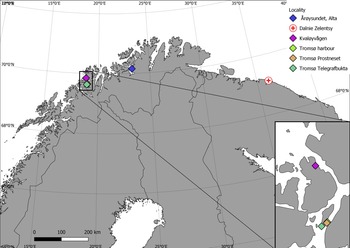
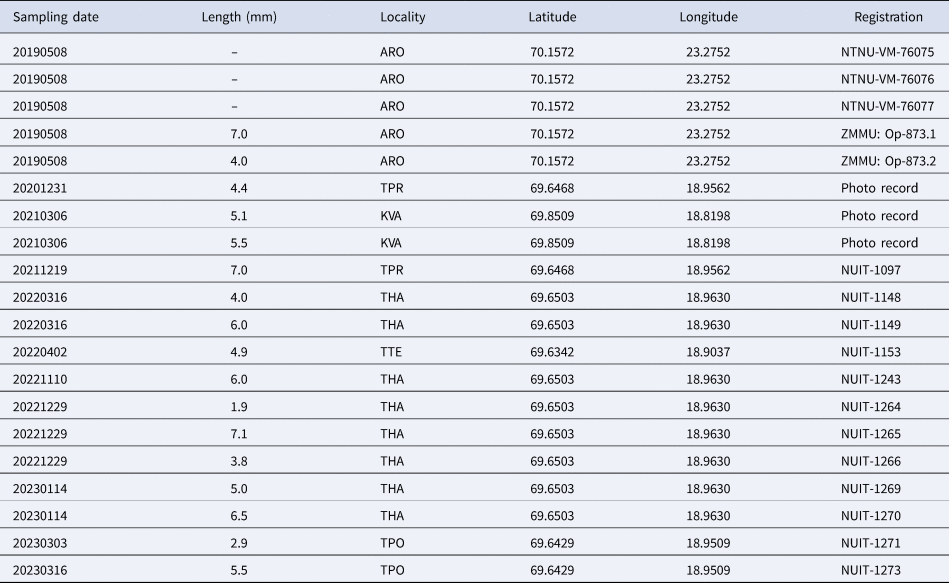
Specimens of Z. ninel were obtained from fieldwork within a project mapping nudibranch fauna along the Norwegian Barents Sea coast as well as the ‘Nudibranchs in Troms’ (NUIT) project in northern Norway from 2019 to 2023 (Figure 1). Single finds of animals from both intertidal- and fouling community localities were investigated (Table 1). Animals were carefully picked by hand in situ and transferred back to the laboratory where they were kept in oxygenated plastic buckets containing sea water from the sampling localities at as near the same temperature as they were collected from as possible. Upon return to the laboratory total body length was measured down to closest millimetre from the distance between the anterior margin of the head, excluding the tentacles, to the posterior tip of the tail (Risso-Dominguez, Reference Risso-Dominguez1963). Animals were then fixed in 96% vol ethanol and deposited in the NTNU University Museum, Norwegian University of Science and Technology (NTNU-VM), Trondheim, Norway (Bakken et al., Reference Bakken, Hårsaker and Daverdin2023), the Nudibranchs in Troms (NUIT) project, Tromsø, Norway, and in the Zoological Museum, Moscow State University (ZMMU), Moscow, Russia. Specimens were identified by investigation of external and internal morphology from living and preserved samples as well as by molecular analysis. Where preserved specimens are referred to in the text this is indicated by the sample registration number in brackets.
Map showing the localities with observations of Zelentia ninel in northern Norway 2019–2023 and the type locality of Dalnie Zelentsy, Barents Sea, Russia.

Overview of observations of Zelentia ninel with sampling date, body length (mm), locality name, position and registration number

Locality acronyms: ARO, Årøysundet, Altafjorden; KVA, Kvaløyvågen harbour; THA, Tromsø harbour; TPO, Tromsø Polarhavna; TPR, Tromsø Prostneset; TTE, Tromsø Telegrafbukta.
Morphological analysis
External morphology was studied under a stereomicroscope and animals were photographed using a Nikon D810 and a Nikon D4s DSLR camera with an AF Micro-Nikkor 105 mm 1:2.8 D macro lens. For the descriptions of the internal features, specimens were dissected under a stereomicroscope. The radulae, jaws and other internal structures were coated, then examined and photographed using scanning electron microscopes CamScan II, JSM 6380 and QuattroS in the Electron Microscopy Laboratory, Moscow State University, Russia.
Molecular analysis
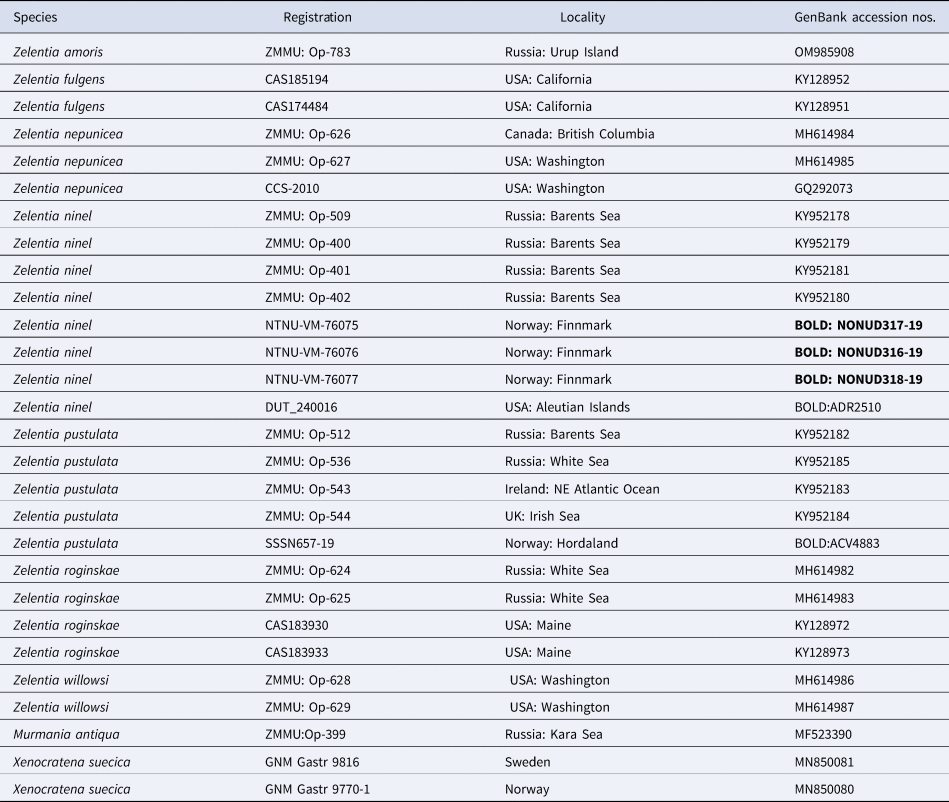
Tissue was taken from specimens and run through the procedures with DNA extraction and sequencing at the Canadian Centre for DNA Barcoding; and processed through the Barcode of Life Database (BOLD) (Ratnasingham and Hebert, Reference Ratnasingham and Hebert2007). All new sequences were translated into amino acids to verify coding regions and avoid improper base-calling deposited in GenBank (Table 2, highlighted in bold). Additionally, publicly available sequences from GenBank (https://www.ncbi.nlm.nih.gov) and BOLDSYSTEMS (https://www.boldsystems.org), accessed online 17 December 2022, were used for the molecular phylogenetic analysis. The phylogenetic analysis was performed using 25 sequences of seven species of Zelentia and three outgroup specimens (Table 2). All sequences were aligned with the MAFFT algorithm (Katoh et al., Reference Katoh, Misawa, Kuma and Miyata2002). Analyses were conducted for COI dataset (657 bp). Evolutionary model was selected using MEGA11 (Tamura et al., Reference Tamura, Stecher and Kumar2021). The GTR + I model was chosen. Two different phylogenetic methods, Bayesian inference (BI) and maximum likelihood (ML), were used to infer evolutionary relationships. Bayesian estimation of posterior probability was performed in MrBayes 3.2 (Ronquist et al., Reference Ronquist, Teslenko, van der Mark, Ayres, Darling, Höhna, Larget, Liu, Suchard and Huelsenbeck2012). Four Markov chains were sampled at intervals of 100 generations. Analysis was started with random starting trees and 107 generations. ML-based phylogeny inference was performed in RaxML 7.2.8 (Stamatakis et al., Reference Stamatakis, Hoover and Rougemont2008) with bootstrap in 1000 pseudo-replications. Final phylogenetic tree images were rendered in FigTree 1.4.2 (http://tree.bio.ed.ac.uk). To evaluate the genetic distribution of the different haplotypes a haplotype network was constructed using the Population Analysis with Reticulate Trees (PopART, http://popart.otago.ac.nz) with the TCS network method. Only sequences 654–657 bp were used for haplotype network calculating. Assemble Species by Automatic Partitioning (ASAP, Puillandre et al., Reference Puillandre, Brouillet and Achaz2021) was used as method of species delimitation. The program MEGA11 (Tamura et al., Reference Tamura, Stecher and Kumar2021) was used to calculate the uncorrected P-distances.
List of specimens used for the molecular analyses

XXX, Sequences will be deposited in GenBank.
Results
Morphology and ecology
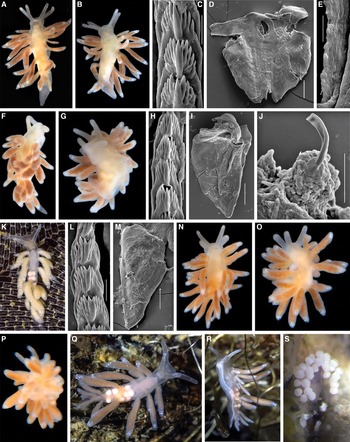
We found in total 20 specimens of Z. ninel at six different localities in northern Norway in the time period 2019–2023 (Figure 1, Table 1). All animals were mature adults with visible eggs inside their bodies except for the smaller of the two animals found at Kvaløyvågen, NUIT-1264 (1.9 mm) and NUIT-1271 (2.9 mm) where no eggs could be observed. The smallest animal where eggs were observed inside the body had a total body length of 3.8 mm (NUIT-1266). External morphology analysis showed that all specimens closely resembled the description of the species from the type locality (Figure 2). The specimens from Altafjorden had an average length of 5.5 ± 2.1 mm (SD) and the specimens from the Tromsø region had an average length of 5.0 ± 1.5 mm (SD) (range 1.9–7.1 mm). Rhinophores and mouth tentacles were of similar length, were smooth and had small scattered white pigment spots. Eyes were clearly visible. Cerata were long and typically had several small white pigment spots at the tops (Figure 2Q). Colour of the digestive branches in the cerata ranged from dull orange to bright orange and pale yellow. The body and the foot of all specimens was narrow, and the foot had no foot corners but were rounded anteriorly.
Zelentia ninel. ZMMU: Op-873.1: A. living animal, dorsal view; B. living animal, ventral view; C. radular teeth, anterior part, SEM; D. Jaws, SEM; E. Masticatory processes of jaws SEM; ZMMU: Op-873.2: F. living animal, dorsal view; G. living animal, ventral view; H. radular teeth, anterior part, SEM; I. Jaws, SEM; J. Penis with curved stylet, SEM; NUIT-1097: K. living animal, dorsal view; L. radular teeth, anterior part, SEM; M. Jaws, SEM; NTNU-VM-76075: N. living animal, dorsal view; NTNU-VM-76076: O. living animal, dorsal view; NTNU-VM-76077: P. living animal, dorsal view; NUIT-1149: Q. living animal, dorsal view; R. living animal, ventral view; S. egg mass. Photos: A, B, F, G by Tatiana Korshunova; K, Q, R, S by Fredrik Broms; N, O, P by Torkild Bakken; C, D, E, H, I, J, L, M by Alexander Martynov. Scale bars: C, H, L, 20 μm; D, I, M, 100 μm; J, 50 μm; E—10 μm.

All animals were found in very shallow waters (0–1 m), either in the intertidal or at fouling communities. Specimens found in the intertidal were typically observed underneath small rocks in the Ascophyllum nodosum belt along rocky intertidal areas. Specimens found at fouling community localities were either found crawling on sugar kelp Saccharina latissima lamina with an epigrowth of the bryozoan Membranipora membranacea and Obelia spp. hydroids or directly on artificial hard substrates. Animals were also found directly associated with Sarsia lovenii hydroids and upon closer inspection several often small animals (NUIT-1264, NUIT-1266, NUIT-1271, and NUIT-1273, Table 1) as well as numerous egg masses were discovered attached to the stems of the colonies. The only animal found associated with M. membranacea and Obelia spp. (NUIT-1097) had a distinctly different pale-yellow colour (Figure 2K) compared to all other specimens which had an orange colour similar to what was observed in the specimens found associated with S. lovenii.
The present material of Z. ninel from all locations was essentially similar to the diagnostic features of Z. ninel from the type locality at the Barents Sea (Korshunova et al., Reference Korshunova, Martynov and Picton2017a) and had few numbers of anterior ceratal rows, specific colouration without any significant amount of white spots over the cerata (Figure 2) and the copulative stylet had a similar shape (Figure 2J). The general pattern of the radulae is also consistent among specimens in the present material although we detected minor differences in some Norwegian specimens in the shape of some lateral denticles on the teeth with slightly higher number (commonly up to five) compared to the type specimens from the Barents Sea.
Molecular analysis
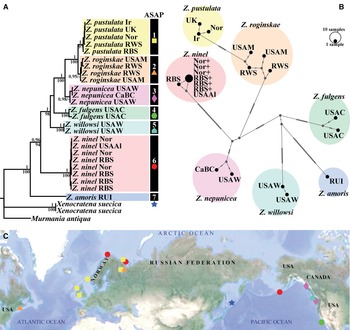
The phylogenetic analysis from BI and ML analyses yielded the same results. Twenty-five investigated specimens of the genus Zelentia formed seven distinct clades. ASAP analysis run with two different models also revealed (asap-score 1.5) seven species (Figure 3A). All eight specimens of Z. ninel, including three Finnmark specimens and one specimen registered from Aleutian Islands, nested together and formed a maximally supported (PP = 1, BS = 100) separate clade. Regarding the supposedly fast-evolving COI marker, genetic distance values within the Z. ninel clade range from 0 to 0.16%. The minimum intergroup distance of 11.1% is found between Z. ninel and Z. nepunicea. Results obtained by PopART showed a network of haplotypes that clearly clustered into seven groups coincident with Z. amoris, Z. fulgens, Z. nepunicea, Z. ninel, Z. pustulata, Z. roginskae, and Z. willowsi (Figure 3B). The molecular phylogenetic results confirm the morphological analysis data and document that Z. ninel is present in northern Norway.
A. Phylogenetic relationships of Zelentia based on COI dataset (563–657 bp) inferred by Bayesian inference. Numbers above branches represent posterior probabilities from BI; numbers below branches indicate bootstrap values for maximum likelihood. B. The haplotype network based on COI molecular data (654 bp) showing genetic mutations occurring within Zelentia species. C. Map of the north-eastern part of the northern hemisphere showing localities of the Zelentia species used for the analysis. Coloured symbols are indicated in the figure. Abbreviations: CaBC, Canada (British Columbia); Ir, Ireland; Nor, Norway; UK, United Kingdom, RBS, Russia (Barents Sea); RWS, Russia (White Sea); RUI, Russia (Urup Island); USAAl, USA (Aleutian Islands); USAC, USA (California); USAM, USA (Maine); USAW, USA (Washington).

Discussion
The biogeographic patterns of the North Atlantic and adjacent parts of the subarctic have been among important kernels in formation of biogeography as a scientific discipline (Briggs, Reference Briggs1995). The Norwegian and adjacent Barents Sea faunal composition and biogeographic subdivisions have been the subject of long-term investigations and discussions (e.g. Hjort et al., Reference Hjort, Nordgaard and Gran1899; Derjugin, Reference Derjugin1915; Galkin, Reference Galkin and Kuznetsov1979; Anisimova et al., Reference Anisimova, Jørgensen, Ljubin, Manushin, Jakobsen and Ozhigin2011; Johannesen et al., Reference Johannesen, Jørgensen, Fossheim, Primicerio, Greenacre, Ljubin, Dolgov, Ingvaldsen, Anisimova and Manushin2016; Buhl-Mortensen et al., Reference Buhl-Mortensen, Dolan, Ross, Gonzalez-Mirelis, Buhl-Mortensen, Bjarnadóttir and Albretsen2020). The Norwegian coast has been considered to have three geographic subprovinces (e.g. Høisæter et al., Reference Høisæter, Brattegard and Sneli1997; Evertsen and Bakken, Reference Evertsen and Bakken2013) where the northernmost subprovince, encompassing the region of Finnmark, is connected with the subarctic Barents Sea region. Together with the Arctic, the Barents Sea region is among the areas affected the most by ongoing warming (Kortsch et al., Reference Kortsch, Primicerio, Fossheim, Dolgov and Aschan2015). Biodiversity redistribution under changing climate has, in that region, been exemplified by such different model groups as marine mammals (Hamilton et al., Reference Hamilton, Lydersen, Ims and Kovacs2015), fish (Fossheim et al., Reference Fossheim, Primicerio, Johannesen, Ingvaldsen, Aschan and Dolgov2015), long-lived shelled mussels (Berge et al., Reference Berge, Johnsen, Nilsen, Gulliksen and Slagstad2005) and shell-less nudibranchs with a short lifespan (Martynov et al., Reference Martynov, Korshunova and Savinkin2006). In addition to changes caused by environmental factors such as advection (Andrews et al., Reference Andrews, Christiansen, Bhat, Lynghammar, Westgaard, Pampoulie and Præbel2019) the region is also experiencing increased human activity such as shipping and new trade routes which may introduce species far outside of their native range (Miller and Ruiz, Reference Miller and Ruiz2014; Chan et al., Reference Chan, Stanislawczyk, Sneekes, Dvoretsky, Gollasch, Minchin, David, Jelmert, Albretsen and Bailey2018).
When Z. ninel was first described in 2017 body length was found to range from 4 to 6 mm based on measurements of more than 100 mature specimens (Korshunova et al., Reference Korshunova, Martynov and Picton2017a). This corresponds well with our measurements from northern Norway (see Results, Table 1) and our observations on morphology and ecological patterns also fit well with the descriptions from the type locality at Dalnie Zelentsy (Figure 1, 3). At the type locality, Z. ninel was found exclusively in the stony intertidal where it was found preying on hydroids such as Gonothyraea loveni and Obelia longissima. Our observations from the locality near Alta in Finnmark reveal the same ecological pattern, where all specimens of Z. ninel were found exclusively in a stony intertidal area resembling the type locality at Dalnie Zelentsy. Curiously, the sampling in the Tromsø area shows that the species also occur in fouling community habitats and our field observations suggest a fairly broad diet including S. lovenii hydroids. Whereas our findings fundamentally confirm the same ecological adherence of Z. ninel to very shallow waters, our data also show that Z. ninel inhabits a wider range of habitats than previously known. Animals found on S. lovenii in the field brought back to the laboratory and kept isolated in oxygenated jars were found to actively prey on this hydroid and lay numerous egg masses of a distinct pale pink-orange colour (Figure 2S).
The small size of Z. ninel makes the species easy to overlook and apart from the animals found in Altafjorden on 08 May 2019 all animals were observed during winter (10 November – 02 April) when polar darkness makes visual observations in the area challenging. It is, therefore, not surprising that Z. ninel has eluded detection in the past. We observed egg masses through the body of all specimens save two in the present study, including a specimen as small as 3.8 mm (NUIT-1266). Whereas most nudibranchs have indirect life cycles and develop through planktonic veligers, Z. ninel notably has a direct development where the eggs hatch into fully developed postlarvae benthic juveniles (Korshunova et al., Reference Korshunova, Martynov and Picton2017a). Despite the limited capacity for dispersal this gives compared to most other nudibranchs, our observations of mature adults with eggs from one locality in Finnmark and five different localities in Troms over four consecutive winter seasons strongly indicate that Z. ninel has a well-established presence in the area and in light of the present findings it is reasonable to assume that the species is distributed along the coast of northern Norway in suitable habitats. Considering a much higher degree of sampling effort in the southern parts of Norway compared to northern regions, we consider Z. ninel to be a high-boreal – subarctic species and its range is probably less likely to include southern Norway.
In addition to the above-described biogeographical pattern in distribution based on our data, there is, in the BOLDSYSTEMS (https://www.boldsystems.org accessed online 17 February 2023) registered a sequence of a single specimen of Z. ninel from the unexpected location of the Aleutian Islands (Dutch Harbor, Amaknak Island, Unalaska, Alaska, U.S.) in the Bering Sea, NE Pacific. These data have therefore been included in the present analysis (Figure 3). As that potential record is highly inconsistent with the known biogeographic and ontogenetic patterns for Z. ninel, we have had the following considerations to explain these data: (1). Anthropogenic transfer with fouling community fauna. Although this is possible, it is somewhat curious and unclear how Z. ninel may have overcome such a large distance over several thousand kilometres; (2). Occasional error in the labelling of the geographical locality of this particular specimen or error in the attributing of the geographical location of the sequence or some other error. Our findings of Z. ninel in fouling communities in the Tromsø area partly support the first hypothesis, but that hypothesis would still need confirmation.
To clarify the original data, we contacted Dr Ellen Strong at the Invertebrate Zoology Department of the National Museum of Natural History (the Smithsonian Institution), which according to the BOLD data keeps original specimen collected at Dutch Harbor, Unalaska. She kindly informed (E. Strong, pers. comm.) us that the supposed specimen of Z. ninel had been collected from small settlement PVC plates specially installed at a fouling community at the locality. These plates were secured to the pilings of several docks (City Spit, Discovery, and North Pacific Fuel), all within a 4-mile area of Dutch Harbor. From these locations only a single specimen of supposed Z. ninel was collected and that specimen was completely destroyed during molecular analysis making any further morphological study in the course of the present study impossible. While the sequenced specimen was unfortunately not photographed, no conspecific specimens could be seen among photographs of other nudibranchs collected during the sampling expedition to Dutch Harbor. At the time of the sampling, according to the provided information, an industrial Norwegian trawler lay at Dutch Harbor and while no conclusions can be drawn from this coincidence Dutch Harbor is an important ice-free fishing port close to some of the richest fishing grounds in the world. It does, therefore, seem plausible that the specimen in question may have been reached Dutch Harbor by human-related transportation from its native range in distribution in the Northeast Atlantic. Since Z. ninel has deeply modified direct development and therefore cannot reach such a distant location by natural means, we do not consider the putative occurrence of Z. ninel in the Northern Pacific as part of the natural range of Z. ninel. The occasional transportation may have occurred via ballast waters or, for example, by transportation along with fouling community fauna either as an egg-mass of Z. ninel or a small specimen, which developed or survived during a potential route of shipping from the Northeast Atlantic to the Aleutians.
Our discovery of Z. ninel in northern Norway adds a new species to the Norwegian fauna and significantly expands the species' known range of distribution. Whilst the knowledge on the nudibranch fauna of Norway was disjoined for a long time, investigations during the first decade of the new millennium have dramatically increased the knowledge (Evertsen and Bakken, Reference Evertsen and Bakken2002, Reference Evertsen and Bakken2005) although information on distribution is still scattered and relatively sparse (Evertsen and Bakken, Reference Evertsen and Bakken2013). In general, fewer nudibranch species are found in polar areas compared to more temperate areas (García and Bertsch, Reference García and Bertsch2009) and fewer boreal species are found in northern parts of Norway compared to further south along the Norwegian coast (Evertsen and Bakken, Reference Evertsen and Bakken2005). In neighbouring Russian areas this pattern is even more explicit (Martynov et al., Reference Martynov, Korshunova and Savinkin2006). When Z. ninel was first described from the Russian Barents Sea coast in 2017 the authors suggested that the natural range of Z. ninel might be found to encompass also the geographically neighbouring region of northern Norway in the future (Korshunova et al., Reference Korshunova, Martynov and Picton2017a). Our discovery of Z. ninel along the coast of northern Norway therefore fits well with the originally predicted biogeographic patterns. While the new data extend the known distribution of the species, our findings do, however, not imply any real or recent change in the distribution of the species but rather corroborates the natural range of Z. ninel occurring along the southern Barents Sea coast. The low sampling intensity in northern Norway, together with its position as a geographical outermost limit of distribution of boreal species to the Arctic, makes the region an especially interesting area for mapping and studying changes in diversity in the context of climate change. The current findings highlight the need for updated comprehensive studies of the nudibranch fauna of the under sampled region of northern Norway as a baseline to better accurately track changes in diversity in the future.
Acknowledgments
We are grateful for the help in the field by the ‘Sneglebuss’ field team: Karstein Hårsaker, Erling Svensen, Christian Skauge, Aina Mærk Aspaas and Renate Kvernberg. We also wish to thank Lara Beckmann for her help with identification of S. lovenii colonies from Tromsø. We are indebted to Ellen Strong at the Smithsonian National Museum of Natural History for providing important information regarding the details of the specimen of Z. ninel from Dutch Harbor. We are grateful to the Editor and the three anonymous reviewers for their comments that helped improving the final version of this paper.
Author's contributions
F.B., T.B., A.M., and T.K. collected the data. F.B. measured and took photographs of living specimens. T.K. performed molecular analysis and prepared all plates of illustrations. A.M took SEM photographs of radulae and jaws. F.B., T.B., A.M., and T.K. prepared and analysed samples. F.B., A.M., and T.K. were major contributors in writing the manuscript. All authors read and approved the final manuscript.
Financial support
The present contribution was made as part of the Sneglebuss (NTNU, Trondheim, Norway) and the NUIT (NUdibranchs In Troms, Tromsø, Norway) projects from 2019 to 2023. Fieldwork activities were funded by the Norwegian Taxonomy Initiative project ‘#sneglebuss Barents Sea’ (19–18, 70184240) to T.B., A.M., and T.K., and a grant (Kartleggingsmidler) from SABIMA (Council for Biodiversity) to F.B. The work of A.M. was performed under research project of MSU Zoological Museum (18-1-21 No. 121032300105-0). The work of T.K. was conducted under the IDB RAS basic research programme in 2021 No. 0088- 2021-0019. The work of A.M. and T.K. was supported by the project ‘ReDNAcarnation of the museum collections’ from the Vladimir Potanin Philanthropic Foundation (the programme ‘Museum without borders’, ‘Museum 4.0’ contest).
Competing interest
None.
Ethical standards
Not applicable.
Data
The authors confirm that the data supporting the findings of this study are available within the article. Additionally, publicly available sequences used for molecular analysis are openly available in the National Institutes of Health (NIH) genetic sequence database GenBank (https://www.ncbi.nlm.nih.gov) and the Barcode of Life Data System (BOLD) (https://www.boldsystems.org).