Introduction
In common with most solid tumours, the incidence of haematological malignancies increases with age. It is therefore important to have an understanding of their presentation and prognosis in the older population. The presentation, treatment and outcomes for patients with haematological malignancies are heterogenous, varying with disease. Some patients will present with symptoms directly related to their haematological malignancy; other patients may be diagnosed incidentally during unrelated investigations. Prognosis may be measured in days, weeks or years. Potential treatments are equally wide-ranging. For high-grade diseases (such as acute leukaemias or high-grade lymphoma), a curative approach requires intensive chemotherapy. Low-grade diseases (such as chronic lymphocytic leukaemia, or low-grade lymphoma) may be treated as an out-patient, or even with watchful witing only.
This review will focus on the presentation, investigation and management of the commonest haematological malignancies in the older population, and will explore reasons for poorer outcomes in older compared with younger patients.
Publications were identified by searching the Ovid Medline database from 1990 to 2010. Search terms used were ‘leukaemia’, ‘lymphoma’, ‘myeloma’, ‘myelodysplasia’, ‘aged’ and ‘older’. Studies were considered for inclusion if they were written in the English language and had particular relevance to the older population. Additional publications were identified by searching the reference lists of retrieved articles.
Why are outcomes poorer for older patients?
For many haematological cancers, advanced age at presentation remains the strongest negative predictor of survival.Reference Jarrett, Stark, White, Angus, Alexander, Krajewski, Freeland, Taylor and Taylor1, Reference Appelbaum, Gundacker, Head, Slovak, Willman, Godwin, Anderson and Petersdorf2 There are a number of factors that potentially contribute to these poor results.
(1) The biology of the tumour may be inherently different in older patients
Using Hodgkin lymphoma (HL) as an example, histological subtypes of HL vary between older and younger patients.Reference Kennedy, Loeb, Peterson, Donegan, Natarajan and Mettlin3 In addition, the prognostic impact of Epstein Barr Virus (EBV) in Hodgkin Reed Sternberg cells appears to vary with age. Older patients with EBV-positive tumour cells have a poorer prognosis than younger patients.Reference Jarrett, Stark, White, Angus, Alexander, Krajewski, Freeland, Taylor and Taylor1, Reference Clarke, Glaser, Dorfman, Mann, DiGiuseppe, Prehn and Ambinder4, Reference Stark, Wood, Jack, Angus, Proctor and Taylor5 One might speculate that a reduction in immune function in the elderly may contribute, but this is by no means proven.
Acute myeloid leukaemia (AML) can be stratified prognostically by the presence of certain cytogenetic abnormalities within tumour cells. Certain abnormalities are associated with a favourable outcome and others with a poor outcome. A higher proportion of older patients with AML have unfavourable cytogenetic abnormalities.Reference Appelbaum, Gundacker, Head, Slovak, Willman, Godwin, Anderson and Petersdorf2, Reference van der Holt, Breems, Berna Beverloo, van den Berg, Burnett, Sonneveld and Löwenberg6 In many cases there are multiple genetic abnormalities (often described as ‘complex cytogenetics’), which suggest that a higher proportion of older patients who develop AML have had antecedent myelodysplastic syndrome (MDS). This is associated with a poorer outcome. To compound these problems, leukaemic blasts from older patients with AML have higher levels of expression of multidrug resistance gene-1 (MDR-1); expression correlates with poor treatment outcome.Reference Leith, Kopecky, Godwin, McConnell, Slovak, Chen, Head, Appelbaum and Willman7
(2) Patient-specific factors
(i) The impact of co-morbidity and performance status
Co-morbidities may contraindicate the use of certain chemotherapy drugs. Anthracyclines, for example, may have to be restricted in the setting of impaired left ventricular function. Treatment dose-adjustments may also be needed in older patients, in the setting of renal or hepatic impairment. Interactions with concomitant medications must also be considered.
In general terms, even after accounting for known prognostic factors such as tumour stage, tumour bulk and cytogenetic abnormalities, older adults with cancer tend to experience inferior outcomes compared with younger adults. A major challenge for oncologists remains: to standardize assessment of co-morbidity, functional status and cognitive state. All of these issues are likely to impact on the ability of a patient to tolerate treatment-related toxicity. It is clear that chronological age is unlikely to be a useful surrogate for these functional characteristics.
(ii) Age and treatment-related toxicity
Irrespective of specific co-morbidities, age is recognized as a poor risk factor with respect to tolerance of therapy. Taking febrile neutropenia as an example, international guidelines recommend that patients aged ≥65 years, being treated with curative intent for high-grade non-Hodgkin lymphoma (NHL), receive primary prophylaxis with granulocyte colony-stimulating factor (GCSF). Younger patients are not felt to benefit from such intervention.Reference Aapro, Cameron, Pettengell, Bohlius, Crawford, Ellis, Kearney, Lyman, Tjan-Heijnen, Walewski, Weber and Zielinski8
(3) Lack of clinical trial data
There are far fewer publications related to older patients with haematological malignancies, than for younger patients. Historically, older patients were excluded from many trials on the basis of chronological age. In addition, because many trials are run through tertiary centres there may be selection bias in favour of younger, fitter patients. More recently, a population-based approach has been adopted. These studies may have a trial component, but always try to compare data with that from a defined denominator population.Reference Proctor and Wilkinson9, Reference Juliusson, Antunovic, Derolf, Lehmann, Möllgård, Stockelberg, Tidefelt, Wahlin and Höglund10 This approach clearly reduces the potential for selection bias and ideally means that data generated are more broadly applicable than those derived from selected cohorts that participated in randomized trials.
Acute leukaemia
Both AML and acute lymphoblastic leukaemia (ALL) can present in older patients, but AML is seen much more commonly. Whilst specific treatment regimens differ, there is overlap between many diagnostic and therapeutic issues, such as the need to assess fitness for treatment. Given the relative prevalence of AML, we have concentrated discussions on this disease.
Acute myeloid leukaemia
Incidence
The incidence of AML increases with age; median age at diagnosis is 67 years. Age-adjusted incidence of AML is 1.7/100,000 for those aged <65 years and 16.4/100,000 for those aged >65 years.
Diagnosis
Most patients are diagnosed on the basis of a full blood count after presenting with symptoms such as fatigue, recurrent/severe infections or bleeding. Occasional patients may present with gum hypertrophy or skin infiltration secondary to infiltration by leukaemic blasts. The blood count usually shows pancytopenia due to marrow infiltration by tumour, or the white cell count may be increased (due to leukaemic blasts), usually in association with some degree of anaemia or thrombocytopenia. A high white cell count (>100 × 109/l) is associated with a poor prognosis.
In the majority of patients the diagnosis is confirmed by bone marrow aspiration. Aspirated material can be analysed for clonality, by assessment of cell surface markers and cytogenetic abnormalities. These help to define the subtype of the disease using WHO criteria and are often useful prognostically.Reference Arber, Brunning, LeBeau, Swerdlo, Campo and Harris11 There may be occasions, particularly in very frail patients, where it is clear that specific chemotherapy for AML would not be tolerated. Under such circumstances, the physician and patient may elect to avoid marrow biopsy.
Treatment
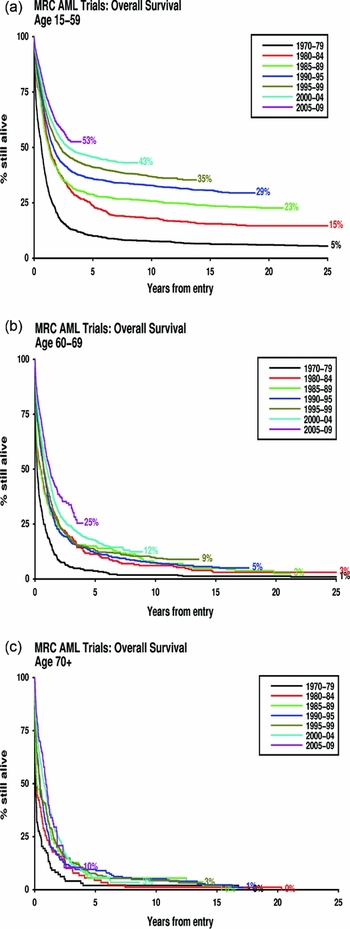
(1) Overall strategy. In older patients with AML, just as in younger patients, disease-related deaths are either a result of treatment-induced complications or a failure of disease control. AML tends to follow a rapidly progressive trajectory and, in the absence of disease control, survival is likely to be measured in weeks. Even amongst responding patients, outcomes are poor: median overall survival in those >60 years is between 6 and 9 months in most studies.Reference Appelbaum, Gundacker, Head, Slovak, Willman, Godwin, Anderson and Petersdorf2, Reference Burnett, Milligan, Goldstone, Prentice, McMullin, Dennis, Sellwood, Pallis, Russell, Hills and Wheatley12 The outcomes are even worse in patients over the age of 70 (Figure 1).
a–c, survival graphs demonstrating overall survival by age and by year of diagnosis for all patients entering Medical Research Council (MRC) randomized controlled trials, 1970–2009. An improvement in survival over time is apparent for younger but not older patients (with thanks to Professor A.K. Burnett).

The central question facing the patient and physician on making a diagnosis of AML is: what is the balance of risk between treatment-induced toxicity and likelihood of tumour responsiveness, especially when the prognosis is so poor? In situations where toxicity is deemed manageable and there is a reasonable hope of inducing remission, an intensive chemotherapy approach is appropriate. Where toxicity is likely to be higher, for instance in the presence of multiple co-morbidities or significant cognitive impairment, a supportive approach would be favoured. Straightforward assessment of chronological age cannot fully inform this decision-making process. It is hoped that better assessment of physiological age, using standardized frailty assessments, will help and will be a focus for future trials. Given the fine balance of these decisions for many patients, it is clear that careful communication with patients is paramount. Only with an understanding of the issues can patients give fully informed consent.
Having accepted these difficulties, the results of AML 14, an MRC-sponsored international study of AML in those aged over 60, are particularly illuminating.Reference Burnett, Milligan, Goldstone, Prentice, McMullin, Dennis, Sellwood, Pallis, Russell, Hills and Wheatley12 Physicians and patients were given the option of a randomization between an intensive treatment arm, aimed at cure, or a non-intensive treatment arm, aimed at palliation with a degree of disease control. Alternatively they could elect which arm to enter that patient into. Of 1273 patients entered into this trial, only eight were entered into the randomization. Whilst haematologists and their patients seem to feel relatively comfortable making these judgements regarding suitability for intensive and non-intensive therapy, future studies may tell us whether we have judged correctly.
(2) Intensive treatment. In order to induce remission, patients currently need to be treated with the same standard ‘induction’ regimens as younger patients: typically a combination of anthracycline and cytarabine. Chemotherapy is given over about 10 days and is associated with 2–3 weeks of severe pancytopenia. Patients will need red cell and platelet support and are likely to become febrile and require treatment with intravenous antibiotics. Generally patients are hospitalized for the entirety of such a treatment course and as such are in-patients for about 1 month. Induction-related death rate, most commonly related to infection, is around 10–15% in most studies.Reference Klepin and Balducci13
If remission is achieved, one has to consider options for consolidation therapy, else the disease will rapidly relapse. In younger patients the standard of care would be a total of four courses of intensive chemotherapy or an allogeneic haematopoietic stem cell transplant (HSCT) procedure after the second or third course. A similar strategy of consolidation chemotherapy can be adopted in older patients if tolerated, though most older patients can only tolerate a maximum of three courses of therapy due to a lack of bone marrow reserve.
The alternative to a chemotherapy-based approach to remission consolidation is allogeneic hematopoietic stem cell transplantation (HSCT). A very intensive transplant is not tolerated by older patients and is restricted to those under 50 years of age. More recently, with the advent of reduced intensity conditioning (RIC) schedules, older patients have had the option of allogeneic HSCT. These transplants rely less on the intensity of chemotherapy conditioning, and more upon a graft versus leukaemia effect, exerted by incoming donor T-cells. It is undoubtedly true that fewer patients experience disease relapse if they are treated with allogeneic HSCT as opposed to chemotherapy alone. The difficulty is that treatment-related toxicity is higher amongst transplanted patients. Transplant-related mortality at 1 year post-HSCT ranged from 16 to 55% in a recent review.Reference Ciurea, Rodrigues, Geralt and de Lima14 It is not yet clear whether RIC HSCT provides a survival advantage over chemotherapy alone. Where possible, patients should be treated as part of a clinical trial. Even with the reduced toxicity of this form of transplant it is not readily applicable to patients aged over 70 because of very high transplant-related mortality.
(3) Non-intensive treatment. When the balance of risks is not in favour of intensive therapy, a range of palliative options should be considered. These range from simple supportive measures, to disease-modifying chemotherapy aimed at disease control for a time. Commonly adopted treatment strategies are outlined below:
(i) Supportive care only
Clearly, excellence in supportive care is paramount in the management of any patient with AML, whether having treatment with curative or palliative intent. For frailer patients, supportive care alone may be considered the best modality. Red cell and platelet transfusion, and antibiotics to treat infection, are all good symptom-relieving measures.
(ii) Low-dose chemotherapy
Some frail patients may have symptoms that reflect the high-grade nature of AML. They typically experience weight loss, sweats, fevers and often symptoms of leucostasis if the white cell count is >50–100 × 109/l. Such symptoms might include dyspnoea, headache and progressive drowsiness or confusion. Low-dose chemotherapy with cytarabine, hydroxycarbamide or etoposide, for instance, can control the white cell counts over a short period of time and extend life by a few weeks or months.
(iii) Novel agents and clinical trial participation
A number of new drugs are available. These include azacitidine and decitabine (DNA demethylating agents), and clofarabine (a nucleoside analogue). These agents aim to induce remission or control the disease for a period, but with reduced toxicity compared with standard treatments. Clinical trials are ongoing in a number of areas, searching in many cases for molecular targets unique to leukaemic cells, thus allowing leukaemic rather than normal dividing cells to be targeted.
The myelodysplastic syndromes
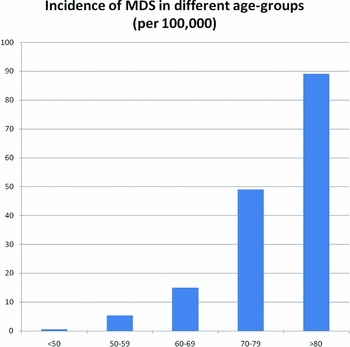
The myelodysplastic syndromes (MDS) are a group of conditions characterized by cytopenias of one or more cell line, in association with abnormal cellular maturation. The incidence of MDS increases exponentially with age (Figure 2).Reference Williamson, Kruger, Reynolds, Hamblin and Oscier15 Bone marrow failure is the commonest cause of death in patients with MDS. There is also a significant risk of progression to AML.
Variation in incidence of myelodysplastic syndromes (MDS) with increasing age

Diagnosis
The diagnosis is suspected in the presence of cytopenias associated with classical dysplastic features on the blood film. Macrocytosis is common. The diagnosis is confirmed by finding myelodysplastic features on bone marrow examination. As for AML, the decision as to whether a marrow biopsy is required must take account of the patient's general condition and suitability or otherwise for specific therapy.
Classification and prognosis
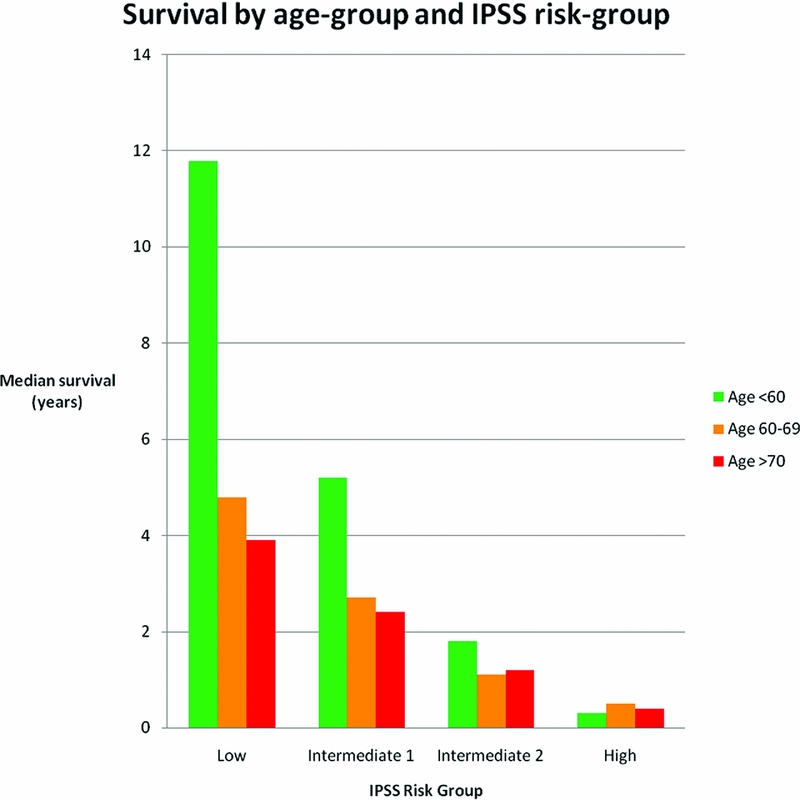
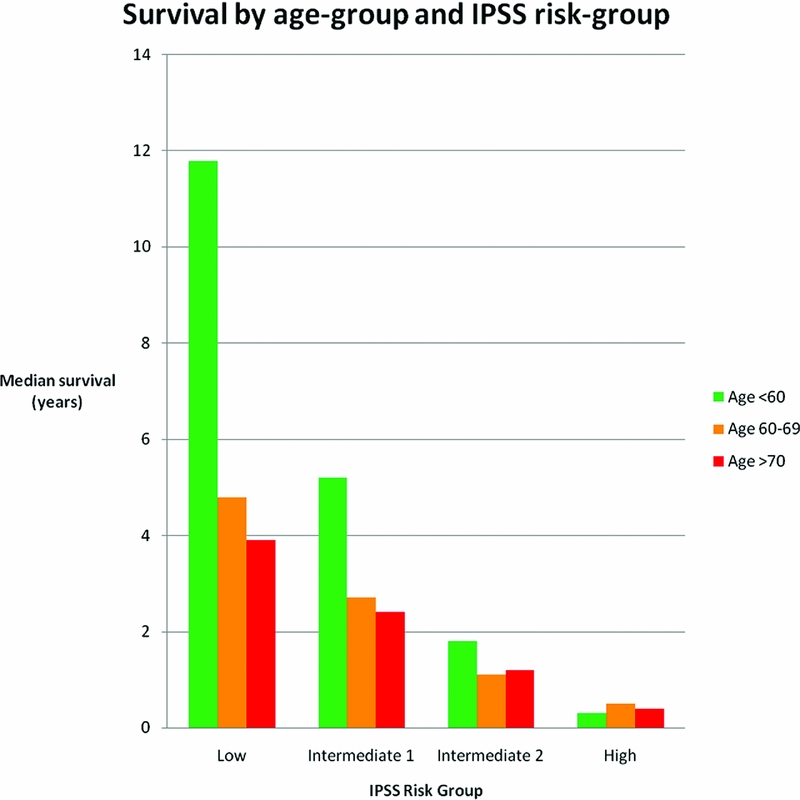
The term MDS covers a spectrum of disease with varying speed of presentation and prognosis. The WHO has classified the myelodysplastic syndromes into eight groups based on: bone marrow appearances, percentage of blasts in the bone marrow and cytogenetic abnormalities. The International Prognostic Scoring System (IPSS) divides patients into four risk groups, determined by: number of peripheral blood cytopenias, percentage of blasts in the marrow and cytogenetic findings.Reference Greenberg, Cox, LeBeau, Fenaux, Morel, Sanz, Sanz, Vallespi, Hamblin, Oscier, Ohyashiki, Toyama, Aul, Mufti and Bennett16 The IPSS prognostic model is shown in Figure 3.
Survival by age group and IPSS score for MDS
Treatment
Treatment needs to be tailored as far as possible to the individual and can be considered in several categories.
(1) Supportive therapies
Most patients with MDS are older than 65 years and therefore receive supportive therapy including red cell and platelet transfusion, and antimicrobial therapy for infection. Careful consideration has to be given to transfusion. The symptomatic benefit of transfusion should be assessed rather than treating on the basis of haemoglobin concentration alone. Iron overload is a common concern in these multi-transfused patients. There is controversy in the literature as to whether iron chelation in patients with MDS reduces end organ damage.Reference Tefferi and Stone17 At present a pragmatic approach is generally applied, and iron chelation is considered in patients who are likely to survive >1 year and who have required more than 20–30 units of red cells.
(2) Treatment aimed at inducing remission and possible cure
Fitter patients with high-risk disease according to the IPSS can be treated in the same way as those with AML. In contrast to some patients with de novo AML, patients with a background of MDS are not cured by the use of intensive chemotherapy alone, though the disease burden may be reduced. HSCT is the only proven curative therapy for this disease and should be considered in appropriate patients.
(3) New drugs
Newer drugs are now available for certain subsets of patients. A small subgroup of patients with a specific myelodysplastic syndrome associated with the cytogenetic abnormality (5q-) respond well to lenalidomide (a thalidomide analogue), with improved survival advantage and reduced transfusion requirements.Reference Sekeres and List18, Reference List, Kurtin, Roe, Buresh, Mahadevan, Fuchs, Rimsza, Heaton, Knight and Zeldis19 Azacitidine, a DNA demethylation agent, has been shown to significantly improve quality of life for patients and has a survival benefit in all age groups.Reference Seymour, Fenaux, Silverman, Mufti, Hellström-Lindberg, Santini, List, Gore, Backstrom, McKenzie and Beach20, Reference Kantarjian21 Decitabine has also shown some encouraging outcomes.Reference Wijermans, Suciu and Baila22
Lymphoproliferative disease (LPD)
There are a range of high-grade (rapidly proliferating) and low-grade (slowly proliferating) LPDs. This article will focus on the commonest diseases: HL, NHL and chronic lymphocytic leukaemia (CLL).
Presenting features
Most patients with LPD present with either lymphadenopathy or B symptoms (night sweats, unexplained weight loss and fevers). Unexplained itch can be a presenting feature and occasional patients with HL report alcohol-induced node pain. Forty per cent of patients present with extranodal involvement by LPD. The disease can affect any organ but stomach, testis and breast are commoner sites. Some patients are asymptomatic at presentation.
Diagnosis and staging
The key to diagnosis is getting an adequate biopsy of tissue for histological assessment and multiple immunohistochemical stains. Fine needle aspiration (FNA) of lymph nodes should be avoided in cases where suspicion of lymphoma is high, as it is very unusual for a diagnosis of lymphoma to be either confirmed or refuted by FNA. Excision biopsy of a worrying node is preferred to percutaneous needle core biopsy; the amount of tissue gained using the latter approach can be too small to allow adequate histological assessment. Clearly the risks of an open biopsy should be weighed against potential advantages, in terms of diagnostic certainty. Advice may be required from the local lymphoma multidisciplinary team (MDT) at this time.
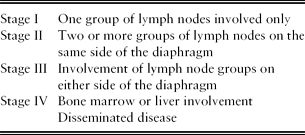
Potentially useful prognostic markers are lactate dehydrogenase, haemoglobin, lymphocyte count, disease stage and the presence or absence of bulk disease. Computerized tomography (CT) scan of chest, abdomen and pelvis along with bone marrow biopsy complete staging. The utility of additional staging with positron emission tomography (PET) scanning in lymphoma remains unclear. There are no consensus guidelines as yet to its best application. The staging nomenclature for LPD is shown in Table 1.
Staging system for lymphoma
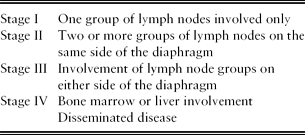
This staging system can also be further defined, e.g. stage IIA, stage IVB.
A equates to no B symptoms, while B denotes the presence of B symptoms.
E denotes the presence of extranodal disease.
Hodgkin lymphoma (HL)
Incidence
HL accounts for 1 in 4 cases of lymphoma, and patients over 60 years of age account for 20% of cases. Age-specific incidence is estimated at 2 per 100,000 population for those aged = 60 years.Reference Stark, Wood, Jack, Angus, Proctor and Taylor5
Management
Increasing age is recognized as a poor prognostic factor in HL. Current 5-year overall survival results for those over 60 years are 40–55% compared with 80–90% in younger patients.Reference Stark, Wood, Jack, Angus, Proctor and Taylor5, Reference Roy, Vaughan Hudson and Vaughan Hudson23, Reference Levis, Anselmo, Ambrosetti, Adamo, Bertini, Cavalieri, Gavarotti, Genua, Liberati, Pavone, Pietrasanta, Ricetti, Scalabrini, Salvi, Vitolo, Angelucci, Boccadoro, Gallo and Mandelli24 In the international prognostic index (IPI),Reference Hasenclever and Diehl25 Hasenclever and Diehl define age >45 years as indicative of higher risk disease. Whilst this may be useful in the context of the IPI, there is evidence that there is no cut-off in risk with increasing age, but instead a ‘sliding scale’ of increasing risk from around age 40–50 years.Reference Kennedy, Loeb, Peterson, Donegan, Natarajan and Mettlin3, Reference Stark, Wood, Jack, Angus, Proctor and Taylor5, Reference Erdkamp, Breed, Bosch, Wijnen and Blijham26
As for all of the haematological malignancies, there are likely to be a number of factors that contribute to the negative impact of advancing age on prognosis. For HL, perhaps more so than some other diagnoses, there is good evidence to suggest that inability of patients to tolerate therapy is the major factor.Reference Engert, Ballova, Haverkamp, Pfistner, Josting, Dühmke, Müller-Hermelink and Diehl27
In younger patients the standard chemotherapeutic regimen used is ABVD (doxorubicin (Adriamycin), bleomycin, vinblastine and dacarbazine). This is often intensified to a 7- or 8-drug regimen in high-risk patients. The best treatment approach in older patients has yet to be determined. A prospective randomized trial, however, showed no benefit for intensification of first-line therapy in those over 60 years: improved disease response was offset by increased toxicity and 5-year survival was 50% in both groups.Reference Ballova, Rüffer, Haverkamp, Pfistner, Müller-Hermelink, Dühmke, Worst, Wilhelmy, Naumann, Hentrich, Eich, Josting, Löffler, Diehl and Engert28 VEPEMB is a promising regimen developed by the Italian Lymphoma group.Reference Levis, Anselmo, Ambrosetti, Adamo, Bertini, Cavalieri, Gavarotti, Genua, Liberati, Pavone, Pietrasanta, Ricetti, Scalabrini, Salvi, Vitolo, Angelucci, Boccadoro, Gallo and Mandelli24 It is currently the subject of a randomized trial comparing this regimen with ABVD in those over 60 years.
This latter randomized trial is being undertaken under the auspices of the SHIELD programme.Reference Proctor and Wilkinson9 This is a web-based forum for patient registration, the principle being to encourage 100% population-based case registration with documentation of treatment given. Co-morbidity scores and frailty assessments are collected for all patients. Patients may choose to enter the randomized part of this study or simply to participate in the registration aspect. Understanding the denominator population from which trial participants are drawn is clearly important in this difficult disease area, characterized by significant patient heterogeneity.
Non-Hodgkin lymphoma
Diffuse large B-cell lymphoma
Diffuse large B-cell lymphoma (DLBCL) is the commonest high-grade lymphoma and >50% of all new DLBCL cases occur in patients >60 years old.29 Four prognostic groups with 5-year overall survival of 26–73% can be determined by the IPI. Within the IPI, age >60 years and performance status of >2 are both associated with poorer survival.30
Treatment
(1) Curative chemotherapy regimens in DLBCL
Treatment outcomes in DLBCL have improved in both younger and older patients, with addition of the monoclonal anti-CD20 antibody (Rituximab) to the standard chemotherapy CHOP regimen (cyclophosphamide, doxorubicin, vincristine and prednisolone). The GELA study group tested the addition of Rituximab to standard CHOP chemotherapy in a randomized trial of nearly 400 patients aged 60–80 years. Complete response to treatment was significantly better in the Rituximab-CHOP (R-CHOP) group than the standard CHOP group (76 versus 64%). Overall survival (OS) at 2 years was 70 and 57%, respectively.Reference Coiffier, Lepage, Briere, Herbrecht, Tilly, Bouabdallah, Morel, Van Den Neste, Salles, Gaulard, Reyes, Lederlin and Gisselbrecht31
The number of cycles of treatment given is determined by disease stage and treatment tolerability. The RICOVER-60 trial demonstrated a superior 3-year event-free survival (EFS) following six courses of R-CHOP compared with eight courses, in a randomized study of over 1200 patients between the ages of 61 and 80 years.Reference Pfreundschuh, Schubert and Ziepert32 Typically, six courses of R-CHOP are followed by two courses of Rituximab only, in patients with stage II–IV disease.Reference Pfreundschuh33
(2) Side-effects of R-CHOP chemotherapy
Side-effects of the R-CHOP regimen include short- and long-term cardiac toxicity, peripheral neuropathy, constipation, and febrile neutropenia. Steroid-induced side-effects including hyperglycaemia are also common.
The anthracycline chemotherapy, doxorubicin, is known to cause cardiotoxicity, including congestive cardiac failure (CCF) and arrhythmias. A retrospective population-based survey of over 6000 DLBCL patients >65 years old demonstrated a 29% increase in risk of congestive heart failure in patients who had received doxorubicin. Pre-existing hypertension was found to act synergistically with doxorubicin in provoking CCF. Patients with diabetes, valvular heart disease and history of smoking were also at greater risk of CCF.Reference Hershman, McBride, Eisenberger, Tsai, Grann and Jacobson34 Attention should be paid to increasing age and other risk factors for heart disease. All patients should be considered for an echocardiogram or multi-gated acquisition scan (MUGA) prior to starting chemotherapy, and doxorubicin may need to be reduced or omitted in certain cases.
Peripheral neuropathy and constipation may develop due to vincristine chemotherapy, and can be very troublesome. An alternative vinca-alkaloid can be substituted for vincristine if peripheral neuropathy progresses.
Febrile neutropenia (FN) is a common adverse event associated with myelosuppressive chemotherapy regimes such as R-CHOP. Increasing age is recognized as a risk factor for FN post-chemotherapy. Primary prophylaxis with GCSF is thus commonly recommended for patents aged ≥65 years treated with curative chemotherapy regimes, to reduce the incidence of FN.Reference Aapro, Cameron, Pettengell, Bohlius, Crawford, Ellis, Kearney, Lyman, Tjan-Heijnen, Walewski, Weber and Zielinski8, Reference Smith, Khatcheressian, Lyman, Ozer, Armitage, Balducci, Bennett, Cantor, Crawford, Cross, Demetri, Desch, Pizzo, Schiffer, Schwartzberg, Somerfield, Somlo, Wade, Wade, Winn, Wozniak and Wolff35
(3) Role of radiotherapy
Radiotherapy is usually considered if residual disease persists on re-staging CT scan, after chemotherapy has been completed.Reference Pfreundschuh33
(4) Palliative regimes in DLBCL
Management of patients who are unsuitable for intensive chemotherapy, or who have relapsed or refractory disease, is extremely challenging. In patients considered unable to tolerate R-CHOP due to frailty or other co-morbidities, palliative oral regimes comprising chemotherapy agents and steroids can be administered as an out-patient. Intravenous or oral steroids can be used for symptomatic relief and temporary reduction in tumour bulk for patients who are unsuitable or unwilling for chemotherapy agents.
Non-Hodgkin lymphoma: follicular lymphoma
Follicular lymphoma is the most common indolent, slow-growing lymphoma. Median age of presentation is 60 years. Patients can often remain asymptomatic for some time after diagnosis. There is no evidence to support early institution of therapy while patients remain asymptomatic. Good response rates can be achieved with follicular lymphoma, but relapse rates are high. Typically, each consecutive remission is shorter than the last. The goal of treatment is to maintain quality of life and treat only when symptoms develop.Reference Gribben36 As for DLBCL, age >60 years is a poor prognostic indicator, as determined by the follicular lymphoma international prognostic index (FLIPI).Reference Solal-Céligny, Roy, Colombat, White, Armitage, Arranz-Saez, Au, Bellei, Brice, Caballero, Coiffier, Conde-Garcia, Doyen, Federico, Fisher, Garcia-Conde, Guglielmi, Hagenbeek, Haïoun, LeBlanc, Lister, Lopez-Guillermo, McLaughlin, Milpied, Morel, Mounier, Proctor, Rohatiner, Smith, Soubeyran, Tilly, Vitolo, Zinzani, Zucca and Montserrat37 Data from the pre-Rituximab era demonstrate a 49% 10-year overall survival for patients diagnosed at ≥75 years.Reference Pulte, Gondos and Brenner38
Treatment
The commonest regimen used in first-line therapy is CVP-R (cyclophosphamide, vincristine, prednisolone and Rituximab), though R-CHOP may be used in those with a high-risk FLIPI score. A randomized study of 321 patients demonstrated improved disease-free survival and time to relapse, when Rituximab was added to CVP. A quarter of the patients were over 60 years of age.Reference Marcus, Imrie, Belch, Cunningham, Flores, Catalano, Solal-Celigny, Offner, Walewski, Raposo, Jack and Smith39
In an attempt to prolong remission duration, the PRIMA study randomized >1000 patients aged 22–84 years, to maintenance Rituximab or not, over a 2-year period following induction treatment with standard chemotherapy regimes and Rituximab. Progression free survival in the Rituximab maintenance group was 82% versus 66% in the observation cohort at 2 years. This was associated with little added toxicity and may become a useful regimen in older patients.Reference Salles, Seymour, Offner, López-Guillermo, Belada, Xerri, Feugier, Bouabdallah, Catalano, Brice, Caballero, Haioun, Pedersen, Delmer, Simpson, Leppa, Soubeyran, Hagenbeek, Casasnovas, Intragumtornchai, Fermé, da Silva, Sebban, Lister, Estell, Milone, Sonet, Mendila, Coiffier and Tilly40
Chronic lymphocytic leukaemia
Chronic lymphocytic leukaemia (CLL) is a clonal proliferation of mature lymphoid cells. It is commoner in men with an annual incidence of 6.75/100,000 compared with 3.65/100,000 in women.Reference Hernandez, Land and McKenna41 The median age of presentation is 70 years. CLL is a very heterogeneous disease with a sub-group of patients having the same life expectancy as those without CLL.
Presentation
Patients with CLL often present with the typical symptoms of lymphoma, with B symptoms or lymphadenopathy. However, CLL is also frequently detected as an incidental finding when a full blood count is done for an unrelated reason. Autoimmune haemolytic anaemia is seen in 10% of patientsReference Mauro, Foa, Cerretti, Giannarelli, Coluzzi, Mandelli and Girelli42 and autoimmune thrombocytopenia in 3%.Reference Diehl and Ketchum43 Recurrent infections may be problematic.
Prognosis and staging
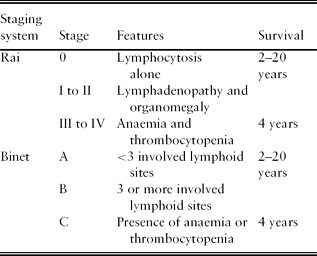
There is a marked variation in survival from patient to patient. To assist in prognostication, two main staging systems have been developed. These are shown in Table 2.
Rai and Binet staging systems for CLL
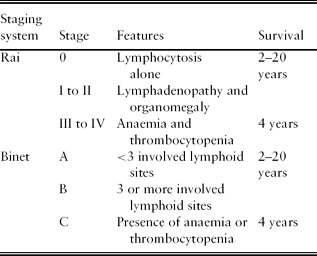
Lymphocyte doubling time, specific cytogenetic abnormalities and bone marrow histology can further inform prognosis. A lymphocyte count doubling time of less than 12 months is associated with a poorer prognosis.Reference Molica and Alberti44 Most patients in high-risk groups (Binet stage C, Rai stage III and IV) have a relatively rapid progression of disease and a median 4-year survival.
Patients with CLL are at increased risk of developing a second lymphoid malignancy. Richter's transformation is characterized by the development of a high-grade lymphoma on a background of CLL. Transformation is suspected if there are increasing B symptoms and/or marked increase in lymphadenopathy, especially if the adenopathy is asymmetric. Patients have a median survival of 5–8 months following Richter's transformation.Reference Tsimberidou and Keating45
Treatment
The decision to treat CLL should not be determined by the lymphocyte count alone, but by associated features, specifically: presence of B symptoms, anaemia or thrombocytopenia, or significant lymphadenopathy. Early treatment of asymptomatic patients has not been shown to confer any OS benefit.46
(1) Active monitoring
Patients with early stage disease can be safely monitored in the community. Due to the increased risk of infection and specifically shingles, all patients should be encouraged to present promptly in the setting with a fever or any infective symptoms.
(2) Measures aimed at disease control
Like follicular lymphoma, CLL tends to follow a relapsing–remitting course, and treatment is generally aimed at disease control, rather than cure. Given that bone marrow function is likely to be adversely affected after multiple courses of chemotherapy, it is important to intervene with therapy only when indicated by the patient's symptoms.
First-line therapy is usually with a fludarabine-based regimen, typically FCR (fludarabine, cyclophosphamide and Rituximab). Fludarabine is very immunosuppressive, and patients require irradiated blood products following treatment to prevent transfusion-associated graft versus host disease. FCR can be given as an out-patient, but it is associated with significant cytopenias which can be prolonged, and some older patients may struggle to tolerate this regime. In these cases, chlorambucil is a good treatment option.
(3) A strategy for cure?
Increasing numbers of allogeneic HSCTs are being done following recognition that CLL is an excellent target for graft versus leukaemia effects. Some studies have shown promise in improved overall survival in fitter patients over the age of 60, but more data are required.Reference Paneesha and Milligan47
Monoclonal B-cell lymphocytosis (MBL)
CLL is diagnosed when patients have >5 × 10⁹/l lymphocytes of clonal CLL phenotype in the peripheral blood. However, some patients have clonal B-cells present at a lower level. Such patients are diagnosed with MBL. MBL is found in 5% of adults >60 years. MBL progresses to CLL requiring treatment at a rate of 1–2% per year.Reference Rawstron, Bennett, O'Connor, Kwok, Fenton, Plummer, de Tute, Owen, Richards, Jack and Hillmen48 Follow-up may detect CLL development but may also cause significant anxiety. The advantages and disadvantages of follow-up need to be considered on an individual basis.
Multiple myeloma and monoclonal gammopathy of uncertain significance (MGUS)
Incidence
MGUS and multiple myeloma become more common with age. Monoclonal gammopathy of uncertain significance is defined as the presence of a monoclonal protein in the serum or urine of an individual with no evidence of lymphoma, myeloma, amyloidosis, Waldenstom's macroglobulinaemia or other plasma cell dyscrasia. MGUS is common with a paraprotein detectable in around 1% of the population. It is uncommon under the age of 50 years, but can be detected in 4–5% of the population aged over 80 years. It is twice as common in individuals of Afro-Caribbean descent.Reference Kyle, Therneau, Rajkumar, Larson, Plevak, Offord, Dispenzieri, Katzmann and Melton49
Risk factors for progression of MGUS to myeloma
It has been demonstrated that nearly all cases of myeloma have emerged from a pre-existing MGUS. However, the risk of a patient developing myeloma is low, at around 1% per annum over 20 years. Risk factors for progression include IgA isotype, a paraprotein level > 15 g/l and an abnormal serum free light chain (SFLC) ratio.
Individuals with an IgM MGUS have an increased risk of developing a lymphoproliferative disorder such as lymphoplasmacytic lymphoma or the hyperviscosity syndrome Waldenstrom's macroglobulinaemia. Patients with IgM paraproteins may also have anti-myelin associated glycoprotein (anti-MAG) antibodies and an associated peripheral neuropathy. In patients with an IgA or IgG paraprotein, amyloidosis, POEMS syndrome and isolated plasmacytoma should be considered as possible diagnoses.Reference Kyle, Therneau, Rajkumar, Larson, Plevak, Offord, Dispenzieri, Katzmann and Melton49, 50
Indications for treatment
If a patient presents with or develops multiple myeloma, it is important to recognize whether the patient requires treatment. Patients with so-called ‘smouldering’ or ‘asymptomatic’ myeloma have myeloma without end organ damage. They have no evidence of hyperCalcaemia, Renal impairment, Anaemia or Bone disease (‘CRAB’). These patients do not require immediate therapy. They should be carefully followed and regularly assessed for evidence of progression.50
Patients with active myeloma can present as emergencies where urgent intervention is required to prevent significant morbidity and mortality. Myeloma should be considered in patients presenting with acute renal failure, spinal cord compression, pathological fractures, infection and hypercalcaemia.
Treatment
(1) Supportive care
Patients with multiple myeloma require careful supportive therapy. Bisphosphonates have been shown to significantly reduce skeletal morbidity and potentially have an impact on survival. Zoledronic acid, pamidronate and clodronate are all effective. Zoledronate appears to be the most active agent, although its use is associated with an increased risk of osteonecrosis of the jaw. Intravenous bisphosphonates may also impair renal function.
Antibiotics should be used promptly as patients with myeloma have an increased risk of bacterial infection and patients on bortezomib therapy have an increased risk of Herpes zoster infections.
A multidisciplinary approach is essential to good myeloma care with renal, orthopaedic, radiotherapy and palliative care input being key.
(2) High-dose therapy
Patients who have active myeloma requiring treatment are often assessed according to age and general fitness. Patients aged 60–65 years or less are usually considered for combination chemotherapy, followed by consolidation therapy using an autologous stem cell transplant. A chronological age ‘cut-off’ is clearly arbitrary and patients should be assessed according to their biological status rather than their chronological age. It is still fairly unusual, however, for patients aged over 70 to be considered for intensification with autologous stem cell transplant. Patients considered for intensification should have initial treatment with a regime which allows a stem cell harvest, once the patient has responded to treatment. Such regimes currently include high-dose dexamethasone and thalidomide. Newer agents such as lenalidomide and bortezomib are being increasingly incorporated into initial treatment regimes for such patients.
(3) Particular considerations in older patients
For the last 30–40 years, melphalan and prednisolone have been the mainstay of treatment for older patients or patients with significant co-morbidities who are not suitable for a transplant. Responses rates are, however, poor and complete remissions are unusual. Whilst melphalan and prednisolone are still the backbone of initial therapy for older patients with myeloma, novel agents such as thalidomide,Reference Palumbo, Bringhen, Caravita, Merla, Capparella, Callea, Cangialosi, Grasso, Rossini, Galli, Catalano, Zamagni, Petrucci, De Stefano, Ceccarelli, Ambrosini, Avonto, Falco, Ciccone, Liberati, Musto and Boccadoro51 bortezomibReference San Miguel, Schlag, Khuageva, Dimopoulos, Shpilberg, Kropff, Spicka, Petrucci, Palumbo, Samoilova, Dmoszynska, Abdulkadyrov, Schots, Jiang, Mateos, Anderson, Esseltine, Liu, Cakana, van de Velde and Richardson52 and lenalidomideReference Palumbo, Falco, Falcone, Benevolo, Canepa, Gay, Larocca, Magarotto, Gozzetti, Luraschi, Morabito, Nozza, Knight, Zeldis, Boccadoro and Petrucci53 have been added to this core treatment with marked improvements in response rates, complete responses and progression free survival. Alternative regimes including cyclophosphamide, dexamethasone and thalidomide have shown similar benefits.
Older patients are at greater risk than younger patients of side-effects of therapy. Steroids are associated with increased risks of infection and psychiatric side-effects. Thalidomide can cause dizziness, venous thrombosis, constipation and neuropathy. Similarly, bortezomib can cause neuropathy which can be painful and takes some time to resolve. Patients treated with bortezomib are also at risk of Herpes zoster infections and thrombocytopenia. Lenalidomide can be associated with major haematological toxicity and increased risk of significant neutropenia.
Ideally, myeloma patients should be managed in a disease-specific clinic with a multidisciplinary approach. The outlook for all patients with myeloma that require treatment is improving with the advent of novel agents. However, novel agents and new drug combinations can bring novel or more severe side-effects that can cause significant morbidity.
Conclusions
Older patients diagnosed with a haematological cancer have a poorer prognosis than younger patients diagnosed with the same disease. This may be due to different tumour biology in older patients, but the fact that older patients are less able to tolerate intensive chemotherapy is also important.
In general terms, the treatment of haematological malignancies can be either intensive or supportive in nature; individual patient assessment and careful communication with the patient and their family is required to ensure optimal patient management. Currently older people are under-represented in clinical trials despite the incidence of many of the malignancies being higher in older adults. Recruitment of older patients into clinical trials is likely to be essential in helping improve both quality of life and overall survival. Standardized assessment tools defining co-morbidity, functional status and cognitive state are needed and would assist with trial interpretation. Both the investigation and treatment of haematological malignancy need to be tailored to individual patient wishes after informed discussion.
Conflicts of interest
None of the authors declared any conflicts of interest.