Traumatic injuries are among the leading causes of death for Americans under 45 y of age.1 Hemorrhagic shock is a common cause of mortality secondary to traumatic injury, but rapid response and hemorrhage control can reduce mortality risk.Reference Curry, Hopewell and Dorée2 Empowering bystanders with hemorrhage control techniques may increase the likelihood that victims receive timely care while waiting for first responder arrival and improve their chances of survival.
One increasingly common source of trauma in the United States is gun violence.3 School shootings are of significant concern, as 97 occurred in the United States in 2018 alone.4 In an effort to reduce injury and death from gun violence, a committee of health-care professionals developed the Hartford Consensus, which outlines several measures to reduce mortality in the event of an active shooter.Reference Jacobs, McSwain and Rotondo5 One of these measures includes hemorrhagic control, which is the foundation for the development of Stop The Bleed (STB).
STB is a national initiative created by the American College of Surgeons Committee on Trauma to educate and empower bystanders to respond to major bleeding events. The STB initiative led to the development of a Bleeding Control Basics course, a 60-min program designed to teach participants how to respond to a major hemorrhage through wound packing and proper tourniquet application. This course uses a train-the-trainer process by certifying health-care providers to lead civilian trainings. In February 2019, the list of professions eligible to become certified trainers was expanded to incorporate several additional disciplines, including pharmacists.6
Several published studies have shown STB trainings to be efficacious in increasing participants’ knowledge and readiness to respond to bleeding events. However, none have been led by pharmacists, and few have assessed the efficacy of these trainings in school settings.Reference Lei, Swartz and Harvin7-Reference Martin, Smith and Zeoli9
An interprofessional pharmacist and student-led community service learning project was developed to provide STB trainings to school faculty and staff and equip the schools with the resources needed to control a life-threatening bleed. This study evaluated the efficacy of pharmacist-led STB trainings for public school educators in South Texas.
METHODS
Training and Participants
In brief, the 60-min STB training includes a large-group didactic educational presentation (material provided by the STB program) regarding hemorrhage control techniques, followed by small-group, hands-on practice of tourniquet application, wound-packing, and pressure application taught by several instructors interspersed throughout the audience.6 More information about the course can be found at https://www.bleedingcontrol.org/.
STB was developed as a train-the-trainer program, in which participants are trained to not only respond themselves, but also to train others. Two University of Texas at Austin College of Pharmacy faculty members completed training to be certified as STB instructors. They led 3 trainings for health professional students, who subsequently assisted in leading 3 trainings for school teachers, administrators, and staff from 2 public school districts in Laredo, Texas. In this study, pharmacists led the lecture portion of the training, while student volunteers assisted in leading the hands-on portion, providing a unique interprofessional student learning opportunity. The student volunteers included pharmacy and medical students, as well as 1 preprofessional student applying for physician assistant school. While students did help lead the hands-on portion, this was considered a pharmacist-led intervention, as the only certified STB trainers involved were pharmacists, and the pharmacists were solely responsible for leading the didactic teaching during the trainings. The study cohort consisted of the training participants who voluntarily completed both a pre- and postsurvey. Those who had previous medical, military, and/or tourniquet training experience (self-identified in the presurvey questionnaire) were excluded.
Pre- and Postevent Surveys
Training efficacy was assessed by means of anonymous pre- and postevent surveys. Paper surveys were distributed at the beginning of the training and numbered to allow for matching of the pre- and postsurveys. Participants completed pre-event surveys immediately before the training and postevent surveys immediately after.
The survey tool used for this study was derived from a previously published study assessing the efficacy of an STB course.Reference Ross, Redman and Mapp10 Data collected included participant demographics, knowledge of basic hemorrhagic bleeding control techniques, comfort with and perceived safety of using a tourniquet, and willingness to respond to traumatic emergencies. Knowledge of bleeding control measures and accurate tourniquet placement was assessed with true/false and diagram-based questions. Comfort level using a tourniquet and responding to a medical emergency was assessed on a 5-point Likert scale ranging from strongly disagree (1) to strongly agree (5). The participants’ perceived safety of and willingness to use a tourniquet were assessed with ordinal scales. Finally, in the postevent survey, participants were asked to rate the usefulness of this training by means of a 5-point Likert scale ranging from not useful (1) to very useful (5). If a participant did not answer a question on the pre- or postsurvey, that participantʼs survey was not entirely excluded. Instead partial surveys were included, with only the questions in which that individual responded on both the pre- and postsurveys included in the analysis.
Statistical Analysis
Statistical analysis was conducted with SAS JMP® (SAS Institute Inc; Cary, NC). The differences between pre- and postevent knowledge, comfort level, and opinion on the safety of using a tourniquet were compared with Wilcoxon signed rank tests. Statistical significance was defined as an alpha of less than 0.05.
Community Support
Along with the training sessions, 350 bleeding control kits were donated to equip the schools with the necessary tools to respond to bleeding emergencies. These kits contained a combat application tourniquet, gauze, scissors, a marker, and gloves. Additionally, each school district received a training kit that included a mannequin and 10 tourniquets, allowing them to train future employees. Funding for the kits, teaching equipment, and travel was made possible through a grant provided by the Kleberg Scholar Program.
This study was deemed nonregulated research by The University of Texas Health San Antonio Institutional Review Board (Protocol HSC20180855N).
RESULTS
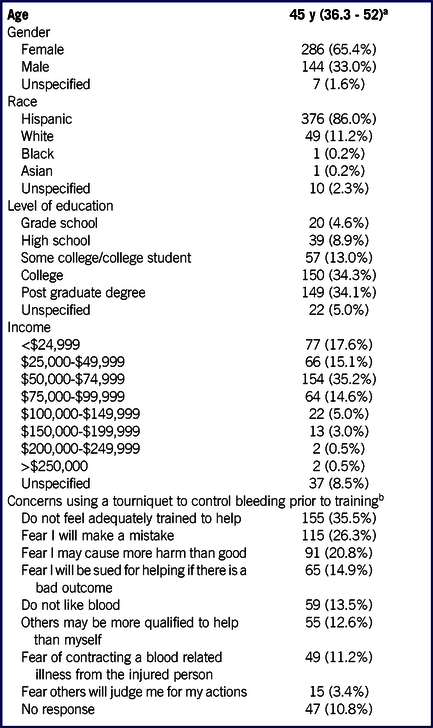
Pre- and postsurveys were distributed to 612 trainees, with 535 completing and returning both (87.4% response). The study cohort included 437 people, as 98 were excluded due to prior medical, military, and/or tourniquet training. The median age of participants was 45-y-old (interquartile range, 36-52). Participants were predominantly female (N = 286; 65.4%) and Hispanic (N = 376; 86.0%). Most had achieved a college degree or higher (N = 299; 68.4%). Complete demographics are presented in Table 1.
Participant Demographics and Baseline Concerns Using a Tourniquet (n = 437)

All responses are self-reported.
a Value reported as median (interquartile range).
b Participants selected as many or as few responses as they desired.
Before training, participants were asked to indicate reasons they felt uncomfortable using a tourniquet to intervene in a bleeding event. The most common included not feeling adequately trained to help (N = 155; 35.5%), fear of making a mistake (N = 115; 26.3%) or causing additional harm (N = 91; 20.8%), possible legal repercussions of a bad outcome (N = 65; 14.9%), and not liking blood (N = 59; 13.5%).
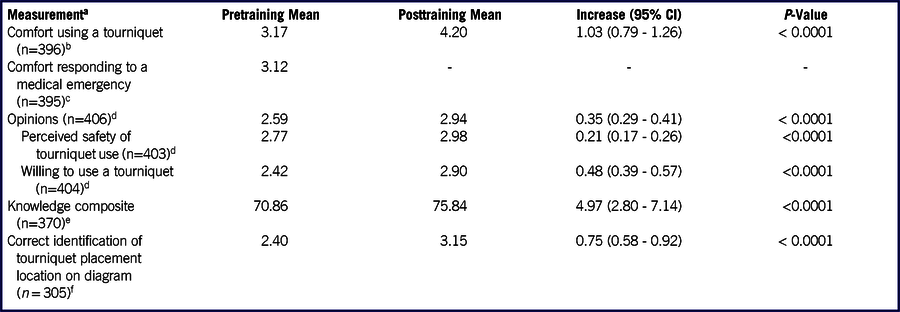
Compared with baseline assessment before training, significant improvements were observed in reported comfort level using a tourniquet (mean, 3.17 vs 4.20; P < 0.0001), opinions on the safety of tourniquets (2.59 vs 2.94; P < 0.0001), tourniquet knowledge (70.86 vs 75.84; P < 0.001), and proper tourniquet placement after participants completed the training (2.40 vs 3.15; P < 0.0001). Table 2 provides additional information regarding results of the pre- and posttraining surveys.
Mean Scores From Pre- and Postsurveys

Abbreviation: CI, confidence interval.
Knowledge and diagram scores were included if the participants filled out the section on the presurvey. The post survey was scored as a 0 if it was left blank.
a As survey responses were not forced, N varies per question.
b Scored from 1 to 5 (1 = very uncomfortable, 5 = very comfortable); based on answers to the following question from the pre- and postsurveys: “How would you rate your comfort level in regards to using a tourniquet in real life?”
c Scored from 1 to 5 (1 = very uncomfortable, 5 = very comfortable); based on answers to the following question from the presurveys: “How would you rate your comfort level in regards to responding to medical emergencies?”
d Scored from 1 to 3 as follows: unsafe/no = 1, unsure = 2, safe/yes = 3; based on answers to the following questions from the pre- and postsurveys: Safety question: “In your opinion, the use of tourniquets is … ”; Willing to use question: “In your opinion, would you use a tourniquet in real life?”
e Knowledge was scored based on answers to 5 questions. Each correct answer was worth 20 points, for a minimum score of 0, and a maximum score of 100.
f Diagrams were scored based on answers from pre- and post- survey in which participants were asked to mark where to place a tourniquet in the event of an injury to a location specified on the diagram. Participants could score a minimum of 0 and a maximum of 4.
Trainees indicated this event was useful, as 96.6% rated it as either useful or very useful, with a mean rating of 4.9 of 5.
DISCUSSION
This study demonstrated that STB training led by pharmacists, with the assistance of pharmacy and medical students, significantly improved attitudes, knowledge, and opinions regarding hemorrhage control in emergency situations.
Comparisons to Prior Studies
Several previous studies have shown improvement in readiness, proficiency, and confidence in responding to bleeding emergencies through STB training.Reference Lei, Swartz and Harvin7-Reference Ross, Redman and Mapp10 Ross et al. assessed the efficacy of an STB training event through the same pre- and postsurveys used in our study, and similarly noted improvements in attendee opinions regarding the safety of a tourniquet and willingness to use tourniquets in an emergency situation (64.2% vs 95.6%; P < 0.001), comfort using a tourniquet in a life-threatening situation (2.5 vs 4.0; P < 0.001), and hemorrhage control knowledge (4.1 vs 4.7; P < 0.001).Reference Ross, Redman and Mapp10 While this study similarly targeted laypeople in South Texas, it was not directed toward school teachers or staff. Furthermore, it was led primarily by physicians and nurses, whereas the present study was led by pharmacists. As of February 2019, the American College of Surgeons recognized pharmacists as eligible to become certified STB trainers.6 However, to date, no published studies have assessed the efficacy of pharmacist-led STB training. Given that our study used analogous methodology and an identical survey tool to Ross et al., the similar results observed provide some evidence that pharmacist-led STB trainings are an efficacious approach to expanding the reach of the STB program and increasing the number of laypersons trained to provide hemorrhage control.
In addition to providing evidence regarding the efficacy of pharmacist-led STB training this study also demonstrated efficacy of training school teachers and staff. Lei et al. demonstrated positive results of a physician and medical student-led STB training through pre- and posttraining surveys.Reference Lei, Swartz and Harvin7 Participants answering all 5 knowledge-based questions correctly increased from 12% pretraining to 63% posttraining. The cohort trained consisted of school nurses, medical students, researchers, and community members. While a limited number of studies such as this have included school staff among a varied trainee cohort, to the authors’ knowledge, the present study represents the first published assessment of STB training specifically targeting school employees.
Community Impact
The need for school employees to be proficient in these lifesaving techniques is emphasized by the increasing prevalence of school shootings. In 2018, a total of 97 gun-related incidents occurred in US K-12 schools. Texas ranked third in the number of gun-related incidents on K-12 school campuses since 1970.11 At a recent Texas school shooting in which 10 people were killed and 13 more injured, more than 11 min elapsed before police entered the building to apprehend the shooter.3 This demonstrates the importance of bystanders’ readiness to respond to bleeding emergencies, as rapid response is a critical factor in victim survival.
Through this study, 2 public school districts, which are home to more than 60,000 students, now have teachers, administrators, and staff trained in hemorrhage control interventions.12 However, this training may not be as effective if these schools are not equipped with the resources to use the training. A recent study found that only 16.4% of STB trainees bought tourniquets, even though, following training, 74.7% indicated they would purchase them.Reference Elkbuli, Dowd and Casin13 This study highlights the importance of supplying bleeding control kits to schools and places of high traffic. Thus, to have a greater impact on the community, our project also included distribution of enough bleeding control kits to stock at least 1 in each school and training kits to enable each district to conduct future trainings. Providing kits to the school systems eliminated the need to use limited school funds to purchase them, resulting in a greater capability of responding to emergency situations.
Furthermore, a significant factor in the community impact of this project was the location of these trainings, as they were conducted in Laredo, Texas, a city near the Mexico border. The closest level 1 trauma center to Laredo is located in San Antonio, Texas, approximately 150 miles away.14 Areas without direct access to a level 1 trauma center are at a significant disadvantage for receiving timely, lifesaving treatment.Reference Crandall, Sharp and Unger15 Suffering a life-threatening bleed more than 5 miles from a trauma center is associated with increased mortality (8.7% vs 7%; P < 0.001).
Interprofessional Training Opportunity
Finally, this project was developed as a component of an interprofessional student-led community service learning project. Pharmacy and medical students collaborated in all aspects of the project, including obtaining a service-learning grant, identifying interested school districts, and coordinating the training and travel logistics with the schools and other student volunteers. The student volunteers traveled to these school districts to assist the pharmacy faculty in the trainings. The success of this project demonstrated the merit of STB events as a meaningful opportunity for health professions students to perform valuable community service and gain important interprofessional educational experiences.
Limitations
As this study was conducted exclusively in South Texas and included a largely Hispanic cohort, the results may not be generalizable to different settings. Several participants spoke Spanish as their primary language. Although multiple volunteers were able to translate surveys into Spanish for participants, the presentations were provided in English. This may have impacted the results if a large proportion of the surveyed cohort had difficulty understanding the survey tool or presentation. Additionally, some respondents left some survey questions blank. In this situation, we did not throw out the entire survey, but instead excluded specific questions from the survey if there was not a response on both the pre- and postsurvey. Some participants also noted ambiguity in the phrasing of some survey questions, specifically questions referring to the placement of the tourniquet. Lastly, some trainees either chose not to complete or forgot to turn in the voluntary pre- and postsurvey. However, the response rate was relatively high, with 87.4% of those trained completing both pre- and postsurveys.
CONCLUSION
Pharmacist-led STB trainings significantly increased school faculty and staff knowledge and willingness to respond to an emergent bleeding event. Although the STB training does not prevent students and teachers from experiencing gun violence, it can help prepare them to respond appropriately, which may reduce injury and potentially save lives.
Acknowledgments
We acknowledge the following people who volunteered their time to assist with these trainings: Cheryl Baker, Tataka Johnson, Lillian Liao, Aly Jusino, Amrita Kanwar, Andres Leos, Andrew Rubio, Annie Liu, Ashly Ibrahim, Brittany Santos, Grace Akinyemi, Haneen Hussein, Josh Perez, Kari Tornes, Kevin Salinas, Linda Taing, Lindsey Groff, Lisa Garcia, Monica Rios, Ralph Galega, Samantha Aguilar, Simone Donelley, Sorina Brinae Torrez, Stephanie Nwokedi, Ted Sohn, Joseph Kim, Rosemary Liu, Sarah Rumbellow and Jordan Suh. None of the volunteers listed were compensated for their role. We also acknowledge the University of Texas Health San Antonio Center for Medical Humanities and Ethics and the Kleberg Foundation for funding this project and the University Health System in San Antonio and the Southwest Texas Regional Advisory Council for assistance with local training and acquisition of supplies.
Funding
This research study was funded by the University of Texas Health San Antonio Center for Medical Humanities and Ethics Kleberg Scholar Grant.
Conflicts of interest
There are no conflicts of interest to disclose.
Authors’ contributions
Study concept and design: Baus, Brandt, Kazen, Moote, Evoy. Statistical analysis: Allen. Interpretation of data: All authors. Drafting of the manuscript: Moton, Baus, Brandt, Coleman, Kennedy, Swank, Tran. Critical revision of the manuscript for important intellectual content: All authors. Study supervision: Evoy, Moote.
Previous presentation of this work
The final results of this study were presented as an academic poster presentation at the Texas Society of Health-System Pharmacists Annual Seminar in Frisco, Texas in April 2019, while an encore presentation was presented locally at the University of Texas at Austin Littlefield Research Day in Austin, Texas in April 2019.