



1 General introduction
Statistical skills used not to be a prerequisite for doing phonological analyses in the generative tradition. In fact, the field was dominated by a strong belief that grammatical knowledge (competence) is independent of the statistical patterns observed in the lexicon (e.g. Chomsky Reference Chomsky1957, Halle Reference Halle, Halle, Bresnan and Miller1978). This situation has changed rapidly in recent years, as a result of a growing body of studies that have demonstrated that phonological knowledge is – or at least can be – stochastic, partly reflecting statistical trends in the lexicon (e.g. Ernestus & Baayen Reference Ernestus and Harald Baayen2003, Hayes & Londe Reference Hayes and Londe2006). Another reason for the increased use of statistical methods is the rise of interest in employing experimental techniques and corpus data for phonological argumentation, a general approach now known as ‘laboratory phonology’ (Beckman & Kingston Reference Beckman, Kingston, Kingston and Beckman1990, Pierrehumbert et al. Reference Pierrehumbert, Beckman, Robert Ladd, Burton-Roberts, Carr and Docherty2000). It is safe to say that familiarity with statistical techniques has now become a desirable skill for theoretical phonologists. One can of course take the position that phonological knowledge is strictly dichotomous, that (lexical) statistics has nothing to do with phonological competence or that evidence from experimental and corpus studies is irrelevant for phonological theorisation. Nevertheless, in order to evaluate how quantitative data and analyses bear upon questions about phonological competence, I believe that it is crucial that we have some basic understanding of statistics. To take an example, MaxEnt Harmonic Grammar has recently been used to model various aspects of linguistic knowledge (e.g. Goldwater & Johnson Reference Goldwater, Johnson, Spenader, Eriksson and Dahl2003, Hayes & Wilson Reference Hayes and Wilson2008, Shih Reference Shih2017, Breiss & Hayes Reference Breiss and Hayes2020), and is mathematically equivalent to (multinomial) logistic regression (Jurafsky & Martin Reference Jurafsky and Martin2019). Whether we endorse or reject it as a theory of grammar, we need to understand it, and to do so, it is necessary to know how regression works in general.
There are already several statistics textbooks written for linguists, including Baayen (Reference Baayen2008), Johnson (Reference Johnson2008), Gries (Reference Gries2013) and Levshina (Reference Levshina2015). Nevertheless, Winter's book is a very welcome addition to the field. I thoroughly enjoyed reading the book, and learned a lot from it.
2 The structure of the book
The structure of the book is as follows. Chapter 1 is a general introduction to R, and is followed in Chapter 2 by an introduction to the tidyverse, ‘a modern way of doing R’ (p. 27). Even if the reader is already familiar with the tidyverse, §2.10 is required reading. It explains what reproducible research is, why it is important and why we should not be scared to make our code and data available. Chapter 3 explains basic statistical measures such as means, medians and distributions. Rather than discussing ‘more traditional’ statistical testing like ANOVA, in Chapter 4 Winter moves onto the linear regression model. Chapter 5 explains various linear and non-linear transformations, including centring, standardisation, log-transformation and Pearson correlation analyses. One topic that is of particular importance is centring, which is essential in interpreting multiple regression models with significant interaction terms, covered in Chapter 6. In Chapters 7 and 8, Winter spends considerable time explaining how to interpret the coefficients in regression modelling. This first half of the book makes very clear that what is important is understanding the data using statistical modelling, rather than asking whether an effect of interest is statistically significant or not. Modelling comes first; significance testing is next.
Once this has been established, Chapter 9 very cautiously introduces statistical inferences, taking t-tests as an example. Chapter 10 explains common misunderstandings about statistical testing, apparent for example in how p-values have been misused, and Chapter 11 discusses significance testing in the context of regression models. Chapter 12 is devoted to logistic regression, a method that is useful for modelling binary categorical responses. Poisson regression, suited for the analysis of count data, is discussed in Chapter 13. Any readers who use ANOVA for categorical data (by averaging over participants or items) should carefully consult these chapters. The next two chapters are devoted to explaining linear mixed-effects modelling, which has become the de facto standard analytical strategy in linguistics and neighbouring disciplines. Chapter 16 offers future perspectives – what I found most useful was the discussion in §16.5, which argues in detail why it is important to construct statistical models based on theoretical considerations. In Appendix A, interested readers can learn how more traditional statistical tests such as ANOVA correspond to linear modelling, while Appendix B lists recommendations for future reading. The book ends with an index of keywords and one of R functions, both of which seem comprehensive and useable. The e-book version is searchable, allowing readers to look for particular keywords or functions, for example.
3 Distinguishing features of the book
There are a number of features that make this book special; they are listed in (1).
-
(1)

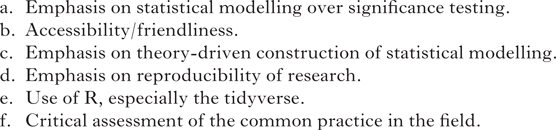
Let me expand on each of these. First, an advantage of statistical modelling over more traditional significance testing (e.g. t-tests or ANOVA) is that it forces us to better understand the data, rather than relying too much on p-values, which can be misunderstood and misused in several important ways. Reliance on significance tests can cause the harmful illusion that there is a dichotomous distinction between a particular effect being either significant or not, which has a number of undesirable consequences (see §9.5 and references cited there). As Winter emphasises throughout the book, statistical modelling instead encourages us to think more deeply about what the data actually look like, which mathematical functions would be useful to fit the data and what meanings we can extract from the data. Moreover, statistical modelling allows us to make predictions about the data that we have not seen before – something that significance testing alone is unable to do. Although Winter does not make this point very clearly in the book (perhaps intentionally), this is an important advantage of statistical modelling, because making predictions is arguably one important task for science in general (cf. Breiman Reference Breiman2001).
The tone of the book is informal and friendly for an introductory statistics book of this sort, and my assessment is that this strategy works very well. Winter uses ‘you’ to address the readers, and going through the book may make them feel like they are working together with him in an actual statistics course.Footnote 1 Winter consistently reminds the readers that they should not worry if, for example, they forget specific R commands, make mistakes or get overwhelmed. This ‘hand-holding’ approach makes the long journey in the book – from simple addition to linear mixed-effects modelling – easier to follow. The book can be used as a textbook for both undergraduate and graduate statistical classes, as well as for self-teaching. Statistics can be offputting, especially for those who think that they are ‘not good at numbers’. Winter does a wonderful job of lowering, perhaps eliminating, the psychological threshold for such readers. The mathematics underlying the statistics introduced in the book are deliberately kept to a minimum. However, in Appendix B Winter has many pointers to other books for those who would like to know more about the mathematical foundations.
We tend to believe that there is an objective way to build ‘the best’ statistical model; Winter does a good job of debunking this myth. For example, in my own statistics training during my graduate study, I was told that we should include as many factors as possible in ANOVA to soak up variance, but Winter has informative discussion on why this is bad practice, and argues that model construction should be a subjective, theory-driven process (see especially §16.5). He discusses the interesting history of how linguists have adapted linear mixed-effects model (p. 242). After Baayen (Reference Baayen2008), it became common to include random intercepts only. There was a swing back to including random slopes to maximise random structure, due to the influential recommendation of Barr et al. (Reference Barr, Levy, Scheepers and Tily2013). In many portions of the book, Winter stresses how important it is to let our theory guide which free varying parameters should be included in the model, rather than blindly following what the field sets as its standard. This advice is not just about random slopes and intercepts, but also about which fixed factors should be included, as well as how interaction terms should be coded.
Winter repeatedly argues that it is important that the data and the code are published together with a paper, in order to promote open and reproducible research practice in linguistics. He claims that reproducible research, in which any third-party reader can reproduce the reported results, is essential in order for science to progress in a cumulative fashion. In addition, making the data publicly available may help other researchers conduct additional analyses on the published results, which may reveal new aspects of the data. However, some of us may feel shy about, and/or scared of, making the code and data publicly available – Winter discusses several reasons why we may have those feelings, and explains very gently why we should not (§2.10). To promote more reproducible research practice in linguistics, he emphasises that using R and its markdown function is essential, and provides some convincing reasons for why this is so. Winter even goes so far as to say that ‘teaching SPSS to students is unethical’ (p. xiv), because SPSS is not well suited for open and reproducible research. Making research results open and reproducible is likely to become the norm for journal publication in the near future; journals already encouraging or requiring this practice include Laboratory Phonology, Language, Linguistics and Phonology.
Finally, another aspect which makes this book special as a textbook is that Winter challenges some common practices in the field. For example, he argues against both the convention which asks us to conduct statistical tests on all possible comparisons instead of limiting ourselves to those comparisons that are theoretically motivated (p. 187), and the use of stepwise regression (§16.4), the standard strategy in some branches of linguistics, primarily because in this approach the critical portion of the thinking process is relegated to a machine. He reports a case in which he was asked to include interaction terms by a reviewer, but refused to follow that advice, because doing so was not theoretically motivated (p. 278). This general strategy of including some critical remarks about common practices in the field, I believe, nurtures critical thinking, and conveys the message to the readers that we need to argue for particular statistical analyses, just as we argue for particular linguistic analyses.
4 General evaluation
Taken together, these features make the book informative and useful for a wide range of readers, from beginning students to professional linguists, i.e. anybody who is eager to learn statistical techniques in modern linguistics research. I believe that the book is worth reading for readers who can identify with any of the statements in (2).
-
(2)
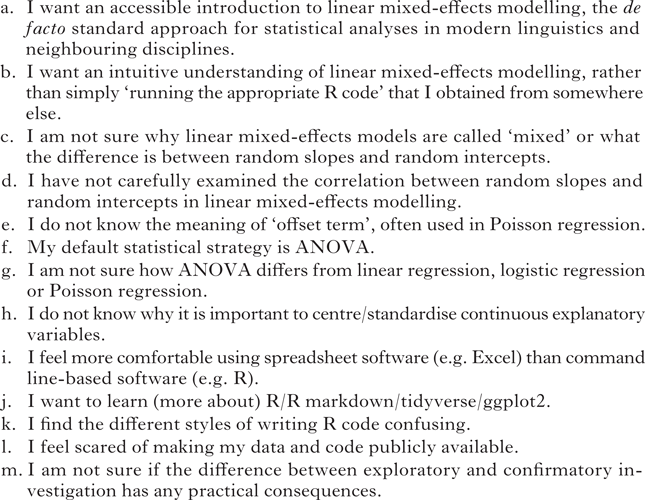
Winter also identifies, and corrects, a number of misunderstandings about statistical analyses. For example, it seems common to think, mistakenly, that we can interpret regression coefficients as ANOVA main effects, and relatedly, that if we are dealing with a categorical variable, choosing between sum coding and treatment coding does not affect the interpretation of the results (see §8.2). A frequently observed thinking trap is to believe that the lower the p-values, or the higher the R 2 values, the more correct the proposed hypothesis (p. 171). I used to think that the interpretation of intercept terms is not very interesting, but it is apparent from Winter's book that they in fact convey important information, sometimes as much as slope coefficients (e.g. p. 205). Relatedly, I used to think that examining estimates for random effects is not important, because they represent just random variability coming from inter-speaker or inter-item differences; however, Winter reminds us that we can learn much from random effects, sometimes more than from fixed effects (e.g. p. 272). One might think that we can safely interpret model results as long as we do not get a warning message or a convergence issue, but the story is not that simple (§15.5). The list could go on. Readers who are interested in finding out more about these issues are encouraged to read the book.
In short, the book is extremely informative in various ways. However, it is not for readers who want to learn about more traditional significance tests like t-tests or ANOVA. Neither is it appropriate for readers who simply want to know which test to apply given the nature of their data (what Winter refers to as ‘the cookbook approach’; §16.3), or those who want to know the nuts and bolts of the mathematical foundation of statistical modelling. There are a plenty of other books out there for these purposes (e.g. Levshina Reference Levshina2015; see also those listed in Appendix B of the book).
To recapitulate, the most important message of this book is to engage more with the data. Applying a linear mixed-effects model is as dangerous as applying ANOVA if we do not carefully examine the nature of the data, do not consider which mathematical function should be used to fit the data or which factors should be included in the model, do not examine the resulting coefficients or do not think about what the model predicts about new data. After reading the book, readers should be convinced that they will at least be able to defend why they chose a particular model for their analyses, and can go beyond merely saying that ‘I am following the standard practice in our field’. Although the book is written in a very friendly manner, Winter does not allow us to be ‘lazy’; he consistently encourages the reader to go beyond mindlessly applying particular statistical tests that the field sets as ‘the standard’. Relatedly, another general strategy he employs in the book is to encourage the reader to generate a toy example and reanalyse the constructed example with regression modelling. This strategy is very helpful – in particular, the exercise in the context of the linear mixed-effects model in §15.2 helps us to understand the general structure of linear mixed-effects modelling.
Throughout the book Winter uses illustrative data from his own research. He is a cognitive linguist by profession, but because his research interests cover a wide range of topics, some of the data are of direct interest to many readers of Phonology, for example response-time data, speech-error counts and vowel duration. Generally, the topics chosen in the book are concepts that are relatively easy to understand, so that any student of linguistics will be able to understand what is being analysed. All the data and the R code used in the book are available on its Open Science Framework (OSF) repository.Footnote 2 The book is replete with practical advice regarding the use of R for quantitative analyses, as well as which values should be reported in published papers, and how. Each chapter comes with a number of exercises, and the solutions are available on the OSF repository, another feature which makes the book useful as a textbook both for classes and for self-teaching.
5 Final remarks
There are a few typos, but not to the extent of hindering readability. The book discusses the use of colours, which do not appear (or at least not clearly) in the printed book, but this is a very minor problem (although it could be confusing to some beginning readers).Footnote 3
If there is a second edition of the book, which is to be hoped, given Winter's ability to explain statistical concepts so clearly, there are some topics that I would hope to see covered in greater detail, for example log-likelihood, (null and residual) deviance and AIC/BIC, as well as other statistical methods, including ordinal logistic regression, Generalised Additive Models (GAMs) and hierarchical Bayesian regression models. Since log-likelihood and other related measures are key notions in interpreting a model's fit to the data and its ability to make predictions, they could have been discussed in further depth in a book focusing on statistical modelling. A brief discussion of ordinal logistic regression, an extension of logistic regression to deal with ordinal data, might be added at the end of Chapter 12, since it is very common for linguists to use ordinal scales in their experiments (e.g. ‘1’ might be ‘completely unacceptable’ and ‘5’ ‘completely acceptable). GAMs and Bayesian regression modelling are becoming increasingly common in linguistic analyses, and it would be very helpful if Winter were to provide an accessible introduction to these analytical strategies. For the time being, Franke & Roettger's (Reference Franke and Roettger2019) illustration of Bayesian modelling, which itself is based on Winter's (Reference Winter2013) work, is very readable, while more advanced readers can consult Vasishth et al. (Reference Vasishth, Nicenboim, Beckman, Li and Kong2018). Readers interested in GAMs can consult the references that Winter cites on page 155, especially Winter & Wieling (Reference Winter and Wieling2016) and Wieling (Reference Wieling2018).
In conclusion, I wish there had been a book like this when I started learning statistics. It would be my first recommendation both for use as the textbook in an undergraduate statistics course and for graduate students of linguistics looking for an introduction to statistics.


