1. Introduction
There is increasing evidence that when we listen to speech, we map the phonetic forms we hear to phonological as well as orthographic representations stored in our mental lexicon (Pattamadilok, Morais, Ventura & Kolinsky, Reference Pattamadilok, Morais, Ventura and Kolinsky2007; Perre & Ziegler, Reference Perre and Ziegler2008; Taft, Castles, Davis, Lazendic & Nguyen-Hoan, Reference Taft, Castles, Davis, Lazendic and Nguyen-Hoan2008; Ventura, Morais, Pattamadilok & Kolinsky, Reference Ventura, Morais, Pattamadilok and Kolinsky2004; Ziegler, Ferrand & Montant, Reference Ziegler, Ferrand and Montant2004). For instance, when an English speaker hears the form [kæt], this form will be mapped onto the phonological representation /kæt/, but will also activate the orthographic form <cat>.
The activation of orthographic forms during perception and word recognition occurs not only when listening to one's native language, but also when listening to a non-native language. Escudero, Hayes-Harb and Mitterer (Reference Escudero, Hayes-Harb and Mitterer2008) demonstrated that participants categorized non-native vowels in a lexical context differently if they had previously been exposed to the orthographic forms of the words. In a word-learning task, Dutch learners of English were presented with English nonwords that contained the vowels /æ/ and /ɛ/, a contrast that does not exist in Dutch, which has only /ɛ/. They were taught to associate each nonword with its corresponding drawing of a nonsense object. During this training phase, half of the participants saw the orthographic representation with the word along with hearing the auditory token, while the other half were not exposed to the orthographic representations. In the subsequent testing phase, participants who had not received orthographic exposure confused words containing /æ/ and /ɛ/ symmetrically. By contrast, participants who had been exposed to the orthographic representations displayed an asymmetric confusion pattern in which words containing /æ/ were confused more often with words containing /ɛ/ than in the opposite direction. This same asymmetry had been previously found by Weber and Cutler (Reference Weber and Cutler2004) and the link with orthography was explicitly made by Cutler, Weber and Otake (Reference Cutler, Weber and Otake2006), who pointed out that words written with ‘e’ are pronounced similarly in Dutch and English, while words spelled with ‘a’ are pronounced very differently. Hence, if Dutch listeners perceive /ɛ/ and /æ/ as a front central vowel, they map both to the letter <e>. However, when English words are spelled with <a>, this has a positive effect, as Dutch listeners are inclined to associate this letter with a back rather than a front vowel (since in Dutch, <a> represents the back-central vowel /ɑ/) and therefore confusion with English /ɛ/ is less likely. Weber and Cutler (Reference Weber and Cutler2004) and Escudero et al. (Reference Escudero, Hayes-Harb and Mitterer2008) thus presented cases where orthographic forms facilitated non-native word recognition. This article explores the possibility of orthographic forms having the opposite, i.e. a negative, effect on non-native word learning.
There is good reason to think that activation of orthographic forms can have a negative effect on word recognition. Native listeners have been reported to be slower and less accurate at making lexical judgments of auditorily presented words for which the rime could be spelled in multiple ways (e.g., in English, the rime /aɪn/ can be spelled <ine>, as in canine, or <ign>, as in sign) than when there is just one possible spelling (Ziegler & Ferrand, Reference Ziegler and Ferrand1998). Similarly, Hayes-Harb, Nicol and Barker (Reference Hayes-Harb, Nicol and Barker2010) showed that orthography may also have a negative effect on non-native word learning. In their study, three groups of native English speakers were taught English nonwords that were spoken by a native English speaker. Participants were subsequently tested on their word learning through an auditory word–picture matching test. During training, one group received orthographic forms of words that were congruent with their native spelling conventions (e.g., [kɑməd] was spelled ‘kamad’), the second group received orthographic input that was incongruent with their native spelling conventions (e.g., [kɑməd] was spelled ‘kamand’), while the third group received no orthographic information at all. Orthographic input that was incongruent with the learners’ native spelling conventions had an inhibitory effect on word learning compared to congruently spelled items. However, although Hayes-Harb et al. (Reference Hayes-Harb, Nicol and Barker2010) aimed to simulate a non-native learning context, the nonwords were produced by a native speaker of English, which was the listeners’ native language. Consequently, we believe that the results of this task cannot be said to reflect a real non-native language learning context, where the speaker's native language is different from that of the learner.
The effect of orthographic exposure on non-native word learning may also be affected by whether the native language is orthographically transparent (or shallow), which means that these languages have many correspondences between graphemes and phonemes, or opaque (also called deep), where there are relatively few one-to-one grapheme-to-phoneme correspondences. An inhibiting effect of orthographic exposure is predicted when a person whose native language has a transparent orthographic system is learning words in a language with a more opaque orthographic system. Erdener and Burnham (Reference Erdener and Burnham2005) examined the production of Spanish and Irish nonwords, which have transparent and opaque orthographic systems respectively, by speakers of a transparent language, Turkish, and an opaque language, Australian English. Participants were asked to repeat the Spanish and Irish nonwords immediately after they heard them and as quickly as possible. They found that Turkish speakers indeed made fewer production errors than English speakers when the orthographic information presented to them during training was transparent. In contrast, when the orthographic information provided during training was opaque, the Turkish perceivers were outperformed by the English listeners. These results suggest that listeners with a transparent native orthography tend to be misled when the orthography does not match the phonology in a straightforward way, and that native speakers of opaque languages may have a weaker connection between orthography and phonology.
Escudero and Wanrooij (Reference Escudero and Wanrooij2010) showed that the effect of orthographic exposure on non-native vowel perception can be positive or negative, depending on the vowel contrasts involved. Dutch vowel contrasts such as /ɑ–a/, /i–ɪ/, and /y–ʏ/ are among the most problematic for native Spanish listeners (Escudero & Wanrooji, Reference Escudero and Wanrooij2010). L2 perception models such as the Perceptual Assimilation Model (Best, Reference Best1995; Best & Tyler, Reference Best, Tyler, Bohn and Munro2007) or the Second Language Linguistic Perception model (Escudero, Reference Escudero2005) propose that this is because these Dutch contrasts do not exist in Spanish and thus the vowels in each of the contrasts are perceived as two tokens of the same vowel, namely Spanish /a/, /i/, and /u/, respectively. These models further predict that non-native sounds that are heard as single native language sounds will be most difficult to discriminate by naïve listeners and L2 learners.
While Spanish learners of Dutch show considerable difficulty in the perceptual discrimination of the Dutch contrast /ɑ–a/, Escudero and Wanrooij (Reference Escudero and Wanrooij2010) found they had little trouble in a vowel identification task in which orthographic labels of the vowels were presented. However, the opposite (i.e. a negative) effect, was found for the identification of the vowel /y/ in the same task with orthographic labels. The authors surmise that since Spanish has a transparent orthography, Spanish listeners, who are unfamiliar with double vowel letters in their native language, decoded the Dutch spellings <aa> and <uu> as doublings of the Spanish spellings <a> and <u>. In the former case, this may have helped them to perceive the difference between the auditory stimuli /ɑ/ and /a/ (<a> and <aa>), since the latter sound is indeed longer in Dutch. Conversely, the short Dutch vowel /y/ was correctly identified in the auditory task but yielded the most mistakes in the orthography task, because listeners incorrectly chose the orthographic label <u> rather than <uu>. Thus, in these two cases of non-native sound perception, exposure to orthography seems to help and hinder, respectively, depending on the grapheme–phoneme correspondences across the languages involved.
Escudero, Broersma and Simon (Reference Escudero, Broersma and Simon2013; henceforth EBS) examined the relationship between non-native speech perception and non-native word learning. They tested the ability of native Spanish-speaking learners of Dutch to learn and subsequently recognize fifteen Dutch pseudoword pairs that differed only in their vowels (e.g. /pix/–/pɪx/), and which included the same vowel contrasts used in Escudero and Wanrooij's (Reference Escudero and Wanrooij2010) vowel perception task. Spanish listeners made more recognition errors and had slower response times for words containing the vowel contrasts that are known to be perceptually difficult than for those that are known to be perceptually easy. These results confirm that there is continuity between sublexical and lexical processing in L2 learners, in that vowel contrasts that are difficult to discriminate yield word learning and recognition difficulty, as has been shown by previous studies (Broersma Reference Broersma2005, Broersma & Cutler, Reference Broersma and Cutler2008, Cutler & Broersma, Reference Broersma2005, Cutler & Otake, Reference Cutler, Weber and Otake2004, Cutler et al., Reference Cutler, Weber and Otake2006, Escudero et al., Reference Escudero, Hayes-Harb and Mitterer2008, Hayes-Harb & Masuda Reference Hayes-Harb and Masuda2008, Pallier et al., Reference Pallier, Colomé and Sebastián-Gallés2001, Weber & Cutler, Reference Weber and Cutler2004). This close relationship between pre-lexical and lexical processing in L2 learning is explicitly proposed within the Second Language Linguistic Perception model (Escudero, Reference Escudero2005, Reference Escudero, Boersma and Hamann2009).
The present study examines the role of orthographic exposure in non-native word learning. Spanish listeners with varying levels of proficiency in Dutch (Dutch learners), or with no prior exposure to Dutch (Dutch-naïve listeners) were presented with the same word-learning task used in EBS. During word learning, participants were taught novel word–object pairings via simultaneous presentation of a visual referent line drawing and either its corresponding spoken pseudoword alone or its corresponding spoken pseudoword along with its orthographic representation. After the learning phase, participants completed a test phase in which they were presented with pairs of images and asked to identify the image corresponding to the spoken pseudoword. Although the words used in the study were not actual Dutch words, they adhered to Dutch phonotactics and were produced by a native speaker of Dutch. Moreover, participants were informed that they were learning new Dutch words,Footnote 1 thus mimicking a foreign-language word-learning context.
The inclusion of an orthographic training condition with spoken word forms enables a direct comparison with the results from EBS, which involved exposure to only the spoken words. Additionally, while that study tested native Spanish speakers who had regular exposure to Dutch, the present study includes, along with that group, a group of native Spanish speakers who are naïve to Dutch. This may allow capture of emerging changes in orthographic–phonemic relationships between the initial state of L2 learning and later stages.
The test session required participants to identify which of two line drawings corresponded to a spoken word. These visual referent pairs corresponded to pseudowords that either differed in multiple sounds, which will be referred to as non-minimal pairs (e.g. “beeptoe” – “pag”), or in a single vowel, referred to as minimal pairs (e.g. “pag” – “puug”). EBS found that Spanish learners of Dutch produced more errors when identifying minimal pairs compared to non-minimal pairs. To explore this further, the authors divided the minimal word pairs into perceptually easy and perceptually difficult, depending on whether they pose perceptual problems for native Spanish learners. This contrast was based on the L2 perception results reported in Escudero and Wanrooij (Reference Escudero and Wanrooij2010), where participants produced more errors for perceptually difficult than for perceptually easy minimal pairs.
The first aim of the present study was to replicate EBS's results. We thus predicted that both Spanish learners of Dutch and Dutch-naïve listeners would perform better on non-minimal than on minimal pairs, and better on perceptually easy than on perceptually difficult minimal pairs, regardless of learning condition. Importantly, we examined whether participants’ proficiency in Dutch affected their accuracy in word recognition, since the lack of such an effect in EBS is inconsistent with accounts that non-native vowel perception can improve with exposure to the target language (e.g., Best & Tyler, Reference Best, Tyler, Bohn and Munro2007; Escudero Reference Escudero2005; Escudero & Boersma, Reference Escudero and Boersma2004).
The second and more important aim was to determine the role of exposure to orthographic representations on non-native word learning. Including a learning condition with spoken words paired with non-native orthographic representations allows examination of whether exposure to orthographic forms themselves helps (as suggested Weber & Cutler, Reference Weber and Cutler2004, and demonstrated for English orthography by Escudero et al., Reference Escudero, Hayes-Harb and Mitterer2008) or hinders non-native word learning. To our knowledge, the present study is the first to explicitly investigate how congruence between native and non-native grapheme–phoneme correspondences affects non-native word learning. Specifically, we compare non-native listeners’ performance on congruent items, in which native (Spanish) and non-native (Dutch) grapheme–phoneme correspondences match, versus incongruent ones, in which there is a mismatch between the native and non-native grapheme–phoneme correspondences.
Since previous studies have shown that native orthography is activated during non-native perception (Escudero et al., Reference Escudero, Hayes-Harb and Mitterer2008, Escudero & Wanrooij, Reference Escudero and Wanrooij2010), we predicted that the effect of orthographic congruence will be stronger for listeners exposed to orthography, regardless of their proficiency with the Dutch language and its orthographic system. Since the native orthography is always activated during non-native word learning, an incongruent orthography in the non-native language is predicted to inhibit the learning process, independent of the listener's proficiency. Such a finding would extend Escudero and Wanrooij's (Reference Escudero and Wanrooij2010) demonstration of pre-lexical activation of native orthography in naïve listeners to lexical processing and to L2 learning. Thus, the present study also contributes to the debate in the literature about the locus of orthographic effects in word recognition, that is, whether orthographic representations are activated at the sublexical (Taft et al., Reference Taft, Castles, Davis, Lazendic and Nguyen-Hoan2008), lexical (Pattamadilok et al., Reference Pattamadilok, Morais, Ventura and Kolinsky2007; Perre, Pattamadilok, Montant & Ziegler, Reference Perre, Pattamadilok, Montant and Ziegler2009; Ventura et al., Reference Ventura, Morais, Pattamadilok and Kolinsky2004; Ziegler & Ferrand, Reference Ziegler and Ferrand1998; Ziegler et al., Reference Ziegler, Ferrand and Montant2004), or at both processing levels (Perre & Zeigler, Reference Perre and Ziegler2008).
In addition, as mentioned above, besides including Spanish learners of Dutch with various proficiency levels, the present study also included Spanish listeners who were naïve to Dutch. Escudero & Wanrooij (Reference Escudero and Wanrooij2010) report an experiment (Experiment 2) in which Spanish listeners who were naïve to Dutch were presented with a Dutch vowel discrimination task that did or did not include orthographic forms as response options. They found that the naïve listeners’ Dutch vowel discrimination was indeed influenced by the presence of orthographic forms. Since the naïve listeners had not been exposed to Dutch orthography, these results showed that the effect was due to their native Spanish orthography. In the present study, we directly test the effect of both native and L2 orthography by presenting both naïve listeners and Dutch learners with one of our two word-learning conditions: exposure to auditory words alone, or simultaneous exposure to auditory words and their orthographic forms. We expected to find a stronger effect of orthographic congruence for listeners exposed to orthographic forms regardless of whether they were Dutch learners or naïve listeners.
We also predicted that the level of proficiency in Dutch would affect the role of the native orthography in non-native word learning. Specifically, a higher proficiency may lead to a decrease in the difference between congruent and incongruent items for L2 learners, since learners may be able to deactivate Spanish orthography when learning new Dutch words. Alternatively, the effect of native orthography may be as strong for L2 learners as for naïve listeners, which would indicate how entrenched the native orthography is and how long-lasting its effect is on L2 learning.
2. Method
2.1 Participants
All 73 participants in this study were native speakers of Spanish who were originally from Spain or Latin America.Footnote 2 Thirty of these participants had never been exposed to Dutch before and were recruited and tested in Lima, Peru (Dutch-naïve). The remaining 43 participants were native speakers of Spanish residing in the Netherlands, with regular exposure to Dutch. This latter group was tested in Amsterdam, the Netherlands (Dutch learners). The Dutch learners in the present study (N = 43) and those reported in EBS (N = 92) were drawn from the same larger participant pool (N = 500) that took part in a longitudinal study with the first author as Principal Investigator, and therefore the Dutch learners across the two studies had very similar characteristics. All participants had normal hearing and normal or corrected-to-normal vision. They received either course credit or a small fee for participation.
To determine their Dutch proficiency, Dutch learners completed the comprehension (listening) component of the Dialang diagnostic language assessment test for Dutch (www.dialang.org; Alderson & Huhta, Reference Alderson and Huhta2005). This test assigns one of six scores (expressed in letter–number combinations, as A1, A2, B1, B2, C1, C2), ranging from basic (A1) to highly advanced (C2). These scores correspond to those established by the Common European Framework for Language Learning (for a full description, see www.coe.int/t/dg4/linguistic/source/framework_EN.pdf). After assigning numbers from 1 to 6 to each of the ascending Dialang scores, Dutch learners’ average Dutch proficiency was calculated to be 4.63 (SD = 2.1).
Following EBS, we also considered the Dutch learners’ English proficiency, which was measured with the English version of the comprehension (listening) component of the Dialang. After assigning the numbers from 1 to 6 to each of the ascending Dialang scores for English, Dutch learners’ average English proficiency was calculated to be 2.60 (SD = 1.9). A paired t-test comparing learners’ Dialang scores (from 1 to 6) in the two languages showed that learners’ general comprehension proficiency was higher in Dutch than in English, t(42) = 6.29, p < .001. Unlike in EBS, we found a positive correlation between our learners’ Duch and English proficiency scores (r = .438, p < .01).
As will be explained below, participants were assigned to one of two training conditions: auditory forms only (Audio-Only Condition), or auditory forms with their orthographic representations (Audio + Orthography Condition). Since the main aim of the present study is to compare participants’ performance across these two conditions, we computed their Dutch proficiency scores separately (auditory-only group: M = 4.7, SD = 1, auditory + orthography group: M = 4.4, SD = 2.1). A one-way ANOVA showed that the scores did not differ across groups, F = .347, p = .558, η2 p = .005.
2.2 Materials and design
The stimuli and design were the same as in EBS, except for the new auditory and orthography condition. Stimuli comprised 12 Dutch pseudowords presented in a carrier sentence, and their referent images. Six of the 12 pseudowords were monosyllables of the form /p/–vowel–/χ/, containing one of the six Dutch vowels /ɪ i ɑ a ʏ y/. The remaining six pseudowords had two syllables, and did not contain any of the same consonants or vowels as the previous six. Three had a long vowel or diphthong (/‘beːptu:/, /‘foːmpəl/, /‘tœykfɔm/) and three a short vowel in the stressed syllable (/‘jɔmtoː/, /‘kɛsta/, /‘surkɛt/). The six disyllabic words were either taken or adapted from Shatzman and McQueen (Reference Shatzman and McQueen2006). All pseudowords were phonotactically legal in Dutch.
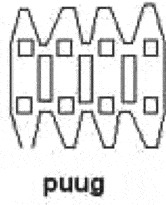
Each Dutch pseudoword was randomly paired with one of 12 line drawings of nonsense objects taken from Shatzman and McQueen (Reference Shatzman and McQueen2006), which had previously been used with L2 learners (Escudero et al., Reference Escudero, Hayes-Harb and Mitterer2008, EBS). Figure 1 shows an example of a pseudoword together with its corresponding line drawing.
Example stimulus: line drawing of the pseudoword [pyx].

Auditory stimuli were produced by a native female speaker of Dutch. All pseudowords were spoken in the context of two carrier sentences used in the task, “Dit is een X” (“This is an X”), and “Klik op de X” (“Click on the X”). These were recorded in a soundproof booth at the Institute of Phonetic Sciences at the University of Amsterdam, and stored at a sample rate of 41.1 kHz. The carrier sentences and pseudowords were read one by one, separated by a pause, in a clear citation style. To keep the context of the carrier sentence constant, pseudowords were cut from the end of one carrier sentence and spliced onto the end of another carrier sentence that originally contained the same word (e.g., the pseudoword “puug” was cut from the sentence “Klik op de puug” and spliced onto the sentence “Dit is een puug”).
A word-learning trial consisted of two parts. First, participants saw one line drawing, and heard its corresponding pseudoword spoken in the context of the carrier sentence “Dit is een X” (“This is an X”). Immediately after, the same line drawing was presented paired with another line drawing, and the same pseudoword was spoken this time in the context of the carrier sentence “Klik op de X” (“Click on the X”), at which point participants would click on the correct referent image. Test trials consisted only of this latter part. In this way, during the latter part, the drawing corresponding to the spoken pseudoword (i.e. the “X” in “Klik op de X”) was the target image, and the drawing that did not correspond to the spoken word was the distractor image. The position of targets and distractors on the screen (left vs. right) was counterbalanced and presented in a pseudorandom order, such that the same target could appear maximally twice in succession, and targets could appear on the same place on the screen maximally five times in succession.
Listeners were presented with 51 trials with target–distractor pairs that formed non-minimal pairs. This occurred either by pairing two of the six disyllabic words with one another (e.g., “beeptoe” – “fompel”; 15 pairs) or by pairing one of the disyllabic words with one of the monosyllabic words (e.g., “beeptoe” – “pag”; 36 pairs). The stimuli also included the 15 possible minimal-pair combinations of the six monosyllabic words (e.g., “pag” – “pieg”). The large ratio of non-minimal pairs to minimal pairs served to divert the participants’ attention away from the minimal pairs, which were the primary focus of the experiment. The minimal pairs were divided into two groups according to their expected level of difficulty of perceptual discrimination for Spanish learners of Dutch, as was done in EBS:
-
(1) Perceptually difficult pairs:/ɪ–i/, /ɪ–ʏ/, /ɪ–y/, /i–ʏ/, /i–y/, /ɑ–a/, /ʏ–y/
-
(2) Perceptually easy pairs:/ɪ–ɑ/, /ɪ–a/, /i–ɑ/, /i–a/, /ɑ–ʏ/, /ɑ–y/, /a–ʏ/, /a–y/
These classifications were based on findings reported in EBS . The authors of that study found that native Spanish listeners had difficulties identifying the correct image in a similar word-learning task when presented with the seven Dutch minimal pairs in (1), which will be referred to as perceptually difficult. This was because the Dutch pseudowords that correspond to the two displayed images contain either two high or two low vowels that are not differentiated in Spanish, a language that, from among the vowels used here, has only /i/ and /a/ in its vowel inventory. Furthermore, Escudero and Wanrooij (Reference Escudero and Wanrooij2010) have shown that Spanish learners of Dutch with advanced proficiency in Dutch have difficulty identifying the vowels involved in some of these contrasts.
The eight minimal pairs in (2), which will be referred to as perceptually easy, were expected to be learned with ease either because Spanish also has such pairs, as is the case of /i–a/, or because they involve a vowel contrast between a (mid-)high and a low vowel, which should be easy to discriminate for Spanish listeners, as Spanish also distinguishes between (mid-)high and low vowels (e.g., /e/ and /o/ versus /a/). Hence, the vowels in these pairs are likely to be classified as two different vowels by Spanish listeners, a situation that should cause little trouble for naïve listeners and language learners according to the Perceptual Assimilation Model (Best, Reference Best1995; Best & Tyler, Reference Best, Tyler, Bohn and Munro2007) and the Second Language Linguistic Perception Model (Escudero, Reference Escudero2005, Reference Escudero, Benders and Lipski2009).
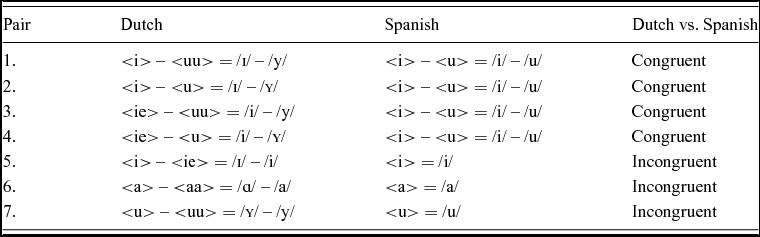
Unlike in the EBS study, which included a single training condition, half of the participants in the present study saw only the line drawing and heard the corresponding pseudoword during training (Audio-Only Condition), while the other half not only heard the corresponding auditory pseudoword but also saw the written form of the word below the line drawing (Audio + Orthography Condition). These orthographic forms were based on the Dutch grapheme–phoneme correspondences in Table 1. The perceptually difficult pairs were thus further divided into two groups depending on whether native (Spanish) and non-native (Dutch) orthographies are grapheme–phoneme congruent, in which case the grapheme–phoneme correspondence leads to the same or a similar phoneme contrast in both orthographies (Table 1, pairs 1–4), or incongruent, in which case there is a mismatch between grapheme–phoneme correspondences in the two orthographic systems (Table 1, pairs 5–7).
Orthographic (angled brackets) and phonemic (slants) representation of the perceptually difficult Dutch vowel pairs and of the closest Spanish vowel(s). The last column indicates whether both the Dutch and Spanish orthographic systems signal a phonemic contrast (i.e. they are congruent), or whether only one of them does (i.e. they are incongruent).

Grapheme–phoneme congruent pairs 1–4 display a match or near-match between Spanish and Dutch grapheme–phoneme correspondences. Matching the graphemes to Spanish vowels would lead the participants to perceive a contrast between the vowels in these Dutch vowel pairs. Although these contrasts are not the Dutch vowel contrast, interpreting the Dutch graphemes according to Spanish orthographic conventions does not lead to a merger or a swapping of the vowels. In pairs 2 and 4, all graphemes correspond to Spanish sounds and interpreting the graphemes according to Spanish spelling conventions leads to the vowel contrasts /i–u/ and /je–u/, in which the vowels have a clearly different vowel quality. In pairs 1 and 3, the graphemes <uu> do not correspond to any Spanish vowel sound, but interpreting the doubling of the letter as a lengthened vowel would lead to a contrast between long /u/ and /i/ (pair 1) and long /u/ and /je/ (pair 3), which differ not only in length, but also in quality.
Conversely, for incongruent pairs 5–7, the graphemes <i>, <a>, and <u> correspond to Spanish /i/, /a/, and /u/, respectively, thus leading to a merger of the Dutch vowel contrast. This is because Spanish listeners will likely match single and double graphemes to the same vowel, given that Spanish monophthongs are not represented by double graphemes. The Dutch grapheme pair <i>–<ie> may also be mapped to Spanish /i/ and /je/, rather than to /i/ alone. In that case, the contrast is maintained, but the mapping would still provide difficulties, since in Dutch <i> represents the lax vowel /ɪ/, while in Spanish it represents the tense /i/.
Alternatively, Spanish listeners may also match double graphemes to a phonetically lengthened vowel. Escudero, Benders and Lipski (Reference Escudero, Benders and Lipski2009) have shown that Spanish listeners are able to classify English and Dutch vowel contrasts such as /ɑ–a/ solely on the basis of duration when the vowels are presented in isolation in a labelling task, even though vowel length is not phonemic in Spanish. This may explain why Escudero and Wanrooij (Reference Escudero and Wanrooij2010) found a positive effect of orthography on the categorization of the /ɑ–a/ contrast, since the length contrast is reflected in the orthography (<a> versus <aa>). One could hypothesize that vowel pairs 5 and 7 may be more difficult than vowel pair 6 because, despite some regional variation, both of the vowels in pairs 5 and 7 are short in Dutch (Adank, van Hout & Van de Velde, Reference Adank, van Hout and Van de Velde2007), and therefore relying on vowel duration rather than vowel quality to discriminate /ɪ–i/ and /ʏ–y/ will not be a successful strategy. Despite the possible advantage for /ɑ–a/, we predict that in a lexical task where the focus is on learning words rather than on labelling vowels, Spanish listeners may find it more difficult to rely on a newly acquired length contrast, which may make this contrast as difficult as the previous two. Additionally, as mentioned above, in pair 5, the grapheme combination <ie> represents the diphthong /je/ in Spanish, which may lead to the swapping of vowel qualities in this Dutch vowel pair, that is, Dutch /i–ɪ/ may be labelled with the opposite graphemes <ie> and <i>, respectively.Footnote 3
Thus, we predict that learning grapheme–phoneme incongruent contrasts 5–7 will be more difficult than learning grapheme–phoneme congruent contrasts 1–4, and more so if learners are exposed to the Dutch vowel's orthographic representations.Footnote 4
2.3 Procedure
The procedure was kept as similar as possible to that reported in EBS. Participants were tested individually in a single session and in a quiet room. During word learning and testing, sound files were played over closed headphones at a comfortable listening level, while line drawings were presented on a computer screen in front of the participants. All listeners were given oral instructions for each part of the experiment. Instructions for both the word learning and testing were followed by 6 and 12 practice trials respectively, after which questions could be asked. The experiment was controlled with E-prime 2.0 software (Psychology Software Tools, Inc.), and lasted approximately 30 minutes.
For the word-learning phase, participants were told that they would be taught new Dutch words. For each trial, they would first hear the sentence “Dit is een X” (“This is an X”), and see the corresponding picture on the computer screen, as well as the orthographic representation of the item for those participants in the Audio + Orthography Condition. Next they would hear “Klik op de X” (“Click on the X”) with the same item name again, and corresponding orthographic representation (if applicable) while two pictures were shown on the screen. Participants were asked to indicate whether “X” was the picture on the left or on the right side of the screen by pressing the alt key on the left or right side of a keyboard in front of them.
Presentation of the first sound file (“Dit is een X”) and the line drawing started simultaneously. The line drawings stayed in the middle of the screen for 2000 ms. At 1500 ms after the offset of the sound file (after the line drawing had disappeared), presentation of the second sound file (“Klik op de X”) began. At the offset of that sound file, two line drawings were shown next to one another, one of which corresponded to the item “X”, and remained on the screen until one of the two response buttons was pressed. The next trial started at 1000 ms after the button press, with a time-out of 10,000 ms. Word-learning trials for those participants in the Audio + Orthography Condition were identical, with the exception that the orthographic representation of the item accompanied presentation of the line drawings, and was situated on the center on the screen, below the line drawing.
During the word-learning phase, each of the twelve pseudowords was presented as target (i.e., as “X” in the sentence “Click on the X”) six times. The total number of trials in the training phase was 72 (12 items × 6 trials as target). For the testing phase, each of the twelve pseudowords was presented as the target 22 times, twice with each of the other 11 pseudowords as the distractor. All combinations of items occurred 4 times, with each item being the target twice. The total number of trials was 264 (12 items × 22 trials as target) and comprised 204 non-minimal trials (51 pairs × 4 presentations), 32 perceptually easy trials (8 pairs × 4 presentations), and 28 perceptually difficult trials (7 pairs × 4 presentations). The 28 perceptually difficult trials were further divided into four grapheme–phoneme congruent trials, and three grapheme–phoneme incongruent trials.
The testing phase started immediately after the word-learning phase, with no break in-between. Participants were informed that they would be tested on their recognition of the newly learned words. They would hear the sentence “Klik op de X” while two images were shown on the screen. They were asked to indicate whether “X” was the image on the left or on the right by pressing the left or right alt key, as in the training phase. No orthographic representations were present in the test phase.
Each trial started with the presentation of the sound file. At offset of the sound file, two line drawings were shown next to one another, one of which corresponded to the item “X”, and stayed on the screen until one of the two response buttons was pressed. The next trial started at 500 ms after each button press, with a timeout of 10,000 ms.
3. Results
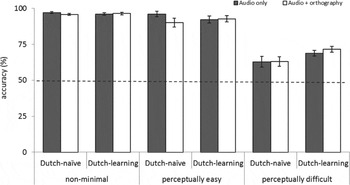
The average accuracy across all trials for all listeners was 93.16% (SD = 4.02%). Figure 2 shows accuracy as percentage correct for non-minimal pairs, perceptually easy minimal pairs, and perceptually difficult minimal pairs for participants in the Audio + Orthography and Audio-Only Conditions, and for Dutch-naïve listeners and Dutch learners separately.
Mean accuracy for non-minimal, perceptually easy, and perceptually difficult minimal pairs in the Audio-Only and Audio + Orthography Conditions.

Participants’ accuracy by pair type regardless of exposure to orthographic forms was examined via a repeated measures ANOVA on accuracy, with Pair Type (non-minimal pairs, perceptually easy minimal pairs, and perceptually difficult minimal pairs) as within-subjects and Dutch Exposure (Dutch-naïve versus Dutch-learning) as between-subjects factor, which revealed a main effect of Pair Type, F(2,142) = 308.831, p < .001, η2 p = .813. In line with findings from EBS, participants had a higher accuracy for non-minimal than for minimal pairs (non-minimal vs. perceptually easy: t(72) = 3.338, p = .001, 95% Confidence Interval (CI) (1.41, 5.60); non-minimal vs. perceptually difficult: t(72) = 21.526, p < .001, 95% CI (26.32, 31.69); and a higher accuracy for perceptually easy than for perceptually difficult minimal pairs: t(72) = 16.590, p < .001, 95% CI (22.43, 28.56).
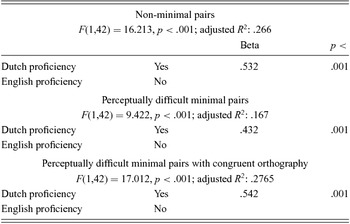
Although the main effect of Dutch Exposure did not reach significance, F(1,71) = 1.931, p = .169, η2 p = .026, the analysis revealed an interaction Pair Type × Dutch Exposure, F(2,142) = 5.820, p = .004, η2 p = .076. Bonferroni-corrected t-tests showed that Dutch learners were more accurate on perceptually difficult minimal pairs than Dutch-naïve listeners, t(71) = 2.697, p = .009, 95% CI (1.90, 12.68). To replicate EBS's findings for the effect of Dutch and English proficiency on Dutch learners’ word recognition accuracy, we also used proficiency scores to fit linear regression models (Method Stepwise). We entered the 43 Dutch learners’ English and Dutch proficiency scores (measured by the Dialang tests described in Section 2.1 above) as possible predictors of word recognition accuracy for non-minimal and for perceptually easy and difficult minimal pairs. As shown in Table 2, for both non-minimal pairs and perceptually difficult minimal pairs, Dutch proficiency significantly predicted learners’ accuracy, while English proficiency was not included in the model. No regression model could be formed for perceptually easy minimal pairs, indicating that neither Dutch nor English proficiency significantly predicted accuracy for this pair type.
Regression models for accuracy on non-minimal pairs and perceptually difficult minimal pairs, Beta weight and p-value. The variables in the regression model were Dutch and English proficiency, which were entered only if they significantly contributed to the model, with p < .05.

We then tested the effect of non-native orthographic exposure on non-native word learning, which was the novel and most important factor in the present study. We conducted a repeated-measures ANOVA on participants’ accuracy on perceptually difficult word pairs, with Word-Learning Condition (Auditory + Orthographic versus Auditory-Only) and Dutch Exposure (Dutch-naïve listeners versus Dutch learners) as between-subjects factors, and Grapheme–Phoneme Congruence (congruent vs. incongruent across Dutch and Spanish) as the within-subject variable.
We found main effects for Grapheme–Phoneme Congruence, F(1,69) = 133.813, p < .001, η2 p = .660, and Dutch Exposure, F(1,69) = 5.423, p = .023, η2 p = .073, but not for Word-Learning Condition, F(1,69) = .038, p = .846, η2 p = .073, indicating that participants were more accurate on congruent than incongruent pairs, t(72) = 11.220, p < .001, 95% CI (23.70, 33.95), and that Dutch learners were more accurate than Dutch-naïve listeners, t(71) = 2.697, p = .009, 95% CI (1.90, 12.68). The main effects were qualified by the interaction Grapheme–Phoneme Congruence × Dutch Exposure, F(1,69) = 10.309, p = .002, η2 p = .130, which indicates that Dutch learners were more accurate than Dutch-naïve listeners only on congruent pairs, t(71) = 3.559, p = .001, 95% CI (6.10, 21.63). Table 2 also shows the results of a linear regression model using the same method as above (Stepwise Method) including Dutch and English proficiency scores and accuracy on congruent and incongruent trials. As shown in Table 2, Dutch proficiency significantly predicted accuracy for congruent trials, while English was not included in the model. No model could be generated for incongruent trials, indicating that neither Dutch nor English proficiency are good predictors for accuracy on incongruent trials.
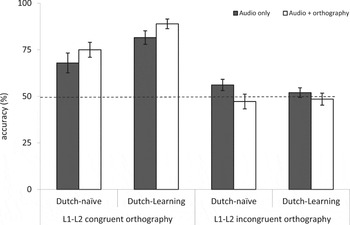
Crucially, the analysis also revealed an interaction Grapheme–Phoneme Congruence × Word-Learning Condition, F(1,69) = 8.030, p = .006, η2 p = .104. This interaction is illustrated in Figure 3. A simple effects analysis showed that, as predicted, participants who were in the Audio + Orthography Condition during training performed better than participants who were in the Audio-Only Condition on congruent pairs, Maudio = 75.87%, Maudio + orthography = 83.28%, t(71) = 1.822, p (single-tailed) = .037, single-tailed 95% CI (0.63, 7.41), while they performed worse on incongruent pairs, Maudio = 53.70%, M audio + orthography = 47.97%, t(71) = –1.816, p (single-tailed) = .037, single-tailed 95% CI (–5.73, –0.47).
Mean accuracy for L1 and L2 grapheme–phoneme congruent and incongruent minimal pairs in Dutch-naïve listeners and Dutch learners.

No interaction between Word-Learning Condition and Dutch Exposure was found, F(1,69) = .287, p = .594, η2 p = .004, nor was there a three-way interaction between Word-Learning Condition, Dutch Exposure, and Grapheme–Phoneme Congruence, F(1,69) = 290, p = .592, η2 p = .004.
With respect to the individual vowel pairs, it was suggested that availability of Dutch orthography may lead to higher accuracy for the incongruent /ɑ–a/ contrast, represented by <a> and <aa>, than for the other two incongruent contrasts (see Table 1), as was the case in Escudero and Wanrooij (Reference Escudero and Wanrooij2010). However, we predicted that in our lexical task where the focus is on learning words rather than on identifying vowels (as was the case in Escudero and Wanrooij), Spanish listeners will find it more difficult to rely on a newly acquired length contrast, which will lead to similar levels of difficulty for all incongruent contrasts. As predicted, a repeated-measures ANOVA on the incongruent word pairs with Contrast as the within-subject variable and Word-Learning Condition as the between-subjects factor did not yield a main effect of contrast, F(2,142) = 2.230, p = .111, η2 p = .030 or an interaction contrast × Word-Learning Condition, F(2,142) = 2.373, p = .097, η2 p = .032.
4. Discussion
The first aim of our study was to replicate EBS's findings for non-native word learning of non-minimal versus minimal word pairs. The second and most important aim was to examine the possibility that exposure to orthographic information during training on learning non-native minimal pairs may have positive or negative effects, rather than always only positive effects, depending on the congruence between the native and non-native grapheme-to-phoneme conventions. The study also investigated whether effects of orthographic exposure could be observed for both naïve listeners and listeners learning the non-native language, and whether proficiency in the non-native language also plays a role.
Firstly, as found in EBS, Spanish listeners were more accurate at identifying members of non-minimal pairs compared to minimal pairs and more accurate at perceptually easy compared to perceptually difficult minimal pair contrasts. Importantly, Dutch learners were more accurate at distinguishing perceptually difficult minimal pairs than Spanish listeners who were naïve to Dutch. This expands on the findings from EBS, as a Dutch-naïve group was not included in that study, and suggests that non-native perception may improve with exposure to the non-native language. Additionally, within the Dutch-learning group, Dutch proficiency predicted accuracy on non-minimal pairs and perceptually difficult minimal pairs. This may demonstrate that non-native perception may improve as proficiency in that language improves, as proposed by models of L2 perception (e.g., Best & Tyler, Reference Best, Tyler, Bohn and Munro2007; Escudero, Reference Escudero2005; Escudero & Boersma, Reference Escudero and Boersma2004; Flege, Reference Flege1995).
However, the fact that a similar correlation between Dutch proficiency and word recognition accuracy was not found in EBS casts doubt on this interpretation. We explored whether the difference in the effect of proficiency between the present study and EBS could be due to the inclusion of orthography in the present study, as the analysis collapsed the data across Word-Learning Condition. However, including Word-Learning Condition as a factor in the analysis yielded no main effects or interactions of Word-Learning Condition, which suggests that the effect of proficiency found in this study was not caused by the availability of orthography in one group. The diverging findings may instead result from the variation across the participant populations of the two studies. Although the participants across the two studies had very similar characteristics (see Section 2.1. above), the two participant groups differed with respect to Dutch/English proficiency. Specifically, while English and Dutch proficiency scores in EBS were not correlated, they showed a strong correlation in the present study, which may have weakened the role of English proficiency as a predictor. That the relation between general L2/L3 proficiency and non-native word learning is a complex one, is also evidenced by our finding that Dutch proficiency had an effect on non-minimal and perceptually difficult minimal pairs, but not on perceptually-easy minimal pairs, for which there does not seem to be an explanation.
With regard to our most important aim, to test the effect of exposure to orthographic word forms, presenting Dutch-naïve listeners and Dutch learners with orthographic information during non-native word learning did not yield overall improved performance. That is, whereas both Weber and Cutler (Reference Weber and Cutler2004) and Escudero et al. (Reference Escudero, Hayes-Harb and Mitterer2008) found positive effects of exposure to orthographic forms on non-native word recognition, the results of the present study suggest that this relationship may be more complex.
Exposure to orthographic word forms during training clearly influenced performance, but this influence was dependent on grapheme–phoneme congruence. Specifically, participants exposed to both auditory and orthographic forms during training performed worse on pairs in which the grapheme–phoneme correspondences in Dutch were incongruent with correspondences in their native language, Spanish, than participants who were only exposed to auditory forms. Crucially, the converse effect was also significant: there was a benefit of orthographic exposure for grapheme–phoneme congruent pairs.
These findings are in line with our prediction that the effect of exposure to orthographic forms on non-native learning depends on the congruence of grapheme–phoneme mappings across the native and non-native languages. This is further supported by the absence of a main effect of Word-Learning Condition (exposure to auditory word forms only or auditory and orthographic word forms together), indicating that the effects of orthographic exposure are unlikely to be resulting simply from the addition of visual information.
Instead, a confusion or interference explanation is far more likely. To the native Spanish listener of Dutch, the incoming orthographic and auditory information for the incongruent pairs is in conflict. This finding is in line with previous studies that have found orthographic cues which do not follow the native orthographic conventions to be a hindrance to speech perception (Escudero & Wanrooij, Reference Escudero and Wanrooij2010) and word learning (Hayes-Harb et al., Reference Hayes-Harb, Nicol and Barker2010). The results are also consistent with those of Erdener and Burnham (Reference Erdener and Burnham2005), who demonstrated that participants whose native language has a transparent orthography, such as Spanish, can be misled by orthographic cues that are opaque, as in Dutch. For the congruent pairs there is no incompatible mismatch between the orthographic and auditory cues, and the exposure to the additional congruent orthographic cue facilitates word learning.
While our results did not reveal any interaction of Dutch Exposure and Word-Learning Condition (exposure to auditory word forms only or auditory and orthographic word forms together), an interaction of Grapheme–Phoneme Congruence and exposure to Dutch was found. Dutch learners were more accurate than Dutch-naïve listeners on grapheme–phoneme congruent pairs. Further, Dutch proficiency significantly predicted performance on grapheme–phoneme congruent word pairs, but not performance on incongruent pairs. Previous findings suggest that non-native vowel perception can improve with exposure to the new language (e.g., Best & Tyler, Reference Best, Tyler, Bohn and Munro2007; Escudero, Reference Escudero2005; Escudero & Boersma, Reference Escudero and Boersma2004). With sufficient exposure to a non-native language, learners can expand their vowel inventory and this expansion needed for the acquisition of a second language can even be beneficial when learning a third language with a similarly large vowel inventory (see EBS). Thus, it seems reasonable to expect an improvement with an increasing proficiency in Dutch. However, that this improvement was found only for grapheme–phoneme-congruent items, and not for grapheme–phoneme incongruent items, suggests that native grapheme–phoneme correspondences have a deep-rooted and far-reaching influence on non-native word learning. That is, when learning another language, the grapheme–phoneme mappings that are shared or congruent across the native and target language are reinforced with increased proficiency in that language, but native grapheme–phoneme correspondences lead to persistent interference when they cannot be mapped to the target language, regardless of proficiency.
Taken together, the results show that while presenting orthographic forms during training can facilitate non-native word learning, this is not always the case. Specifically, presenting learners with the orthographic forms of words has a negative effect when the native and non-native grapheme–phoneme correspondences do not match. The implications of these results for non-native language learning are thus not straightforward. The suggestion that presenting learners with incongruent orthographic forms, or any orthographic forms during word learning should be avoided is both unrealistic and in all probability too simplistic. Non-native learners always come into contact with the orthography of the language they are learning and obviously need knowledge about the orthographic system to learn to read and write in the new language. Non-native language learning may benefit from awareness of potential incongruence between the grapheme–phoneme correspondences in their native and non-native languages. For instance, it could be pointed out to native speakers of Spanish learning Dutch words that in Dutch the grapheme combination <aa> corresponds to a different vowel than <a>. Further research that examines whether directing listeners’ attention to incongruent cases would mitigate the negative effects is needed to draw further conclusions for language teaching.
In sum, we have shown that presenting orthographic information during non-native word learning had a negative effect on listeners’ performance when the non-native grapheme–phoneme correspondences were incongruent with the native correspondences, but had a positive effect when they were congruent. Further, we have shown that participants with exposure to the non-native language perform better on items that have congruent grapheme–phoneme mappings across the native and non-native language, and that this benefit is positively correlated with proficiency in the non-native language. The lack of progress on grapheme–phoneme incongruent items with non-native language exposure and proficiency presents evidence for the strength of the influence of native orthographic rules. Importantly, orthographic effects were found both in a lexical context here and previously in a sublexical context (Escudero & Wanrooij, Reference Escudero and Wanrooij2010), which shows that lexical information does not override orthographic effects that rely on grapheme–phoneme correspondences. This in turn supports continuity between these levels of speech processing and further strengthens the role of orthography within phonological knowledge. Future research may test sublexical and lexical orthographic effects with languages that have different writing systems.