Introduction
Pesticide use is an important component of an agricultural system's sustainability. While important for staving off crop loss due to insects and diseases, widespread pesticide use can contaminate water bodies, affect air quality and endanger the health and safety of agricultural workersReference Keifer and Firestone1–Reference Tsai, Elgethun, Ramaprasad, Yost, Felsot, Hebert and Fenske3. In Washington State, the apple industry is phasing out its use of the organophosphate (OP) pesticide azinphos-methyl (AZM or Guthion) in compliance with the Environmental Protection Agency's (EPA's) decision to eliminate use of the product after 2012. This policy decision, spurred primarily by environmental groups and worker safety advocates, is likely to improve the environmental and social sustainability of apple (and other AZM-dependent crop) production4. AZM has been used in apples since 1959, and is currently applied on the majority of Washington State's apple acres as one of the more effective products available for the control of the key pest codling mothReference Pulaski5, 6. However, it is also a product of concern with regard to human and environmental health7.
In a state heavily dependent on apple production for its agricultural economy and highly reliant on pesticides to produce quality fruit, the phase-out of one of the Washington apple industry's most used insecticides has presented a challenge to the more than 3000 growers operating over 165,000 acres of apple orchards in the state8. While there are OP-alternative insecticides available for managing codling moth that are significantly less toxic for both workers and the environment, they require more precise timing and application techniques, integration with other integrated pest management (IPM) practices such as pheromone mating disruption, monitoring to target specific insect life cycle stages and rotation schemes to prevent insect resistance to new chemicals. The OP-alternatives, as these new chemicals are known, tend to be less effective and are more expensive than AZM. Most OP-alternatives are classified by the EPA as reduced-risk products and thus an evolving part of a more environmentally and socially sustainable IPM program in apple production9.
Because these new IPM-based systems are much more knowledge intensive and complex than previous systems based primarily on OP insecticides, transitioning from AZM to OP-alternatives has presented a challenge to Washington's apple industry. In response to this challenge, Washington State University's Pest Management Transition Project (WSU-PMTP) was started in 2007 with funding from the State Legislature (and continued in 2009 with a USDA Specialty Crop Block Grant) to help growers transition to the use of OP-alternative insecticides and more sustainable IPM programs. Using field- and classroom-based educational sessions, web and print handbooks and newsletters, and regular meetings of small groups of apple growers, pest management consultants and researchers, WSU-PMTP developed a program to help growers eliminate AZM and transition to use of OP-alternatives in apple IPM9. Many growers have already begun or completed the transition to a more sustainable apple IPM model even though AZM is still legal for use through 2012.
The transition of a large-scale mainstream agricultural industry toward adoption of new pest control technologies mandated by regulations imposed by the EPA provides the opportunity to ask pointed questions about sustainable agriculture. Sustainability has often, explicitly or implicitly, been associated with small farmsReference D'Souza and Ikerd10–Reference Hamilton12. Some, however, have questioned this link, arguing that farm and industry size neither facilitates nor precludes the use of sustainable agricultural practices. Born and PurcellReference Born and Purcell13 argue that farms can easily be sustainable or unsustainable at all scales. CarolanReference Carolan14 calls attention to the cross-pollination of ideas and practices across sustainable and conventional farms. WarnerReference Warner15 similarly finds that collaborative learning can play a major role in transitioning conventional farms toward more sustainable practices. Nevertheless, the idea that ‘productive’ farms are large and ‘sustainable’ farms are small permeates much of agricultural and public opinion alike. Therefore, this study explores the following question: to what extent can a large mainstream agricultural industry approach or achieve environmental and social sustainability?
This study uses data from a survey of apple growers to assess the transition of Washington State's apple industry away from AZM and toward the adoption of AZM-alternatives and use of IPM practices during the 2008 crop year. It asks what this transition means for sustainability in the apple industry and for the meanings and assumptions embedded in the notion of sustainable agriculture. Specifically, this study focuses on what growers think about the AZM phase-out, the steps they are taking (and not taking) to change their practices and the challenges they face in using AZM-alternatives. Chi-square and analysis of variance (ANOVA) techniques are employed to examine the relationships between actions and attitudes toward the AZM phase-out and orchard and grower characteristics. Known as the ‘apple capital’ of the USA, Washington State is an appropriate place to investigate these questions and better understand some of the complexities and tensions embedded in the notion and practice of sustainable agriculture, especially in orchard systems.
Methods and Data
Study population and sample selection
The population of interest for this study is all commercial apple growers (except for exclusively organic growers) in Washington State. A random sample of 2000 apple growers was drawn from a list (N=3775) obtained from the Washington Apple Commission. This list included all commercial apple farmers who grow apples as their primary crop and partner with the warehouses handling two-thirds of all Washington apples salesReference Perez and Pollack16. Small-scale growers may be underrepresented in the sample because of their preferences for direct-to-consumer marketing channels that bypass warehouse channels; however, this population is considered very small relative to the Washington apple industry.
Survey design
The survey questionnaire was developed by WSU-PMTP representatives. The questionnaire consisted of six main sections. The first section focused on the use of OP insecticides, OP-alternatives (e.g., ‘softer’ insecticides, horticultural oils and mating disruption) and IPM practices (e.g., economic thresholds, degree day models and border sprays) for codling moth control. The second section included similar questions about leafroller control. The third section consisted of questions about the AZM phase-out. Information was collected on awareness of the phase-out, trends in AZM use, knowledge of AZM-alternatives, barriers to using AZM-alternatives and opinions about the phase-out. The fourth section asked about the importance of different sources of information for making pest control decisions. The final two sections focused on orchard characteristics (e.g., acreage, geographic location and gross farm income) and grower demographics (e.g., age, ethnicity and education).
Survey implementation
The survey was conducted with the cooperation of WSU's Social and Economic Sciences Research Center (SESRC). Survey implementation followed the Tailored Design Method (TDM)Reference Dillman17 that centers on a series of carefully designed and timed contacts. The first contact was a cover letter, questionnaire and postage-paid return envelope. A reminder postcard was mailed to everyone approximately a week and a half later. The third contact was sent to non-respondents and included a revised cover letter, replacement questionnaire and postage-paid envelope. A final reminder postcard was sent to non-respondents. A link to an online version of the survey was provided in each mailing. Online surveys were programmed by SESRC staff. Screen layouts followed TDM protocolsReference Dillman17 for maximizing respondent comprehension and ease of navigation. The survey was conducted in February–April 2009.
Five hundred and twenty individuals were excluded from the sample because of ineligibility (e.g., no longer growing apples or growing only organic apples), incorrect contact information or death. The corrected sample totaled 1480 growers. Four hundred and one questionnaires were returned for a response rate of 27%.
Variables
Dependent variables
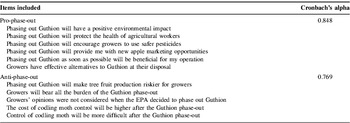
One action-oriented and two attitudinal dependent variables are included in this study. The first variable, phase-out action, is based on the follow-ing survey question: ‘Which of the following statements best reflects your approach to the Guthion (the common trade name for AZM) phase-out in the apple orchard(s) you own or manage?’ Answer categories include: 1=I have not yet reduced my Guthion use, 2=I am in the process of reducing my Guthion use, and 3=I have already stopped using Guthion. Respondents who indicated they had never used Guthion (N=5) or failed to answer the question (N=32) were excluded from the analysis. Of the remaining respondents, 14.1% (N=51) had not yet reduced their Guthion use, 67.1% (N=243) were in the process of reducing their Guthion use and 18.8% (N=68) had already stopped using Guthion. The two attitudinal dependent variables are summated scales composed of responses to Likert items with five ordered response levels: 1=strongly disagree, 2=disagree, 3=neither disagree nor agree, 4=agree, and 5=strongly agree. Pro-phase-out measures positive attitudes toward the AZM phase-out and ranges from 6 to 30 (mean of 17.6). Anti-phase-out measures negative attitudes and ranges from 7 to 25 (mean of 19.7). The high Cronbach's alpha coefficients confirm the internal reliability of the two scales. Table 1 presents the items included in each scale and reliability results.
Attitudinal dependent variables: items included and reliability results.

Independent variables
The independent variable groups include grower demographics, farm size variables, variables measuring codling moth damage and variables measuring experience with Washington State University. All the independent variables presented in the tables were measured by direct survey questions. The continuous variables (e.g., total apple acres) were recoded as categorical variables for the purpose of analysis.
After a series of closed-ended questions about the AZM phase-out, survey respondents were also asked to share their thoughts about the phase-out. Selected responses to this open-ended question are presented to complement the quantitative data.
Statistical analysis
Survey data were analyzed using the statistical package SPSS. Frequency distributions, cross tabulations, Pearson chi-square tests and one-way ANOVA were used to explore the relationships between the dependent and independent variables. The Pearson chi-square test is designed to test for independence between two nominal variables. The null hypothesis is that the two variables are statistically independent. The test is based on a comparison between the observed and expected frequencies in cross-tabulation cells. ANOVA is a statistical test designed to measure whether the means of two or more groups are equal.
Results
AZM phase-out actions and attitudes
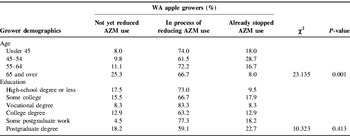
Table 2 presents percentage distributions for AZM phase-out action by two grower demographic variables: age and education. There is a statistically significant difference in AZM phase-out action for age, but not education. Older growers are more likely than younger growers to have not yet reduced their AZM use. Growers aged 45–54 are most likely to have already stopped using AZM.
Percentage distribution of AZM phase-out action by grower demographics, Washington apple growers, 2008.

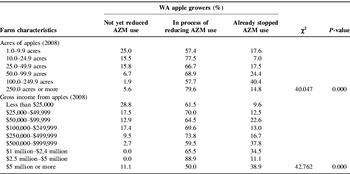
Table 3 presents percentage distributions for AZM phase-out action by two farm size variables: apple acreage and gross income from apples. Chi-square results indicate statistically significant relationships between AZM phase-out action and both farm size variables. Small-scale growers (under 50 acres) are more likely to have not yet reduced their AZM use compared to larger-scale growers (50 acres or more). Only 7% of growers with 10–24 acres have stopped using AZM compared to over 40% of growers with 100–249 acres. Similarly, growers with less than $250,000 gross apple income are more likely to have not yet reduced their AZM use compared to larger-income growers ($250,000 or more). Approximately 10% of growers with less than $25,000 gross apple income have stopped using AZM compared to nearly 39% of growers with gross apple income of $5 million or more.
Percentage distribution of AZM phase-out action by farm size variables, Washington apple growers, 2008.

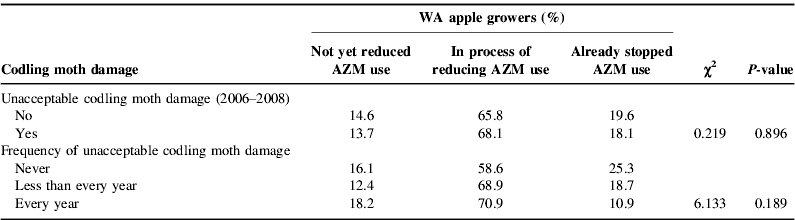
Table 4 presents percentage distributions for AZM phase-out action by two variables that measure experience with codling moth damage. Survey respondents were asked if codling moths had caused unacceptable crop damage in their apple orchards during 2006–2008. They were also asked about the frequency of unacceptable crop damage caused by codling moths. The Chi-square results reported in Table 4 indicate no statistically significant relationship between AZM phase-out action and experience with codling moth damage.
Percentage distribution of AZM phase-out action by codling moth damage variables, Washington apple growers, 2008.
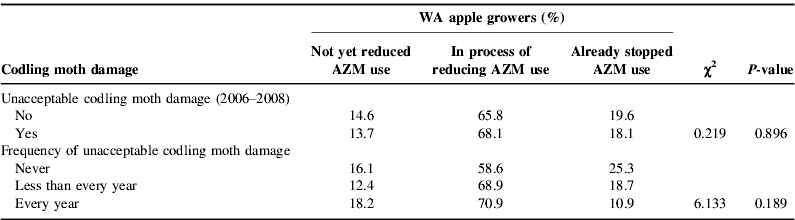
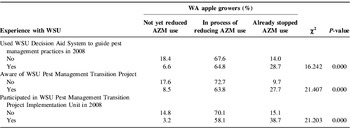
Table 5 presents percentage distributions for AZM phase-out action by three variables that measure experience with Washington State University. AZM phase-out action appears to be significantly influenced by growers’ use of the Washington State University Decision Aid System (WSU-DAS, a web-based tool that integrates phenology models for insects and diseases with management recommendations), awareness of the WSU-PMTP and participation in WSU-PMTP Implementation Units (groups of growers and orchard managers who farm in close proximity and want to learn about OP-alternatives and IPM practices). Growers who reported awareness of and participation in WSU's programs are more likely to have already stopped using AZM. Nearly 29% of WSU-DAS users have stopped using AZM compared to 14% of non-users. Similarly, nearly 39% of Implementation Unit participants have stopped using AZM compared to 15% of non-participants.
Percentage distribution of AZM phase-out action by variables measuring experience with WSU, Washington apple growers, 2008.

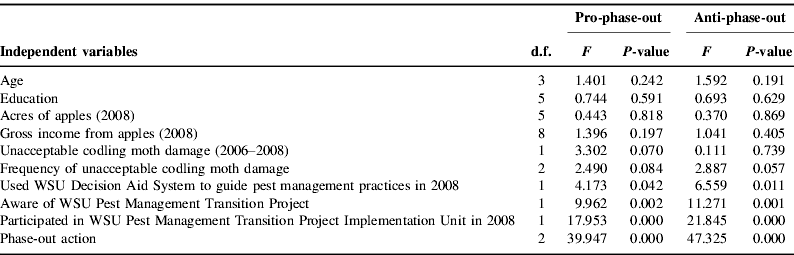
Table 6 presents one-way ANOVA results for the two attitudinal dependent variables (pro-phase-out and anti-phase-out) and nine independent variables. Attitudes about the AZM phase-out appear to be influenced by awareness of and participation in WSU's programs. Respondents familiar with the WSU-DAS and WSU-PMTP are more likely to agree that the AZM phase-out will have positive environmental, health and marketing impacts. In addition, these respondents are less likely to agree that the phase-out will increase production risks and pest management costs. Table 6 also includes ANOVA results for the two attitudinal variables and phase-out action. Respondents who have already stopped using AZM score significantly higher on the pro-phase-out scale and lower on the anti-phase-out scale compared to respondents who have not yet reduced their AZM use.
ANOVA of attitudinal-dependent variables by independent variables, Washington apple growers, 2008.
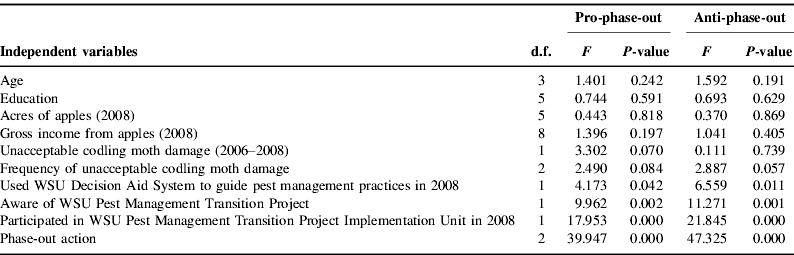
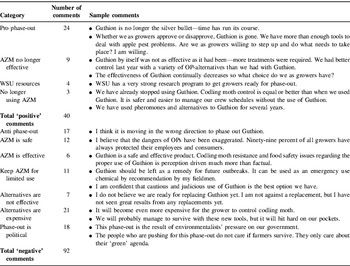
Table 7 presents growers' responses to the open-ended survey question about the AZM phase-out. Responses were grouped into either ‘positive’ or ‘negative’ categories. Table 7 includes the categories, number of comments per category and sample comments (full comments are available from the authors). Forty ‘positive’ comments included general pro-phase-out opinions, testimonies of successful phase-out experiences, praise for WSU research on alternatives and concern about AZM's reduced effectiveness. Ninety-two ‘negative’ comments included general anti-phase-out opinions, support for AZM's safety and effectiveness, recommendations for preserving AZM use for specific circumstances, concerns about AZM-alternatives' cost and effectiveness, and feelings that the phase-out is more about politics than facts.
Washington apple growers' responses to open-ended question about AZM phase-out.

Perceived barriers and changing practices
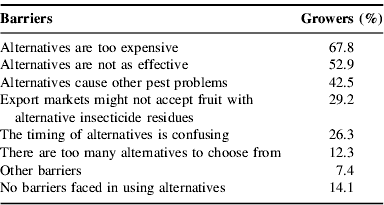
This study not only focuses on the determinants of AZM phase-out actions and attitudes (as described above) but also seeks to understand the perceived barriers to using AZM-alternatives as well as trends in apple growers’ use of OPs, OP-alternatives and IPM practices. Table 8 presents the percentage of growers facing each of the listed barriers to using AZM-alternatives. Nearly 68% of growers believe AZM-alternatives are too expensive; 53% believe they are not as effective as AZM; and 43% believe they cause other pest problems. Fourteen percent of growers reported they do not face barriers to using AZM-alternatives.
Barriers faced by Washington apple growers to using AZM-alternatives.
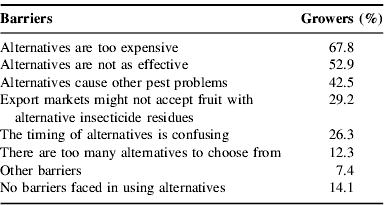
Perceptions of barriers to using AZM-alternatives are influenced by grower demographics, farm size variables, variables measuring codling moth damage and variables measuring experience with WSU. Chi-square results (available from the authors) indicate statistically significant relationships between each of the items listed in Table 8 and from one to seven of the independent variables. For example, respondents who are 65 years or older, respondents who experienced unacceptable codling moth damage in 2006–2008, and WSU-DAS users are more likely to perceive the expense of AZM-alternatives as an adoption barrier. Respondents who experienced unacceptable codling moth damage and those unfamiliar with the WSU-PMTP are more likely to perceive the effectiveness of AZM-alternatives as an adoption barrier.
Perceived barriers are also correlated with phase-out action and attitudes. Chi-square results (available from the authors) indicate statistically significant relationships between phase-out action and three of the perceived barriers to using AZM-alternatives: effectiveness of alternatives, too many alternatives and confusing timing of alternatives. In addition, growers who have already stopped using AZM are more likely than growers who have not yet reduced their AZM use to report no barriers to using AZM-alternatives (28% compared to 4%). Finally, t-test results (available from the authors) indicate that respondents who face five of the barriers listed in Table 8 score higher on the anti-phase-out attitudinal scale. Moreover, respondents who do not face any barriers in using AZM-alternatives are more likely than other respondents to have positive attitudes about the AZM phase-out.
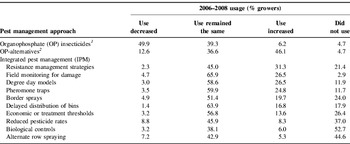
Table 9 presents Washington apple growers' use of OP insecticides, OP-alternatives and IPM practices for codling moth control between 2006 and 2008. During this time period, 50% of respondents decreased their use of OP insecticides and 46% increased their use of OP-alternatives. An overwhelming majority of respondents maintained or increased their use of IPM practices. At least one-quarter of respondents increased their use of pheromone traps, degree day models, field monitoring for damage and resistance management strategies between 2006 and 2008.
Washington apple growers' use of different pest management approaches for codling moth control, 2006–2008.

1 OP insecticides included Guthion, Diazinon and Imidan.
2 OP-alternatives included Assail, Calypso, Esteem, Altacor, Delegate, Rimon, Intrepid, Entrust/Success, pheromone mating disruption, horticultural spray oil and CM granulosis virus.
Discussion
This study revealed several interesting relationships between growers’ AZM phase-out actions and attitudes and various independent variables, particularly grower age, scale of operation, codling moth damage, experience with university educational outreach programs and barriers to adoption of OP-alternatives.
Grower age and phase-out action
Apple growers aged 45–54 are more likely than younger and older growers to have already stopped using AZM (Table 2). This finding is not surprising given that growers in this age group tend to have larger-scale operations and are the most likely to use the WSU-DAS, know about the WSU-PMTP, and participate in WSU-PMTP Implementation Units. In addition, they are the most likely to have decreased their use of OP insecticides (in general) for codling moth control between 2006 and 2008. Whether seeking out WSU resources and programs on their own or ‘targeted’ by WSU (and other entities) as potential early adopters of OP-alternatives, growers aged 45–54 appear to be the vanguard in the transition to more environmentally and socially sustainable IPM programs. Moreover, unlike beginning apple growers or those close to retirement, growers aged 45–54 are likely to have developed the clout, resources and frame of mind to innovate.
Grower size and phase-out action
Instructive for questions of sustainability is the finding that small-scale growers (under 50 acres) and those with lower gross apple incomes (under $250,000) were more likely to have not yet reduced AZM use compared to larger-scale and larger-income growers (Table 3). This supports what Born and PurcellReference Born and Purcell13 suggested, that small does not necessarily mean more environmentally or socially sustainable, at least in terms of orchard pest management. While philosophically motivated small-scale organic or alternative farmers—many of whom were omitted from this survey because they only grew organic fruit or sold through direct-marketing channels—might be more likely to embrace sustainable pest management, smaller-scale conventional growers were less likely than larger growers to quickly phase out AZM.
There are many likely reasons for this finding. First, the higher costs of alternative pest control technologies can be intimidating (Table 8). Perhaps these costs are prohibitive for growers who do not experience the economies of scale (or bulk pesticide purchasing discounts) that larger growers do. However, analysis of the survey data indicated that smaller orchardists (in terms of apple acreage and gross income) were no more likely than larger orchardists to perceive the expense of AZM-alternatives as an adoption barrier. Moreover, the 21 respondents whose open-ended comments mentioned the high cost of AZM-alternatives (see Table 7) included equal numbers of small-, medium- and large-scale growers.
Second, larger tree fruit companies, who frequently pack and sell their fruit under their company brand, are often more visible to the public than small-scale conventional growers who send fruit to an unaffiliated warehouse to be marketed jointly with other fruit under a separate brand name. As such, larger growers who pack their own fruit are more susceptible to current and increasing public pressure for sustainability in food production, and are thus also more able to benefit from marketing and selling their fruit as ‘sustainably grown’ (see Florax et al.Reference Florax, Travisi and Nijkamp18 for consumer willingness to pay for such products).
Third, many larger tree fruit companies have entered the market for organic apples, while maintaining production of their conventionally produced fruit. Survey results indicate a statistically significant relationship between total apple orchard acreage and production of certified organic apples. Less than 3% of the smaller-scale growers (<50 apple acres) compared to 44% of the largest growers (250 apple acres or more) operated some certified organic apple acres. Consequently, larger growers may be more familiar than smaller-scale growers with the pest management practices and principles that cross-pollinate between organic and conventional systems, as suggested by CarolanReference Carolan14. In other words, larger growers with both conventional and organic apple acres may be more aware of alternative markets and production practices and, thus, more willing to innovate.
Finally, different levels of access to information about the AZM phase-out may result in different phase-out actions. Survey results suggest a statistically significant relationship between orchard size (measured in terms of acres and gross apple income) and familiarity with WSU educational outreach activities for learning about the AZM phase-out and alternative technologies. Larger growers are more likely than small-scale growers to use the WSU Decision Aid System, know about the WSU-PMTP, and participate in WSU-PMTP Implementation Units. Greater familiarity among larger growers with these WSU services may reflect broader shifts in agricultural extension from on-farm visits (regardless of operation size) to less individual-based forms of information dissemination, such as online resources and group workshops. The latter may favor larger growers who have the manpower and financial resources to take advantage of multiple types of information dissemination strategies.
Similarly, larger growers may have greater access to the services of non-university-based pest management consultants. Their larger acreages may make them a higher priority for visits from agricultural chemical distributor fieldmen and warehouse consultants. Moreover, larger growers may have the resources to employ their own in-house pest management consultants who can focus specifically on pest management decisions in their orchards.
Codling moth damage and phase-out action
Because AZM is the product with the greatest effectiveness per unit cost for controlling codling moth, one might think that growers with greater codling moth damage would be slower to phase out AZM. However, survey results showed no significant relationship between perceived extent of crop damage and AZM phase-out action (Table 4) or attitudes (Table 6). One explanation for these results is the apple industry's zero or very low tolerance for codling moth in apples, specifically for apples designated for export. In 2002, Taiwan ruled that the discovery of three codling moths in US apple shipments in any given crop year would result in the closing of the Taiwanese market to all US apple importsReference Lynch19. Since then, warehouses and shippers have been very careful in inspecting and rejecting damaged fruit from growers, and growers have been vigilant in spraying for codling moth as needed. In other words, the apparent non-relationship between codling moth damage and AZM phase-out action (and attitudes) is likely due to the very minimal amount of fruit damage found across the Washington State apple industry overallReference Walker20.
Experience with WSU and phase-out action and attitudes
Another robust finding is the significant relationship between growers’ AZM phase-out actions and attitudes and their experiences with WSU educational outreach programs. As discussed above, the WSU-PMTP seeks to assist growers in the transition from AZM to more sustainable OP-alternatives and IPM practices. The WSU Decision Aid System and WSU-PMTP Implementation Units are cornerstones of this program. Chi-square and ANOVA analyses (Tables 5 and 6) suggest that WSU programs are successfully contributing to changing practices and attitudes with regard to the phase-out of the apple industry's most relied-upon insecticide, AZM. This impact is especially visible among larger-scale apple growers who are more likely than small-scale apple growers to use the WSU-DAS, know about the WSU-PMTP, and participate in WSU-PMTP Implementation Units (as discussed above). These findings, however, do not necessarily mean that WSU educational outreach programs have had a direct impact on growers’ pest management practices. Alternatively, these findings could indicate that growers who are more inclined to adopt new practices are also more inclined to seek out new information.
Barriers to the adoption of AZM-alternatives and IPM
This study found that the greatest barriers to the adoption of AZM-alternatives were cost, concern over product effectiveness and creation of new pest problems (Table 8). Older growers (65 years or older) were more likely than younger growers to perceive cost as a barrier, perhaps because of their attachment to times when codling moth control options were cheaper. Similarly, growers who experienced unacceptable codling moth damage in 2006–2008—and who thus probably relied more on AZM and faced increased costs upon switching to alternative insecticides—were more likely than other growers to perceive the expense of AZM-alternatives as an adoption barrier. Lastly, WSU-DAS users, who may have a more thorough and sophisticated knowledge of pest management options and their relative price tags, also saw cost as a barrier.
While helpful for understanding grower perspectives and willingness to innovate, cost is determined by the companies producing each insecticide. In contrast, the other perceived barriers to adoption of AZM alternatives (namely, secondary pest problems and the effectiveness of AZM-alternatives) can be more easily addressed through research and extension efforts. Research is under way to understand and minimize the impacts of AZM-alternatives on secondary pest outbreaks21. The effectiveness of AZM-alternatives is a concern addressed through education and outreach programs such as the WSU-PMTP. Accordingly, growers familiar with the WSU-PMTP (i.e., those exposed to research and outreach on AZM-alternatives) did not see AZM-alternatives’ effectiveness as an adoption barrier. Similarly, growers who had stopped using AZM did not feel that alternatives were less effective, that there were too many alternatives or that the timing of alternatives was confusing. In other words, there is a learning curve associated with the effective incorporation of AZM-alternatives into IPM programs, as a product's effectiveness depends on a strong understanding of insect life cycles and how best to target use of different chemistries.
These findings make a case for educational programs that help growers more effectively incorporate OP-alternatives into IPM programs. They also provide feedback to help strengthen such educational programs. By knowing which adoption barriers are associated with particular grower characteristics (age, codling moth damage and familiarity with WSU resources), educators can better tailor training to meet growers’ needs. For example, extending outreach to target smaller (in addition to the larger) conventional growers could help the Washington apple industry become more fully sustainable in its pest management practices.
Finally, despite these barriers to adopting AZM-alternatives and IPM practices, and despite the many growers who have not yet phased out AZM, this study shows that the Washington apple industry is in large part moving toward softer and more sustainable IPM systems (Table 9). Half of the growers surveyed decreased their OP use between 2006 and 2008, and almost half increased their use of OP-alternatives, including high levels of pheromone mating disruption. Much of this change is likely due to AZM regulation, which has necessitated a switch to alternative methods of pest control. The move to increasingly sustainable pest management is thus not necessarily the philosophically driven adoption associated with sustainable agriculture that permeates public discussions of sustainability (see Table 7, for example, for negative attitudes expressed toward the phase-out). Nevertheless, it does represent an important and meaningful change in sustainability practices being adopted by Washington's apple industry, one spearheaded in this case by large-scale, conventional orchards.
Conclusion
Sustainable agriculture has been regarded by some as a philosophy by which farmers make a living through a more harmonious relationship with other beings and the environment. Others have viewed it more instrumentally as a specific set of agricultural practices that protect soil, water, air quality and human healthReference Gold22. For those working in the area of sustainability and food systems, it becomes important to consider these different definitions of sustainable agriculture and how they appeal (or do not appeal) to specific groups and individuals in order to target research, outreach and policy activities to appropriate audiences and goals.
In this study, Washington apple growers transitioning from an OP-based management system for codling moth to an OP-alternative and more biologically intensive IPM system were pushed in this direction by regulatory change. Interestingly, those transitioning fastest were owners of larger orchards (both in terms of size and income), growers in lower-to-middle-age ranges (45–54), and those who had interacted with WSU educational outreach programs. However, they were neither necessarily the ones most philosophically committed to the idea of sustainability nor were they the smaller-scale growers most often associated with sustainable agriculture movements. Nevertheless, as they transition their orchards toward increasingly sustainable practices in pest management, the impacts made on these larger acreages to soil, water, air quality and human health are substantive, at least according to the more instrumental (rather than strictly philosophical) definitions of sustainable agriculture.
This study thus encourages a broader look at sustainability, especially with regard to promoting sustainable agriculture across materially and philosophically different types of farms and farm operators. As WarnerReference Warner15 suggests, while some farmers may be philosophically committed to sustainable agriculture principles, others can contribute equally to a more environmentally, economically and socially sustainable agricultural sector if provided incentives or regulatory structures that uphold a strong commitment to a robustly sustainable agriculture (though see GuthmanReference Guthman23 on the ‘watering down’ of organic production principles through similar mechanisms). Sustainable agriculture advocates should be mindful of the multiple perspectives of actors differentially embedded in ‘sustainable’ agricultural operations and the possibilities for and implications of working toward such sustainability on its many possible levels.
Acknowledgements
We thank Jim McFerson (Manager, Washington Tree Fruit Research Commission) for his input during this project, and Todd Fryhover and Don Zones at the Washington Apple Commission for graciously providing a list of Washington apple growers. We also wish to acknowledge Rose Krebill-Prather and Leona Ding at WSU's Social and Economic Sciences Research Center for their assistance with survey implementation, web programming and data management. This work was funded by the Washington State Legislature, a USDA/WSDA Specialty Crop Block Grant (No. K273) and the William D. Ruckelshaus Center's Agricultural Pilots Program.