


It is rare to see a unified phonological analysis that draws evidence from a wide range of phenomena.Footnote * While Vowel patterns in language focuses on vowel assimilation (harmony, umlaut, metaphony), the approach is extended to other vowel-related processes, such as reduction, metathesis and deletion. Rachel Walker convincingly shows that these patterns exhibit the same kind of asymmetries in terms of (marked) features, combinations thereof and prominence.
The formal implementation is done within Optimality Theory. The idea is that vowel patterns are typically driven by a single class of markedness constraints, termed generalised licensing constraints. The cross-linguistic differences stem from parametric variation of these constraints and their interaction with faithfulness and other markedness constraints.
Walker's approach relies on two major empirical observations. First, the distinction between (prosodically, morphologically, phonetically, psycholinguistically) prominent and other positions underlie many vowel patterns. Second, the interactions between positional prominence and vocalic features can be classified into several types. In some cases, a feature is limited to prominent positions. In other cases, prominent positions affect other positions (or vice versa), with both local or non-local effects. Neither of these two observations is new in itself. For example, it has been shown that prominent positions such as initial, stressed, final syllables or roots are exempt from the markedness restrictions that apply elsewhere (Trubetzkoy Reference Trubetzkoy1939, Beckman Reference Beckman1997, Reference Beckman1998, Crosswhite Reference Crosswhite2001, Smith Reference Smith2005). Conversely, non-prominent positions such as codas, affixes and final syllables are subject to specific restrictions (Barnes Reference Barnes2006, de Lacy Reference de Lacy2006). The novelty of the proposal lies in the connections between the varied vowel patterns involving these positional asymmetries.
This unification is couched in terms of a single type of markedness constraint: generalised licensing constraints. A licensing constraint refers to multiple variables, which can be features, feature bundles or positions. In the simplest of cases, a violation mark is assigned for an instance of [αF] that does not appear in a prominent position. In more complex situations, the prominent and weak positions can be relativised, such that only particular feature combinations count. The broad typological predictions require a complex, yet strikingly explicit definition. The licensing constraint is satisfied in one of three main ways: by spreading to/from a prominent position, by long-distance agreement or by changing the feature in that position. The distinction between these three situations relies on other constraints.
Let us look at these typological predictions in more detail. Vowel patterns fall into three groups, involving, in Walker's terms, direct, indirect and identity licensing. Direct licensing presents a situation in which a particular contrast or feature is limited to a prominent position. For example, many languages allow more vowels in stressed syllables than in unstressed syllables. Indirect licensing, on the other hand, involves a feature that is shared between a prominent and non-prominent position, such as in many cases of vowel harmony. Finally, identity licensing refers to a situation where the licensed feature in a prominent position is in correspondence with the feature in a non-prominent position. For example, some cases of metaphony are triggered by a suffix vowel, targeting the stressed one. The crucial difference between indirect and identity licensing lies in locality. Because strict locality is always observed in Walker's approach, indirect licensing involves a feature shared among adjacent vowels, whereas identity licensing involves long-distance agreement. This typological difference suggests that representations, and association lines in particular, play a crucial role in Walker's analysis. The broad typological distinctions between the three types of licensing are supported by in-depth studies of 25 diverse vowel patterns.
The book is organised as follows. Chapter 1 introduces the concept of licensing and summarises the proposal. Chapter 2 discusses the different kinds of prominence in language and their grounding. Next, Chapter 3 formalises the concept of generalised licensing and Chapter 4 presents the basic typological predictions. A substantial part of this chapter is dedicated to the factorial typology based on licensing and other constraints obtained through OT software. Walker demonstrates that most of the predicted patterns are attested, and that the gaps are heterogeneous and appear to be accidental rather than systematic. The following chapters focus on the three basic types of licensing. Chapter 5 looks at indirect licensing in various languages. In Buchan Scots, for example, a high vowel in the suffix is lowered when the stressed vowel is also non-high. Crucially, voiced obstruents block spreading (Paster Reference Paster2004). Chapter 6 examines identity licensing, which occurs at a distance. Unlike the pattern in Buchan Scots, no segment between the weak and strong positions can block the pattern; transparency always obtains. One interesting prediction of Walker's approach is that licensing constraints refer to particular features (or combinations), which means that there is no pressure for vowels to agree in all features, rather than just one. A typical case is back harmony in Eastern Meadow Mari, which is triggered by the initial vowel, and targets the final vowel (Vaysman Reference Vaysman2009). Another instance is found in Francavilla Fontana Italian, in which the suffix vowel affects stressed mid vowels: tense vowels raise, whereas lax vowels diphthongise (Calabrese Reference Calabrese1988). Chapter 7 presents several cases of direct licensing, such as neutralisation in unstressed positions (in Belarusian, and in dialects of Italy), consonant–vowel metathesis under licensing pressure (northern dialects of Italy), deletion of non-prominent positions (Modern Greek dialects), umlaut (German) and floating features (Esimbi). Chapter 8 discusses an extension of the licensing approach to vowel harmony in general. The licensing constraint in these cases is sensitive to each vowel, and the constraint enforces sharing (without transparent vowels) or long-distance agreement (with transparent vowels). An interesting case study comes from Bayinna Orochen, in which long vowels fail to trigger rounding harmony when they appear in initial position. At the same time, long vowels undergo rounding elsewhere in the word (Li Reference Li1996). The chapter concludes with a study of vowel patterns in Servigliano Italian. Servigliano has two types of raising harmony (post-tonic high vowels raise stressed mid vowels, whereas high vowels raise pre-tonic tense mid vowels), vowel copy (all post-tonic vowels are copies of the final stem or clitic vowel) and vowel reduction (lax mid vowels surface as tense when unstressed). Finally, Chapter 9 fleshes out some challenges for generalised licensing, and shows how they can be addressed by complementing licensing with other approaches.
I now look at specific proposals in greater detail. Generalised licensing refers to a feature in various positions. A particular feature realised in those positions may be in a (non-local) correspondence relationship. While long-distance agreement by correspondence has been standardly used for consonant harmony (Walker Reference Walker2000, Hansson Reference Hansson2001, Rose & Walker Reference Rose and Walker2004), the extension to vowel patterns is more recent (Rhodes Reference Rhodes2011). Licensing and agreement by correspondence share the common idea of correspondence, but operate at different levels of representation. In particular, agreement by correspondence refers to a correspondence relationship between segments, whereas licensing may only refer to correspondence at the level of features. This distinction makes sense, given that the empirical facts in consonant and vowel patterns are generally different. More specifically, long-distance agreement in consonant harmony stems from the similarity among (a subset of) consonants; by contrast, long-distance effects in vowel patterns are rooted in the similarity between two distant positions.
The licensing approach, however, also allows for feature spreading. Agreement and spreading sometimes make identical predictions. One such instance involves an adjacent trigger and target. In this case, Walker proposes that spreading is preferred as a result of constraint interaction: the spreading candidate harmonically bounds the candidate with agreement. In contrast, when a trigger affects a distant target, the agreement by correspondence and licensing approaches make different predictions. One difference concerns blocking: agreement by correspondence predicts a much smaller set of blockers (Hansson Reference Hansson2007). For example, sibilant harmony can be blocked by coronal fricatives, but not solely by vowels. The same principle could be extended to vowel patterns, which often exhibit blocking by a subset of vowels, whereas blocking by consonants is rare. As Walker points out, there are very few cases of vowel patterns with transparent and blocking vowels. In light of this fact, spreading across vowels is ruled out by strict locality. In short, agreement and spreading in Walker's approach are complementary. One intriguing prediction of this approach is a language in which both long-distance agreement and local spreading occur in the same word. Consider a form in which the initial trigger affects two distant targets that are adjacent to each other. Such a form has exactly one possible output representation, involving (i) long-distance agreement between the trigger and targets, and (ii) spreading between the targets.
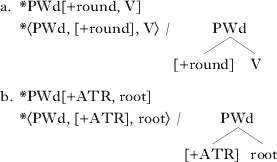
Licensing constraints distinguish between prominent and non-prominent positions. From a broader perspective, these two positions can be seen as trigger–target pairs. In this sense, Walker's approach is similar to another recently proposed constraint family that combines some properties of alignment constraints with licensing-based constraints. Classic alignment requires gradient evaluation, which makes other, problematic predictions (McCarthy Reference McCarthy2003). A more recent version of the constraint has been proposed by Hyde (Reference Hyde2012). Jurgec (Reference Jurgec2011), which appeared after the publication of Walker's monograph, extends the approach to segmental features, using what he terms Licensed Alignment constraints. Licensed Alignment constraints are formally categorical, but can still achieve the gradient effect of classical alignment. Consider for example a constraint that drives rounding harmony triggered by the initial vowel *PWd[+round, V] (1a). This constraint is violated by triplets 〈PWd, [+round], V〉, when [+round] precedes a vowel within a word. Note that every vowel participates in its own triplet, potentially incurring a violation mark. Round vowels are associated with the feature [+round] and hence do not precede the feature, satisfying the constraint. The third variable of the alignment constraint can also be morphological (root, affix) or prosodic (e.g. a foot head or a prosodic word head). For instance, the constraint *PWd[+ATR, root] in (1b) forces spreading of ATR to any segment of the root (and the actual target segment is determined by other alignment constraints).
(1)

What licensed alignment and licensing have in common is a distinction between triggers (from which the relevant feature typically originates) and a set of targets, which can be segments, prominent prosodic positions (syllable, foot and word heads) or morphological constituents (roots and affixes). In this sense, the standard account, in which assimilation is determined by the triggering feature, is replaced by the concept of ‘neediness’ (Nevins Reference Nevins2010), according to which it is actually the target that seeks a feature from a trigger.
There are, however, several differences between licensing and licensed alignment. First, licensed alignment seems to be easier to formalise, since it refers to simple concepts of precedence and association, whereas the very definition of generalised licensing is actually rather complex, requiring reference to (i) triggering and (ii) targeted features or feature combinations, (iii) strong and (iv) weak positions, and (v) the correspondence relationships among these variables. Second, licensing does not directly contain a directional variable, whereas alignment does. For example, it is easy to imagine the mirror variant of (1a): *PWd[V, +round]. On the other hand, generalised licensing has no inherent directionality (but maximal licensing includes precedence), although this can be defined by specifying the non-prominent position. For instance, a licensing constraint could refer to pre- and post-tonic positions, or to prefixes or suffixes. The crucial difference is that licensing predicts non-directional assimilation. Such non-directional patterns are rare and often show restrictions. For example, Lango shows bidirectional assimilation at the boundary between the root and the suffix. Vowel harmony is often controlled by the root, and affects the prefix and suffix (Baković Reference Baković2000). The opposite pattern, in which a feature spreads to the root from a prefix or a suffix, is not attested. Walker's approach all but excludes this last pattern, because the ranking required would be very specific. In particular, the prefix and suffix would each have to be protected by a positional faithfulness constraint, which would be ranked above the relevant licensing constraint.
A related issue is that licensing does not refer to a domain: prominence is defined independently of the domain in which it occurs. On the face of it, this predicts an unattested pattern, in which a feature spreads from an affix to a root several words away (while not affecting intermediate vowels). While licensing constraints could easily be redefined to refer to domains, Walker instead makes use of CrispEdge constraints, which are required independently to distinguish local and non-local vowel patterns. Licensed alignment, on the other hand, refers to a common domain, and rules out such patterns. The same is true for other alignment or domain-based approaches (Cole & Kisseberth Reference Cole and Kisseberth1994, Kisseberth Reference Kisseberth, Cole and Kisseberth1994, McCarthy Reference McCarthy2004, Smolensky Reference Smolensky, Smolensky and Legendre2006, Potts et al. Reference Potts, Pater, Jesney, Bhatt and Becker2010).
One further empirical insight is that vowel patterns are often subject to exceptionality. For example, metaphony and umlaut are typically found only in a subset of affixes that contain the triggering segments. Walker's response is to lexically index these affixes, and to make licensing constraints specific to these indices. At first, this appears to be a straightforward extension of a lexical indexation approach, in which both faithfulness and markedness constraints may be indexed (Itô & Mester Reference Itô, Mester and Goldsmith1995, Reference Ito and Mester2003, Pater Reference Pater2000, Reference Pater, Bateman, O'Keefe, Reilly and Werle2007, Reference Pater and Parker2009, Flack Reference Flack2007, Gouskova Reference Gouskova2007, Jurgec Reference Jurgec2010). However, compared to the existing literature, Walker goes one step further. Indexed constraints in the literature typically refer only to the indexed morpheme, and can see any non-indexed material to a limited degree. For example, Pater (Reference Pater and Parker2009) uses alignment constraints that require an indexed morpheme to be aligned with a heteromorphemic consonant. Walker's indexed licensing constraints are consistent with Pater's locality convention, but these constraints are not lexically specific to the contextual restriction.
Walker's monograph is a significant contribution to our understanding of patterns involving vowels. The novel contribution is the idea that the same basic mechanism, prominence-based licensing, is involved in many vowel patterns. In terms of Optimality Theory, this monograph provides one of the best worked-out analyses of a single phenomenon across many languages. The detailed and software-verified factorial typology makes strong predictions about what kind of patterns are attested, predictions which are confirmed by the numerous case studies provided.


