Introduction
When we listen to someone speaking in their second language (L2), we can often detect an accent: that is, we can hear an influence of their first language (L1) on their L2 speech. The most obvious influence is in the sounds of words, but sometimes grammatical errors are made in L2 that are influenced by the L1 grammar. Less obviously, bilinguals can also exhibit accents in their use of lexical-conceptual knowledge. De Groot (Reference De Groot and Faust2012, Reference De Groot, Filipović and Pütz2014) noted that a bilingual exhibits a semantic accent when they comprehend or use a word in one language in a way that is influenced by knowledge of its translation. Semantic accents occur because a word in one language often does not have a perfectly matching translation in another language (Van Hell & De Groot, Reference Van Hell and De Groot1998). For example, the word ball in English is typically translated as balle in French. The two words, however, do not refer to the same set of objects because the word balle refers to small balls such as tennis balls, but not to basketballs or footballs (Paradis, Reference Paradis, De Groot and Kroll1997). Thus, when English–French bilinguals use balle to refer to a soccer ball with the assumption that the word means the same as ball, they are exhibiting a semantic accent. Such differences between presumed translations can pose communication challenges. If an L1 English child asks a French L1 speaker to bring a balle to the park, the ball that is brought may be too small for an intended game of soccer.
Differences between translations in underlying conceptual representations can also come from contextual circumstances, especially when the two languages are learned in different cultures (Athanasopoulos, Reference Athanasopoulos and Schwieter2015; Lupyan & Lewis, Reference Lupyan and Lewis2019; Masuda, Ishii, Miwa, Rashid, Lee & Mahdi, Reference Masuda, Ishii, Miwa, Rashid, Lee and Mahdi2017; Jared, Poh & Paivio, Reference Jared, Poh and Paivio2013; Pavlenko, Reference Pavlenko and Pavlenko2009). For example, the English word pumpkin is translated as kabocha in Japanese, but the actual objects look and are used differently depending on cultural contexts. In North America, pumpkins are typically orange and used for carving jack o'lanterns whereas typical pumpkins in Japan have green skins and are eaten as a vegetable. Such cultural differences raise the possibility that bilinguals develop different lexical-conceptual representations depending on where they learn and use their languages.
The present study investigated how Japanese–English bilinguals represent and process translation word pairs that do not convey identical conceptual information, and on changes that may occur with increasing proficiency and L2 cultural exposure. We take a conceptual feature-based approach. The novel aspect of our work is that we focus on specific features that may be differentially associated with conceptual representations for translations in a bilingual's two languages using feature-typicality ratings, and feature-verification and feature-priming tasks. Before presenting our study we first briefly review feature theories of conceptual representation, particularly those that have considered how a bilingual might represent translation words that are not entirely equivalent.
The Distributed Conceptual Feature model
A prominent view in the research on conceptual knowledge representation in monolinguals is that the meaning of words is represented, at least partially, in terms of semantic features (e.g., “barks” for dog), and studies have shown the usefulness of features in explaining various behavioural and neuropsychological phenomena (e.g., Barsalou, Reference Barsalou1982; Collins & Quillian, Reference Collins and Quillian1969; McRae, de Sa & Seidenberg, Reference McRae, de Sa and Seidenberg1997; Norman & Rumelhart, Reference Norman and Rumelhart1975; Rogers & McClelland, Reference Rogers and McClelland2004). Adopting this notion of feature-based representation of concepts from the monolingual literature, De Groot and colleagues (De Groot, Reference De Groot1992; Kroll & De Groot, Reference Kroll, De Groot, De Groot and Kroll1997; Van Hell & De Groot, Reference Van Hell and De Groot1998) proposed the Distributed Conceptual Feature (DCF) model of bilingual conceptual representation. According to this model, conceptual information is stored in terms of feature units, and those feature units are connected to word forms for each language. Because translations (e.g., dog in English and chien in French) typically convey comparable meanings, they are assumed to activate mostly the same feature units (e.g., has four legs, barks, etc.). The subtle differences in meanings between translations are assumed to be reflected in the unique features that each word activates. That is, features provide a way to describe the part of conceptual representations that may differ across languages or cultural contexts. For example, concrete words are assumed to share more conceptual features across translations than abstract words, an assumption that can account for findings such as stronger cross-language priming effects for concrete than for abstract words (e.g., Jin, Reference Jin1990), and more word associations that are translations for concrete than abstract translation pairs (Van Hell & De Groot, Reference Van Hell and De Groot1998). De Groot (Reference De Groot2011) reviews other evidence from word studies that support the DCF model.
The DCF model can also provide an account of results from bilingual object naming studies (e.g., Ameel, Storms, Malt & Sloman, Reference Ameel, Storms, Malt and Sloman2005; Malt, Li, Pavlenko, Zhu & Ameel, Reference Malt, Li, Pavlenko, Zhu and Ameel2015; Malt & Sloman Reference Malt and Sloman2003; Pavlenko & Malt, Reference Pavlenko and Malt2011; Zinszer, Malt, Ameel & Li, Reference Zinszer, Malt, Ameel and Li2014). For example, Ameel et al. asked Dutch–French simultaneous bilinguals to name images of containers. Some of the containers used in the study are usually given different names by French monolinguals (e.g., bouteille or flacon, depending on size), but the same name by Dutch monolinguals (e.g., fles). Ameel et al. observed that bilinguals’ naming patterns for their two languages were more similar compared to the naming patterns observed in monolinguals of each language. Thus, bilinguals may use bouteille for both the bouteille and the flacon when naming in French, suggesting that they verbally categorize them more similarly than French monolinguals. Such findings are not limited to simultaneous bilinguals. Malt et al. (Reference Malt, Li, Pavlenko, Zhu and Ameel2015) tested late Mandarin–English bilinguals living in the U. S. and also found that naming patterns for household objects differed from both native speakers of English and native speakers of Mandarin. The researchers hypothesized that the reason bilinguals’ naming patterns converge across languages is that their lexical-conceptual representations were simplified, either by dropping language-specific features or generalizing those features to both languages. We are unaware, however, of any studies that have empirically tested this claim by focusing on individual features that may be generalized or dropped in the process of becoming bilingual.
The Shared Distributed Asymmetrical model
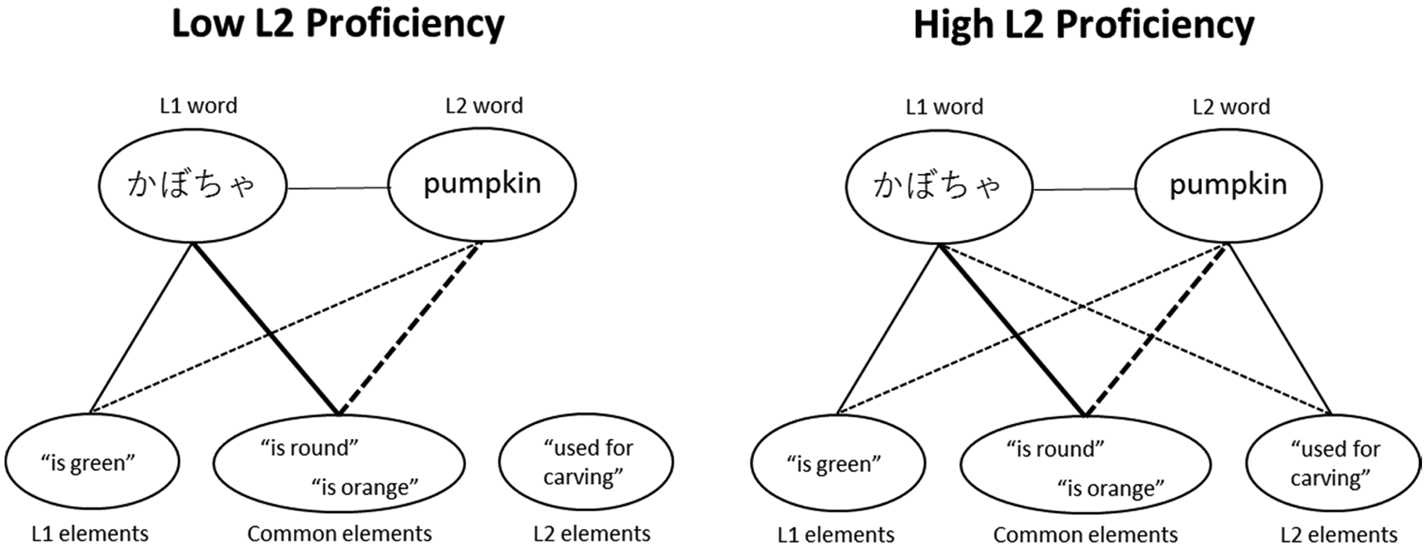
The Shared (Distributed) Asymmetrical (SDA) model (Dong, Gui & MacWhinney, Reference Dong, Gui and MacWhinney2005) builds on the insights of the DCF model (see Figure 1). As in the DCF, translations can have links to both shared and language-specific conceptual elements. The SDA model goes further in providing an account of how L2 proficiency influences the connection strengths between words and conceptual elements. More specifically, the model assumes that bilinguals with low L2 proficiency acquire a new L2 word by developing connections to the conceptual elements of the translations in their L1 (see also Jiang, Reference Jiang2002; Pavlenko, Reference Pavlenko, Kroll and de Groot2005, Reference Pavlenko and Pavlenko2009). For example, Japanese–English bilinguals may learn the word pumpkin assuming that it conveys the same semantic information as the Japanese kabocha: that is, a round vegetable with green skin. This produces a semantic accent in their L2 because the word pumpkin would activate the L1-specific element “is green”. This overextension of L1-specific elements to L2 words is similar to one of the mechanisms of semantic convergence discussed in Ameel et al. (Reference Ameel, Storms, Malt and Sloman2005). However, the proposal of the SDA model differs in that the semantic representations activated by the L2 word are initially solely based on knowledge from L1.
The Shared (Distributed) Asymmetrical (SDA) model. The SDA model proposes that conceptual representations differ in L1 and L2 depending on L2 proficiency. Adapted from Dong, Y., Gui, S. and MacWhinney, B. (Reference Dong, Gui and MacWhinney2005), Shared and separate meanings in the bilingual mental lexicon, Bilingualism: Language & Cognition, 8, 221–238, Figure 9, p. 233.

The SDA model further proposes that as L2 proficiency develops, bilinguals form connections between L2 words and L2-specific conceptual elements, and weaken the connections between L2 words and L1-specific elements, lessening their semantic accent in L2. These processes lead bilinguals to have somewhat different conceptual representations for translations. However, the SDA model also proposes that the acquisition of L2-specific elements can result in bilinguals developing connections between L1 words and L2 elements (e.g., kabocha, used for carving jack o'lanterns), producing a semantic accent in L1. Such connections produce semantic convergence in bilinguals, where the meanings activated by kabocha and pumpkin are more similar compared to those activated by monolinguals of each language. That is, Dong et al. suggest that there are mechanisms that produce both convergence and divergence of the representations activated by translations. While these mechanisms can also be accommodated in the DCF model, an advantage of the SDA model is that it makes specific predictions about how bilingual conceptual representations change with increasing proficiency.
Dong et al. (Reference Dong, Gui and MacWhinney2005) tested their model by asking participants to rank the semantic similarity between a word (e.g., red) and eight other words (e.g., debt, bride, color). Some of the relations were culturally-specific (e.g., red and bride are related in a Chinese context because a red wedding dress is common in China but not in North America). The task was completed by Chinese–English bilinguals who varied in English proficiency, as well as by Chinese and English monolinguals. When the task was completed in English, the ranking pattern of the less-proficient bilinguals deviated more from English monolinguals than did the ranking pattern of the more-proficient bilinguals. The researchers argued that this difference supports the idea that low-proficiency bilinguals have less English monolingual-like conceptual representations because they are more dependent on their L1 knowledge. On the other hand, when the task was done in Chinese, the ranking pattern of the high-proficiency bilinguals deviated from Chinese monolinguals more than that of low-proficiency bilinguals. The researchers explained that this occurred due to the influence from the acquisition of L2 conceptual elements. That is, L2 conceptual elements not only connected to L2 words, but they also developed links to L1 words. These findings suggest that less-proficient bilinguals have stronger semantic accents in their L2 compared to more-proficient bilinguals, while more-proficient bilinguals have stronger semantic accents in their L1 compared to less-proficient bilinguals.
Further research examining translation-nonequivalence at the feature level is needed not only to test the predictions of the SDA, but also to provide data for the development of computational models of bilingual word processing. Dijkstra et al.'s (Dijkstra, Wahl, Buytenhuijs, Van Halem, Al-Jibouri, De Korte & Rekké, Reference Dijkstra, Wahl, Buytenhuijs, Van Halem, Al-Jibouri, De Korte and Rekké2019) recent model of word translation, Multilink, assumes equivalent meanings for translations, and they acknowledge that this is a simplification that needs to be addressed in future simulation work.
The present study
We investigated semantic accents in Japanese–English bilinguals by probing individual features that are likely to be responsible for those accents. Our study differs, therefore, from previous studies of semantic accents that have examined patterns of naming responses for pictured objects. A key assumption of the feature-based bilingual models is that the conceptual differences in translations can be described in terms of language- or culture-specific features. Semantic accents in bilinguals can be considered to emerge from the activation of such features when they are using the other language. Tasks that tap into semantic features specifically may, therefore, be useful tools to investigate the nature of semantic accents. Three feature tasks that have been used in the monolingual literature were selected for use here: a feature-typicality rating task, a feature-verification task, and feature-priming lexical decision task. These tasks vary in the extent to which they require an explicit judgment of the relation between a word and a feature. The critical features were culture-specific features that were either perceptual or situational features. In the monolingual literature, it has been suggested that the kind of feature influences how people recognize concepts (e.g., Cree, McNorgan & McRae, Reference Cree, McNorgan and McRae2006; Solomon & Barsalou, Reference Solomon and Barsalou2001). In bilinguals, the type of feature may affect how easily it can be acquired when learning a word meaning. A perceptual feature may be readily learned by observing the object in the new culture, but situational information may require deeper cultural knowledge.
Bilinguals performed the three feature tasks in both English and Japanese; the tasks were also completed by monolinguals of each language. The study addressed three main questions. One was whether the bilinguals in our study exhibited a semantic accent in either L2 or L1. In particular, we examined whether Japanese-specific cultural features are associated with representations of English words to a greater extent for Japanese–English bilinguals than for English monolinguals, and whether Canadian-specific cultural features are associated with representations of Japanese words to a greater extent for Japanese–English bilinguals than for Japanese monolinguals. The DCM and SDA models presume that such is the case for semantic accents, but no study has examined this assumption at the level of features, as far as we are aware. Although it would not be particularly surprising to find that L1 Japanese-specific conceptual features are associated with L2 English words, it is much less clear whether Canadian-specific features become associated with the much more entrenched Japanese L1, as Dong et al. (Reference Dong, Gui and MacWhinney2005) propose. Some evidence that L1 lexical-conceptual representations are modified when L2 is learned comes from the previously mentioned Malt et al. (Reference Malt, Li, Pavlenko, Zhu and Ameel2015) object naming study with late bilinguals.
The second question was whether bilinguals perform differently depending on the language in which they completed the task: that is, whether they have symmetric or asymmetric lexical connections. If bilinguals’ semantic accents arise because their conceptual representations have converged across languages, then culture-specific features should be as strongly associated with a word in one language as with its translation in the other language, either because bilinguals have dropped language-specific features or have generalized those features to both languages. As noted, Ameel et al. (Reference Ameel, Storms, Malt and Sloman2005) found evidence for converging conceptual representations in simultaneous Dutch–French bilinguals. In contrast, if the conceptual representations that are activated by words in each language are somewhat different, then culture-specific features should be more strongly associated with the culturally-congruent language than the incongruent language. The latter finding would be consistent with two previous studies in our lab. Using pictures of culturally-specific objects, Jared et al. (Reference Jared, Poh and Paivio2013) found that Chinese–English bilinguals’ naming times were faster when the language of the task and the culture of the picture matched than when they mismatched. A congruency effect was also observed for similar bilinguals in a subsequent word-picture matching study in both decision latency and ERP data (Pan, Xiong, Jouravlev & Jared, Reference Pan, Xiong, Jouravlev and Jaredin press). These studies provide evidence that bilinguals who have learned each of their languages in quite different cultural contexts may activate somewhat different conceptual representations from words that are translations of one another. The current study extends this previous research by focusing in on culture-specific features rather than on images of whole objects.
The third question that we addressed was whether the SDA's developmental account is accurate. This view predicts that, as proficiency in English increases, we should see weaker associations of Japanese-specific features and stronger association of Canadian-specific features with English words, and that we should also see a stronger association of Canadian-specific features with Japanese words. Proficiency was assessed using a vocabulary test, and this hypothesis was examined by comparing bilinguals with different scores on the test. These analyses can not only provide evidence concerning whether the general pattern of results is consistent with the SDA, but they also provide some insight into just how much proficiency it takes for such patterns to emerge.
However, proficiency may not be the main driver of conceptual change in bilinguals. Several studies have provided evidence that immersion in an L2-speaking country facilitates the development of native-like conceptual representations (e.g., Malt, Reference Malt2019; Malt & Sloman, Reference Malt and Sloman2003; Mok & Yu, Reference Mok and Yu2016; Pavlenko & Malt, Reference Pavlenko and Malt2011; Zinszer et al., Reference Zinszer, Malt, Ameel and Li2014). For example, Mandarin learners of L2 English who were immersed in an English environment showed household object (Zinszer et al., Reference Zinszer, Malt, Ameel and Li2014) and verb (Malt, Reference Malt2019) naming patterns that were more similar to native English speakers than those who were learning in classrooms in China. Furthermore, Malt and Sloman (Reference Malt and Sloman2003) found that bilinguals’ naming patterns for household objects in L2 diverged less from those of native speakers as the number of years of immersion in an L2-speaking country increased, but the number of years of classroom instruction did not show such a relationship. Even the group with more than 10 years of L2 immersion still differed from native speakers, indicating that developing native-like lexical-conceptual representations can be a long process. This research suggests that it is possible that the SDA's developmental account is broadly correct, but that years of immersion in an L2 speaking country rather than proficiency may be more strongly associated with conceptual change. Therefore, we also investigated the influence of length of residence in English-speaking countries on the strength of the association between culture-specific features and words in English and Japanese.
In summary, the current study extends previous research on semantic accents by probing specific features that are likely to contribute to semantic accents. Furthermore, much of the research has focused on lexical-conceptual representations for household objects. Here we included a large range of items.
Method
Participants
Bilinguals
Ninety-nine Japanese–English bilingual participants were recruited (37 male, mean age = 28.1 years); 49 were recruited in Tokyo and 50 were recruited in London and Toronto, Canada. The bilinguals were recruited in Japan and Canada to obtain participants with different amounts of L2 cultural exposure. The number of years residing in English-speaking countries ranged from 0–22 years (mean = 7.7 years, SD = 8.9). Participants’ L1 was Japanese and they had good English proficiency. Participants in Japan were required to have a score of 700 or higher on the Test of English for International Communication (TOEIC). The participants recruited in Canada received $15 for each session and those recruited in Japan received a book card of similar value. Ninety-four participants completed both English and Japanese sessions as planned, but five participants were available only for one session (three did not do the English session and two missed the Japanese session).
English monolinguals
Forty-eight English speakers (12 male, mean age = 19.4 years) were recruited at Western University. All were born in Canada and had English as their L1. Their knowledge of a second language was minimal. The participants received course credit.
Japanese monolinguals
Forty-four Japanese monolinguals (16 male, mean age = 19.5 years) were recruited at Waseda University. All were born in Japan and had Japanese as their L1. They had at least some knowledge of English, because English is a part of compulsory education in Japan. However, none met the bilingual criterion on the TOEIC.
Materials
Stimuli
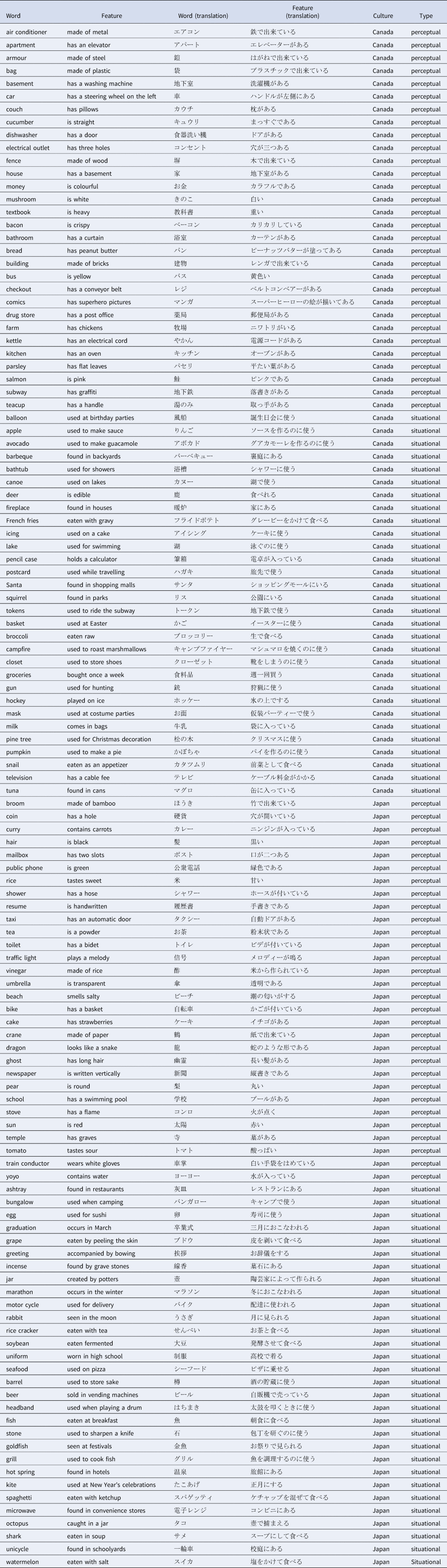
Both English and Japanese versions (translations) of the stimuli were developed. The critical stimuli consisted of 120 culture-specific word and feature pairs (see Appendix). One challenge in testing feature-based models of conceptual representations in bilinguals is the difficulty in identifying language- or culture-specific features. The process of developing the stimuli involved first asking Japanese and Canadian participants to generate features for lists of words (see Matsuki, Reference Matsuki2018). To select the set of stimuli that were used in the research, a further pilot study was conducted in which feature-typicality ratings were collected for 200 pairs of words and features from Japanese- and English-speaking participants. The pilot study had 80 items that each had a corresponding feature that was judged by the experimenters to be prevalent in Canada but not in Japan and 90 items that each had a feature that was judged to be prevalent in Japan but not in Canada. Henceforth, these are referred to as Canada-specific and Japan-specific features, respectively. Although many of these features are also typical in other countries, these terms were used here as a concise way to distinguish the culture of a feature (Japan) from the language in which it was presented (Japanese). Thirty filler items were also included to help detect whether participants were completing the task carefully. Half were paired with highly typical features and half with highly atypical features.
Pilot study participants were 20 Japanese speakers residing in Japan (6 female, mean age = 38.2 years, SD = 10.51) and 25 English speakers residing in Canada (16 female, mean age = 40.2 years, SD = 15.18). All were recruited and tested via crowdsourcing websites (Lancers for Japanese speakers, CrowdFlower for English speakers). Participants were asked to rate the typicality of each pair of words and features on a 1 (not typical at all) to 7 (very typical) scale. For Canadian participants, the word-feature pairs were given in English, and for Japanese participants, the same word-feature pairs were presented in Japanese. Participants were paid $3 or 270 yen.
Using these ratings, 60 Japan-specific word-feature pairs and 60 Canada-specific word-feature pairs were selected. Half of each had a culture-specific perceptual feature and half had a culture-specific situational feature. Canadian participants rated the Canada-specific items higher (perceptual: M = 5.4, SD = 0.7, situational: M = 5.8, SD = 0.6) compared to Japanese participants (perceptual: M = 3.3, SD = 1.0, situational: M = 3.5, SD = 1.0), whereas Japanese participants rated the Japan-specific items higher (perceptual: M = 5.33, SD = .75, situational: M = 5.39, SD = .89) compared to Canadian participants (perceptual: M = 2.95, SD = 1.00, situational: M = 3.09, SD = 1.21).
Feature-typicality rating and feature-verification tasks
For these tasks, 60 culture-neutral word-feature pairs were included with the 120 critical pairs. Thirty of these filler pairs were highly typical (e.g., SNOW–is cold) and the other 30 filler pairs were not typical (e.g., BALL–is square).
Feature-priming lexical decision task
Critical words (e.g., BROOM) were used as the targets and shortened forms of the features (e.g., made of bamboo to bamboo) were used as primes. Table 1 reports the mean length and frequency of the primes and targets. Word frequency was obtained from SUBTLEX (Brysbaert & New, Reference Brysbaert and New2009) for English and the NTT database (Amano & Kondo, Reference Amano and Kondo2000) for Japanese. Unrelated pairs were created by re-pairing each target with a feature from another target. Two counterbalanced lists were created; each had an equal number of related and unrelated trials, items with Canada- and Japan-specific features, and perceptual features and situational features. Each prime and target appeared only once on a list.
Mean Word Length and Frequency (per million) of Stimuli in the Lexical Decision Task (SD in parentheses)

Another 120 pairs of prime words and nonword targets were developed for “NO” response filler trials. The English-like nonwords were selected from the English Lexicon Project database (Balota, Yap, Cortese, Hutchison, Kessler, Loftis, Neely, Nelson, Simpson & Treiman, Reference Balota, Yap, Cortese, Hutchison, Kessler, Loftis, Neely, Nelson, Simpson and Treiman2007), and the Japanese-like nonwords were created by changing the order of, or substituting, the characters of real words. Both the primes and their nonword targets were matched in length to the primes and targets used for the critical trials. The same filler items were added to each list.
Vocabulary test
Japanese and English vocabulary tests were used to assess language proficiency. Each test had 40 words and 20 nonwords, and the participants were asked to indicate if they were real words or nonwords. Japanese words were taken from the NTT vocabulary estimation test (Amano & Kondo, Reference Amano and Kondo2000), and the nonwords were created by reordering the characters of real Japanese words. Both word and nonword items used for the English test were taken from LexTale (Lemhöfer & Broersma, Reference Lemhöfer and Broersma2012). These tests were created on the Qualtrics platform and completed using a computer. They were scored using the sensitivity index (d’) instead of percentage correct to take into account false alarms.
Language questionnaire
Items were based on the LEAP-Questionnaire (Marian, Blumenfeld & Kaushanskaya, Reference Marian, Blumenfeld and Kaushanskaya2007). English and Japanese versions were created. Of particular importance was a question that asked participants to indicate the number of years they had lived in an English-speaking country. This was the measure of L2 cultural exposure.
Procedure
Participants completed the language questionnaire, the vocabulary test, and then the three experimental tasks. To minimize the influence of repeated exposure to the stimuli, participants started from the implicit and time-sensitive task, the feature-priming task, followed by the feature-verification task, and then the feature-typicality rating task. Each task had English and Japanese versions. Monolinguals did the version appropriate for their language (except that Japanese monolinguals also did the English vocabulary test), whereas the bilingual participants were asked to do both language versions, in different sessions at least one week apart. Language order was counterbalanced across participants.
For the feature-priming task, participants were asked to decide whether a target word was a real word. First, a fixation point was presented in the center of a computer monitor for 500 ms, followed by the prime (e.g., bamboo) for 200 ms. Finally, the target (e.g., BROOM) was presented until the participant responded. English words were presented in 12 pt Courier New font, with the prime in lower case and the target in upper case. Japanese stimuli were presented in 12 pt Mincho font. All participants did 10 practice trials before the 240 experimental trials. The intertrial interval was 2 s. The order of stimuli was randomized for each participant. The task was programmed using DMDX (Forster & Forster, Reference Forster and Forster2003).
In the feature-verification task, participants were asked to determine whether a feature (e.g., made of bamboo) is reasonably true for a given concept word (e.g., broom). On each trial, a fixation point was presented for 500 ms, followed by the feature, which was presented for 1500 ms. Finally, the concept word was presented until the participant made response. All participants did 10 practice trials before the 180 experimental trials. Other aspects of the procedure were the same as for the feature-priming task.
In the feature-rating task, participants were asked to rate the typicality of each of the pairs of words (e.g., broom) and features (e.g., made of bamboo) using slider scales ranging from 0 (not typical at all) to 100 (very typical). The order of stimuli was randomized for each participant. The task was created on the Qualtrics platform and was completed using a computer.
Results
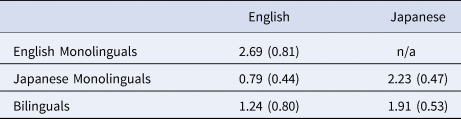
The descriptive data from the vocabulary tests are in Table 2.
English and Japanese Vocabulary Test Mean d’ Scores (SD in parentheses)

Analysis overview
Words for which a bilingual participant did not give a typicality rating (4.5% for English, 0.9% for Japanese) were assumed to be unknown to the participant; data from those items were not included in any analysis. Three different sets of analyses were conducted for each task. The first set involved comparisons of bilinguals with monolinguals in each language to investigate semantic accents. In these analyses, four English monolinguals and three Japanese monolinguals were excluded due to high error rates on the feature-priming task. The second set of analyses involved comparisons across languages within the bilingual group to investigate whether access to culture-specific features differs depending on the language used for the task. Finally, the last set of analyses explored whether bilinguals’ access to culture-specific features depends on individual differences, including L2 proficiency and L2 cultural exposure. Data from bilinguals who missed a session were included where possible in the first and third analyses. The results are presented by research question, with each section including analyses of data from each of the experimental tasks. This presentation order was used to avoid undue repetition of the description of the analyses. The analyses for a particular question were very similar across the tasks, but they were somewhat different for the three questions. Furthermore, although participants performed the feature-priming task first, then the feature-verification task, and lastly the typicality-rating task, the data from these tasks are presented in reverse order in each section. The feature-priming task data are more complex than for the other two tasks because of the additional variable of prime-target relation, and we felt these analyses would be best understood if the simpler analyses came first.
The data were analyzed using linear mixed models (RT and rating data) or generalized linear mixed models (binary data) within the lme4 package (Bates, Maechler, Bolker & Walker, Reference Bates, Maechler, Bolker and Walker2015) of R (R Core Team, 2012). RT data were log transformed. The function Anova in the car package version 2.1–2 (Fox & Weisberg, Reference Fox and Weisberg2011) was used to obtain the estimates and probability values for the fixed effects that are reported in the text (Type II Wald chi-square tests). Just the effects of interest are reported in the text. Complete model outputs appear in the Supplemental Materials, Appendices S1-S3.
Do the bilinguals have semantic accents in L1 and L2?
The analyses investigated whether there were any differences between bilinguals and the monolinguals in each language, specifically whether participant Group interacts with Culture-Pair and Feature-Type. Fixed factors included: Group (Monolingual vs. Bilingual; sum coded), Culture-Pair (Canada-specific vs. Japan-specific word-feature pairs; sum coded), Feature-Type (Perceptual vs. Situational; sum coded), and their interaction terms. The feature-priming task had the additional fixed factor of prime-target Relation (Related vs. Unrelated). Random factors included: subject (random intercept and random slope adjustment for Culture-Pair) and items (random intercept only). Random effects here and elsewhere were determined by comparing models with different random structures and selecting the one with the best fit.
Feature-typicality ratings
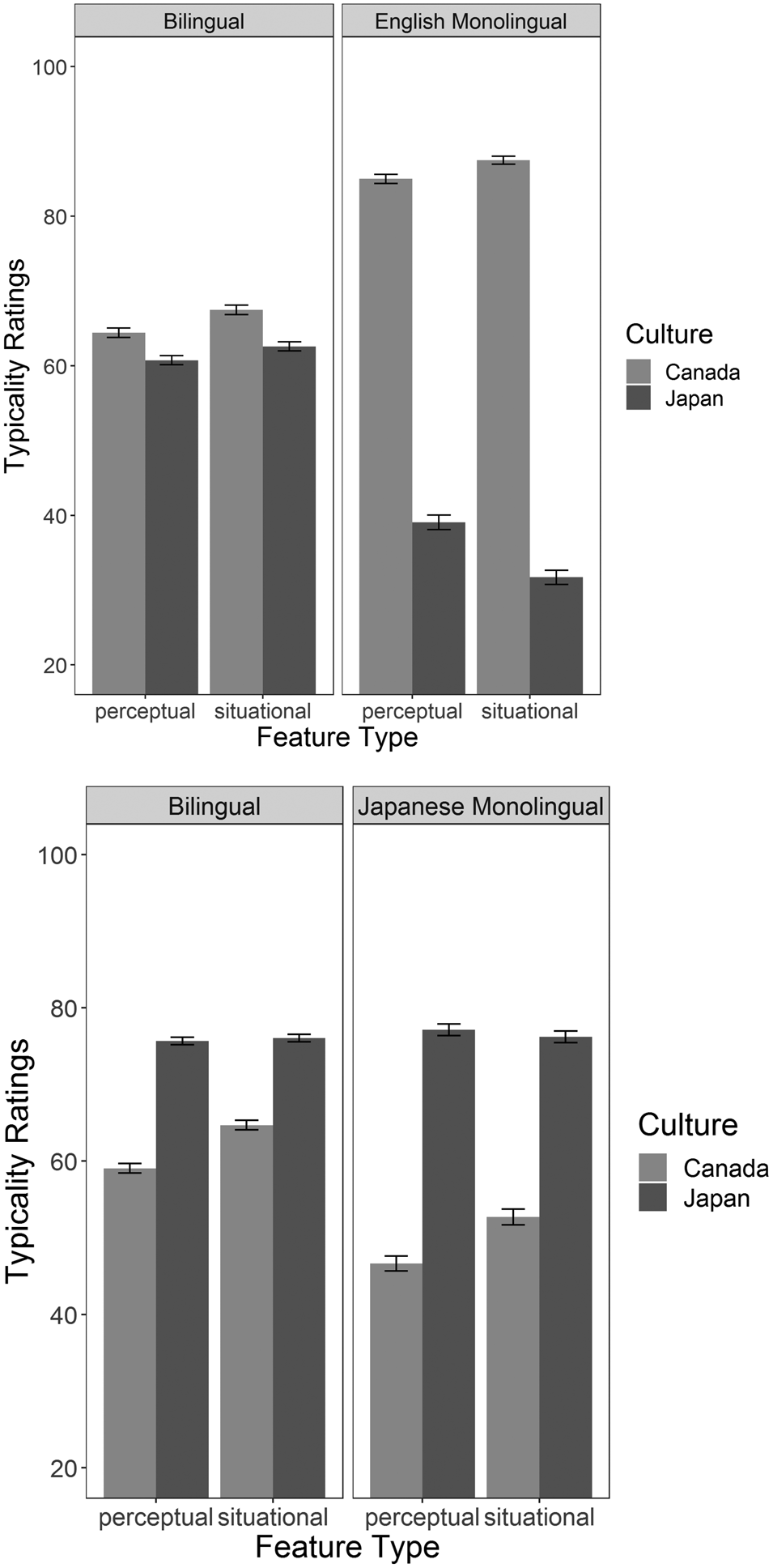
Mean typicality ratings on the English and Japanese versions of the task are presented in Figure 2.
Mean typicality ratings on the English (top) and Japanese (bottom) versions of the task.

English
There was a significant interaction of Group x Culture-Pair, χ 2(1) = 396.67, p < .001. Bilinguals gave lower ratings for pairs with Canada-specific features and higher ratings for pairs with Japan-specific features than did English monolinguals (t = 9.45, p < .001, t = -12.64, p < .001, respectively). There was also a significant Group x Culture-Pair x Feature-Type interaction χ 2(1) = 23.02, p < .001. The difference between the bilinguals and English monolinguals was particularly evident for pairs with Japan-specific situational features.
Japanese
The Group x Culture-Pair interaction was again significant, χ 2(1) = 32.48, p < .001. Post-hoc comparisons revealed that bilinguals gave higher ratings for pairs with Canada-specific features than Japanese monolinguals, t = -5.00, p < .001, but both groups gave similar ratings for pairs with Japan-specific features, t = 0.40, p = .69. The Group x Culture-Pair x Feature-Type interaction was not significant.
Feature-verification task
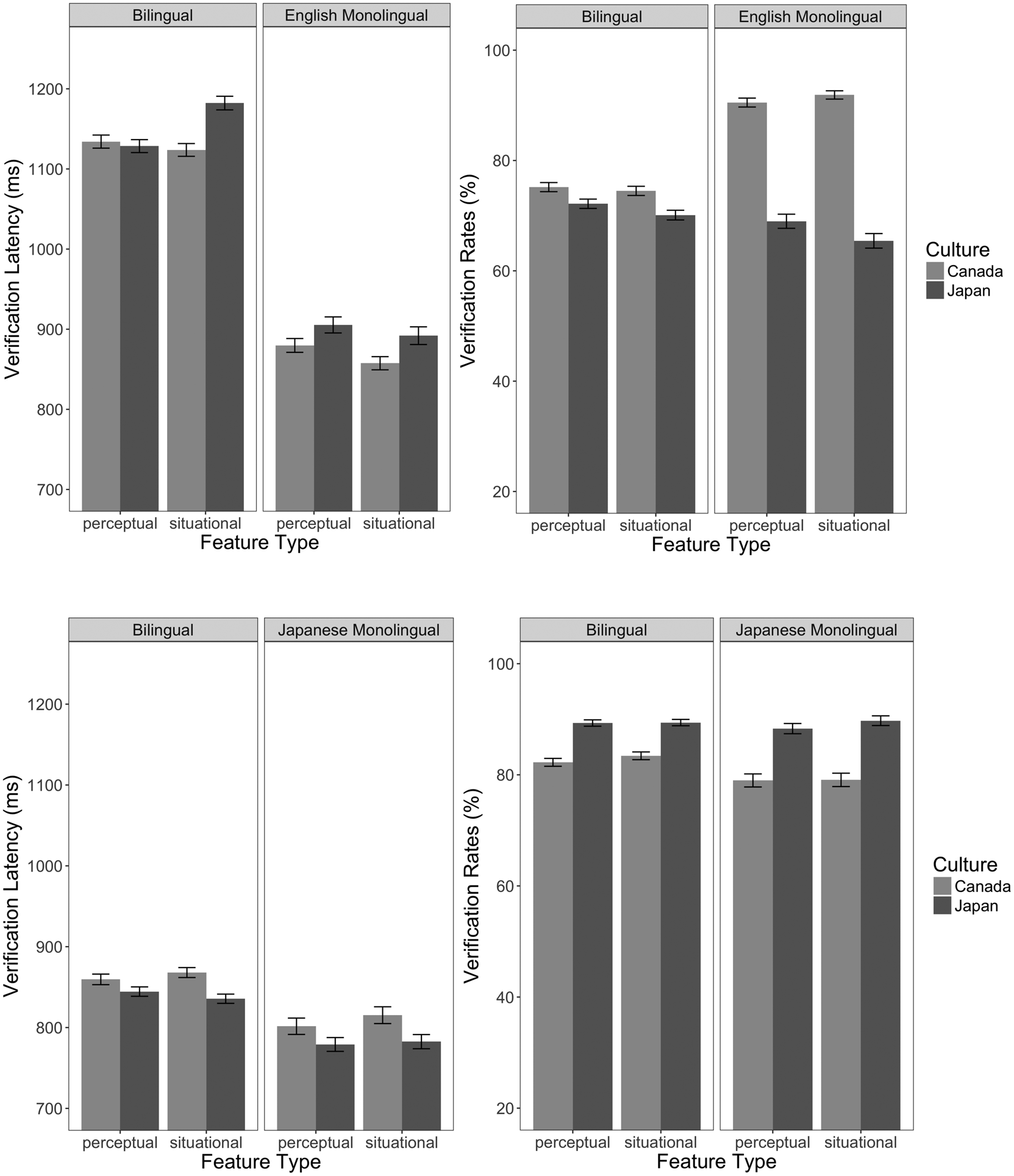
Mean verification latencies and rates for the English and Japanese versions of the task are presented in Figure 3.
Mean verification latencies (left) and rates (right) on the English (top) and Japanese (bottom) versions of the task.

English
For the verification latency analyses, the NO responses (19.7% of data across bilinguals and monolinguals) and then RT outliers (residuals greater than 2.5 standard deviation in absolute values; 0.1% of data) were removed from the analyses. The Group x Culture-Pair interaction was not significant, χ 2(1) = 0.68, p = .41. There was, however, a significant Group x Culture-Pair x Feature-Type interaction, χ 2(1) = 9.69, p < .01. Bilinguals had slower verification latencies than English monolinguals, particularly for pairs with Japanese situational features, t = 2.06, p < .05.
For verification rates, there was significant Group x Culture-Pair interaction, χ 2(1) = 210.29, p < .001. Post-hoc comparisons revealed that bilinguals’ verification rates for pairs with Canada-specific features were considerably lower than the verification rates of English monolinguals, t = 10.27, p < .001, and their verification rates for pairs with Japan-specific features were higher than those of English monolinguals, t = -2.31, p < .05. The Group x Culture-Pair x Feature-Type interaction was not significant.
Japanese
For verification latency, The NO responses (14.3% of data across bilinguals and monolinguals) and then RT outliers (residuals greater than 2.5 standard deviation in absolute values; 1.6% of data) were removed from the analyses. As for the English version, the Group x Culture-Pair interaction was not significant, χ 2(1) = 1.32, p = .22. However, here the Group x Culture-Pair x Feature-Type interaction was also not significant.
For verification rates, as for the English version, there was a significant Group x Culture-Pair interaction, χ 2(1) = 4.70, p < .05. Post-hoc comparisons revealed that bilinguals’ verification rates for pairs with Canada-specific features were higher than Japanese monolinguals, t = -2.73, p < .01, while both groups had similar verification rates for pairs with Japan-specific features, t = -0.45, p = .65. As for the English version, the Group x Culture-Pair x Feature-Type interaction was not significant.
Feature-priming task
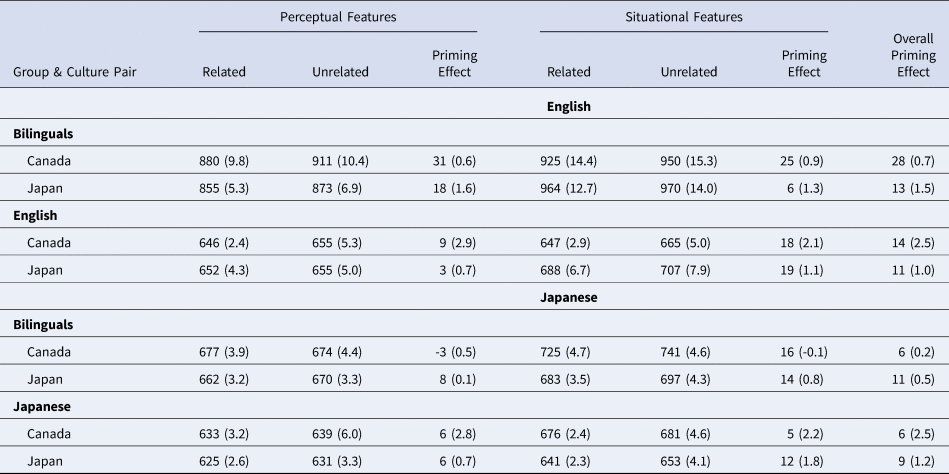
Mean latencies and error rates for the English and Japanese versions of the task are presented in Table 3.
Mean Decision Latencies (ms) and Percentage Errors (in parentheses) on English and Japanese Versions of the Lexical Decision Task

English
In the RT data, there was a significant effect of Relation, χ 2(1) = 37.02, p < .001. Related features produced greater facilitation for targets than unrelated features. However, neither of the interactions of interest was significant.
In the error data, there was again a significant main effect of Relation, χ 2(1) = 19.88, p < .001; there were fewer errors on target words preceded by a related feature than an unrelated feature. There was also a significant Relation x Group x Culture-Pair interaction, χ 2(1) = 4.54, p < .05. Post hoc analyses revealed that, for pairs with Japan-specific features, bilinguals produced a significant facilitatory priming effect, t = -2.28, p < .05, whereas English monolinguals did not, t = -1.25, p = 0.21. For pairs with Canada-specific features, on the other hand, bilinguals did not show a significant priming effect, t = -1.63, p = 0.10, whereas English monolinguals did, t = 3.60, p < .05. The Relation x Group x Culture-Pair x Feature-Type interaction was not significant.
Japanese
The RT results were much the same as for the English version. There was a significant main effect for Relation, χ 2(1) = 17.30, p < .001. Related pairs were responded to faster than unrelated pairs. However, neither of the interactions of interest was significant. In the error data, there was also a significant main effect for Relation, χ 2(1) = 11.35, p < .001, but again neither of the interactions of interest were significant.
Summary
Bilinguals’ performance differed from that of monolinguals in both languages, demonstrating a semantic accent in each language. In comparison to English monolinguals on the English versions of the tasks, bilinguals gave lower typicality ratings and were less likely to verify items with Canada-specific features, and they gave higher typicality ratings and were more likely to verify Japan-specific features. In the error data of the English feature-priming task, bilinguals showed a priming effect only for Japan-specific features whereas English monolinguals showed a priming effect only for Canada-specific features. In comparison to Japanese monolinguals on the Japanese versions of the tasks, bilinguals gave higher typicality ratings and were more likely to verify pairs with Canada-specific features. Decision data were more sensitive than latency data in the feature-verification and feature-priming tasks, and there was little evidence that effects depended on feature type.
Does the processing of culture-specific pairs by bilinguals depend on the language of the task?
The analyses compared the performance of bilinguals on the English and Japanese versions of each task. Fixed factors included: Language (English vs. Japanese; sum coded), Culture-Pair (Canadian vs. Japanese word-feature pairs; sum coded), Feature-Type (Perceptual vs. Situational; sum coded), and their interaction terms. The feature-priming task had the additional fixed factor of prime-target Relation (Related vs. Unrelated; sum coded). Random factors included: subject (random intercept and random slope adjustment for Language, Culture-Pair, and Feature-Type) and items (random intercept only). The relevant data can be seen in the same Figures and Table as for the previous question (Figures 2 & 3, Table 3).
Feature-typicality ratings
There was a significant Language x Culture-Pair interaction, χ 2(1) = 640.87, p < .001. Bilinguals’ ratings for pairs with Japan-specific features were considerably higher when the task was in Japanese than when it was in English (t = 5.14, p < .05), whereas their ratings for pairs with Canada-specific features were only slightly higher when they completed the ratings in English compared to Japanese (t = -1.30, p < .20). There was also a Language x Culture-Pair x Feature-Type interaction, χ 2 (1) = 6.27, p < .05. The language of the task did not differentially affect ratings of Japanese perceptual and situational pairs, but it did have a somewhat larger impact on Canadian perceptual pairs than situational pairs.
Feature-verification task
For verification latency, there was a significant Language x Culture-Pair interaction, χ 2(1) = 37.97, p < .001. Responses to pairs with Canada-specific features were marginally faster than responses to pairs with Japan-specific features when the task was in English (t = 1.77, p = .08), whereas responses to pairs with Japan-specific features were marginally faster than responses to pairs with Canada-specific features when the task was in Japanese (t = -1.88, p = .06). Furthermore, there was a significant Language x Culture-Pair x Feature-Type interaction, χ 2(1) = 23.89, p < .001. Post-hoc comparisons revealed that, when the task was in English, pairs with Japanese-specific situational features had longer latencies than pairs with Canadian-specific situational features, t = 2.72, p < .01, whereas, when the task was in Japanese, pairs with Canadian situational features had marginally longer latencies than pairs with Japanese situational features, t = -1.97, p = .05. There was no impact of Culture-Pair on latencies for perceptual features in either language.
For verification rates, there was also a significant Language x Culture-Pair interaction, χ 2(1) = 109.93, p < .001. Post hoc comparisons revealed that bilinguals verified pairs with Canada-specific features more often than pairs with Japan-specific features when the task was in English, z = -1.90, p = .06, while they verified pairs with Japan-specific features more often than pairs with Canada-specific features when the task was in Japanese, z = 3.88, p < .001. The Language x Culture-Pair x Feature-Type interaction was not significant.
Feature-priming task
In the RT data, there was a significant interaction of Relation x Language x Culture-Pair, χ 2 (1) = 7.04, p < .01. Post-hoc comparisons revealed that when the words were in English, there were significant priming effects for both pairs with Canada-specific features, t = 3.88, p < .001, and Japan-specific features, t = 2.38, p < .05. However, when the words were in Japanese, a priming effect was only present for pairs with Japan-specific features, t = 3.14, p < .01, but not for pairs with Canada-specific features, t = 1.03, p = .30. The Relation x Group x Culture-Pair x Feature-Type interaction was not significant. In the error data, neither of the interactions of interest were significant.
Summary
Bilinguals processed culture-specific pairs differently depending on the language of the task. There was a Language x Culture-Pair interaction in the typicality ratings data, the feature-verification RT and rates data, and in the RT data in the feature-priming task. Generally, congruency between the language of the task and the culture of the feature led to enhanced performance.
Is the processing of culture-specific pairs by bilinguals influenced by L2 proficiency or cultural exposure?
The analyses investigated whether individual differences in L2 proficiency and cultural exposure influence bilinguals’ processing of the culture-specific pairs, and, if so, whether one of these variables better accounts for performance than the other. L2 proficiency was based on the d’ scores from the English vocabulary test and Cultural-Exposure was the number of years lived in an English-speaking country. The analyses started with a baseline model (Model 1) that included the main effects of the four fixed factors: Culture-Pair (Canada- vs. Japan-specific word-feature pairs; sum coded), Feature-Type (Perceptual vs. Situational; sum coded), L2 Proficiency (continuous; scaled), and L2 Cultural-Exposure (continuous; scaled). Random effects included intercepts for subjects and items, as well as the by-subject random slope for Culture-Pair and the by-item random slope for the effect of L2 Cultural-Exposure. To examine whether the interaction between Culture-Pair and each of the individual differences variables improved model fit, a series of model comparisons was performed using the likelihood ratio test. L2 Proficiency (Model 2) and Cultural-Exposure (Model 3) were each added independently to the baseline model. If both improved model fit, then both were included simultaneously in a model (Model 4). This model was then compared to each of the previous models to see if it was a significantly better fit to the data. This process is illustrated in detail for the first data set, and, thereafter, just the final models are described. To further simplify the presentation, only the critical interactions in the final models are mentioned in the text. The feature-priming analyses were more complex because the Relation variable was also included. Those analyses are described in more detail when the data for that task are presented.
Feature-typicality ratings
English
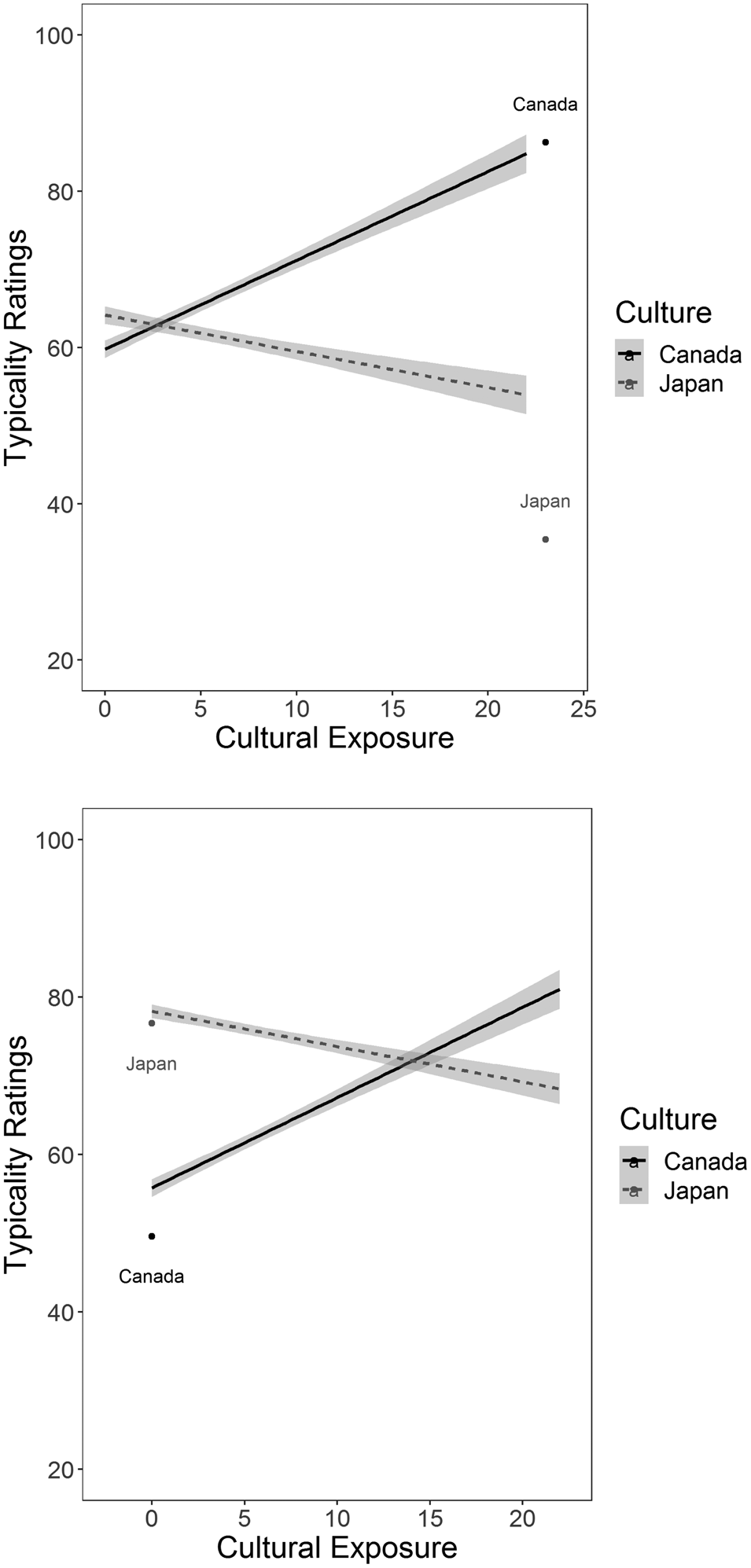
The addition to the baseline model of the Culture-Pair x L2 Proficiency interaction (Model 2) significantly improved the model fit, χ 2 (1) = 5.78, p < .05, as did the addition to the baseline model of the Culture-Pair x Cultural-Exposure interaction (Model 3), χ 2(1) = 39.40, p < .001. Furthermore, the addition to the baseline model of both the Culture-Pair x L2 Proficiency and the Culture-Pair x Culture-Exposure interactions (Model 4) provided a better fit compared to Model 2 with the Culture-Pair x L2 Proficiency interaction alone, χ 2 (1) = 33.78, p < .001, but did not improve the fit compared to Model 3 with the Culture-Pair x Cultural-Exposure interaction alone, χ 2(1) = .16, p = .69. These results imply that the model fit was improved by the addition of the Culture-Pair x Cultural-Exposure interaction but not the further addition of the Culture-Pair x L2 Proficiency interaction. Indeed, the numerical comparison of negative log likelihood revealed that Model 3 (-51866) has a better fit compared to Model 2 (-52167). In Model 3, the critical Culture-Pair x Culture-Exposure interaction was significant, χ 2 (1) = 44.41, p < .001 (see Figure 4, top). Post-hoc comparisons revealed that more L2 cultural exposure is associated with higher ratings for pairs with Canada-specific features, t = 5.15, p < .001, although not significantly lower ratings for pairs with Japan-specific features, t = -1.67, p = .10. Figure 4 (top) also displays points indicating the mean typicality ratings for pairs with Canada- and Japan-specific features by English monolinguals on the English version. As can be seen in that Figure, it takes a surprisingly large number of years of L2 cultural exposure before the bilinguals’ ratings for pairs with Canada-specific features approach the ratings of monolingual English speakers, and their ratings for pairs with Japanese-specific features remained substantially higher than those of English monolinguals even after a lengthy stay.
The Culture Pair (Canadian vs Japanese pairs) x L2 Cultural Exposure (in years) interaction effect on English (top) and Japanese (bottom) typicality ratings. The dots indicate the mean typicality ratings given by the respective monolingual participants.

Japanese
Model 3 was also the best fit for the Japanese typicality ratings. In that model, the Culture-Pair x Culture-Exposure interaction was significant, χ 2 (1) = 63.58, p < .001 (see Figure 4, bottom). Post-hoc comparisons revealed that more L2 cultural exposure is associated with significantly higher ratings for pairs with Canada-specific features, t = 5.32, p < .001, but significantly lower ratings for pairs with Japan-specific features, t = -2.15, p < .001. That is, with more time in the L2 culture, typicality ratings diverge more from those of monolingual Japanese participants.
Collinearity
An important issue that needs to be addressed is that L2 Proficiency and L2 Cultural-Exposure are correlated, r = .48, p < .001, and they suffer from mild collinearity, k = 13.19. Thus, the results reported above need to be further investigated to determine whether the effect of L2 Proficiency is truly absent. To do this we tested the effect of L2 Proficiency while keeping L2 Cultural-Exposure constant by analyzing a subset of the data. Specifically, we tested a model for each language version to see if there is a Culture-Pair x L2 Proficiency interaction using data from bilinguals who have never lived in L2 speaking countries (n = 32). Fixed factors included: Culture-Pair (Canadian vs. Japanese word-feature pairs; sum coded), L2 Proficiency (continuous), and their interaction term. Random factors included: subject (random intercept and random slope adjustment for Culture-Pair) and items (random intercept and random slope adjustment for L2 Proficiency). There was no significant Culture-Pair x L2 Proficiency interaction, either in the data from the English version of the task, χ 2 (1) = 1.05, p = .31, or from the Japanese version of the task, χ 2 (1) = 0.10, p = .75, which means that L2 proficiency does not differentially influence the typicality ratings for the Canada-specific and Japan-specific culture pairs. Therefore, the results of the best-fit models (Model 3) are likely to be valid, because the effect of L2 Proficiency is still absent when L2 Cultural-Exposure is kept constant.
Feature-verification task
English
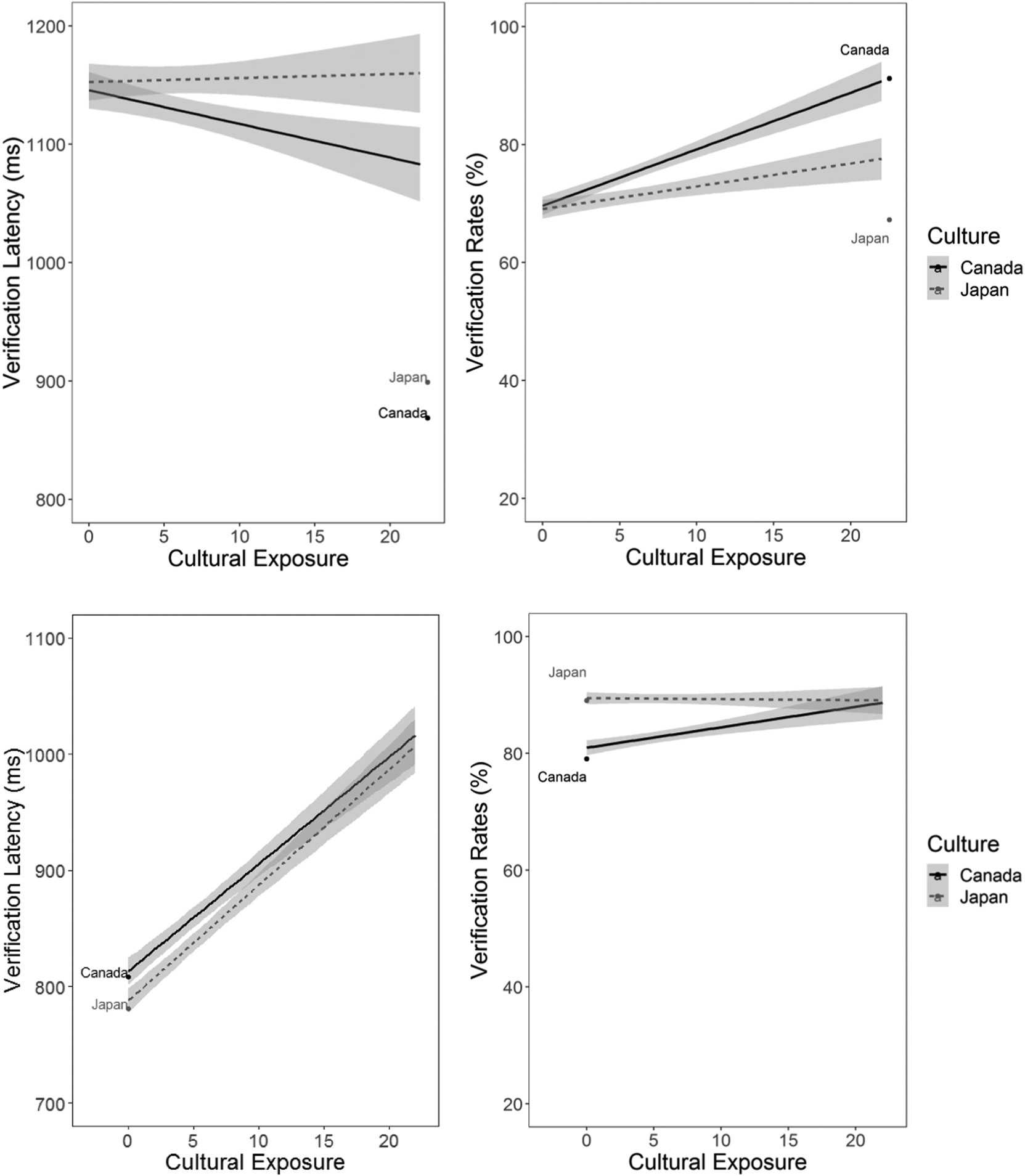
The latency data are based only on verified responses (25.8% of trials for bilinguals were excluded because they received “NO” responses). As for the typicality-rating data, Model 3 had the best fit. In this model, there was a significant Culture-Pair x L2 Cultural-Exposure interaction effect, χ 2 (1) = 2.34, p < .05. As L2 cultural exposure increases, response times for pairs with Canadian-specific features become faster but response times do not change for pairs with Japanese-specific features (see Figure 5, top left). The results of further analyses with bilinguals with no L2 cultural exposure confirmed that there is no Culture-Pair x L2 Proficiency interaction, χ 2 (1) = 0.39, p = .53, indicating that the L2 Cultural-Exposure is likely to be the factor responsible for the interaction with Culture-Pair.
The Culture Pair (Canadian vs Japanese pairs) x L2 Cultural Exposure (in years) interaction effect on English (top) and Japanese (bottom) verification latency (left) and verification rates (right). The dots indicate the means from the respective monolingual participants.

In the verification rates data, Model 4 had the best fit. In that model, the Culture-Pair x L2 Proficiency interaction was significant, χ 2(1) = 3.97, p < .05. Post-hoc comparisons revealed that more L2 proficiency was associated with higher verification rates for pairs with Canada-specific features, z = 2.69, p < .01, but not for pairs with Japanese-specific features, z = 1.25, p = .21. There was also a significant Culture-Pair x L2 Culture-Exposure interaction, χ 2(1) = 9.20, p < .01, indicating that more cultural exposure was associated with higher verification rates for pairs with Canada-specific features, z = 3.92, p < .001, but not for pairs with Japan-specific features, z = 1.36, p = .17 (see Figure 5, top right). Similar to the analyses conducted for typicality ratings, these results were further investigated to check the influence of collinearity between L2 Proficiency and Cultural-Exposure. The analyses (using the data from bilinguals with no L2 cultural exposure) revealed that there was no longer a significant Culture-Pair x L2 Proficiency interaction, χ 2 (1) = 0.14 p = .71, which implies that the interaction effect in Model 4 above is probably largely due to the Cultural-Exposure factor. Taken together, the results suggest that cultural exposure, but not L2 proficiency, is likely to differentially impact the verification rates for the two types of culture pairs.
Japanese
The latency data are only based on verified responses (13.76% of trials for bilinguals were excluded from the analyses). Neither Model 2 nor Model 3 significantly improved the fit of the model over the baseline model for the latency data (nor did Model 4). As for the English version of the task, Model 4 had the best fit for the verification rates data. In this model, the Culture-Pair x L2 Proficiency interaction was significant, χ 2(1) = 4.61, p < .05. With more L2 proficiency, the verification rate for pairs with Canada-specific features increased while it slightly declined for pairs with Japan-specific features. Furthermore, there was a marginally significant Culture-Pair x L2 Culture-Exposure interaction, χ 2(1) = 3.78, p < .06. More L2 cultural exposure led to a higher verification rate for pairs with Canada-specific features, z = 1.88, p < .06, but not for pairs with Japanese-specific features (see Figure 5, bottom right). Although these analyses indicated the presence of two interactions (i.e., Culture-Pair x L2 Proficiency and Culture-Pair x Cultural-Exposure), further analyses revealed that the Culture-Pair x L2 Proficiency interaction no longer exists, χ 2 (1) = 0.07, p = .78, when the Culture-Exposure factor is controlled by only analyzing bilinguals with no L2 cultural exposure. This finding indicates that the results above suffered from collinearity between L2 Proficiency and L2 Cultural-Exposure, and L2 cultural exposure is more likely to differentially impact the verification rates for the two types of culture pairs.
Feature-priming task
The baseline model for these analyses included the main effects for five factors (Relation, Culture-Pair, Feature-Type, L2 Proficiency, and Cultural-Exposure), three relevant double interactions (Relation x Culture-Pair, Relation x Feature-Type, Culture-Pair x Feature-Type), and the random intercepts for subjects and items, as well as by-subject random slope for Culture-Pair and by-item random slope for L2 Proficiency. We examined whether including the triple interactions of Relation x Cultural-Pair x L2 Proficiency or Relation x Culture-Pair x Cultural-Exposure improved the fit of models compared to the baseline model. The results can be summarized briefly. Model fit was not significantly improved by the addition of any interactions of interest, in either language version and for either the latency or error data.
Summary
The processing of culture-specific pairs was influenced more strongly by L2 cultural exposure than by L2 proficiency. Not surprisingly, more L2 cultural exposure particularly influenced performance on Canada-specific pairs, with higher typicality ratings and verification rates in both language versions and faster verification times on the English version of the task with more exposure to L2 culture. More L2 cultural exposure was also associated with lower typicality ratings on Japan-specific pairs, although the difference was significant only when the task was done in Japanese. L2 cultural exposure did not differentially affect feature-priming effects for Canada- and Japan-specific pairs, likely because these priming effects were not large to begin with.
Discussion
Semantic accents in Japanese–English bilinguals were investigated using a feature-based approach. Although De Groot (Reference De Groot1992) proposed quite some time ago that a feature-based model could be useful to describe how bilinguals represent translations that do not have full meaning equivalence in two languages, and Dong et al. (Reference Dong, Gui and MacWhinney2005) extended her view to provide a developmental account of L2 learning, there has been little research to date that focuses on the specific features that contribute to semantic accents. Empirical evidence for semantic accents is mostly based on object naming studies; few studies have directly examined word-feature connections. To fill this gap and to further explore the development of semantic accents, we tested the predictions of the SDA model (Dong et al., Reference Dong, Gui and MacWhinney2005), and also explored how other factors, including the amount of cultural exposure and feature type, influence the development of bilingual semantic accents. Three main findings and their implications are discussed in the next three sections.
Semantic accents: Differences between bilinguals and monolinguals
We examined semantic accents by comparing Japanese–English bilinguals with Japanese and English monolinguals. Using language-specific word-feature pairs, we observed semantic accents at the feature level in experiments that involved three different tasks, including feature-typicality rating, feature-verification, and feature-priming tasks. Generally, semantic accents were more salient in English (L2) compared to Japanese (L1), which is reasonable given that most bilinguals had Japanese as their dominant language and there was already a well-established L1 representation before L2 learning began. Although evidence that bilingual lexical-conceptual representations differ from those of monolinguals has been already found in several object naming studies (e.g., Ameel et al., Reference Ameel, Storms, Malt and Sloman2005; Zinszer et al., Reference Zinszer, Malt, Ameel and Li2014; Malt et al., Reference Malt, Li, Pavlenko, Zhu and Ameel2015; Pavlenko & Malt, Reference Pavlenko and Malt2011), the data from this study provide further understanding of semantic accents through examining the connection between words and culture-specific features.
All three tasks performed in English revealed that bilinguals had semantic accents in English. In the feature-typicality rating and the feature-verification tasks, the bilinguals perceived Japan-specific features to be more representative of the word and Canada-specific features to be less representative compared to English monolinguals. In the feature-priming task, the bilinguals produced a priming effect for pairs with Japan-specific features and a marginal priming effect for pairs with Canada-specific features, while English monolinguals showed the priming effect only for Canada-specific features. These findings indicate that the bilinguals have weaker connections to Canada-specific (L2) features and stronger connections to Japan-specific (L1) features compared to English monolinguals. The difference in priming effects between bilinguals and monolinguals provides particularly strong evidence because it indicates that the accents in L2 can be observed even if bilinguals do not explicitly seek the relationship between words and features. These semantic accents in L2 can be explained by the SDA model by assuming that the bilinguals have created links between L2 lexical representations and L1 culture-specific features, and have not yet developed as strong links between L2 culture-specific features and L2 lexical representations as monolinguals.
In contrast, the results from the Japanese tasks revealed that bilinguals and Japanese monolinguals differed only in the feature-typicality ratings and the feature-verification tasks but not in the feature-priming task. For the first two tasks, the bilinguals perceived Canada-specific features to be more representative of the word compared to Japanese monolinguals, but both groups responded similarly to the Japan-specific features. These findings indicate that bilinguals’ semantic accents in L1 mainly arose from their knowledge of L2-specific features, while the acquisition of L2 does not necessarily weaken the L1-specific word-feature connections. These findings can be explained by the SDA model by assuming that the bilinguals have created some links between L2 culture-specific features and L1 lexical representations, but their links between L1 culture-specific features and L1 lexical representations have not been altered by the acquisition of L2. In the feature-priming task, between-group differences were not observed, which is possibly because semantic accents in L1 were relatively subtle compared to the accents in L2.
L1 and L2 conceptual asymmetry in bilinguals
The results for bilinguals were not the same for both languages, suggesting that they activated somewhat different conceptual information depending on the language of task (although the extent of the difference varies depending on L2 cultural exposure, which will be discussed in detail in the next section). The current study has, therefore, provided evidence for conceptual asymmetry at the level of features. Such conceptual asymmetry can be explained by the SDA model by assuming that culture-specific features can have stronger links to the lexical representations of one language than the other.
The results from the feature-typicality rating and feature-verification tasks revealed that the bilinguals on average perceived Canada-specific features to be more representative of words in the English (L2) task than in the Japanese (L1) task, while Japan-specific features were more representative in the Japanese task than in the English task. That is, these findings provide evidence for stronger connections for language-congruent word-feature pairs (e.g., pairs with Canada-specific features in the English task) compared to language-incongruent pairs (e.g., pairs with Canada-specific features in the Japanese task). These findings are consistent with those of the object naming study by Jared et al. (Reference Jared, Poh and Paivio2013), in which bilinguals named culturally-biased images of objects faster when the language of the task was congruent than when it was incongruent, and the subsequent word-picture matching task (Pan et al., Reference Pan, Xiong, Jouravlev and Jaredin press).
In the feature-priming task, priming effects were found in pairs with Japan-specific features regardless of the language of the task, indicating that these features had strong connections to word forms in both languages. On the other hand, the priming effect for pairs with Canada-specific features was only found in the English task and not in the Japanese task. This is a particularly interesting finding because it provides evidence that bilinguals are not merely learning new features for a word, but those acquired conceptual features are linked to word forms in each language at different strengths, causing asymmetrical conceptual representations.
The influence of L2 proficiency and cultural exposure
We investigated the developmental change hypothesis of the SDA by examining the impact of L2 proficiency and cultural exposure on performance in our tasks. According to the predictions from the SDA model, more L2 proficiency would reduce semantic accents in bilinguals’ L2 by developing stronger connections to L2-specific features and weakening the links to L1-specific features. On the other hand, greater L2 proficiency would lead to stronger semantic accents in their L1 due to the influence of their L2 knowledge. The results of the current study, however, indicate that more L2 proficiency is not associated with a significant change in the connection strength between words and culture-specific features. Instead, more L2 cultural exposure was associated with stronger connections between L2 words and L2-specific features as well as a weaker connection between L2 words and L1-specific features, resulting in weaker L2 semantic accents. Furthermore, more cultural exposure was also associated with stronger connections between L1 words and L2-specific features, leading bilinguals to exhibit semantic accents when performing tasks in their L1. These conclusions are supported by the analyses showing that bilinguals with no experience residing in L2-speaking countries differed little in their semantic accents as a function of their L2 proficiency. A perhaps surprising aspect of the results was in just how much L2 cultural exposure is needed for the strength of connections between L2-specific features and L2 words to approach those of native speakers.
The influence of such individual differences, however, was not found in the feature-priming task. More specifically, the presence or the size of feature-priming effect was not modulated by either L2 proficiency or cultural exposure. This is possibly because the priming effects were too small to observe gradual change as a function of either variable. A likely reason that effects were not larger is that the culture-specific features are typically more peripheral rather than central or defining features. Thus, the feature-priming task may be of limited utility in understanding how individual differences influence the acquisition of culture-specific features.
One important finding regarding the effect of L2 cultural exposure is that the data from the feature-typicality rating task and the feature-verification task indicate somewhat different conclusions about how Japan-specific features are perceived by bilinguals with different amounts of cultural exposure. In both Japanese and English versions, the typicality ratings for pairs with Japan-specific features declined with more L2 cultural exposure, while the verification rates remained unchanged regardless of amount of cultural exposure. This finding may indicate that untimed explicit judgment is more sensitive to subtle changes in how bilinguals consciously perceive certain word-feature pairs. On the other hand, the responses on the speeded binary decision task may indicate that, at a more implicit level of processing, the connections between L1-specific word-feature pairs are less susceptible to change.
Another issue to note is that the data from the current study indicate little effect of L2 proficiency while Dong et al. (Reference Dong, Gui and MacWhinney2005) found that proficiency does impact bilinguals’ conceptual representations. One possible cause of the discrepancy may be differences in the stimuli selected. The current study employed 120 word-feature stimuli that ranged in domains of knowledge (e.g., visual feature, location, function) that can be experienced through physical experience of the surrounding environment. Dong et al. (Reference Dong, Gui and MacWhinney2005), on the other hand, used only 16 groups of words and they had to limit their analyses to nine groups of words to observe the effect of proficiency on the Chinese (L2) task. Thus, it might be the case that the language-specific conceptual information involved in some of their stimuli may be obtained through more experience with the language itself, not necessarily the physical cultural experience. Thus, it is quite likely that bilinguals’ conceptual representations change as a function of L2 proficiency or/and L2 cultural exposure, depending on the kind of language-specific information. It is important to note that our data were not longitudinal, and such data are needed to confirm our conclusions about developmental changes. Finally, the two languages investigated here are quite different, as are the associated cultures. Further research needs to extend our study to pairs of languages which are more similar and are associated with more similar cultures.
Conclusions
Words in one language that do not have a perfectly matching translation in another language pose a communication challenge for individuals who are learning a second language. Both the DCF model and the SDA model characterize such cross-language differences in terms of language-specific features, but little research has focused on these features. Here we explored a feature-based approach, employing three feature-based tasks from the monolingual literature on semantic representations, and we demonstrated that these tasks can provide useful insights into bilingual's lexical-conceptual representations. Our results broadly supported Dong et al.'s (Reference Dong, Gui and MacWhinney2005) SDA model, although here L2 cultural exposure rather than proficiency was a critical variable. Cultural immersion appears to be particularly helpful in gaining native-like lexical-conceptual representations: however, the process is a long one.
Supplementary Material
For supplementary material accompanying this paper, visit https://doi.org/10.1017/S1366728920000322
Appendices S1-S3 provide full details of the analyses.
Acknowledgements
This research was supported by a grant from the Natural Sciences and Engineering Research Council of Canada to Debra Jared. We thank Ken McRae, Paul Minda, and Barbara Malt for their feedback on an earlier version of this work, Masahiro Yoshihara and Keisuke Ida for assistance in testing participants in Japan, and Kaz Matsuki for advice on the statistical analyses.
Critical Stimuli Used in the Experimental Tasks.