INTRODUCTION
Oilseed rape (Brassica napus L.) is one of the four major oil crops and the most important nectar-producing plants in the world (Murphy Reference Murphy1996; Enkegaard et al. Reference Enkegaard, Kryger and Boelt2016). As a cross-pollination crop, the pollen dispersal of oilseed rape is mediated by wind and insects, especially honeybees (Williams et al. Reference Williams, Martin and White1986; Thompson et al. Reference Thompson, Squire, Mackay, Bradshaw, Crawford, Ramsay and Lutman1999). Honeybees may increase the hybridization of plants during the nectar and pollen-collecting processes (Morse & Calderone Reference Morse and Calderone2000). Currently, pollination by honeybees is commonly used to increase the production of hybrid seeds (Steffan-Dewenter Reference Steffan-Dewenter2003; Klein et al. Reference Klein, Vaissiere, Cane, Steffan-Dewenter, Cunningham, Kremen and Tscharntke2007). The global commercialization of genetically modified (GM) oilseed rape has aroused great biosafety concern over the bee products, because of the risks caused by honeybee-mediated gene flow from GM to non-GM oilseed rape (Gilbert Reference Gilbert2013). In addition, GM oilseed rape can also hybridize with other closely related plants such as cabbage and mustard under natural conditions, causing unwanted environmental impacts (Mikkelsen et al. Reference Mikkelsen, Andersen and Jorgensen1996; Chevre et al. Reference Chevre, Eber, Baranger and Renard1997; Zhao et al. Reference Zhao, Lu, Qi, Pu, Xia, Lu, Liu and Wang2005, Reference Zhao, Xia, Lu, Lu, Qi, Pu, Liu, Zhao and Wang2006).
Many studies have confirmed that the gene flow of oilseed rape is affected by factors including honeybee species, cultivars of the pollen donor and acceptor, wind direction, temperature, terrain and the presence of other pollinators (Cresswell et al. Reference Cresswell, Osborne and Bell2002; Hoyle & Cresswell Reference Hoyle and Cresswell2007; Hoyle et al. Reference Hoyle, Hayter and Cresswell2007). Long-distance pollen dispersal in oilseed rape is primarily mediated by honeybees (Thompson et al. Reference Thompson, Squire, Mackay, Bradshaw, Crawford, Ramsay and Lutman1999). Rieger et al. (Reference Rieger, Lamond, Preston, Powles and Roush2002) surveyed non-GM oilseed rape fields in the vicinity of a GM oilseed rape field in Australia and found that outcrossing occurred in the fields 2–3 km away from the GM oilseed rape field, although at a relatively low outcrossing frequency – up to 0·005. This result is probably due to the long-distance honeybee pollination, although the role of bees remains unclear. In some farmland landscapes in the UK, pollinator-mediated gene flow in oilseed rape appears to be negligible because of the low abundance of flower-visiting bees in agricultural oilseed rape and the action of a competing mode of pollination, which involves transfer of pollen between colliding flowers when the crop is disturbed by wind (Hoyle & Cresswell Reference Hoyle and Cresswell2007; Hoyle et al. Reference Hoyle, Hayter and Cresswell2007). Cresswell et al. (Reference Cresswell, Osborne and Bell2002) and Cresswell & Osborne (Reference Cresswell and Osborne2004) predicted that the bumblebee-mediated gene flow would be even lower in larger patches, accounting for between 0·001 and 0·005 of the progeny in agricultural fields in their mathematical model. However, previous investigations of honeybee-mediated gene flow from GM oilseed rape have concentrated mainly on investigating and debating the distance of honeybee pollination. How the degree of honeybee foraging affects gene flow transfer between GM oilseed rape and its relatives remains poorly understood. Precise data on the extent of pollination and the intra-specific gene flow frequency mediated through bee foraging are lacking.
It has been reported that each worker bee can carry 60 000 pollen grains, and 20 000–80 000 pollen grains are present in every 10 g of nectar product (Abrol Reference Abrol and Abrol2011). Therefore, worker bees that collect nectar and pollen from GM plants may contaminate bee products, leading to safety concerns. Cheng et al. (Reference Cheng, Jin, Wu, Wang, You, Peng and Jia2007) detected an exogenous DNA sequence (Bt-cry1Ac) in honey from an insect-resistant transgenic cotton planting area in China. Because nectar is primarily composed of sugar (glucose and fructose) and does not contain DNA, pollen is likely to be the major factor responsible for the presence of GM ingredients in honey. To the best of our knowledge, little research on exogenous proteins in honey has been done so far. Therefore, the contamination of GM components in honey could be determined by the presence of pollen from GM plants and the expression of exogenous proteins after the isolation of pollen.
China has the largest oilseed rape cultivation area in the world and is also the world's largest user of honeybees (Wang Reference Wang2010; Chen et al. Reference Chen, Zhao and Xi2014). Chinese honeybee (Apis cerana cerana Fabricius) is a sub-species of A. cerana F. unique to China and is an important honeybee species in the major oilseed rape production areas. Compared with Apis mellifera L., Chinese honeybees work more efficiently to pollinate wild plants and have both a stronger honey collecting ability and a longer honey collecting period (Ji Reference Ji2009; Bo et al. Reference Bo, Shi, Xu, Hu and Zhao2012). The Chinese honeybee has unique pollination characteristics and possibly a significant impact on the gene flow of GM oilseed rape. Therefore, the current study on the effects of honeybee-mediated gene flow between GM and non-GM oilseed rape and the presence of GM components in honey was performed to provide a scientific basis for the economic risk assessment and management of GM oilseed rape and to present a reference for field trials of GM oilseed rape.
MATERIALS AND METHODS
Materials
The pollen donor, Z7B10, is a GM glufosinate-resistant line of B. napus developed by the Oil Crops Research Institute (OCRI) of the Chinese Academy of Agricultural Sciences (CAAS) through Agrobacterium-mediated transformation. Z7B10 is a winter-type containing one copy of the Bar (phosphinothricin (PPT) acetyltransferase (PAT)) gene conferring resistance to the herbicide glufosinate ammonium (trade name Basta®, Hoechst). This line was approved for environmental test release in China in 2009. The pollen recipient, Zhongshuang No. 10, is a winter-type cultivar of B. napus registered in 2005 and developed by the same institute, which is cross compatible with Z7B10. Zhongshuang No. 10 and Z7B10 have co-sexual flowers and flower at the same time. The seed purity and germination rates of Z7B10 and Zhongshuang No. 10 were examined under laboratory conditions before seeds were sown in the field. The pollinator is the Chinese honeybee (A. cerana cerana). The herbicide Basta® (Bayer Cropscience, Langenfeld, Germany) contains 135 g/kg of the active ingredient, PPT ammonium salt.
Experimental site
The experimental site is a major winter oilseed rape production area located in Huai'an (32°43′–34°06′N, 118°12′–119°36′E, 6 m a.s.l.), Jiangsu province, China. The site is located on the climatic demarcation line of northern and southern China, and its climate represents the transition from the north sub-tropical climate of the mid-latitudes to a warm temperate climate. The experiments were conducted in the oilseed rape isolation region in the Biotechnology Park on the campus of Huaiyin Normal University. The experimental region was surrounded by fences and isolated, 3 km away from urban residential areas and business districts, which fully satisfied the required environmental isolation conditions (MOA 2002).
Effects of honeybee foraging on gene flow frequency of GM oilseed rape
Field test design
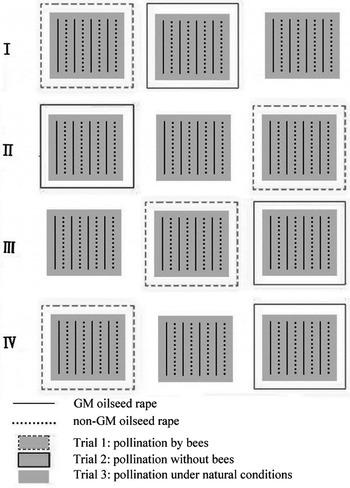
Z7B10 and Zhongshuang No. 10 oilseed rape lines were planted alternately in rows adjacent to each other in September 2011. The flowering period of oilseed rape was from 2 April to 25 April 2012, in which honey bees were used. The honeybee-mediated gene flow experiment was conducted using three different pollination trials (Fig. 1) in 12 randomly assigned separated plots, with four repeated plots for each trial. The density of plants in each plot (5 × 6 m) was adjusted to18 plants/m2 when the seedlings reached the five-leaf stage. The honeybees were isolated for 1 week prior to the experiment and artificially fed on syrup. In trial 1, the oilseed rape was pollinated by honeybees. During the flowering period, the field plot was isolated with a nylon net (100 mesh/inch) cage (5 × 6 × 3 m), and a small beehive with a queen from the current year and a brood frame containing approximately 400 worker bees (based on Bee Pollination Technical Regulations (Trial) (2010) and the Durán calculation method (Durán Reference Durán, Ulloa, Carrillo, Contreras and Bastidas2010) for the optimum amount of honeybees) was placed in the field. During the experiment, all bees foraged freely on oilseed rape. In trial 2, oilseed rape was pollinated without honeybee foraging. The oilseed rape was isolated with the same nylon net, but no beehive was placed in the field. In trial 3, pollination was conducted under natural conditions.
Experimental design of the cross-pollination between genetically modified (GM) and non-GM oilseed rape in the field.

The honey was collected once every 5 days and stored in a 50 ml tube at −20 °C until testing for GM components. At the end of the flowering period, all nylon nets were removed. When the oilseed rape matured, the seeds of non-GM Zhongshuang No. 10 were collected from each plot.
Selection of glufosinate-resistant plants
In September 2012, seeds of the pollen recipient Zhongshuang No. 10 were selected randomly from each plot and sown in 12 plots of 120 m2. Non-GM Zhongshuang No. 10 and GM oilseed rape Z7B10 lines were used as negative and positive controls, respectively. The final plant populations were estimated for each plot at the two-leaf stage by counting the number of plants in five 1 × 1 m wooden frames based on a five-point sampling method. At the two- or three-leaf stage, the seedlings were sprayed with the herbicide Basta® (Bayer Crop Science Ltd), which contained 135 g/kg of the active ingredient PPT ammonium salt, at the optimal concentration recommended by Xiao (Reference Xiao2009). The same concentration of herbicide was sprayed both 10 and 20 days after the first spraying to prevent the survival of plants sensitive to glufosinate. The survivors in each plot were counted 10 days after the third spraying. Seeds (0·117 kg) were planted in each plot (120 m2) at the standard rate of 9·75 kg/ha.
Bar gene detection for glufosinate-resistant seedlings
Polymerase chain reaction (PCR)-mediated screening was used for the presence of the B ar gene to further verify the glufosinate resistance of the seedlings surviving from repeated sprays of the herbicide glufosinate. Total DNA was extracted from all samples using the sodium dodecyl sulphate method, and 30 ng DNA was used as a template to amplify the B ar gene in a 20 µl PCR reaction system containing 1 U Taq DNA polymerase, 1× buffer, 2 · 2 mmol/l magnesium chloride (MgCl2), 0 · 2 mmol/l deoxynucleotides (dNTPs), 0 · 15 mmol/l 35SF primer (5′-CCTTCGCAAGACCCTTCCTC-3′) and 0·15 mmol/l BarR primer (5′-AAACCCACGTCATGCCAGTT-3′) under the following conditions: 3 min of denaturation at 94 °C, 35 cycles of 30 s at 94 °C, 30 s at 60 °C and 1 min at 72 °C and a final 7 min extension at 72 °C. The PCR products were analysed using 0·01 agarose gel electrophoresis.
Calculation of gene flow frequency
The frequency of gene flow between GM oilseed rape and non-GM oilseed rape under the different pollination conditions was calculated as follows: pollen flow frequency = number of glufosinate-resistant seedlings per plot/number of total seedlings per plot × 100. These values were compared statistically to examine the impacts of honeybee foraging on the frequency of gene flow between GM and non-GM oilseed rape.
Detection of genetically modified ingredients in honey
Detection of an exogenous gene in pollen isolated from honey
To examine the presence of the exogenous GM oilseed rape gene Bar in honey, pollen was isolated from the honey produced in trial 1, DNA extracted and quantitative real-time fluorescence PCR performed. Three technical replicates were used to validate the accuracy of the PCR reaction system. The procedure was conducted in a simplex system, in which the assays for the endogenous oilseed rape reference gene CruA (Cruciferin A) (Wu et al. Reference Wu, Zhang, Wu, Cao and Lu2010) and the exogenous target gene (Bar) were performed in separate wells. In every PCR run, Zhongshuang No. 10 DNA was used as a negative control, and water was used as a blank control.
In detail, 35 ml samples of honey were diluted fivefold with water and filtered using an Amicon® Ultra-15 membrane with a cut-off molecular weight of 5 kDa. The pollen in the filtrates was collected by centrifugation at 5000 g for 30 min and used directly for genomic DNA extraction and purification with a DNA Extraction kit for GMO Detection ver. 2·0 (Takara, Shiga, Japan) following the protocol provided by the manufacturer.
A 60 bp fragment specific to the Bar gene in GM oilseed rape was used as an indicator for the presence of GM ingredients and was detected using real-time PCR with the primer pair qBarF91 (ACAAGCACGGTCAACTTCC) and qBarR150 (GAGGTCGTCCGTCCACTC) and the labelled probe qBarFP111 (FAM-TACCGAGCCGCAGGAACC-TAMRA). In addition, a 101 bp fragment specific to the CruA (Cruciferin A) gene of oilseed rape was used as an endogenous reference and detected using real-time PCR with a primer pair MDB510 (GGCCAGGGTTTCCGTGAT) and MDB511 (CCGTCGTTGTAGAACCATTGG) and the labelled probe TM003 (FAM-AGTCCTTATGTGCTCCACTTTCTGGTGCA-TAMRA). All real-time PCR was conducted on a fluorometric thermocycler in a 20 µl reaction system containing 2·5 ng/μl template DNA, 0·04 U SH Taq DNA polymerase, 1× buffer, 3 · 0 mmol/l MgCl2, 0·3 mmol/l dNTPs, 0 · 2 µmol/l primers and 0·1 µmol/l probes under the following conditions: denaturation at 95 °C for 5 min, 50 cycles of 15 s at 95 °C and 1 min at 60 °C and a final extension at 60 °C for 10 min. Fluorescence intensity was measured for every PCR cycle at the annealing step.
Detection of exogenous protein in honey
The Bar gene product, PAT, was detected using an immunochromatographic detection kit according to the protocol provided by the manufacturer (Quick Stix™ for LibertyLink®/bar) in both the filtrate (containing unbroken pollen) and the supernatant collected after centrifugation at 5000 g for 30 min (pollen-free). In addition, a leaf extract of the non-GM oilseed rape Zhongshuang No. 10 was used as a negative control.
Statistical analysis
Differences in the gene flow frequencies under different pollination conditions were analysed by one-way analysis of variance (ANOVA) with Duncan's multiple range test.
Data were analysed using SPSS 19.0.
RESULTS
Gene flow frequency under the different pollination conditions
Three pollination experiments were conducted to study the effects of different pollination conditions on the frequency of gene flow between GM oilseed rape (Z7B10) and non-GM oilseed rape (Zhongshuang No.10). A total of 10 794 glufosinate-resistant oilseed rape seedlings was detected from 408 192 examined seedlings after spraying the plants with the herbicide glufosinate three times.
The gene flow frequency between GM and non-GM oilseed rape varied under different pollination conditions (Table 1) with the highest frequency (0·041) for honeybee-mediated pollination and the lowest (0·014) without honeybee pollination. The ANOVA (Tables 1 and 2) showed that the gene flow frequency was significantly different among the different pollination conditions (one-way ANOVA, F = 800·7, d.f. = 2, 9, P < 0·01). Furthermore, the gene flow frequency (0·024) of natural pollination was higher than that of pollination without honeybees (0·014), probably because of the nylon net that prevented bees and other pollinators to enter and also reduced the wind speed.
Gene flow frequencies (proportion) under different pollination conditions

s.e.m., standard error of the mean.
Analysis of variance (ANOVA) for gene flow frequencies under different pollination conditions

Detection of the glufosinate-resistant Bar gene
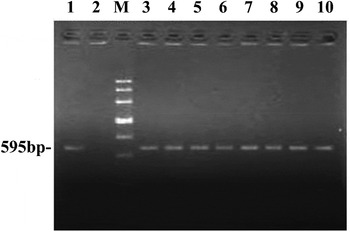
To further confirm the resistance of seedlings, a total of 330 surviving seedlings was collected randomly to examine the presence of the B ar gene. Results (Fig. 2) showed that a 595-bp band specific to the B ar gene was amplified from all surviving seedlings examined and the positive control (Z7B10), but not from the negative control (Zhongshuang No. 10). This indicates that all seedlings surviving from the glufosinate spray in the field possessed the B ar gene, confirming that the gene flow frequency obtained in the field trial was reliable.
Detection of the bar gene, which confers glufosinate resistance, using polymerase chain reaction (PCR). M, marker III; 1, positive control of the genetically modified (GM) oilseed rape Z7B10; 2, negative control of the non-GM oilseed rape Zhongshang No. 10; 3–10, the Zhongshuang No. 10 oilseed rape seedlings surviving after three separate sprayings with the herbicide glufosinate.

Detection of an exogenous gene in pollen isolated from honey
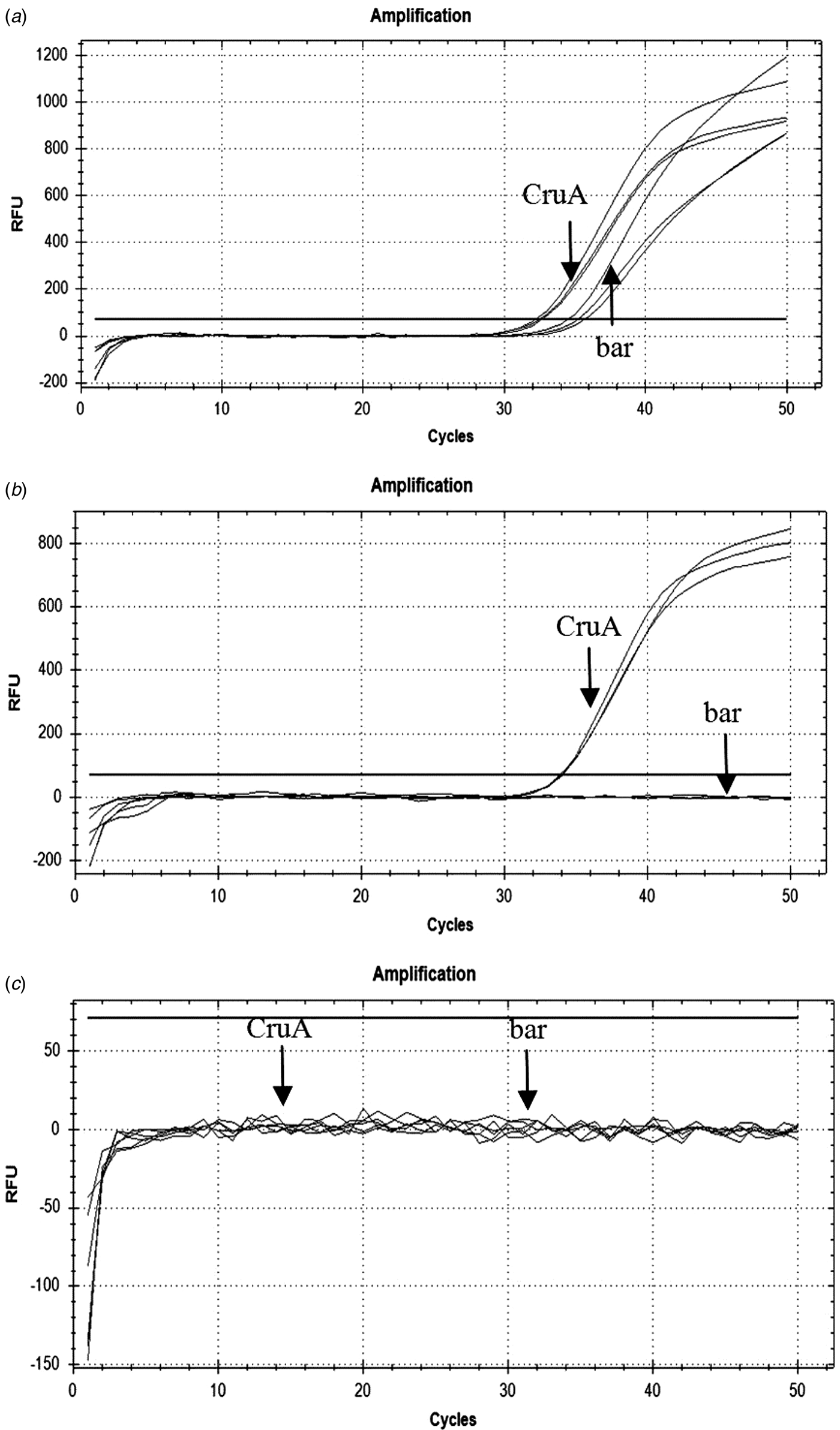
To determine the presence of GM pollen in the honey, DNA that had been extracted from the pollen isolated from the honey was used as a template for the quantitative detection of the exogenous gene Bar and the endogenous reference gene CruA using real-time PCR. Figure 3(a) shows the amplification of both CruA and Bar in the oilseed rape pollen isolated from honey, while Fig. 3(b) shows that CruA alone was amplified in the negative control (Zhongshuang No. 10) and Fig. 3(c) shows that no genes were amplified in the blank control (water).
Detection of the reference gene (CruA) and foreign gene (Bar) using real-time polymerase chain reaction (PCR). (a) Oilseed rape pollen isolated from honey; (b) negative control of the non-genetically modified (GM) oilseed rape Zhongshang No. 10; (c) blank control of double-distilled water.

Detection of exogenous protein in honey
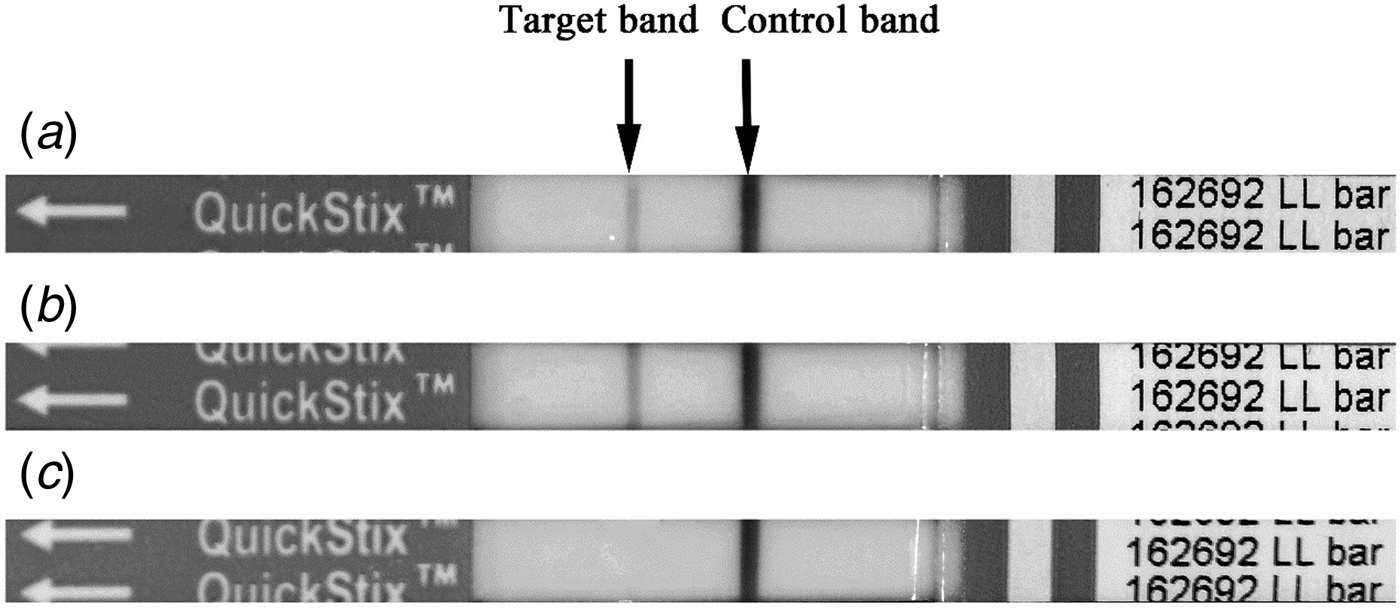
The presence of exogenous PAT, the Bar gene product, in both unbroken pollen-containing and pollen-free honey was examined using the Quick Stix™ strips for LibertyLink®/bar. Staining of both the target and control bands was considered as positive for PAT. Results showed that both sets of honey samples were positive for PAT (Figs 4(a) and (b)), while the samples from the non-GM oilseed rape Zhongshuang No. 10 were negative (Fig. 4(c)), demonstrating that honeybees foraging on GM flowers could lead to the contamination of honey with exogenous protein.
Detection of the protein phosphinothricin acetyltransferase (PAT) using protein testing strips (Quick Stix™ for LibertyLink®/bar). (a) Unbroken pollen-containing honey; (b) pollen-free honey; (c) negative control of the non-genetically modified (GM) oilseed rape Zhongshang No. 10.

DISCUSSION
Oilseed rape has bright yellow flowers with a unique fragrance that can attract insect pollinators, especially honeybees. Honeybee foraging behaviour is affected by a number of environmental factors and by species (Gauld & Bolton Reference Gauld and Bolton1989; Li et al. Reference Li, Zhu, Wang, Huang, Zhang, Ding and Huang2007). In the current study, three different pollination treatments were designed to estimate the effects of Chinese honeybee foraging on gene flow of GM oilseed rape. The results demonstrated that the gene flow frequency (0·041) under honeybee pollination was the highest and was significantly greater than that (0·014) without any honeybee involvement. Previous researchers found that under conditions of frequent honeybee pollination, the outcrossing frequency of oilseed rape increased significantly, which improved yield, fruit set and oil production markedly (Shi et al. Reference Shi, Guan, Zeng, An and Luo2009; Durán et al. Reference Durán, Ulloa, Carrillo, Contreras and Bastidas2010). In addition, Hayter & Cresswell (Reference Hayter, Cresswell and Boelt2003) used the approach of removing petals from oilseed rape flowers to determine that insects were the primary pollen vectors. Ramsay et al. (Reference Ramsay, Thompson and Squire2003) showed that covering male-sterile oilseed rape planted next to GM oilseed rape field with anti-insect nets largely reduced the number of pollinated flowers on these plants. All of these studies confirmed that honeybee foraging on oilseed rape could lead to pollen dispersal. It was likely that in the current experimental system, as in previous studies (Timmons et al. Reference Timmons, O'Brien, Charters, Dubbels and Wilkinson1995; Ramsay et al. Reference Ramsay, Thompson, Neilson, Mackay and Lutman1999; Hoyle et al. Reference Hoyle, Hayter and Cresswell2007), wind and bees were the main vectors of gene flow in oilseed rape. Moreover, the current results provided some evidence about the relative contribution of these two vectors. Specifically, it was found that the level of gene flow into the experimental plots increased with their exposure to flower-visiting honeybees. These observations strongly suggest that gene flow was mediated by honeybee activity. If wind pollination was the sole pollen vector, it might be expected that gene flow would have been highest in the open-pollinated patches, because in these alone the airflow was uninterrupted by caging. The current interpretation is provisional, however, because of the un-replicated nature of the current experimental treatments. Discriminating the relative importance of bees v. wind is a target for future experiments. One potential avenue for further investigation is to vary the size of recipient plots, because if honeybees were indeed the main vector for gene flow, lower levels would be observed in larger plots (Cresswell & Osborne Reference Cresswell and Osborne2004).
In the current study, an isolation distance of 3 km was established around the experimental fields, and there were no artificial beehives within a radius of 5 km. The main pollinating insects observed in the field were honeybees and hover flies (Bo et al. Reference Bo, Shi, Xu, Hu and Zhao2012). However, relatively few honeybees were present under natural conditions (Zhao et al. Reference Zhao, Tang, Chen, Liu, Wang, Bu and Lu2013). The results showed that the gene flow frequency of 0·041 under the honeybee pollination condition was significantly higher than the frequency of 0·024 observed under the natural pollination condition, which suggested that honeybees, not wind, became the main vector of gene flow if the number of honeybees reached a certain amount in the rape field. Therefore, the risk of transgene dispersal would increase if artificial beehives were located near the areas with the commercial cultivation of GM crops. To reduce the frequency of gene flow from GM crops, the appropriate isolation distance between artificial beehives and GM crops should be further determined, and the buffer zones around fields of GM crops should also be defined.
Transgenes and their expressed proteins may also be present in plant organs and their secretions, and honeybee foraging on GM crops may therefore contaminate bee products. Cheng et al. (Reference Cheng, Jin, Wu, Wang, You, Peng and Jia2007) detected the exogenous worm-resistant Cry1Ac gene in honey from a Bt-transgenic cotton planting area in China. However, some researchers noted that the Bowman–Birk soybean trypsin inhibitor (BBI) gene could not be detected in the nectar or pollen of BBI-transgenic oilseed rape (Malone & Pham-Delègue Reference Malone and Pham-Delègue2001 ). The current results showed that honey collected from hives in trial 1 was contaminated with GM pollen. Furthermore, the exogenous protein PAT was found in both unbroken pollen-containing and pollen-free honey, indicating that honeybee foraging could lead to the contamination of honey with GM ingredients. In New Zealand and other countries, honeybee hives used for the production of organic honey must be placed at least 3 km away from commercially planted crops (Malone Reference Malone2002).
In China, rapeseed oil accounts for 0·57 of the national total vegetable oil production; rape honey accounts for >0·40 of national honey production and is exported to other countries around the world (Wang Reference Wang2010; Yan Reference Yan2015). As a predominant pollen vector, honeybees can affect the frequency and distance of gene flow directly. Contamination of honey products with GM material can affect their export potential. Previous studies indicated that the level of GM contamination from pollen might be controlled to an acceptable level (<0·001) by adequate isolation distance and buffer zones (Cresswell Reference Cresswell1994; Damgaard & Kjellsson Reference Damgaard and Kjellsson2005; Hüsken & Dietz-Pfeilstetter Reference Hüsken and Dietz-Pfeilstetter2007). Zhao et al. (Reference Zhao, Tang, Chen, Liu, Wang, Bu and Lu2013) suggested that 300 m was a reasonable distance to ensure a tolerable threshold of pollen flow (<0·0001) under conditions of winter oilseed rape production in China. However, no standard has been developed so far for the detection of GM components in bee products. Considering that the range of the pollinator reaches 1·5–6 km, or even further in cases of insufficient nectar (Thompson et al. Reference Thompson, Squire, Mackay, Bradshaw, Crawford, Ramsay and Lutman1999; Pasquet et al. Reference Pasquet, Peltier, Hufford, Oudin, Saulnier, Paul, Knudsen, Herren and Gepts2008; Hagler et al. Reference Hagler, Mueller, Teuber, Machtley and Van Deynze2011), honeybee hives should be placed at least 1·5 km away from GM crops.
Genetically modified oilseed rape is still not approved for commercial cultivation in China. The systems for risk assessment, monitoring and management of GM oilseed rape are still imperfect. Prevalence of the scattered farming model in China, in particular, is not conducive to either extensive commercial cultivation or risk management of GM crops. Insect-mediated gene flow, particularly that involving honeybees, is an important factor restricting the commercial cultivation of GM crops. Although the current research confirmed the influence of honeybee-mediated pollen dispersal and gene flow in a small area, long-distance gene dispersal mediated by Chinese honeybees requires further intensive investigation.
This work was supported by the National Natural Science Foundation of China (31300463), the Natural Science Foundation of Jiangsu Province (BK20130414, BK2012242), and the Qing Lan Project of Jiangsu Province. The authors gratefully acknowledge the technical assistance provided by Gang Wu, Jun Li and Changming Lu (Oil crops Research Institute, Chinese Academy of Agricultural Sciences).