Introduction
The environmental conditions under which a seed can germinate can be described by the germination niche, which forms a part of the larger regeneration niche as described by Grubb (Reference Grubb1977). Temperature is usually the main environmental factor governing germination when water is not limiting (Probert, Reference Probert and Fenner2000; Fenner and Thompson, Reference Fenner and Thompson2005). The germination niche has temperature dimensions that can be described in terms of niche position (optimum temperature for germination), niche breadth (range of temperatures over which germination can occur) and niche limits (upper and lower limits for germination). The optimum temperature for germination may be defined as the temperature at which the greatest germination percentage is achieved in the shortest possible time (Mayer and Poljakoff-Mayber, Reference Mayer and Poljakoff-Mayber1975). This temperature, by and large, matches the most favourable conditions for subsequent seedling establishment and survival (Bell et al., Reference Bell, Plummer and Taylor1993; Fenner and Thompson, Reference Fenner and Thompson2005). When temperatures rise above optimum, there is typically a delay and decline in germination. The slope of the change in germination from this ‘threshold’ high temperature may be considered a measure of the seeds' sensitivity to temperature: the steeper the slope the more vulnerable a seedlot is to smaller increases in temperature above the optimum (Cochrane et al., Reference Cochrane, Daws and Hay2011). These characteristics of the germination niche are useful parameters to use when comparing seed performance across species, populations and seedlots, and in the context of climate change.
Rapid climate change has the potential to disrupt existing environmental cues for germination (Walck et al., Reference Walck, Hidayati, Dixon, Thompson and Poschlod2011). The degree of disruption will depend largely on species' sensitivity to changes in temperature and the plasticity in response among populations and individuals (Vickery, Reference Vickery1967). However, studies that have investigated the projected impacts of climate change on the germination niche have often ignored population-level variation in seed traits and responses (but see Perez-Garcia et al., Reference Perez-Garcia, Hornero and Gonzalez-Benito2003; Giménez-Benavides et al., Reference Giménez-Benavides, Escudero and Pérez-García2005; Orrù et al., Reference Orrù, Mattana, Pritchard and Bacchetta2012), yet these may vary substantially among different populations of a species. Among-population variation in seed traits is predicted to increase with increasing range size and heterogeneity (Luna and Moreno, Reference Luna and Moreno2010) and, like adaptive plasticity, among-population variation in seed traits is expected to buffer the effects of climate on plant performance. Specialist species with small geographic distributions appear to have narrow germination niches (Ascough et al., Reference Ascough, Erwin and Van Staden2007; Ranieri et al., Reference Ranieri, Pezzini, Garcia, Chautems and França2012). Those species already encountering broad climatic conditions across their range are likely to have more flexible dimensions for germination (i.e. a broader germination niche) (Thuiller et al., Reference Thuiller, Lavorel and Araújo2005; Luna et al., Reference Luna, Pérez, Torres and Moreno2012). These generalist species are the ones that will have a greater chance of persisting in unpredictable environments.
In seasonal Mediterranean-climate ecosystems like the South Western Australian Floristic Region (SWAFR), temperature is currently not considered to be a limiting factor for recruitment (Lloret et al., Reference Lloret, Peñuelas and Estiarte2004). Here, the cool, wet winter conditions commonly trigger germination (Mott, Reference Mott1972; Bellairs and Bell, Reference Bellairs and Bell1990; Bell et al., Reference Bell, Rokich, McChesney and Plummer1995; Bell, Reference Bell1999), maximizing the period of root development prior to the warm, summer drought, thereby reducing the risk of seedling desiccation (Moles and Westoby, Reference Moles and Westoby2004). However, the forecast for the SWAFR (and other Mediterranean-climate regions of the world), is for an upward shift in mean annual temperature coupled with a downward trend in precipitation (http://www.ioci.org.au/). Already, an increase of 0.15°C per decade in annual mean temperature has occurred over the past 30 years in the SWAFR, including a significant reduction in early winter rainfall since the 1970 s (Bates et al., Reference Bates, Hope, Ryan, Smith and Charles2008). Changes are likely to influence the timing and success of germination, resulting in substantial implications for individual species survival (Hanson and Weltzin, Reference Hanson and Weltzin2000; Klausmeyer and Shaw, Reference Klausmeyer and Shaw2009; Walck et al., Reference Walck, Hidayati, Dixon, Thompson and Poschlod2011) and community composition (Suttle et al., Reference Suttle, Thomsen and Power2007; Suggitt et al., Reference Suggitt, Gillingham, Hill, Huntley, Kunin, Roy and Thomas2011). In all likelihood, there will be a point in the future when the climate tolerances of many species will be exceeded (Yates et al., Reference Yates, McNeill, Elith and Midgley2010).
In light of these forecast changes, we examined the current temperature characteristics of the germination niche in natural populations of four Banksia R.Br. (Proteaceae) species that inhabit a longitudinal climate gradient in the SWAFR. Bio-climatic modelling has highlighted the vulnerability of Western Australian Banksia to the effects of predicted climate change (Fitzpatrick et al., Reference Fitzpatrick, Gove, Sanders and Dunn2008; Yates et al., Reference Yates, McNeill, Elith and Midgley2010); however, there is limited empirical evidence to support these claims, and little is known of among-population variation in responses to altered climatic conditions. Specifically, we aimed to identify the temperatures that define the germination niche (position, breadth and limits) for these species, across multiple populations and in the context of the region's changing climate. By collecting seeds from wild populations across a range of habitats and relating their responses to habitat of origin we hoped to learn how germination strategies have maximized establishment probabilities in specific habitats. We investigated whether the temperature dimensions of the germination niche: (1) varied between species; (2) varied among populations of each species; and; (3) varied in a consistent manner reflecting the climatic gradients of seed origin. We hypothesized that the characteristics of the germination niche of the four species would differ due to their different geographic distributions, expecting that the species with the smallest geographic distribution would have the smallest niche breadth and vice versa. Furthermore, we predicted that niche characteristics would differ among populations, but that there would be geographic patterning in germination response that reflected the climatic gradients of seed origin. We expected that seeds from species and populations currently at the warmer, drier end of the climate gradient would be better adapted to higher temperatures, potentially more plastic, and thus have a broader germination niche, than seeds from the cooler, wetter habitats.
Materials and methods
Species and seed collecting
Four congeneric Banksia species endemic to the South Western Australian Floristic Region (SWAFR) were selected for this investigation: Banksia baxteri, B. coccinea, B. media and B. quercifolia (Table 1, Fig. 1). All species are fire-killed (obligate seeding), recruiting in the post-fire environment from woody fruit held in the plant canopy, with inter-fire establishment only significant in B. coccinea (Lamont and Connell, Reference Lamont and Connell1996). The species grow in different but partially overlapping habitats and are locally common where they occur. Seeds were collected from six geographically distinct groups of individuals of each species (24 populations in total, covering a range of approximately 850 km). The phylogenetically related B. baxteri and B. coccinea share a similar range (c. 300 km and 360 km respectively) and occur roughly in the centre of the gradient; B. media has the largest geographic range of the study species (c. 600 km) and its distribution is at the eastern, warmer end of the gradient; B. quercifolia, at the cooler, western end of the gradient, has the smallest range at c. 200 km. Within species, two populations represent sites from the core of the species' range (M1 and M2), while two other populations represent sites from the western, high rainfall, cool margin (H1 and H2) and two from the eastern, low rainfall, warmer margin (L1 and L2). In the region, mean annual temperature (MAT °C) along the gradient is positively correlated with longitude (Pearson's r= 0.7297; P< 0.001), and the coefficient of variation for temperature seasonality confirms greater heterogeneity in temperature towards the eastern edge of the gradient (Pearson's r= 0.4987; P= 0.013) (unpublished data). Across all populations, similar aged cones (1–2 years old) were sampled from the canopies of at least 50 adult plants at each site and pooled. Fruits were stored in a temperature and humidity controlled drying room at 15°C and 15% relative humidity until ready for processing. Seed extraction involved the burning of woody cones with a gas blowtorch for 2–4 s until follicles cracked; then the soaking of burnt cones in water for 6–8 h to expand the follicles; followed by drying of cones at 15°C and 15% relative humidity until seeds were released. This wetting and drying process mimics rainfall after an autumn bushfire in situ and enhances rapid seed release in many Banksia species. Seeds found to be damaged or predated by insect larvae were discarded.
Geographic distribution, rainfall gradient (H, high rain; M, medium rain; L, low rain) and site details for populations of four fire-killed Banksia species from the SWAFR. Mean annual precipitation (MAP; mm) and mean annual temperature (MAT; °C) were extrapolated from bioclimatic data from WorldClim, a set of global climate layers with a spatial resolution of approximately 1 km2 (Hijmans et al., Reference Hijmans, Cameron, Parra, Jones and Jarvis2005)

* Both B. baxteri and B. coccinea occur at these sites.
(colour online) Geographic distribution of the four study species (small symbols) and specific seed source sites (large symbols) in the South Western Australian Floristic Region.

Seed germination testing
Germination tests were carried out at 14 constant temperatures between 5 and 40°C on a temperature gradient plate (TGP) (Model GRD1, Grant Instruments, Cambridge, UK). We chose constant rather than alternating temperatures because many species of Banksia from the South Western Australian Floristic Region appear to have temperature requirements for germination that are generally satisfied by constant, rather than alternating, temperatures (unpublished data) despite probably experiencing alternating temperatures in situ.
For each of the 14 temperatures, we used three replicates of either five (B. baxteri and B. media) or ten (B. coccinea and B. quercifolia) seeds, depending on seed size. Seeds were sown on the surface of 1% w/v water agar in 35-mm Petri dishes and received irradiance for 12 h d− 1. The TGP was capable of incubating dishes from 12 populations at a time across all temperatures, therefore, in order to perform germination tests on three replicates of all 24 populations, six runs of the TGP were required. The populations were randomized across each run, with one population of each species sown per run. Germination, defined as visible radicle emergence to at least 4 mm, was scored every 2 d and seedlings were removed and discarded. All runs ran for 56 d, after which non-germinated seeds were subjected to a cut-test to estimate potential viability. Empty or infested seeds were subtracted from the number of seeds sown.
Statistical analysis
Germination percentage was calculated as the percentage of viable seeds that germinated within 56 d. The mean time to germination (MTG) was calculated using the formula: MTG = Σ(n i × d i )/N where n i = the number of seedlings that germinated in each scoring interval, d i = the time in days since seed was sown to the end of the interval and N= the total number of seedlings that germinated. MTG is an indication of the spread of germination of a seed population and describes the delay in germination from the start of imbibition to radicle protrusion.
A generalized linear model was fitted for each replicate for populations of each species to relate the proportion of seeds germinating to temperature. A binomial distribution with a logistic link function was fitted and a quadratic equation for temperature was used as the linear predictor of response. From the fitted models we derived the optimum temperatures which gave maximum germination (Gmax), the temperatures at which maximum germination occurred (Topt), the niche breadth for 50% (Tb50) and 90% of maximum germination (Tb90) as well as the upper and lower temperature limits for 50% (Tu50, Tl50) and 90% of maximum germination (Tu90, Tl90), and finally the temperatures at which germination declined to < 1% (T1). We fitted the models to derive the slope of the decline in germination that occurred between 90% and 50% of maximum germination (S90-50), and fitted a quadratic equation to the logarithm of the mean time to germination (MTG) to derive the slope that described the delay in germination time between 50% and 90% germination (MTG50-90). We were interested in the upper niche limits for germination and the slope of the germination delay and decline due to the increase in mean annual temperature forecast for the region (Bates et al., Reference Bates, Frederiksen and Wormworth2012). We analysed the resulting data in a linear model to investigate whether parameters were correlated with mean annual temperature (MAT) along the climate gradient.
Analysis of variance of the derived parameters from the 72 combinations of species, replicates and populations was used to investigate the variation in niche parameters between species and populations. We plotted the relationship between temperature and final germination percentage (and separately MTG) above the optimum constant temperature for seeds of the 24 populations and compared the slopes of reaction norms (S90-50 and MTG50-90) to identify variation in population response. All analyses were performed using GenStat 15th edition (VSN International, 2011) and data back-transformed before analyses.
Results
Species-level responses
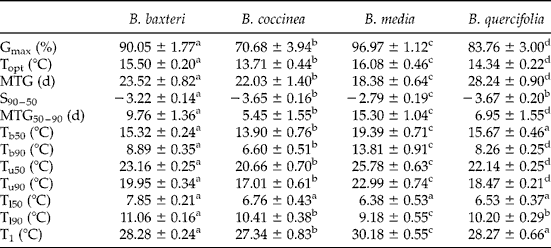
Mean maximum germination (i.e. the mean of six populations per species) was relatively high across the species and ranged from 71% in B. coccinea to 97% in B. media (Table 2). The optimum constant temperature for maximum germination was 15°C (commonly within the range of 13–16°C), with germination possible between 5 and 26°C. Germination response to increasing temperature followed a normal, bell-shaped distribution, rising to a plateau before declining past the optimum temperature for both the fitted values from the linear predictor and the measured temperatures for germination (Fig. 2a). Mean time to germination across the range of temperatures was between 18 and 50 d (Fig. 2b), and was 28 d or less for all species at optimum temperatures. Temperatures for germination between 50 and 90% of maximum germination demonstrate the breadth of the temperature range over which germination occurred and illustrate the differences between the species (Fig. 3). When seeds were sown above the optimum temperatures, germination was delayed (i.e. MTG was higher), and final germination percentage was lower than that at optimum temperatures (Fig. 4).
Species values (± standard error) for the germination niche parameters (mean of six populations per species). Maximum germination (Gmax), the temperatures at which maximum germination occurred (Topt), mean time to germination (MTG) for maximum final germination percentage, the slope of the decline between 90% and 50% germination (S90–50), the slope of the delay between 50 and 90% germination (MTG50–90), the breadth of the temperature niche for 50% (Tb50) and 90% germination (Tb90), the upper and lower temperatures that gave 50% (Tu50, Tl50) and 90% of maximum germination (Tu90, Tl90) and the maximum temperatures which gave 1% (T1). Species trait values with the same superscript are not significantly different at P<0.05

The impact of constant temperatures on mean germination response in four Banksia species from Western Australia. Points represent mean germination values and the fitted line is the predicted response for each species. (a) Final germination percentage and (b) mean time to germination. Banksia baxteri (▲), B. coccinea (○), B. media (●) and B. quercifolia (Δ).

The temperature windows for species germination for (a) 50% and (b) 90% of maximum germination. Mean optimum temperature for each species indicated by ●. Banksia baxteri (Bb), B. coccinea (Bc), B. media (Bm) and B. quercifolia (Bq).

Germination response to above-optimum constant temperatures in populations of four Banksia species: (a–d) final germination percentage; and (e–h) mean time to germination (MTG). The linear predictor of response (slope) represents the decline in germination (left panels) or the increase in MTG (right panels) from maximum (scaled to 100%), through 90 and 50% germination, to the temperature intercept where germination response is < 1%. H, high rainfall populations (solid lines); M, medium rainfall populations (dashed lines); and L, low rainfall populations (fine dotted lines).

Our hypothesis that the germination niche of the four species would be characterized by a different pattern of germination response was supported. The analysis of variance revealed that species differed significantly in almost all germination parameters (Table 2), despite the shape of the response being consistent across the species (Fig. 2). Of the four species, B. media exhibited the highest germination (97%), in the fastest time (MTG 18.4 d) and had the highest optimum temperature for germination (16°C). The slope of the decline in germination between 90 and 50% of maximum was smallest in this species, resulting in 30°C being the predicted temperature at which germination would decline to < 1%. However, B. media had the greatest lag time to germination between 50 and 90%. This resulted from fast germination under optimum temperatures but much slower germination under suboptimal temperatures relative to the other species. B. media had the broadest range of temperatures for germination (19.4°C for 50% and 13.8°C for 90% germination). The upper temperature thresholds for 50 and 90% germination were 25.8 and 23°C; this species also had the lowest temperatures for 50 and 90% germination (6.4 and 9.2°C respectively), thus reflected in the broad range of temperatures over which germination occurred (Table 2).
In contrast, B. coccinea exhibited the lowest final germination percentage, lowest optimum temperature for maximum germination (13.7°C) and shared the steepest slope of decline in germination with B. quercifolia ( − 3.65 and − 3.67, ns) (Table 2). B. coccinea also exhibited the least delay in MTG between 50 and 90% germination (shallowest slope); however, the width of the temperature niche for germination was smallest (13.9 and 6.6°C, respectively). The upper temperature limits for germination were smallest (20.7°C for 50% and 17°C for 90%), and the temperature at which germination was predicted to decline to < 1% was 27.3°C, the lowest across all species.
Despite germination declining steeply between 90 and 50%, B. quercifolia had the longest mean time to maximum germination (28 d to achieve 83.8% at 14.3°C). B. baxteri had the highest low threshold temperature for both 50 and 90% germination (7.8 and 11°C, respectively) (Table 2).
Population-level responses and their relationship to climate
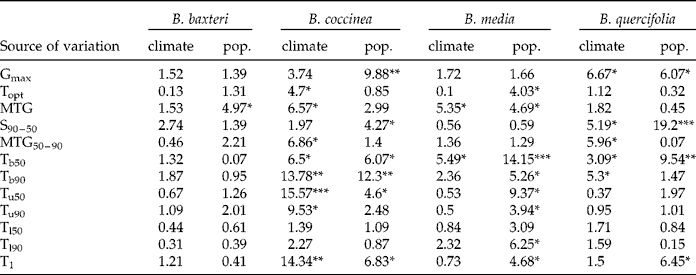
The predicted slope of the decline (or delay) between maximum and < 1% germination represents the sensitivity of seed to increasing temperatures above the optimum (for both germination and MTG) and highlights the differences between the six populations of each species (Fig. 4). There were a number of significant population differences for the niche parameters (Table 3), confirming our expectations that populations would diverge in their various responses to temperature. Final germination percentage, MTG, difference in niche breadth for 50 and 90% germination, the maximum temperature at which < 1% germination could occur and the upper temperature limits for both 50 and 90% germination all show among-population differences for at least one of the species (Table 3). B. coccinea was the only species to exhibit differences among its populations for both optimum temperature for germination and MTG. B. baxteri was the only species that did not show significant population differences for maximum temperature at which germination declines to < 1%, or the breadth of the temperature window for 50% germination. B. baxteri and B. quercifolia, populations did not differ in optimum temperature for germination. There were no among-population differences for the lower temperature limits for germination to 50% or the delay in MTG between 50 and 90% germination.
Results of analysis of variance examining the effect of climate (n=3) and population (pop.; n=2 per climate) on germination niche parameters. Abbreviations as for Table 2

*P< 0.05; **P< 0.01; ***P< 0.001.
The optimum temperatures for maximum germination and MTG were both correlated with mean annual temperature at sites along the gradient (i.e. cross species); mean annual temperature (MAT) explained 22% of variance in MTG, and 16% of variance in optimum germination temperature along the gradient (Fig. 5). However, the data do not support our expectations of local adaptation as the relationships decoupled within the individual geographical ranges of each species, such that there was no significant correlations between MAT and germination response (as measured by optimum temperature for germination and MTG) for any species.
The relationship between mean annual temperature (MAT °C) at the geographical location of seed source and (a) optimum temperature for maximum germination (Topt) and (b) mean time to germination at maximum germination (MTG) (n= 24 populations). Solid black line represents the fit of the relationship between germination response and MAT along the gradient. Banksia baxteri (▲), B. coccinea (○), B. media (●) and B. quercifolia (Δ). Pearson's correlation r and significance of the relationship are displayed in each panel.

Discussion
In this study, seeds were pushed past the limit of normally experienced (but kept within ecologically relevant) temperature ranges to examine the temperature characteristics of the germination niche across natural populations of four Banksia species from the Mediterranean-climate ecosystem of the South Western Australian Floristic Region (SWAFR). We demonstrated that the relationship between temperature and germination parameters varied between the species, and for some niche parameters this relationship also varied among populations.
Of the four species, B. media demonstrated greatest thermal tolerance: compared to the other species, germination was quicker and more complete when seeds were exposed to above-optimum germination temperatures. Germination also occurred at a higher mean temperature compared to the other species, with more than 50% germination occurring over temperatures spanning more than 13°C. Temperatures are commonly higher but more variable towards the eastern end of the gradient where B. media occurs. The geographical range of this species is also 2–3 times larger than that of the other species investigated, potentially contributing to significant variation among populations in temperature sensitivities and the breadth of the germination niche (Luna and Moreno, Reference Luna and Moreno2010; Luna et al., Reference Luna, Pérez, Torres and Moreno2012; Ranieri et al., Reference Ranieri, Pezzini, Garcia, Chautems and França2012). The ability of B. media to germinate over a wide range of temperatures may indicate that the geographical range of this species will remain stable or contract to a lesser degree compared to the other species in the future. That said, the faster decline in mean time to germination above optimum temperatures may be detrimental for seedling survival, as slow-germinating seeds risk predation prior to emergence and may be subject to greater competition for moisture and nutrients than faster-germinating seeds (Norden et al., Reference Norden, Daws, Antoine, Gonzalez, Garwood and Chave2009). Despite the relatively high optimum temperature for germination of B. media and the breadth of its germination niche, regeneration is only one aspect of a species' life cycle and bio-climatic modelling has indicated range decline for this species under future climate scenarios (Fitzpatrick et al., Reference Fitzpatrick, Gove, Sanders and Dunn2008; Yates et al., Reference Yates, McNeill, Elith and Midgley2010).
In contrast, B. coccinea demonstrated the narrowest range of temperatures above which greater than 50% germination was observed. This species co-occurs with B. baxteri across much of its geographical distribution, yet the response to temperature diverged for these two species: B. coccinea demonstrated significant among-population variation for a number of germination parameters, whereas B. baxteri did not. Species that exploit a similar ecological niche generally show differentiation in traits that permit co-existence (Violle and Jiang, Reference Violle and Jiang2009). In this case, differences in speed of germination and temperature at which germination is possible (and optimal), may reduce competition for resources. B. coccinea can germinate under cooler conditions, potentially providing an advantage over B. baxteri, which is faster growing (unpublished data). The fourth species, B. quercifolia, was able to achieve 50% or greater germination over a similar range of temperatures to B. baxteri. Populations of this species showed little differentiation in response to temperature, potentially reflecting homogeneity in the environment across its smaller geographical range.
When data were pooled across species, optimum temperatures for germination were correlated with mean annual temperature at location of seed origin; however, the variation observed among the populations was generally not related to the climate from where seeds were sourced. Our hypothesis that warmer, eastern populations of each species would be more tolerant of the effects of temperature (and have a broader germination niche) was not supported. Failure to identify geographical patterning (Hernández-Verdugo et al., Reference Hernández-Verdugo, Oyama and Vázquez-Yanes2001) or local adaptation (Leimu and Fischer, Reference Leimu and Fischer2008) within species is not rare, and seed sensitivity to temperature thresholds and climate from seed source site is not always related (Battaglia, Reference Battaglia1997). Our data illustrated occasions when populations diverged in their response to temperature, but this difference was not consistently driven by climate at seed origin. The lack of correlation with climate variables should not negate the value of the data, and even though doubts do exist as to the relevance of laboratory experiments for predicting field response (Thompson and Ceriani, Reference Thompson and Ceriani2003) or climate change effects (Barnes et al., Reference Barnes, Peck and Morley2010), a temperature gradient plate allows tolerance to a single environmental variable to be identified across multiple populations. In the context of climate change, this approach to examining the germination niche is useful for screening responses over a large range of temperature conditions, without the need for multiple germination incubators.
Niche characteristics can be powerful indicators of species' sensitivities to climate change. Consequently, experiments that provide insight into dimensions of the germination niche are relevant to our understanding of a species' ability to cope with physiological stress. In particular, the upper and lower temperature limits for performance are significant components of the germination niche for many species (Larcher, Reference Larcher1995). If the niche of a species is static, then it is unlikely to shift easily (Pearman et al., Reference Pearman, Guisan, Broennimann and Randin2008). On the other hand, natural selection should favour aspects of the niche that show flexibility, acting more strongly on niche parameters that show divergence among populations. However, tolerance to heat appears to be largely conserved between and within species, while tolerance to cold is not (Araújo et al., Reference Araújo, Ferri-Yáñez, Bozinovic, Marquet, Valladares and Chown2013). In contrast, our four Banksia species were generally similar in their lower thermal limits for germination but the species differences in the upper limits were significant. Among populations of B. coccinea and B. media the upper thermal limits for germination were also more flexible than the lower limits, and not conserved. We therefore conclude that there is the potential for germination niche shift in these species in a future, warmer world. However, in the context of ongoing warming, the sensitivity of B. coccinea to higher temperatures may still constrain germination and fitness, particularly if temperature changes are rapid.
Increasing our awareness of the effects of temperature on the germination niche is vital to our understanding of post-disturbance regeneration in fire-prone, Mediterranean-type ecosystems like the SWAFR, particularly in a future, warmer world. Species that are killed by fire and rely on germination from seeds may be particularly susceptible to decline and extinction if temperature conditions following a disturbance are unsuitable for germination or subsequently result in seedling death. Recognizing the limitations for germination will help in the selection of appropriate seed sources for ecological restoration and species reintroduction under warmer climates. Incorporating locally adapted genotypes and those expected to be more suited to future conditions (i.e. more generalist), should enhance climate resistance in restoration projects, as among-population variation in adaptive traits can act as a buffer against warming temperatures (Albert et al., Reference Albert, Thuiller, Yoccoz, Soudant, Boucher, Saccone and Lavorel2010). Investigating alternating temperature regimes and the interaction of temperature and moisture on seed response would further clarify the species' ability to acclimatize to forecast climates, and comparable field and glasshouse studies would help determine whether thresholds detected in the laboratory are relevant to the field.
Acknowledgements
We thank Anne Monaghan and Simone Dudley (Department of Parks and Wildlife, Western Australia) for providing technical assistance during scoring of germination, and two anonymous reviewers for helpful comments on a previous draft.
Financial support
The temperature gradient plate was purchased for A.C. by the South Coast Natural Resource Management Inc., Albany, Western Australia through Australian Government funding. A.C. was supported by a doctoral scholarship from the Australian National University, Canberra, Australia.
Conflicts of interest
None.