1 Introduction
The study of extra-legal factors in law is widely developed in socio-legal studies (Sisk et al., Reference Sisk1998; Hunter et al., Reference Hunter2008). Some studies have examined the concepts that legal operators have about the land (Velásquez, Reference Velásquez2012), the influence of judges’ personal values (Cahill-O’Callaghan, Reference Cahill-O’Callaghan2013), the demographic aspects derived from racial segregation (Olawale, Reference Olawale1999; Eisenberg, Reference Eisenberg, Ashcroft and Bevir2019) and the interactions between social classes (Field, Reference Field2019). One idea shared by those studies is that there are other factors, in addition to the law, such as social class, cultural capital, legal-judicial culture, religion, ethnicity and more that affect the reasonings and interpretations made by judges (Hunt, Reference Hunt2015; Hodgson, Reference Hodgson2019).
In this work, we explore a specific extra-legal factor: ideologies. We analyse the way in which ideologies are expressed in a corpus of Chilean penal sentences of domestic violence with Mapuche participants. We seek to identify how the judges ideologically construct the idea of domestic violence in an indigenous context, the woman’s identity and their self-representation as judges. These answers are relevant because they make it possible to understand the way the ideological component influences the construction of indigenous domestic violence. To achieve our objective, we use critical discourse analysis (CDA) on discursive practices that affect the understanding of the indigenous component in relation to domestic violence.
We focus on the issue of domestic violence because it has been widely studied from the perspectives of those who experience it – the aggressor, the victim and their family group (Larsen, Reference Larsen2001; Dutton, Reference Dutton2006; Wendt and Zannettino, Reference Wendt and Zannettino2015; Javier et al., Reference Javier and Herron2018; Nancarrow, Reference Nancarrow2019), in actors in the health care (Pineles et al., Reference Pineles2008) and judicial fields (Buzawa, Reference Buzawa1998; Payne, Reference Payne2008; Ross, Reference Ross2018). However, we are unaware of any studies that analyse the way judges understand the indigenous component and domestic violence, and fewer still that analyse the discursive form in which they manifest their ideological concepts of the issue. This is relevant if we consider that indigenous domestic violence is a space where the role of the Mapuche woman is involved, as is the role of the law to guarantee her protection. Thus, CDA is applied to a corpus of rulings, identifying useful discursive strategies to construct three key aspects: (i) an idea of domestic violence in an indigenous context, (ii) the image of the Mapuche woman and (iii) the self-image of the judges who resolve the conflict. CDA is a technique to analyse texts from an ideological perspective, making it possible to visualise the beliefs present in the text not expressed explicitly. Its application can enrich our description of how judges understand a certain phenomenon.
First, we show the judicial ruling as a discursive genre inherent to the legal field, then we describe the corpus of rulings to be studied. We analyse the corpus according to some categories of political discourse previously prepared by Van Dijk, together with other discursive categories exclusively constructed to analyse the judges’ ideologies. Later, we reflect on the way in which the implementation of discursive strategies of legitimation defines reality from the legal discourse (Van Leeuwen and Wodak, Reference Van Leeuwen and Wodak1999; Van Leeuwen, Reference Van Leeuwen2007) in order to conclude that these strategies serve two purposes: one that legitimates the law as an apparently impartial mechanism and another that defines the way to understand those involved in the issue.
2 A study of the discursive genre ‘judicial rulings’
The law is an institutionalised social phenomenon with practices carried out discursively (Bajtin, Reference Batjin1998). There are different permanent ways of behaving socially to reproduce and transform structures (Fairclough, Reference Fairclough, Wodak and Meyer2003). These practices represent a ‘common’ way of including the world by preparing relatively stable statements, called discursive genres, which reflect the specific features of a community based on their thematic, verbal and structural content (Batjin, Reference Batjin1998). This supposes that discursive practices are executed to interpret and draft different texts (Bourdieu, Reference Bourdieu and Teubner2000, p. 160) that demonstrate a continuum that creates, determines and transmits knowledge (García and Agüero, Reference García and Agüero2014, p. 71).
The judicial ruling is a discursive genre inherent to the legal field (Agüero, Reference Agüero2014). Each ruling is a text composed of a system loaded with political, social, discursive and economic meanings (Barzilai Reference Barzilai2003), which reveals how judges (and really the law) understand and define society (Raz Reference Raz2001). In this sense, they reproduce a mental representation stored in the judges’ memory to interpret events and actions (Van Dijk, Reference Van Dijk1980, p. 37). Thus, they characterise the defendant, the victim, the witnesses, or the self-image of the judge (Agüero, Reference Agüero2014, p. 13). For this reason, they not only express a way to understand social life, but they also give account of what a certain group of people considers valuable (García and Agüero, Reference García and Agüero2014, p. 61).
The judicial ruling is a legally legitimised document that reflects society’s position about certain topics (Hunt, Reference Hunt2015, p. 15). Footnote 1 It acts as a mechanism that drives, controls and generates hegemony (Young and Billings Reference Young and Billings2019, p. 34; Bybee, Reference Bybee2012) because, behind each resolved case, a cognitive-institutional process is executed to interpret and control what is expected of a person or group (Zambrano and Lira, Reference Zambrano-Tiznado and Lira-Rodríguez2022).Footnote 2
Ideologies are a set of socially shared cognitive beliefs. They come from a cultural knowledge made up of attitudes and thoughts considered to be true within a group (Van Dijk, Reference Van Dijk2015). The ideologies of judges are organised according to the frameworks of their professional group, the social positions they occupy and the practices they execute. When enunciating their discourse, they indicate their representations through context elements (Van Dijk, Reference Van Dijk2015, p. 265) that restrict the way the ruling is structured, produced, consumed and circulated (García and Agüero, Reference García and Agüero2014). Thus, the act of judging supposes a practical consensus among the agents (Bourdieu and Waquant Reference Bourdieu and Wacquant2008, pp. 14–15) where the argumentation reflects the way they intervene to resolve the conflict.
The structure of judicial rulings is limited by legal norms, but this does not restrict the freedom of the judges to create discourses that contain knowledge, beliefs, attitudes and meaning (Van Dijk, Reference Van Dijk2015). Then, as judges are free to choose the reasons and arguments to support their position, the ruling has a high semiotic content that expresses ideational and interpersonal meanings (Halliday, Reference Halliday2017). The ideational nature, on the one hand, expresses the experience of the speaker – in this case of the judge with respect to the outside world and their own inner world (Halliday Reference Halliday2017, p. 64). The interpersonal, on the other hand, refers to the language used to establish relations between the speaker and their addressees; it concerns the linguistic procedures executed to establish contact between the interlocutors of the discourseFootnote 3 . Both characteristics indicate that agents tend to select and establish meanings from the statements contained in the ruling (Halliday Reference Halliday2017, p. 160).
The semiotic content of the ruling is born from the habitus of the legal field that textualises the collective and institutional ideology of the judges as a professional group (Zambrano, Reference Zambrano2015). Thus, rulings are a type of discourse located in the origin of new acts, of words that continue them, transform them or speak of them; they are discourses that are sayings, remain sayings and are still to be said (Foucault, Reference Foucault and Young1970). Therefore, their content moulds a cognitive representation that includes verbal and nonverbal elements, social interactions and acts of speaking (Van Dijk, Reference Van Dijk and Giles1990).
3 Methodology
CDA is meant to understand how social domination is reproduced in discourse (Fairclough, Reference Fairclough, Wodak and Van Dijk1997). CDA identifies the influence of the social and discursive practices that judges implement during sentencing of minority cultural groups, such as the Mapuches. In this sense, the practices of the actors in a field are connected and refer to the practices of others (Fairclough, Reference Fairclough, Wodak and Meyer2003). Then, the application of CDA is aimed at discursive strategies, which are the resources from which the discourse is produced (Martín, Reference Martín1999; Menéndez, Reference Menéndez, Jesús de Bustos and Charaudeau2000; Wodak, Reference Wodak2000), executed by agents to establish how the subject reconstructs their reality (Merino, Reference Merino2009). Thus, CDA does not explain the differences between various judicial rulings, rather it is a method to show those differences. In this sense, if we analyse a group of rulings over a period of time, this methodology will show us the ideological shift from one position to another, and then it is the analyst who must hypothesise an explanation of this change. Hence, the discursive strategies have a semiotic content capable of representing the judges’ understanding of their own role, of women and of Mapuches in a situation of domestic violence.
In order to obtain the rulings that form the corpus to be studied, the following common criteria were adopted: (i) the cases refer to situations of domestic violence with Mapuche participants; (ii) they deal with ‘appeal actions’Footnote 4 resolved by the Court of Appeals in Temuco, in the Region of La Araucanía in Chile; (iii) the rulings analysed are from 2011–2012.
The first criterion is justified because the appeals were made in regard to an antimonyFootnote 5 between the application of the Inter-American Convention on the Prevention, Punishment, and Eradication of Violence against Women (Convention of Belém do Pará) or the ILO Indigenous and Tribal Peoples Convention (Convention N°169) in order to define the legality of compensation agreements. A compensation agreement seeks an early end to a judicial process. It is agreed freely between the defendant and victim, and its contents can consist of different activities, such as the payment of a sum of money. In the selected corpus, the agreement ends the conflict by the aggressor offering a public apology to the victim and community, added to the promise of not repeating the acts of violence. Once the agreement has been fulfilled, the court finalises the conflict by giving a ruling. This resolution can be appealed by the parties so that the management is known by a Court of Appeals, a higher body that will determine if the legality of the agreement is justified or not through the ruling given.
While the Convention of Belém do Pará does not authorise compensation agreements because they do not contribute to the eradication of violence against women, Convention N°169 of the ILO does accept them because they are an expression of the way in which the Mapuche people traditional resolve their conflicts (Carmona, Reference Carmona2015). Indeed, since the traditional way to resolve conflict for the Mapuche is through dialogue and especially negotiation (Samaniego and Payás, Reference Samaniego and Payàs2017, pp. 45–46), the judges would assimilate this form to the compensation agreementFootnote 6 . In addition, considering that in Chile the rule of stare decisis does not apply, the decisions made by the courts are not binding for similar and future cases. Therefore, the presence of the ethnic and gender component expresses a tension: each applicable treaty defends different, apparently irreconcilable, positions, highlighting the tragic dilemma in which judges find themselves (Carmona, Reference Carmona2015).
Our analysis takes the problem beyond the legal field to reflect on the tension between respect for the Mapuche culture and the structural problem of domestic violence. One possibility is to resolve the case according to the judges’ interpretation on the compatibility of the compensation agreement with Mapuche custom, excluding a jail term. The other option is to resolve the case by omitting Mapuche custom and giving the accused a term of imprisonment. In this case, given the apparent dichotomy of the two international treaties, applying a jail term would mean not considering the traditional way to resolve conflicts. Thus, this tension is expressed concretely in the consideration that judges make with respect to the required conditions so that a Mapuche woman, a victim of domestic violence, can agree to the aggressor receiving a sentence different from that stipulated by the law, which is between sixty-one and 540 days in prison.
Chilean legislation considers indigenous, and specifically Mapuche, those people of Chilean nationality in the following cases: a) children of an indigenous father or mother, no matter the nature of their affiliation, including adoption; b) descendants of indigenous ethnic groups who inhabit the national territory, as long as they have at least one indigenous surname (Art 2, Law 19.253). However, the legal criteria, particularly as regards surnames, do not consider the practices or beliefs that people have in relation to their culture. Nor do they consider the recognition that their members do regarding the surrounding territorial nature, an issue that has been investigated by studying the identity of the Mapuche people beyond the legal requirements (Aguilar, Reference Aguilar2006; Balbotin, Reference Balbontin2019). Thus, the analysed rulings correspond to Mapuches who live in small family communities whose identity, in recent years, has been based on opposition, marginalisation and aggression by Chilean society (Pacheco, Reference Pacheco2011, p. 195). They are isolated, rural communities representative of a space based on cultural socialisation and which, currently, are becoming a refuge of the historical memory that has identified the Mapuche group in its relation with the Chilean state (Pacheco, Reference Pacheco2011, p. 199).
In this way, to ensure the Mapuche character of the participants, rulings were considered that, through their narration, understand that the compensation agreements run counter to a system of specific practices and beliefs that characterise the Mapuche identity. In particular, the agreements consist of the aggressor making a public apology to the victim and the community, reaffirming their relation with the cultural group in situations of domestic violence. Thus, while the agreement may be what supports the practices of the Mapuche people, the ruling is the instrument that textually recognises the position of the judges on the matter, who judge and reason about others.
The second criterion is justified because according to the latest census data in Chile, the greatest concentration of Mapuche people is in the Region of La Araucanía, with 1,745,147 people (Census 2017). This implies that the conflicts of Mapuche domestic violence occur mainly in these territories. In addition, Chile is organised administratively in different regions and in each one there is a Court of Appeals charged with resolving appeals against decisions made in lower courts. In the case of the Region of La Araucanía, the Court of Appeals is located in Temuco, the regional capital.
With respect to the third criterion, to define the timeframe of the study, it was considered that various studies have given account of a change in jurisprudence in the criterion of the Court in this period (Fernández, Reference Fernández2018; Carmona, Reference Carmona2015). Before 2011, the Court accepted compensation agreements in cases of domestic violence with Mapuche participants and from 2013 it began to reject them. In the period 2011–2012 the Court vacillated between decisions that accepted agreements unanimously by applying ILO Convention Nº 169, decisions that accepted agreements with a minority vote against, and decisions that rejected them by invoking the Convention of Belém do Pará when the accused was a man and the victim a woman.Footnote 7 In addition, an important milestone that justifies the study period is that in June 2012 the Chilean National Institute of Human Rights (INDH) presented an amicus curiae brief to the Appeals Court of Temuco criticising the adoption of compensation agreements in situations of indigenous domestic violence.Footnote 8
Despite the corpus studied being reduced, the research is complete and relevant because it analyses the ideological fluctuation of the judges in a brief period of time. In fact, after the ideological change, the judges’ position was solidified and their future decisions did not change. So then, what were the ideological reasons that influenced and contributed to establishing a new way of understanding Mapuche domestic violence? This question is answered through a full study of the corpus in the period of fluctuation because, from that set, it is possible to extract the ideologies that justify the judges’ decision to modify the manner of penalising domestic violence in cases with Mapuche participants.
3.1 Identification of rulings
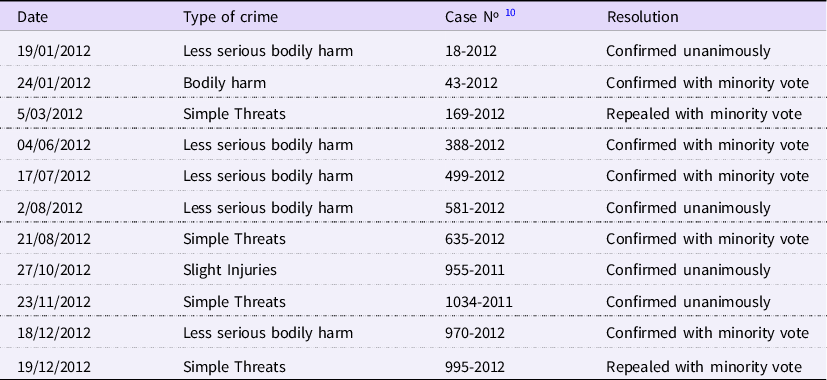
In the selected period (2011–2012), eleven rulings were identified as fulfilling the three criteria to form the corpus. Their contents varied. Table 1 contains the data of the eleven rulings reviewed to form the corpus in terms of date, type of crime, case number and resolution.Footnote 9
Rulings reviewed to form the corpus

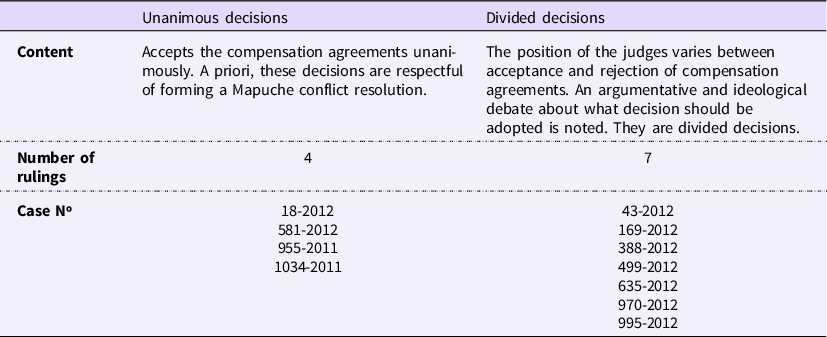
We have distinguished two groups to explain the evolution of the court’s opinion and to delimit the scope of the study: unanimous decisions and divided decisions. The group of unanimous decisions, made up of four rulings, solidly adheres to the legality of compensation agreements. These decisions were the trend prior to the public questioning of the court’s decisions. On the other hand, the group of divided decisions is made up of seven decisions with a splintered vote. This means that at least two judges agree with a decision, whereas a third maintains a dissenting opinion that is recorded in the ruling. Among the seven decisions, five make the decision to accept the legality of compensation agreements and two decide to reject them. Table 2 offers the classification of the rulings in unanimous decisions and divided decisions, their characteristics, the number of rulings of each type, and their case number.
Rulings selected for analysis

The analysis will be performed on the divided decisions because in these the judges pass through divergent ideological positions. It is a group of rulings that enables understanding of the court’s movement from a unanimous to a divided opinion. In addition, this group of rulings is distinguished by the unanimous decisions because they provide a more exhaustive reasoning to support their point of view, showing evidence of ideological tension among the judges.
The selection of the corpus is justified because the cases are similar in terms of the accredited facts (cases of domestic violence), the participants in the process (Mapuche people), the applicable norms (Convention 169 and Convention Belem do Para) and yet they are resolved in different ways. The old adage that similar cases are resolved in a similar manner is challenged, within a short period of time, by the same group of judges. To understand this phenomenon, it is not enough to show that there is a change (A was previously resolved and now B is resolved), but it is also necessary to describe the reasons that judges give to explain this difference. Thus, the CDA allows us to describe the implicit reasons of judges to explain a different legal outcome. Our hypothesis is that as the cases are crossed by two variables (race and gender), describing the judges’ shift from one position to another enables us to explore the possibility that the variation in the results can be explained precisely by the tension of these variables.
In the seven divided decisions, there is constant reference to the arguments of previous rulings. Identical textual expressions are even used to give the foundations of a decision. This is because it is common among judges, and it is no surprise, that extracts are repeated from other rulings handed down on the same issue. Thus, despite there being no rule of stare decisis, the intertextual nature of the rulings shows the judicial decisions as routine and stable, with the previously adopted ideology prevailing. Judges, in this sense, repeat previous parts to avoid breaking the pattern of their decisions. For this very reason, the breaking processes draw attention in that they reveal disagreement among the judges.
In each ruling, different textual units are identified that comprise them, known as statements. They are a formal unit of writing that can contain more than one paragraph and are adapted according to the particular circumstances of the case being judged, producing a functional disarticulation. This disarticulation implies that Chilean judicial rulings do not follow a common written structure, which is why analysing the statements renders the examination complex. Therefore, it is preferable to speak of the segment as a minimum functional unit (Agüero and Zambrano, Reference Agüero and Zambrano2009; Agüero and Zambrano, Reference Agüero and Zambrano2010; Zambrano and Lira, Reference Zambrano-Tiznado and Lira-Rodríguez2022). Segments are formal constituent units of the material object studied. Each unit has a flow of information from the point of view of whoever utters the speech, creating a discursive concatenation of the information in each segment. Thus, there are two types of relations among the segments: (i) informative articulation, which demonstrates how the information mentioned is associated with new information introduced in the discourse and (ii) communicative bond, which involves an analysis of how the ruling communicates its discourse to the audience (Agüero and Zambrano Reference Agüero and Zambrano2009, p. 32). Therefore, each segment fulfils a role in the argument process of the judges: it represents the deployment of the judge’s mental activity to resolve the case before them.
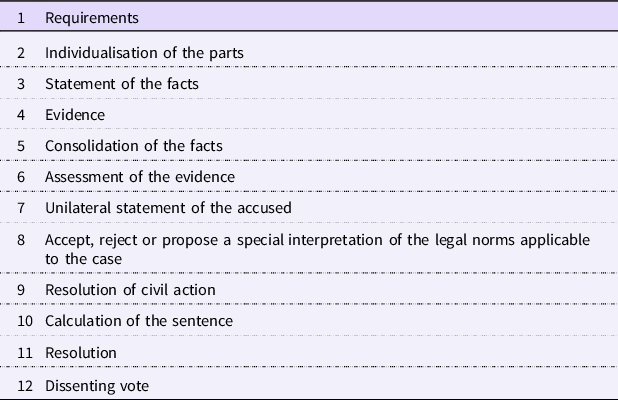
A Chilean penal sentence is composed of twelve segments. Each unit offers an explanation on the purpose or function with which the judge uses the language in that fragment of the ruling (Agüero and Zambrano, Reference Agüero and Zambrano2009, p. 32). The analysis will be sent directly to a segment in particular, which is the one that consists of ‘accepting, rejecting or proposing a special interpretation of the legal norms applicable to the case’. Here is where the judges give their reasoning to resolve the legal conflict. The twelve segments can be seen in Table 3 created previously by Agüero and Zambrano (Reference Agüero and Zambrano2010).
Segments of the rulings

3.2 Categories of analysis
We use some of the categories developed previously by Van Dijk (Reference Van Dijk2005) to analyse political discourse and assess the influence of ideology on the construction of discourses of large magnitude. Its application, within the communicative situation produced when making a ruling, is due to the judges shaping their mental representations in a text that influences those who receive and interpret legal discourse (Van Dijk, Reference Van Dijk2011). The categories make it possible to analyse the most significant elements that the judges use in the production of their discourse, since they delimit, with greater accuracy, the domain of the ideology shaped through the discursive strategies. They work as systematic and theoretical elements that identify what is relevant for the judges when articulating their discourse, characterising how they interpret and represent the social situation in which they are immersed (Van Dijk, Reference Van Dijk2011, p. 21). In particular, they make visible what the judges themselves define as relevant for the production of their discourse, characterising how they interpret and self-represent and represent their office in relation to minority cultural groups. The categories are counterfactuals and polarisations based on generalisations.
The use of these categories is justified because we study ideologies in discursively structural terms. This means that the discourses contain semiotic and lexical elements that provide evidence of the underlying ideologies through the discourse in agreement with specific aspects of the communicative situation (who speaks, when, where and with whom) (Van Dijk, Reference Van Dijk2005, p. 13). For this reason, the categories act as an interface that renders the ideologies ‘observable’ in that only in the discourse can they be explicitly ‘expressed’ and ‘formulated’ (Van Dijk, Reference Van Dijk2005, p. 26). Thus, the polarisation is relevant in the analysis because the ideology of the participants (judges) not only controls most of what they say, but also how they understand other speakers generally (Van Dijk, Reference Van Dijk2005, p. 29). On the other hand, the counterfactual elements matter because they manifest a relevant discursive use to validate the ideology of the judges that, consistent with the polarisation, emphasises intragroup and extra-group markers (Van Dijk, Reference Van Dijk2005, p. 30).
However, it is necessary to partially adjust the content of these categories in regard to our endeavour to apply them to texts that do not indicate their ideologies explicitly and clearly. Thus, the methodological perspective that guides this study understands that Van Dijk’s categories applied to judicial rulings itemise a pattern of statements explicable in their connection with socio-historical forces and a vast set of situational and subjective variables (Paulos, Reference Paulos2015, p. 192). Thus, we provide the categories with a view that analyses the institutions that constitute the outer border of the language and its relation to the discursive genre of judicial rulings. This way, applying Van Dijk’s categories to legal discourse involves them as mechanisms that identify a broad socio-historical systematicity in which discursive and nondiscursive practices, subjects, social institutions and contingencies come together, regulating the formation and interpretation of the statements. Then, they would transcend the textual sphere to understand them as mechanisms that represent social practices that form a discursive universe juxtaposed with events beyond speech (Fairclough and Wodak, Reference Fairclough, Wodak and Van Dijk1997).
The categories develop inductively in the texts. First, the respective segment in each ruling is identified along with the emerging topics contained in it. Then, the subjects are associated with the discursive categories to perform a CDA by selecting sentences and words used by the judges. The chosen words and sentences are related to the actions and character of the social events that the judicial rulings are expected to satisfy. They suppose, then, an important link to the context of the agents to whom they are directed (Krzyzanowski, Reference Krzyzanowski2016), where the judges’ discourse constructs a system of beliefs that connect the textual analysis and their discursive practices.
In this light, and in order to analyse and systematise the discovery of the underlying ideological content in the judicial rulings, three discursive categories of analysis are created: punishment, autonomy and institutional power. Respectively, these categories include the state discursive legal power that judges possess to impose punishments on individuals; the understanding in the discourse of the Mapuche woman’s ability to sign a compensation agreement and the cognitive control that judges have over the people who are the subject of the judicial rulings. These three categories act as a means to channel the varied ideological content that judicial rulings can adopt in cases of Mapuche domestic violence. In addition, they respond to the notion that applying the CDA implies questioning experiences and common-sense meanings, opening them up to many readings and to debate, demystifying the latent ideologies of texts and, above all, strengthening the critical study of legal discourses.
4 Critical discourse analysis according to Van Dijk’s categories
4.1 Counterfactual and polarisations based on generalisations
In the rulings that accept the legality of compensation agreements, it is noted how the judges develop their argument by assuming respect for the minority culture, and allow for an early end to the conflict:
‘4.- In addition, acting differently, preventing the end of the conflict in the way it has occurred, would involve breaking up a family that has been able to reconstitute through a solution that seems fair to them, which would be in contravention of the previously mentioned Convention that obliges strengthening the integration of the peoples, even more so when this contributes to fulfilling the higher interest of strengthening the family according to what is established in the Political Constitution of the Republic.’
Reasoning is counterfactual (Van Dijk Reference Van Dijk2005, p. 35). The judges imagine hypothetically the consequences of not opting for a certain decision (Walton, Reference Walton1999). They reflect on the positive or negative consequences that a certain decision could produce as a reason to support or reject. In this case, they consider the prison sentence to be an unacceptable consequence, harmful or unfavourable to the legal system or society (Carbonell, Reference Carbonell and Martínez Verástegi2016). This is the reason to indicate that acting differently would prevent the end of the conflict in the way it has occurred and would involve breaking up a family.
The counterfactual is accentuated if we consider that acting differently refers to the figure of the judges themselves. They are the image of the court and implement its acts in the field, having to assume the consequences of their decision, such as the possibility of breaking up a family. This aspect defines the dilemma the judges face: to break up a family that has been reconstituted or not. On the one hand, the family, being understood as a higher interest recognised by the political constitution of Chile, would lead to the acceptance of the compensation agreement as a way to avoid its break-up. On the other hand, denying the agreement would suppose acceptance of the break-up of a family that has managed to be put back together although one of its members (the aggressor) has committed an act of domestic violence. In both cases, the judges’ ideology recognises the autonomy of a different cultural group, but limits it through the value supremacy of the family institution established by the law.
The polarisations are sustained in discursive strategies used to categorise an exogenous group and recognise it as ‘other’. In this case, a small group of people from a dominant institution constructs an image of the people judged according to their discursive and political interests. At the same time, they create a hurried generalisation in two perspectives: on the one hand, they state that a negotiated settlement (regardless of the content) is right for the Mapuches for being the result of dialogue, whereas, on the other hand, they value that that solution seems right to them. The judges understand, according to their interpretation, that the agreement is right for the Mapuches (even though it might not be) and value their interpretation positively. However, what in fact happens is that the solution is just (according to the judges) for the defendant and the victim, but this assumption does not extend to all Mapuches.
The generalisations created assume that the agents of the majority culture are attempting to understand the notion of justice of a group of which they are not part. Thus, the categories of polarisation and generalisation intertwine to indicate that the Mapuche people can reconstitute by means of beliefs and practices that bring with them a component linked to the idea of justice. Thus, generalising a characteristic of the Mapuche group heightens the polarisation. It is a cross-sectional category that allows judges to construct the ‘us-them’ distinction.
What is said can be noted in the following fragment of three confirmatory rulings that accept the origin of the agreements:
‘… it is a public and well-known fact in this Region that the people of the Mapuche ethnic group have historically resolved their conflicts, even some of greater severity than those that motivate this case, through negotiation, inasmuch as it is inherent in their culture to resolve conflicts this way ….’
The text indicates different ways in which judges discursively represent and textualise the reality of the Mapuche community. Polarisation is the basis of the argument when referring to a cultural group outside that of the judges. It is recognised that Mapuche people belong to a particular culture whose presence in that geographic area has been historical, with their own conflict resolution mechanisms. It is a public and well-known fact that makes it impossible to ignore the role of negotiation in Mapuche practices to resolve their conflicts. In this scope, the negotiated agreement would prevent institutional criticism of behaviours that shape domestic violence.
The two fragments are connected because judges understand that collaboration to resolve this type of conflict can only be partial. This is so because domestic violence is a multi-factor phenomenon that the law cannot resolve by itself. This means that within the phenomenon of violence there are influential factors that go beyond the strictly legal and which, indeed, undermine legal thinking, the production of disciplinary knowledge and the struggles for social justice (Cho et al., Reference Cho, Crenshaw and McCall2013, p. 787). The problem is that judges do not make an effort to reflect on these factors and are limited to solving the problem formally. In other words, they do not examine the dynamics of difference by considering gender, race and other axes in a wide range of political debates and academic disciplines. Thus, judges do not look beyond the closely circumscribed demands within the logic of equality and difference. They do not address wider ideological structures to reflect on the case, nor do they make a radical critique of the law because they are protagonist agents of that field (Cho et al., Reference Cho, Crenshaw and McCall2013, p. 791).
For this reason, when resolving the judicial conflict, the judges impose a belief of the majority group based on protecting the higher interest of the family. Being based on one-dimensional notions to resolve conflict, they recognise implicitly that Mapuche culture, by accepting their manner of conflict resolution, in which the agreement is functional and consistent with the higher interest of the family that they wish to impose. This explains why the judges recognise Mapuche autonomy guided by a specific notion of justice: integrating cultural groups within the margins that the law of the majority has established. Thus, they are inclined by the co-existence of the two groups in a legal and institutional framework that ensures harmonic development to resolve domestic violence conflicts.
5 Critical discourse analysis according to legal-discursive categories
5.1 Punishment
The category ‘punishment’ is related to the state legal-discursive power that judges possess to impose punishments. It necessitates study of the punishment that the legal system orders for people who, largely, do not share the characteristics of the majority culture.Footnote 11 It supposes a reflection around the demand for justice that the social agents require of the legal system and the judges. It endeavours to answer the following question: Is there a real punishment when the cultural patterns of the Mapuche people are respected, ending the conflict via an agreement? It is already possible to emphasise that, through the rejection or legality of the agreements, there is an established punishment. The difference arises when choosing what type of sanction must prevail, since in contrast to the compensation agreement that depends on the parties (and especially on the Mapuche woman accepting it as a sufficient end to the conflict), the penalty established in criminal law imposes a jail term from sixty-one to 540 days.
The category also tries to find an answer to the need for justice present in the social space. It recognises that the justice system is designed to offer a prompt solution to the domestic violence conflict. Therefore, it reflects on whether accepting the legality of the compensation agreements promotes the idea that the law solves completely (or not) the issue of violence.
A commitment to all eradication of violence in the rulings is found in the dissenting votes of three confirmatory rulings:
‘the origin of the violence is in itself an element of discrimination, and these are exactly the condition of gender, culture or language that sometimes erroneously support that origin’
The fragment maintains that violence against women is considered an element of discrimination in itself. For the judges, this is a phenomenon that should be eradicated through the imposition of a criminal penalty above other cultural considerations. Thus, they indicate that the situation of gender, culture or language are those that ‘justly’ support domestic violence, which involves asserting at least three aspects. First, that the domestic violence originates in situations where the gender, cultural or language component is present. Second, that these components constitute possible triggers of a domestic violence situation because they are differentiating or discriminatory elements. Third, that those components are elements that allow the reproduction of oppressive structures against the woman because they endorse the domestic violence.
At the same time, the judges understand that this issue is supported by the Mapuche culture i.e. accepted, tolerated and even normalised. For this reason, and with the aim of amplifying the responsibility of the Mapuches for accepting violence against women, they associate its origin with elements such as culture or language. Eradication of domestic violence, in this sense, can be considered a more valuable goal for the judges than the recognition of the autonomy of a cultural group. Domestic violence is unacceptable, and it is not eradicated by entering into an agreement incapable of guaranteeing or stopping its reproduction in the family. Thus, violence against women has a relevance according to which the judges assume they have the institutional function of expressing that it is not tolerated by the law in any context.
5.2 Autonomy
The category studies the judges’ portrayal of the victim’s decision-making ability. This arises due to the importance of the victim’s willingness to make an agreement and reflects on the real opportunity that the indigenous woman has to give her consent. In this sense, autonomy necessarily assumes that the victim agrees with a way to resolve the conflict that is different from what is expected through criminal penalty. Thus, the category demands the judges’ description of women, a formulation that also depends on their ideologies (Van Dijk, Reference Van Dijk2005, p. 35).
In three rulings, the minority vote that rejects the compensation agreements indicates the following:
‘8th Multiculturality and respect for the customs of indigenous peoples must recognize as a limitation the objectification and degradation of the woman, even with her apparent consent, which mandates that a definitive dismissal originating in the compensation agreement between a woman allegedly attacked by her spouse or partner be repealed for reasons of fundamental rights and not simply in the misleading perspective of equality in the ability to negotiate covered by cultural aspects.’
Indigenous peoples are a collective that have their own world views and cultural practices, but are subject to the legal norms of the majority community. In this sense, the co-existence of different smaller cultures in a territory where a universalist view of the law prevails is problematic. There can be different behaviour patterns that enter into conflict with moral and political aspects assumed by the law. Some are noted in the judges when adjudicating the situation in that they indicate that the women are subject to objectification, understood as the treatment women receive as goods or things in human societies (Casares, Reference Casares2008), or degradation, which seeks to reduce their dignity to consider them a useful object for men. It is worth emphasising that both notions constitute a nominal lexicalisation to express similar meanings with different words.
In this case, lexicalisation involves categorising indigenous women by allocating certain characteristics. An institutional construction of identities is demonstrated as judges develop a perspective that can agree or disagree with the woman’s own identity in the Mapuche culture (Stamou, Reference Stamou2018). The consent to which the paragraph refers is not only in regard to the possibility of consenting to the agreement but rather that the woman can, for cultural reasons, accept objectification and degradation within the community to which she belongs. This is because the ability to negotiate the agreement is mediated by the way the culture itself understands the role of women. So, fundamental rights are a limitation to accepting the woman’s consent because negotiation – apparently egalitarian – is in fact based on a non-existent equality. Thus, the apparent equality would explain why a woman who lives in a cultural environment that degrades her can, even in such serious situations as domestic violence, hold the position of service to men that the culture has assigned to her.
In terms of consent, the legal system must intervene to punish the conduct of the accused. The misleading perspective of equality, in this sense, involves recognising that, in contexts of gender violence, there is no symmetrical condition between the parties, which indicates a material, symbolic and political inequality of one group over another disadvantaged one. This can be seen in the discursive treatment that the women receive, by suppressing their autonomy so a group with limited power can make decisions, who consider people who have been assaulted as victims at the social and legal level (Ferraro, Reference Ferraro1996).
5.3 Institutional Power
This category considers that the discourse of judicial rulings exerts pressure and coercion on the behaviour of individuals and, from there, analyses the socio-cognitive power that the courts have over people. It recognises that the institutional discourse created by the judges influences individuals; therefore, its purpose is to build and determine relationships of power (Fairclough and Wodak, Reference Fairclough, Wodak and Van Dijk1997) among the judges, the addressees and with others.
From a process of identity construction, institutionalised power judges and discursively represents the subjects that are part of a minority culture. It establishes patterns that the social agents must follow, controlling their cognitive representations (aspirations, desires, plans and beliefs) through penal prescriptive norms that guide people’s minds (Van Dijk Reference Van Dijk2015, p. 62). The judge, as an external actor in the cases and the Mapuche culture, uses the norms to develop knowledge about beliefs, norms and cultural values beyond their own. They observe and interpret the social actions of their addressees (Van Dijk Reference Van Dijk2015, p. 63). From this point of view, the following segment of three confirmatory rulings stands out:
‘… to authorize a compensation agreement of the nature that is under debate constitutes an additional factor of revictimization that can lead to ineffective and pointless investigations’
Legal discourse is a creative and original word, which breathes life into that which enunciates and generates a collectively recognised representation (Bourdieu Reference Bourdieu1977, p. 16). The social situation in which a ruling is dictated affects the intersubjective interpretations that judges make. Thus, the judges’ understanding acts as a social construct that develops an image that affects and conditions people (Van Dijk Reference Van Dijk2011, p. 39). They subject individuals to a structural power that conditions and defines some beliefs and attitudes about what they are experiencing. For that reason, a re-victimisation occurs, founded on the influence of the judges’ decisions in vital aspects of a person.
The judges are aware that their institutional habitus can produce a re-victimisation. The practices needed to condemn a person necessarily assume a re-opening of the experience. In addition, they are aware that discussing the facts again supposes a self-criticism when considering that their investigations are ineffective and pointless. Once again, they use similar and consecutive concepts to underscore an idea they wish to be defended: the deficient nature of their work with respect to the concrete possibilities to effectively eradicate violence against women. Despite this limitation there are two ideas that seem to justify their effort beyond the concrete results: an effort to become legitimate arbiters to resolve disputes in other people’s communities and the attempt to create legal awareness of domestic violence as a phenomenon, which, beyond the legal, has strongly structural aspects that go beyond their work.
6 Reflection on the discursive strategies used by judges
The discursive strategies used by the judges converge in the construction of an idea of domestic violence in an indigenous context, their own representation as judges, and the identity of the Mapuche woman. These constructions are the result of the analyses performed in the preceding sections because judges have legal powers to construct representations of those being judged according to their political and discursive interests. Thus, the three aspects analysed in this section come from the use of representative discursive strategies of social and symbolic capital, the purpose of which is to legitimise symbolic violence exerted by the law (Bourdieu, Reference Bourdieu and Teubner2000). In this order of ideas, the symbolic violence is exerted because the law is not perceived as an element that structures people’s lives (Bourdieu and Wacquant, Reference Bourdieu and Wacquant2008, p. 213), where the exercise of discursive strategies of legitimation seek to define and delimit the reality from legal discourse (Van Leeuwen and Wodak, Reference Van Leeuwen and Wodak1999; Van Leeuwen, Reference Van Leeuwen2007). It is, then, a process of institutional validation where the discursive forms support legal sources to maintain their axiomatic beliefs.
6.1 Domestic violence in an indigenous context
Treating indigenous domestic violence through a culturally distinct justice system is complex in post-colonial and multicultural societies. Considering that domestic violence is a sphere overlapped by religious, socio-economic, racial, educational and gender dimensions, opinions on gender roles and the legitimacy of interpersonal violence can vary widely. Thus, in cases of domestic violence where the cultural component is central, there are two positions that the judges put to the test. On the one hand, the participants (accused and victim) belong to a minority social group with their own world views and conflict resolution mechanisms, creating a dissonance between what is ordered by the law and what is carried out by their cultural practices. On the other, the judges are part of a majority culture that works to protect certain institutions (like the family) from a Western perspective. Both positions assume that judges reflect on the respect for and scope of the autonomy of individuals to resolve conflicts according to their cultural patterns. In this light, there would be various dimensions according to which cultures or some aspects of them can be compared and judged. For example, Raz (Reference Raz1994, p. 202) posits that, in cases where there is systematic violence towards women, the oppressive cultural aspects must be neutralised and changes in their practices must be accepted. In this sense, eradicating domestic violence would involve tacit recognition of the dominance of certain universal values over cultural considerations.
As domestic violence in indigenous spaces is a phenomenon rejected by the law as affecting the woman’s dignity, when it occurs in particular cultural contexts, the judge is forced to implicitly renounce relativistic paradigms (that justify the violation of those legally protected interests and do not consider the causes of the violence) to protect the victims.
Judges’ ideological shifts stem from violence among indigenous couples constituting a disintegration of their cultural power and the rules of the community. However, it is important to emphasise that the ideology recognises, within certain parameters, that it is an issue that affects a minority cultural group. For this reason, most of the strategies are sustained in a polarisation not only to support the imposition of certain values but also to justify the way in which their transgression must be punished. Thus, the tragic dilemma of seeking to eradicate violence against women and at the same time being open to the conflict resolution methods of the Mapuche culture is expressed.Footnote 12 Thus, the effects of the rulings are meant to modify the conditions of the people, positioning the judges as those responsible for their discourse.
When dealing with situations of domestic violence, the ruling only ends the conflict formally and/or institutionally, but not materially in the face of possible repetitions of violence to the victim. Therefore, the problem of domestic violence is not solved, since nothing prevents the same events from being repeated, with this being one of the main reasons to give the nuclear family itself the power to resolve the conflict. One reason is that the nature of indigenous domestic violence is different from that experienced in non-indigenous communities. For example, in non-indigenous domestic violence, a common phenomenon is continuous domination and coercive control, issues not distinguished as clearly in cultural communities, because the participants’ behaviours and beliefs are different (Nancarrow, Reference Nancarrow2019, p. 154). Therefore, the resolution of the conflict in indigenous communities requires an interdisciplinary dialogue to support them in their interaction with the state. In this sense, violence and judicial practice are elements, the evolution of which is similar and continuous (Nancarrow, Reference Nancarrow2019, p. 202).
The colonisation of indigenous communities and the intensification of domestic violence manifests in structural factors (poverty, lack of or limited access to education and health), and indigenous women bear the excessive burden of these factors. These circumstances contribute to the normalisation of indigenous domestic violence as a result of colonial and patriarchal history (Kuokkanen, Reference Kuokkanen2014, pp. 272–273). This understanding makes it possible to assert that the initial judicial ideology understood that indigenous domestic violence was a private (or family) matter as per the norms of the cultural community. Thus, judges tried to balance a limited state intervention with the role of the law to try to eliminate the violence, without reflecting on the true capacity of the culture to do this. They built an idea of domestic violence as a depoliticised phenomenon where the victims’ rights were degraded, devaluated or discarded (Kuokkanen, Reference Kuokkanen2014, p. 277). Such construction implied that judges sought not to stigmatise indigenous peoples, since making the subject a public matter could confirm (or not) certain stereotypes and prejudices (Crenshaw, Reference Crenshaw1991). However, judges make an ideological shift to ignore those considerations and intervene. They understand that there is no negotiation equality between victim and perpetrator, and that indigenous domestic violence is part of a cultural environment that degrades victims. As will be seen, judges are considered responsible for human rights violations, providing people with stability, intelligence and protection.
6.2 Representation of the judge as the entity that resolves the conflict
The judges impose a hegemonic view through language that configures ways in which people use, discuss and think about the law (Conley and O’Barr, Reference Conley and O’Barr1990). Moreover, judges are called to exercise their institutional and symbolic power to establish meanings on domestic violence from a legal point of view, becoming a defining element of social reality (Silbey, Reference Silbey2005). In this sense, they define the ways in which agents understand the law in its more daily respects (Ewick and Silbey, Reference Ewick and Silbey1998), explaining how the legal field, and especially jurisdiction, maintain their institutional power even in cases where there are cultural components at play. They exhibit, therefore, a relational perspective between the law and the representations of the social agents in relation to certain phenomena (Cowan, Reference Cowan2004).
The institutional position of the judges helps to explain the interpretations that they use to resolve cases of multicultural domestic violence. In addition, the relation between the courts of justice and the social culture can be investigated more deeply (Silbey, Reference Silbey2014). For this reason, a specific way to resolve cases and judge people who belong to a minority cultural group is established, being installed, discursively, as impartial figures capable of resolving conflicts in other cultural communities. Thus, the knowledge and practices of indigenous people are eclipsed by the state’s response to close the matter.
However, it is not up to judges to recognise indigenous demands. They resolve the conflict as if they were judging a person in their own majority culture. For that reason, they see the international treaties as antinomic, even though they can be understood complementarily. They think that the decision consists of applying the Convention of Belem do Pará or ILO Convention Nº 169, constituting a false dichotomy. But nothing prevents them from seeking solutions according to a conception of Mapuche justice and using them to punish violence against women. That false dichotomy provokes: (i) them to understand that violence is an intrinsic element of the Mapuche culture that prevents women from being fully protected and (ii) that only by being outside the minority cultural community is it possible to demonstrate the infringement on women’s rights.
By virtue of their position as representatives of the majority culture, judges are considered responsible for human rights violations, providing people with stability, intelligence and protection. This shows a cultural conditional to not seek a third response for these cases, which explains their inability to understand the rights of minorities in the cultural context. On the contrary, if judges were open to a third way, they could be able to execute an intersectional reading to thoroughly analyse racial, class and gender issues. Otherwise, there is a risk of internalising colonial practices as cultural norms, the result of which is the depoliticisation of domestic violence and the silence of the victims (Kuokkanen, Reference Kuokkanen2014, p. 281).
Delving more deeply, if judges do not have the ideological openness to address the phenomenon of indigenous domestic violence, it is likely that they will again understand that cultural practices are sufficient to resolve the problem. Thus, there is a lack of discussion about the topic to establish the urgency that is the problem of indigenous domestic violence (Kuokkanen, Reference Kuokkanen2014, p. 281). In this respect, it is worth noting that judges recreate the myth about the ‘conflict-solving power of the law’ knowing that it is partially true, but clearly insufficient in cases of indigenous domestic violence. As mentioned, these cases are resolved through a judicial relationship based on a one-dimensional notion, liberal in substance, that inspires the legal system.
Although the image of judges as state agents for conflict resolution is a response to the phenomenon of violence, it is also important to guarantee the victims the genuine ability to choose the extent to which the state can interfere in their well-being (Nancarrow, Reference Nancarrow2019, pp. 217–218). This said, an intersectional justice approach would recognise the right to choose alternative justice responses (Nancarrow, Reference Nancarrow2006, Reference Nancarrow and Ptacek2010; Nancarrow, Reference Nancarrow2019, p. 219). Thus, the public policy in indigenous matters cannot be monocultural, but at least consultative, including the possibility of providing members of the peoples with access to the exercise of the colonising power.
Judges understand that the law cannot remain idle in these situations. And if this is the case, it is necessary to guarantee the legal option so indigenous participants can choose their decolonisation or not. This would invite the implementation of restorative practices to disarm a variety of structures, mentalities and organisations who have perpetuated indigenous dispossession. Innovation spaces would be created to establish negotiations between indigenous laws and colonising laws (Blagg and Anthony, Reference Blagg and Anthony2019, pp. 139, 246).
6.3 Identity of the Mapuche woman
Judicial rulings continued to be framed in liberal feminism but are unable, from the judges’ position, to shift to a decolonial perspective. The texts do not develop that perspective and, in fact, they question the very ability of women to solve their violence problems. This implies that the rulings build, in principle, an image of the indigenous woman whose suffering is less significant than family relationships, reputation and honor. This contributes in large part to indigenous communities living under a systematic racial spectrum. Thus, the millions of indigenous people in the world share experiences like the loss of territories and the imposition of psychological assimilation and socially destructive policies (Niezen, Reference Niezen2003; Blagg and Anthony, Reference Blagg and Anthony2019, pp. 138–139).
Why are indigenous women more vulnerable to violence? Why are their cases more complex? Reading the judges indicates that the contemporary forms of indigenous conflict resolution are based on extreme disadvantage and social exclusion that makes them particularly vulnerable. Although indigenous women can have a wide set of alternatives to formal criminal justice, the conventional view of the state directs them to mechanisms created for non-indigenous women (Nancarrow, Reference Nancarrow2019, p. 206). Hence, the image of the Mapuche woman is subject to the perception that the judges have about her: an image objectified or degraded by the culture and language of the Mapuche people, where violence against women is the extreme expression of that objectification. However, it is an image that may or may not be consistent with the Mapuche reality, since it is a perspective that the judges themselves construct without being part of the cultural group. For that reason, the judicial ruling radiates a charged symbolic power to define officially how certain events occurred and how the people developed.
Thus, there is evidence that judges construct a discourse on the various ways in which women can act in situations of domestic violence. There is an interpretation of the autonomy and the role of the victim determined by the power of the legal field to establish an atmosphere of control over the decisions that the woman can make. This is a key aspect because the judges create a representation of the cultural ways in which the indigenous woman acts by analysing her living arrangements (Aman, Reference Aman2010). Under these considerations, it is a consolidated view that indigenous victims of domestic violence must receive protection, failing to understand violence against women from traditional cultural customs (Kimm, Reference Kimm2004).
Colonisation is an ongoing experience for indigenous women in various areas of their life (Agamben, Reference Agamben1998). They are affected by greater discrimination for their cultural, post-colonial contexts and specific laws designed from a non-indigenous perspective. This is especially the case for indigenous women in geographic sectors with a high proportion of indigenous individuals (Nancarrow, Reference Nancarrow2019, p. 207). However, the decolonisation process involves broadening the role of indigenous processes and services that work from a position of cultural safety and integrated into indigenous forms of knowledge. Thus, so that judges construct a new image of the Mapuche indigenous woman, they must work from a new intellectual and theoretical framework to see the differences in experience and perspective between indigenous and non-indigenous women. And a manifestation of this is distinguished in not ignoring that women face a racial bias that prevents them from being beneficiaries of their rights (Kuokkanen, Reference Kuokkanen2014, p. 272). It is therefore to be expected that judges recognise that, due to demands linked to cultural authenticity and affiliation, women who experience violence may feel pressured to not denounce the situation out of fear of being labelled as using ‘culturally inappropriate behavior’ (Kuokkanen, Reference Kuokkanen2014, p. 276).
7 Conclusions
This study argues the utility of the CDA in identifying ideologies understood as an extra-legal factor. One is a factor that influences judges when resolving cases of Mapuche domestic violence, and which manifests in social and judicial discursive practices that reflect the influence the law on minority cultural groups. When they draft a ruling, judges shape their ideology on domestic violence with Mapuche participants and define how it must be understood in a society where those who judge belong to a hegemonic and majority culture. In the analysis implemented, the judges’ ideology manifests in key aspects related to penalising the violence, the autonomy of the woman, and the institutional power of the law to resolve the conflict.
The application of CDA provides evidence of continuities and discontinuities in characteristic traits that the law has concerning cultural groups. At the same time, it shows the evolution of a certain ideology or the way in which it becomes established, over time, in sociocultural knowledge. However, the high degree of formalisation of legal texts compels one to be careful in the selection, since the selected text must render the ideology expressed in institutionalised form visible. This is explained by most judicial discourse being supported in discursive strategies that seek to clarify or accentuate its position and relationship with a minority cultural community. Thus, the law is a sphere of power with specific ideas where judges embed their ideological speech in a judicial ruling. That discourse is complex because, thanks to its public and institutionalised nature, the ruling amplifies the representation that the legal field has for the Mapuche community.
Furthermore, three key images are distinguished linked to the way the issue of domestic violence, the Mapuche woman and the role of the judges in the conflict are understood. Among other things, it is established that there must be a balance between state decisions about indigenous individuals, and the ability of those individuals to make decisions on these topics. Local control is important because the contexts and experiences of indigenous people are diverse and the state cannot assume that significant innovations in one community will translate to others (Nancarrow, Reference Nancarrow2019, p. 222). All these elements are interlaced and make it possible to assert that people affected by domestic violence are trapped in the penal justice system (Nancarrow, Reference Nancarrow2019, p 113). Moreover, the positions that support alternatives to the formal penal justice system, including those that point to restorative justice and indigenous courts, are well on track to address domestic violence in an interdisciplinary way (Blagg, Bluett-Boyd and Williams, Reference Blagg, Bluett-Boyd and Williams2015; Daly, Reference Daly2016; Nancarrow, Reference Nancarrow2019, p. 202).
Law, as we understand it, seeks homegenisation. However, analysis shows that this is not possible in cases that involve diverse cultural groups. For that reason, promoting alternative justice strategies that recognise the intersectional differences among people is a certain path to address racial and gender inequality, guaranteeing safe indigenous communities (Nancarrow, Reference Nancarrow2019, p. 215). A small manifestation of this idea lies in granting an egalitarian place to indigenous people in negotiations when considering the role of the state- and any other-directed strategy to end violence (Nancarrow, Reference Nancarrow2019, p. 217).
The findings suggest that the influence of the law is determinant on two sides: to protect the victim, and to safeguard the practices of a cultural community. The analysis presented helps to identify both aspects by studying the representations of the judges of people belonging to a minority cultural group. This is demonstrated when analysing, for example, the autonomy of the victim and the ability to negotiate in cultural contexts.
From the investigations conducted, indigenous customs in the resolution of penal conflicts, like the discourse on human rights, are changing over time. In that context, there are no monolithic, static cultures, frozen in time and space; rather, there is a dialectic movement to appreciate continuities, breaks, tensions, conflicts, etc. It is therefore fundamental to strengthen those proposals that extend the circle of recognition to the other (Santos, Reference Santos1998, pp. 364–370). Thus, in recent years there has been a global renaissance of indigenous cultural policy. Countries like Ecuador, Bolivia or Chile in its failed Project for a new constitution, are incline to an explicit recognition of indigenous communities and, in this way, aspire to the development of a new indigenous epistemology that acts as resistance to attempts at standardisation, homogenisation and Western globalisation (Blagg and Anthony, Reference Blagg and Anthony2019, p. 138).
This study is an invitation to understand the law not only in its social dimension, but also in its discursive dimension from the analysis of discursive genres inherent to the legal field. In addition, it is a call to specify the impact of the law in minority social groups and an opportunity to explore the way the extra-legal factors are expressed discursively in our political communities.
Competing Interests
None.
Acknowledgements
Many thanks to the editors as well as to the anonymous peer reviewers for constructive and helpful feedback. The second author of this article also is part of ‘Imputatio: Center for Analysis on the Attribution of Intent and Imputation of Responsibilities’.