


Introduction
Mokyr (Reference Mokyr2002, Reference Mokyr2009, Reference Mokyr2017) demonstrated across three decades that the sustained economic growth of the modern era cannot be explained by capital accumulation, factor endowments, or institutional design alone. His central claim is that culture, specifically the cultural valorisation of useful knowledge and the institutions that allowed it to circulate, was the indispensable substrate without which the Industrial Revolution would not have happened. His method matched his claim: historical evidence traced across centuries and tested against the record of civilisations that did not industrialise despite comparable material conditions. The conceptual challenge of separating culture from institutions, and of specifying the mechanisms through which one operates within the other, has been restated within this journal by Hodgson (Reference Hodgson2022). Greif et al. (Reference Greif, Mokyr and Tabellini2025) extend the same programme to the millennial divergence between Europe and China, treating culture and the internal organisation of society as co-determinants of institutional development. That work operates at the scale of civilisations; the present paper operates one level down, specifying a failure-specific mechanism within the cultural substrate they describe.
This paper develops an analogous move in the historical study of entrepreneurial dynamism. The question it asks is narrower than Mokyr’s but operates at a similar level of analysis: how have communities processed the failure of economic actors, and with what long-run consequences for entrepreneurial activity? Failure is not a marginal phenomenon in entrepreneurship; most ventures fail. The cultural architecture through which failure is explained, judged, and either reabsorbed or excluded therefore shapes the conditions under which any economic actor undertakes the risk of founding: a community that treats commercial failure as redeemable produces different incentive conditions than one that treats it as terminal.
Existing scholarship has approached this question from two directions, neither of which has reached the heart of it. Economic historians have examined the legal evolution of bankruptcy, with important work by Coleman (Reference Coleman1974), Mann (Reference Mann2002), Skeel (Reference Skeel2001), and Balleisen (Reference Balleisen2001) on the Anglo-American case, and by Sgard (Reference Sgard2006) and Safley (Reference Safley2009, Reference Safley2013) on European traditions. What this literature has not done is theorise the cultural architecture surrounding the legal infrastructure. Bankruptcy law co-evolves with the verdict a community renders on its failed economic actors, and its evolution becomes intelligible only when read alongside the cultural evolution with which it developed.
Entrepreneurship scholars have approached it from the contemporary side, with extensive discussion of failure-tolerant culture in Silicon Valley (Kenney, Reference Kenney2000; Lee et al., Reference Lee, Miller, Hancock and Rowen2000; Saxenian, Reference Saxenian1994) and cross-national comparisons of stigma and entrepreneurial activity (Cardon et al., Reference Cardon, Stevens and Potter2011; Damaraju et al., Reference Damaraju, Barney and Dess2023; Simmons et al., Reference Simmons, Wiklund and Levie2014; Vaillant and Lafuente, Reference Vaillant and Lafuente2007). A parallel body of work has established that the formal rules of failure condition entrepreneurial entry across countries (Lee et al., Reference Lee, Yamakawa, Peng and Barney2011; Peng et al., Reference Peng, Yamakawa and Lee2010). What neither literature has done is establish the historical depth of the cultural relationship beneath those rules; without it, contemporary findings can be read as artefacts of recent conditions rather than expressions of mechanisms operating across centuries.
What is missing from these literatures is a framework for what will be called cultural reintegration architecture: the set of cultural mechanisms through which a community renders a verdict on a failed economic actor and either provides or withholds pathways for return to legitimate standing. The architecture comprises four observable, traceable elements: narrative scripts through which failure is publicly accounted for; moral attribution processes that distinguish situational from character-level explanations; procedural and ceremonial pathways through which failed actors are marked as returning to standing; and community acceptance mechanisms that confirm or deny restored membership. Together these form the cultural infrastructure within which formal institutions, including bankruptcy law, are constructed and operate.
The framework draws on Braithwaite’s (Reference Braithwaite1989) reintegrative shaming theory, developed in criminology to analyse community responses to wrongdoing. Braithwaite’s distinction between stigmatising shaming, which permanently marks the offender as deviant, and reintegrative shaming, which acknowledges the wrongdoing while providing pathways for return, maps onto the historical analysis of how communities respond to commercial failure.
Six cases are examined: the Venetian commenda system; the Hanseatic League; Meiji Japan; the Nattukottai Chettiar, or Nakarattar, banking caste of colonial South and Southeast Asia; the United States; and Silicon Valley. The cases are selected for civilisational and temporal variation, spanning eight centuries, three continents, and dramatically different formal institutional environments. The argument is that beneath these surface differences a consistent mechanism operates, its variation readable as position on a single spectrum. Where the configuration is reintegrative, dynamism is sustained across generations; where stigmatising, it is constrained regardless of formal institutional support. The Chettiar case occupies an intermediate position: the four elements do not move together there, which reveals their relative weight.
A note on method. The argument is built in the comparative-historical tradition Mokyr’s own work exemplifies. Historians of the individual cases have observed the mechanism without naming it as a general one. The paper names it, shows it operating across six cases, and closes with propositions to structure the empirical work to test it, in the spirit of recent calls to reconnect entrepreneurship research with historical reasoning (Wadhwani and Lubinski, Reference Wadhwani and Lubinski2017). The cases are illustrative, not exhaustive. They support the propositions; they do not confirm them.
Cultural reintegration architecture as an analytical framework
Cultural reintegration architecture is defined here as the configuration of narrative, moral, ceremonial, and acceptance mechanisms through which a bounded community renders a verdict on a failed economic actor and either provides or withholds a pathway back to legitimate commercial standing. It is a structural property of communities, distinct from formal institutional infrastructure. Bankruptcy law, insolvency procedure, and commercial regulation are formal artefacts: written, codified, and enforced through state apparatus. Cultural reintegration architecture is informal, enforced through community processes of narrative, ritual, and acceptance or exclusion. The two interact, but neither can be derived from the other. The same statute is applied by communities that read an identical insolvency in opposite ways, and nothing in the statute predicts which way a given community will read it. Silicon Valley and Route 128 are the case in point: one federal bankruptcy code, two regions of a single national economy, and opposite verdicts on the founder who has failed (Saxenian, Reference Saxenian1994). Meiji Japan shows the same divergence under a single insolvency transplant. The object of analysis is correspondingly narrow: the verdict a community renders on a failure, and the pathway back it opens or closes, not culture in general.
Granovetter (Reference Granovetter1985) and Polanyi (Reference Polanyi1944) supply the foundation: economic action is embedded in social relations, and the verdict on a failed actor is rendered through cultural processes that operate independently of, and often prior to, formal procedure.
The framework sits within the older institutionalist tradition as much as the new. Veblen (Reference Veblen1898) insisted that economic life be analysed as a cumulative sequence of institutions that shape the dispositions of individuals, not as the interaction of given preferences. The present claim that the cultural processing of failure shapes who is willing to found is Veblenian in exactly this sense. Commons (Reference Commons1924: 6) made the transaction, and the collective action that authorises and limits it, the unit of institutional economics, building his account of working rules on Hohfeld’s (Reference Hohfeld1913) analysis of jural relations. The community verdict on failure is a working rule in Commons’s sense: a collective determination of what a failed actor may and may not do next. Bromley’s (Reference Bromley2006: 13–14) volitional pragmatism carries this lineage forward by treating institutions as the reasons communities construct for the conduct they will sustain.
The framework also engages the new institutionalism directly. It sits within the informal-institutional category specified by North (Reference North1990, Reference North2005) but is narrower. It is functionally specialised on the community processing of failure; located in bounded communities rather than nations; decomposable into four observable elements instead of a unitary culture variable of the kind used in cross-national indices (Hofstede, Reference Hofstede2001); and historically dynamic in the way Greif (Reference Greif2006) specifies for institutional change. Hodgson (Reference Hodgson2025) has recently underlined the analytical cost of leaving the formal/informal distinction underspecified; the framework responds by specifying one informal institution narrowly enough to be observable, decomposable, and traceable.
A reasonable objection, in the spirit of Williamson (Reference Williamson2000), is that private ordering already accounts for these phenomena: merchant networks discipline and forgive their members through reputational mechanisms without any need for a separate cultural construct. Private ordering explains enforcement within a network. What it does not explain is the prior question this paper addresses: how the community decides whether a given failure is a cheat at all, and whether a pathway back exists for the actor who failed without cheating. That determination is cultural before it is contractual. Which reading prevails, honourable misfortune warranting support or character defect warranting exclusion, is fixed by the narrative and attribution resources the community has available. Cultural reintegration architecture conditions the transaction costs of post-failure recommitment by actors and capital; in this sense it is upstream of the private ordering Williamson describes rather than redundant with it.
The four elements can be specified as follows. First, narrative scripts are the publicly available stories through which failure is explained, contextualised, and either normalised or pathologised. McAdams (Reference McAdams2006) and Tilly (Reference Tilly2006) have shown how communities use narrative to render verdicts on conduct: a repertoire that includes stories of legitimate failure followed by legitimate return generates different conditions from one that treats failure as the terminal expression of character.
Second, moral attribution processes distinguish situational from character-level explanations of failure, a distinction grounded in Heider’s (Reference Heider1958) attribution theory. Situational attribution treats failure as the consequence of external circumstances that did not reveal the actor’s permanent disposition; character attribution treats it as the manifestation of an enduring deficiency. The cultural default varies across communities, with profound consequences for what failure means. The situational-versus-character distinction is the modal form this element takes, not its only form: the operative axis is itself culturally specified, as the Nakarattar case below makes visible.
Third, ceremonial or ritualised pathways for return are the publicly observable practices through which a failed actor’s transition back to legitimate standing is marked and witnessed. Turner’s (Reference Turner1969) theorisation of liminality and ritual supplies the analytical infrastructure. One qualification holds across the comparative record: the distinctly ceremonial pathway is the least consistently observable of the four. In several cases the work of marking return is performed not by a dedicated rite but by procedural mechanisms: court adjudication, clearance to trade again, mutual-credit rescue, re-engagement. These are functionally reintegrative without being ceremonial in Turner’s strict sense. The element is therefore a procedural-and-ceremonial pathway whose ritual form is one realisation among several, intensifying reintegration where present but not required for it.
Fourth, community acceptance mechanisms confirm or deny the restored membership of the failed actor: invitations resumed, credit extended, marriages arranged, partnerships offered, public roles permitted. These are observable in diaries, correspondence, business records, and congregation rolls, and they operate to reabsorb or, equally, to exclude.
These four elements are not a checklist a community either satisfies or fails but a configuration that locates it on a spectrum running from stigmatising to reintegrative. At the stigmatising pole, failure is attributed to character, narrated as disgrace, and met with durable exclusion through no authorised pathway back. At the reintegrative pole, failure is attributed to circumstance, narrated as recoverable misfortune, and met with acceptance and, where present, an explicit pathway to return. Between the poles lie configurations in which some elements pull toward reintegration while others withhold it; the analytical object is the position, not membership of a binary type. Positions are comparative and ordinal, assigned holistically rather than computed from a weighting formula; formal scoring belongs to the operationalisation agenda. The term cultural register is used for the specific idiom of honour, faith, kinship, or profession within which a community’s four elements are expressed: the register is the cultural form, the spectrum position the structural function, and the two vary independently. The term architecture is established in the study of the built environment, and no priority over that usage is claimed. It is used here for the structural claim it carries: the four elements interlock, and their configuration, not any single element, bears on outcomes.
The mechanism runs through a single chain. The configuration of the four elements fixes whether a pathway back to legitimate standing exists at all. Whether it exists shapes how many failed founders return to commercial activity rather than leaving it for good. The rate of return, accumulated across cohorts, builds the stock of experienced people willing to bear commercial risk, and that stock is what sustains dynamism over generations. Conditioning, in the sense used throughout this paper, means this and no more: the architecture does not cause any particular founding, but it sets the odds that a person who has failed once will be in a position to try again. Figure 1 represents the chain.
The chain through which cultural reintegration architecture conditions long-run entrepreneurial dynamism. Each arrow denotes a conditioning relation rather than deterministic causation: the prior term fixes what the next term has available to it and so shapes the distribution of outcomes, without compelling any single outcome.

The Venetian Commenda System (12th to 15th century)
González de Lara (Reference González de Lara2008), Pryor (Reference Pryor1977), and Puga and Trefler (Reference Puga and Trefler2014) have established the centrality of the commenda contract to Venice’s commercial expansion, and Lane (Reference Lane1944a, Reference Lane1973) documents the wider contractual repertoire, family partnership and commission agency, within which the commenda operated and was eventually superseded. The commenda was a legal instrument through which a sedentary investor advanced capital to a travelling merchant for a specific venture. Profit was shared, and loss was borne by the investor up to the value of the capital advanced. The merchant’s liability was limited to effort and reputation, which protected them from ruin in unsuccessful ventures conducted in good faith. The legal limit on liability would not by itself have produced three centuries of dynamism had Venetian commercial culture treated the failed merchant as morally compromised regardless of that protection. The cultural architecture within which the contract operated is what made it commercially functional.
Lane’s (Reference Lane1944b) reconstruction of one merchant house’s correspondence and account books recovers a cultural register in which commercial setback was an expected feature of commercial life rather than a marker of personal deficiency. Andrea Barbarigo absorbed venture losses as ordinary incidents of trade. The expectation was built into contractual form: the fraterna partnerships Lane (Reference Lane1944a) reconstructs spread precisely such losses across a family’s pooled capital. That register can be characterised, in this paper’s vocabulary rather than as a fixed Venetian lexicon, as distinguishing failure attributable to misfortune, which carried no permanent moral weight, from failure attributable to bad faith, which did. The distinction encoded a default toward situational attribution, and it was given institutional expression in public adjudication. The Avogaria di Comun and Quarantia Civil records analysed by Mueller (Reference Mueller1997: 124–125) show adjudication routinely separating good-faith from fraudulent failure. González de Lara (Reference González de Lara2008: 271–272) finds the distinction written into statute: the law of 1331 barred insolvent merchants from the Rialto and San Marco, an exclusion aimed in its preamble and its application at fraudulent merchants, not at those who failed through need or bad luck. The consequences differed materially. Good-faith failure received an adjudication confirming commercial standing and renewed access to investment partners. Fraudulent failure brought censure and exclusion from the networks through which capital was raised (Mueller, Reference Mueller1997: 124–125).
This procedural pathway, rather than a dedicated restorative rite, performed the work of marking return in Venice. The Scuole Grandi might appear to supply such a rite, but they are better understood, following Pullan (Reference Pullan1971), as institutions of devotion and charity whose relief went to the Poveri Vergognosi, the respectable poor fallen on hardship. Venice therefore sits near the reintegrative pole on three elements: narrative, attribution, and acceptance; the fourth is realised in procedural rather than distinctly ceremonial form.
Community acceptance is observable in the family and partnership records of Venetian commercial dynasties. Lane (Reference Lane1944b) traces the arc within a single family. Nicolò Barbarigo was publicly disgraced and heavily fined for abandoning the galley wrecked under his command. His son Andrea, deprived of his inheritance, rebuilt from two hundred ducats within the same commercial community, and later generations carried the recovered fortune into landholding and office. The sanction fell on the culpable individual and was not hereditary. Descendants of failed merchants remained in commercial activity, retained marriage alliances within the patrician class, and kept their place in the republic’s political institutions; failure foreclosed none of these pathways (Lane, Reference Lane1944b). Puga and Trefler (Reference Puga and Trefler2014) show that the contractual innovations of mediaeval Venice depended on investors’ willingness to risk capital in uncertain ventures, which depended in turn on a sustained supply of competent merchants. That supply held because failure did not produce permanent exclusion: the cultural architecture maintained the supply the legal architecture monetised, and both held for three centuries.
The Hanseatic League (13th to 17th century)
The Hanseatic League offers a contrasting reintegrative case within an explicitly honour-based register. The Hansa, a confederation of merchant guilds and market towns operating across the Baltic and North Sea from approximately 1241 until its Diet dissolved in 1669, sustained a network connecting London, Bruges, Bergen, and Novgorod. It operated without a unified state, a standing army, or centralised legal infrastructure for most of its history. Enforcement across distance therefore ran on what Greif (Reference Greif2006) characterises as the reputational mechanisms of community responsibility systems. A merchant whose conduct fell below community standards could be excluded from the Kontore, from the credit relationships that financed ventures, and from the league’s privileged customs arrangements abroad. Exclusion was culturally rather than formally enforced, through the withdrawal of cooperation by the merchant community itself. Ewert and Selzer (Reference Ewert and Selzer2016: 31–32, 47–50) document the mechanism: reciprocal trade conducted largely without written contracts was policed by multilateral reputation, and a merchant who defected risked losing not one trading relationship but all of them.
The register was one of honour (Ehre). Wubs-Mrozewicz (Reference Wubs-Mrozewicz2011: 11–12) traces the production and policing of merchant honour at the Kontore, where membership was constituted by oath and obedience to community rules. Ewert and Selzer (Reference Ewert and Selzer2016: 9–10, 37–38) show the code sustained through the sociability of overlapping merchant networks. The code required punctual fulfilment, accurate accounts, honourable treatment of counterparties, and subordination of immediate advantage to the community’s longer interest. A naive reading of so demanding a code would predict that all failure produced permanent exclusion. The record shows a more discriminating practice. The Bergen Kontor records locate the code’s exclusionary edge on violation rather than misfortune: the documented grounds are breaches of community rules, above all of secrecy and obedience, not loss as such (Wubs-Mrozewicz, Reference Wubs-Mrozewicz2011: 13). The Hanse meanwhile maintained mediation and arbitration that kept ordinary disputes short of rupture (Wubs-Mrozewicz, Reference Wubs-Mrozewicz2017), and Ewert and Selzer (Reference Ewert and Selzer2016: 47) find that outright fraud was uncommon. The practice closely resembles what Braithwaite (Reference Braithwaite1989) later theorised as reintegrative shaming. The merchant who kept faith with the code was retained in cooperation through acknowledgement and continued dealing. The violator forfeited that cooperation entirely.
Ceremony saturated Hanseatic commercial life; none of it was failure-restorative. Wubs-Mrozewicz (Reference Wubs-Mrozewicz2011: 11–13, 16–17) describes the oath and act of incorporation through which a merchant entered a Kontor’s jurisdiction, the initiation ordeals at Bergen that no wealth could buy a man out of, and the communal festivities through which new members were absorbed. These were rites of entry and membership, not of return; the record is silent on any dedicated rite for the failed. The pathway back, as in Venice, was procedural and network-based. Hildebrand Veckinchusen’s arc documents it. The family and trading network mapped by Ewert and Selzer (Reference Ewert and Selzer2016: 37–38) repeatedly extended credit and guarantees as his ventures collapsed, and the city of Bruges, not the Hanse, held him in its debtors’ tower from 1422 (Fieremans, Reference Fieremans2024). His release was secured by guarantees from within that network, his son-in-law Peter van dem Damme among them (Dollinger, Reference Dollinger1970). The rescue was reintegrative in kind, and it nonetheless failed: he returned to Lübeck ruined and died in 1426. The punitive instrument was external to the Hanse; the community’s own ran toward rescue and re-engagement. The Hansa thus stands with Venice as a case in which an honour register and a Catholic mercantile register expressed the same reintegrative function through different cultural forms.
The Hansa also shows how reintegrative architecture erodes. Dollinger (Reference Dollinger1970) traces its decline from the late sixteenth century, correlating with the rise of state-based commercial regulation, competing structures backed by absolute monarchies, and the displacement of merchant honour culture by formal legal infrastructure as the primary enforcement mechanism. That replacing infrastructure, in its early forms, treated failure as a matter for state punishment rather than community restoration. The Hansa did not simply lose to a more efficient system; on the reading advanced here, it lost in part because the cultural architecture that had sustained it was displaced.
Meiji Japan (1868–1912)
The Meiji Restoration illuminates the framework through within-civilisation variation rather than between-civilisation comparison. After 1868, Japan undertook one of the most rapid programmes of industrial development in modern history, documented by Lockwood (Reference Lockwood1954), Morikawa (Reference Morikawa1992), Rosovsky (Reference Rosovsky1961), Smith (Reference Smith1955), Yui and Nakagawa (Reference Yui and Nakagawa1989), and Sugiyama (Reference Sugiyama2012). Some sectors produced sustained dynamism with multi-generational founder lineages and substantial tolerance for setback; in others the record shows no return after failure at all. The rules through which failure was processed do not explain the difference. The insolvency regime was a uniform transplant, applied identically to a failed spinner and a failed banker. Entry regulation was another matter: banking was chartered under its own statute, and from 1901 the state discouraged new charters and promoted amalgamation among small banks (Yabushita and Inoue, Reference Yabushita and Inoue1993). That policy shaped how many banks there were. It did not shape how a banker who had already failed was judged, and the judgement is what the framework claims to explain.
The register within which Meiji commercial activity operated was structured by the inherited samurai honour ethic and its commercial successors. The samurai were dismantled as a legal status group across the 1870s rather than at a single stroke: the four-class order ended between 1869 and 1871, hereditary stipends were commuted by 1876, and sword-wearing was prohibited the same year, with former samurai reclassified as shizoku. The honour ethic did not dissolve with the class’s legal abolition; it persisted as an inheritance carried into commerce. Hirschmeier (Reference Hirschmeier1964) traces the construction of the Meiji entrepreneur image on samurai values of service and honour, an ideal cultivated as the moral vocabulary of the new commercial elite. Morishima (Reference Morishima1982) argues more broadly that a Confucian ethic of loyalty to the firm and to the collective shaped the distinctive form Japanese capitalism took.
The ideological transformation was not a demographic one: Yamamura (Reference Yamamura1968) finds the samurai classifications on which the image rests often doubtful, and the driving force to be commoner profit-seeking, not an inherited communal ethic. The one concrete channel, the commuted stipend bonds that capitalised the early national banks, carries the same caveat: on Yamamura’s (Reference Yamamura1967) reading they were passive capital, not active enterprise. The revision constrains motive, not verdict: the framework claims only that failure, when it came, was judged in the honour register whose cultivation Hirschmeier documents.
Within this framework, failure met a reintegrative response in some sectors and none in others. The textile industries that drove early industrialisation, cotton spinning and silk reeling, exhibited reintegrative architecture and produced multi-generational founder lineages. The zaibatsu family enterprises that became central to pre-war capitalism operated within reintegrative frameworks of their own: the diversified group form documented by Morikawa (Reference Morikawa1992) absorbed the failure of individual ventures without terminating the founding family’s commercial standing. The independent banking sector outside the major zaibatsu had no such form, and no comparable return is documented for it. Yabushita and Inoue (Reference Yabushita and Inoue1993) document chronic instability among these ordinary banks, with waves of failure and exit running from the late Meiji period into the Shōwa crisis. The counts are suggestive, and they are not decisive. They record how many banks disappeared, not what became of the men who had run them, and a founder bought out under the state’s merger policy is counted alongside a founder finished by his failure. The direct test is the subsequent career of the failed bank founder, and the sources here do not perform it. What the case establishes is narrower: one insolvency regime, a documented pathway back in one sector, and none documented in the other.
The Nattukottai Chettiar and the limits of reintegration (c. 1870–1930)
In the cases so far, the four elements move together or divide cleanly by sector. The Nattukottai Chettiar, or Nakarattar, banking caste breaks that pattern and supplies the intermediate node the spectrum requires. The Nakarattar were a Tamil mercantile-banking caste based in the Chettinad region who, from roughly the 1870s to the 1930s, operated one of the most sophisticated indigenous banking networks in Asia, financing trade and agriculture across South India, Burma, Ceylon, and Malaya. Rudner’s (Reference Rudner1994) study of the caste, drawing on temple records, business correspondence, and colonial archives, supplies an unusually complete account of how a trust-dependent commercial community managed failure.
Three of the four elements pull toward reintegration. The narrative register was organised around nanayam (Rudner, Reference Rudner1994: 109), a concept of creditworthiness, trustworthiness, and reputation that was the operative currency of the network and could be rebuilt after misfortune. The community possessed dense adjudicative machinery: caste panchayats, temple-based forums, and the agency-house assemblies resolved commercial disputes alongside the colonial courts. Rudner traces both its operation and its gradual displacement by court litigation through the 1920s, the best-documented interaction of formal and informal dispute resolution among the cases here. And the community practised real mutual support: solvent but illiquid members were tided over by inter-Chetty lending that functioned as a lender of last resort, and unsuccessful agents were frequently re-engaged rather than cast out (Rudner, Reference Rudner1994: 118).
The fourth element, and the moral logic governing the others, is where the Nakarattar diverge from the reintegrative cases. The axis of moral attribution was not honest failure against fraud but compliance against violation. A member who met his obligations, submitted to caste adjudication, and settled what he owed retained or recovered standing. A member who defied a panchayat ruling or refused settlement was excluded, and excluded severely: Rudner (Reference Rudner1994: 128) records the principle that no Nakarattar would transact with such a person until he complied. The route back was a settlement-and-compliance pathway, not a reading of failure as honourable misfortune deserving restoration. This is not character attribution under another name. A member was sanctioned for defying the collective ruling, not for a verdict on why his venture had failed, so a man ruined by misfortune kept his standing if he honoured the community’s judgements, while a solvent man who defied them could lose it. In the Hansa, exclusion followed a breach of the commercial code itself, and loss alone went unpunished; here the verdict on the failure plays no part at all. The Nakarattar therefore keys moral standing to a different axis than the reintegrative cases do, evidence that the axis of attribution is itself culturally specified.
The ceremonial element sharpens the point. Nakarattar commercial life was saturated with ceremony: temple worship, agency handovers on auspicious days, commensal meals, and religious gifting at the Palani temple all marked commercial relationships. None of this ceremony was failure-restorative. It marked entry, succession, and the acquisition of standing, not return after failure. The Nakarattar therefore present a community rich in ceremony yet without a ceremonial pathway for reintegrating the failed: ceremonial abundance and ceremonial reintegration are distinct, and the latter is the most contingent of the four elements.
The decline of the network was exogenous to its failure architecture: the Depression, agricultural collapse, Burmese land-alienation legislation and its attendant nationalism, and colonial banking regulation together eroded the conditions on which the network depended. The Nakarattar are therefore an intermediate case: trust-rich and mutually supportive, yet gating acceptance on compliance and lacking any ceremonial route back. The elements come apart: a binary classification would either overstate the reintegration offered or understate the support provided; only a spectrum locates the case.
The transformation of American Failure Culture (1800–1900)
The nineteenth-century United States offers a documented transformation in cultural reintegration architecture within a single society, from an inherited English tradition near the stigmatising pole to a distinctively American framework that treated commercial failure as redeemable. The legal evolution from the 1800 Act through the Acts of 1841, 1867, and 1898 has been studied by Coleman (Reference Coleman1974), Mann (Reference Mann2002), Skeel (Reference Skeel2001), and Balleisen (Reference Balleisen2001). The English tradition the early republic inherited supplies the stigmatising counterfactual against which the American shift becomes legible. The first Statute of Bankrupts, enacted under Henry VIII in 1543, offered the failed debtor no route back. It presumed him a fraud, seized his estate for his creditors, and left the underlying debt uncancelled, so that insolvency was an indelible condition rather than a recoverable episode. Discharge, the legal form a second chance takes, did not enter English law until the Statute of Anne in 1706. Even then it reached only traders, only on voluntary surrender of the estate, and soon only with creditor consent, while the same statute made wilful concealment by a bankrupt a capital felony. Outside the narrow category of the trader, the institutional face of failure was the debtors’ prison, where a man might be held at his creditors’ pleasure, his obligations surviving release.
Read through the four elements, the configuration is stigmatising on each. The narrative script cast failure as fraud rather than misfortune. Attribution ran to character, the law reserving bankruptcy’s limited mercy for traders on the reasoning that they alone suffered honest losses. The available pathways were punitive rather than restorative. And acceptance was withheld behind a debt that no proceeding would extinguish. Kadens (Reference Kadens2010: 1236–1270) traces this register through the English statutory record, and Mann (Reference Mann2002) shows how completely the early American republic absorbed it before beginning, across the following century, to dismantle it.
The English configuration set out here is early modern, and it did not hold. England moved early, and on discharge, it moved alone. In 1843 the decision to grant discharge passed from the assembly of creditors to the courts, and Sgard (Reference Sgard2006: 398–399) finds no comparable step anywhere else in Europe between 1808 and 1914. The reforms of 1861 made composition agreements workable, so that bankruptcy could serve to restructure a failing business rather than only to liquidate it (Sgard, Reference Sgard2006: 406). The Debtors Act 1869 abolished imprisonment for debt in most cases while reserving punishment for the fraudulent debtor, and it did so inside a continent-wide shift: no European state had abolished imprisonment for debt in 1866, and thirteen had done so by 1877 (Sgard, Reference Sgard2006: 401). The movement was uneven across the population it governed. English leniency reached traders and entrepreneurs while imprisonment of small debtors persisted well past the point at which the Continent had abandoned it (Sgard, Reference Sgard2006: 401), a selectivity that parallels the Silicon Valley case. England therefore anchors the stigmatising pole as it stood before these reforms, not as a fixed national trait, and its subsequent movement is a further instance of the historical dynamism Proposition 5 states.
Mann (Reference Mann2002: 5, 55–56) locates the central shift in the de-moralisation of insolvency, the movement from treating debt as sin toward treating it as economic misfortune. He traces it to the growth of a commercial economy and the debt politics of the Revolutionary settlement rather than to religious revival. The revivalist Protestant vocabulary of fall and redemption associated with the Second Great Awakening nonetheless supplied a further resource. A failed merchant could acknowledge failure, undergo a period of reform, and re-emerge with moral standing intact, though the religious framing is one strand among several rather than the engine of the change. Balleisen (Reference Balleisen2001) traces a second resource in the practice of the second chance. Reconstructing the afterlives of several hundred bankrupts of the 1841 Act, he finds that most sought a return to independent proprietorship, and that those who succeeded typically did so through the family ties and commercial connections that re-established access to credit. The westward escape that credit reporters recorded as ‘gone to Texas’ (Sandage, Reference Sandage2005) supplied a narrative of reinvention. Migration of that kind removed a merchant from the community’s verdict rather than reversing it, a distinction the section ʼLimitations and scope’ returns to. The de-moralisation reading requires one qualification. Sandage (Reference Sandage2005), working from the credit-reporting records of Lewis Tappan’s Mercantile Agency, does not document a clean de-moralisation. His argument runs the other way: across the nineteenth century, failure became consolidated into a moralised personal identity, the figure of the born loser, an enduring category of the self rather than a transient commercial event. Sandage therefore stands as a moralising counter-current within the American case rather than as evidence of the reintegrative shift. The honest reading is that the elements did not all move together even in the paradigmatic reintegrative case: the institutional and narrative architecture moved toward reintegration while a moralised vocabulary of the failed self persisted alongside it. This tension qualifies the reintegrative reading without overturning it: exactly the internal divergence the spectrum is built to represent.
The 1898 Bankruptcy Act provided for discharge following good-faith compliance, so that a failed debtor emerged from the proceeding with the conditions for reintegration intact. Its framework, with later modification, still governs American bankruptcy. Skeel (Reference Skeel2001) shows that the Act expressed a rehabilitative commitment distinct from the punitive purposes of earlier traditions, while its passage owed much to the specific commercial and political coalitions of the 1890s. Smith and Brownlow (Reference Smith and Brownlow2023) document a parallel channel across the long nineteenth century, showing how the climate of ideas absorbed by judges shaped the courts’ treatment of business regulation under the Constitution, a further instance of informal institutions conditioning formal legal outcomes. The relationship between the cultural shift and the statute is therefore co-evolution rather than cultural causation: the transformation ran alongside the legal evolution and plausibly contributed to it, rather than preceding and producing it. The discharge-and-fresh-start logic the Act consolidated was carried forward into the Bankruptcy Reform Act of 1978, whose Chapter 11 reorganisation provisions have become the international reference point for entrepreneur-friendly bankruptcy design. It is the same logic that comparative research identifies as conditioning entrepreneurial entry across countries (Lee et al., Reference Lee, Yamakawa, Peng and Barney2011; Peng et al., Reference Peng, Yamakawa and Lee2010).
Silicon Valley (1970s to present)
Silicon Valley is the most contemporary and most studied case, and the one in which reintegrative architecture has been, in part, deliberately constructed. Saxenian’s (Reference Saxenian1994) comparison of Silicon Valley with the Boston-area Route 128 ecosystem identified the treatment of failure as the distinctive feature. In Silicon Valley, failure was discussed openly, treated as a learning opportunity, and not held against the founder in subsequent capital raising or hiring. In Route 128, it was held against him, and Saxenian attributes part of the regions’ divergent trajectories to that difference. Gilson (Reference Gilson1999) names a rival channel: California, unlike Massachusetts, does not enforce covenants not to compete. That difference governs whether an employee may leave one firm for another. It does not govern whether a founder who has already failed is financed or hired again, which is the verdict at issue here.
All four elements are observable and, for the founders the ecosystem treats as legitimate, configured near the reintegrative pole. The narrative register frames failure as transitional through the vocabulary of the pivot, the restart, and the second-time founder. Moral attribution defaults strongly toward situational explanation, with character-level attribution reserved for fraud, deception of investors, and abandonment of obligations. The default is visible in venture firms that re-fund founders of failed ventures and established firms that hire them. The procedural-and-ceremonial element appears in the public post-mortem convention, and in advisory and angel roles that mark continued participation in a changed capacity. Community acceptance is visible in failed founders’ continued standing in board, faculty, and senior operating roles.
The case also marks the framework’s limits, and locates the unit of analysis in the bounded community. Silicon Valley’s reintegrative architecture has been most operative for a specific population: predominantly white and Asian, predominantly male, and possessing the cultural capital the ecosystem treats as legitimating. For founders outside that population, it has often been substantially less reintegrative. The absence of formal exclusion is not equivalent to the presence of reintegrative architecture for all participants. Ecosystem-level claims are therefore composites of community-level architectures that differ in reintegrative capacity. The architecture is not self-sustaining: it requires continued cultural work and has shifted as the ecosystem has matured.
Discussion: what the historical record establishes
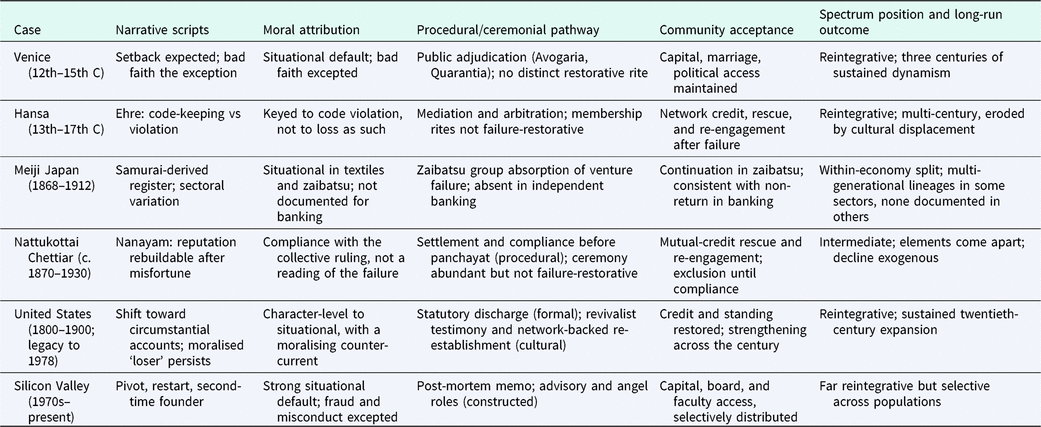
Across the six cases, one mechanism is observable: the cultural architecture surrounding failure operates as a structural variable distinct from formal institutional infrastructure and consequential for long-run dynamism. Table 1 summarises the pattern and locates each case.
Cultural reintegration architecture across six historical cases, located on the stigmatising-to-reintegrative spectrum

Table 1. Long description
A table comparing cultural reintegration architecture across six historical cases. The table has six rows and six columns. The columns are labeled Case, Narrative scripts, Moral attribution, Procedural/ceremonial pathway, Community acceptance, and Spectrum position and long-run outcome. The rows are labeled with different historical cases: Venice (12th-15th C), Hansa (13th-17th C), Meiji Japan (1868-1912), Nattukottai Chettiar (c. 1870-1930), United States (1800-1900; legacy to 1978), and Silicon Valley (1970s-present). Each row provides detailed information about the narrative scripts, moral attribution, procedural/ceremonial pathway, community acceptance, and spectrum position and long-run outcome for each case. For example, the Venice case mentions setback expected, bad faith the exception for narrative scripts, situational default, bad faith excepted for moral attribution, public adjudication (Avogaria, Quarantia), no distinct restorative rite for procedural/ceremonial pathway, capital, marriage, political access maintained for community acceptance, and reintegrative, three centuries of sustained dynamism for spectrum position and long-run outcome.
The stigmatising-to-reintegrative spectrum
Three of the four elements are observable across the cases and move broadly together: narrative, attribution, and acceptance. The fourth, the distinctly ceremonial pathway, is the most variable: abundant but never failure-restorative in the Hansa and among the Nakarattar, realised procedurally in Venice and the United States, and present in dedicated form only in Silicon Valley, where it was deliberately constructed. The Chettiar case is decisive: the elements visibly come apart there, and a binary scheme cannot classify it without distortion.
It is also the clearest evidence that the framework is not confirming itself. A scheme that generated its own findings would have absorbed the case; instead, it broke the binary classification and forced the spectrum, and the evidence overruled the structure brought to it. It is where the structural claim the term architecture carries was tested rather than assumed: the elements came apart, and the framework had to be rebuilt to hold them.
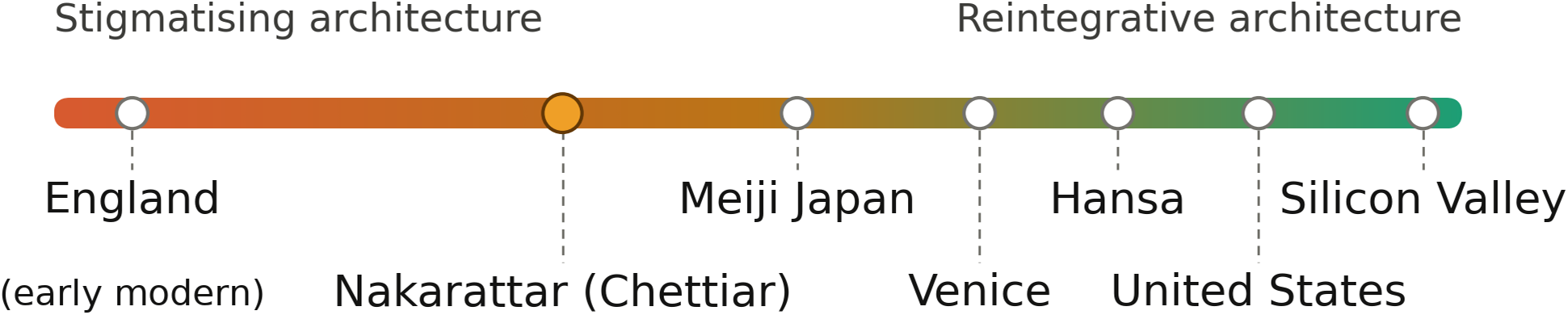
The evidence is not symmetrical across the spectrum. Architectures at the far stigmatising pole suppress the commercial activity, and with it the commercial communities and records, through which an architecture becomes observable at all, so the extreme left of the spectrum is systematically harder to document than the right. Figure 2 places the cases on that spectrum.
The stigmatising-to-reintegrative spectrum. Positions are ordinal, and within-case variation is treated in the text. England (early modern), the inherited tradition analysed within the Anglo-American case, anchors the stigmatising pole. The Nattukottai Chettiar configuration sits intermediate because acceptance is gated on compliance rather than on the reading of failure. Venice, the Hansa, the United States, and Silicon Valley sit toward the reintegrative pole, the United States held short of Silicon Valley by Sandage’s (Reference Sandage2005) moralising counter-current; Meiji Japan’s mid-spectrum point reflects its within-economy split.

The architecture is historically dynamic, and the cases show what moves it. Veblen supplies the floor: economic change is at bottom a change in habits of thought, and habits of thought accumulate, each configuration the outcome of the process that preceded it (Veblen, Reference Veblen1898: 391, 393). Cumulation of this kind explains why an architecture outlasts the conditions that produced it. The English verdict on failure held for three centuries, and the samurai honour ethic outlived the abolition of the samurai class by decades. What it does not explain is movement.
Movement begins in belief. No single efficient cause mechanically pushes one architecture into the next. A community abandons a verdict when the verdict can no longer account for what the community sees, and fixes a new one that can, which is the abductive inference Bromley places at the origin of institutional change (Reference Bromley2006: 25–26). Nineteenth-century America supplies the occasion: commercial failure had become commonplace and a war had made economic risk visible to everyone, so insolvency grew harder to read as moral failure and the older reading gave way (Mann, Reference Mann2002: 55–56). The belief shifted first, and the architecture consolidated around it.
Belief settles what a community holds. Volition settles what it builds. Bromley (Reference Bromley2006: 13–14, 25–26) holds that a working rule is adopted for the sake of an outcome its authors intend to bring about, and that the hoped-for outcome, the final cause in his vocabulary, is the sufficient reason for the rule. Silicon Valley shows this most plainly. Venture investors sit where Bromley (Reference Bromley2006: 25) places those within a going concern who construct its working rules, and their portfolio economics require most ventures to fail. The failure-as-learning script, the pivot, the post-mortem, and the re-funded founder were built for the sake of a future supply of founders willing to try again, and that supply is the purpose the architecture serves and the reason it was made. In America, the same volition was dispersed rather than concentrated, fought out in pamphlets, courtrooms, and legislatures across a century in which the cultural verdict and the statute moved together. An architecture can also lose its author. Where an external state apparatus captures the verdict, as colonial courts did from the Nakarattar panchayats and territorial states from the Hanseatic Kontore, the community loses the collective-action capacity Commons describes, and the architecture decays for want of an agent to carry it.
The framework specifies a mechanism within the informal-institutional space that several established constructs occupy collectively without isolating it. North (Reference North1990, Reference North2005) draws the formal/informal distinction but leaves the content of the informal underspecified; cultural reintegration architecture names one informal institution within it and decomposes it into observable elements. Greif’s (Reference Greif2006) private-order and community-responsibility institutions explain how networks enforce obligations among members; the present framework addresses the prior cultural determination of whether a given failure warrants enforcement or reintegration, which an enforcement-centred account does not isolate. Putnam’s (Reference Putnam2000) social capital captures the generalised reciprocity and trust on which communities draw but does not specify how that stock is applied to the problem of the failed member; the architecture specifies that application. Greif et al. (Reference Greif, Mokyr and Tabellini2025) treat the codification of bankruptcy and the bottom-up development of instruments such as the commenda as formal European achievements enforced through reputation; the present framework specifies the cultural determination that sits beneath that enforcement, fixing whether a given failure warrants sanction or return. The contribution is not a rival to these constructs but a narrower, failure-specific mechanism within the space they share.
The cases also indicate that the architecture operates sectorally, not only nationally. Meiji Japan is the clearest instance available: one insolvency regime supported reintegrative architecture in textiles and the zaibatsu and no documented pathway back in independent banking, a within-economy divergence rendered intelligible by the firm-and-collective loyalty ethic Morishima (Reference Morishima1982) describes. Silicon Valley displays the same sub-community variation in a contemporary setting. A sector within an economy is one kind of bounded community in the sense intended here.
The sectoral location of the architecture also admits a structural reading: sectors differ in how far failure is hardwired into their economics. In film, pharmaceuticals, and venture-financed technology, most projects fail by design and a few successes cross-subsidise the rest, so failure is expected and survivable at portfolio level; in capital-intensive sectors such as aircraft or automobile manufacture, failure is rare, ruinous, and frequently terminal. Where failure is routine, a community has more occasions to build machinery for taking the failed back, and stronger reasons to build it. Silicon Valley and Meiji textiles were both high-failure settings, and both sit toward the reintegrative pole. Reintegrative architecture is therefore shaped in part by the sectoral failure regime in which it grows. This connects the framework to the failure agenda in business history (Fridenson, Reference Fridenson2004).
Theoretical propositions
The historical analysis supports five propositions, and they are stated so that evidence could contradict them. A community stigmatising on all four elements that nonetheless sustained high entrepreneurial dynamism across generations would falsify Proposition 2. A community whose architecture shifted toward the reintegrative pole with no subsequent change in re-entry or founder persistence would falsify the mechanism itself, and the operationalisation of Proposition 3 proposes precisely that test.
Propositions 1 and 3 both concern the relationship between cultural architecture and formal infrastructure, and they are compatible rather than contradictory: the first concerns what can be observed at a single moment, the second what causes what over time.
Proposition 1. (synchronic separability). At any given time, cultural reintegration architecture is analytically separable from formal institutional infrastructure and can be observed independently of it.
Operationalisation. The four elements are independently observable through coded communications, attribution vignettes, documented pathways of return, and capital and board access following failure.
Proposition 2. The long-run dynamism of an ecosystem, measured by the sustained supply of competent actors willing to bear commercial risk, is conditional on its cultural reintegration architecture. Reintegrative configurations sustain dynamism across generations. Stigmatising configurations constrain it regardless of formal institutional support.
Operationalisation. Cross-sectional designs comparing ecosystems matched on formal infrastructure but differing on observable elements would test the relationship using firm-formation rates and founder-cohort persistence.
Proposition 3. (diachronic co-evolution). Over time, cultural architecture and formal infrastructure shape each other, and which direction dominates turns on who writes the law. Where an external state apparatus competes with community enforcement, the formal layer displaces the cultural one, as with the Nakarattar panchayats and the Hanseatic Kontore. Where the community whose architecture is shifting and the polity writing the law are substantially the same public, the two layers co-evolve, as in the nineteenth-century United States.
Operationalisation. Natural experiments on bankruptcy reform, measuring cultural register, failed-founder re-entry, and founder persistence before and after, would test directionality and the mechanism.
Proposition 4. Cultural reintegration architecture operates at the level of bounded communities, including sectors and sub-communities within an economy, rather than at the level of civilisations as wholes. Within-economy variation is observable in the historical record and produces variation in dynamism that civilisation-level analysis cannot capture.
Operationalisation. Within-economy comparison across sectors, regions, and enclaves embedded in common formal environments would isolate the cultural variable.
Proposition 5. Cultural reintegration architecture is historically dynamic, produced and reproduced through ongoing cultural work and capable of substantial transformation across decades or centuries.
Operationalisation. Longitudinal discourse analysis of changing narrative scripts, paired with parallel measurement of entrepreneurial outcomes, would test the dynamic relationship. Computational text analysis of the kind Grajzl and Murrell (Reference Grajzl and Murrell2021a, Reference Grajzl and Murrell2021b) apply to two centuries of English case law offers a scalable instrument for tracing narrative scripts and moral attribution across the long runs the framework requires.
Limitations and scope
Six scope conditions apply. The argument is built through synthesis of secondary scholarship rather than original archival research, and its historical claims are no stronger than the scholarship supporting them. The Nakarattar case widens the selection to a non-Western commercial community, moderating but not removing the weighting toward European and European-derived cultures. The propositions remain provisional pending extension to further non-Western contexts: Sogdian Central Asia, the Indian Ocean Muslim merchant communities, the Chinese diaspora networks of Southeast Asia, and precolonial West African commercial systems. Causal inference is constrained by the historical method; the framework specifies a structural variable to add to existing accounts of dynamism, not a sole explanation of entrepreneurial outcomes. The unit of analysis is the bounded community, and civilisation-level characterisations are first-pass orientations that conceal the within-economy heterogeneity the Meiji, Chettiar, and Silicon Valley cases display. Because the architecture is historically dynamic, empirical work applying it must be temporally specific. Finally, the framework speaks to those who remain within a community’s jurisdiction: where geographic exit is easy, a failed actor may escape the verdict rather than be reintegrated under it, as the American westward escape and the Chettiar’s colonial circuits both illustrate; architecture and mobility must be read together.
Conclusion
The evidence across six cases is consistent with the framework’s central claim: across eight centuries and dramatically different institutional contexts, reintegrative configurations sustained entrepreneurial activity across generations while stigmatising configurations constrained it regardless of formal support. The contribution to economic history is the identification of a historically traceable variable with effects documentable across centuries. The contribution to institutional theory is the demonstration that formal infrastructure operates within a cultural layer not reducible to it and that the layer can be specified narrowly enough to be observed and traced. The contribution to entrepreneurship scholarship is historical depth for the contemporary observation that failure-tolerant culture matters: what recent research documents in particular ecosystems recurs across commercial history.
The framework carries a policy implication. If bankruptcy reform operates within a cultural substrate that conditions its uptake, then jurisdictions pursuing entrepreneurial activity through legal reform alone may see smaller effects than those pairing reform with attention to the cultural elements specified here. The argument is narrower than Mokyr’s case for the cultural foundations of growth but operates at the same level of analysis. Recognising the architecture as a structural variable, located on a spectrum and analysed at the level of the community, opens analytical possibilities that the study of formal institutional design alone cannot reach.
Disclosure statement
This research received no external funding. The author used ChatGPT (OpenAI) and Grammarly for editorial feedback and language refinement. The conceptual framework, historical analysis, and arguments are the author’s own, and the author takes full responsibility for the content.


 Open access

