Introduction
The study of extraterrestrial minerals provides critical insights into the physicochemical conditions that prevailed during the early history of the Solar System. Among these, sulfide minerals play a significant role in shedding light on thermal metamorphism, redox conditions, and differentiation processes within planetary bodies (e.g. Blander, Reference Blander1971; Fleet, Reference Fleet2006). Among such minerals, zolenskyite, a chromium-bearing sulfide that represents a polymorph of FeCr2S4 after daubréelite, has recently been discovered in the Indarch meteorite (EH chondrite), but its crystal structure had not been determined conclusively (Ma and Rubin, Reference Ma and Rubin2022). This work presents the first single-crystal X-ray diffraction analysis of zolenskyite, identified for the first time in the Muonionalusta meteorite. Muonionalusta is classified as an octahedrite belonging to group IVA, which represents ∼8% of all known iron meteorites. Its primary mineral composition – with the metal fraction containing ∼9 wt.% nickel and 0.4 wt.% cobalt (Hidaka et al., Reference Hidaka, Shirai, Yamaguchi and Ebihara2019) – has been documented thoroughly in earlier studies (Buchwald, Reference Buchwald1975; Holtstam et al., Reference Holtstam, Broman, Söderhielm and Zetterqvist2003; Ahlgren et al., Reference Ahlgren, Wasson and Haack2016). The Muonionalusta meteoroid is believed to have been ejected from its parent body roughly 400 million years ago during a high-energy impact event (Blichert-Toft et al., Reference Blichert-Toft, Moynier, Lee, Telouk and Albarède2010). It entered Earth’s atmosphere, probably during the Middle Pleistocene, fragmented during atmospheric entry, and dispersed across a wide region (Lagerbäck and Wickman, Reference Lagerbäck and F.E1997).
Zolenskyite is part of a broader group of sulfides that includes rare and metastable phases often formed under non-equilibrium conditions, such as shock or rapid cooling, commonly encountered in meteoritic environments (e.g. Leroux et al., Reference Leroux, Cuvillier and Zanda2008; Miyahara et al., Reference Miyahara, Tomioka and Bindi2021). Its occurrence in the Muonionalusta meteorite is particularly notable due to the meteorite’s history of high-temperature processes, followed by slow cooling and multiple shock events (Yang et al., Reference Yang, Goldstein and Scott2010). The presence and characteristics of zolenskyite in this context can thus provide important clues regarding the metamorphic and impact history of its parent body.
The structural determination of zolenskyite is essential not only for mineralogical classification but also for understanding the conditions of its formation and stability. Previous studies have relied primarily on electron-backscatter diffraction, limiting the accuracy of atomic positional data (Ma and Rubin, Reference Ma and Rubin2022). By applying single-crystal X-ray diffraction techniques, we here provide a precise and unambiguous characterization of this mineral, contributing significantly to the mineralogical dataset of meteoritic sulfides.
Moreover, the recognition and structural resolution of μm-sized phases such as zolenskyite underscore the growing importance of micron-scale mineralogy in planetary science. Submicron-sized mineral inclusions often record high-resolution signatures of physicochemical processes that are otherwise undetectable in bulk analyses (e.g. Xu et al., Reference Xu, Wang and Liu2017). Such studies do not only expand our mineralogical knowledge but also aid in a better reconstruction of the formation environments of meteorites and their parent bodies.
This paper reports the occurrence, description, and crystal structure of zolenskyite from the Muonionalusta meteorite. The findings provide new constraints on the formation conditions of Fe–Cr sulfides in iron meteorites and highlight the value of high-resolution mineralogical analysis in decoding planetary processes.
Occurrence of zolenskyite in Muonionalusta
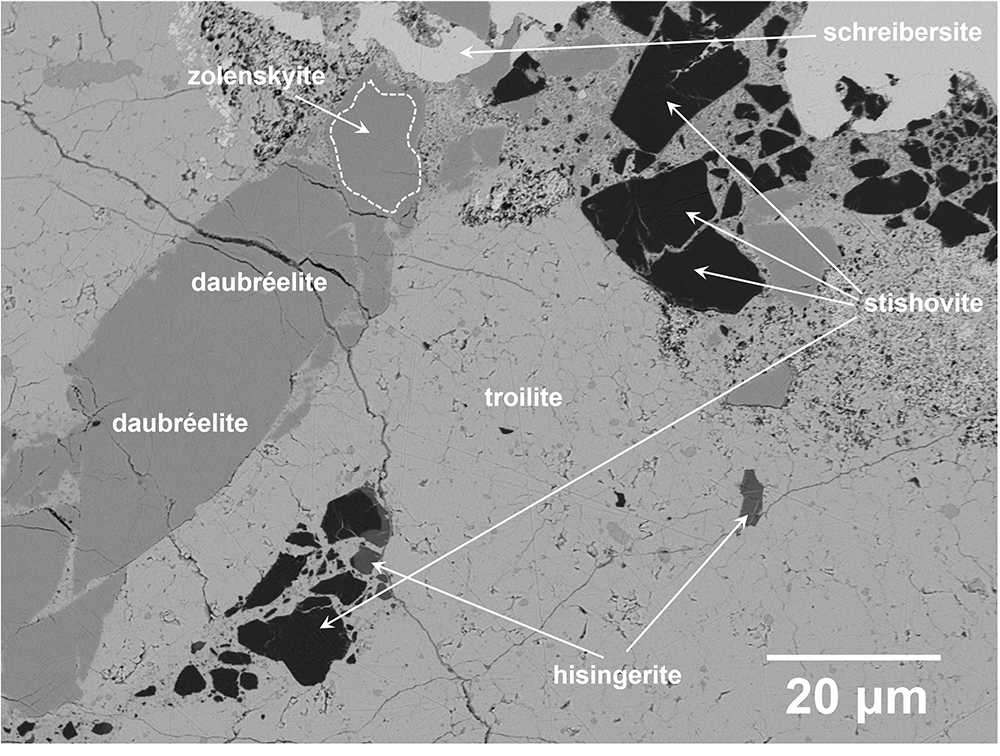
Zolenskyite occurrence in Muonionalusta is very rare. It occurs in μm-sized grains associated closely with daubréelite (the other FeCr2S4 polymorph) in a troilite matrix (Fig. 1). Zolenskyite was found in the Muonionalusta sample originally studied by Holtstam et al. (Reference Holtstam, Broman, Söderhielm and Zetterqvist2003), from the collections of the Swedish Museum of Natural History, catalogue no. GEO-NRM 20020049. These authors identified stishovite (pseudomorph after tridymite), chromite, hisingerite and schreibersite by means of a combination of micron-Raman spectroscopy, chemical spot microanalysis and powder X-ray diffraction.
SEM back-scattered electron image of a portion of the studied Muonionalusta sample. All the phases have been labelled.

Chemical composition
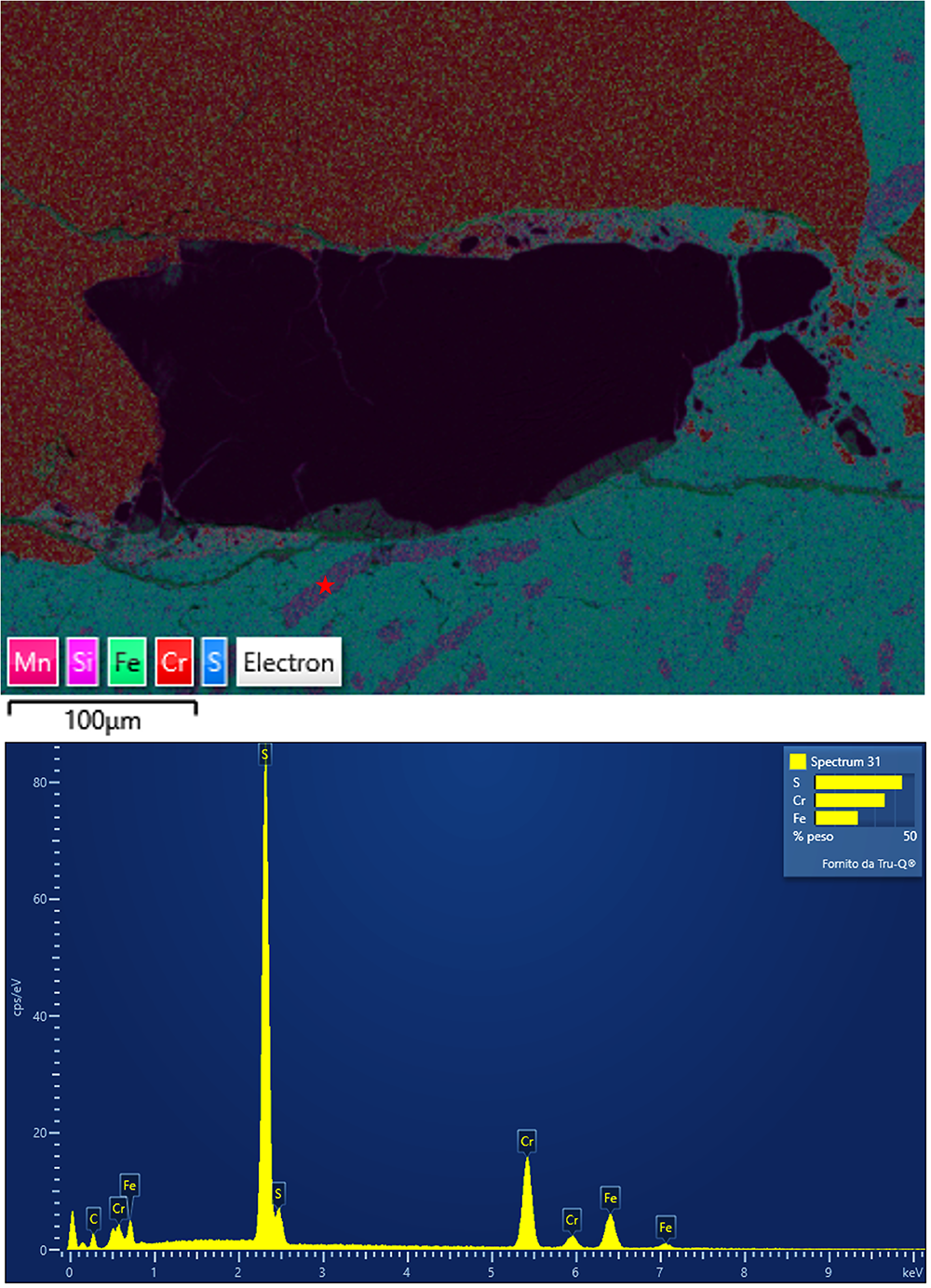
The chemical composition of zolenskyite was analysed qualitatively with energy-dispersive microanalysis (EDS, Fig. 2) with a ZEISS EVO 15-MA scanning electron microscope (SEM) equipped with microanalysis EDS system Oxford UltimMax 40 (Oxford Instruments, UK). SEM-EDS X-ray maps and analyses were performed with an acceleration voltage of 15 kV and nominal beam current of 0.7 nA, acquiring spectra for 20 s live time. The analyses (4 spot analyses) did not show the presence of elements (Z > 9) other than Fe, Cr and S (Fig. 2b) and indicate a chemically homogeneous mineral within analytical uncertainties of our measurements. X-ray compositional maps were also collected from a large area (Fig. 2a). The derived empirical formula for zolenskyite is close to pure FeCr2S4.
X-ray compositional map of the studied sample (top) together with an EDS spectrum of region composed of daubréelite/zolenskyite (bottom).

X-ray single-crystal diffraction
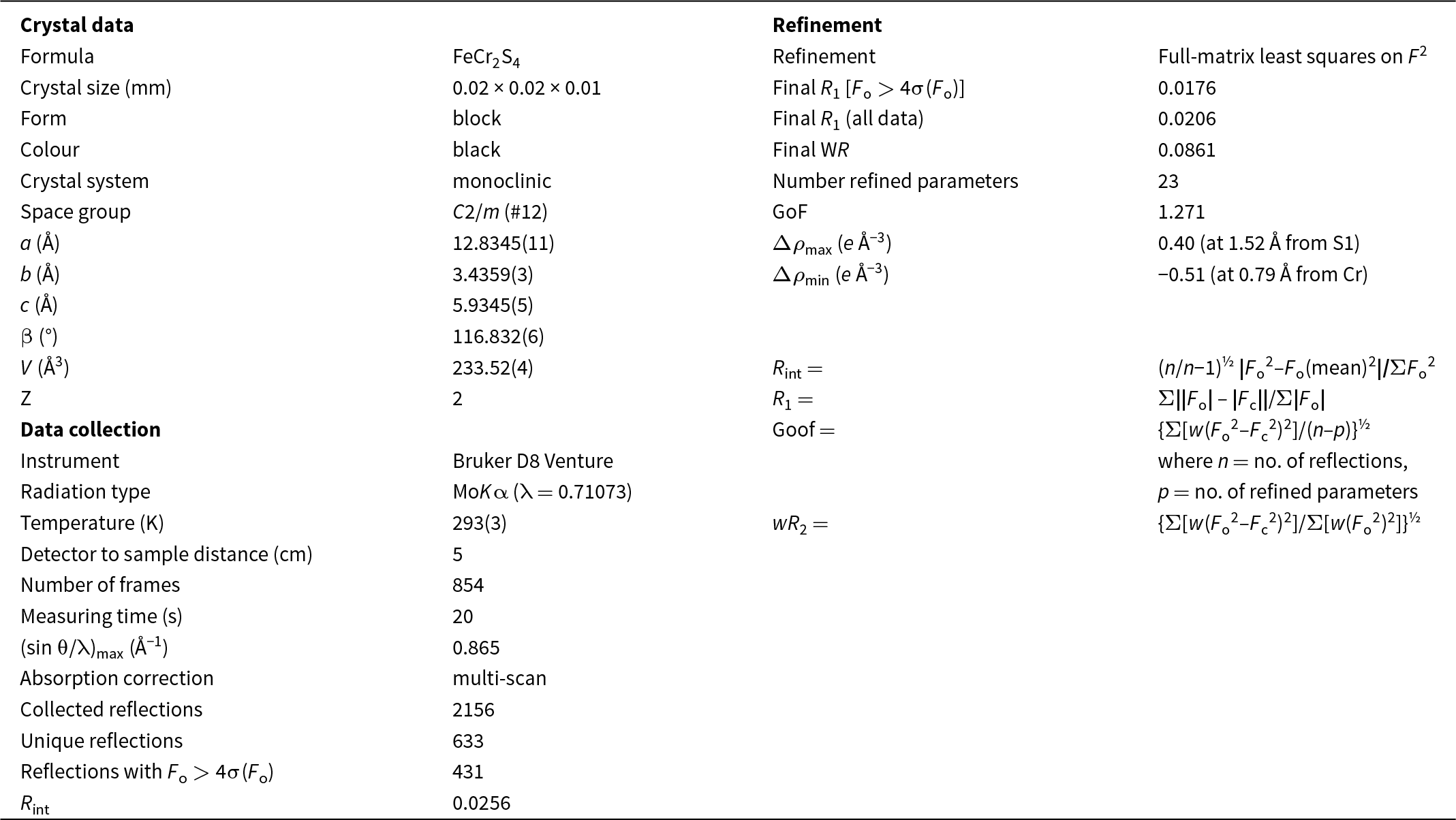
A small zolenskyite fragment (0.02 × 0.02 × 0.01 mm in size) from Muonionalusta (Fig. 1) was extracted from the polished section under a reflected light microscope and mounted on a 5 μm diameter carbon fibre, which was, in turn, attached to a glass rod. The fragment consists of crystalline zolenskyite [unit-cell parameters: a = 12.8345(11), b = 3.4359(3), c = 5.9345(5) Å, β = 116.832(6)°, V = 233.52(4) Å3 and Z = 2; space group C2/m] associated to minor, fine-grained polycrystalline troilite. Single-crystal X-ray diffraction intensity data of zolenskyite were collected with a Bruker D8 Venture Photon 100 CMOS equipped with graphite-monochromatized MoKα radiation (Table 1). The detector-to-crystal distance was 5 cm. Data were collected using ω and φ scan modes, in 0.5° slices, with an exposure time of 20 s per frame. The data were corrected for Lorentz and polarization factors and absorption using the software package APEX3 (Bruker, 2023). A total of 633 unique reflections was collected. Given the similarity in unit-cell values and space groups, the structure was refined starting from the atomic coordinates reported for the C2/m CrNb2Se4–Cr3S4-type structure of synthetic FeCr2S4 (Tressler et al., Reference Tressler, Hummel and Stubican1968), using the program SHELXL-2018 (Sheldrick, Reference Sheldrick2015). The site occupancy factor at the cation sites was allowed to vary [Fe (and Cr) vs. structural vacancy for the two octahedral sites] using scattering curves for neutral atoms taken from the International Tables for Crystallography (Wilson, Reference Wilson1992) but was found to be 26 and 24 e- for the Fe and Cr positions, respectively. It was then fixed in the subsequent refinement cycles. At the last stage, with anisotropic displacement parameters for all the atoms, the structure was refined to R1 = 0.0206 using 633 independent reflections.
Data and experimental details for the selected zolenskyite crystal

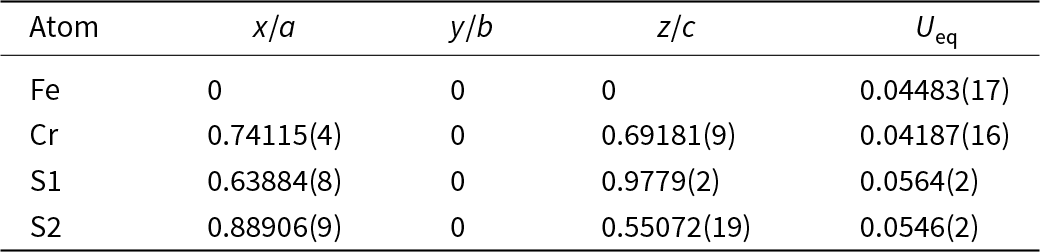
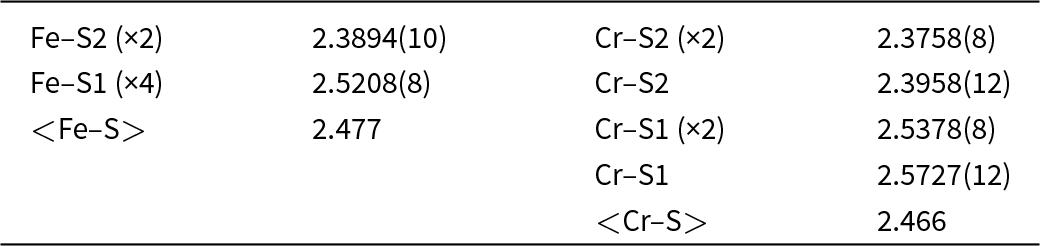
Atomic coordinates are given in Table 2. Selected bond distances are shown in Table 3. A Crystallographic Information File (CIF) is deposited with supplementary material (see below)
Atoms, fractional atomic coordinates, and equivalent isotropic displacement parameters (Å2) for the selected zolenskyite crystal

Selected bond distances (in Å) for cations in the zolenskyite crystal analysed

Results and discussion
Crystal-chemical remarks
FeCr2S4 can crystallize in two distinct structural forms – one adopting the thiospinel structure and the other based on a nickeline-type (NiAs-derived) structure – each exhibiting quantitatively different crystallographic, electronic and magnetic properties that reflect their underlying atomic arrangements. In the thiospinel structure, the mineral daubréelite, FeCr2S4 crystallizes in the cubic system with space group Fd  $\bar 3$m, exhibiting a lattice parameter typically of ∼9.97 Å (Lundqvist, Reference Lundqvist1943). In this configuration, Fe2+ occupies the tetrahedral (8a) sites while Cr3+ resides at the octahedral (16d) sites, leading to a well-ordered distribution of cations. The sulfur anions form a close-packed face-centred cubic sublattice, creating a three-dimensional network of Fe–S–Cr super-exchange paths.
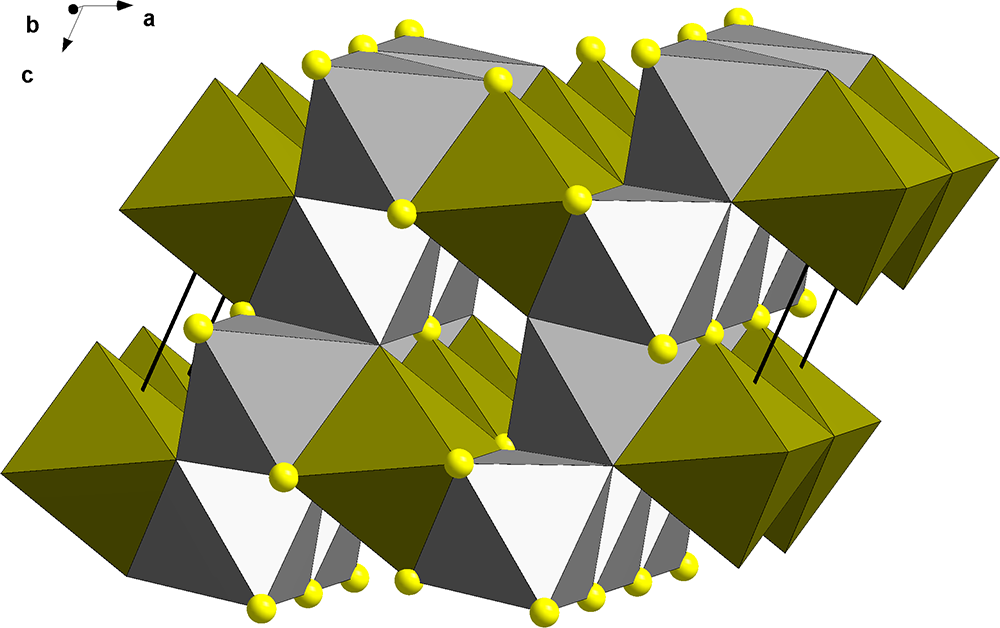
By contrast, in the NiAs-type derivative structure, FeCr2S4 can show two distinct arrangements: (1) the classic hexagonal structure in which the cations and vacancies are disordered; (2) the monoclinic structure in which A2+ ions and vacancies occupy the same plane, and the B3+ ions occupy filled alternate planes. Zolenskyite crystallizes in this second type with the structure made up of face-sharing octahedra (Fig. 3).
The crystal structure of zolenskyite. Yellow and grey octahedra refer to Fe and Cr atoms, respectively. Sulfur atoms are given as yellow circles. The unit cell and the orientation of the structure is given.

The NiAs-derived phase often displays semi-metallic or metallic conductivity due to increased cation–anion–cation orbital overlap and reduced cation ordering, resulting in diminished electronic localization (Motizuki et al., Reference Motizuki, Katoh and Yanase1986). Magnetically, this phase may exhibit weaker long-range order or different transition behaviour, often lacking the well-defined ferrimagnetic transition seen in the spinel form. The effective magnetic moments in the NiAs-type structure can be significantly reduced due to itinerant behaviour or spin compensation effects, and the magnetic susceptibility typically shows a more Pauli-like response.
From a thermodynamic standpoint, the thiospinel structure is the stable equilibrium phase under ambient pressure and moderate temperatures, while the NiAs-type derivative is generally metastable or stabilized only under non-ambient conditions, such as pressures above 5 GPa or through rapid quenching techniques. The energy difference between these phases is subtle – estimated in DFT calculations to be within tens of meV per formula unit – making the relative stability sensitive to factors like stoichiometry, strain, or defect chemistry (e.g. Amiel et al., Reference Amiel, Rozenberg, Nissim, Milner, Pasternak, Hanfland and Taylor2011).
Zolenskyite is the Fe-analogue of brezinaite (ideally Cr3S4) or the Cr-analogue of heideite (FeTi2S4).
Origin
Shock conditions estimated for the Muonionalusta meteorite are in the P range 13–40 GPa and T range 1200–1300 K (Jain and Lipschutz, Reference Jain and M.E1970; Buchwald, Reference Buchwald1975). Experiments show that daubréelite can convert into zolenskyite at high pressures and relatively low temperatures (e.g. 5.5 GPa, 520°C; 3 GPa, 200°C; Tressler et al., Reference Tressler, Hummel and Stubican1968). On the basis of the coexistence of zolenskyite with stishovite (Fig. 1), we suggest that zolenskyite crystallized by solid-state transformation from daubréelite at a temperature > 1000 K and pressure ≥ 7 GPa.
Implications
The micron-scale mineralogy studies of meteorites carry profound implications for understanding planetary processes across the solar system. The studies of high-pressure minerals can help to shed light on high-temperature events, shock metamorphism, and aqueous alteration that occurred during the early formation and evolution of planetary bodies. Micron and submicron-sized minerals, indeed, often preserve conditions that are otherwise lost at larger scales, enabling the reconstruction of thermal histories, chemical exchanges, and dynamic processes within asteroids and protoplanets. Furthermore, micron-scale mineralogical analyses can reveal the presence of exotic or transient phases, offering clues about the environments in which these materials formed.
Although zolenskyite in shock veins may be due to kinetic factors such as a metastable crystallization due to rapid cooling during decompression from the peak shock pressures experienced by the meteorite, new theoretical and experimental studies of the stability of thiospinel-related structures are clearly needed.
Supplementary material
The supplementary material for this article can be found at https://doi.org/10.1180/mgm.2025.10119
Acknowledgements
The paper benefited by the official reviews made by Pete Leverett and two anonymous reviewers.
Funding statement
This study was conducted within the Space It Up project funded by the Italian Space Agency, ASI, and the Ministry of University and Research, MUR, under contract n. 2024-5-E.0-CUP n. I53D24000060005.
Competing interests
The authors declare none.