Introduction
Nowadays, real-time wireless communication is essential for rescuers on a mission [Reference Winterhalter, Teverovsky, Wilson, Slade, Horowitz, Tierney and Sharma1]. So many future projects are aiming to make a wearable system for rescue persons deployed in battlefield or rescue operations. Rescuers on a mission need to wear helmets for personal protection and should always be connected wirelessly with the control room for continuous guidance. Both the issues of personal protection and real-time communication can be addressed by an integrated helmet antenna. There are many situations in which rescuers are bound to carry out their mission indoor. But transmission via satellite cannot support indoor communication directly. So, supportive radio communication, along with satellite communication, is required to assist rescuers in both outdoor and indoor environments. Due to its noise-resistant nature for indoor environment, WLAN standards could be a good choice for this supportive communication. The antenna must support a narrow lower band (2.4–2.484 GHz) and a broad upper band (5.15–5.85 GHz) for WLAN applications [Reference Yan, Soh and Vandenbosch2]. So a dual band helmet integrated antenna can cater both protection and wireless communication for rescuers. Research is undertaken to develop a protruded antenna on military helmet [Reference Nguyen-Trong, Piotrowski, Kaufmann and Fumeaux3] to operate between 800 and 2300 MHz. But antennas with any protruded part may not be suitable for wearable applications. So, compact, low profile antennas have been developed on military beret [Reference Lee, Tak and Choi4] for indoor/outdoor positioning with ISM (915 MHz) and GPS L1 (1.575 GHz) bands. A flexible military beret, however, cannot replace the helmet of a rescuer. Rescuers can also use body worn antennas for the purpose of radio communication. Over the years, several radiator structures have been placed on flexible textile substrates to develop wearable antennas [Reference Gao, Hu, Wang and Yang5–Reference Biswas and Chakraborty7]. But wearable antennas on flexible material suffer from deviation in characteristics due to body bending and crumpling of the clothes [Reference Bai and Langley8]. Therefore, the performance of flexible antennas cannot be claimed reliable without conducting crumpling analysis under bending conditions. To avoid the issues of flexible antennas, research has been started to introduce a rigid antenna structure for wearable applications. A rigid antenna of such type is presented for wearable applications in [Reference Wen, Hao, Munoz, Wang and Zhou9]. With a multi input multi output (MIMO) structure, it is able to hold only the lower band of WLAN communication.
In this paper, we propose a semi rigid, lightweight, aperture fed, stacked microstrip wearable helmet antenna for supporting both WLAN lower band and upper band applications. A lightweight but semi rigid material Arlon foam clad 100 is used as the substrate for the proposed antenna to avoid the behavioral irregularities of the flexible textile antenna due to different body gestures. Aperture feeding of antenna is considered to prevent feed network radiation from interfering with the main radiation pattern. Four layers of dielectric slabs of two different permittivity are stacked on the ground plane comprising a cross slot structure to include two different WLAN bands. Initially, simulation tools are used for developing and investigating the antenna characteristics. Thereafter, a prototype structure of this antenna is fabricated for conducting measurements of scattering parameters and far field radiation pattern. Furthermore, a helmet and a human head model are included with the antenna to monitor application-specific performance of the proposed antenna. SAR assessment of the antenna is carried out to ensure RF radiation safety under wearable condition.
Antenna and helmet modeling
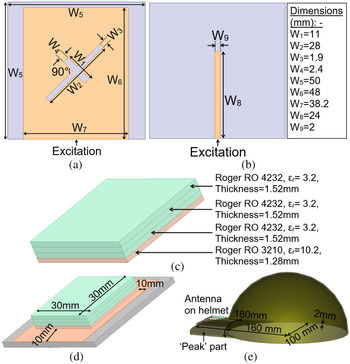
A double-sided copper laminated lightweight semi rigid material Arlon Foam Clad 100 (ɛr = 1.20, tan δ = 0.004, thickness = 2.43 mm) is considered as the substrate of the proposed antenna. Figures 1(a) and 1(b) show the antenna geometry without including dielectric slabs. A cross slot of unequal slot length on the ground plane and one microstrip line at the bottom of the substrate is created to allow the aperture feeding. The substrate structure has an overall dimension of 50 × 50 × 2.43 mm3. The length and width of this structure are determined by the available space of its final position, while the thickness is considered depending on the material available. Figure 1(c) shows the details of stacked layers of dielectric materials to bring the desired resonating frequencies. To address both lower and upper WLAN bands, four layers of specified permittivity are required. The thickness of each dielectric layer is considered depending on material availability. The dimensions of the slots, the microstrip line, and the stacked layers are defined according to the optimization results obtained from repeated iterations. Figure 1(d) shows the complete simulated model of the proposed antenna model. The complete simulated structure, including the antenna and a rescue helmet, is displayed in Fig. 1(e). A cap shape structure is modeled for rescue helmet with simulation, and the antenna is kept on its “peak” part. Acrylonitrile-Butadiene Styrene (ɛr = 2.8, tanδ = 0.004) of thickness 2 mm is used as material [Reference Mujal-Rosas, Orrit-Prat, Ramis-Juan, Marin-Genesca and Rahhali10, Reference Hsu, Tai and Chen11] for this helmet modeling.
Antenna geometry: (a) front view without dielectric layers, (b) back view, (c) stack organization of dielectric layers, (d) complete simulated antenna structure, and (e) integrated helmet antenna.

Effect of stacked layers on antenna performance
To investigate the effect of different stacked layers on the performance of proposed antenna, analysis has been carried out in three stages:
-
Stage 1: Cross aperture structure without dielectric layer (unloaded antenna).
-
Stage 2: Cross aperture structure with only bottom dielectric layer.
-
Stage 3: Cross aperture structure with all four dielectric layers.
Two cross slots of unequal length in the ground plane are responsible for introducing two resonant frequencies at 4.65 and 6.5 GHz. The longer slot is for lower resonant frequency, and the shorter slot is for higher resonant frequency. The bottom dielectric layer (Roger RO 3210, ɛr = 10.2, loss tangent tanδ = 0.003, thickness = 1.28 mm) of four layer stack causes the lower resonating frequency to shift from 4.65 to 2.4 GHz for accommodating the lower WLAN band. The challenge to incorporate the higher WLAN bands along with already obtained 2.4 GHz has been overcome by stacking three more dielectric layers of lower permittivity (Roger RO 4232, ɛr = 3.2, loss tangent tanδ = 0.0018, thickness = 1.52 mm) on the bottom layer. Thus non-homogeneous stacking of layers brings the two WLAN bands in operation. Figure 2 illustrates the loading effect of all dielectric layers incisively.
Effect of stacked layers on S 11.

Parametric analysis
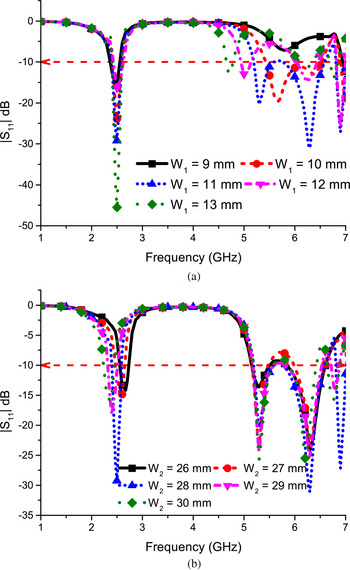
Figures 3(a) and 3(b) show the effect of slot length W 1 and W 2 on the WLAN frequency bands. The change in W 1 mainly affects the higher WLAN band. In the range 9–13 mm, W 1 = 11 mm stands as the best possible slot length for higher WLAN band. Similarly, in the range of 26–30 mm, desired lower WLAN band is achieved with W 2 = 28 mm only.
Parametric analysis: (a) effect of length W 1 on S 11 and (b) effect of length W 2 on S 11.

Measurements and result analysis
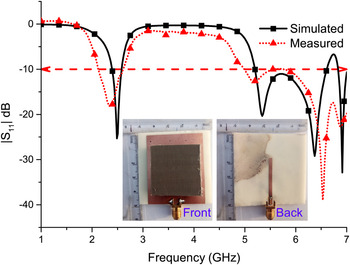
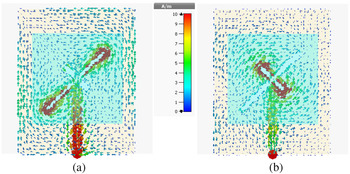
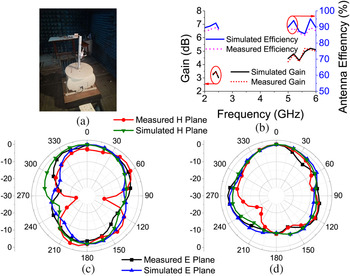
CST MWS software is used for simulation of the proposed antenna. Repetitive simulation is carried out to achieve optimization before starting the fabrication process. Simulation result along with experimental result for S 11 are presented in Fig. 4. Both simulation and experimental results almost confirm 10 dB return loss bandwidth of 7% (2.31–2.48 GHz) and 15.87% (5.12–6 GHz). The current distribution confirms a path length of 28 and 11 mm for lower and upper WLAN band, respectively, as shown in Fig. 5. The far field performance of the proposed antenna in free space is measured inside an anechoic chamber with an experimental setup, as shown in Fig. 6(a). Simulated and measured gain and antenna efficiency for all the desired frequencies are included in Fig. 6(b). Significant advantages over the planar microstrip wearable antenna can be observed in terms of antenna efficiency at both WLAN bands. The normalized E plane and H plane radiation patterns at 2.4 and 5.2 GHz, as shown in Figs 6(c) and 6(d) respectively, ensure good coverage of radiation in all directions.
Simulated and measured S 11 in free space.

Current distribution: (a) 2.4 GHz and (b) 5.2 GHz.

Far field characteristics: (a) experimental set up, (b) antenna gain and efficiency, (c) E plane and H plane radiation pattern at 2.4 GHz, and (d) E plane and H plane radiation pattern at 5.2 GHz.

Comparison with other wearable antennas
The proposed antenna is compared with some other wearable antennas for identifying its significance and limitations. Table I includes a detailed discussion on antenna dimension, operating frequency, antenna bandwidth, antenna gain, and antenna efficiency for some wearable antennas. From this discussion, it could be concluded that the proposed antenna exhibits considerable gain and higher antenna efficiency than the conventional compact wearable antennas. However, thickness of proposed antenna may be an issue in some applications.
Performance comparison table

Helmet antenna performance
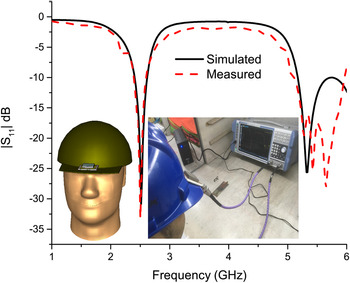
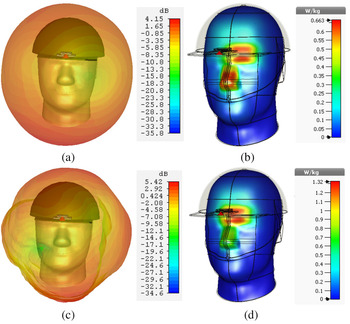
In this section, the performance of the proposed antenna is observed, including a helmet and a human head model. Simulation is carried out on CST platform to observe the helmet antenna performance under wearable condition. A human head model consisting of a shell and fluid material is taken from the CST library to run the simulation. Simulated, as well as measured results for reflection coefficient under wearable condition, are presented in Fig. 7. It can be observed that the proposed antenna holds both WLAN bands under head worn condition. It also exhibits considerable enhancement in gain at both lower and higher WLAN bands, maintaining antenna efficiency still high. SAR assessment is done on both lower and upper WLAN bands to ensure the RF radiation safety norms under wearable condition. The maximum SAR amount is 0.663 W/kg at 2.4 GHz and 1.32 W/kg at 5.2 GHz, which is below the threshold of 2 W/kg for a 10 g tissue mass as per the guidelines of ICNIRP [Reference Ahlbom, Bergqvist, Bernhardt, Cesarini, Grandolfo, Hietanen, Mckinlay, Repacholi, Sliney and Stolwijk14, 15]. Figure 8 presents the far field radiation pattern and evaluated SAR value under wearable condition for both WLAN bands on the simulation platform.
S 11 performance under wearable condition.

Performance under wearable condition: (a) radiation pattern at 2.4 GHz, (b) SAR evaluation at 2.4 GHz, (c) radiation pattern at 5.2 GHz, and (d) SAR evaluation at 5.2 GHz.

Conclusion
A dual-band stacked antenna integrated with a rescue helmet is proposed for lower and upper band WLAN applications. Its dual band operation is enabled by a cross slot created on the ground plane in aperture feeding process. Stack organization of low loss dielectric layers on the cross slot are used to achieve desired frequency bands. Under free space condition, the radiator yields 7% (2.31–2.48 GHz), 15.87% (5.12–6 GHz) 10 dB return loss bandwidth (BW). The use of low loss dielectric layers on the slots also ensures high antenna efficiency (more than 85.78%) and moderate gain (more than 3.48 dB) at both frequency bands. It is also proposed as a compact, low profile antenna implemented on a rescue helmet. The antenna performance observed under head worn conditions is found suitable for both lower and upper band WLAN communication. SAR evaluation has been carried out in both lower and upper WLAN bands for accessing human exposure to RF electromagnetic fields. The maximum amount of SAR obtained at 2.4 and 5.2 GHz is 0.663 and 1.32 W/kg, respectively, for a 10 g tissue mass.
Acknowledgment
The authors would like to thank Sikkim Manipal University, Sikkim, India for providing TMA Pai University Research Seed Grant-Major (Grant/Award Number: 176/SMU/REG/TMAPURF/26/2019) for this research work.
 Hashinur Islam received his B.Tech. degree in Electronics and Telecommunication Engineering from the Institute of Electronics and Telecommunication Engineers (IETE, India) in 2014 and his M.Tech. degree in Digital Electronics and Communication Engineering from the Sikkim Manipal Institute of Technology, Sikkim Manipal University in 2018. He is currently pursuing his Ph.D. at Sikkim Manipal University. He has published over 12 refereed papers in journals and conference proceedings. His research interests include multiband antennas, fractal antennas, circular polarization on antennas, feeding mechanism for antennas, PIFA antennas, wearable antennas, antennas for embedded systems, microstrip filters, reconfigurable filters, and so on. He is a Graduate Student Member of IEEE and Associate Member of IETE India. He also serves as a reviewer of IEEE Access and other journals and conferences.
 Saumya Das received his B.Tech. degree in Electronics and Telecommunication Engineering from the Institute of Electronics and Telecommunication Engineers (IETE), India, and his M.E. degree in Electronics and Communication Engineering from the Delhi College of Engineering, Delhi University. He has more than 15 years of teaching experience with expertise in various subjects, such as electromagnetic field theory, antenna theory, microwave devices and circuits, signals and system, digital signal processing, and adaptive signal processing. He is currently an Assistant Professor with the Department of Information Technology, Sikkim Manipal Institute of Technology, India. He has published several articles in reputed peer reviewed international journals and conferences. His research interests include different feeding techniques for microstrip and dielectric resonator antennas, flexible and wearable antennas for tracking and medical application, computational mathematics for antenna designing, RF exposure testing on human bodies, electromagnetic compatibility, and ultra wideband antenna designing. He is an Associate Member of IETE, India. He also serves as a reviewer of Microwave and Optical Technology Letters (MOTL), IETE Journal of Research and other journals and conferences.
 Tanushree Bose completed her Ph.D. in Design of Printed Antennas using Neural Network in the Department of Electronics and Communication Engineering, B.I.T., Mesra, India, in 2011. Presently, she is working as an Associate Professor at the Sikkim Manipal Institute of Technology, India. She worked extensively in the field of RF and microwave antennas with soft computation. Her current research interests are multiband antennas for handsets and networks, miniature antennas, reconfigurable antennas, EBG application on conformal antennas, flexible and wearable antennas, smart antennas, etc. She has published over 30 refereed papers in journals and conference proceedings and has served on many national and international technical committees. She completed one Govt. (AICTE) sponsored research project on patch antenna designing using artificial neural networks and successfully guided her research scholars.
 Sourav Dhar was born in Raiganj, West Bengal, India, in 1980. He received his B.E. degree from the Bangalore Institute of Technology, VTU in 2002. He received his M.Tech. degree in Digital Electronics and Advanced Communication from Sikkim Manipal University in 2005 and his Ph.D. in 2013. Since 2003, he has been associated with the Sikkim Manipal Institute of Technology, India, where he is currently working as a Professor in ECE Department, SMIT. His current research interest includes antennas and filter designing for IoT, WSN, and remote-sensing technologies. He is currently working on a project on microwave device design funded by TMA Pai University Research Seed Grant-Major, Sikkim Manipal University, India. He is a Member of IEEE, IEEE-GRSS Society, and IEI, India. He has published more than 30 SCI/Scopus indexed international journal and conference papers and guided several PG students. He also serves as the reviewer of Wireless Personal Communication, IEEE Transactions on Vehicular Technology and several other journals and conferences.