The walnut twig beetle (WTB), Pityophthorus juglandis Blackman (Coleoptera: Curculionidae: Scolytinae) (or Coleoptera: Scolytidae sensu Wood Reference Wood and Bright2007; Bright Reference Bright2014), vectors the pathogenic fungus, Geosmithia morbida Kolařík, Freeland, Utley, and Tisserat (Ascomycota: Hypocreales), to the phloem of walnut and butternut trees, Juglans Linnaeus (Juglandaceae) (Kolařík et al. Reference Kuang and Lu2011; Serdani et al. Reference Seybold, Coleman, Dallara, Dart, Graves and Pederson2013). Together, the insect and fungus cause a progressive crown dieback of these trees, which is known as thousand cankers disease (TCD; Tisserat et al. Reference Tisserat, Cranshaw, Leatherman, Utley and Alexander2009a, Reference Tisserat, Cranshaw, Putnam, Pscheidt, Leslie and Murray2009b; Seybold et al. Reference Stanford, Harden and Parks2013b). The phloeophagous bark beetle was first collected in 1896 (Bright Reference Bright1981) and described several decades later (Blackman Reference Blackman1928) from specimens that were collected in southwestern New Mexico, United States of America from a native black walnut, Juglans rupestris Engelmann ex Torrey, which based on the collection locality (United States Geological Survey 2014), was likely the modern synonymous taxon known as Arizona walnut, Juglans major (Torrey) Heller. Walnut twig beetle was not considered to be a significant pest (Furniss and Carolin Reference Furniss and Carolin1977) until it was found in association with G. morbida in dying black walnut trees across the western United States of America (Tisserat et al. Reference Tisserat, Cranshaw, Leatherman, Utley and Alexander2009a, Reference Tisserat, Cranshaw, Putnam, Pscheidt, Leslie and Murray2009b, 2011; Seybold et al. Reference Stanford, Harden and Parks2013b). Walnut twig beetle is thought to be native to Arizona, California, and New Mexico, United States of America and Chihuahua, Mexico (Bright Reference Bright1981; Wood and Bright Reference Yang1992; Seybold et al. Reference Stanford, Harden and Parks2013b), but it has expanded its range to include nine western (Arizona, California, Colorado, Idaho, New Mexico, Nevada, Oregon, Utah, and Washington) and seven eastern (Indiana, Maryland, North Carolina, Ohio, Pennsylvania, Tennessee, and Virginia) states in the United States of America (Seybold et al. Reference Seybold, Dallara, Nelson, Graves, Hishinuma and Gries2012, Reference Stanford, Harden and Parks2013b; University of Maryland Extension 2014; Wiggins et al. Reference Wood2014; Indiana Department of Natural Resources 2015). This range has expanded from four United States of America counties in 1960 to 124 counties in 2015, with the majority of the WTB genetic diversity present among purportedly ancestral populations in Arizona and New Mexico (Rugman-Jones et al. Reference Serdani, Vlach, Wallis, Zerillo, McCleary and Romero-Severson2015). Neither the WTB nor G. morbida has been detected in Canada as of March 2015 (Troy Kimoto, Canadian Food Inspection Agency, personal communication). However, both were recently reported from the Veneto region of northeastern Italy on eastern black walnut, Juglans nigra Linnaeus, grown for timber production (Montecchio and Faccoli Reference Muge Gungor, Nami Kartal and Kantay2014), and on an English walnut, Juglans regia Linnaeus, growing in a garden (Montecchio et al. 2014).
Based on our observations in the Juglans collection of the United States Department of Agriculture (USDA), Agricultural Research Service (ARS), National Clonal Germplasm Repository (NCGR) (Wolfskill Experimental Orchards, Winters, Solano Co., California, United States of America, 38°30'2.8"N, 121°58'38.6"W, ~40 m elevation; ~2.4 km SW of Winters), WTB is considered to have the capacity to develop in all species of Juglans that it may encounter. Although the colonisation behaviour of the pathogen has been evaluated on phylogenetically related extra-generic tree species (Utley et al. Reference Utley, Nguyen, Roubtsova, Coggeshall, Ford and Grauke2009, Reference Whittemore2013), little is known about the extra-generic extent of host acceptability and suitability for the WTB. Here we report for the first time incidence of both the WTB and G. morbida in two species of wingnut (Pterocarya Kunth; Juglandaceae) in the NCGR in northern California and a third species in the Los Angeles County Arboretum and Botanic Garden in southern California. In addition, Koch’s postulates were satisfied with an isolate of G. morbida from Pterocarya, which confirms that this fungus is the causal agent of TCD in wingnut.
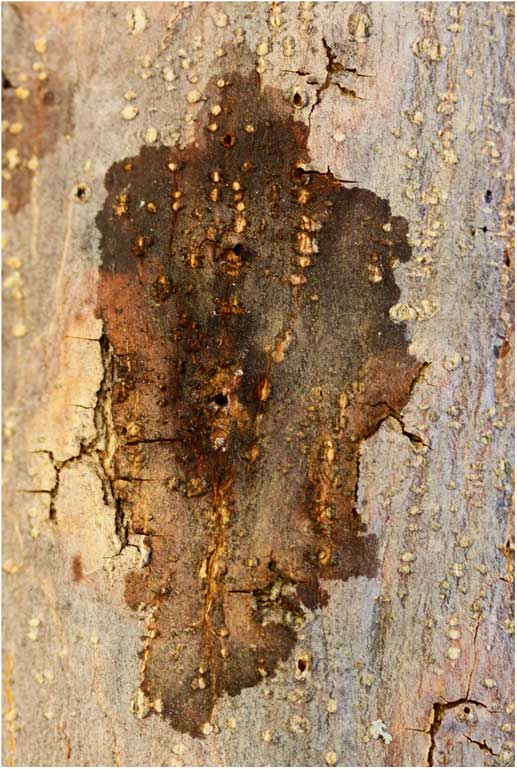
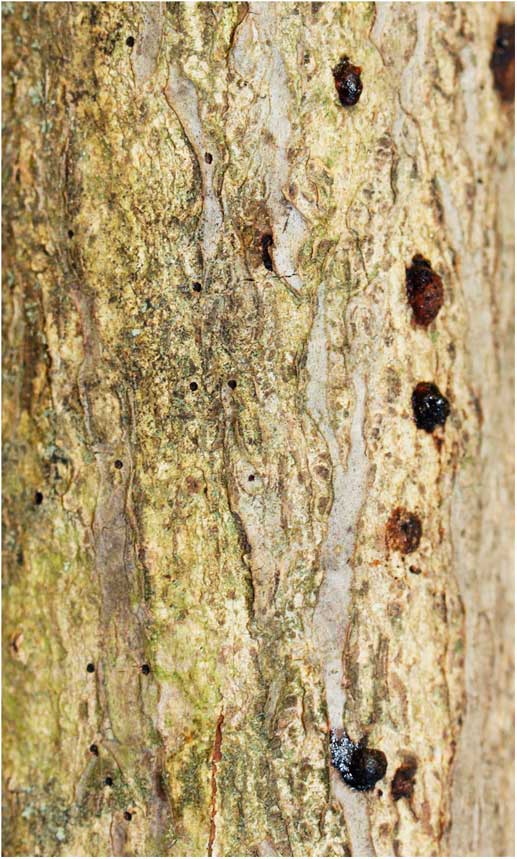
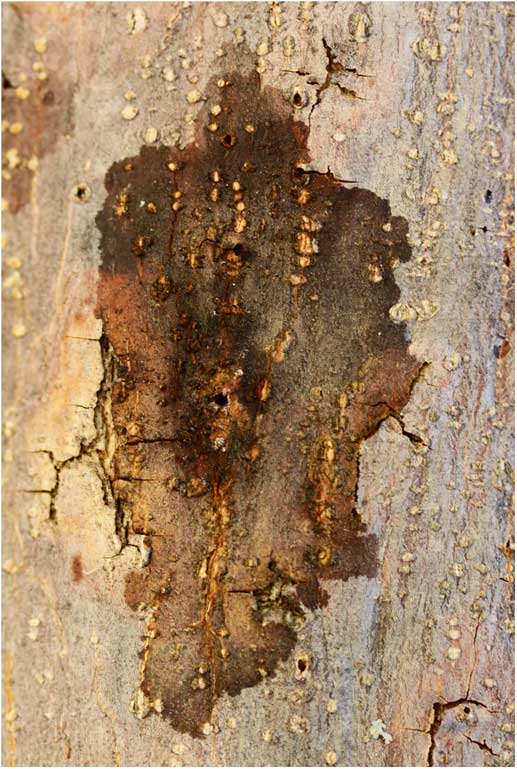
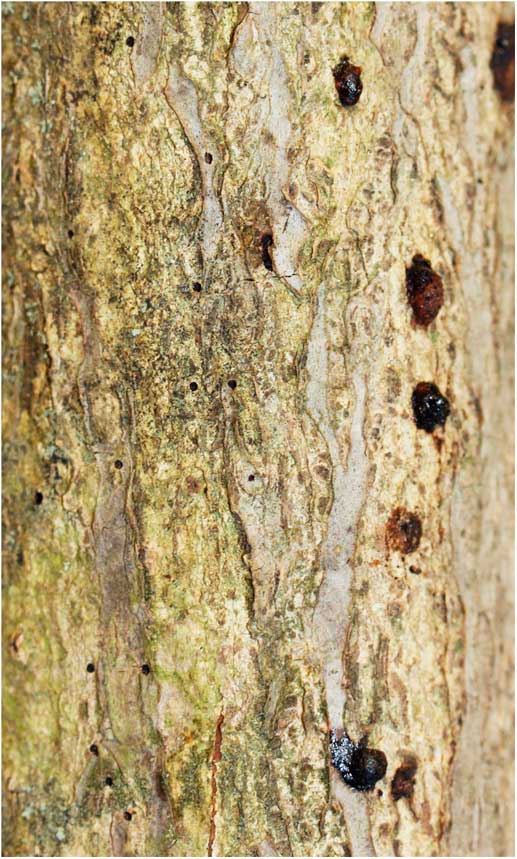
When examining the branches and main stem of several accessions in the NCGR Pterocarya collection (38°29'28.0"N, 121°58'31.0"W) on 31 July and 1 August 2012, we observed dark brown staining on the bark surface surrounding small bark beetle entrance or emergence holes, which were similar in size to those of WTB (0.5 mm diameter). These symptoms were first noted on Chinese wingnut, Pterocarya stenoptera de Candolle (accession DPTE 1.05 A; A-1-5; Fig. 1) and on Caucasian wingnut, Pterocarya fraxinifolia Spach (accession DPTE14.02 A; A-2-9; Fig. 2). Six infested branches were removed from each of these trees and returned to the laboratory at the University of California, Davis for further analysis and photographic documentation. Small (10–12 cm long×3–5 cm diameter) branch sections containing putative WTB entrance holes and stained bark were shipped to the laboratory of N.A.T. in Fort Collins, Colorado, United States of America for fungal isolation and identification by using methods described in Kolařík et al. (Reference Kuang and Lu2011). Following their consistent isolation from necrotic phloem in both Pterocarya species, putative G. morbida isolates were grown on half-strength potato dextrose agar (½ PDA, Difco Corp., Sparks, Maryland, United States of America) containing 100 mg/L chloramphenicol and streptomycin sulphate to confirm their identity by observing morphological characteristics (shape and colour) of conidiophores and conidia consistent with the species. Isolates were also verified by DNA sequence comparisons following DNA extraction and amplification of the rDNA internal transcribed spacer region (ITS), and the β-tubulin (BT) and methionine aminopeptidase (MAP) genes to known G. morbida isolates (Zerillo et al. Reference Zerillo, Caballero, Woeste, Graves, Hartel and Pscheidt2014). Based on ITS, BT, and MAP sequences, the multilocus haplotypes of two isolates (1821 and 1822) collected from P. stenoptera differed from one another, one so far unique to Pterocarya (1821) and the other having co-occurred in Juglans (1822) (Zerillo et al. Reference Zerillo, Caballero, Woeste, Graves, Hartel and Pscheidt2014). The haplotype of a G. morbida isolate (1830) collected from P. fraxinifolia was identical to other G. morbida haplotypes recorded from isolates from Juglans and to those from a second isolate (2032) from P. fraxinifolia collected in southern California (see below; Zerillo et al. Reference Zerillo, Caballero, Woeste, Graves, Hartel and Pscheidt2014).
Dark sap staining on the bark surface of a Pterocarya stenoptera branch (United States Department of Agriculture, Agricultural Research Service, National Clonal Germplasm Repository accession DPTE 1.05 A; A-1-5) caused by underlying damage from Pityophthorus juglandis and Geosmithia morbida surrounding two P. juglandis entrance or emergence holes.
Numerous Pityophthorus juglandis entrance and emergence holes in the bark of a Pterocarya fraxinifolia branch (United States Department of Agriculture, Agricultural Research Service, National Clonal Germplasm Repository Accession DPTE14.02 A; A-2-9) next to several hardened sap exudates caused by underlying damage from P. juglandis and Geosmithia morbida.
Beetle specimens collected in the field (NCGR) and in the laboratory (after bark removal and recovery from beneath the bark of the corresponding branch samples) were identified as P. juglandis by S.J.S. and P.L.D. Following photography, in mid-August 2012, the remaining branches were placed into emergence cages (Browne Reference Browne1972), and adult bark beetles that emerged between October 2012 and August 2013 (P. fraxinifolia) or between October 2012 and December 2013 (P. stenoptera) were also identified as WTB. The long periods noted here were a consequence of irregular monitoring of the emergence cages. Adult specimens of a small bark weevil, Rhyncolus cercocarpus (Thatcher) (Coleoptera: Curculionidae) and a small longhorned beetle, Nathrius brevipennis (Mulsant) (Coleoptera: Cerambycidae) also emerged from branch sections of P. stenoptera and P. fraxinifolia, respectively. Voucher specimens of all taxa have been deposited with the Department of Entomology, California Academy of Sciences (CAS), San Francisco, California, United States of America, and the WTB were submitted to colleagues in the Department of Entomology at the University of California, Riverside for mitochondrial and ribosomal DNA analysis (Rugman-Jones et al. Reference Serdani, Vlach, Wallis, Zerillo, McCleary and Romero-Severson2015). The latter specimens (from P. fraxinifolia) were primarily teneral adults that had emerged in the collection cages between January and August 2013, providing evidence of complete development in the host. At the NCGR site, branch sections of P. stenoptera exposed in the field for 8–14 days and baited with the male-produced WTB aggregation pheromone (Seybold et al. Reference Seybold, Haugen, O’Brien and Graves2013a) elicited landing and colonisation of the uninfested host material by WTB and transmission of G. morbida to the phloem (C.M.P., S.J.S., and T.V.R., personal observation). Walnut twig beetle developed and produced brood in these branch sections in the laboratory (voucher specimens of adults that emerged between 18 and 25 January 2013 were also sent to the CAS).
In an independent analysis of a P. stenoptera tree at the University of California Davis Plant Pathology Experimental Farm (Davis, Yolo County, California, 38°31'21.1"N, 121°45'28.7"W) conducted in the laboratory of R.M.B., symptomatic bark and phloem tissue around the beetle galleries was cultured as described above to yield a single-spore isolate (Gm146) with penicillate and verrucose conidiophores and narrowly cylindrical conidia (5.5±0.1×2.3±0.1 µm, n=50). This isolate was then grown in 1% yeast extract glucose liquid culture for 7–10 days, and mycelia and spores were collected with Miracloth (EMD Millipore Corp., Billerica, Massachusetts, United States of America); washed twice with sterile water; and then lyophilised prior to DNA extraction and sequencing of the ITS region (GenBank accession KJ960181). This sequence was 100% identical to the ITS sequence of G. morbida strain CBS 124663 (Kolařík et al. Reference Kuang and Lu2011). Using methods outlined in Yaghmour et al. (Reference Zerillo, Caballero, Woeste, Graves, Hartel and Pscheidt2014), isolate Gm146 was used to satisfy Koch’s postulates to confirm it as a causal agent of TCD on P. stenoptera. In brief, pathogenicity of the isolate was tested on 28-cm long and 2.3–4.6 cm diameter sections of freshly cut (i.e., detached) branches obtained from two P. stenoptera trees at the NCGR. Sixteen branch sections were each inoculated with a 5-mm-diameter mycelial plug from a two-week-old culture (Yaghmour et al. Reference Zerillo, Caballero, Woeste, Graves, Hartel and Pscheidt2014). The branch sections were distributed among four humidified containers, with four branches in each container (each container was considered a replicate), and incubated at room temperature (23±2 °C) for three weeks. The bark was removed to permit us to examine canker development and determine canker length. All inoculated branch sections produced cankers (mean±SE canker length, 24.2±2 mm; n=4). Pieces of the cankered area from a selected branch section from each container were placed in acidified PDA and incubated four to five days at 30 °C. Geosmithia morbida emerged from pieces of all cankers tested. This re-isolated G. morbida exhibited the same growth morphology in culture on PDA as the original culture, and produced reproductive structures identical in form to those of the strain used for inoculation, completing Koch’s postulates.
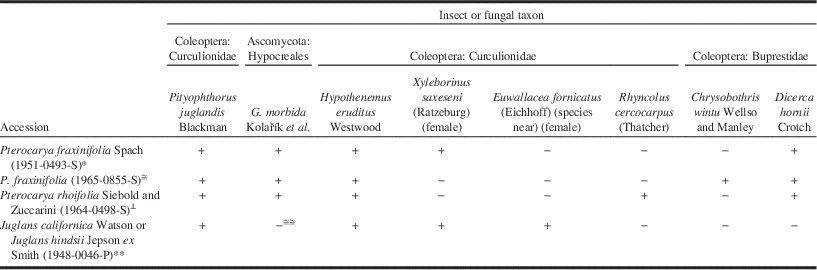
To broaden our understanding of the geographic and habitat extent of the association of WTB with Pterocarya, on 14 December 2013 we also collected and vouchered (CAS) adult WTB from galleries in the phloem of branches from an unidentified species of Pterocarya growing wild along a disturbed creek bottom in Davis, Yolo County, California (38°33'52.1"N, 121°44'40.2"W, ∼16 m elevation). On 17 January 2014, we collected and later curated and vouchered (CAS) WTB that emerged in the laboratory from branches removed from two accessions of P. fraxinifolia and one accession of Pterocarya rhoifolia Siebold and Zuccarini, which were mature trees growing in the Los Angeles County Arboretum and Botanic Garden in Arcadia, Los Angeles County, California (Table 1). Both of these hosts were also positive for G. morbida, and molecular characterisation was carried out on the isolate from accession 1951-0493-S of P. fraxinifolia (Zerillo et al. Reference Zerillo, Caballero, Woeste, Graves, Hartel and Pscheidt2014, techniques as described above). Several hundred specimens of Hypothenemus eruditus Westwood (Coleoptera: Curculionidae) were also reared from branches removed from the Pterocarya accessions as were 16 specimens (nine males and seven females) of Dicerca hornii Crotch, one male specimen of Chrysobothris wintu Wellso and Manley (both Coleoptera: Buprestidae); ∼30 specimens of R. cercocarpus; and one female specimen of the fruit-tree pinhole borer, Xyleborinus saxeseni (Ratzeburg) (Coleoptera: Curculionidae) (Table 1). Further, at this site, we collected branches from a diseased black walnut (likely Juglans californica Watson or Juglans hindsii Jepson ex Smith) from which we reared not only WTB, female X. saxeseni, and H. eruditus, but also two teneral female adult specimens of a species near Euwallacea fornicatus (Eichhoff) (Coleoptera: Curculionidae) (Table 1). This is the first developmental record of this invasive ambrosia beetle, known as the polyphagous shot hole borer, in Juglans (Eskalen et al. Reference Eskalen, Stouthamer, Lynch, Rugman-Jones, Twizeyimana and Gonzalez2013).
Occurrence of subcortical insects and a fungus, Geosmithia morbida, in branches of accessions of Pterocarya and Juglans trees from the Los Angeles County Arboretum and Botanic Garden, Arcadia, California, United States of America.

Notes: Presence (+) or absence (−) of the WTB, G. morbida, or associated subcortical insects in branch sections collected from arboretum accessions on 17 January 2014 and emerged between January 2014 and January 2015 in the laboratory.
* 34°8′33.78"N, 118°3′16.26"W, ∼147 m elevation, seed source was the Bureau of Parks, Rochester, New York, United States of America.
≅ 34°8′30.06"N, 118°3′27.42"W, ∼147 m elevation, seed source was the University Botanic Garden, Sofia, Bulgaria.
⊥ 34°8′27.1"N, 118°3′26.6"W, ∼147 m elevation, seed source was the Musée National d’Histoire Naturelle, Paris, France.
** 34°8′30.0"N, 118°3′18.2"W, ∼147 m elevation, native tree on the site when arboretum was founded.
≅≅ Isolation of G. morbida not attempted.
WTB, walnut twig beetle.
In October 2013, we looked for evidence of successful WTB colonisation and G. morbida transmission in all P. stenoptera and P. fraxinifolia accessions at the NCGR. This collection was assembled originally from seed obtained in 1983 from a Chinese botanical garden. Mean (±SE) stem diameters were 38.46 (±1.96) cm for P. stenoptera (n=31) and 40.13 (±3.40) cm for P. fraxinifolia (n=6), measured at the highest point below the first bifurcation of branching in these orchard-grown trees. These trees were surveyed for signs of WTB infestation (entrance or emergence holes) or for symptoms of the disease (sap exudate or staining on the bark surface and necrotic lesions in the phloem around WTB galleries). These signs and symptoms were consistent with the presence of the insect and pathogen, but because this collection of trees was the source of the original new generic record, we did not deem it necessary to collect additional specimens of the WTB or make additional isolations of the pathogen during the survey. Of the 31 P. stenoptera accessions surveyed, 12 (37%) had some evidence of attacks by WTB. Of those 12 with evidence of WTB attacks, six (19.3% of total) also had bark staining. Of the six P. fraxinifolia trees in the collection, five (83%) had WTB attacks and all of those trees (83% of total) also had bark staining. Some of the trees in the collection showed evidence of crown dieback that may have been a consequence of TCD. Further work to quantify this impact needs to be carried out in the future.
The Pterocarya are the sister group to the Juglans (Stanford et al. Reference Thomas and Allen2000; Manos and Stone Reference Montecchio and Faccoli2001; Aradhya et al. Reference Aradhya, Potter, Gao and Simon2007) in the family Juglandaceae. Pterocarya stenoptera grows along mountain slopes or riverbanks near sea level to 1500 m in China, Japan, Korea, and Taiwan, but is grown as a shade tree in other countries (Kuang and Lu Reference Manos and Stone1979; Yang Reference Yang2014). It is planted infrequently in the United States of America as a shade or street tree (e.g., it has been recorded in the California Central Valley, in two counties in Louisiana, in Missouri, and in North Carolina (Thomas and Allen Reference Thomas and Allen1993, Reference Tisserat, Cranshaw, Leatherman, Utley and Alexander1997; Gilman and Watson Reference Gilman and Watson1994; Whittemore Reference Wiggins, Grant, Lambdin, Merten, Nix and Hadžiabdić2012; S. Wright, Missouri Department of Conservation, personal communication). A search of urban forest inventories from analyses of municipal forest resources for 18 United States of America cities prepared by the USDA Forest Service Pacific Southwest Research Station yielded no occurrences of Pterocarya in the geographically widespread urban forests in the surveys (including Albuquerque, Bismarck, Boise, Charleston, Charlotte, Cheyenne, Fort Collins, Honolulu, Indianapolis, Minneapolis, New York, Orlando, and San Francisco) (http://www.fs.fed.us/psw/programs/uesd/uep/research/studies_detail.php?ProjID=151). In California, the typical habitat is in disturbed riparian areas (Whittemore Reference Wiggins, Grant, Lambdin, Merten, Nix and Hadžiabdić2012). In this state, P. stenoptera has also been evaluated in breeding programs for hybrid rootstocks for J. regia, with emphasis on its compatibility with J. regia and resistance to Phytophthora De Bary (Pythiaceae) (Browne et al. Reference Browne, Grant, Schmidt, Leslie and McGranahan2011). Pterocarya fraxinifolia has a limited distribution in its native range from northern Caucasia to western Iran, southeastern Turkey, and the border areas with Syria (Anșįn Reference Anșįn1987). It is a riparian species whose southern distribution may be threatened by changes in land use practices (Anșįn Reference Anșįn1987). It is used primarily as a landscape tree in urban areas of Europe and the United States of America (Anșįn Reference Anșįn1987), but it also has some use for structural wood products and plywood (Muge Gungor et al. Reference Rugman-Jones, Seybold, Graves and Stouthamer2007).
Neither tree species appears to have been associated with major insect or disease problems in the United States of America (Gilman and Watson Reference Gilman and Watson1994), although at the NCGR we observed numerous larval mines and emergence holes on stems and branches from large woodborers (likely in the Buprestidae and/or Cerambycidae), and, in addition to various bark and ambrosia beetles and weevils, we reared two species of large woodborers from the material collected in southern California (Table 1). The mines and holes in the accessions at the NCGR were much larger than those of N. brevipennis, which typically infests the twigs. Thus, we suspect that D. hornii, C. wintu, or related species may be infesting the Pterocarya accessions at the NCGR as well. The emerald ash borer, Agrilus planipennis Fairmaire (as the synonymised name A. marcopoli ulmi Kurosawa), has been reported to colonise Pterocarya in Asia (reviewed in Anulewicz et al. Reference Anulewicz, McCullough, Cappaert and Poland2008), but host range tests with the invasive North American population have demonstrated that larvae of A. planipennis do not develop on cut logs of J. nigra (Anulewicz et al. Reference Anulewicz, McCullough, Cappaert and Poland2008). This suggests that individuals in the invasive North American population of A. planipennis are not likely to use Pterocarya as a host.
Our observations here suggest that if WTB were to be introduced to Asia (including the Caucasus region), it could not only threaten native Asian Juglans species, but also Pterocarya species in their native ranges. The potential impact of TCD on other species of Pterocarya and closely related genera such as Alfaroa Standley, Annamocarya Chevalier, Carya Nuttall, Cyclocarya Iljinskaja, Engelhardia Leschenault ex Blume, and Platycarya Siebold and Zuccarini (Manos and Stone Reference Montecchio and Faccoli2001) might require further study. Although there is limited data on the planting frequency and distribution in North American urban landscapes of the three Pterocarya species discussed here, we have shown that they are susceptible to colonisation by WTB and infection by G. morbida, which could diminish their utility as shade trees in North America.
Acknowledgements
The authors thank John Preece and Howard Garrison (United States Department of Agriculture, Agricultural Research Service, National Clonal Germplasm Repository) and Charles A. Leslie (University of California, Davis, Department of Plant Sciences) for access to and support of our research in the National Clonal Germplasm Repository Juglans and Pterocarya collections. They thank J.E. Henrich for access to the Los Angeles County Arboretum Collection and K.J. Greby, D.R. Hodel, A. Liu, and L.M. Ohara for assistance with collecting infested branches. The authors are grateful to L.J. Nelson (United States Department of Agriculture, Forest Service, Pacific Southwest Research Station), and especially to O. Batuman (University of California, Davis, Department of Plant Pathology) for assistance with obtaining and translating Turkish scientific literature. They also thank M. Aradhya (United States Department of Agriculture, Agricultural Research Service, National Clonal Germplasm Repository), C.A. Leslie, and G. McGranahan (University of California, Davis, Department of Plant Sciences, retired) for critical reviews of the manuscript. The authors thank D.E. Bright (Colorado State University) for identifying Hypothenemus and Euwallacea, and R.L. Westcott (Oregon Department of Agriculture) for identifying Chrysobothris and Dicerca. This work was supported by grants from the United States Department of Agriculture, NIFA Specialty Crops Research Initiative, the United States Department of Agriculture, Forest Service, Washington Office Forest Health Protection; and United States Department of Agriculture, Animal and Plant Health Inspection Service, Center for Plant Health Science Technology administered through cooperative agreements 10-CA-11272172-055 and 10-JV-11272172-092 between the United States Department of Agriculture, Forest Service, Pacific Southwest Research Station and the University of California, Davis, Department of Entomology and Nematology. The work was also supported by University of California Agriculture and Natural Resources Competitive Grant number 11-1025 to R.M.B. and S.J.S. The authors are especially grateful to Bruce Moltzan for facilitating the funding from the United States Department of Agriculture, Forest Service Washington Office and to David Lance for facilitating the funding from United States Department of Agriculture, Animal and Plant Health Inspection Service.